
ZF WABCO mBSP Modular Braking System Platform
Quick Facts
- Manufacturer: ZF Commercial Vehicle Solutions
- Original Brand: WABCO
- Product Name: mBSP Modular Braking System Platform
- mBSP Meaning: Modular Braking System Platform
- Product Type: Modular electronic commercial-vehicle braking platform
- Brake-System Category: ABS, electronic braking, traction control, and stability control
- Primary Function: Provides a common hardware and software foundation for multiple braking and active-safety functions
- Supported Brake Architectures: Pneumatic ABS and electronic braking-system configurations
- Available Safety Functions: ABS, automatic traction control, roll stability, and ESCsmart electronic stability control, depending on configuration
- Advanced-System Integration: Supports compatible OnGuard collision-mitigation and other driver-assistance functions
- Electrical Configurations: Application-specific 12-volt and 24-volt systems
- Primary Applications: Medium- and heavy-duty trucks, tractors, buses, and specialty commercial vehicles
- Installation Type: Original-equipment, vehicle-specific integrated platform
- Current Brand Relationship: WABCO became part of ZF; current literature and support may use ZF, WABCO, or ZF WABCO identification
- Primary Benefit: Allows manufacturers to use a scalable, standardized braking architecture across different vehicles and levels of functionality
Overview
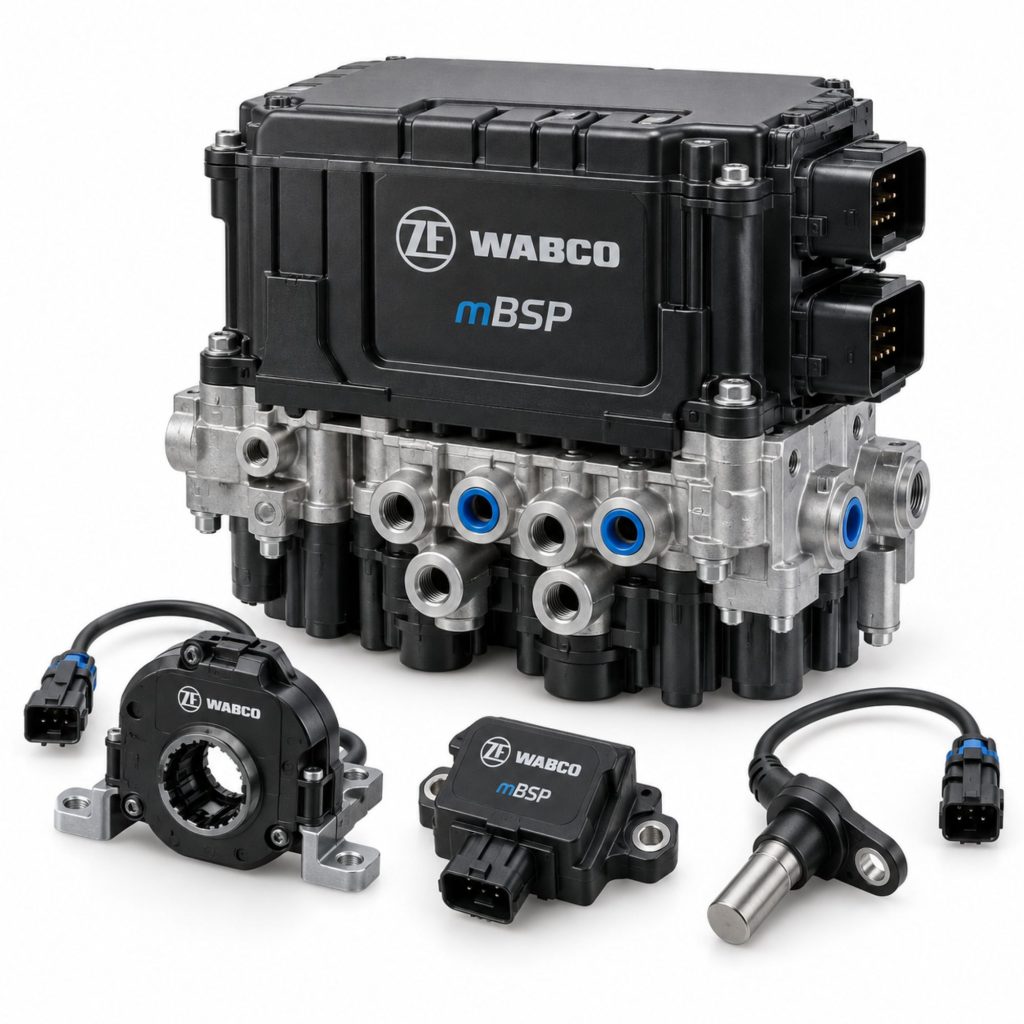
The ZF WABCO mBSP Modular Braking System Platform is an electronic braking architecture developed to support multiple levels of commercial-vehicle brake control through a common platform.
Depending on the vehicle and system configuration, mBSP can provide antilock braking, automatic traction control, roll-stability functions, ESCsmart electronic stability control, and integration with advanced driver-assistance systems.
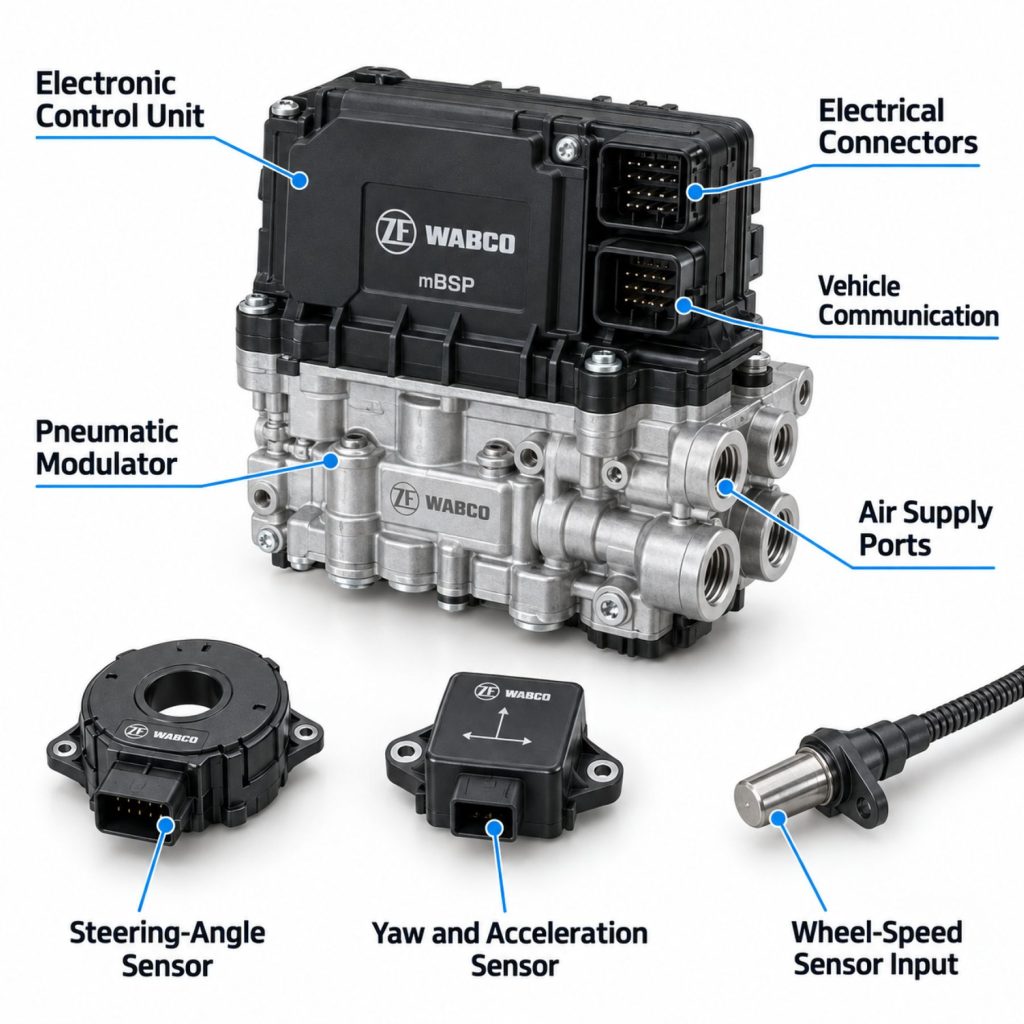
Unlike a single brake component, mBSP is a coordinated system of electronic controllers, wheel-speed sensors, pneumatic valves, vehicle-dynamics sensors, wiring, software, and network communications. Vehicle manufacturers can configure the platform according to the braking and safety functions required for a particular truck, tractor, bus, or specialty chassis.
The platform was designed to standardize software and component packaging across pneumatic ABS and electronic braking systems. This modular approach helps manufacturers use related system architecture across multiple vehicle families while adapting the calibration, controller, sensor count, modulator arrangement, and safety functions to each application.
ZF identifies mBSP as the commercial-vehicle industry’s first modular braking-system platform and states that it provides a common foundation for ABS and EBS. ZF commercial-vehicle ABS and mBSP information

Key Characteristics
- Modular electronic braking architecture
- Common platform for ABS and EBS configurations
- High level of software standardization
- Scalable functionality
- Supports medium- and heavy-duty vehicles
- Provides antilock braking
- Supports automatic traction control
- Supports roll-stability functions
- Supports ESCsmart electronic stability control
- Can integrate with OnGuard collision-mitigation systems
- Uses electronic wheel-speed monitoring
- Controls pneumatic brake-pressure modulation
- Supports vehicle-network communication
- Available in application-specific 12-volt and 24-volt configurations
- Vehicle-specific controller programming
- Supports diagnostic trouble codes
- Compatible with ZF WABCO diagnostic software
- Designed for original-equipment integration
- Provides a foundation for higher levels of vehicle automation
Major Components
- mBSP electronic control unit
- ABS wheel-speed sensors
- Wheel-speed sensor tone rings
- ABS modulator valves
- Automatic traction-control valve where equipped
- Active braking valve where equipped
- Steering-angle sensor on ESC configurations
- Yaw-rate sensor
- Lateral-acceleration sensor
- Brake-pressure sensor where required
- Brake pedal or stop-lamp input
- Air-brake relay valves
- Service-brake chambers
- Spring-brake chambers
- Electronic foundation-brake controls on EBS configurations
- J1939 vehicle-network connections
- Engine controller interface
- Transmission controller interface
- ADAS communication interface
- ABS warning lamp
- Traction-control indicator
- Electronic stability-control indicator
- Electrical wiring harnesses
- Pneumatic lines and fittings
- Diagnostic connector
How the Brake Component or System Works
The mBSP electronic control unit receives information from the vehicle’s wheel-speed sensors and other installed sensors. It evaluates these signals to determine whether wheels are approaching lockup, drive wheels are spinning, or the vehicle is entering an unstable condition.
During normal braking, the pneumatic or electronic brake-control system directs pressure to the foundation brakes. The exact control path depends on whether the vehicle uses an ABS-based or EBS-based mBSP configuration.
If a wheel approaches lockup, the ECU commands the appropriate modulator valve to hold, reduce, or restore brake pressure. This allows the wheel to continue rotating and helps the driver retain steering control.
When automatic traction control detects excessive drive-wheel spin, the system can apply a spinning wheel’s brake and request reduced engine torque.
On ESCsmart-equipped vehicles, the platform also evaluates steering angle, yaw rate, lateral acceleration, vehicle speed, and brake information. If the vehicle’s actual motion differs significantly from its intended path, the system can reduce engine torque and selectively apply brakes to help mitigate certain understeer, oversteer, or rollover events.
When integrated with a compatible collision-mitigation system, mBSP can provide the brake-control foundation needed for automatic service-brake intervention.
Position and Function Within the Brake System
mBSP operates between the vehicle’s driver controls, electronic sensors, powertrain controllers, pneumatic valves, and foundation brakes.
The electronic control unit serves as the platform’s primary decision-making component. It receives data from wheel-speed sensors, vehicle-dynamics sensors, brake inputs, and the vehicle communication network.
The controller then sends commands to:
- ABS modulator valves
- Automatic traction-control valves
- Active braking valves
- Electronic brake-control components
- Engine controller
- Transmission controller
- Instrument-panel warning systems
- Compatible advanced driver-assistance systems
The platform does not replace the vehicle’s foundation brakes. It manages how pneumatic or electronically requested braking force is delivered to them.
Common Specifications
- System Type: Modular electronic braking platform
- Base Functions: ABS and vehicle brake control
- Optional Functions: ATC, roll stability, ESCsmart, and ADAS braking integration
- Brake-System Types: Pneumatic ABS and application-specific EBS
- Primary Controller: mBSP electronic control unit
- Wheel-Speed Configurations: Vehicle- and axle-specific sensor and modulator arrangements
- System Voltage: 12 or 24 volts, depending on application
- Vehicle Communication: Application-specific SAE J1939 and related network connections
- Brake Modulation: Electronically controlled pneumatic modulation
- Foundation-Brake Compatibility: Approved air-disc and drum-brake configurations
- Vehicle Applications: Trucks, tractors, buses, and specialty commercial vehicles
- Diagnostics: ZF WABCO TOOLBOX PLUS or approved vehicle-manufacturer software
- Installation: Factory-engineered and vehicle-specific
- Exact sensor count, modulator layout, controller number, pin configuration, software, voltage, and stability functions must be verified for the individual vehicle.
Operating Specifications and Performance
The mBSP controller monitors wheel-speed information whenever the vehicle is operating. Additional stability sensors are monitored on vehicles equipped with roll-stability or ESCsmart functions.
The system’s available capabilities depend on its hardware and software configuration. A basic mBSP ABS installation does not automatically provide electronic stability control or collision mitigation.
Performance depends on:
- Accurate wheel-speed signals
- Correct modulator-valve operation
- Reliable electrical power
- Vehicle-specific software
- Proper sensor calibration
- Functional pneumatic circuits
- Adequate air pressure
- Balanced foundation brakes
- Correct tire dimensions
- Reliable vehicle-network communication
- Available tire-to-road traction
ABS intervention manages brake pressure at monitored wheel positions to help prevent lockup. It does not necessarily reduce the shortest possible stopping distance on every surface.
ESCsmart and roll-stability functions can assist during certain developing events but cannot overcome excessive speed, insufficient tire traction, improperly secured cargo, or the physical limits of the vehicle.
Braking Performance and System Integration
mBSP provides the electronic foundation for coordinating service-brake performance with traction, stability, and compatible driver-assistance functions.
Depending on the configuration, the platform may:
- Reduce brake pressure at a locking wheel
- Hold pressure at a selected wheel
- Restore pressure when wheel rotation recovers
- Apply a spinning drive wheel’s brake
- Request reduced engine torque
- Apply selected brakes during a stability event
- Apply broader vehicle braking during rollover mitigation
- Support automatic braking requested by compatible ADAS
The system’s effectiveness depends on the condition of the mechanical and pneumatic braking components. Worn linings, damaged rotors, cracked drums, sticking calipers, excessive chamber stroke, air leakage, or mismatched brake components can reduce the force available during an intervention.
Air Supply, Controls, and Electronic Integration
mBSP coordinates electronic commands with the vehicle’s pneumatic brake system. The air compressor, dryer, reservoirs, brake valves, relay valves, modulators, and actuators must all function correctly.
The platform may communicate with:
- Engine electronic control module
- Transmission controller
- Instrument cluster
- Body controller
- Steering-angle sensor
- Stability sensors
- OnGuard collision-mitigation system
- Vehicle telematics
- Diagnostic software
- Other chassis-control systems
Network communication allows the system to request engine-torque reduction, receive vehicle configuration information, share wheel-speed data, illuminate warning lamps, and coordinate advanced safety functions.
An electrical or network fault may disable one or more advanced features while basic pneumatic braking remains available. Drivers must respond to warning lamps according to the vehicle operator’s manual.
Installation, Adjustment, and Brake Balance
The mBSP platform is engineered and calibrated for a particular vehicle. It should not be treated as a universal controller that can be transferred between trucks based only on connector appearance.
Correct installation depends on:
- Vehicle make and model
- Model year
- Wheelbase
- Axle configuration
- Brake-system layout
- Sensor and modulator count
- System voltage
- Foundation-brake type
- Tire size
- Engine and transmission communication
- Stability-system calibration
- Advanced driver-assistance integration
Replacement ECUs may require programming with vehicle-specific parameters. Installing an unprogrammed or incorrectly programmed controller can produce warning lamps, disabled functions, or improper braking behavior.
Steering-angle and stability sensors may require calibration after replacement, steering repairs, suspension changes, alignment work, or controller programming.
Brake balance must be maintained across the vehicle. Chamber size, slack-adjuster length, brake lining, caliper type, drum or rotor condition, and air-delivery timing all influence the vehicle’s response.
Foundation Brake, Axle, and Wheel-End Compatibility
mBSP can support approved air-disc and S-cam drum-brake systems. Some vehicles may use different foundation-brake types at different axle positions.
Compatibility depends on:
- Axle count
- Driven and non-driven axle layout
- Steer-axle configuration
- Lift-axle arrangement
- Wheel-speed sensor locations
- Tone-ring design
- Modulator-valve configuration
- Foundation-brake type
- Brake chamber size
- Slack-adjuster geometry
- Tire rolling radius
- Electronic controller calibration
A controller intended for one sensor and modulator arrangement should not be installed on a different configuration without confirmed approval and programming.
Tire size and wheel-end condition are especially important. Different rolling circumferences, damaged tone rings, excessive bearing movement, or incorrect sensor gaps can create inaccurate wheel-speed information.
Common Applications
- Heavy-duty highway tractors
- Medium-duty trucks
- Heavy-duty straight trucks
- Vocational trucks
- Delivery vehicles
- Refuse trucks
- Construction trucks
- Emergency vehicles
- Transit buses
- School buses
- Motor coaches
- Specialty commercial vehicles
- Electrified commercial vehicles
- Vehicles equipped with compatible collision-mitigation systems
Vehicle and Brake-System Compatibility
mBSP has been used as original equipment on selected commercial-vehicle platforms. The exact system varies by manufacturer, vehicle model, production year, axle layout, and optional safety equipment.
A vehicle may have:
- mBSP ABS
- mBSP ABS with automatic traction control
- mBSP with roll-stability functionality
- mBSP with ESCsmart
- mBSP integrated with OnGuard
- An EBS-based mBSP configuration
- A later ZF braking platform
The mBSP platform was selected for the North American Hino XL Series to support ABS, ESCsmart, and compatible advanced driver-assistance technologies. This does not mean every Hino XL configuration uses identical controllers or features.
The installed system should be identified through the controller label, vehicle build records, diagnostic report, and ZF WABCO service information.
Advantages
- Common platform for ABS and EBS
- Scalable system functionality
- Standardized software architecture
- Supports multiple vehicle categories
- Provides antilock braking
- Supports automatic traction control
- Supports ESCsmart stability control
- Can support rollover mitigation
- Integrates with compatible collision-mitigation systems
- Allows vehicle-specific customization
- Reduces the need for entirely separate braking architectures
- Supports 12-volt and 24-volt applications
- Provides diagnostic trouble codes
- Enables software-based configuration
- Supports future safety and automation functions
- Backed by ZF WABCO technical resources
Limitations or Considerations
- Functions vary by vehicle configuration
- Basic mBSP ABS does not automatically include ESC
- Vehicle-specific programming may be required
- Controllers are not universally interchangeable
- Sensor calibration may be required after repairs
- Electrical faults can disable advanced functions
- Network faults can interrupt integrated features
- Incorrect tire sizes can affect wheel-speed calculations
- Foundation-brake condition affects system performance
- Low air pressure reduces available braking
- Used ECUs may contain incompatible software
- OEM diagnostic access may be required
- Cannot overcome insufficient road traction
- Does not replace attentive driving
- Later vehicles may use newer ZF platform generations
Driver and Operator Experience
Most mBSP functions operate automatically. During ordinary driving, the driver may only notice the system during startup lamp checks or when ABS, traction-control, stability, or collision-mitigation intervention occurs.
During ABS operation, the driver may feel changes in brake response as the system modulates air pressure. The driver should continue making the appropriate brake and steering inputs rather than pumping the brake pedal.
During traction-control intervention, the driver may notice reduced engine torque or braking at a spinning drive wheel.
During ESCsmart or collision-mitigation intervention, the driver may feel automatic brake application or engine-power reduction. These actions are intended to assist the driver during certain hazardous conditions.
Drivers should report:
- ABS warning lamps that remain illuminated
- Stability-control warning lamps
- Traction-control warning messages
- Unexpected engine-torque reduction
- Unexpected automatic braking
- Wheel-speed signal faults
- Intermittent warning lamps
- Recent tire-size changes
- Steering or suspension repairs
- Brake imbalance
- Vehicle-network fault messages
Maintenance and Ownership Notes
- Inspect wheel-speed sensor wiring.
- Check sensor connectors for corrosion.
- Inspect tone rings for damage and contamination.
- Verify correct wheel-speed sensor gaps.
- Inspect ABS modulator-valve wiring.
- Check pneumatic lines for leaks and abrasion.
- Inspect ECU mounting and connectors.
- Verify battery voltage and electrical grounds.
- Check vehicle-network wiring.
- Inspect steering-angle sensor connections.
- Verify yaw and lateral-acceleration sensor mounting.
- Maintain proper tire sizes and pressures.
- Inspect wheel bearings for excessive movement.
- Maintain air compressors, dryers, and reservoirs.
- Measure brake chamber stroke.
- Inspect drums, rotors, linings, pads, and calipers.
- Retrieve diagnostic trouble codes before replacing parts.
- Follow required sensor-calibration procedures.
- Use approved diagnostic software.
- Document controller programming and repair information.
Common Brake-System Problems
- ABS warning lamp remains illuminated: A wheel-speed sensor, tone ring, wiring circuit, modulator valve, controller, power supply, or communication fault may be present.
- Intermittent wheel-speed signal: Excessive sensor gap, wheel-bearing movement, damaged tone-ring teeth, corrosion, debris, or broken wiring can interrupt the signal.
- Traction control is unavailable: Wheel-speed faults, engine-network problems, controller faults, incorrect programming, or ATC valve problems may disable the function.
- ESC warning lamp is active: A steering-angle sensor, yaw sensor, lateral-acceleration sensor, wheel-speed circuit, calibration, or network problem may be responsible.
- Unexpected intervention: Incorrect tire sizes, wheel-speed errors, sensor-calibration problems, poor traction, or mechanical brake issues can cause unexpected system response.
- Modulator-valve fault: Damaged wiring, open or shorted solenoid circuits, valve contamination, internal valve failure, or pneumatic restrictions may prevent correct modulation.
- Controller communication failure: Low voltage, poor grounds, damaged J1939 wiring, connector corrosion, incompatible software, or controller failure can interrupt communication.
- Uneven braking: Mismatched foundation-brake components, air-delivery differences, incorrect adjustment, contaminated friction material, or worn wheel-end components may create imbalance.
- Fault remains after component replacement: Wiring, connectors, programming, calibration, or another related component may be the actual cause.
- Collision-mitigation function unavailable: An mBSP fault, radar-system fault, network problem, calibration issue, or other ADAS-related condition may disable automatic braking.
Safety and Service Precautions
mBSP controls safety-critical braking functions. Diagnosis and repair should be performed by technicians trained in commercial air brakes, ABS, stability control, vehicle electronics, and network communications.
Before servicing the system:
- Park the vehicle on a level surface.
- Apply the parking brakes.
- Block the wheels.
- Follow approved lockout procedures.
- Drain air pressure before opening pneumatic circuits.
- Disconnect electrical power when required.
- Record active and stored diagnostic trouble codes.
- Identify the exact system configuration.
- Use the correct ZF WABCO maintenance manual.
- Confirm programming requirements before replacing the ECU.
Automatic brake applications may occur during diagnostic tests. Personnel must stay clear of wheel ends, brake chambers, pushrods, driveshafts, and other moving components.
Do not apply external voltage to controller or sensor terminals unless an approved test procedure specifically requires it. Improper testing can damage electronic components.
Erasing fault codes does not repair the condition that caused them. The vehicle should not return to service until required braking and warning functions have been verified.
Identification Information
mBSP identification may be found on the electronic control unit, valve labels, diagnostic report, wiring documentation, or vehicle build records.
Record the following information:
- Vehicle manufacturer
- Vehicle identification number
- Vehicle model and model year
- ZF WABCO ECU part number
- Customer or vehicle-manufacturer part number
- Controller serial number
- Software version
- Calibration number
- System voltage
- ABS configuration
- Number of wheel-speed sensors
- Number of modulator channels
- Automatic traction-control status
- ESCsmart status
- ADAS integration
- Axle configuration
- Wheelbase
- Tire size
- Modulator-valve part numbers
- Stability-sensor part numbers
- Active diagnostic trouble codes
- Stored diagnostic trouble codes
Do not identify an ECU only by its housing or connector arrangement. Multiple mBSP controllers may appear similar while containing different hardware, software, or vehicle-specific programming.
Buying Considerations
- Confirm the vehicle is equipped with mBSP.
- Record the complete ECU part number.
- Check the customer-specific part number.
- Verify system voltage.
- Identify the ABS sensor and modulator configuration.
- Confirm automatic traction-control requirements.
- Determine whether ESCsmart is installed.
- Identify OnGuard or other ADAS integration.
- Verify vehicle wheelbase and axle configuration.
- Check programming requirements.
- Confirm whether the replacement ECU is new, programmed, or remanufactured.
- Avoid used controllers with unknown calibration.
- Inspect wiring and connectors before replacing the ECU.
- Retrieve diagnostic trouble codes before ordering parts.
- Confirm TOOLBOX PLUS compatibility.
- Check steering and stability-sensor calibration requirements.
- Use an authorized ZF WABCO service source.
- Verify all warning lamps and functions after repair.
Variants and Configurations
- 12-volt mBSP system
- 24-volt mBSP system
- ABS-only configuration
- ABS with automatic traction control
- ABS with roll-stability control
- ABS with ESCsmart
- EBS-based configuration
- OnGuard-integrated configuration
- Truck configuration
- Tractor configuration
- Bus configuration
- Medium-duty vehicle configuration
- Heavy-duty vehicle configuration
- Different wheel-speed sensor counts
- Different modulator-channel configurations
- Vehicle-manufacturer-specific software
- Application-specific active braking valves
- mBSP XBS next-generation platform
The original mBSP and newer mBSP XBS are related modular braking architectures, but they should not be treated as identical or automatically interchangeable. mBSP XBS represents a newer scalable platform designed for higher levels of integration and automation.
Comparison to Similar Equipment
Compared with a conventional standalone ABS controller, mBSP provides a broader modular platform that can support ABS, traction control, stability control, EBS, and advanced driver-assistance integration.
Compared with the Bendix ESP Full-Stability System, an ESCsmart-equipped mBSP system provides similar categories of roll and yaw stability assistance through ZF WABCO hardware, software, valves, and calibration.
Compared with a basic roll-stability system, an ESCsmart-equipped mBSP configuration evaluates both rollover risk and directional stability. It can assist during certain understeer and oversteer events as well as potential rollovers.
Compared with a full electronic braking system, pneumatic mBSP ABS configurations still use a conventional pneumatic service-brake command during ordinary braking. EBS electronically controls the normal brake request and can provide faster pressure response and additional integration.
Compared with mBSP XBS, the original mBSP is an earlier-generation platform. XBS is intended to provide increased scalability, integration, and support for advanced automation.
Best Fit For
- Vehicles originally equipped with ZF WABCO mBSP
- Commercial vehicles requiring modular ABS architecture
- Medium-duty trucks
- Heavy-duty tractors
- Straight trucks
- Buses and motor coaches
- Vehicles equipped with ESCsmart
- Vehicles equipped with OnGuard
- Fleets maintaining electronically controlled braking systems
- Original-equipment manufacturers using scalable brake architectures
- Vehicles requiring programmed replacement ECUs
- Fleets with access to qualified diagnostic support
Related Vehicle and Trailer Types
- Complete Guide to Semi Truck Types
- Class 6 vs Class 7 vs Class 8 Trucks
- Highway tractors
- Medium-duty trucks
- Heavy-duty straight trucks
- Vocational trucks
- Refuse vehicles
- Delivery vehicles
- Transit buses
- School buses
- Motor coaches
- Specialty commercial vehicles
- Electrified commercial vehicles
Related Truck and Trailer Models
- Hino XL Series
- Freightliner Cascadia
- Western Star 47X
- Western Star 49X
- International LT Series
- Volvo VNL
- Commercial bus chassis
- Specialty vocational chassis
Related Brake System Types
- Brake Systems
- Air Brake Systems
- ABS & Electronic Braking Systems
- Air Disc Brake Systems
- Drum Brake Systems
- Trailer Brake Systems
- Antilock braking systems
- Electronic braking systems
- Automatic traction-control systems
- Electronic stability-control systems
- Collision-mitigation braking systems
Related Brake Products
- ZF WABCO MAXXUS L2.0 Air Disc Brake
- Bendix ESP Full-Stability System
- Bendix Intellipark Electronic Parking Brake
- Meritor EX+ LS Air Disc Brake
- mBSP electronic control units
- WABCO ABS modulator valves
- WABCO wheel-speed sensors
- WABCO ESCsmart components
- WABCO OnGuard systems
- ZF WABCO active braking valves
Related Equipment Systems
- Equipment Systems
- Axles & Differentials
- Suspension Systems
- Tires & Wheels
- Vehicle electrical systems
- Compressed-air systems
- Steering systems
- Engine-management systems
- Transmission controls
- Advanced driver-assistance systems
- Vehicle telematics systems
Related Guides
- Brake System Guides
- Air Brake Systems Explained
- How Truck ABS and Electronic Stability Control Work
- How to Inspect and Maintain Commercial Truck Brakes
- Tractor vs Trailer Brake Systems
- Air Disc Brakes vs Drum Brakes
- Commercial Truck Brake Components Explained
Regulatory and Compliance Notes
Commercial vehicles must maintain operational antilock braking, warning lamps, foundation brakes, and related safety systems according to applicable regulations.
Electronic stability control is required on many newer heavy truck tractors and certain large buses in the United States. Requirements depend on vehicle classification and production date.
An illuminated ABS warning lamp generally indicates that the antilock function or another related electronic braking feature may be unavailable. Normal pneumatic braking may remain, but the vehicle should be inspected according to regulatory and manufacturer requirements.
Modifications to wheelbase, axle layout, tire size, steering, suspension, foundation brakes, or electronic controllers may affect system calibration and regulatory certification.
Replacement ECUs must use approved hardware and correct vehicle-specific programming. Installing incompatible software may disable ABS, ESC, traction control, or integrated collision-mitigation functions.
Real World Operating Notes
mBSP is a platform rather than one fixed system. Two trucks with mBSP controllers may have different sensor counts, modulator arrangements, stability functions, and software.
Accurate identification is essential before diagnosis or component replacement. Technicians should begin with the vehicle identification number, ECU part number, system configuration, and a complete diagnostic scan.
Many apparent controller failures are caused by wheel-speed sensors, tone rings, wiring, connectors, low voltage, poor grounds, air-system faults, or network communication problems.
Replacing the ECU should not be the first diagnostic step unless testing confirms controller failure. The replacement unit may require programming and calibration before the vehicle can return to service.
ZF continues to support mBSP through technical publications, diagnostic software, replacement components, and its commercial-vehicle service network. New vehicle programs may use later platforms, including mBSP XBS.
Frequently Asked Questions
What is the ZF WABCO mBSP?
It is a modular electronic braking platform that provides a common architecture for commercial-vehicle ABS, EBS, traction control, stability control, and compatible advanced safety functions.
What does mBSP mean?
mBSP stands for Modular Braking System Platform.
Is mBSP an ABS system?
ABS is one of its core functions. Depending on the configuration, the platform can also support automatic traction control, roll stability, ESCsmart, EBS, and collision-mitigation integration.
Does every mBSP system have ESCsmart?
No. Installed functions depend on the controller, sensors, valves, software, and vehicle specification.
Does mBSP work with air disc brakes?
Yes. It can be integrated with approved air-disc brake systems.
Can it work with drum brakes?
Yes. Vehicle-specific mBSP configurations can operate with approved S-cam drum-brake systems.
What is ESCsmart?
ESCsmart is ZF WABCO’s electronic stability-control technology. It uses vehicle-dynamics information and selective braking to assist during certain rollover, understeer, and oversteer situations.
Can mBSP support automatic emergency braking?
The platform can provide brake-control integration for compatible systems such as OnGuard. The exact collision-mitigation functions depend on the installed ADAS package.
Are mBSP controllers interchangeable?
No. Controllers may differ in voltage, hardware, connector configuration, sensor count, software, and vehicle-specific calibration.
Does a replacement ECU require programming?
Many replacement situations require correct vehicle parameters, software, or calibration. Requirements must be confirmed before installation.
What diagnostic software is used?
ZF WABCO TOOLBOX PLUS and vehicle-manufacturer diagnostic systems may be used, depending on the application.
Is mBSP the same as mBSP XBS?
No. mBSP XBS is a newer modular and scalable braking platform. Components and software should not be assumed interchangeable.
Availability and Where to Find
ZF WABCO mBSP systems are primarily installed as original equipment. Replacement ECUs, modulator valves, wheel-speed sensors, stability sensors, wiring components, and service parts may be available through ZF distributors, commercial-truck dealers, bus dealers, vehicle manufacturers, and qualified brake-system repair facilities.
Availability depends on the complete part number, vehicle manufacturer, system voltage, axle configuration, installed functions, and controller software.
Before ordering, buyers should obtain the vehicle identification number, ECU part number, customer-specific number, system configuration, diagnostic trouble codes, and programming requirements.
Technical publications include the ZF WABCO ABS and ESC Maintenance Manual for mBSP, publication MM1719. Current product, diagnostic, training, and service resources are available through the ZF Commercial Vehicle Solutions literature center, ZF mBSP product information, and the WABCO Customer Centre.
Support Trucking Families
Truck Equipment Atlas supports the mission of Grey Cross, a nonprofit dedicated to helping families of truck drivers who lose their lives while on the road. As the site grows, part of its mission is to bring awareness and support to these families.
Podcast or Video Section
Learn More Through Audio and Video
Truck Equipment Atlas will continue expanding with podcast episodes, interviews, and equipment breakdowns to help drivers and fleets better understand trucks and equipment.
Follow the Growth of Truck Equipment Atlas
Truck Equipment Atlas continues to expand with new truck profiles, trailer coverage, diesel engine pages, equipment system resources, manufacturer information, and educational guides.
Visit our Site Updates page to explore recent additions, project milestones, and upcoming resources as we continue building one of the industry’s growing commercial trucking equipment reference libraries.
View the Latest Site Updates: Truck Equipment Atlas Site Updates