
Quick Facts
- Manufacturer: Delco Remy
- Product Family: 38MT
- Product Type: Medium- and heavy-duty gear-reduction starter
- Motor Design: Wound-field motor with planetary reduction gears
- System Voltage: 12 or 24 volts
- Engine Compatibility: 12-volt applications up to 10 liters; 24-volt applications up to 12 liters
- Peak Output: 4.3 kilowatts at 12 volts or 7.8 kilowatts at 24 volts
- Rotation: Clockwise
- Mounting: SAE No. 1 or SAE No. 3, depending on application
- Drive Design: Electrical soft-start with overrunning clutch
- Pinion Support: Noseless
- Primary Applications: Medium-duty trucks, heavy-duty trucks, buses, vocational vehicles, construction equipment, and specialty diesel equipment
- Production Status: Application and individual part-number availability vary
Overview
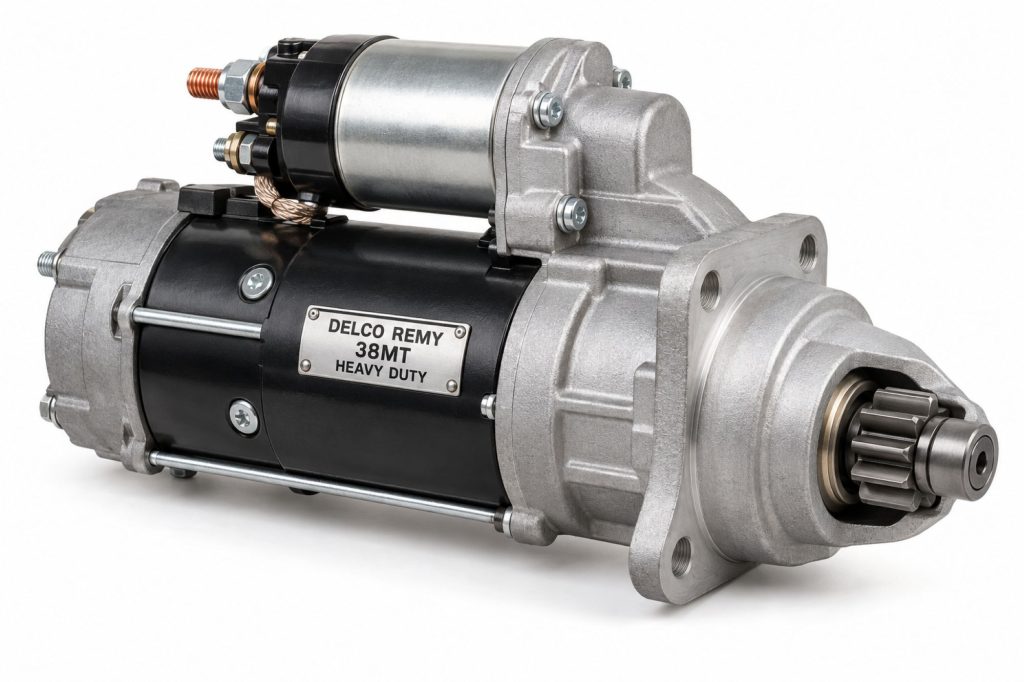
The Delco Remy 38MT is a gear-reduction starter designed for medium- and heavy-duty diesel applications. It combines a wound-field electric motor with planetary reduction gears to produce the torque required to crank commercial engines.
The 38MT includes electrical soft-start technology that begins rotating the starter pinion before full cranking torque is applied. This helps the pinion engage the engine ring gear smoothly and reduces tooth-abutment damage.
The product family includes 12- and 24-volt versions, SAE No. 1 and SAE No. 3 mounting options, several pinion configurations, and optional Over-Crank Protection. Exact features and compatibility depend on the individual Delco Remy part number.
Key Characteristics
- Medium- and heavy-duty gear-reduction starter
- Available for 12-volt and 24-volt systems
- Wound-field electric motor
- Planetary reduction gears
- Electrical soft-start pinion engagement
- Noseless drive-end design
- Overrunning clutch
- Clockwise rotation
- SAE No. 1 and SAE No. 3 mounting options
- Multiple pinion configurations
- Optional Over-Crank Protection
- Application-specific Integral Magnetic Switch configurations
- Available in new and remanufactured versions for applicable part numbers
Major Components
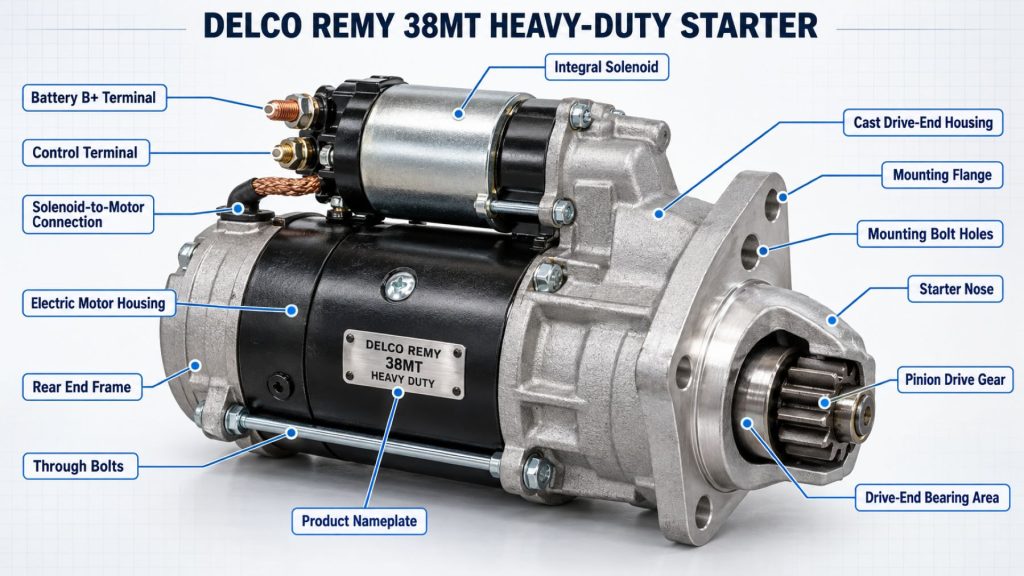
- Wound-field electric motor
- Armature
- Field coils
- Brushes and brush holder
- Commutator
- Planetary reduction gears
- Drive shaft
- Pinion gear
- Overrunning clutch
- Shift lever
- Electrical soft-start drive
- Starter solenoid
- Integral Magnetic Switch where equipped
- Drive-end housing
- Commutator-end housing
- Mounting flange
- Over-Crank Protection device where equipped
- High-current terminals and internal conductors
Product Type and Construction
The 38MT is a wound-field starter motor that uses planetary reduction gears between the motor and drive assembly. The motor turns at a higher speed, while the gears reduce pinion speed and multiply torque.
Its noseless drive-end housing reduces the extended support structure used by some older starter designs. Internal components are enclosed within a compact assembly designed for commercial-vehicle starting loads.
How the Electrical Component or System Works
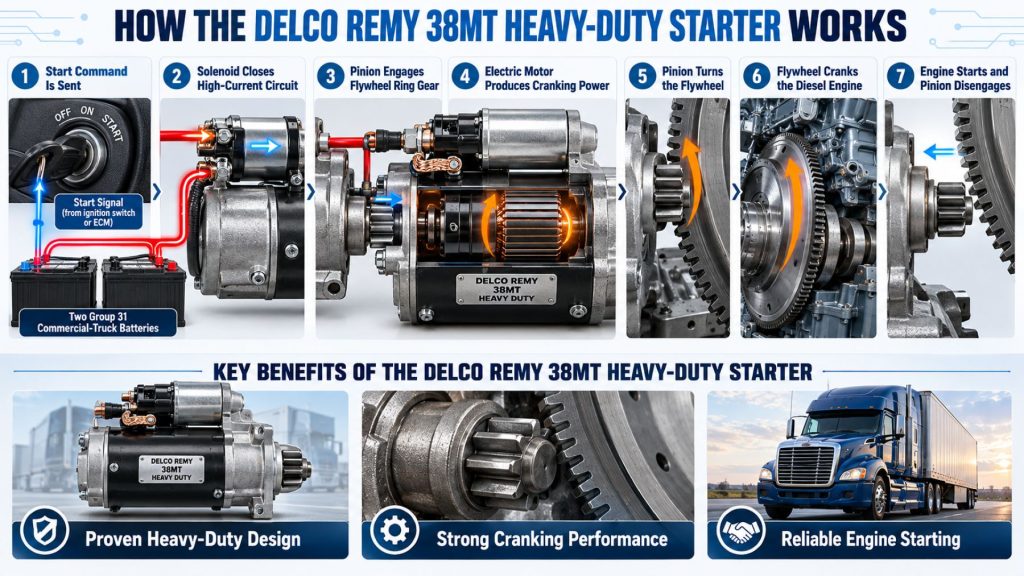
When the operator activates the start circuit, control current energizes the starter solenoid and related switching equipment. The solenoid moves the pinion toward the engine flywheel or flexplate ring gear.
The electrical soft-start system begins rotating the pinion before full motor torque is applied. This helps align the pinion and ring-gear teeth. After engagement, the main electrical contacts close and battery current flows to the starter motor.
The motor drives the planetary reduction gears, which multiply torque before transferring it through the overrunning clutch and pinion. After the engine starts, the clutch protects the starter from engine speed, and the pinion retracts when the start command ends.
Position and Function Within the Vehicle
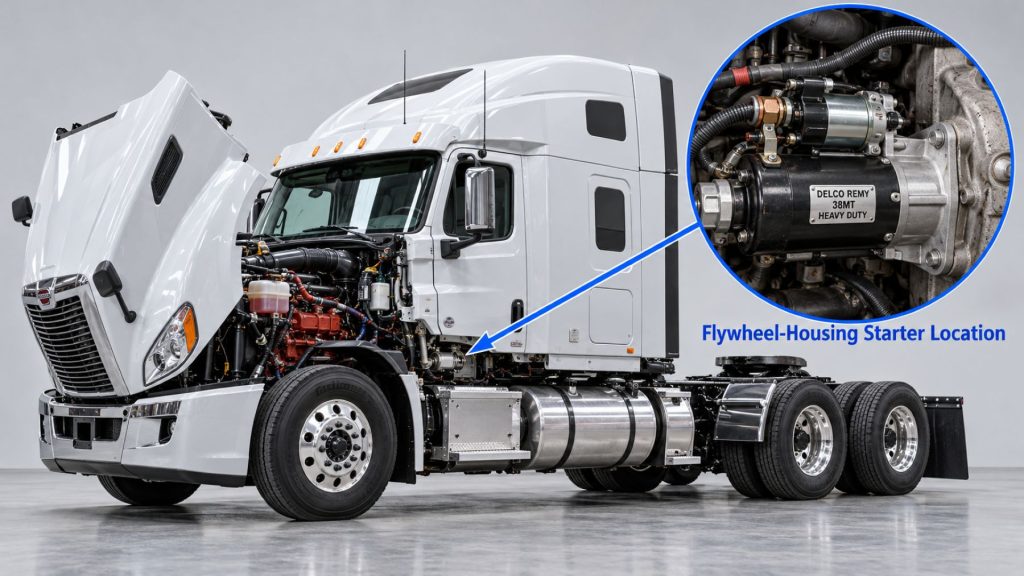
The 38MT mounts to the engine flywheel housing. Its pinion enters the housing and engages the ring gear during starting.
The starter converts electrical energy from the battery bank into mechanical torque that rotates the engine. The engine must reach sufficient cranking speed for compression, fuel delivery, electronic controls, and combustion to begin operating.
Common Specifications
- Starter Type: Gear-reduction starter
- Motor Type: Wound field
- Gear System: Planetary reduction gears
- System Voltage: 12 or 24 volts
- Maximum Engine Size at 12 Volts: Up to 10 liters
- Maximum Engine Size at 24 Volts: Up to 12 liters
- Peak 12-Volt Output: 4.3 kilowatts
- Peak 24-Volt Output: 7.8 kilowatts
- Rotation: Clockwise
- Mounting: SAE No. 1 or SAE No. 3
- Pinion Options: 10-tooth 8/10 pitch, 11-tooth MOD 3 metric, or 12-tooth 8/10 pitch
- Pinion Support: Noseless
- Drive Design: Electrical soft-start with overrunning clutch
- Approximate Weight: 22 pounds or 10 kilograms
- Frame Diameter: Approximately 3.9 inches or 100 millimeters
- Overall Length: Approximately 15.55 inches or 395.1 millimeters
- Optional Feature: Over-Crank Protection
Exact voltage, polarity, pinion, mounting flange, solenoid position, protection features, terminals, and engine compatibility depend on the individual 38MT part number.
Operating Capacity and Performance
The 12-volt 38MT is rated for compatible engines up to 10 liters and has a published peak output of 4.3 kilowatts. The 24-volt version supports compatible engines up to 12 liters and has a published peak output of 7.8 kilowatts.
Actual cranking performance depends on battery state of charge, battery temperature, cable resistance, engine temperature, oil viscosity, engine mechanical condition, starter condition, and ring-gear compatibility.
Installation Position and System Function
The starter is installed at the engine flywheel housing. The mounting flange positions the starter so its pinion can engage the ring gear at the correct depth and angle.
Pinion specifications, mounting configuration, rotation, solenoid position, and available clearance must match the engine and vehicle installation.
System Voltage and Electrical Architecture
The 38MT is available for nominal 12-volt and 24-volt starting systems. The selected starter must match the vehicle’s batteries, alternator, electrical controls, wiring, and starting-system voltage.
A 12-volt starter must not be substituted for a 24-volt model or the reverse. Grounded and insulated configurations may also vary between individual part numbers.
Electrical Input, Output, and Power Function
The starter draws high current from the battery bank and converts it into mechanical rotation. The planetary reduction gears trade motor speed for greater torque at the pinion.
The starter’s electrical load is substantial but normally brief. Batteries, cables, switches, grounds, and terminals must deliver the necessary current without excessive voltage loss.
Voltage, Current, and Electrical Load Management
Weak batteries or high-resistance connections reduce the voltage available at the starter. Low voltage can slow the motor, extend cranking time, interfere with solenoid operation, and increase heat.
Applicable configurations may use an Integral Magnetic Switch to reduce voltage loss in the solenoid-control circuit. Its presence and wiring requirements must be confirmed using the complete starter part number.
Starting and Cranking Function
The 38MT turns the engine crankshaft through the flywheel or flexplate ring gear. Adequate cranking speed allows the engine-management, fuel, compression, and combustion systems to begin operating.
Cold temperatures, heavy oil, low battery capacity, fuel-system problems, and excessive engine resistance can increase the time and torque required for starting.
Circuit Design and Power Distribution
The starting circuit commonly includes batteries, battery cables, grounds, battery disconnects, ignition controls, starter relay, safety interlocks, Integral Magnetic Switch where equipped, solenoid, and starter motor.
High-current cables must be properly sized and securely connected. Corrosion, loose terminals, damaged cables, poor grounds, and worn switches can prevent normal cranking.
Internal Components and Electrical Design
The wound-field motor uses field coils, an armature, brushes, and a commutator to produce rotation. The solenoid moves the drive assembly and closes the main high-current electrical contacts.
The planetary gears transmit motor output to the drive shaft at reduced speed and increased torque. The overrunning clutch transfers cranking torque while protecting the starter after the engine begins running.
Materials and Component Construction
The 38MT incorporates steel gears and shafts, copper conductors and windings, carbon-based brushes, cast housings, electrical contacts, insulating materials, bushings or bearings, seals, and hardened drive components.
Heat, vibration, moisture, road chemicals, dirt, oil contamination, loose mounting, and repeated extended cranking can affect these materials and shorten service life.
Wiring, Terminals, Connectors, and Grounding
The battery terminal, solenoid-control terminal, motor connections, Integral Magnetic Switch wiring, and ground path must match the vehicle wiring diagram and selected starter model.
Connections should be clean, secure, and protected from accidental contact with the frame or nearby components. Grounded and insulated starter configurations must not be interchanged without confirming system compatibility.
Circuit Protection and Electrical Safety
Applicable 38MT configurations may include Over-Crank Protection. This protection interrupts starter operation when excessive temperature develops and resets after the starter cools to a safe operating temperature.
Battery disconnects, wiring protection, cable routing, and starter controls should follow the vehicle manufacturer’s electrical design. Protection features vary by part number.
Controls, Monitoring, and Diagnostics
The starter may receive its command through an ignition switch, starter button, relay, engine controller, body controller, clutch switch, neutral-safety circuit, or automated-transmission interlock.
Diagnosis should include battery testing, cranking voltage, starter current draw, positive- and ground-side voltage drop, control-circuit voltage, cranking speed, mounting condition, and pinion engagement.
Electronic Controls and Driver-Assistance Integration
Electronically controlled vehicles may require approved transmission position, clutch position, engine status, battery voltage, and security authorization before the starter circuit is activated.
The 38MT does not directly operate driver-assistance equipment, but low cranking voltage can disrupt electronic controllers and create unrelated warning messages or diagnostic codes.
Power Demand, Capacity, and Energy Management
Starter demand increases during cold weather, low-battery conditions, and situations involving thick engine oil or elevated engine resistance. Battery capacity should be selected for the engine, vehicle, and operating climate.
Repeated unsuccessful starts can discharge the batteries and overheat the starter. The underlying engine, fuel, electrical, or control problem should be diagnosed instead of continuing to crank.
Power Consumption and System Efficiency
The planetary gear-reduction system allows a compact motor to produce the torque required for medium- and heavy-duty diesel engines. It reduces output speed while multiplying torque at the pinion.
Electrical efficiency declines when batteries, cables, terminals, switches, solenoid contacts, brushes, or internal conductors develop excessive resistance.
Heat, Efficiency, and Electrical Loss Management
The starter produces significant heat during cranking because of its high current demand. Normal starting cycles are brief and allow cooling time between operations.
Extended cranking, repeated attempts, low battery voltage, excessive voltage drop, internal starter damage, or a mechanically resistant engine can increase temperature. Over-Crank Protection helps limit thermal damage on equipped models.
Environmental Sealing and Contamination Protection
The noseless design reduces the extended opening and support structure found on some older starter configurations. This can help limit debris accumulation around the drive assembly.
The starter should still be protected from direct pressure washing, deep water, road chemicals, oil leaks, fuel, excessive exhaust heat, and damaged electrical insulation.
Duty Cycle and Operating Conditions
The 38MT is designed for short cranking cycles rather than continuous operation. Maximum cranking time and required cooling intervals should follow the applicable engine and vehicle instructions.
Frequent starts, cold climates, high vibration, construction environments, contamination, and poorly maintained batteries can increase starter-system stress.
Mounting and Installation
Installation requires the correct SAE mounting flange, voltage, polarity, pinion tooth count, pinion pitch, solenoid position, rotation, terminal arrangement, and housing clearance.
The mounting surface should be clean and undamaged. Correct fastener torque and alignment are required to maintain proper pinion-to-ring-gear engagement.
Wiring, Grounding, and Installation Requirements
- Disconnect battery power before removing the starter
- Verify 12-volt or 24-volt system compatibility
- Match SAE No. 1 or SAE No. 3 mounting
- Confirm pinion tooth count and pitch
- Verify clockwise rotation
- Match the required solenoid position
- Use correctly sized battery cables
- Clean and secure all high-current connections
- Verify a low-resistance ground path
- Retain the Integral Magnetic Switch where required
- Route wiring away from exhaust heat and moving components
- Tighten mounting hardware to specification
- Test cranking voltage and voltage drop after installation
Vehicle and Electrical-System Compatibility
Compatibility depends on system voltage, engine model, engine displacement, flywheel housing, mounting flange, ring-gear design, pinion specifications, polarity, solenoid position, electrical controls, and installation clearance.
The vehicle VIN, engine serial number, and original starter part number should be used when selecting a replacement. Similar-looking 38MT configurations may not be interchangeable.
Battery and Charging-System Compatibility
The battery bank must match the starter voltage and provide sufficient cold-cranking capacity. Battery cables, disconnect switches, grounds, and connections must carry the starter’s high current demand.
The alternator must restore the energy removed during starting. A weak charging system can leave the batteries unable to provide reliable cranking even when the starter is operating correctly.
Related Component and System Compatibility
The 38MT must be matched with the engine ring gear, flywheel housing, batteries, alternator, battery cables, grounds, starter relay, control switches, engine electronics, and transmission safety interlocks.
An incompatible mounting flange or pinion can damage the starter and ring gear even if the starter operates electrically.
Common Applications
- Medium-duty straight trucks
- Heavy-duty trucks
- Vocational trucks
- Delivery vehicles
- Service trucks
- Utility trucks
- Dump trucks
- Terminal tractors
- School buses
- Transit buses
- Construction equipment
- Agricultural machinery
- Industrial diesel equipment
- Specialty commercial vehicles
Advantages
- Gear-reduction design provides strong cranking torque
- Available for 12-volt and 24-volt systems
- Electrical soft-start improves pinion engagement
- Noseless drive-end design
- Overrunning clutch protects the starter after engine start
- Multiple mounting and pinion configurations
- Optional Over-Crank Protection
- Suitable for medium- and heavy-duty applications
- Lower weight than the larger Delco Remy 39MT
- New and remanufactured replacement options may be available
- Service parts are available for applicable models
Limitations or Considerations
- Not designed for continuous operation
- Lower engine-size capability than the Delco Remy 39MT
- Part numbers are not universally interchangeable
- System voltage must match the vehicle
- Pinion specifications must match the ring gear
- Mounting flange and solenoid position are application-specific
- Protection features vary by part number
- Weak batteries can cause slow cranking and overheating
- High-resistance cables can reduce starter performance
- Incorrect installation can damage the starter or ring gear
- Replacing the starter will not correct engine or fuel-system faults
Driver and Operator Experience
A correctly operating 38MT should engage quickly and crank the engine at a consistent speed. Electrical soft-start engagement occurs automatically when the start command is applied.
Slow cranking, repeated clicking, grinding, delayed engagement, intermittent starting, or a no-crank condition should be investigated instead of addressed through repeated start attempts.
Controls, Indicators, and Driver Feedback
- Ignition or start switch
- Push-button starting control
- Neutral or clutch safety interlock
- Low-battery warning
- Engine-control warning message
- No-crank condition
- Slow-cranking sound
- Repeated solenoid clicking
- Grinding during engagement
- Over-Crank Protection interruption where equipped
Common Electrical Tests and Diagnostic Information
- Battery state-of-charge test
- Battery load or conductance test
- Cranking-voltage measurement
- Starter current-draw test
- Positive-cable voltage-drop test
- Ground-side voltage-drop test
- Solenoid-control voltage test
- Starter-relay test
- Integral Magnetic Switch test where equipped
- Neutral-safety or clutch-switch test
- Engine cranking-speed measurement
- Diagnostic-code review
- Pinion and ring-gear inspection
Inspection and Wear Points
- Battery terminals
- Positive battery cables
- Ground cables and straps
- Starter terminals
- Solenoid connections
- Integral Magnetic Switch and wiring
- Mounting flange and bolts
- Starter housing
- Pinion teeth
- Ring-gear teeth
- Overrunning clutch
- Brushes and commutator
- Planetary gears
- Bushings and bearings
- Evidence of overheating or contamination
Cooling, Ventilation, and Environmental Requirements
The starter cools during the periods between cranking cycles. After an unsuccessful starting attempt, it should be allowed to cool according to the engine and vehicle manufacturers’ instructions.
Oil leaks, road debris, direct pressure washing, exhaust heat, missing shields, and damaged wiring can shorten starter life. Protective equipment should remain correctly installed.
Component Service Life and Rebuildability
Service life depends on starting frequency, cranking duration, battery condition, cable resistance, engine condition, operating temperature, vibration, and contamination.
Service kits may be available for brushes, field coils, armatures, pinions, drive shafts, shift levers, solenoids, housings, and Integral Magnetic Switches. The assembly may be repaired, professionally rebuilt, replaced with a remanufactured unit, or replaced with a new starter.
Maintenance and Ownership Notes
- Keep batteries properly charged and maintained
- Inspect battery and ground cables
- Keep starter terminals clean and secure
- Check mounting bolts and flange condition
- Inspect wiring for heat and abrasion damage
- Investigate slow or intermittent cranking promptly
- Avoid extended cranking cycles
- Allow cooling time between unsuccessful starts
- Correct engine oil, fuel, and coolant leaks
- Inspect the pinion and ring gear after grinding complaints
- Retain the Integral Magnetic Switch when required
- Use the complete part number when ordering components
Common Electrical-System Problems
- No-crank condition: Discharged batteries, an open control circuit, defective relay, failed Integral Magnetic Switch, solenoid failure, damaged cables, or an internal starter fault may prevent operation.
- Single click without cranking: Weak batteries, excessive cable resistance, damaged solenoid contacts, a locked engine, or an internal motor fault may be responsible.
- Slow cranking: Low battery capacity, cold temperatures, thick oil, excessive voltage drop, worn brushes, motor damage, or high engine resistance can reduce cranking speed.
- Grinding during engagement: Incorrect pinion specifications, damaged teeth, loose mounting, worn ring gear, or improper starter alignment may cause grinding.
- Pinion fails to engage: Low control voltage, solenoid failure, damaged shift components, contamination, or incorrect mounting geometry may prevent engagement.
- Starter remains engaged: A sticking solenoid, faulty control circuit, welded relay contacts, defective ignition switch, or binding drive may keep the starter operating.
- Repeated protection trips: Long cranking cycles, weak batteries, excessive circuit resistance, difficult engine starting, or starter damage may activate Over-Crank Protection.
- Starter overheating: Repeated starting attempts, low voltage, excessive current draw, prolonged cranking, or engine mechanical resistance can produce excessive heat.
Safety and Service Precautions
Battery power must be disconnected according to the vehicle manufacturer’s procedure before the starter or its wiring is serviced. Starting circuits can deliver enough current to cause severe arcing, burns, component damage, or fire.
The vehicle must be secured against movement, and the transmission must be placed in the required safe position. The starter should be supported during removal and installation.
Do not bypass neutral-safety or clutch interlocks. Avoid bridging starter terminals as a routine diagnostic method. Follow approved Delco Remy, engine, and vehicle procedures.
Identification Information
Record the information on the starter identification label before ordering a replacement:
- Delco Remy model family
- Complete part number
- New or remanufactured status
- System voltage
- SAE mounting configuration
- Pinion tooth count
- Pinion pitch
- Solenoid position
- Clockwise rotation
- Grounded or insulated polarity
- Over-Crank Protection status
- Integral Magnetic Switch configuration
- Engine manufacturer and model
- Engine serial number
- Vehicle identification number
Buying Considerations
- Confirm 12-volt or 24-volt operation
- Verify engine model and displacement
- Match the original starter part number
- Confirm SAE No. 1 or SAE No. 3 mounting
- Match pinion tooth count and pitch
- Verify clockwise rotation
- Match the required solenoid position
- Confirm grounded or insulated polarity
- Determine whether Over-Crank Protection is required
- Verify Integral Magnetic Switch requirements
- Inspect the batteries and cables
- Inspect the ring gear after engagement problems
- Compare new and remanufactured options
- Use the engine serial number and vehicle VIN
Variants and Configurations
- 12-volt starter configurations
- 24-volt starter configurations
- SAE No. 1 mounting
- SAE No. 3 mounting
- 10-tooth 8/10-pitch pinions
- 11-tooth MOD 3 metric pinions
- 12-tooth 8/10-pitch pinions
- Different solenoid positions
- Grounded or insulated electrical configurations
- Over-Crank Protection configurations
- Integral Magnetic Switch configurations
- New starter assemblies
- Remanufactured starter assemblies
Comparison to Similar Equipment
Compared with the Delco Remy 39MT Heavy-Duty Gear-Reduction Starter, the 38MT is intended for smaller compatible engines and has lower peak output. The 39MT supports engines up to 15 liters at 12 volts or 16 liters at 24 volts.
Compared with a conventional direct-drive starter, the 38MT uses planetary reduction gears to multiply motor torque while controlling starter size and weight.
Compared with the Prestolite PowerPro Starter, the 38MT uses Delco Remy’s application-specific mounting, drive, pinion, and electrical configurations.
Compared with the Prestolite PowerPro Extreme Starter, the correct selection depends on engine size, system voltage, required output, mounting, pinion, and operating environment.
Best Fit For
- Vehicles originally equipped with a compatible 38MT
- 12-volt diesel engines up to the approved 10-liter range
- 24-volt diesel engines up to the approved 12-liter range
- Medium-duty straight trucks
- Vocational trucks
- School and transit buses
- Construction and agricultural equipment
- Applications requiring electrical soft-start engagement
- Vehicles using compatible SAE No. 1 or SAE No. 3 mounting
- Fleets seeking new or remanufactured replacement options
Related Vehicle and Trailer Types
- Complete Guide to Semi Truck Types
- Class 6 vs Class 7 vs Class 8 Trucks
- Medium-duty straight trucks
- Vocational trucks
- Delivery trucks
- Service trucks
- Utility trucks
- Terminal tractors
- School buses
- Transit buses
- Construction equipment
Related Truck and Trailer Models
- Freightliner M2 106
- Freightliner 114SD
- Ford F-650
- Ford F-750
- International CV Series
- International MV Series
- Kenworth T280
- Peterbilt 536
- Mack MD Series
Related Electrical System Types
- Starters & Starting Systems
- Commercial Truck Batteries & Energy Storage
- Alternators & Charging Systems
- Wiring, Connectors & Power Distribution
- Inverters, Converters & Auxiliary Electrical Power
Related Electrical Products
- Delco Remy 39MT Heavy-Duty Gear-Reduction Starter
- Prestolite PowerPro Starter
- Prestolite PowerPro Extreme Starter
- Delco Remy 40SI Heavy-Duty Brushless Alternator
- Delco Remy 36SI High-Output Alternator
- Delco Remy 28SI High-Output Alternator
- Delco Remy 24SI Heavy-Duty Alternator
- Deka Intimidator AGM Group 31 Battery
- Odyssey Extreme Series Group 31 Battery
Related Equipment Systems
- Electrical Systems
- Engines
- Transmissions
- Drivelines & Steering Systems
- Telematics & ELD Systems
- Safety Systems
Related Guides
- Electrical System Guides
- How Commercial Truck Electrical Systems Work
- Commercial Truck Starters and Starting Systems Explained
- Commercial Truck Batteries Explained
- Commercial Truck Alternators and Charging Systems Explained
- How to Inspect and Maintain Truck Wiring and Electrical Connections
- Commercial Truck and Trailer Lighting Systems Explained
Regulatory and Compliance Notes
Starter installation must preserve the vehicle’s engine controls, emissions equipment, neutral-safety or clutch interlocks, automated-transmission logic, and electrical protection.
Modifications to the mounting, wiring, battery system, or safety interlocks should follow approved engine and vehicle-manufacturer procedures. Protection features should not be bypassed.
Real World Operating Notes
Many starter complaints originate in batteries, cables, terminals, grounds, relays, or control circuits. Voltage-drop and battery testing should be completed before the starter is condemned.
Ring-gear damage may cause intermittent grinding because only a portion of the gear circumference is affected. The engine may repeatedly stop with the damaged area near the starter pinion.
If Over-Crank Protection repeatedly interrupts operation, the vehicle likely has an unresolved battery, circuit, engine, fuel, temperature, or starter problem.
Frequently Asked Questions
What is the Delco Remy 38MT?
The 38MT is a gear-reduction starter designed for medium- and heavy-duty diesel applications.
Is the 38MT available for 12-volt and 24-volt systems?
Yes. Application-specific models are available for both electrical systems.
What engine sizes can the 38MT support?
Delco Remy lists compatible 12-volt models for engines up to 10 liters and compatible 24-volt models for engines up to 12 liters.
What does electrical soft-start do?
It begins rotating the pinion before full cranking torque is applied, helping the pinion engage the ring gear and reducing tooth-abutment damage.
What is Over-Crank Protection?
It is an optional thermal-protection feature that interrupts starter operation when excessive heat develops and resets after the starter cools.
What is the main difference between the 38MT and 39MT?
The 39MT has greater peak output and supports larger compatible engines. The 38MT is lighter and is intended for medium- and selected heavy-duty applications.
Why does the starter click without cranking?
Possible causes include weak batteries, high cable resistance, poor grounds, defective solenoid contacts, a locked engine, or an internal starter fault.
Why does the starter grind?
Grinding may result from damaged pinion or ring-gear teeth, incorrect pinion specifications, loose mounting, poor alignment, or a defective drive assembly.
Are all 38MT starters interchangeable?
No. Voltage, mounting, pinion, polarity, solenoid position, protection features, and engine compatibility vary between part numbers.
How is the correct replacement identified?
Use the complete Delco Remy part number, system voltage, mounting style, pinion specifications, polarity, solenoid position, engine serial number, and vehicle VIN.
Availability and Where to Find
Delco Remy 38MT starters may be available through commercial-truck dealers, engine dealers, heavy-duty electrical specialists, bus dealers, construction-equipment suppliers, fleet-parts distributors, and qualified online parts sources.
Availability varies by voltage, mounting flange, pinion, solenoid position, polarity, protection features, and new or remanufactured status. Buyers should order by the complete part number rather than the 38MT family name alone.
Current product information, installation instructions, replacement cross-references, service parts, and distributor resources are available through the Delco Remy website.
Support Trucking Families
Truck Equipment Atlas supports the mission of Grey Cross, a nonprofit dedicated to helping families of truck drivers who lose their lives while on the road. As the site grows, part of its mission is to bring awareness and support to these families.
Podcast or Video Section
Learn More Through Audio and Video
Truck Equipment Atlas will continue expanding with podcast episodes, interviews, and equipment breakdowns to help drivers and fleets better understand trucks and equipment.
Follow the Growth of Truck Equipment Atlas
Truck Equipment Atlas continues to expand with new truck profiles, trailer coverage, diesel engine pages, equipment system resources, manufacturer information, and educational guides.
Visit our Site Updates page to explore recent additions, project milestones, and upcoming resources as we continue building one of the industry’s growing commercial trucking equipment reference libraries.
View the Latest Site Updates: Truck Equipment Atlas Site Updates