
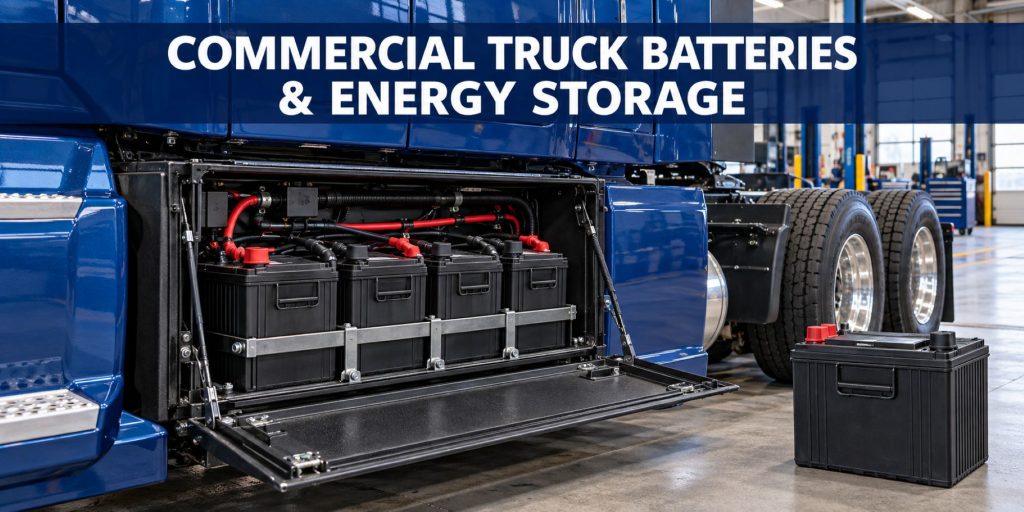
Commercial truck batteries store the electrical energy required for engine starting, electronic controls, exterior lighting, safety systems, cab accessories, sleeper equipment, liftgates, refrigeration accessories, and other vehicle or trailer equipment.
Heavy-duty trucks commonly use multiple batteries connected into a battery bank. The exact configuration depends on system voltage, engine-starting requirements, accessory demand, vehicle design, climate, operating schedule, and whether the vehicle uses separate starting and auxiliary energy-storage systems.
Truck Equipment Atlas covers flooded lead-acid batteries, absorbed glass mat batteries, commercial Group 31 batteries, starting batteries, dual-purpose batteries, auxiliary battery banks, battery boxes, disconnects, isolation equipment, charging connections, and energy-management systems used throughout commercial trucking.
Commercial Truck Batteries on Truck Equipment Atlas
Explore the commercial-truck batteries and energy-storage products being added to Truck Equipment Atlas:
Deka
Odyssey Battery
NorthStar Battery
Additional flooded, AGM, starting, deep-cycle, dual-purpose, auxiliary, liftgate, and commercial-vehicle battery products will be added as the Truck Equipment Atlas Electrical Systems Library continues to expand.
How Commercial Truck Batteries Work
A commercial truck battery converts stored chemical energy into direct-current electrical power. When the starting circuit is activated, the battery bank supplies high current to the starter motor so it can crank the engine.
After the engine starts, the alternator supplies electricity to the vehicle and restores energy removed from the batteries. The batteries also help stabilize system voltage and provide power when electrical demand temporarily exceeds alternator output.
When the engine is off, batteries may continue powering electronic modules, lighting, communication equipment, sleeper accessories, liftgates, refrigeration controls, and other connected loads. Excessive key-off demand can discharge the battery bank and leave insufficient energy for engine starting.
Starting Batteries vs Auxiliary Batteries
Starting batteries are designed to deliver a large amount of current for a short period while the starter cranks the engine. They are selected according to engine requirements, system voltage, climate, battery-bank configuration, and vehicle-manufacturer specifications.
Auxiliary batteries are used to support electrical equipment when the engine is not operating. Depending on their construction, they may be better suited to repeated discharge-and-recharge cycles than conventional starting batteries.
Some trucks use one battery bank for both starting and accessory loads. Other vehicles use separate starting and auxiliary banks connected through isolators, relays, converters, chargers, or electronic energy-management controls.
Flooded Lead-Acid Batteries
Flooded lead-acid batteries use liquid electrolyte surrounding internal lead plates. They remain common in commercial trucks because of their broad availability, established service history, familiar testing procedures, and range of starting and reserve-capacity options.
Flooded batteries must remain correctly mounted and ventilated. Their service life can be affected by vibration, high temperatures, deep discharge, undercharging, overcharging, loose connections, corrosion, and low electrolyte levels in serviceable designs.
Some modern flooded commercial batteries use sealed or maintenance-free construction, but this does not eliminate the need to inspect the case, terminals, cables, mounting equipment, charging voltage, and overall battery condition.
Absorbed Glass Mat Batteries
Absorbed glass mat batteries hold their electrolyte within fiberglass separators positioned between the plates. AGM construction can provide improved resistance to vibration, reduced electrolyte movement, sealed operation, and strong starting or cycling performance when properly matched to the application.
AGM batteries are often selected for trucks with high electrical demand, extended key-off accessory use, automatic engine start-stop operation, severe vibration, or frequent discharge-and-recharge cycles.
An AGM battery should not be installed solely because its dimensions match an existing battery. Charging voltage, battery capacity, operating temperature, battery-bank configuration, accessory demand, and manufacturer requirements must also be verified.
Commercial Group 31 Batteries
Group 31 is a widely used commercial battery size found in highway tractors, vocational trucks, buses, trailers, construction equipment, agricultural equipment, and other heavy-duty applications.
The Group 31 designation primarily describes the battery’s physical size and terminal arrangement. It does not mean every Group 31 battery has the same electrical capacity, chemistry, cranking performance, cycle life, vibration resistance, or intended application.
Before replacing a Group 31 battery, buyers should confirm:
- Battery chemistry
- Cold-cranking amperage
- Cranking amperage
- Reserve capacity
- Amp-hour capacity when specified
- Terminal type and polarity
- Starting or cycling application
- Battery-bank compatibility
- Vehicle charging requirements
- Battery-box and hold-down fit
Battery Banks and System Voltage
Commercial vehicles may connect multiple batteries in parallel, series, or a combination of both arrangements.
Parallel connections retain the battery bank’s nominal voltage while increasing available current and capacity. Series connections increase voltage by adding the voltage of each connected battery.
Most North American highway trucks use 12-volt electrical architecture, but certain commercial vehicles, heavy equipment, military vehicles, buses, specialty chassis, and imported equipment may use 24-volt systems or multiple operating voltages.
Batteries installed in the same bank should be compatible in type, capacity, condition, and application. Mixing batteries with substantially different ages, capacities, chemistries, or states of health can contribute to unequal charging and reduced battery-bank performance.
Cold-Cranking Amps and Reserve Capacity
Cold-cranking amps describe a battery’s ability to deliver starting current under a defined low-temperature test condition. Adequate cold-cranking performance is especially important for diesel engines operating in cold climates.
Reserve capacity describes how long a fully charged battery can supply a defined electrical load before reaching a specified voltage. Reserve capacity is important for vehicles that operate lighting, electronic controls, communication equipment, sleeper accessories, liftgates, or other loads when alternator output is unavailable or insufficient.
A battery should not be selected using only one rating. Engine-starting requirements, reserve capacity, battery-bank size, accessory demand, operating temperature, alternator output, cable condition, and duty cycle must be considered together.
Battery Charging and Energy Management
The alternator and voltage regulator must maintain the battery bank within the correct charging range while supplying the truck’s operating electrical loads.
Charging performance can be affected by:
- Alternator output
- Engine speed and idle time
- Voltage-regulator operation
- Battery temperature
- Battery chemistry
- Battery state of charge
- Cable size and circuit length
- Terminal and ground resistance
- Connected electrical loads
- Auxiliary battery isolators and controls
Repeated undercharging can allow batteries to remain at a low state of charge and shorten service life. Excessive charging voltage can cause heat, water loss in flooded batteries, internal damage, and premature failure.
Auxiliary and Hotel-Load Battery Systems
Sleeper tractors and specialized commercial vehicles may use auxiliary battery systems to power climate-control equipment, refrigerators, inverters, lighting, communication equipment, entertainment devices, computers, chargers, and other hotel loads while the engine is off.
A separate auxiliary battery bank can help preserve starting capacity by isolating accessory loads from the engine-starting batteries. The system may use automatic disconnects, battery isolators, relays, chargers, converters, monitoring equipment, or programmable low-voltage protection.
Auxiliary systems must be sized according to expected load, operating time, recharge opportunity, battery type, available mounting space, vehicle weight, ventilation, cable capacity, and temperature conditions.
Battery Boxes, Mounting, and Connections
Commercial batteries must be securely mounted to prevent movement, vibration damage, terminal contact, cable strain, and damage during vehicle operation.
Battery mounting equipment can include:
- Battery boxes
- Battery trays
- Hold-down brackets
- Insulated covers
- Protective terminal boots
- Interconnect cables
- Positive and negative main cables
- Frame and engine grounds
- Battery disconnect switches
- Ventilation provisions
Cables should be properly sized, routed, supported, protected from abrasion, and kept away from excessive heat, sharp edges, and moving components.
Common Commercial-Truck Battery Problems
Battery and energy-storage problems can develop gradually or appear suddenly during engine starting or high electrical demand.
Common problems include:
- Low state of charge
- Internal battery failure
- Sulfation
- Damaged or swollen battery cases
- Loose battery hold-downs
- Corroded terminals
- Loose cable connections
- Damaged interconnect cables
- Poor engine or frame grounds
- Excessive key-off electrical draw
- Insufficient alternator output
- Overcharging or undercharging
- Unequal batteries within a battery bank
- Heat or vibration damage
Replacing a discharged battery without identifying the reason for the discharge can allow the same problem to return. The complete starting, charging, cable, grounding, and key-off electrical system may require testing.
Battery Inspection and Testing
Commercial-truck batteries should be inspected and tested according to vehicle-manufacturer instructions, battery-manufacturer guidance, fleet procedures, and operating conditions.
Important inspection areas include:
- Battery state of charge
- Open-circuit voltage
- Battery conductance or load-test results
- Battery-case cracks, swelling, or leakage
- Terminal corrosion and damage
- Cable and interconnect condition
- Battery-box and tray condition
- Hold-down security
- Ground connections
- Charging voltage
- Starter-circuit voltage drop
- Key-off current draw
- Battery temperature
- Electrolyte level where serviceable
Battery testing should account for battery type, temperature, charge level, installed configuration, and the testing procedure specified for the equipment.
Common Applications
- Long-haul highway tractors
- Regional and day-cab tractors
- Pickup-and-delivery trucks
- Box trucks
- Dump trucks
- Concrete mixers
- Refuse trucks
- Utility and service trucks
- Tow and recovery vehicles
- Refrigerated trucks and trailers
- Liftgate-equipped trailers
- Transit and school buses
- Construction and off-highway equipment
- Emergency and specialized commercial vehicles
Selecting a Commercial Truck Battery
Battery selection should be based on verified vehicle, engine, starting, charging, accessory-load, climate, and operating requirements.
Important selection factors include:
- Vehicle electrical-system voltage
- Starting or auxiliary application
- Battery chemistry
- Battery group size
- Cold-cranking amperage
- Reserve capacity
- Amp-hour capacity
- Terminal configuration
- Battery-bank arrangement
- Alternator and charging-system compatibility
- Key-off accessory demand
- Climate and operating temperature
- Vibration and severe-service exposure
- Warranty and replacement availability
- Total ownership cost
Purchase price should not be considered separately from expected service life, starting reliability, cycle capability, replacement availability, charging-system compatibility, maintenance requirements, downtime, and the consequences of battery failure.
Related Electrical System Categories
- Alternators & Charging Systems
- Starters & Starting Systems
- Wiring, Connectors & Power Distribution
- Truck & Trailer Lighting Systems
- Inverters, Converters & Auxiliary Electrical Power
Related Electrical System Guides
- Electrical System Guides
- How Commercial Truck Electrical Systems Work
- Commercial Truck Batteries Explained
- Commercial Truck Alternators and Charging Systems Explained
- Commercial Truck Starters and Starting Systems Explained
- How to Inspect and Maintain Truck Wiring and Electrical Connections
- Commercial Truck and Trailer Lighting Systems Explained
Related Truck and Equipment Resources
- Electrical Systems
- Commercial Trucks
- Commercial Trailers
- Diesel Engines
- Drivelines & Steering Systems
- Telematics & ELD Systems
- Safety Systems
- Equipment Systems
Commercial Truck Battery Library Expansion
Truck Equipment Atlas will continue expanding its commercial-truck battery and energy-storage coverage as additional manufacturers, battery chemistries, sizes, applications, and electrical-management technologies are added.
Future coverage may include:
- Additional flooded Group 31 batteries
- Additional AGM Group 31 batteries
- Commercial starting batteries
- Deep-cycle auxiliary batteries
- Dual-purpose commercial batteries
- Liftgate battery systems
- Sleeper-cab auxiliary battery systems
- Battery isolation systems
- Battery monitoring equipment
- Low-voltage disconnect systems
- Commercial lithium-ion auxiliary batteries
- Battery chargers and shore-power equipment
The goal is to build an organized commercial battery reference that helps drivers, owner-operators, fleets, technicians, students, and equipment buyers understand how different battery systems work and where individual products fit within the trucking industry.
Explore the Complete Electrical Systems Library
Visit the Electrical Systems hub to explore batteries, alternators, starters, wiring, electrical connectors, power-distribution equipment, truck and trailer lighting, inverters, converters, auxiliary electrical-power systems, product profiles, and educational guides.
Follow the Growth of Truck Equipment Atlas
Truck Equipment Atlas continues to expand with new truck profiles, trailer coverage, diesel engine pages, equipment-system resources, manufacturer information, and educational guides.
Visit our Truck Equipment Atlas Site Updates page to explore recent additions, project milestones, and upcoming resources.