
Quick Facts
- Manufacturer: Delco Remy
- Parent Company: PHINIA Inc.
- Product Series: 36SI
- Product Type: High-output heavy-duty alternator
- Electrical Design: Brushless
- System Voltages: 12-volt and 24-volt configurations
- Maximum Published 12-Volt Output: 170 amps
- Published 12-Volt Idle Output: Up to 100 amps
- Maximum Published 24-Volt Output: 105 amps
- Mounting Options: J180 hinge or pad mount, depending on part number
- Remote Sense: Optional and included on applicable models
- Primary Applications: Heavy-duty trucks, buses, vocational vehicles, construction equipment, emergency vehicles, and specialty equipment
- Production Status: Active configurations available; verify the exact part number
Overview
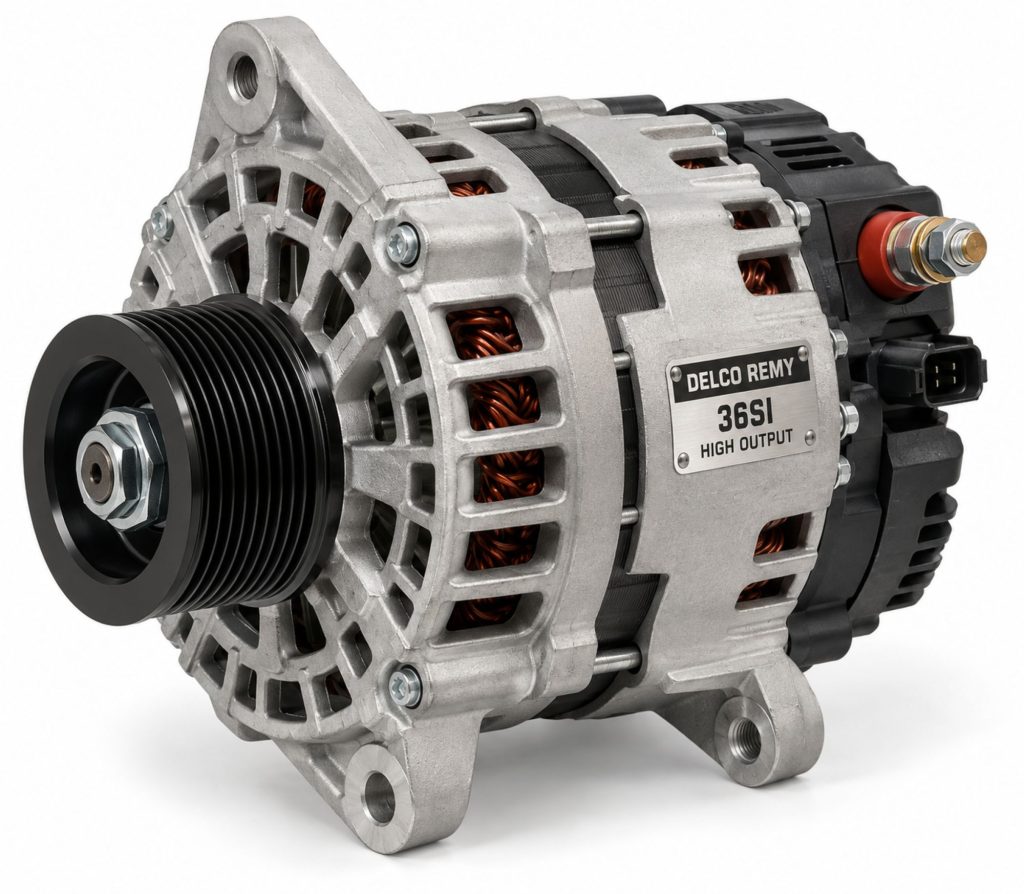
The Delco Remy 36SI is a high-output brushless alternator developed for heavy-duty commercial vehicles. It converts mechanical energy from the engine’s accessory drive into regulated direct-current electrical power for vehicle loads and battery charging.
Delco Remy lists 12-volt configurations with output ratings up to 170 amps and 24-volt configurations with output ratings up to 105 amps. Exact voltage, output, mounting style, terminals, grounding arrangement, pulley, and Remote Sense capability depend on the complete part number.
The 36SI was designed as an upgrade or replacement option for applications using earlier Delco Remy 33SI, 34SI, and 35SI alternator families, along with selected competitive alternators. Compatibility must still be confirmed for the individual vehicle.
Its brushless construction eliminates brushes and slip rings from the field-current design, reducing conventional wear points and supporting long service life in demanding commercial applications.
Key Characteristics
- Heavy-duty brushless alternator design
- 12-volt output ratings up to 170 amps
- 24-volt output ratings up to 105 amps
- Up to 100 amps at idle on the published 170-amp 12-volt configuration
- Remote Sense available on applicable models
- J180 hinge and pad-mount configurations
- New and remanufactured service options
- Designed for demanding commercial-vehicle duty cycles
- Available in negative-ground and application-specific insulated-ground arrangements
- Can replace selected earlier alternator families when correctly specified
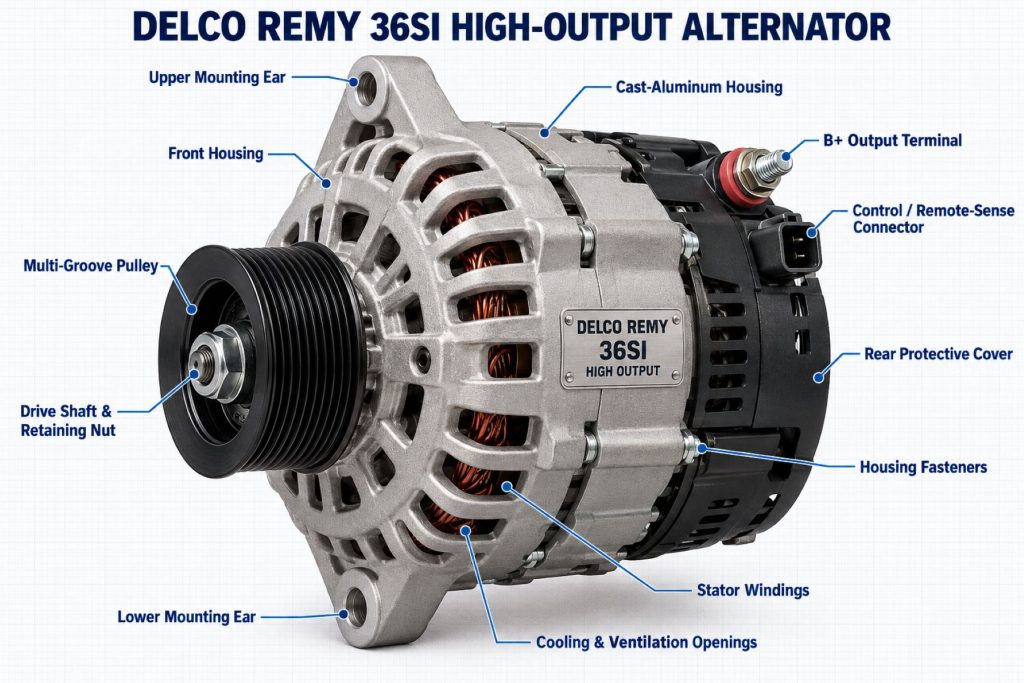
Major Components
- Drive-end housing
- Rectifier-end housing and cover
- Rotor assembly
- Stator assembly
- Rectifier bridge
- Diode trio
- Voltage regulator
- Drive-end and rectifier-end bearings
- Cooling fan
- Drive pulley
- B+ output terminal
- Ground connection
- Remote Sense terminal on applicable models
- R and I terminals where specified
- Mounting feet or pad-mount structure
Product Type and Construction
The 36SI is an engine-driven, internally regulated alternator constructed for heavy-duty service. Its housing supports the rotor, stator, rectifier, regulator, bearings, fan, pulley, electrical terminals, and mounting structure.
Brushless construction removes the brushes and slip rings used in many conventional alternators. Bearings, windings, rectifier components, terminals, and the regulator remain service-sensitive components affected by heat, vibration, contamination, belt loading, and electrical demand.
Different 36SI part numbers may use different voltages, outputs, mounting arrangements, terminals, pulleys, regulators, and grounding systems. Visual similarity does not establish interchangeability.
How the Electrical Component or System Works
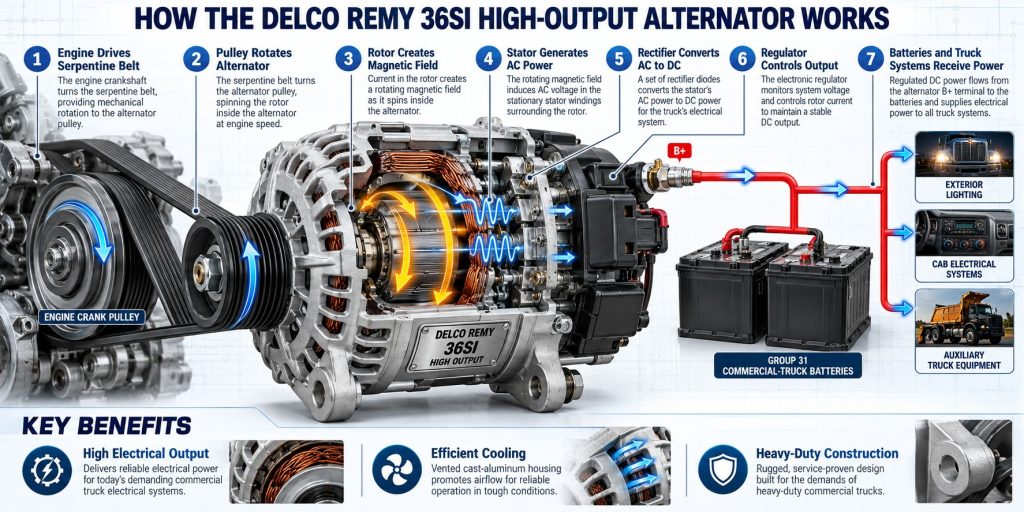
The engine turns the alternator pulley through the accessory-drive belt. The pulley rotates the alternator’s rotor inside the stationary stator, creating a changing magnetic field that induces electrical current in the stator windings.
The generated current begins as alternating current. The rectifier converts it into direct current for the vehicle’s batteries and electrical system.
The internal voltage regulator manages alternator output to maintain the required system voltage. Applicable Remote Sense configurations can monitor voltage elsewhere in the electrical system and compensate for voltage loss between the alternator and battery circuit.
Position and Function Within the Vehicle
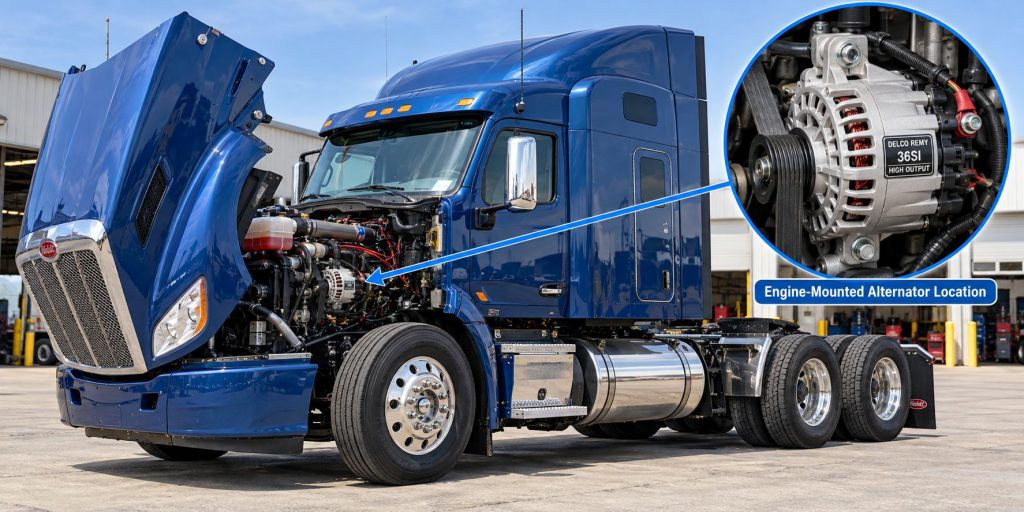
The 36SI mounts on the engine and receives mechanical power from the accessory-drive belt. Its exact position depends on the engine, mounting bracket, belt routing, cooling package, and nearby accessories.
It supplies electrical energy for engine controls, lighting, HVAC equipment, emissions systems, communication equipment, safety electronics, body equipment, auxiliary loads, and battery charging.
The batteries temporarily supply current when electrical demand exceeds alternator output. When alternator output exceeds current demand, available energy can restore battery charge.
Common Specifications
- Alternator Type: Internally regulated heavy-duty brushless alternator
- System Voltage: 12 or 24 volts, depending on part number
- Maximum Published 12-Volt Output: 170 amps
- Published 12-Volt Idle Output: Up to 100 amps on the 170-amp configuration
- Maximum Published 24-Volt Output: 105 amps
- Maximum Continuous Speed: 10,000 rpm
- Maximum Intermittent Speed: 12,000 rpm
- Mounting: J180 hinge or pad mount, depending on part number
- Remote Sense: Optional or included on applicable configurations
- Grounding: Negative-ground or insulated-ground, depending on part number
- Availability: New and remanufactured configurations
All specifications must be verified against the exact Delco Remy part number and vehicle application.
Operating Capacity and Performance
The 36SI family supports medium-to-high electrical demand in commercial vehicles. Delco Remy publishes output up to 170 amps at 12 volts and up to 105 amps at 24 volts.
The published 170-amp 12-volt configuration can provide up to approximately 100 amps at idle. Actual output depends on alternator speed, temperature, system voltage, wiring resistance, battery condition, regulator strategy, and active electrical demand.
The maximum output rating should not be confused with continuous output under every operating condition. Application-specific output curves should be used when evaluating low-speed electrical performance.
Installation Position and System Function
The alternator must be mounted to an approved engine bracket with the correct pulley, belt, tensioner, alignment, hardware, wiring, and clearances.
Its function is to support electrical loads and maintain battery charge while the engine operates. It cannot compensate for severely damaged batteries, undersized cables, poor grounds, excessive resistance, or continuous demand beyond the charging system’s capacity.
System Voltage and Electrical Architecture
The 36SI is available for 12-volt and 24-volt vehicle architectures. The selected alternator must match the batteries, starter, controls, electrical loads, protective devices, and grounding arrangement.
Most North American highway trucks use 12-volt electrical systems with multiple batteries connected in parallel. Certain buses, construction machines, specialty vehicles, and international applications may use 24-volt systems.
A 12-volt alternator must not be substituted for a 24-volt unit, or the reverse, even if the housing and mounting arrangement appear similar.
Electrical Input, Output, and Power Function
The alternator receives mechanical input through its pulley and supplies regulated electrical output through its B+ terminal and grounding path. Additional terminals support sensing, indication, and application-specific control functions.
Mechanical input requirements rise as electrical output increases. Alternator efficiency determines how much engine power is required to produce the requested electrical energy.
Output cables, grounds, terminals, and protective equipment must safely support the maximum available current.
Voltage, Current, and Electrical Load Management
The regulator adjusts alternator operation as electrical demand and battery condition change. Loads may include lighting, engine controls, HVAC blowers, heaters, communications, safety electronics, body equipment, and auxiliary systems.
Vehicles that idle for extended periods require careful comparison between total demand and available idle output. When demand exceeds alternator output, the batteries discharge even though the engine is running.
A complete load analysis should include continuous loads, intermittent loads, battery recovery, seasonal equipment, idle time, and future electrical additions.
Charging and Battery-Support Function
The 36SI supports active vehicle loads and supplies available current for battery charging. Charging demand increases after engine starting and after electrical equipment has operated while the engine was off.
Battery condition, chemistry, temperature, state of charge, cable resistance, and charging time affect how much current the battery bank accepts.
Batteries should be tested when an alternator is replaced. Weak, shorted, deeply discharged, or mismatched batteries can overload the charging system and shorten component life.
Circuit Design and Power Distribution
The alternator’s B+ circuit supplies the batteries and vehicle power-distribution network through heavy-gauge wiring. The grounding path returns current through approved cables, engine connections, chassis connections, or an insulated-ground arrangement.
High resistance at a terminal, splice, battery connection, junction point, or ground can reduce charging performance and create excessive heat.
Vehicles using auxiliary batteries, isolators, liftgate chargers, inverters, or specialized electrical equipment require additional charging-system review.
Internal Components and Electrical Design
The rotor creates the rotating magnetic field, while the stator produces electrical current. The rectifier changes the generated alternating current into direct current, and the regulator controls system voltage.
The brushless design removes conventional brushes and slip rings. Bearings support the rotating assembly, while the fan and housing passages manage cooling airflow.
The alternator remains vulnerable to overspeed, excessive belt loading, contamination, blocked airflow, loose connections, and abnormal electrical demand.
Materials and Component Construction
The 36SI uses metal housings, copper windings, insulated conductors, semiconductor rectifier components, steel hardware, bearings, a cooling fan, and application-specific terminals.
The housings provide mounting strength, bearing support, component protection, and airflow. Insulation must withstand electrical stress, heat, vibration, and normal environmental exposure.
Materials and internal details may vary between part numbers, production revisions, new units, and remanufactured units.
Wiring, Terminals, Connectors, and Grounding
Terminal arrangements vary across the 36SI family. Applicable connections can include:
- B+ output terminal
- Negative-ground connection
- Insulated-ground terminal on applicable models
- Remote Sense terminal
- R terminal
- I terminal
- Application-specific connectors or harness leads
Every cable must be routed, protected, supported, and connected according to the approved diagram. Incorrect wiring can cause undercharging, overcharging, damaged electronics, or alternator failure.
Circuit Protection and Electrical Safety
The charging circuit must use approved conductor sizes, insulation, terminal covers, routing, and circuit protection. Battery power should be isolated according to manufacturer procedures before alternator wiring is removed.
Accidental contact between an energized B+ terminal and ground can create severe current, electrical arcing, heat, component damage, burns, or fire.
Never bypass a protective device or replace it with equipment rated above the circuit’s approved capacity.
Controls, Monitoring, and Diagnostics
Charging-system operation may be monitored through a warning lamp, voltage gauge, dashboard message, electronic control module, battery monitor, or fleet telematics system.
Some applications use conventional indicator circuits, while others integrate charging information into multiplexed vehicle electronics. The exact arrangement depends on the vehicle and alternator part number.
Dashboard information should be confirmed with direct electrical measurements when diagnosing a charging problem.
Power Demand, Capacity, and Energy Management
The 36SI is suited to vehicles whose electrical demand falls within its output range. Alternator capacity should be evaluated at the engine speeds where the vehicle actually operates.
Demand may come from exterior lighting, cab HVAC equipment, engine controls, heaters, emissions systems, communication equipment, warning lights, auxiliary batteries, and body-mounted equipment.
Electrical accessories added after vehicle production can change the required charging capacity and should be included in the load calculation.
Power Consumption and System Efficiency
Alternator efficiency affects the amount of mechanical power drawn from the engine. A more efficient alternator requires less engine power to produce the same electrical output than a less efficient design.
Actual operating efficiency is affected by alternator speed, electrical load, temperature, belt condition, wiring resistance, battery condition, and vehicle duty cycle.
Poor electrical connections waste energy as heat and can reduce the benefit of an efficient alternator.
Heat, Efficiency, and Electrical Loss Management
Electrical generation creates heat within the stator, rotor, rectifier, regulator, terminals, and conductors. Bearings and belt loading also contribute to operating temperature.
The fan and housing passages move cooling air through the alternator. Oil deposits, dirt, debris, restricted airflow, high ambient temperature, or sustained maximum output can increase thermal stress.
Loose or corroded terminals create resistance and localized heat. Discolored hardware, melted insulation, hardened cables, or a burning odor require immediate inspection.
Environmental Sealing and Contamination Protection
The alternator should be protected from direct pressure washing, oil saturation, coolant leaks, fuel contamination, road chemicals, and packed debris.
Cooling openings must remain clear. Contamination can restrict airflow, damage insulation, corrode terminals, and shorten bearing or electronic-component life.
Vocational and severe-service vehicles may require more frequent inspection because of mud, dust, road salt, vibration, and fluid exposure.
Duty Cycle and Operating Conditions
The 36SI can support highway, regional, vocational, bus, emergency, construction, and specialty applications when correctly specified.
Vehicles operating for long periods at idle require adequate low-speed output. Vehicles making frequent starts may require faster battery recovery. High-mileage vehicles place different demands on the alternator than equipment operating short, low-speed duty cycles.
Temperature, vibration, contamination, engine speed, electrical loading, belt alignment, and maintenance practices all influence service life.
Mounting and Installation
Installation requires the correct voltage, output, mounting style, pulley, belt arrangement, terminals, grounding method, control connections, and physical clearance.
The mounting bracket should be checked for cracks, distortion, looseness, corrosion, and damaged threads. The pulley must align with the accessory drive, and the belt tensioner must operate correctly.
Electrical cables should be routed away from exhaust heat, sharp edges, moving parts, and locations where vibration can cause abrasion.
Wiring, Grounding, and Installation Requirements
Output and ground circuits must be sized for the alternator rating, conductor length, environmental temperature, routing, and vehicle duty cycle.
Negative-ground models depend on sound connections between the alternator, engine, batteries, chassis, and power-distribution system. Insulated-ground versions require the dedicated ground arrangement specified for the application.
Remote Sense circuits must follow the approved Delco Remy instructions. Incorrect sensing connections can cause inaccurate regulation or charging problems.
Vehicle and Electrical-System Compatibility
Compatibility depends on the vehicle, engine, system voltage, mounting bracket, pulley, belt drive, electrical demand, grounding method, terminals, controls, and available clearance.
Confirm the following before installation:
- Complete Delco Remy part number
- 12-volt or 24-volt operation
- Required rated and idle output
- J180 hinge or pad mounting
- Pulley and belt compatibility
- Terminal arrangement
- Remote Sense requirements
- Negative-ground or insulated-ground design
- Cable and circuit-protection capacity
- Vehicle-control compatibility
Battery and Charging-System Compatibility
The alternator must be matched to batteries approved for the vehicle’s voltage and charging system. Battery chemistry, capacity, age, temperature, and state of charge affect charging demand.
Vehicles using multiple battery banks, isolators, inverters, liftgate chargers, or auxiliary equipment require a complete energy-management review.
A higher-output alternator may require upgraded output cables, grounds, protective devices, and belt-drive components.
Related Component and System Compatibility
The 36SI operates as part of the engine accessory drive, battery bank, starting system, power-distribution network, lighting system, electronic controls, and auxiliary electrical equipment.
Changes to alternator capacity can affect belt loading, battery recovery, cable temperature, circuit protection, idle performance, and energy-management strategies.
Common Applications
- Highway tractors
- Regional and day-cab tractors
- Medium- and heavy-duty straight trucks
- Vocational trucks
- Construction equipment
- Transit buses
- School buses
- Emergency vehicles
- Utility and service vehicles
- Transport refrigeration and auxiliary-power equipment
- Specialized commercial vehicles
Advantages
- Brushless construction
- Reduced conventional brush and slip-ring wear
- 12-volt and 24-volt availability
- Output ratings suitable for many commercial applications
- Strong low-speed output on applicable configurations
- Remote Sense available
- J180 hinge and pad-mount options
- Can replace selected earlier Delco Remy alternator families
- New and remanufactured options
- Supported by Delco Remy application and service resources
Limitations or Considerations
- Output is lower than larger high-output alternator families
- Part numbers are not automatically interchangeable
- System voltage must be matched exactly
- Mounting and pulley compatibility must be verified
- Idle output may be insufficient for unusually large loads
- Remote Sense is not included on every configuration
- Grounding arrangements vary
- Higher output does not correct weak batteries or poor wiring
- Cooling airflow must remain unobstructed
- Incorrect belt loading can damage bearings and drive components
Driver and Operator Experience
A properly operating 36SI should provide stable electrical performance without routine driver adjustment. The driver may notice consistent lighting, reliable battery recovery, and stable system voltage under normal loads.
Operators should report charging warnings, slow cranking, dim or flickering lamps, repeated battery discharge, unusual belt noise, bearing noise, electrical odors, or changing voltage readings.
Continued operation with a charging failure can discharge the batteries and eventually interrupt engine or electronic-system operation.
Controls, Indicators, and Driver Feedback
Vehicle feedback may be provided through a charging warning lamp, voltage gauge, dashboard display, electronic message, battery monitor, or telematics alert.
A normal dashboard reading does not rule out resistance between the alternator, batteries, power-distribution system, and instrument circuit.
Warnings should be investigated with vehicle-specific procedures and direct electrical measurements.
Common Electrical Tests and Diagnostic Information
- Battery state-of-charge testing
- Battery load or conductance testing
- Charging-voltage measurement
- Alternator current-output testing
- Output-circuit voltage-drop testing
- Ground-circuit voltage-drop testing
- Remote Sense circuit inspection
- Belt, pulley, and tensioner inspection
- Parasitic-current testing
- Vehicle fault-code review
- Connection-temperature inspection
Testing equipment must be rated for the expected voltage and current. Follow Delco Remy and vehicle-manufacturer procedures for the exact application.
Inspection and Wear Points
- Mounting brackets and fasteners
- Drive pulley
- Accessory belt and tensioner
- Alternator bearings
- B+ output terminal
- Output cable and protective cover
- Grounding connections
- Remote Sense, R, and I terminals
- Connector locks and seals
- Cooling fan and housing openings
- Oil, coolant, fuel, water, and debris contamination
- Heat discoloration or damaged insulation
Cooling, Ventilation, and Environmental Requirements
Cooling air passes through the alternator housing to control internal temperature. Fan damage, blocked openings, oil deposits, or packed debris can restrict airflow.
The installation must preserve adequate clearance from exhaust heat and other high-temperature components. Direct pressure washing should be avoided unless specifically permitted.
Severe-duty vehicles operating in dust, road salt, mud, or extreme temperature may require more frequent inspection.
Component Service Life and Rebuildability
The brushless design eliminates conventional brush and slip-ring wear, but alternator life still depends on bearings, windings, rectifier components, regulator condition, belt alignment, temperature, and electrical demand.
Delco Remy provides service-parts information for supported 36SI configurations. Available components vary by part number and production version.
Repair and rebuilding should use approved parts and procedures. Complete replacement may be more practical when damage affects multiple internal components.
Maintenance and Ownership Notes
Inspect the alternator, mounting hardware, belt drive, wiring, batteries, terminals, and grounds during scheduled maintenance.
Repeated alternator failure should prompt a review of battery condition, electrical demand, cable voltage drop, grounding, belt alignment, vibration, heat, contamination, and vehicle controls.
Maintenance records should include the complete part number, output rating, voltage, mounting style, installation date, battery condition, and test results.
Common Electrical-System Problems
Low charging voltage: Belt slip, excessive resistance, poor grounding, weak batteries, insufficient output, Remote Sense problems, or excessive electrical demand may be responsible.
No alternator output: A broken belt, open cable, failed regulator, damaged rectifier, control-circuit problem, or internal failure can prevent charging.
Overcharging: Incorrect sensing, damaged wiring, poor battery connections, regulator failure, or an incompatible alternator may cause excessive voltage.
Overheated terminals: Loose connections, corrosion, undersized cables, excessive current, or damaged hardware can produce resistance and heat.
Belt noise: Misalignment, incorrect tension, pulley wear, tensioner problems, contamination, or bearing resistance may cause noise.
Repeated battery discharge: Insufficient charging time, excessive parked loads, weak batteries, poor connections, or inadequate alternator capacity may be responsible.
Intermittent charging: Loose terminals, damaged wiring, vibration, heat-related faults, belt slip, or regulator problems may cause changing output.
Safety and Service Precautions
Disconnect and isolate battery power according to approved procedures before removing alternator wiring or beginning service.
Never disconnect a battery cable while the engine is running as an alternator test. Doing so can create voltage spikes and damage electronic systems.
Keep tools, jewelry, and conductive objects away from energized terminals. Follow approved procedures for belt release, alternator support, mounting torque, terminal torque, wiring, and electrical testing.
Identification Information
Record the following information before ordering a replacement:
- Complete Delco Remy part number
- 36SI model designation
- System voltage
- Rated output
- J180 hinge or pad-mount configuration
- Pulley type and dimensions
- Terminal sizes and locations
- Remote Sense configuration
- Grounding arrangement
- New or remanufactured status
- Vehicle VIN and engine information
Do not identify the correct alternator only by appearance or model family. Part-number differences can affect voltage, output, mounting, terminals, pulley, grounding, and control compatibility.
Buying Considerations
- Verify the complete Delco Remy part number
- Confirm 12-volt or 24-volt operation
- Match the required output rating
- Compare idle output with vehicle demand
- Match J180 hinge or pad mounting
- Verify pulley and belt compatibility
- Match terminal and connector arrangements
- Confirm Remote Sense requirements
- Verify the grounding configuration
- Check cable and circuit-protection capacity
- Compare new and remanufactured options
- Confirm warranty and core requirements
Variants and Configurations
- 12-volt models with different output ratings
- 24-volt models with different output ratings
- J180 hinge-mount configurations
- Pad-mount configurations
- Remote Sense and non-Remote-Sense versions
- Negative-ground configurations
- Insulated-ground configurations
- Different pulleys and terminals
- New alternators
- Remanufactured alternators
- Original-equipment and all-makes replacement applications
Comparison to Similar Equipment
Compared with the Delco Remy 40SI Heavy-Duty Brushless Alternator, the 36SI provides a lower maximum 12-volt output in a different application range. The 40SI is better suited to installations requiring substantially greater charging capacity.
Compared with the Delco Remy 28SI High-Output Alternator, the 36SI uses a heavy-duty brushless design and is available in different voltage, output, and mounting configurations.
Compared with the Delco Remy 24SI Heavy-Duty Alternator, the 36SI is intended for applications seeking brushless durability and greater heavy-duty output capability.
Compared with the Leece-Neville IdlePro Alternator, the 36SI offers a Delco Remy alternative with different mounting, terminal, output, control, and replacement configurations.
Best Fit For
- Commercial vehicles requiring up to 170 amps at 12 volts
- Compatible 24-volt commercial vehicles
- Fleets seeking brushless alternator construction
- Vehicles replacing compatible 33SI, 34SI, or 35SI models
- Highway and regional trucks
- Buses and motorcoaches
- Construction and vocational equipment
- Emergency and utility vehicles
- Applications using J180 hinge or pad mounting
- Vehicles originally specified for a compatible 36SI part number
Related Vehicle and Trailer Types
- Long-Haul Sleeper Trucks
- Day Cab Trucks
- Heavy-Haul Trucks
- Dump Trucks
- Commercial straight trucks
- Transit and school buses
- Emergency vehicles
- Construction equipment
- Utility and service vehicles
- Specialized commercial vehicles
Related Truck and Trailer Models
- Freightliner Cascadia
- Freightliner M2 106
- Kenworth T680
- Kenworth T880
- Peterbilt 579
- Peterbilt 567
- International LT Series
- International MV Series
- Mack Anthem
- Mack Granite
Related Electrical System Types
- Alternators & Charging Systems
- Commercial Truck Batteries & Energy Storage
- Starters & Starting Systems
- Wiring, Connectors & Power Distribution
- Inverters, Converters & Auxiliary Electrical Power
- Brushless alternators
- Brushed alternators
- High-output alternators
- 12-volt charging systems
- 24-volt charging systems
Related Electrical Products
- Delco Remy 40SI Heavy-Duty Brushless Alternator
- Delco Remy 28SI High-Output Alternator
- Delco Remy 24SI Heavy-Duty Alternator
- Delco Remy 39MT Heavy-Duty Gear-Reduction Starter
- Delco Remy 38MT Heavy-Duty Starter
- Leece-Neville IdlePro Alternator
- Leece-Neville IdlePro Extreme Alternator
- Deka Intimidator AGM Group 31 Battery
Related Equipment Systems
- Electrical Systems
- Engines
- Transmissions
- Truck & Trailer Lighting Systems
- Telematics & ELD Systems
- Safety Systems
- Equipment Systems
Related Guides
- Electrical System Guides
- How Commercial Truck Electrical Systems Work
- Commercial Truck Batteries Explained
- Commercial Truck Alternators and Charging Systems Explained
- Commercial Truck Starters and Starting Systems Explained
- How to Inspect and Maintain Truck Wiring and Electrical Connections
- Commercial Truck and Trailer Lighting Systems Explained
Regulatory and Compliance Notes
Charging-system modifications must preserve compliance with the vehicle’s electrical, emissions, lighting, braking, safety, and electronic-control requirements.
Replacement cables, circuit protection, terminals, mounting hardware, and control connections must meet the requirements for the exact vehicle and alternator.
Buses, emergency vehicles, refrigerated equipment, and specialized commercial vehicles may have additional electrical-capacity, redundancy, inspection, or operating requirements.
Real World Operating Notes
The 36SI is well suited to many conventional commercial-truck electrical systems, but it should not be selected solely because its maximum rating appears adequate.
Idle output is especially important for buses, utility vehicles, emergency equipment, and vocational trucks that operate substantial electrical loads at low engine speed.
Replacing an alternator without testing the batteries and performing voltage-drop checks can leave the original charging problem unresolved.
A vehicle that has gained electrical accessories over time may require a fresh load analysis rather than a direct replacement based only on the original alternator rating.
Frequently Asked Questions
What is the Delco Remy 36SI?
The 36SI is a heavy-duty brushless alternator family available for commercial 12-volt and 24-volt electrical systems.
How much output does the 36SI provide?
Delco Remy publishes output up to 170 amps at 12 volts and up to 105 amps at 24 volts. Exact ratings depend on the part number.
Is the 36SI brushless?
Yes. Its brushless design eliminates conventional brushes and slip rings from the field-current system.
What mounting arrangements are available?
The 36SI family includes J180 hinge-mount and pad-mount configurations.
Does every 36SI include Remote Sense?
No. Remote Sense is optional and depends on the selected part number.
Can the 36SI replace a 33SI, 34SI, or 35SI?
Compatible replacement configurations are available, but voltage, output, mounting, pulley, terminals, grounding, and vehicle integration must be confirmed.
Can a 36SI replace a 40SI?
Not automatically. The 40SI supports greater output in many configurations, and the vehicle’s electrical demand, mounting, pulley, terminals, wiring, and control requirements must be evaluated.
Why might charging voltage remain low after alternator replacement?
Possible causes include weak batteries, excessive electrical demand, voltage drop, poor grounds, belt slip, incorrect Remote Sense wiring, or an incompatible replacement alternator.
Are remanufactured 36SI alternators available?
Yes. Delco Remy lists new and remanufactured configurations for selected applications.
How is the correct replacement identified?
Use the complete Delco Remy part number, system voltage, output rating, mounting style, pulley, terminal arrangement, grounding method, Remote Sense configuration, vehicle VIN, and engine information.
Availability and Where to Find
Delco Remy 36SI alternators and supported service components may be available through heavy-duty truck dealers, commercial electrical specialists, fleet-parts suppliers, engine dealers, and authorized Delco Remy distributors.
Availability depends on voltage, output, mounting style, pulley, terminals, grounding arrangement, Remote Sense configuration, and whether a new or remanufactured unit is required.
Current product details, part-number lookup, service information, and technical resources are available through the Delco Remy 36SI product page.
Support Trucking Families
Truck Equipment Atlas supports the mission of Grey Cross, a nonprofit dedicated to helping families of truck drivers who lose their lives while on the road. As the site grows, part of its mission is to bring awareness and support to these families.
Podcast or Video Section
Learn More Through Audio and Video
Truck Equipment Atlas will continue expanding with podcast episodes, interviews, and equipment breakdowns to help drivers and fleets better understand trucks and equipment.
Follow the Growth of Truck Equipment Atlas
Truck Equipment Atlas continues to expand with new truck profiles, trailer coverage, diesel engine pages, equipment-system resources, manufacturer information, and educational guides.
Visit our Site Updates page to explore recent additions, project milestones, and upcoming resources as we continue building one of the industry’s growing commercial trucking equipment reference libraries.
View the Latest Site Updates: Truck Equipment Atlas Site Updates