
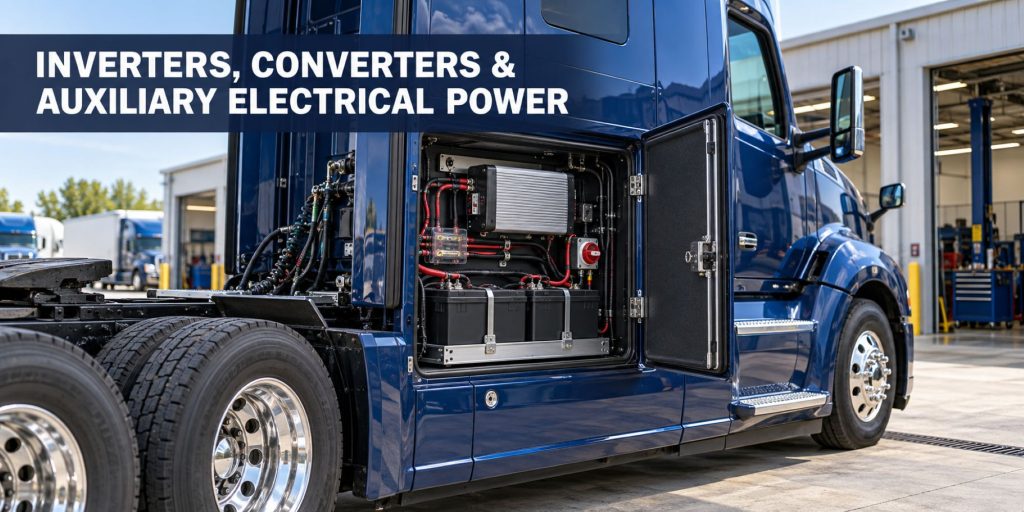
Commercial-truck inverters, converters, chargers, auxiliary batteries, shore-power equipment, and idle-reduction systems provide electrical power for sleeper-cab appliances, tools, communication equipment, liftgates, refrigeration equipment, emergency systems, service bodies, and other vehicle-mounted loads.
These systems allow equipment designed for different voltages or electrical-current types to operate from the truck or trailer’s primary electrical system. They can also manage battery charging, protect starting batteries, distribute auxiliary power, and reduce the need to idle the engine for electrical loads.
Truck Equipment Atlas covers DC-to-AC inverters, DC-to-DC converters, inverter-chargers, auxiliary battery systems, shore-power connections, low-voltage disconnects, idle-reduction power equipment, trailer auxiliary power systems, installation requirements, maintenance, and individual products from major manufacturers.
Inverters, Converters, and Auxiliary Power Products on Truck Equipment Atlas
Explore the commercial-vehicle auxiliary electrical products being added to Truck Equipment Atlas:
Xantrex
- Xantrex Freedom XC PRO 2000 Inverter/Charger
- Xantrex Freedom XC PRO 3000 Inverter/Charger
- Xantrex Freedom XC 2000 Inverter/Charger
Purkeys
Additional inverters, converters, inverter-chargers, auxiliary battery systems, low-voltage disconnects, shore-power connections, solar charging equipment, electric standby systems, and idle-reduction power technologies will be added as the Truck Equipment Atlas Electrical Systems Library expands.
How Auxiliary Electrical Power Systems Work
An auxiliary electrical power system receives energy from the vehicle’s batteries, alternator, a separate battery bank, shore power, solar panels, an auxiliary power unit, or another approved source. Electrical equipment then converts, stores, controls, protects, or distributes that energy according to the needs of the connected loads.
An inverter changes direct current from a battery system into alternating current for compatible appliances, tools, chargers, and other equipment. A converter changes electrical voltage or converts alternating current into direct current. An inverter-charger combines inverter operation with the ability to charge batteries from an external AC source.
Controllers, relays, fuses, circuit breakers, low-voltage disconnects, battery-management systems, transfer switches, and monitoring devices protect and coordinate the system. Correct component selection is necessary to prevent excessive battery discharge, overheated conductors, damaged electronics, or insufficient power.
Major Auxiliary Power System Types
- DC-to-AC power inverters
- DC-to-DC voltage converters
- AC-to-DC converters and battery chargers
- Combination inverter-chargers
- Auxiliary battery banks
- Battery isolators and separators
- Low-voltage disconnect systems
- Shore-power connections
- Automatic transfer switches
- Solar charging systems
- Trailer auxiliary power systems
- Electric standby systems
- Idle-reduction power systems
- Auxiliary power units
- Battery monitoring and energy-management systems
DC-to-AC Power Inverters
A power inverter draws direct current from the vehicle or auxiliary batteries and produces alternating current for compatible equipment. Commercial-truck inverters are frequently used to operate sleeper-cab appliances, computers, televisions, chargers, small refrigerators, microwave ovens, and approved power tools.
Inverters are commonly identified by continuous wattage, surge wattage, input voltage, output voltage, waveform, outlet configuration, efficiency, environmental rating, and low-voltage protection.
The inverter must be large enough for the connected load without exceeding the capacity of the battery bank, charging system, cables, protective devices, or mounting location. Appliances with motors, compressors, transformers, or heating elements may require significantly more power during startup or operation than their basic description suggests.
Pure Sine Wave and Modified Sine Wave Inverters
Pure sine wave inverters produce AC power with a waveform intended to resemble conventional utility power. They are commonly selected for sensitive electronics, variable-speed equipment, battery chargers, medical devices, audio equipment, and appliances that may not operate correctly from a modified waveform.
Modified sine wave inverters may be suitable for certain basic electrical loads, but some motors, chargers, electronic controls, clocks, and audio devices may operate inefficiently, produce noise, run hotter, or fail to function correctly.
Waveform selection should be based on the requirements of the connected equipment rather than purchase price alone.
DC-to-DC Converters
DC-to-DC converters change one direct-current voltage into another. Commercial vehicles may use them to operate 12-volt equipment from a 24-volt system, supply regulated power to electronics, charge an auxiliary battery bank, or isolate sensitive equipment from voltage fluctuations.
Converters may step voltage down, step voltage up, stabilize the output, or provide electrical isolation. Selection depends on input-voltage range, required output voltage, continuous current, peak demand, efficiency, environmental exposure, and the electrical characteristics of the connected equipment.
A converter must not be used to support loads that exceed its continuous or intermittent rating. Insufficient converter capacity can cause voltage drop, overheating, protective shutdown, or equipment malfunction.
Inverter-Chargers
An inverter-charger combines a DC-to-AC inverter with an AC-powered battery charger. When external AC power is unavailable, the unit uses battery energy to supply approved AC loads. When shore power or another compatible AC source becomes available, it can pass power to the loads and recharge the battery bank.
Depending on the model, an inverter-charger may include an internal transfer relay, programmable charging profiles, battery-temperature compensation, remote controls, communication networks, low-voltage protection, and support for multiple battery chemistries.
The charging profile must match the installed battery type. Incorrect settings can reduce battery life, cause incomplete charging, produce excessive heat, or damage the battery system.
Auxiliary Battery Systems
An auxiliary battery system supplies electrical loads without relying entirely on the batteries used to start the engine. Separating starting and accessory loads can reduce the risk of discharging the starting batteries while the vehicle is parked.
Auxiliary battery systems may include:
- One or more deep-cycle batteries
- Battery trays or enclosures
- Battery isolators or separators
- DC-to-DC chargers
- Low-voltage disconnects
- Fuses and circuit breakers
- Heavy-gauge battery cables
- Battery-monitoring equipment
- Temperature sensors
- Remote displays and controls
Battery chemistry, capacity, charging profile, mounting, ventilation, temperature exposure, cable length, and expected duty cycle must be evaluated as one complete system.
Low-Voltage Disconnects and Battery Protection
A low-voltage disconnect monitors battery voltage and removes designated electrical loads when voltage falls below a programmed threshold. This can help preserve enough battery capacity for engine starting and protect batteries from excessive discharge.
Some systems restore power automatically after battery voltage recovers, while others require manual intervention. More advanced controllers may provide warning indicators, adjustable thresholds, time delays, load prioritization, or communication with a vehicle-management system.
A low-voltage disconnect does not correct an undersized battery bank, weak batteries, insufficient charging capacity, excessive electrical demand, or poor connections. Those conditions must be diagnosed separately.
Shore Power and Automatic Transfer Equipment
Shore-power equipment allows a parked truck, trailer, bus, emergency vehicle, or specialty vehicle to connect to an external AC electrical supply. It can operate onboard equipment, power HVAC systems, and support battery charging without running the vehicle’s engine.
A typical shore-power arrangement may include an external inlet, cable, circuit protection, transfer equipment, inverter-charger, distribution panel, grounding system, and interior outlets.
An automatic transfer switch selects between shore power, inverter power, generator power, or another approved source. Transfer equipment must be rated for the voltage, frequency, current, grounding arrangement, and connected loads.
Trailer Auxiliary Electrical Power
Trailers may require auxiliary power for liftgates, interior lighting, refrigeration controls, hydraulic equipment, telematics, security systems, tire-pressure equipment, cargo sensors, and other electrical loads.
A trailer auxiliary power system may charge trailer batteries while the tractor is connected and operating. Depending on the design, it may regulate charging voltage, compensate for cable length, monitor battery condition, isolate circuits, and protect the tractor’s starting system.
Voltage loss across long conductors is a major concern in tractor-trailer charging systems. Cable size, connector condition, charging current, grounding, circuit protection, and total conductor length must be considered during installation and diagnosis.
Solar Charging and Supplemental Power
Solar panels can provide supplemental energy for maintaining batteries and supporting smaller electrical loads. Commercial vehicle installations may use roof-mounted or trailer-mounted panels connected through a charge controller.
Available output depends on panel area, sunlight, shade, orientation, temperature, dirt, wiring condition, controller efficiency, and battery state of charge. Solar equipment generally supplements the vehicle’s charging system rather than replacing the alternator or shore-power charger.
Panels and wiring must be mounted securely and protected from vibration, wind, branches, cargo equipment, water intrusion, and service-related damage.
Idle-Reduction and Engine-Off Power
Auxiliary electrical systems can reduce engine idling by supporting hotel loads, climate controls, communication equipment, lighting, and other accessories while the vehicle is parked.
Engine-off power may be supplied by auxiliary batteries, an inverter, a diesel-powered auxiliary power unit, an electric HVAC system, shore power, solar charging, or a combination of technologies.
The appropriate system depends on parking duration, climate, electrical demand, available vehicle space, weight, charging time, maintenance capability, operating routes, and anti-idling requirements.
Electrical Capacity and Load Management
Every auxiliary electrical system must be sized for its expected continuous and peak loads. Adding the wattage of connected equipment provides a starting point, but startup demand, simultaneous operation, conversion losses, duty cycle, battery capacity, charging capacity, and operating time must also be considered.
Important electrical ratings include:
- Nominal input voltage
- Allowable input-voltage range
- Output voltage
- Output frequency
- Continuous wattage
- Surge wattage and duration
- Continuous current
- Peak current
- Conversion efficiency
- Battery amp-hour capacity
- Charging current
- Standby current draw
- Operating-temperature range
An inverter’s advertised wattage does not independently establish whether the complete vehicle electrical system can support that load.
Installation and Mounting Considerations
Inverters, converters, chargers, and batteries should be installed in locations that provide adequate ventilation, environmental protection, service access, cable routing, structural support, and separation from heat, moisture, fuel, moving components, and cargo damage.
Installation planning should address:
- Manufacturer-approved mounting orientation
- Ventilation and cooling clearance
- Battery-cable length and conductor size
- Overcurrent protection near the power source
- Chassis and equipment grounding
- Protection from water and road debris
- Vibration and shock exposure
- Battery ventilation requirements
- Separation of AC and DC conductors
- Remote-control and communication wiring
- Access for inspection and service
High-current DC circuits require properly sized conductors, terminals, disconnects, and protective devices. Improvised wiring or undersized components can create severe heat and fire hazards.
Common Auxiliary Electrical Power Problems
- Inverter will not turn on
- Low-voltage shutdown
- Overload or short-circuit shutdown
- Overtemperature shutdown
- Appliance fails to start
- Insufficient surge capacity
- Rapid auxiliary battery discharge
- Starting batteries discharged while parked
- Auxiliary batteries not charging
- Excessive voltage drop
- Loose or overheated cable connections
- Blown fuse or tripped circuit breaker
- Shore power not transferring
- Incorrect battery-charging profile
- Remote display or communication failure
- Moisture or corrosion damage
Troubleshooting should include battery condition, system voltage under load, cable voltage drop, terminal temperature, protective devices, grounding, charging output, controller settings, fault codes, and the demand created by connected equipment.
Inspection and Maintenance
Auxiliary electrical equipment should be inspected according to manufacturer instructions, fleet procedures, operating conditions, and the type of batteries and loads used.
Important inspection points include:
- Battery state of charge and condition
- Battery terminals and interconnect cables
- Inverter and converter mounting
- Power and grounding connections
- Fuses, circuit breakers, and disconnects
- Heat discoloration or melted insulation
- Cooling fans and ventilation openings
- Water, corrosion, and contaminant intrusion
- Shore-power inlet and cable condition
- Remote displays and warning indicators
- Charging voltage and current
- Stored fault codes and operating history
Loose high-current connections should be corrected promptly. Electrical resistance at a poor connection can create damaging heat even when the connected equipment appears to continue operating.
Selecting an Inverter or Auxiliary Power System
Equipment selection should begin with a complete inventory of the electrical loads, their operating time, and whether they will operate simultaneously.
Important selection factors include:
- Vehicle electrical-system voltage
- Required AC and DC outputs
- Continuous and startup power demand
- Pure sine wave or modified sine wave output
- Battery type and capacity
- Alternator and charging-system capacity
- Expected engine-off operating time
- Shore-power availability
- Required charging functions
- Low-voltage protection
- Installation space and ventilation
- Environmental and vibration exposure
- Remote controls and communications
- Service and replacement support
- Applicable electrical and vehicle standards
The inverter, batteries, charging equipment, cables, circuit protection, transfer equipment, and connected loads should be treated as one engineered system.
Common Applications
- Long-haul sleeper tractors
- Expedited freight trucks
- Work trucks and service bodies
- Utility trucks
- Recovery and towing vehicles
- Emergency vehicles
- Mobile workshops
- Mobile medical vehicles
- Buses and motorcoaches
- Liftgate-equipped trailers
- Refrigerated trailers
- Mobile command vehicles
- Construction and vocational equipment
- Specialized commercial vehicles
Related Electrical System Categories
- Commercial Truck Batteries & Energy Storage
- Alternators & Charging Systems
- Starters & Starting Systems
- Wiring, Connectors & Power Distribution
- Truck & Trailer Lighting Systems
Related Electrical System Guides
- Electrical System Guides
- How Commercial Truck Electrical Systems Work
- Commercial Truck Batteries Explained
- Commercial Truck Alternators and Charging Systems Explained
- Commercial Truck Starters and Starting Systems Explained
- How to Inspect and Maintain Truck Wiring and Electrical Connections
- Commercial Truck and Trailer Lighting Systems Explained
Related Truck and Equipment Resources
- Electrical Systems
- Equipment Systems
- Commercial Trucks
- Commercial Trailers
- Refrigeration Units
- Telematics & ELD Systems
- Safety Systems
Auxiliary Electrical Power Library Expansion
Truck Equipment Atlas will continue expanding its auxiliary electrical power coverage as additional manufacturers, power ratings, battery technologies, charging systems, and commercial-vehicle applications are added.
Future coverage may include:
- Pure sine wave truck inverters
- Combination inverter-chargers
- DC-to-DC converters
- Auxiliary battery chargers
- Battery isolators and separators
- Low-voltage disconnect systems
- Truck shore-power systems
- Trailer auxiliary power systems
- Electric standby systems
- Commercial solar charging systems
- Idle-reduction electrical equipment
- Auxiliary power system comparisons
The goal is to build an organized auxiliary power reference that helps drivers, owner-operators, fleets, technicians, body builders, students, and equipment buyers understand how these systems operate and where individual products fit within the commercial trucking industry.
Explore the Complete Electrical Systems Library
Visit the Electrical Systems hub to explore commercial batteries, alternators, charging systems, starters, wiring, connectors, power-distribution equipment, truck and trailer lighting, inverters, converters, auxiliary electrical systems, individual product profiles, and educational guides.
Follow the Growth of Truck Equipment Atlas
Truck Equipment Atlas continues to expand with new truck profiles, trailer coverage, diesel engine pages, equipment-system resources, manufacturer information, and educational guides.
Visit our Truck Equipment Atlas Site Updates page to explore recent additions, project milestones, and upcoming resources.