
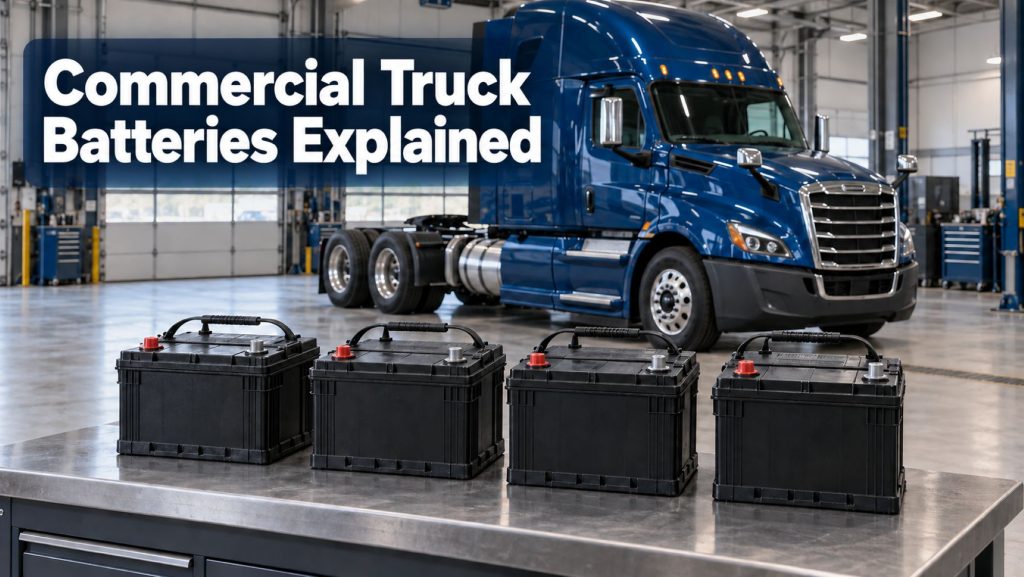
Commercial truck batteries provide the stored electrical energy needed to crank the engine, power electronic controls, support lighting and accessories, and keep critical systems operating when alternator output is unavailable or insufficient. A battery that looks simple from the outside must withstand vibration, temperature extremes, repeated starting loads, long idle periods, and the growing electrical demands of modern trucks.
Choosing and maintaining the correct batteries requires more than matching the physical size. Voltage, cold-cranking amps, reserve capacity, construction, terminal arrangement, duty cycle, and charging-system compatibility all matter. This guide explains the main commercial truck battery types, how battery banks work, the ratings found on battery labels, common failure symptoms, testing methods, and practical maintenance considerations.
What Commercial Truck Batteries Do
A truck battery converts stored chemical energy into direct-current electrical power. Its most demanding job is usually supplying the high current required by the starter motor. Once the engine is running, the alternator normally carries vehicle loads and restores energy removed during starting. The battery also stabilizes system voltage and supplies power when the engine is off or when electrical demand temporarily exceeds alternator output.
Batteries may support engine and transmission controls, fuel-system components, lighting, brakes, telematics, safety systems, HVAC controls, sleeper equipment, liftgates, hydraulic controls, refrigeration accessories, and other installed equipment. The guide to How Commercial Truck Electrical Systems Work explains how the batteries interact with the rest of the starting, charging, distribution, and control system.
How a Lead-Acid Truck Battery Works
Most conventional commercial truck batteries use lead-acid chemistry. Each cell contains positive and negative plates immersed in an electrolyte of sulfuric acid and water. A chemical reaction between the plates and electrolyte produces electrical energy. A fully charged lead-acid cell produces a little more than two volts, so six cells connected in series create a nominal 12-volt battery.
During discharge, the active materials on both plates gradually convert to lead sulfate and the electrolyte becomes less concentrated. Charging reverses much of this reaction by forcing current back through the battery. Repeated undercharging, prolonged storage in a discharged state, excessive heat, overcharging, contamination, and vibration can damage the plates or reduce the battery’s usable capacity.
Major Types of Commercial Truck Batteries
Flooded Lead-Acid Batteries
Flooded batteries contain liquid electrolyte surrounding the internal plates. They are widely used because they are proven, available, and generally economical. Some designs have removable caps for checking electrolyte level, while maintenance-free flooded batteries use sealed or restricted-access covers that reduce routine service requirements.
Flooded batteries can provide strong cranking performance, but they must remain upright and properly secured. Electrolyte loss, corrosion, vibration, and plate shedding can shorten service life. A damaged case or overfilled cell may also release acid into the battery box.
Absorbed Glass Mat Batteries
Absorbed glass mat, or AGM, batteries hold electrolyte in fiberglass separators between the plates. They are valve-regulated lead-acid batteries and do not contain freely moving liquid in the same way as a conventional flooded design. AGM construction can provide strong vibration resistance, low internal resistance, good cranking performance, reduced acid leakage, and improved acceptance of charging current.
AGM batteries are often selected for severe service, high electrical demand, frequent cycling, or installations where spill resistance is important. They usually cost more than flooded batteries and require compatible charging voltage. Chronic overcharging can dry the battery and permanently reduce capacity.
Thin Plate Pure Lead Batteries
Thin plate pure lead batteries are a specialized AGM design that uses many thin, high-purity lead plates. The increased plate surface area can support high cranking output, rapid recharge, and strong cycling capability. These batteries may be useful where dependable starting and accessory support are both priorities, but the correct charging profile remains important.
Starting Batteries
Starting batteries are designed to deliver a large amount of current for a short period. Their plate construction favors cranking performance rather than repeated deep discharge. They work well when the engine starts promptly and the alternator restores the removed energy soon afterward.
Deep-Cycle and Dual-Purpose Batteries
Deep-cycle batteries are designed to tolerate deeper and more frequent discharge than starting batteries. Dual-purpose batteries balance cranking ability with cycling durability. They may be used in auxiliary banks for sleeper loads, liftgates, refrigeration accessories, or work-truck equipment. A battery intended primarily for cycling should not automatically replace an engine-starting battery unless its cranking performance and the vehicle manufacturer’s requirements are satisfied.
Common Commercial Truck Battery Sizes
Battery group size identifies standardized physical dimensions and general terminal placement. Group 31 is especially common in Class 6, 7, and 8 trucks, buses, vocational equipment, and trailers with auxiliary electrical systems. Other group sizes appear in medium-duty trucks, specialty vehicles, auxiliary compartments, and imported platforms.
Group size alone does not determine whether a battery is correct. Two Group 31 batteries may differ substantially in cold-cranking amps, reserve capacity, construction, terminal type, cycling ability, weight, warranty, and vibration resistance. The battery must fit the tray and hold-down while also meeting the truck’s electrical requirements.
Understanding Battery Ratings
Voltage
Most North American commercial trucks use a 12-volt electrical system, although the battery bank may contain several 12-volt batteries connected in parallel. Some vehicles and equipment use 24-volt systems or a series-parallel arrangement. The replacement configuration must match the vehicle design; changing battery connections can damage electrical components or create a serious safety hazard.
Cold-Cranking Amps
Cold-cranking amps, commonly shown as CCA, indicate the current a battery can deliver under a standardized low-temperature test while maintaining a specified minimum voltage. Higher CCA can improve starting capability in cold weather, but the rating must be considered with battery condition, cable resistance, starter condition, engine oil viscosity, and the number of batteries in the bank.
Cranking Amps
Cranking amps may be measured at a warmer temperature than CCA and will normally show a higher number. The two ratings should not be compared as if they were identical. When a vehicle specification calls for CCA, use the CCA value.
Reserve Capacity
Reserve capacity indicates how long a fully charged battery can supply a standardized current before voltage falls to a defined limit. It helps describe how much energy is available for vehicle loads if alternator output is lost or when equipment operates with the engine off. Trucks with significant hotel or auxiliary loads need enough usable capacity without repeatedly discharging the starting bank too deeply.
Amp-Hour Capacity
Amp-hours describe the amount of current a battery can theoretically deliver over a specified test period. The actual energy available in service changes with discharge rate, temperature, battery age, and the minimum voltage required by connected equipment. Amp-hour ratings are especially useful when sizing auxiliary banks, but they do not replace a cranking rating for engine-starting applications.
How Multiple-Battery Banks Work
Heavy trucks commonly use two, three, or four batteries because one battery may not provide sufficient cranking current and reserve capacity. In a parallel connection, all positive terminals are connected together and all negative terminals are connected together. System voltage stays the same while available current and capacity increase.
In a series connection, the positive terminal of one battery connects to the negative terminal of another. Voltage increases while the amp-hour capacity remains approximately equal to that of one battery. Series wiring is used when the equipment requires a higher system voltage. Some older or specialized trucks use series-parallel switching to provide one voltage for starting and another for normal operation.
Batteries within the same bank should normally match in type, capacity, age, and condition. A weak battery can reduce the performance of the entire bank, and mixing batteries can cause uneven charging and discharging. Cable routing also matters. Poorly arranged connections can make one battery carry more of the load than the others.
Starting Batteries and Auxiliary Battery Banks
A truck with substantial sleeper, work-body, refrigeration, or liftgate loads may use a separate auxiliary battery bank. An isolator, automatic charging relay, battery-management controller, or low-voltage disconnect allows auxiliary equipment to use stored energy while preserving sufficient starting capacity.
This separation is valuable because repeated deep discharge can shorten the life of batteries designed mainly for starting. Proper system design must account for alternator output, cable size, fuse protection, charging time, idle operation, expected load, and the discharge characteristics of the selected batteries. Learn more about generation and voltage regulation in Commercial Truck Alternators and Charging Systems Explained.
Battery Cables, Terminals, Grounds, and Protection
A healthy battery bank cannot perform correctly through loose, corroded, undersized, or damaged connections. Starting current travels from the battery positive terminals through cables, switches, relays, solenoids, and the starter. The return path travels through the starter housing, engine, frame or dedicated negative cables, and back to the batteries.
Resistance anywhere in that path causes voltage drop and heat. A connection may look acceptable while failing under load, which is why voltage-drop testing is more useful than visual inspection alone. Battery cables must be routed away from exhaust heat, sharp edges, moving parts, and areas where road debris or chemicals can damage the insulation. Circuit protection should be installed and rated according to the equipment manufacturer’s design.
The guide How to Inspect and Maintain Truck Wiring and Electrical Connections covers cable condition, connector protection, grounding, corrosion, and testing in greater detail.
How the Charging System Affects Battery Life
After starting, the alternator must supply vehicle loads and replace the energy removed from the batteries. Chronic undercharging allows lead sulfate to harden on the plates, reducing capacity and cranking performance. Overcharging increases heat, water loss, grid corrosion, and damage to valve-regulated batteries.
Charging voltage measured at the alternator may differ from voltage reaching the batteries because of resistance in cables, connections, switches, and grounds. Some systems use remote voltage sensing or temperature compensation to improve charging control. A correct diagnosis therefore considers alternator output, regulator behavior, cable voltage drop, battery temperature, electrical load, and battery condition together.
How the Starting System Affects Battery Performance
Slow cranking does not always mean the batteries are defective. A worn starter, high-resistance cable, poor ground, mechanical engine problem, incorrect oil viscosity, or control-circuit fault can create similar symptoms. Replacing batteries without testing the starting circuit may provide only a temporary improvement.
Conversely, weak batteries can force a starter to operate at low voltage and excessive current, increasing heat and wear. A complete starting complaint should be evaluated using battery tests, voltage-drop measurements, starter current draw, cranking speed, and the procedures described in Commercial Truck Starters and Starting Systems Explained.
Common Battery Problems and Warning Signs
| Symptom | Possible Causes |
|---|---|
| Slow or uneven cranking | Low state of charge, weak battery, corroded connection, cable voltage drop, starter wear, cold temperature, or mechanical engine resistance |
| No crank with clicking | Discharged batteries, loose terminal, high resistance, failed solenoid, control-circuit fault, or starter problem |
| Repeated dead batteries | Parasitic draw, inadequate alternator output, short drive cycles, excessive key-off loads, defective battery, or poor connections |
| Corrosion around terminals | Acid vapor, electrolyte leakage, loose connection, damaged seal, overcharging, or inadequate cleaning and protection |
| Swollen or distorted case | Freezing, severe overcharging, overheating, internal damage, or improper hold-down pressure |
| Strong sulfur odor | Overcharging, overheating, internal short, or battery failure |
| One battery differs from the bank | Internal defect, unequal cable resistance, mismatched battery, poor connection, or cell failure |
| Headlights or electronics reset during cranking | Low battery voltage, excessive voltage drop, poor ground, or excessive starter current draw |
How Commercial Truck Batteries Are Tested
Visual Inspection
Inspection begins with the battery case, cover, posts, terminals, cables, hold-downs, tray, and surrounding compartment. Cracks, bulging, leaks, loose hardware, damaged insulation, corrosion, missing protective covers, and signs of heating require attention. A leaking, frozen, or physically damaged battery should not be load-tested until it has been handled according to the appropriate safety procedure.
Open-Circuit Voltage
Open-circuit voltage provides an estimate of state of charge after surface charge has been removed and the battery has rested. It does not prove that the battery can supply high current. Temperature and battery chemistry affect interpretation, and readings taken immediately after charging or operation can be misleading.
Conductance Testing
An electronic conductance tester evaluates the battery’s ability to conduct current and estimates available cranking performance. It is fast and useful for routine service, but the correct battery type and rating must be entered. Results should be considered with state of charge, temperature, physical condition, and service history.
Load Testing
A load test applies a controlled electrical load while voltage is monitored. It can reveal a battery that shows acceptable open-circuit voltage but cannot maintain voltage under demand. The test load, duration, temperature correction, and minimum acceptable voltage must follow the battery or tester manufacturer’s instructions.
Individual Battery Testing
A multi-battery bank should be evaluated as a system and, when necessary, each battery should be isolated and tested individually. Testing only across the complete bank can hide one weak unit. Before disconnecting batteries, follow vehicle procedures for preserving electronic settings, isolating power, and preventing accidental short circuits.
Battery Inspection and Maintenance
- Secure the vehicle and use proper protection. Batteries can produce explosive gas and contain corrosive electrolyte. Wear appropriate eye and hand protection, remove ignition sources, and use insulated tools where required.
- Inspect the battery box and hold-downs. Confirm that the tray is sound, drains are open, covers are secure, and the batteries cannot move. Do not allow hold-downs to distort the cases.
- Check cases and terminals. Look for cracks, swelling, leaks, damaged posts, melted areas, and corrosion.
- Clean connections correctly. Disconnect and reconnect cables in the sequence specified by the vehicle manufacturer. Neutralize and clean corrosion without allowing cleaning material into battery cells or connectors.
- Check electrolyte where serviceable. Use the manufacturer’s procedure and approved water. Never add acid as routine maintenance.
- Verify cable condition and routing. Inspect insulation, crimps, lugs, boots, grounds, clamps, and points where cables may rub or overheat.
- Measure state of charge and condition. Test each battery with equipment and settings appropriate for its construction and rating.
- Check parasitic draw when batteries repeatedly discharge. Allow electronic modules to enter sleep mode and follow the vehicle procedure before deciding whether key-off current is excessive.
- Test the charging and starting systems. Confirm charging voltage, alternator output, voltage drop, cranking voltage, and starter current as needed.
- Document the results. Record battery age, ratings, test values, repairs, and replacement dates so recurring problems can be identified.
Replacing Batteries in a Commercial Truck
Replacement batteries should meet or exceed the vehicle manufacturer’s requirements for group size, voltage, cold-cranking performance, reserve capacity, terminal configuration, and construction. They must also be appropriate for the mounting location, temperature range, vibration level, and expected cycling duty.
If one battery in an older matched bank fails, replacing only that battery can create imbalance. The new battery may charge and discharge differently from the remaining units. Whether the entire bank should be replaced depends on the age, condition, test results, and manufacturer recommendations for all batteries involved.
Before installing replacements, correct cable, charging, starter, parasitic-load, and mounting problems that could damage the new batteries. Confirm polarity before making any connection. Reversed polarity can cause arcing and immediate damage to electronic equipment.
Factors That Shorten Commercial Truck Battery Life
- Repeated deep discharge of starting batteries
- Long periods in a partially discharged state
- High underhood or battery-box temperature
- Cold weather combined with low state of charge
- Loose hold-downs and severe vibration
- Corroded or high-resistance connections
- Incorrect charging voltage or alternator capacity
- Excessive key-off electrical draw
- Frequent short trips that do not restore starting energy
- Extended idling with more electrical load than alternator output
- Mixing battery types, ages, capacities, or conditions in one bank
- Improper storage or failure to maintain stored vehicles
Lighting faults and trailer electrical problems can also create unexpected loads or repeated fuse and connection issues. For a closer look at those circuits, see Commercial Truck and Trailer Lighting Systems Explained.
Choosing the Right Battery for the Application
A highway tractor that starts twice a day has different battery demands from a refuse truck with constant stops, a sleeper tractor with long key-off accessory use, or a work truck that operates electric and hydraulic equipment. Selection should begin with the vehicle manufacturer’s minimum requirements and then account for the actual duty cycle.
| Application Factor | Battery Consideration |
|---|---|
| Cold-weather starting | Adequate CCA, full state of charge, sound cables, and correct engine and starter condition |
| High vibration or rough roads | Durable internal construction, secure mounting, and strong case design |
| Frequent key-off accessory use | Greater reserve or amp-hour capacity, cycling capability, isolation, and low-voltage protection |
| High-temperature operation | Heat management, correct charging voltage, ventilation, and frequent inspection |
| Long idle periods | Alternator output at idle must support loads and still recharge the bank |
| Liftgate or work equipment | Appropriate auxiliary bank, cable sizing, circuit protection, and charging strategy |
| Seasonal storage | Low parasitic draw, maintenance charging, clean connections, and periodic testing |
Frequently Asked Questions
Why do heavy trucks use several batteries?
Large diesel engines require substantial cranking current, especially in cold weather. Multiple batteries connected in parallel increase available cranking current and reserve capacity while maintaining a 12-volt system.
Can flooded and AGM batteries be mixed?
They generally should not be mixed in the same bank unless the vehicle and battery manufacturers specifically approve the arrangement. Different internal resistance, charging characteristics, and state-of-charge behavior can create imbalance and shorten service life.
Does a higher CCA rating always mean a better battery?
No. CCA is important for starting, but reserve capacity, cycling durability, vibration resistance, physical fit, terminal layout, charging compatibility, and application requirements also matter. The best battery is the one correctly matched to the truck and its duty cycle.
Why does a new battery keep going dead?
The cause may be a charging-system problem, parasitic draw, poor connection, incorrect battery-bank configuration, short operating cycles, excessive key-off loads, or a starter that draws too much current. A new battery will not correct an underlying system fault.
Should every battery in the bank be replaced together?
Matched replacement is often appropriate when the batteries are the same age and one has failed because the remaining units may also have reduced capacity. Test each battery and follow the truck and battery manufacturers’ recommendations before deciding.
The Role of Batteries in Truck Reliability
Batteries are the foundation of the starting system and a stabilizing part of the complete electrical system. Their performance depends on correct sizing, secure mounting, balanced connections, adequate charging, low-resistance cables, controlled key-off loads, and maintenance suited to the battery construction.
Testing the entire battery bank and its supporting circuits is more reliable than replacing parts based on symptoms alone. A disciplined approach helps prevent no-start events, protects starters and alternators, supports electronic equipment, and reduces avoidable roadside downtime.