
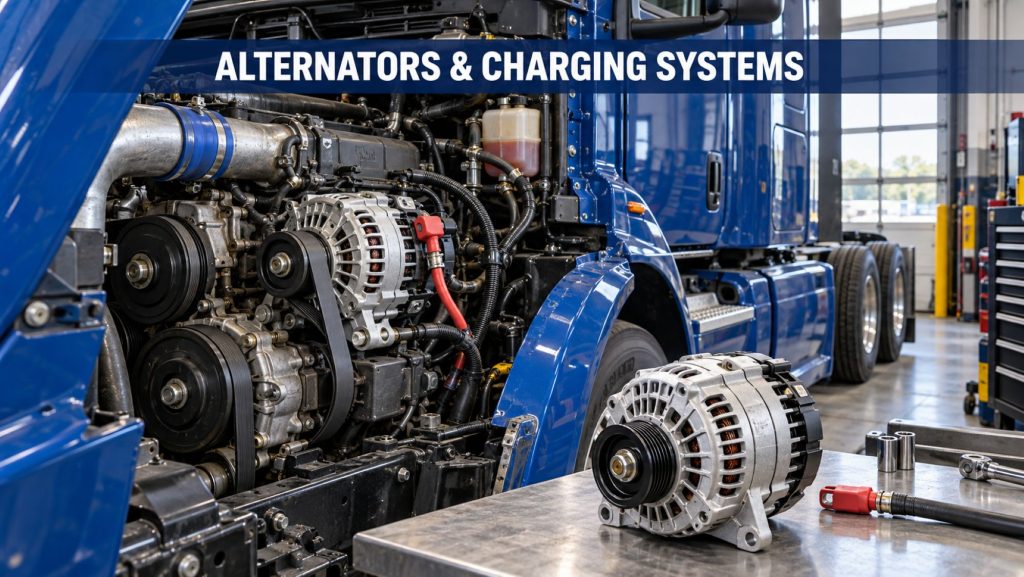
Commercial truck alternators and charging systems generate electrical power while the engine is operating, support the vehicle’s electrical loads, and restore energy removed from the batteries during engine starting and key-off operation.
Heavy-duty charging systems must support engine and transmission controls, lighting, safety equipment, climate controls, communication systems, sleeper accessories, liftgates, refrigeration equipment, vocational body systems, and other electrical loads.
Truck Equipment Atlas covers heavy-duty alternators, brushless alternators, high-output charging systems, voltage regulators, remote-sense systems, alternator mounting arrangements, drive components, wiring, charging controls, diagnostics, maintenance, and individual alternator models from major manufacturers.
Commercial Truck Alternators on Truck Equipment Atlas
Explore the commercial-truck alternators and charging-system products being added to Truck Equipment Atlas:
Delco Remy
- Delco Remy 40SI Heavy-Duty Brushless Alternator
- Delco Remy 36SI High-Output Alternator
- Delco Remy 28SI High-Output Alternator
- Delco Remy 24SI Heavy-Duty Alternator
Leece-Neville
Additional heavy-duty, high-output, brushless, vocational, transit, emergency-vehicle, and specialty charging products will be added as the Truck Equipment Atlas Electrical Systems Library continues to expand.
How Commercial Truck Alternators Work
An alternator converts mechanical energy from the engine into electrical energy. The engine drives the alternator through a belt-and-pulley system or another application-specific drive arrangement.
As the alternator rotor turns, its magnetic field moves within the stator windings and produces alternating electrical current. Internal rectifier diodes convert this alternating current into direct current that can be used by the truck’s electrical system and battery bank.
A voltage regulator controls alternator output according to system voltage, battery condition, electrical demand, temperature, and alternator design. The regulator helps maintain charging voltage within the range required by the complete electrical system.
Alternator Output and Electrical Demand
Alternator output is commonly expressed in amperes. The rated maximum output does not necessarily describe how much current an alternator can produce at engine idle, under high temperatures, or throughout every operating condition.
Electrical demand can come from:
- Engine and transmission electronic controls
- Exterior and interior lighting
- Heating and air-conditioning blowers
- Radiator and condenser fans
- Fuel heaters and intake heaters
- Safety and driver-assistance systems
- Telematics and communication equipment
- Sleeper-cab appliances and inverters
- Liftgates and material-handling equipment
- Refrigeration controls and accessories
- Hydraulic and vocational equipment controls
- Warning lights and work lighting
The charging system must support these operating loads while maintaining enough additional capacity to recharge the battery bank.
High-Output Alternators
High-output alternators are designed for commercial vehicles with substantial electrical demand. They may be used on sleeper tractors, emergency vehicles, utility trucks, refuse equipment, buses, refrigerated vehicles, work trucks, and other applications carrying extensive electrical equipment.
A high maximum output rating does not guarantee adequate low-speed performance. Vehicles that spend significant time idling may require an alternator designed to produce useful current at low alternator and engine speeds.
Installing a higher-output alternator may require evaluation of drive belts, pulleys, mounting brackets, output cables, grounds, circuit protection, batteries, regulators, connectors, and the vehicle’s electronic-control architecture.
Brushless and Brushed Alternators
Traditional brushed alternators use brushes and slip rings to supply current to the rotating field circuit. These components provide proven operation but are subject to mechanical wear over time.
Brushless alternators use an internal design that eliminates conventional field brushes and slip rings. Removing these wear components can improve durability and reduce certain maintenance concerns in high-mileage, high-output, dusty, or severe-service applications.
The correct design depends on the truck, engine, electrical demand, mounting arrangement, environment, duty cycle, service requirements, and manufacturer specifications.
Voltage Regulation and Remote Sense
The voltage regulator adjusts alternator field current to control charging-system voltage. Some regulators are mounted inside the alternator, while other systems may use external or vehicle-integrated controls.
Remote-sense systems monitor voltage at a point away from the alternator, such as the battery bank or electrical-distribution system. This can help the regulator compensate for voltage loss through cables, connections, and distribution equipment.
Remote-sense wiring must be correctly connected and protected. An open, shorted, corroded, or improperly routed sense circuit can contribute to incorrect charging voltage or unstable system operation.
Low-Speed and Idle Output
Many commercial vehicles spend significant time operating at idle or low engine speed. At these speeds, the alternator turns more slowly and may produce substantially less than its maximum rated output.
Low-speed output is especially important for:
- Urban delivery vehicles
- Refuse trucks
- Utility and service trucks
- Emergency vehicles
- Transit buses
- Refrigerated vehicles
- Trucks operating warning lights and work lamps
- Vehicles with heavy climate-control demand
- Tractors supporting sleeper-cab accessories
If electrical demand exceeds alternator output at idle, the battery bank supplies the difference and gradually discharges. Frequent low-speed operation should therefore be considered when selecting and testing an alternator.
Alternator Mounting and Drive Systems
Commercial alternators are available with different mounting arrangements, housing sizes, shaft designs, pulley configurations, connector locations, and rotation requirements.
Common mounting considerations include:
- J180 hinge mounting
- Pad mounting
- Application-specific bracket mounting
- Mounting-foot dimensions
- Pulley diameter and groove count
- Belt type and alignment
- Shaft size and pulley retention
- Housing and terminal clearance
- Cooling-air access
- Engine rotation and alternator fan design
An alternator should not be substituted solely because its voltage and amperage appear similar. Mounting, pulley ratio, rotation, terminals, regulation, communication, output characteristics, and physical clearance must also be verified.
Charging Cables, Grounds, and Circuit Protection
Alternator output travels through heavy-gauge cables and connections before reaching the batteries and electrical-distribution system. Resistance within this path can reduce charging performance and create heat.
Important charging-circuit components include:
- Alternator output cable
- Alternator ground path
- Engine-to-frame ground straps
- Battery cables and interconnects
- Electrical-distribution connections
- Fusible links or high-current protection
- Remote-sense wiring
- Warning-lamp and control circuits
Connections should be clean, secure, properly protected, and sized for the expected current and circuit length. Voltage-drop testing can help identify resistance that may not be visible during a basic inspection.
Charging-System Heat and Cooling
Alternators generate heat while producing electrical power. High current, low engine speed, high ambient temperature, restricted airflow, contamination, excessive belt tension, and sustained electrical demand can increase operating temperature.
Alternator output may be reduced at elevated temperatures to protect internal components. A charging system that appears adequate when cold may perform differently after the engine compartment reaches normal operating temperature.
Airflow around the alternator should remain unobstructed. Oil, fuel, coolant, dirt, and debris can reduce cooling and damage internal components, bearings, wiring, and insulation.
Common Alternator and Charging-System Problems
Charging-system problems can result from the alternator itself or from another component within the drive, battery, wiring, grounding, control, or electrical-load system.
Common problems include:
- Insufficient charging output
- Excessive charging voltage
- Low output at idle
- Worn alternator bearings
- Damaged rectifier diodes
- Voltage-regulator failure
- Brush or slip-ring wear on applicable designs
- Loose or slipping drive belts
- Incorrect pulley ratio
- Loose alternator mounting
- Damaged output cables
- Poor engine or frame grounds
- Corroded terminals and connectors
- Remote-sense circuit faults
- Electrical demand exceeding system capacity
- Weak or damaged batteries
Replacing the alternator without testing the batteries, belts, cables, grounds, electrical loads, and control circuits can leave the original problem unresolved.
Alternator and Charging-System Inspection
Commercial charging systems should be inspected and tested according to vehicle-manufacturer instructions, alternator-manufacturer guidance, fleet procedures, and operating conditions.
Important inspection areas include:
- Alternator mounting security
- Housing condition
- Electrical-terminal condition
- Output-cable routing and protection
- Ground connections
- Remote-sense and control wiring
- Drive-belt condition and tension
- Pulley condition and alignment
- Unusual bearing or drive noise
- Charging voltage
- Alternator current output
- Low-speed output
- Voltage drop on positive and ground circuits
- Battery condition and state of charge
- Total electrical load
Testing should be performed with appropriate equipment and under operating conditions that reproduce the reported problem whenever practical.
Common Applications
- Long-haul highway tractors
- Regional and day-cab tractors
- Pickup-and-delivery trucks
- Box trucks
- Dump trucks
- Concrete mixers
- Refuse trucks
- Utility and service trucks
- Tow and recovery vehicles
- Refrigerated trucks
- Transit and school buses
- Construction and off-highway equipment
- Emergency vehicles
- Specialized commercial vehicles
Selecting a Commercial Truck Alternator
Alternator selection should be based on verified engine, vehicle, electrical-load, battery, mounting, control, and operating requirements.
Important selection factors include:
- Vehicle system voltage
- Maximum alternator output
- Output at idle and low engine speed
- Expected continuous electrical load
- Battery-bank size and chemistry
- Mounting configuration
- Pulley design and ratio
- Belt configuration
- Rotation and cooling-fan design
- Terminal locations and connector type
- Internal or external regulation
- Remote-sense compatibility
- Vehicle electronic-control requirements
- Operating temperature and contamination exposure
- Warranty and replacement availability
Purchase price should not be considered separately from electrical capacity, low-speed performance, efficiency, durability, serviceability, downtime, installation requirements, warranty support, and expected operating life.
Related Electrical System Categories
- Commercial Truck Batteries & Energy Storage
- Starters & Starting Systems
- Wiring, Connectors & Power Distribution
- Truck & Trailer Lighting Systems
- Inverters, Converters & Auxiliary Electrical Power
Related Electrical System Guides
- Electrical System Guides
- How Commercial Truck Electrical Systems Work
- Commercial Truck Batteries Explained
- Commercial Truck Alternators and Charging Systems Explained
- Commercial Truck Starters and Starting Systems Explained
- How to Inspect and Maintain Truck Wiring and Electrical Connections
- Commercial Truck and Trailer Lighting Systems Explained
Related Truck and Equipment Resources
- Electrical Systems
- Commercial Trucks
- Commercial Trailers
- Diesel Engines
- Telematics & ELD Systems
- Safety Systems
- PTO & Hydraulic Systems
- Equipment Systems
Alternator and Charging-System Library Expansion
Truck Equipment Atlas will continue expanding its alternator and charging-system coverage as additional manufacturers, output ratings, mounting designs, applications, and charging technologies are added.
Future coverage may include:
- Additional heavy-duty alternators
- High-output alternators
- Brushless alternators
- Low-speed and high-idle charging systems
- Transit and school-bus alternators
- Emergency-vehicle charging systems
- Vocational and severe-service alternators
- Twenty-four-volt alternators
- Dual-alternator systems
- Smart charging and energy-management systems
- Alternator cables and circuit protection
- Commercial-vehicle charging-system comparisons
The goal is to build an organized commercial charging-system reference that helps drivers, owner-operators, fleets, technicians, students, and equipment buyers understand how alternators operate and where individual products fit within the trucking industry.
Explore the Complete Electrical Systems Library
Visit the Electrical Systems hub to explore batteries, alternators, starters, wiring, electrical connectors, power-distribution equipment, truck and trailer lighting, inverters, converters, auxiliary electrical-power systems, product profiles, and educational guides.
Follow the Growth of Truck Equipment Atlas
Truck Equipment Atlas continues to expand with new truck profiles, trailer coverage, diesel engine pages, equipment-system resources, manufacturer information, and educational guides.
Visit our Truck Equipment Atlas Site Updates page to explore recent additions, project milestones, and upcoming resources.