
Quick Facts
- Manufacturer: Prestolite Electric
- Brand: Leece-Neville Heavy Duty Systems
- Product Family: IdlePro Extreme
- Product Type: High-output heavy-duty alternator
- Alternator Design: Brushless on applicable models
- Electrical System: Application-specific 12-volt and 24-volt configurations
- Published 24-Volt Outputs: Application-specific models including 275, 600, and 680 amps
- Grounding Design: Isolated Ground Technology on applicable models
- Voltage Compensation: Remote Sense capability on applicable models
- Mounting Options: J180 hinge, pad, and application-specific configurations
- Primary Applications: Heavy-duty trucks, buses, emergency vehicles, vocational equipment, and specialized high-electrical-load vehicles
- Production Status: Current availability and specifications depend on the individual part number and application
Overview
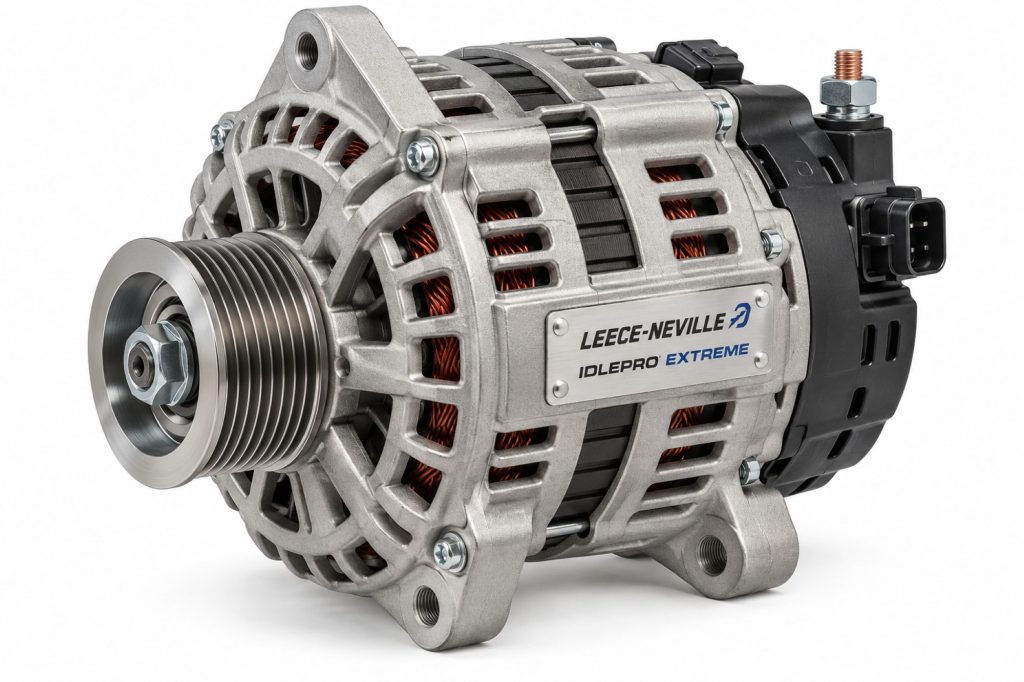
The Leece-Neville IdlePro Extreme is a family of premium heavy-duty alternators developed for vehicles and equipment with substantial electrical demands. It is designed to deliver strong charging output at low engine speeds, helping support electrical accessories while the engine is idling.
Depending on the model, IdlePro Extreme alternators may use a brushless electrical design, isolated grounding, heavy-duty housing protection, enhanced cooling, Remote Sense voltage compensation, and multiple output-terminal arrangements. These features make the family suitable for demanding applications where dependable charging and battery support are essential.
The IdlePro Extreme name covers more than one voltage, amperage, mounting, and application configuration. Buyers and service facilities should use the complete Leece-Neville part number rather than the family name alone when identifying a replacement.
Key Characteristics
- High-output heavy-duty alternator family
- Strong output at low engine speeds
- Brushless construction on applicable models
- Application-specific 12-volt and 24-volt configurations
- Isolated Ground Technology on applicable models
- Remote Sense capability on applicable models
- Heavy-duty housing and corrosion protection
- Enhanced cooling on selected configurations
- Designed to support high accessory loads
- Available with application-specific mounting systems
- Intended to improve battery charging during extended idling
- Suitable for severe-duty and specialized equipment
Major Components
- Alternator housing
- Stator assembly
- Rotor assembly
- Rectifier and diode assembly
- Voltage regulator
- Front and rear bearings
- Drive-end frame
- Slip-ring-end frame or rear housing
- Pulley and shaft
- Output terminals
- Ground terminals
- Remote Sense connection where equipped
- Lamp or monitoring connection
- Cooling fan and airflow passages
- Mounting ears or pad-mount structure
Product Type and Construction
The IdlePro Extreme is an engine-driven alternator that converts mechanical rotation into electrical energy. Applicable models use brushless construction to reduce maintenance associated with brushes and slip rings while supporting long service life in demanding commercial applications.
Its structural design may include a heavy-duty housing, corrosion-resistant coatings, sealed or protected electrical components, high-capacity rectifiers, and enhanced internal cooling. Construction details vary by part number and intended vehicle.
How the Electrical Component or System Works
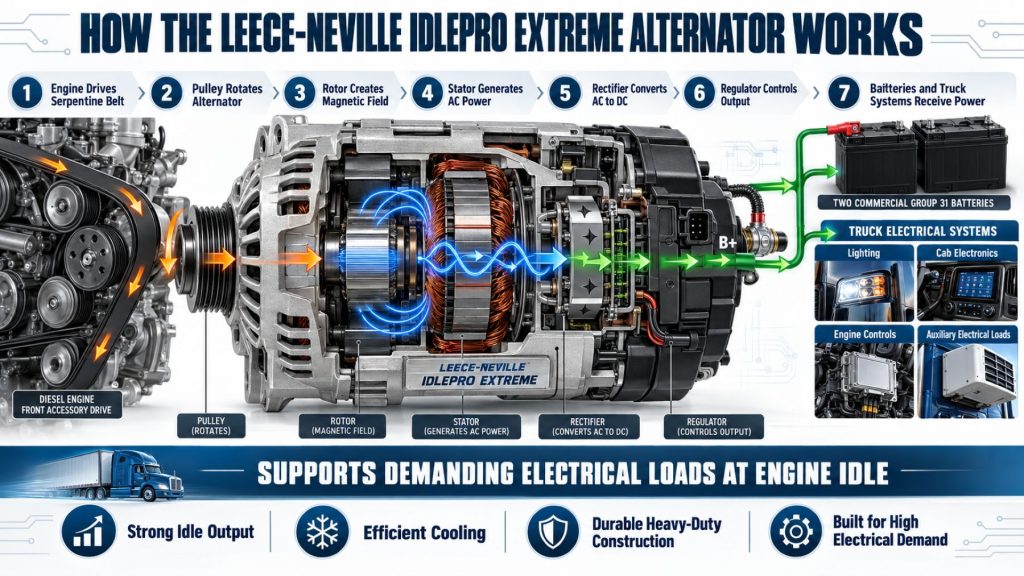
The engine drives the alternator through a belt and pulley system or another application-specific drive arrangement. Rotation creates a changing magnetic field inside the stator, producing alternating electrical current.
The rectifier converts that alternating current into direct current for the vehicle. The voltage regulator manages field strength and alternator output so the charging system can support electrical loads and replenish the batteries without exceeding the intended system voltage.
Position and Function Within the Vehicle
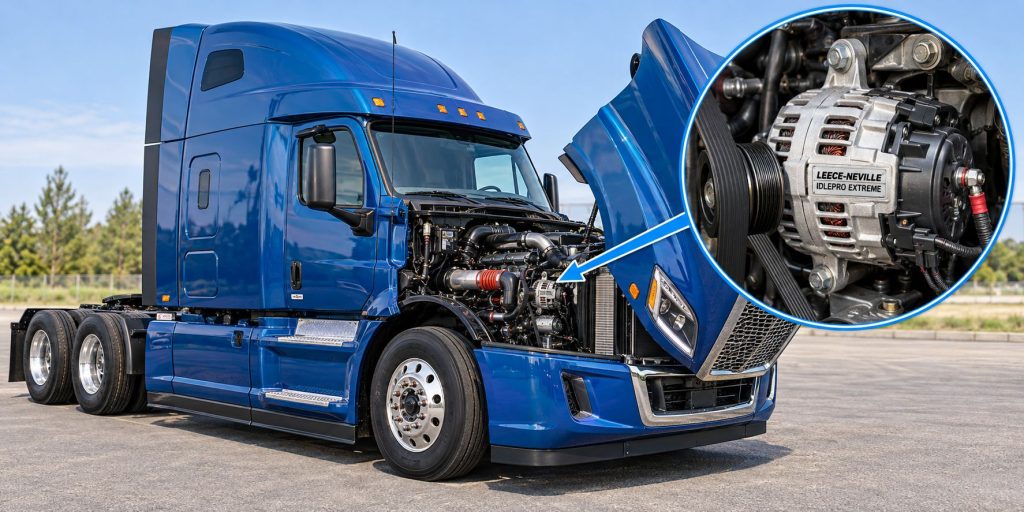
The alternator is normally mounted on the engine and driven by the accessory belt system. Its primary functions are to supply electrical power while the engine is running, maintain battery charge, and support vehicle systems that may include lighting, climate control, communications equipment, pumps, fans, control modules, and emergency accessories.
Common Specifications
- Product Type: Heavy-duty high-output alternator
- Electrical Architecture: Application-specific 12-volt or 24-volt system
- Output: Model-specific; published 24-volt configurations include 275-, 600-, and 680-amp applications
- Internal Design: Brushless on applicable configurations
- Mounting: J180 hinge, pad mount, or application-specific arrangement
- Rotation: Application-specific, with clockwise configurations available
- Grounding: Isolated Ground Technology on applicable models
- Voltage Regulation: Integrated electronic regulator
- Remote Voltage Sensing: Available on applicable models
- Cooling: Internal ventilation with enhanced cooling technology on selected models
- Operating Temperature: Model-specific; selected applications are designed for approximately -40°C to 125°C
- Terminal Configuration: Part-number-specific output, ground, sense, and indicator connections
Operating Capacity and Performance
IdlePro Extreme alternators are designed for applications that require substantial electrical output during both road operation and engine idling. Actual performance depends on alternator shaft speed, temperature, system voltage, battery condition, wiring resistance, and the electrical demand placed on the vehicle.
A documented 24-volt, 275-amp configuration is designed to provide a high percentage of rated output at engine idle. Specialized higher-output versions serve applications with much larger continuous electrical loads. These configurations should not be treated as interchangeable.
Installation Position and System Function
The alternator must occupy the mounting location specified by the engine, vehicle, or equipment manufacturer. Correct bracket geometry keeps the pulley aligned with the accessory drive and allows the belt-tensioning system to operate properly.
Within the electrical system, the alternator functions as the primary source of power whenever the engine is running. The batteries stabilize system voltage and supply power when alternator output is unavailable or temporarily below demand.
System Voltage and Electrical Architecture
IdlePro Extreme alternators must be matched to the vehicle’s nominal electrical system. A 12-volt alternator cannot replace a 24-volt unit, and a 24-volt alternator cannot be installed in a 12-volt system without a complete engineered conversion.
The alternator must also be compatible with the battery-bank arrangement, regulator strategy, electrical controls, isolation requirements, and any power-conversion equipment installed on the vehicle.
Electrical Input, Output, and Power Function
Mechanical power from the engine is the alternator’s input. Regulated direct-current electricity is its output. As electrical demand increases, the alternator places a greater mechanical load on the engine and accessory drive.
Output varies with alternator speed. A high-output-at-idle design is particularly useful on vehicles that operate emergency lighting, HVAC equipment, hydraulic controls, communications systems, or other accessories while stationary.
Voltage, Current, and Electrical Load Management
The regulator adjusts alternator operation to maintain the intended charging voltage as engine speed and electrical load change. Current demand is determined by the connected equipment and battery condition rather than being forced continuously at the alternator’s maximum rating.
Proper load management requires the vehicle’s continuous and intermittent electrical demands to remain within the charging system’s practical capacity, including operation at idle.
Charging and Energy-Supply Function
The IdlePro Extreme supplies power to active electrical systems and replaces energy removed from the batteries during starting or engine-off operation. Strong low-speed output can reduce battery discharge during extended idling, but the batteries must still be correctly sized and maintained.
Circuit Design and Power Distribution
The alternator output circuit connects to the batteries and vehicle power-distribution system through cables, terminals, protection devices, and grounding paths sized for the maximum expected current. High-output models require especially careful cable selection and terminal installation.
Voltage drop across undersized cables, loose connections, switches, or grounds can reduce charging performance and create excessive heat.
Internal Components and Electrical Design
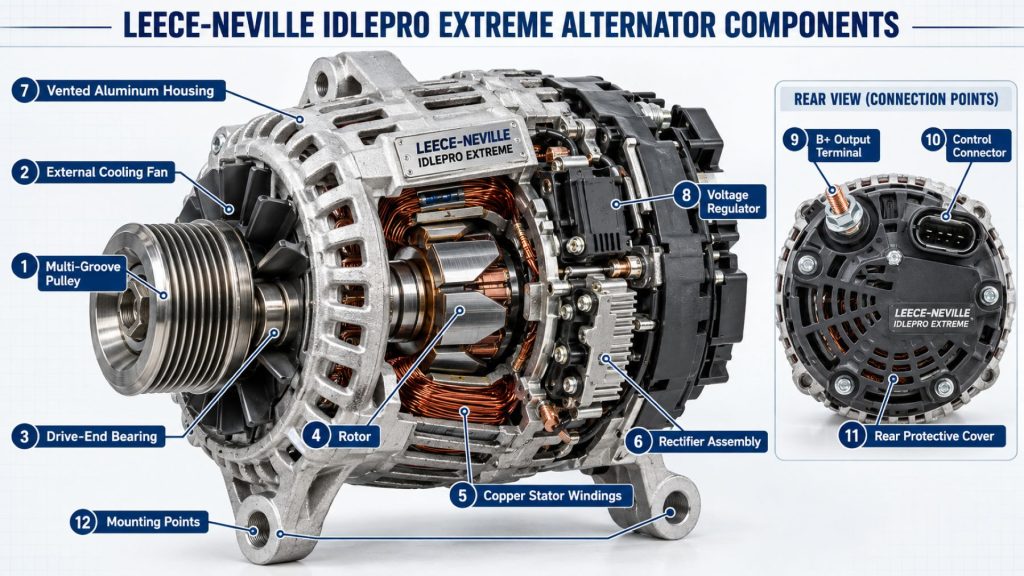
The internal stator, rotor, rectifier, regulator, diodes, bearings, and cooling components work together to produce and control electrical output. Brushless configurations eliminate conventional wear brushes while retaining the electrical control needed to energize the rotating magnetic field.
Materials and Component Construction
Construction may include a cast-metal housing, copper stator windings, steel shaft and rotor components, high-capacity semiconductor diodes, sealed bearings, insulated terminals, and corrosion-resistant exterior coatings. Exact materials and protection levels depend on the alternator model.
Wiring, Terminals, Connectors, and Grounding
Correct output and ground connections are essential on a high-amperage alternator. Applicable models may include dual cable terminals, isolated positive and negative connections, Remote Sense wiring, and lamp or monitoring terminals.
Terminals should be clean, correctly crimped, properly supported, protected against short circuits, and tightened to the specified torque. The alternator must not depend on an unintended mounting path when the model requires an isolated ground cable.
Circuit Protection and Electrical Safety
The output circuit should use protection appropriate for the vehicle architecture and alternator capacity. Cable routing must prevent contact with exhaust components, rotating parts, sharp edges, and locations where movement can fatigue conductors.
Protection devices must be selected according to the manufacturer’s requirements. Improperly sized protection can either fail to protect the circuit or interrupt normal high-current operation.
Controls, Monitoring, and Diagnostics
Depending on the application, alternator performance may be monitored through a charge indicator, voltmeter, ammeter, battery-management system, body controller, or diagnostic display. Lamp-driver and Remote Sense circuits may also support vehicle-specific monitoring and regulation.
Diagnostic testing should include system voltage, alternator output, voltage drop, belt condition, battery condition, cable temperature, and electrical-load measurements.
Electronic Controls and Driver-Assistance Integration
The alternator may supply numerous electronic systems but does not directly control them. These can include engine controllers, transmission controls, stability systems, steering assistance, collision-mitigation equipment, cameras, telematics, multiplexed body systems, and driver-assistance sensors.
Stable system voltage helps these systems operate correctly. Low voltage or excessive electrical noise can create warning messages, communication faults, or intermittent operation.
Power Demand, Capacity, and Energy Management
Alternator selection should begin with an electrical-load analysis covering both normal road operation and the most demanding idle condition. The analysis should account for continuous loads, intermittent loads, battery recovery, ambient temperature, and planned accessory additions.
An alternator’s maximum rating alone does not guarantee that it can support the complete vehicle at idle. The output curve at the expected pulley speed is equally important.
Power Consumption and System Efficiency
Generating electricity requires engine power and fuel. A high-efficiency alternator can reduce the mechanical power required to produce a given electrical output, particularly during sustained high-load operation.
Actual fuel and efficiency benefits depend on vehicle duty cycle, alternator loading, engine speed, temperature, wiring condition, and battery health.
Heat, Efficiency, and Electrical Loss Management
Heat is produced in the windings, diodes, regulator, bearings, connections, and cables. Selected IdlePro Extreme models use enhanced airflow and Auxiliary Draft Cooling to manage internal temperature.
Blocked airflow, oil contamination, excessive current demand, loose terminals, or high-resistance wiring can increase operating temperature and shorten component life.
Environmental Sealing and Contamination Protection
Heavy-duty alternators may be exposed to water, salt, dust, mud, oil, fuel residue, vibration, and temperature extremes. Applicable IdlePro Extreme models use protective coatings and application-specific construction to resist these conditions.
Protective construction does not make the alternator immune to direct pressure washing, chemical attack, sustained submersion, blocked ventilation, or damaged electrical seals.
Duty Cycle and Operating Conditions
The IdlePro Extreme is best suited to vehicles that regularly experience high electrical demand, long idle periods, extreme temperatures, severe vibration, contaminated environments, or limited opportunities for battery recovery.
Alternator capacity should be evaluated at the actual engine and alternator speeds encountered during the vehicle’s working cycle.
Mounting and Installation
Installation requires the correct mounting style, bracket spacing, pulley, belt arrangement, rotation, terminal orientation, wiring capacity, and clearance. Mounting surfaces and fasteners must support the alternator without distortion or movement.
The belt must be aligned and tensioned according to the engine and accessory-drive specifications. Incorrect alignment can damage belts, pulleys, bearings, brackets, and the alternator shaft.
Wiring, Grounding, and Installation Requirements
Output and ground cables must be sized for alternator capacity, circuit length, ambient temperature, insulation type, and acceptable voltage drop. Cable lugs should match the conductor size and terminal hardware.
Remote Sense, indicator, and control connections must follow the diagram for the exact part number. Improper wiring can cause incorrect charging voltage, warning-light problems, or alternator damage.
Vehicle and Electrical-System Compatibility
Compatibility depends on the vehicle’s nominal voltage, required amperage, mounting system, pulley ratio, belt capacity, rotation, regulator strategy, grounding design, terminal arrangement, operating environment, and available clearance.
A higher-output alternator should not be installed without confirming that the belts, brackets, cables, batteries, protection devices, and power-distribution system can safely support it.
Battery and Charging-System Compatibility
The alternator must be compatible with the number, type, capacity, and arrangement of the vehicle’s batteries. Flooded lead-acid, absorbed glass mat, and other battery technologies may have different charging requirements.
Weak, internally damaged, mismatched, or deeply discharged batteries can overload the charging system or create misleading alternator symptoms.
Related Component and System Compatibility
- Engine accessory-drive system
- Drive belts and automatic tensioners
- Battery banks
- Battery isolators and disconnect switches
- Output and ground cables
- Power-distribution modules
- Inverters and converters
- Auxiliary power systems
- Vehicle control modules
- Battery-monitoring equipment
- Emergency and vocational body systems
Common Applications
- Heavy-duty highway tractors
- Emergency vehicles
- Fire apparatus
- Ambulances
- Transit and motor coaches
- School buses
- Construction equipment
- Mining vehicles
- Utility trucks
- Refuse vehicles
- Military vehicles
- Specialized vocational equipment
- Vehicles with high idle-time electrical demand
Advantages
- Strong electrical output at low engine speeds
- Supports demanding accessory loads
- Can reduce battery discharge during extended idling
- Brushless designs reduce brush-related maintenance
- Isolated grounding can improve circuit control
- Remote Sense can compensate for charging-circuit voltage drop
- Enhanced cooling is available on selected models
- Heavy-duty construction supports severe operating conditions
- Multiple voltage and output configurations are available
- Can improve charging-system uptime when correctly specified
Limitations or Considerations
- Specifications vary considerably between part numbers
- Higher output may require upgraded wiring and circuit protection
- Accessory-drive capacity must be verified
- Physical mounting styles are not universally interchangeable
- Improper pulley selection can reduce output or overspeed the alternator
- High-current connections require careful installation
- Cooling airflow must remain unobstructed
- A larger alternator cannot correct failed batteries or damaged wiring
- Electronic connections must match the vehicle architecture
- Premium high-output models may cost more than standard replacements
Driver and Operator Experience
A correctly matched IdlePro Extreme alternator can help maintain more consistent voltage when the vehicle is idling with multiple accessories operating. Drivers may notice fewer low-voltage warnings, stronger lighting performance, and improved battery recovery.
The operator should still respond to charge warnings, dimming lights, slow cranking, electrical odors, belt noise, or repeated battery failures. These symptoms can indicate a wider charging-system problem.
Controls, Indicators, and Driver Feedback
Driver information may be provided through a charging-system warning lamp, dashboard voltmeter, battery display, audible warning, diagnostic message, or vehicle-management system. Normal indicated voltage varies according to system design, temperature, battery condition, and charging strategy.
Common Electrical Tests and Diagnostic Information
- Resting battery-voltage test
- Battery conductance or load test
- Charging-voltage test
- Alternator current-output test
- Positive-circuit voltage-drop test
- Ground-circuit voltage-drop test
- AC-ripple test
- Parasitic-current test
- Belt-tension and pulley-speed inspection
- Terminal-temperature inspection
- Remote Sense circuit test
- Warning-lamp and monitoring-circuit test
Inspection and Wear Points
- Drive belt
- Pulley grooves
- Belt tensioner
- Mounting brackets
- Mounting fasteners
- Front and rear bearings
- Output terminal
- Ground terminal
- Cable insulation
- Crimped cable lugs
- Remote Sense connection
- Cooling openings
- Housing and protective coating
- Nearby wiring supports and clamps
Cooling, Ventilation, and Environmental Requirements
The alternator requires adequate airflow around its intake and discharge openings. Debris, oil, mud, aftermarket covers, or tightly packed accessories can restrict cooling and raise internal temperature.
The installation should also limit direct exposure to exhaust heat, hydraulic leaks, fuel contamination, and high-pressure washing whenever possible.
Component Service Life and Rebuildability
Service life depends on electrical loading, operating temperature, belt condition, bearing loads, vibration, contamination, wiring resistance, and maintenance. Some alternators may be professionally rebuilt, while other applications favor complete replacement or a manufacturer-supported remanufactured unit.
A rebuild should preserve the original voltage, output, regulator, grounding, mounting, cooling, and terminal specifications.
Maintenance and Ownership Notes
Inspect the belt drive, terminals, cables, brackets, batteries, and ventilation openings during scheduled service. Charging-system tests should be performed before condemning the alternator because battery, cable, belt, and ground faults can produce similar symptoms.
Electrical accessories added later in the vehicle’s life should be included in a new load analysis. A charging system that was adequate when the vehicle was built may become undersized after substantial equipment is installed.
Common Electrical-System Problems
- Low charging voltage: Loose belts, low alternator speed, excessive voltage drop, regulator faults, damaged diodes, poor grounding, or excessive electrical demand may be responsible.
- Overcharging: Incorrect sensing voltage, Remote Sense wiring faults, regulator failure, poor battery connections, or incompatible system components may raise charging voltage.
- Low output at idle: An incorrect pulley ratio, slipping belt, excessive load, high temperature, wiring resistance, or incorrect alternator selection may reduce available output.
- Repeated battery failure: Undercharging, overcharging, excessive engine-off loads, mismatched batteries, loose connections, or damaged batteries may be responsible.
- Overheated terminals: Loose hardware, corrosion, undersized cables, damaged lugs, or excessive current can create resistance and heat.
- Belt noise or failure: Pulley misalignment, improper tension, worn grooves, bearing problems, or excessive accessory-drive load may damage the belt.
- Electrical noise or warning faults: Diode problems, poor grounding, damaged wiring, unstable voltage, or incompatible controls can affect vehicle electronics.
- Alternator overheating: Blocked airflow, sustained overload, high-resistance connections, contamination, or inadequate cooling can raise internal temperature.
Safety and Service Precautions
Disconnect electrical power according to the vehicle manufacturer’s procedure before removing cables or servicing the alternator. High-output charging circuits can produce severe arcing, heat, component damage, fire, or personal injury if shorted.
Never disconnect a battery cable to test alternator operation. Use correctly rated meters, current clamps, protective equipment, and approved diagnostic procedures. Keep tools, clothing, and hands away from belts, fans, and rotating pulleys.
Identification Information
Identification information is normally printed or stamped on the alternator label or housing. Record the complete Leece-Neville part number before ordering a replacement.
- Manufacturer and brand
- Complete part number
- Serial or production code
- Nominal voltage
- Rated amperage
- Mounting style
- Pulley type and diameter
- Rotation
- Grounding configuration
- Terminal locations
- Remote Sense provision
- Vehicle make, model, year, and engine
Buying Considerations
- Confirm the complete original part number
- Match nominal system voltage
- Verify required output at road speed and idle
- Confirm brushless or other internal design requirements
- Match the mounting configuration
- Verify pulley type, diameter, and alignment
- Confirm rotation and operating-speed limits
- Match isolated or case-ground architecture
- Verify terminal positions and cable capacity
- Confirm Remote Sense and indicator compatibility
- Review operating-temperature and environmental requirements
- Check warranty terms for the selected part number
- Determine whether wiring or belt-drive upgrades are required
Variants and Configurations
- 12-volt configurations
- 24-volt configurations
- Different maximum-amperage ratings
- Brushless application-specific designs
- J180 hinge mounting
- Pad mounting
- Different pulley arrangements
- Different terminal orientations
- Isolated-ground configurations
- Remote Sense-equipped configurations
- Application-specific lamp-driver arrangements
- Enhanced-cooling configurations
- On-highway and specialized-equipment versions
Comparison to Similar Equipment
Compared with the Leece-Neville IdlePro Alternator, the IdlePro Extreme family is aimed at especially demanding electrical-load and operating environments. The exact difference depends on the two part numbers being compared.
Compared with the Delco Remy 40SI Heavy-Duty Brushless Alternator, both product families can provide brushless construction and high-output performance. Mounting, output curves, terminals, controls, and application approvals differ.
Compared with the Delco Remy 36SI High-Output Alternator, the best choice depends on the required voltage, idle output, maximum output, engine installation, wiring, and original equipment specification.
Best Fit For
- Vehicles with high electrical loads at idle
- Emergency and rescue vehicles
- Buses with substantial HVAC and accessory demand
- Vocational trucks with electrical body equipment
- Mining and construction equipment
- Vehicles requiring a heavy-duty brushless alternator
- Applications requiring isolated grounding
- Fleets experiencing battery discharge during extended idling
- Equipment operating in demanding temperatures and environments
- Vehicles originally specified with a compatible IdlePro Extreme model
Related Vehicle and Trailer Types
- Highway tractors
- Emergency vehicles
- Fire apparatus
- Ambulances
- Transit buses
- Motor coaches
- School buses
- Utility trucks
- Refuse trucks
- Construction vehicles
- Mining equipment
- Specialized vocational vehicles
Related Truck and Trailer Models
- Freightliner Cascadia
- Freightliner 114SD
- Kenworth T680
- Kenworth T880
- Peterbilt 579
- Peterbilt 567
- International LT Series
- International HX Series
- Volvo VNL
- Volvo VHD
- Mack Anthem
- Mack Granite
Related Electrical System Types
- Alternators & Charging Systems
- Commercial Truck Batteries & Energy Storage
- Starters & Starting Systems
- Wiring, Connectors & Power Distribution
- Truck & Trailer Lighting Systems
- Inverters, Converters & Auxiliary Electrical Power
Related Electrical Products
- Leece-Neville IdlePro Alternator
- Delco Remy 40SI Heavy-Duty Brushless Alternator
- Delco Remy 36SI High-Output Alternator
- Delco Remy 28SI High-Output Alternator
- Delco Remy 24SI Heavy-Duty Alternator
- Delco Remy 39MT Heavy-Duty Gear-Reduction Starter
- Delco Remy 38MT Heavy-Duty Starter
- Prestolite PowerPro Starter
- Deka Intimidator AGM Group 31 Battery
Related Equipment Systems
- Electrical Systems
- Engines
- Transmissions
- PTO & Hydraulic Systems
- Drivelines & Steering Systems
- Brake Systems
- Safety Systems
- Telematics & ELD Systems
Related Guides
- Electrical System Guides
- How Commercial Truck Electrical Systems Work
- Commercial Truck Alternators & Charging Systems Explained
- Commercial Truck Batteries Explained
- Commercial Truck Starters & Starting Systems Explained
- How to Inspect and Maintain Truck Wiring and Electrical Connections
- Commercial Truck & Trailer Lighting Systems Explained
Regulatory and Compliance Notes
Charging-system modifications must preserve compliance with applicable vehicle electrical, emissions, safety, electromagnetic-compatibility, and body-builder requirements. Emergency vehicles, buses, accessible vehicles, and specialized equipment may have additional electrical reserve-capacity or system-performance standards.
Replacement equipment should meet the vehicle manufacturer’s voltage, mounting, output, grounding, and control requirements. Changes to the charging system should be documented when they affect completed-vehicle certification or critical equipment operation.
Real World Operating Notes
High idle output is most valuable when the vehicle operates substantial electrical accessories while stationary. Alternator shaft speed, not engine speed alone, determines available output, so pulley ratio is an important part of system design.
A high-output alternator will not solve every low-voltage complaint. Battery condition, cable resistance, ground integrity, accessory-drive performance, and parasitic loads should be tested before replacement.
When electrical equipment is added to a vehicle, the charging system should be evaluated under the worst expected combination of idle speed, ambient temperature, lighting, HVAC operation, and body-equipment demand.
Frequently Asked Questions
What is the Leece-Neville IdlePro Extreme?
It is a family of heavy-duty, high-output alternators designed to provide strong charging performance, including substantial output at low engine speeds.
Is the IdlePro Extreme a brushless alternator?
Applicable IdlePro Extreme models use brushless construction. The exact internal design should be confirmed using the complete part number.
Is it available for 12-volt and 24-volt vehicles?
The family includes application-specific electrical configurations. Voltage must be verified from the individual alternator specification before purchase or installation.
Why is low-speed output important?
Vehicles such as fire apparatus, ambulances, buses, and vocational trucks may operate large electrical loads while the engine is idling. Strong low-speed output helps support those loads and maintain battery charge.
What is Isolated Ground Technology?
An isolated-ground alternator uses a dedicated negative terminal and cable rather than relying only on the alternator housing and engine structure as the electrical return path.
What does Remote Sense do?
Remote Sense allows the regulator to monitor voltage at a selected point in the vehicle’s electrical system. It can compensate for normal voltage drop between the alternator and that sensing location when installed correctly.
Can a higher-amperage IdlePro Extreme replace any alternator?
No. Voltage, mounting, pulley, rotation, wiring, grounding, terminal layout, control circuits, belt capacity, and vehicle compatibility must all be confirmed.
Why does the vehicle still show low voltage with a high-output alternator?
Possible causes include low alternator speed, excessive electrical demand, damaged batteries, slipping belts, poor grounds, cable voltage drop, overheated connections, or an alternator fault.
How should the correct replacement be identified?
Use the complete Leece-Neville part number, nominal voltage, amperage rating, mounting style, pulley, rotation, grounding design, terminals, and vehicle application.
Does installing this alternator eliminate the need for battery maintenance?
No. Battery condition, cable integrity, connection cleanliness, state of charge, and capacity remain essential to reliable electrical-system operation.
Availability and Where to Find
Leece-Neville IdlePro Extreme alternators may be available through Prestolite Electric distributors, heavy-duty electrical specialists, commercial-truck dealers, emergency-vehicle service facilities, fleet-parts suppliers, and authorized rebuilders.
Availability depends on system voltage, amperage, mounting, pulley, terminal arrangement, grounding design, and vehicle application. Buyers should confirm the complete part number and current supersession information before ordering.
Current product information, application assistance, distributor resources, and technical support are available through the Prestolite Electric website.
Support Trucking Families
Truck Equipment Atlas supports the mission of Grey Cross, a nonprofit dedicated to helping families of truck drivers who lose their lives while on the road. As the site grows, part of its mission is to bring awareness and support to these families.
Podcast or Video Section
Learn More Through Audio and Video
Truck Equipment Atlas will continue expanding with podcast episodes, interviews, and equipment breakdowns to help drivers and fleets better understand trucks and equipment.
Follow the Growth of Truck Equipment Atlas
Truck Equipment Atlas continues to expand with new truck profiles, trailer coverage, diesel engine pages, equipment system resources, manufacturer information, and educational guides.
Visit our Site Updates page to explore recent additions, project milestones, and upcoming resources as we continue building one of the industry’s growing commercial trucking equipment reference libraries.
View the Latest Site Updates: Truck Equipment Atlas Site Updates