
Quick Facts
- Manufacturer: Prestolite Electric
- Brand: Leece-Neville Heavy Duty Systems
- Product Family: IdlePro
- Product Type: High-efficiency, high-output commercial alternator family
- Electrical Systems: Application-specific 12-volt and 24-volt configurations
- Published 24-Volt Outputs: 120 or 180 amps for applicable models
- Low-Speed Performance: Designed to provide substantial output at low engine speeds
- Grounding: Isolated Ground technology
- Remote Sense: Available on applicable models
- Mounting Options: J180, swing, lug, pad, spool, and other application-specific configurations
- Primary Applications: Commercial trucks, buses, motor coaches, construction equipment, agricultural equipment, industrial vehicles, and specialty applications
- Production Status: Availability and specifications vary by individual part number
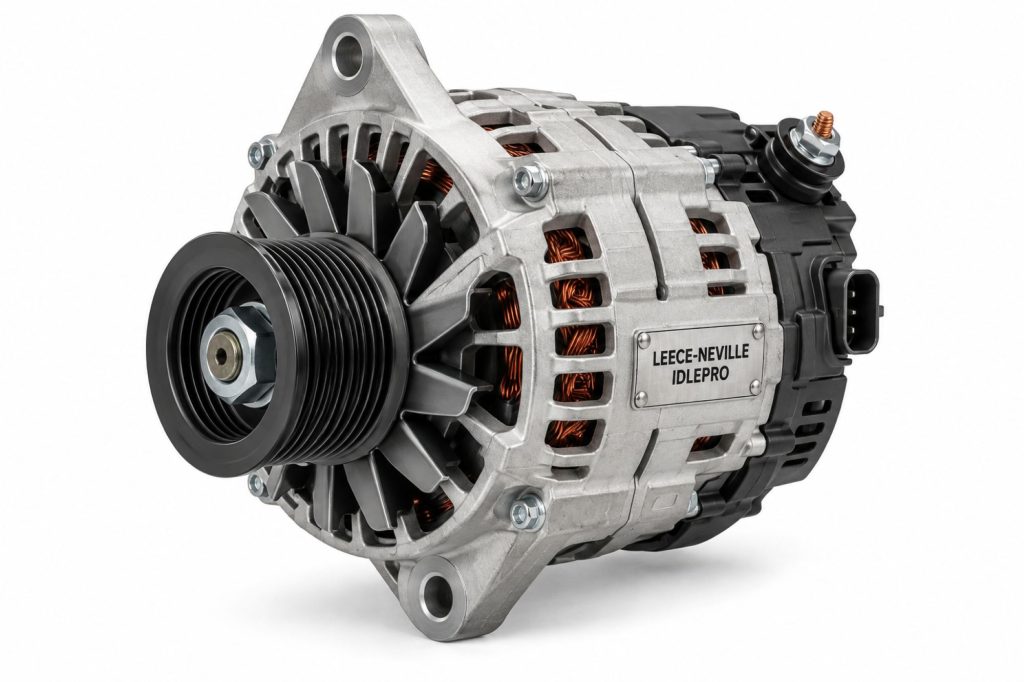
Overview
The Leece-Neville IdlePro is a family of high-efficiency, high-output alternators manufactured by Prestolite Electric for commercial vehicles and heavy equipment. The family is designed to deliver substantial charging output at low engine speeds, helping vehicles support electrical demand during idling and low-speed operation.
IdlePro alternators are used in applications where lighting, climate control, communication equipment, body systems, electronic controls, and other accessories can place significant demands on the charging system. Application-specific configurations are available with different voltages, output ratings, mounting systems, pulleys, regulators, and terminal arrangements.
IdlePro models feature Isolated Ground technology, while applicable configurations may include Remote Sense and load-sharing capabilities. Buyers should use the complete Leece-Neville part number when verifying specifications or ordering a replacement.
Key Characteristics
- High-efficiency commercial alternator family
- Designed for strong output at low engine speeds
- Application-specific 12-volt and 24-volt configurations
- Isolated Ground technology
- Remote Sense capability on applicable models
- Dual internal fans on specified configurations
- Heavy-duty bearings for high belt loads
- Intelligent multifunction regulators on applicable models
- Load-sharing capability on specified multiple-alternator systems
- Corrosion-resistant coated housing on applicable models
- Multiple commercial mounting configurations
- Designed for demanding truck, bus, and equipment applications
Major Components
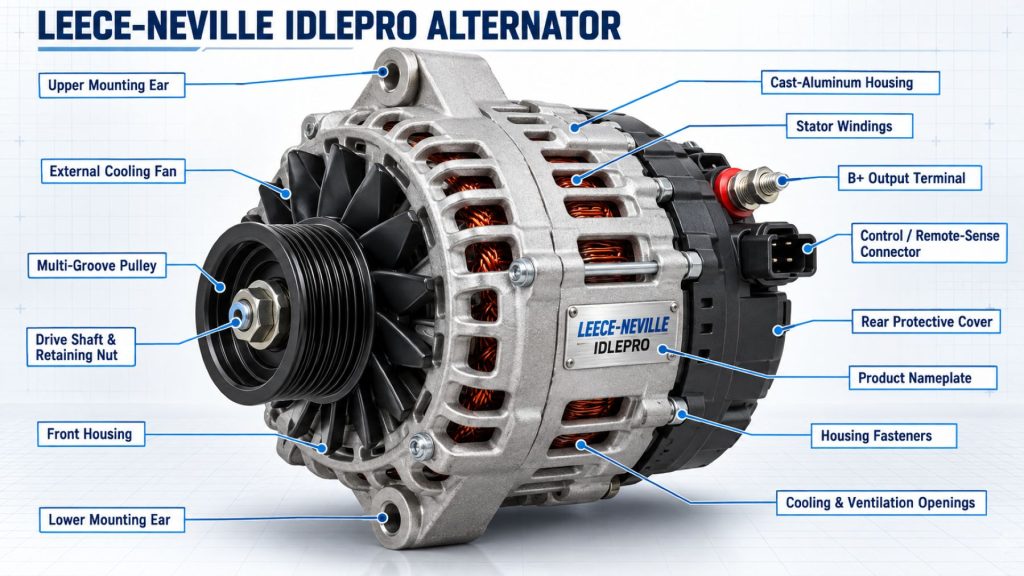
- Rotor assembly
- Stator assembly
- Voltage regulator
- Rectifier assembly
- Front and rear bearings
- Drive-end housing
- Rear housing
- Internal cooling fans
- Output terminal
- Isolated ground terminal
- Remote Sense connection where equipped
- Indicator and control connections
- Application-specific pulley
- Mounting ears or mounting pads
- Internal electrical conductors
- Protective coatings and insulating components
Product Type and Construction
IdlePro alternators use application-specific heavy-duty architectures designed to balance electrical output, cooling, durability, and installation requirements. Construction details can differ between individual models within the family.
Specified configurations use dual internal fans, heavy-duty bearings, corrosion-resistant housings, intelligent regulators, and isolated electrical grounds. The alternator’s exact internal design must be confirmed using its complete part number.
How the Electrical Component or System Works
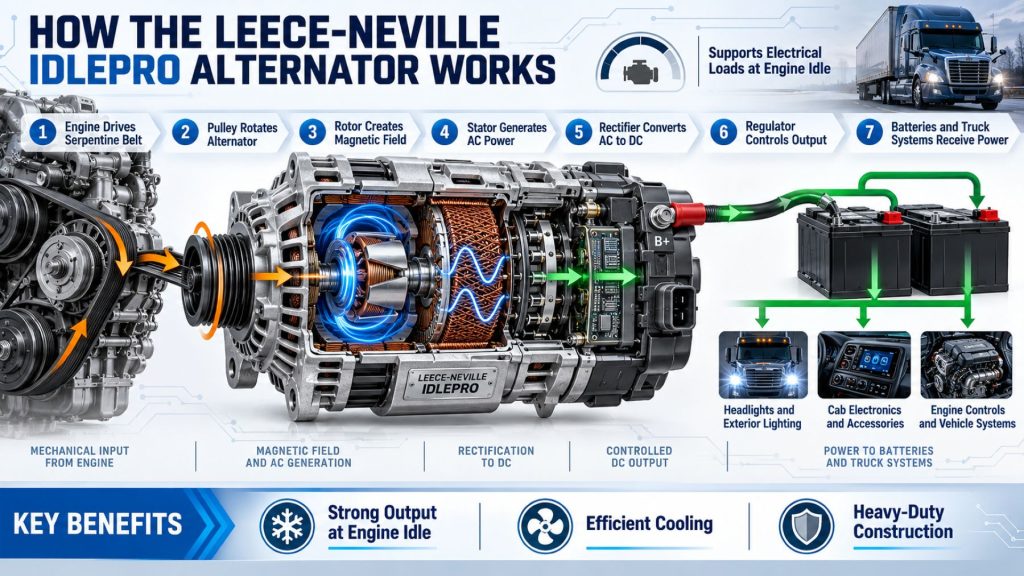
The engine drives the alternator through an accessory belt and pulley. The rotating magnetic field induces alternating current in the stator windings.
The rectifier converts the generated alternating current into direct current for the batteries and vehicle electrical system. The voltage regulator changes field excitation to maintain the required system voltage as engine speed and electrical demand change.
Applicable Remote Sense configurations monitor voltage at a remote point in the electrical system and compensate for voltage losses between the alternator and the principal load or battery connection.
Position and Function Within the Vehicle
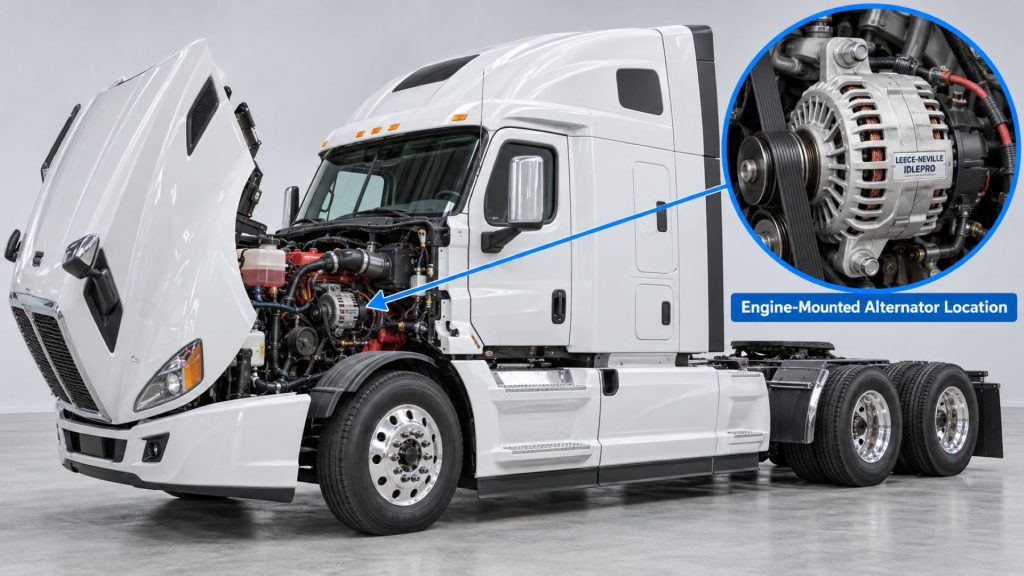
The IdlePro alternator mounts to the engine and is driven by the accessory-drive system. Its output and ground cables connect it to the batteries and vehicle power-distribution network.
The alternator powers active electrical equipment and restores energy removed from the batteries during starting and engine-off operation. Strong low-speed output is particularly useful in vehicles that idle while operating lighting, HVAC, communication equipment, or vocational systems.
Common Specifications
- Product Family: Leece-Neville IdlePro
- System Voltage: Application-specific 12-volt or 24-volt configurations
- Published 24-Volt Ratings: 120 or 180 amps for specified models
- Low-Speed Output: Specified 24-volt models provide at least 70 percent of rated maximum output at engine idle speed
- Operating Temperature Range: Approximately -40°C to 125°C for specified models
- Mounting: J180, swing, lug, pad, spool, or application-specific mounting
- Grounding: Isolated Ground technology
- Voltage Regulation: Application-specific intelligent multifunction regulator
- Remote Sense: Available on applicable models
- Cooling: Dual internal fans on specified configurations
- Multiple-Alternator Operation: Load-sharing capability on applicable models
Exact voltage, amperage, rotation, mounting, pulley, terminal arrangement, regulator, dimensions, weight, and operating limits depend on the complete Leece-Neville part number.
Operating Capacity and Performance
IdlePro alternators are designed to maintain useful charging output when the engine is idling or operating at low speed. Published 24-volt 120- and 180-amp configurations provide at least 70 percent of their rated maximum output at engine idle speed under specified conditions.
Actual output depends on alternator speed, temperature, battery condition, regulator strategy, wiring resistance, and electrical demand. Maximum rated output is not available at every engine speed.
Installation Position and System Function
The alternator must be positioned so its mounting system, pulley alignment, belt wrap, belt tension, terminal orientation, cooling airflow, and surrounding clearance match the engine installation.
A replacement IdlePro must provide the required voltage and output while matching the original mounting, rotation, pulley, wiring, grounding, regulator, and control functions.
System Voltage and Electrical Architecture
IdlePro alternators are offered in application-specific voltage and output configurations. The selected alternator must match the vehicle’s batteries, starter, electronic controls, lighting, accessories, and power-distribution system.
A 12-volt alternator cannot be substituted for a 24-volt unit or the reverse. The regulator and electrical connections must also match the vehicle architecture.
Electrical Input, Output, and Power Function
Mechanical power reaches the alternator through its pulley and shaft. The alternator converts that input into regulated direct-current electrical output.
The generated current supports vehicle accessories and recharges the batteries. Increased electrical production places a greater mechanical load on the engine and accessory drive.
Voltage, Current, and Electrical Load Management
The regulator adjusts alternator output to maintain system voltage as battery condition, electrical load, engine speed, and temperature change. Applicable load-sharing regulators can coordinate current production in approved multiple-alternator installations.
Remote Sense can help compensate for charging-circuit voltage drop when it is correctly connected at the specified electrical point.
Charging and Energy-Supply Function
The IdlePro supplies electricity while the engine is running and replenishes energy removed from the battery bank. Strong low-speed performance helps reduce battery discharge during extended idling.
Alternator capacity should be evaluated against continuous and intermittent loads, including lighting, HVAC, heaters, lifts, communication systems, passenger equipment, body electronics, and auxiliary controls.
Circuit Design and Power Distribution
The charging circuit includes the alternator output and ground terminals, cables, batteries, circuit protection, disconnect switches, distribution points, sensing circuits, and monitoring equipment.
Charging and ground cables must be sized for the alternator’s output and circuit length. Loose, damaged, corroded, or undersized connections create resistance and reduce the power delivered to the vehicle.
Internal Components and Electrical Design
The rotor creates a rotating magnetic field, while the stator develops alternating current. The rectifier converts that current into direct current, and the voltage regulator controls field excitation.
Internal design details vary across the IdlePro family. Brushes, slip rings, field systems, regulators, rectifiers, fans, bearings, and connection arrangements should be identified through the specific model and part number.
Materials and Component Construction
IdlePro alternators incorporate cast housings, copper windings, steel rotating components, bearings, semiconductor rectifiers, regulating electronics, insulating materials, and plated electrical terminals.
Specified models use corrosion-resistant housing coatings and heavy-duty bearings intended for high belt loads and demanding operating environments.
Wiring, Terminals, Connectors, and Grounding
Output, ground, sensing, indicator, and control connections must match the selected alternator and vehicle wiring diagram. Isolated Ground models use a dedicated ground terminal rather than depending solely on the housing and engine mounting.
Connections should be clean, correctly tightened, and protected from corrosion, heat, movement, and accidental grounding.
Circuit Protection and Electrical Safety
The charging circuit must use approved cable routing and appropriately rated protection where required. Cables should remain clear of exhaust components, sharp edges, rotating parts, and locations where vibration can damage insulation.
Incorrect polarity, accidental grounding, or disconnecting energized high-current cables can cause dangerous arcing and damage the alternator, batteries, wiring, or electronic equipment.
Controls, Monitoring, and Diagnostics
Charging-system operation may be monitored through a warning lamp, dashboard voltmeter, battery monitor, body controller, engine controller, telematics system, or diagnostic software.
Diagnosis should include battery condition, alternator voltage and current, low-speed output, cable voltage drop, ground-circuit resistance, belt condition, pulley ratio, terminal integrity, and vehicle electrical demand.
Electronic Controls and Driver-Assistance Integration
The IdlePro supplies electricity used by engine and transmission controllers, ABS, stability systems, cameras, telematics, passenger systems, and other electronic equipment.
Insufficient or unstable system voltage can produce warning messages and diagnostic faults in systems that are otherwise operating normally.
Power Demand, Capacity, and Energy Management
Alternator selection should begin with an electrical-load analysis covering continuous loads, intermittent loads, low-idle operation, seasonal accessories, body equipment, passenger systems, and future additions.
The selected IdlePro model should provide enough low-speed output to support critical loads while preserving adequate capacity for battery charging.
Power Consumption and System Efficiency
Producing electrical power requires mechanical energy from the engine. Higher alternator efficiency reduces the engine power required to supply a given electrical load.
Actual efficiency depends on the specific IdlePro model, alternator speed, temperature, electrical demand, belt condition, and charging-circuit resistance.
Heat, Efficiency, and Electrical Loss Management
Heat is produced by winding resistance, rectifier losses, bearing friction, electrical connections, and other conversion losses. Internal fans move cooling air across the alternator’s internal components.
Blocked airflow, high current demand, weak batteries, slipping belts, damaged rectifiers, or high-resistance connections can increase operating temperature.
Environmental Sealing and Contamination Protection
Specified IdlePro housings use corrosion-resistant coatings to help withstand demanding commercial environments. Ventilation openings remain necessary for cooling and should not be blocked.
Direct pressure washing, oil leaks, coolant, fuel, road chemicals, and accumulated dirt can damage bearings, insulation, terminals, regulators, and internal electrical components.
Duty Cycle and Operating Conditions
IdlePro alternators are intended for demanding commercial duty, including vehicles that spend extended periods operating at idle or low engine speed.
Service life still depends on electrical loading, alternator speed, ambient temperature, vibration, contamination, belt loads, battery condition, and maintenance.
Mounting and Installation
Installation requires the correct mounting system, pulley alignment, belt configuration, rotation, terminal orientation, cable capacity, dedicated ground connection, control wiring, and surrounding clearance.
Mounting hardware and belt tension should follow the engine, vehicle, and Prestolite instructions for the identified IdlePro part number.
Wiring, Grounding, and Installation Requirements
- Disconnect battery power before installation
- Verify system voltage and polarity
- Match the required mounting configuration
- Match pulley diameter and belt grooves
- Use output and ground cables sized for the alternator
- Connect the dedicated ground terminal where specified
- Connect Remote Sense according to the approved diagram
- Verify control and indicator wiring
- Protect cables from heat and abrasion
- Align the pulley with the accessory drive
- Set belt tension to the specified value
- Test charging performance and voltage drop after installation
Vehicle and Electrical-System Compatibility
Compatibility depends on voltage, required amperage, engine mounting, pulley dimensions, belt type, rotation, terminal arrangement, regulator function, grounding, sensing circuits, and available installation space.
The vehicle VIN, engine model, and original alternator part number should be used when selecting a replacement. The IdlePro name alone does not identify one interchangeable alternator.
Battery and Charging-System Compatibility
The alternator must match the battery-bank voltage, capacity, chemistry, wiring, disconnect switches, isolators, and charging controls.
Weak or internally damaged batteries can force the alternator to operate at high output for extended periods. Batteries and charging cables should be tested before replacing an alternator.
Related Component and System Compatibility
The IdlePro must work with the engine accessory drive, belts, tensioner, batteries, starter, disconnect system, electrical distribution network, monitoring circuits, and auxiliary equipment.
Multiple-alternator installations require compatible regulators, wiring, drive systems, and approved load-sharing arrangements.
Common Applications
- Heavy-duty highway trucks
- Regional-haul trucks
- Vocational trucks
- Transit buses
- School buses
- Motor coaches
- Construction equipment
- Agricultural machinery
- Industrial vehicles
- Utility trucks
- Emergency-support vehicles
- Vehicles with extended idle operation
- Vehicles with substantial low-speed electrical demand
- Multiple-alternator installations where approved
Advantages
- Strong electrical output at low engine speeds
- Application-specific 12-volt and 24-volt options
- Isolated Ground technology
- Remote Sense availability
- Heavy-duty cooling and bearing designs
- Corrosion-resistant coatings on applicable models
- Multiple mounting configurations
- Load-sharing capability on specified models
- Can help maintain battery state of charge during idling
- Designed for demanding commercial applications
- Qualifying models receive extended warranty coverage
Limitations or Considerations
- IdlePro is a product family rather than one universal model
- Specifications vary substantially by part number
- Rated output is not available at every engine speed
- Mounting configurations are not universally interchangeable
- Requires correct output and isolated-ground cable sizing
- Remote Sense wiring must follow the approved diagram
- High electrical demand can increase operating temperature
- Weak batteries can overload the alternator
- Incorrect pulley selection can reduce idle output or cause overspeed
- Multiple-alternator systems require compatible controls
- Exact compatibility requires full vehicle and alternator identification
Driver and Operator Experience
A correctly selected IdlePro alternator should help maintain more stable electrical-system voltage during idling and low-speed operation. This can support consistent lighting, HVAC, electronic controls, and accessory performance.
Charging problems may appear as dim lights, low-voltage warnings, slow starting, battery discharge, accessory shutdown, or repeated electronic-system faults.
Controls, Indicators, and Driver Feedback
- Charging-system warning lamp
- Dashboard voltmeter
- Low-voltage warning message
- Battery-monitoring display
- Engine or body-controller diagnostic codes
- Telematics voltage reports
- Accessory load-shedding warnings
- Multiple-alternator status indicators where equipped
Common Electrical Tests and Diagnostic Information
- Battery state-of-charge test
- Battery load or conductance test
- Charging-voltage measurement
- Alternator current-output test
- Idle-output test under representative load
- Positive-cable voltage-drop test
- Isolated-ground voltage-drop test
- Remote Sense circuit test
- AC-ripple test
- Belt and tensioner inspection
- Pulley and bearing inspection
- Regulator and load-sharing diagnostic test
Inspection and Wear Points
- Drive belt
- Belt tensioner
- Alternator pulley
- Mounting brackets and fasteners
- Output terminal and cable
- Isolated-ground terminal and cable
- Remote Sense connection
- Control and indicator wiring
- Housing ventilation openings
- Front and rear bearings
- Internal wear components appropriate to the model
- Wiring insulation
- Evidence of overheating
- Oil, coolant, fuel, or road contamination
Cooling, Ventilation, and Environmental Requirements
Cooling openings must remain unobstructed so the internal fans can move air across the electrical components. Accumulated dirt and oil can restrict airflow and retain heat.
Direct pressure washing should be avoided. Oil, fuel, and coolant leaks near the alternator should be corrected before they damage the bearings, wiring, regulator, or insulation.
Component Service Life and Rebuildability
Service life varies with electrical loading, alternator speed, belt loads, temperature, vibration, contamination, battery condition, and maintenance.
Depending on the model and parts availability, an IdlePro alternator may be professionally repaired, rebuilt, replaced with a remanufactured unit, or replaced with a new assembly.
Maintenance and Ownership Notes
- Maintain the batteries in good condition
- Inspect belts and tensioners regularly
- Check mounting brackets and fasteners
- Keep output and ground terminals clean and tight
- Inspect cables for heat damage and corrosion
- Test voltage drop when charging performance declines
- Inspect Remote Sense wiring where equipped
- Keep cooling openings clear
- Correct nearby fluid leaks
- Investigate repeated low-voltage warnings
- Test the batteries before replacing the alternator
- Verify charging performance after installation
- Order replacements using the complete part number
Common Electrical-System Problems
- Low charging voltage: A loose belt, weak battery, damaged cable, poor ground, regulator problem, or internal alternator fault can reduce voltage.
- Insufficient output at idle: Excessive electrical demand, an incorrect pulley ratio, low alternator speed, belt slippage, high resistance, or alternator damage may reduce low-speed output.
- No charging output: An open circuit, broken belt, regulator failure, damaged rotor or stator, or rectifier failure may prevent charging.
- Overcharging: Incorrect sensing, damaged Remote Sense wiring, poor connections, or regulator failure can produce excessive voltage.
- Repeated battery discharge: Alternator undersizing, excessive idle loads, weak batteries, parasitic draw, or circuit resistance may leave the batteries undercharged.
- Belt noise: Misalignment, incorrect tension, worn belts, damaged pulleys, or bearing resistance can cause squealing or chirping.
- Overheating: Excessive demand, weak batteries, blocked airflow, damaged rectifiers, slipping belts, or poor connections can increase heat.
- Electrical noise or false codes: Grounding problems, damaged rectifiers, wiring faults, or incorrect installation can interfere with vehicle electronics.
Safety and Service Precautions
Battery power should be disconnected according to the vehicle manufacturer’s procedure before alternator wiring is removed. High-current charging circuits can cause severe arcing, burns, component damage, or fire.
Tools, clothing, and hands must remain clear of moving belts, pulleys, fans, and engine components. Running tests require suitable instruments and safe service procedures.
Never disconnect a battery cable while the engine is running to test alternator operation. The resulting voltage surge can damage vehicle electronics.
Identification Information
Record the information on the alternator identification label before ordering a replacement:
- Leece-Neville model family
- Complete part number
- Serial or manufacturing information
- System voltage
- Rated amperage
- Mounting configuration
- Rotation
- Pulley type and diameter
- Belt-groove arrangement
- Output and ground-terminal locations
- Remote Sense configuration
- Regulator and load-sharing configuration
- Vehicle manufacturer and model
- Engine manufacturer and model
- Vehicle identification number
Buying Considerations
- Confirm the system voltage
- Calculate continuous and peak electrical demand
- Determine the required output at idle
- Match the required amperage rating
- Verify the mounting configuration
- Match pulley diameter and belt grooves
- Confirm rotation and terminal orientation
- Verify Isolated Ground cable requirements
- Confirm Remote Sense requirements
- Check regulator and load-sharing compatibility
- Verify engine-compartment clearance
- Inspect the batteries and charging cables
- Compare new and remanufactured options
- Use the original part number and vehicle VIN
Variants and Configurations
- Application-specific 12-volt alternators
- 24-volt 120-amp configurations
- 24-volt 180-amp configurations
- J180 mounting
- Swing mounting
- Lug mounting
- Pad mounting
- Spool mounting
- Different pulley diameters and belt arrangements
- Remote Sense configurations
- Load-sharing regulator configurations
- Application-specific terminal arrangements
- New and remanufactured assemblies where available
Comparison to Similar Equipment
Compared with the Leece-Neville IdlePro Extreme Alternator, the standard IdlePro family generally serves applications that do not require the highest Extreme-series outputs. Exact differences depend on the individual part numbers.
Compared with the Delco Remy 28SI High-Output Alternator, IdlePro offers different mounting, grounding, low-speed-output, and regulator arrangements. The 28SI is a defined brush-type Delco Remy product family.
Compared with the Delco Remy 36SI High-Output Alternator, IdlePro provides a broader family of application-specific Leece-Neville configurations with Isolated Ground technology.
Compared with the Delco Remy 40SI Heavy-Duty Brushless Alternator, the appropriate choice depends on required voltage, amperage, idle output, mounting, grounding, dimensions, and engine compatibility.
Best Fit For
- Vehicles originally equipped with a compatible IdlePro
- Vehicles with substantial electrical demand at idle
- Transit and school buses
- Motor coaches
- Vocational trucks
- Construction equipment
- Agricultural and industrial vehicles
- Applications requiring an isolated electrical ground
- Applications requiring Remote Sense capability
- Approved multiple-alternator systems
- Fleets seeking strong low-speed charging performance
Related Vehicle and Trailer Types
- Complete Guide to Semi Truck Types
- Class 6 vs Class 7 vs Class 8 Trucks
- Highway tractors
- Vocational trucks
- Transit buses
- School buses
- Motor coaches
- Construction equipment
- Agricultural machinery
- Industrial vehicles
Related Truck and Trailer Models
- Freightliner Cascadia
- Freightliner M2 106
- Kenworth T680
- Kenworth T880
- Peterbilt 579
- Peterbilt 567
- International LT Series
- Mack Anthem
- Volvo VNL
- Western Star 49X
Related Electrical System Types
- Alternators & Charging Systems
- Commercial Truck Batteries & Energy Storage
- Starters & Starting Systems
- Wiring, Connectors & Power Distribution
- Inverters, Converters & Auxiliary Electrical Power
Related Electrical Products
- Leece-Neville IdlePro Extreme Alternator
- Delco Remy 40SI Heavy-Duty Brushless Alternator
- Delco Remy 36SI High-Output Alternator
- Delco Remy 28SI High-Output Alternator
- Delco Remy 24SI Heavy-Duty Alternator
- Deka Intimidator AGM Group 31 Battery
- Odyssey Extreme Series Group 31 Battery
- Prestolite PowerPro Starter
Related Equipment Systems
- Electrical Systems
- Engines
- Transmissions
- Telematics & ELD Systems
- Safety Systems
- Refrigeration Units
Related Guides
- Electrical System Guides
- How Commercial Truck Electrical Systems Work
- Commercial Truck Alternators and Charging Systems Explained
- Commercial Truck Batteries Explained
- Commercial Truck Starters and Starting Systems Explained
- How to Inspect and Maintain Truck Wiring and Electrical Connections
- Commercial Truck and Trailer Lighting Systems Explained
Regulatory and Compliance Notes
Alternator installation must preserve required lighting, braking, emissions, safety, accessibility, and electronic-control functions. Wiring changes should comply with vehicle-manufacturer requirements and applicable electrical standards.
A higher-output alternator does not increase the ratings of the charging cables, circuit protection, batteries, connectors, or other electrical components. Modified systems should receive a complete electrical-load and installation review.
Real World Operating Notes
Low-speed output is especially important on buses, vocational trucks, and equipment that operate accessories while idling. Maximum output alone does not show whether an alternator can support the vehicle’s actual duty cycle.
Isolated Ground requires both output and ground connections to be installed correctly. A loose or undersized ground cable can reduce performance even when the alternator housing is securely mounted.
Repeated alternator replacement without testing the batteries, cables, grounds, belt drive, and electrical load can leave the original problem unresolved.
Frequently Asked Questions
What is the Leece-Neville IdlePro?
IdlePro is a family of high-efficiency commercial alternators designed to provide substantial electrical output at low engine speeds.
Is IdlePro one specific alternator?
No. IdlePro includes multiple application-specific alternators with different voltage, output, mounting, pulley, regulator, and terminal configurations.
What output ratings are available?
Output varies by model. Published 24-volt IdlePro configurations include 120- and 180-amp versions. Other application-specific configurations should be confirmed through the Prestolite catalog.
What is Isolated Ground technology?
Isolated Ground uses a dedicated ground circuit instead of relying only on the alternator housing and engine. It helps control stray voltage and unwanted electrical current through engine components.
Does IdlePro support Remote Sense?
Remote Sense is available on applicable IdlePro models. The exact capability and wiring requirements must be confirmed by part number.
Why is low-speed output important?
Vehicles can operate substantial electrical equipment while idling. Strong low-speed output helps support those loads and limits battery discharge.
Can IdlePro be used in a multiple-alternator system?
Specified models include regulator features for approved load-sharing installations. All alternators, wiring, regulators, and drive components must be compatible.
Why does the vehicle still show low voltage at idle?
Electrical demand may exceed available idle output. Other possible causes include weak batteries, belt slippage, an incorrect pulley ratio, cable resistance, poor grounding, regulator problems, or internal alternator damage.
Are IdlePro and IdlePro Extreme the same?
No. They are related product families, but IdlePro Extreme includes configurations intended for greater output and more demanding applications.
How is the correct replacement identified?
Use the complete Leece-Neville part number, voltage, amperage, mounting style, pulley, rotation, terminals, regulator information, engine model, and vehicle VIN.
Availability and Where to Find
Leece-Neville IdlePro alternators may be available through commercial-truck dealers, bus dealers, heavy-duty electrical specialists, equipment dealers, fleet-parts suppliers, Prestolite distributors, and qualified online parts sources.
Availability varies by system voltage, output, mounting, pulley, regulator, terminal arrangement, application, and new or remanufactured status. Buyers should order using the complete part number rather than the IdlePro family name alone.
Current product information, application data, replacement cross-references, dealer resources, and technical support are available through the Prestolite Electric website.
Support Trucking Families
Truck Equipment Atlas supports the mission of Grey Cross, a nonprofit dedicated to helping families of truck drivers who lose their lives while on the road. As the site grows, part of its mission is to bring awareness and support to these families.
Podcast or Video Section
Learn More Through Audio and Video
Truck Equipment Atlas will continue expanding with podcast episodes, interviews, and equipment breakdowns to help drivers and fleets better understand trucks and equipment.
Follow the Growth of Truck Equipment Atlas
Truck Equipment Atlas continues to expand with new truck profiles, trailer coverage, diesel engine pages, equipment system resources, manufacturer information, and educational guides.
Visit our Site Updates page to explore recent additions, project milestones, and upcoming resources as we continue building one of the industry’s growing commercial trucking equipment reference libraries.
View the Latest Site Updates: Truck Equipment Atlas Site Updates