
Quick Facts
- Manufacturer: East Penn Manufacturing
- Brand: Deka
- Product Family: Intimidator
- Product Model: 9A31
- Product Type: Commercial dual-purpose AGM battery
- Battery Group: BCI Group 31
- Nominal Voltage: 12 volts
- Battery Technology: Valve-regulated absorbed glass mat lead-acid
- Cold-Cranking Amps: 925 CCA
- Cranking Amps: 1,060 CA
- Reserve Capacity: 190 minutes
- 20-Hour Capacity: 100 amp-hours
- Published Weight: Approximately 63 pounds
- Primary Applications: Commercial trucks, buses, vocational equipment, agricultural machinery, marine equipment, and auxiliary electrical systems
- Primary Benefit: Combines strong engine-starting performance with greater cycling capability than many conventional starting batteries
Overview
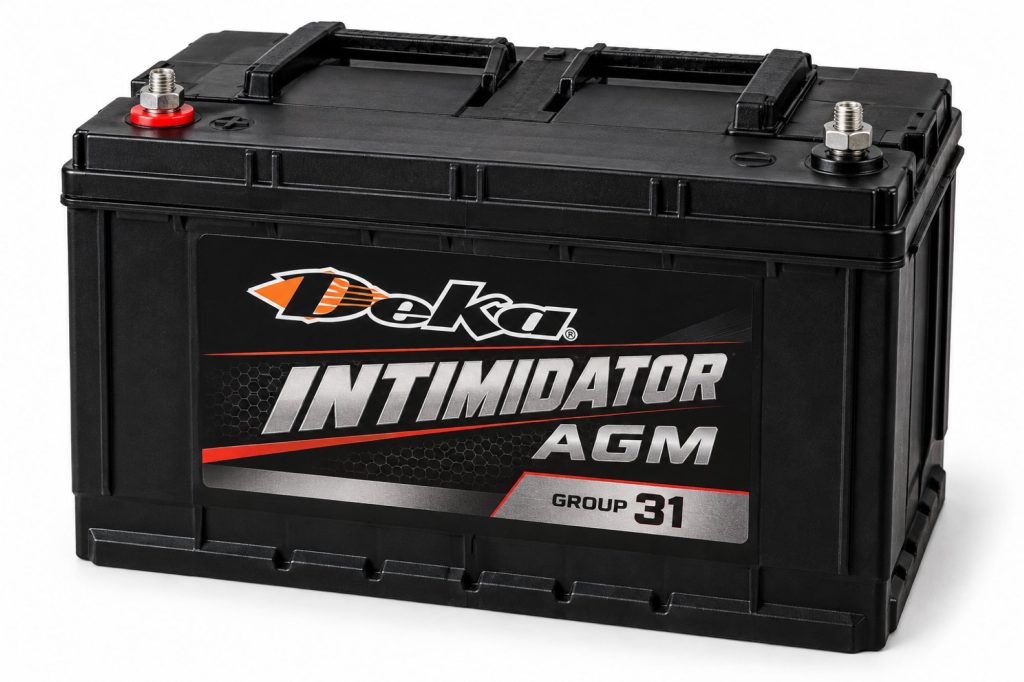
The Deka Intimidator AGM Group 31 Battery is a valve-regulated lead-acid battery manufactured by East Penn Manufacturing. The 9A31 combines commercial starting capability with cycling support for vehicles and equipment that place substantial demands on their batteries.
Its absorbed glass mat construction holds the electrolyte within fiberglass separators instead of allowing free-flowing liquid inside the case. This creates a spill-resistant, maintenance-free battery that can tolerate vibration and repeated electrical loading better than many conventional flooded starting batteries.
The 9A31 is intended for applications requiring a standard Group 31 footprint, high cranking output, reserve power, and AGM construction. Battery fitment must still be confirmed using the vehicle manufacturer’s voltage, capacity, terminal, hold-down, and charging-system requirements.
Key Characteristics
- Group 31 commercial battery
- Absorbed glass mat construction
- Valve-regulated lead-acid design
- Dual-purpose starting and cycling capability
- Maintenance-free operation under normal conditions
- Spill-resistant electrolyte containment
- High cold-cranking output
- Substantial reserve capacity
- Greater deep-discharge tolerance than many conventional starting batteries
- Designed to resist vibration and severe service
- Faster recharge capability than many flooded batteries
- Compatible with approved series and parallel battery-bank arrangements
- Multiple terminal configurations within the broader Group 31 family
Major Components
- Impact-resistant battery case
- Sealed top cover
- Positive plates
- Negative plates
- Absorbed glass mat separators
- Lead-alloy grids
- Contained electrolyte
- Internal cell connectors
- Positive terminal
- Negative terminal
- Pressure-relief valves
- Cell partitions
- Flame-arresting and venting features
- Terminal seals
- Carry handles where equipped
Product Type and Construction
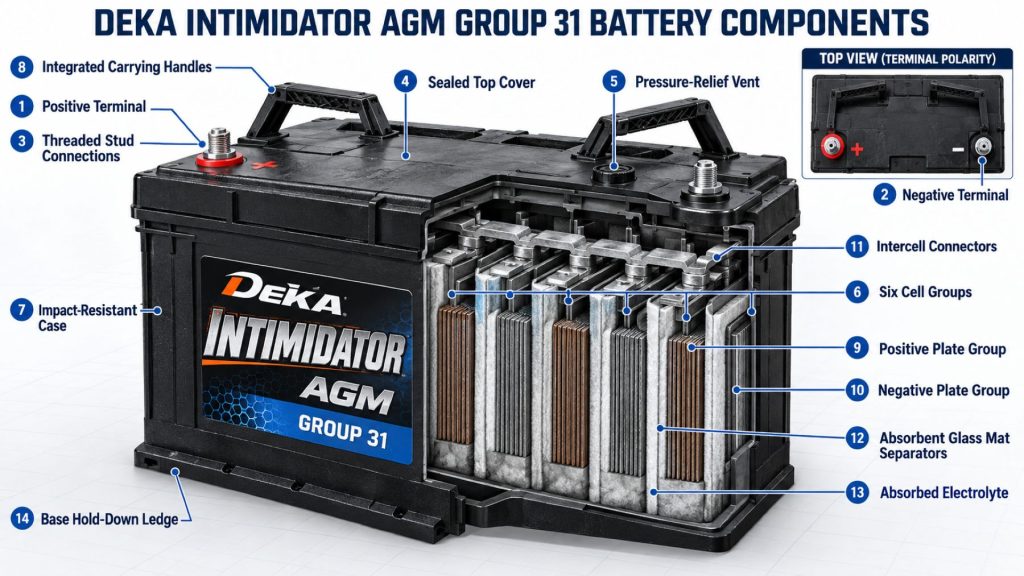
The 9A31 is a rechargeable valve-regulated lead-acid battery using absorbed glass mat technology. Its electrolyte is absorbed and immobilized within fiberglass separators positioned between the positive and negative plates.
The sealed case does not require routine water addition. Pressure-relief valves allow controlled venting if abnormal internal pressure develops, but the battery should not be opened or serviced like a conventional flooded battery.
How the Electrical Component or System Works
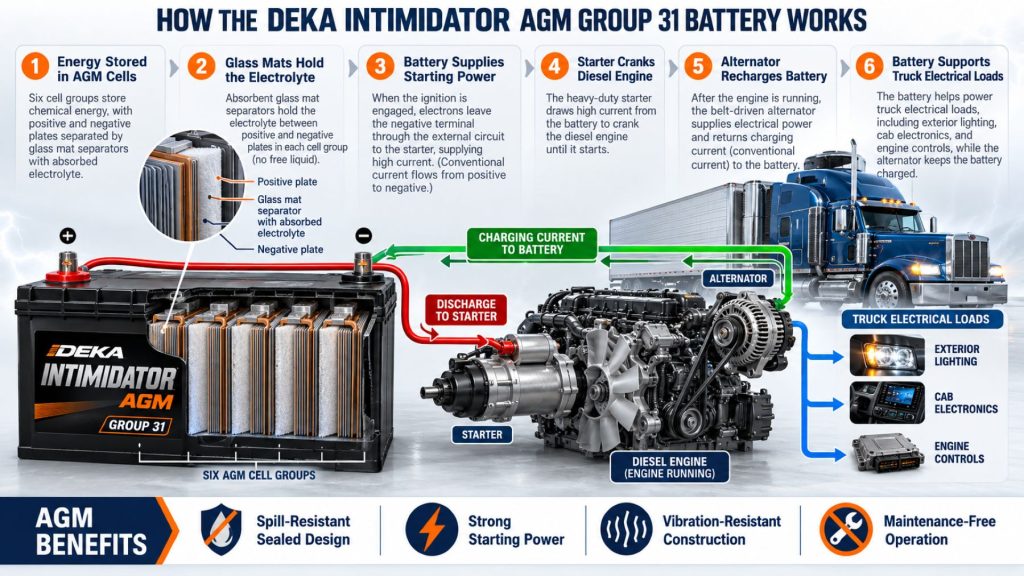
The battery stores electrical energy through a reversible chemical reaction between its lead-based plates and sulfuric-acid electrolyte. During discharge, chemical energy is converted into direct-current electricity that powers the starter and vehicle electrical systems.
When the charging system supplies the correct voltage, the chemical reaction reverses and restores the battery’s state of charge. AGM separators keep the electrolyte in close contact with the plates while supporting internal gas recombination during normal charging.
Position and Function Within the Vehicle
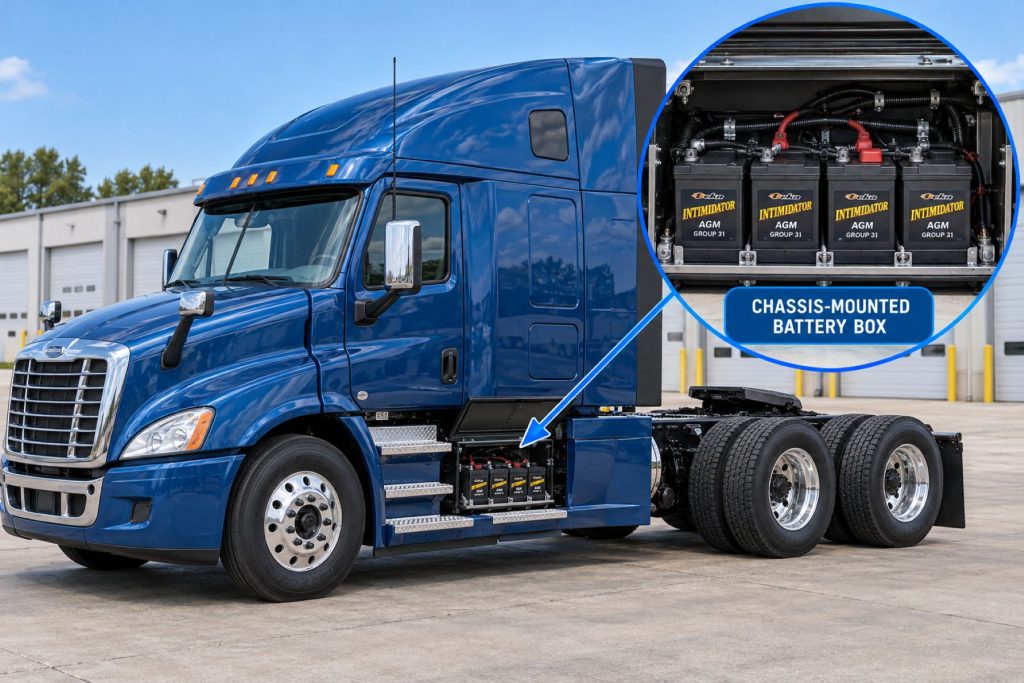
The battery may be installed in a chassis-mounted battery box, under-cab compartment, engine compartment, equipment enclosure, or another approved location. Commercial vehicles frequently use multiple Group 31 batteries connected as a battery bank.
Its functions can include supplying starter current, stabilizing system voltage, powering electrical loads when the engine is off, supporting high-demand accessories, and storing energy produced by the alternator.
Common Specifications
- Model: Deka Intimidator 9A31
- BCI Group Size: Group 31
- Battery Type: Dual-purpose AGM valve-regulated lead-acid battery
- Nominal Voltage: 12 volts
- Cold-Cranking Amps: 925 amps
- Cranking Amps: 1,060 amps
- Reserve Capacity: 190 minutes
- 20-Hour Capacity: 100 amp-hours
- Approximate Length: 13 inches
- Approximate Width: 6.75 inches
- Approximate Height: 9.5 inches
- Approximate Weight: 63 pounds
- Terminal Configuration: Model-specific Group 31 commercial terminal arrangement
- Maintenance: Maintenance-free under normal operating conditions
Operating Capacity and Performance
The 9A31 provides 925 cold-cranking amps for engine starting and 190 minutes of published reserve capacity for supporting electrical loads. Its 100-amp-hour rating describes capacity when discharged under the specified 20-hour test conditions.
Actual performance depends on temperature, state of charge, battery age, discharge rate, cable condition, charging voltage, battery-bank configuration, and vehicle electrical demand.
Installation Position and System Function
The battery must be installed in a tray or enclosure designed for its Group 31 dimensions and weight. Hold-down hardware must secure the case without distorting or damaging it.
The installed orientation, ventilation, cable routing, terminal clearance, and environmental exposure must comply with East Penn and vehicle-manufacturer requirements.
System Voltage and Electrical Architecture
A single 9A31 supplies nominal 12-volt power. Multiple batteries may be connected in parallel to increase available current and capacity while retaining a 12-volt system.
Two or more batteries may also be connected in series for approved 24-volt or higher-voltage arrangements. Every battery in the bank should be compatible in type, capacity, age, condition, and state of charge.
Electrical Input, Output, and Power Function
The battery accepts direct-current energy from the alternator or an approved external charger. During discharge, it supplies direct-current power to the starter, vehicle electronics, lighting, safety systems, accessories, and auxiliary equipment.
Battery voltage decreases as the state of charge falls or electrical demand increases. Excessive discharge can reduce available starting power and shorten battery life.
Voltage, Current, and Electrical Load Management
The battery must supply high current during engine cranking while maintaining enough voltage for starter relays, engine controllers, fuel systems, and vehicle electronics to function.
Electrical loads used while the engine is off should be managed to preserve adequate starting capacity. Low-voltage disconnects or auxiliary battery systems may be appropriate when vehicles support extended hotel or work-equipment loads.
Starting, Cycling, and Reserve-Power Function
The Intimidator 9A31 is identified as a dual-purpose battery because it supports both high-current engine starting and repeated cycling. It can tolerate cycling demands better than many batteries intended only for starting service.
Dual-purpose construction does not make the battery immune to repeated deep discharge. System design should avoid regularly draining the battery below the operating limits recommended by East Penn.
Cold-Cranking and Reserve Capacity
The 925-CCA rating represents the battery’s tested cold-starting capability under standardized conditions. The 1,060-CA rating measures cranking performance at a warmer test temperature.
The 190-minute reserve-capacity rating indicates how long a fully charged battery can support a standardized electrical load before reaching the specified cutoff voltage. Real vehicle runtime depends on actual load and battery condition.
Internal Components and Electrical Design
Each battery cell contains positive and negative plates separated by absorbed glass mat material. Internal connectors join six cells in series to produce a nominal 12-volt battery.
Valve regulation supports internal gas recombination during normal charging. Pressure-relief valves provide controlled venting if internal pressure exceeds the designed operating range.
Materials and Component Construction
The battery uses lead-alloy plates and grids, fiberglass separators, sulfuric-acid electrolyte, internal lead connections, molded case materials, sealed terminals, and pressure-relief components.
Its reinforced internal construction is intended to support commercial vibration resistance, current transfer, and cycling performance.
Wiring, Terminals, Connectors, and Grounding
Battery cables must match the terminal arrangement and carry starting and accessory current without excessive voltage drop. Cable lugs should make full, clean contact with the terminals and be tightened to the specified torque.
Positive terminals must be protected from accidental contact with grounded tools, covers, or vehicle structures. Ground cables and bonding straps should be inspected along with the positive circuit.
Circuit Protection and Electrical Safety
Battery circuits can release enough current to melt tools, damage wiring, ignite materials, and cause severe injury. Cable routing and protection must prevent abrasion, crushing, overheating, and accidental short circuits.
Battery disconnects, fuses, circuit breakers, and power-distribution equipment should be selected according to the vehicle’s electrical architecture and maximum expected current.
Controls, Monitoring, and Diagnostics
Battery condition may be monitored through a dashboard voltmeter, battery sensor, electronic battery-management system, low-voltage disconnect, telematics platform, or external diagnostic equipment.
Useful diagnostic information includes open-circuit voltage, conductance, available cranking capacity, state of charge, charging voltage, parasitic current, cable voltage drop, and individual battery balance.
Electronic Controls and Driver-Assistance Integration
The battery supplies stabilized power to engine, transmission, braking, steering, lighting, telematics, safety, and driver-assistance systems when the electrical architecture calls for battery support.
Low battery voltage can cause warning messages, interrupted module communication, failed startup checks, false diagnostic codes, or disabled safety features.
Power Demand, Capacity, and Energy Management
Battery quantity and capacity should be based on starter requirements, engine-off accessory demand, minimum reserve capacity, climate, alternator output, recharge time, and the vehicle’s operating schedule.
Vehicles with sleeper accessories, liftgates, emergency lighting, refrigeration controls, communications equipment, or hydraulic controls may require a larger battery bank or a separate auxiliary system.
Charging Efficiency and Energy Recovery
AGM batteries generally accept charge efficiently, allowing the 9A31 to recover energy faster than many conventional flooded designs when connected to an appropriate charging system.
Charging voltage must remain within the approved range. Chronic undercharging can cause sulfation, while excessive voltage can generate heat, venting, dry-out, and permanent battery damage.
Heat, Efficiency, and Electrical Loss Management
Heat can develop from high charging current, excessive voltage, loose connections, internal damage, high-resistance cables, or demanding discharge cycles. Elevated temperature accelerates battery aging.
Clean connections, correctly sized cables, proper charging voltage, adequate ventilation, and secure mounting help control electrical losses and temperature.
Environmental Sealing and Contamination Protection
The sealed AGM design contains the electrolyte and reduces routine exposure to liquid acid. It also eliminates normal water addition.
The battery should still be protected from impact, fire, excessive heat, damaged terminals, standing water, conductive contamination, pressure washing, and chemicals that can damage the case.
Duty Cycle and Operating Conditions
The 9A31 is suitable for commercial applications combining engine-starting demand with moderate cycling and accessory use. Performance is affected by temperature, discharge depth, recharge time, vibration, storage duration, and charging-system condition.
Vehicles stored for extended periods may require a compatible maintenance charger or battery disconnect to prevent damaging discharge from parasitic loads.
Mounting and Installation
The battery tray must support the battery’s dimensions and approximately 63-pound weight. Hold-down hardware should secure the battery firmly without crushing or distorting the case.
Installation must provide correct terminal orientation, cable reach, polarity, ventilation, service access, and clearance from conductive covers or surrounding structures.
Wiring, Grounding, and Installation Requirements
Cables should be connected with correct polarity and routed without tension on the battery terminals. Parallel cables should be arranged to promote balanced current flow across the battery bank.
Series-connected batteries must be wired in the correct order to produce the intended system voltage. Reversed polarity can damage the battery, alternator, controllers, and other electrical equipment.
Vehicle and Electrical-System Compatibility
Compatibility depends on group size, system voltage, cold-cranking requirements, reserve capacity, amp-hour requirements, terminal arrangement, battery-box dimensions, hold-down design, cable routing, charging voltage, and operating environment.
A Group 31 designation confirms general physical dimensions but does not guarantee that every Group 31 battery has the correct terminals, capacity, polarity, technology, or charging requirements for a particular vehicle.
Battery and Charging-System Compatibility
The alternator, external charger, battery isolator, inverter-charger, or maintenance charger must be compatible with AGM batteries. Charging equipment should provide the voltage and current profile recommended by East Penn.
When multiple batteries share a bank, replacing only one aged or failed battery can create imbalance. The condition of every battery should be tested before deciding whether individual or complete-bank replacement is appropriate.
Related Component and System Compatibility
- Heavy-duty starters
- Alternators and voltage regulators
- Battery cables and terminals
- Battery disconnect switches
- Battery isolators
- Low-voltage disconnect systems
- Power-distribution modules
- Inverters and converters
- External AGM-compatible chargers
- Auxiliary power systems
- Battery heaters
- Battery-monitoring and telematics systems
Common Applications
- Heavy-duty highway tractors
- Vocational trucks
- Transit buses
- School buses
- Motor coaches
- Emergency vehicles
- Utility trucks
- Construction equipment
- Agricultural machinery
- Marine equipment
- Recreational vehicles
- Generator systems
- Auxiliary electrical systems
- Vehicles with substantial engine-off electrical loads
Advantages
- Strong engine-starting performance
- 925 cold-cranking amps
- 190 minutes of reserve capacity
- Dual-purpose starting and cycling capability
- Greater deep-discharge tolerance than many starting batteries
- Maintenance-free operation under normal conditions
- No routine water addition
- Spill-resistant AGM construction
- Good vibration resistance
- Efficient charging acceptance
- Standard Group 31 commercial footprint
- Can support demanding truck and equipment electrical systems
Limitations or Considerations
- Generally costs more than a conventional flooded battery
- Requires an AGM-compatible charging profile
- Can be damaged by chronic overcharging
- Can still be damaged by repeated deep discharge
- Weighs approximately 63 pounds
- Terminal configuration must match the vehicle
- Battery-box dimensions and hold-downs must be verified
- Multiple-battery banks require compatible batteries
- Sealed construction prevents routine internal electrolyte service
- A new battery cannot correct alternator or wiring problems
- Long storage periods may require maintenance charging
- Actual service life depends heavily on operating conditions
Driver and Operator Experience
A properly charged 9A31 should provide strong cranking and stable electrical-system voltage. Its reserve and cycling capability can better support accessories during engine-off operation than many conventional starting-only batteries.
Drivers should report slow cranking, repeated low-voltage warnings, dimming lights, electrical resets, swollen cases, unusual odors, hot terminals, or repeated jump-start requirements.
Controls, Indicators, and Driver Feedback
Battery condition may be reflected through a voltmeter, low-voltage warning, battery-status display, telematics alert, starter performance, or charging-system message.
Dashboard voltage alone cannot provide a complete battery diagnosis. Proper testing is required to measure state of charge, available cranking capacity, and battery-bank balance.
Common Electrical Tests and Diagnostic Information
- Open-circuit voltage test
- Battery conductance test
- Cranking-voltage test
- Load test using AGM-compatible procedures
- State-of-charge measurement
- Charging-voltage test
- Alternator output test
- Positive-circuit voltage-drop test
- Ground-circuit voltage-drop test
- Parasitic-current test
- Individual battery comparison
- Battery-bank balance test
- Terminal-temperature inspection
Inspection and Wear Points
- Battery case
- Top cover and seams
- Positive and negative terminals
- Terminal seals
- Cable lugs
- Battery cables
- Ground connections
- Hold-down hardware
- Battery tray
- Insulating covers
- Ventilation openings
- Nearby heat shields
- Evidence of swelling, leakage, corrosion, or impact damage
Cooling, Ventilation, and Environmental Requirements
The battery should be installed in a ventilated location protected from excessive exhaust heat, direct flame, physical damage, and standing water. Valve-regulated batteries can release gas under abnormal charging or failure conditions.
Battery compartments should not allow gas to accumulate near ignition sources. Heat shields and compartment vents should remain in their original positions.
Component Service Life and Replacement
Battery life depends on temperature, discharge depth, charging voltage, starting frequency, vibration, storage conditions, parasitic loads, and time spent at a partial state of charge.
AGM batteries are not normally rebuilt in vehicle service. A battery that fails approved testing, develops case damage, leaks, swells, or cannot maintain charge should be replaced and recycled through an appropriate lead-acid battery program.
Maintenance and Ownership Notes
The sealed battery does not require routine water addition. Maintenance should focus on keeping the case and terminals clean, checking cable condition, verifying secure hold-downs, testing battery condition, and maintaining the correct charging voltage.
Batteries in a shared bank should be tested individually. Chronic low state of charge should be corrected by identifying excessive engine-off loads, insufficient alternator output, inadequate driving time, or improper charging equipment.
Common Electrical-System Problems
- Slow engine cranking: A discharged battery, internal battery deterioration, loose terminals, high cable resistance, starter problems, cold temperatures, or engine resistance may reduce cranking speed.
- Battery repeatedly discharges: Parasitic loads, inadequate alternator output, short operating cycles, excessive engine-off accessory use, or a damaged battery may be responsible.
- Low charging voltage: Alternator problems, belt slip, voltage drop, poor grounds, faulty regulators, or excessive electrical demand may prevent full charging.
- Overcharging: Incorrect charger settings, regulator failure, wiring faults, or temperature-compensation problems can overheat and damage the battery.
- Swollen battery case: Overcharging, excessive temperature, freezing after severe discharge, or internal failure may deform the case.
- Hot terminals: Loose connections, corrosion, damaged cables, undersized conductors, or excessive current can generate heat.
- Uneven battery-bank performance: Mismatched batteries, poor cable balance, different states of charge, internal failure, or unequal connection resistance may cause imbalance.
- Reduced reserve time: Battery aging, sulfation, repeated deep discharge, chronic undercharging, high temperatures, or increased vehicle loads may reduce capacity.
Safety and Service Precautions
Wear appropriate eye and hand protection when handling or testing the battery. Remove jewelry and prevent tools from contacting both terminals or a positive terminal and grounded vehicle structure.
Disconnect and reconnect cables according to the vehicle manufacturer’s procedure. Use lifting methods appropriate for the battery’s approximately 63-pound weight. Never open the sealed case, add water, expose the battery to flame, or use charging equipment not approved for AGM batteries.
Identification Information
Battery identification information is printed on the case label or stamped into the case. Record the complete model and date information before ordering a replacement.
- Deka brand name
- Intimidator product family
- 9A31 model number
- BCI Group 31 designation
- Nominal voltage
- Cold-cranking-amp rating
- Cranking-amp rating
- Reserve-capacity rating
- Amp-hour capacity
- Terminal configuration
- Polarity and terminal positions
- Manufacturing date code
- Vehicle battery-bank configuration
Buying Considerations
- Confirm the 9A31 model number
- Verify the Group 31 physical dimensions
- Match the 12-volt electrical system
- Confirm required cold-cranking amps
- Confirm reserve-capacity requirements
- Review amp-hour requirements
- Match terminal type and position
- Verify cable reach and polarity
- Confirm battery-box and hold-down compatibility
- Check alternator and charger compatibility with AGM technology
- Evaluate whether all batteries in the bank should be replaced
- Confirm storage and installation orientation requirements
- Review warranty terms
- Use a supplier that accepts the old battery for recycling
Variants and Configurations
- Deka Intimidator 9A31
- Polarity- or terminal-specific Group 31 configurations
- Commercial dual-purpose AGM batteries
- AGM starting and cycling batteries
- AGM heavy-duty deep-cycle batteries
- Single-battery installations
- Parallel 12-volt battery banks
- Series-connected 24-volt battery banks
- Combined series-parallel battery systems
- Vehicle-starting applications
- Auxiliary-power applications
Comparison to Similar Equipment
Compared with a conventional flooded Group 31 starting battery, the Deka Intimidator 9A31 offers spill-resistant AGM construction, stronger cycling capability, no routine water addition, and improved resistance to vibration and deep-discharge abuse.
Compared with a dedicated deep-cycle battery, the 9A31 places greater emphasis on engine-starting power while still supporting cycling and reserve loads. A dedicated deep-cycle model may be better for applications dominated by repeated deep discharge.
Compared with a lithium auxiliary battery, the 9A31 uses familiar lead-acid charging and recycling infrastructure. Lithium systems may offer lower weight and greater usable cycling capacity but require compatible controls, charging equipment, and protection systems.
Best Fit For
- Commercial vehicles requiring a Group 31 battery
- Trucks needing high cold-cranking performance
- Vehicles with substantial engine-off accessory loads
- Applications combining starting and cycling duty
- Vehicles operating in high-vibration environments
- Fleets seeking maintenance-free battery construction
- Battery boxes where spill resistance is important
- Parallel commercial battery banks
- Approved 24-volt series battery systems
- Vehicles equipped with AGM-compatible charging systems
Related Vehicle and Trailer Types
- Heavy-duty trucks
- Highway tractors
- Vocational trucks
- Transit buses
- School buses
- Motor coaches
- Emergency vehicles
- Utility trucks
- Agricultural equipment
- Construction equipment
- Recreational vehicles
- Specialized commercial vehicles
Related Truck and Trailer Models
- Freightliner Cascadia
- Kenworth T680
- Kenworth T880
- Peterbilt 579
- Peterbilt 567
- International LT Series
- International HX Series
- Volvo VNL
- Volvo VHD
- Mack Anthem
- Mack Granite
- Western Star 49X
Related Electrical System Types
- Commercial Truck Batteries & Energy Storage
- Alternators & Charging Systems
- Starters & Starting Systems
- Wiring, Connectors & Power Distribution
- Inverters, Converters & Auxiliary Electrical Power
Related Electrical Products
- Delco Remy 40SI Heavy-Duty Brushless Alternator
- Delco Remy 36SI High-Output Alternator
- Delco Remy 28SI High-Output Alternator
- Delco Remy 24SI Heavy-Duty Alternator
- Leece-Neville IdlePro Alternator
- Leece-Neville IdlePro Extreme Alternator
- Delco Remy 39MT Heavy-Duty Gear-Reduction Starter
- Delco Remy 38MT Heavy-Duty Starter
- Prestolite PowerPro Starter
- Prestolite PowerPro Extreme Starter
Related Equipment Systems
- Electrical Systems
- Engines
- Transmissions
- Drivelines & Steering Systems
- PTO & Hydraulic Systems
- Safety Systems
- Telematics & ELD Systems
Related Guides
- Electrical System Guides
- How Commercial Truck Electrical Systems Work
- Commercial Truck Batteries Explained
- Commercial Truck Alternators and Charging Systems Explained
- Commercial Truck Starters and Starting Systems Explained
- How to Inspect and Maintain Truck Wiring and Electrical Connections
Regulatory and Compliance Notes
Lead-acid batteries must be transported, handled, stored, and recycled according to applicable environmental, workplace-safety, fire, and hazardous-material requirements.
Battery replacement must preserve the vehicle manufacturer’s voltage, capacity, terminal, mounting, ventilation, and electrical-protection requirements. Used batteries should be returned through an approved recycling program rather than discarded with ordinary waste.
Real World Operating Notes
A battery with acceptable open-circuit voltage can still lack sufficient cranking capacity. Conductance, load, and cranking-voltage testing provide a more complete evaluation.
Vehicles that idle extensively may still discharge their batteries if accessory demand exceeds alternator output at idle. A high-capacity battery delays the voltage drop but does not correct an undersized charging system.
When batteries are connected as a bank, one weak unit can reduce the performance of the complete system. Testing should include every battery and the cables joining them.
Frequently Asked Questions
What is the Deka Intimidator AGM Group 31 Battery?
It is a sealed, valve-regulated, dual-purpose AGM battery designed to provide commercial starting power, cycling capability, and reserve electrical capacity.
What is the model number?
The Group 31 Intimidator battery covered on this page is the Deka 9A31. Other terminal or application configurations may use different model numbers.
How many cold-cranking amps does it provide?
The published rating for the 9A31 is 925 cold-cranking amps.
What is its reserve capacity?
The published reserve-capacity rating is 190 minutes under the standardized test conditions.
Does it require water?
No. Its sealed AGM design does not require routine water addition and should not be opened.
Can it be used for engine starting and accessory power?
Yes. The 9A31 is identified as a dual-purpose battery supporting both engine starting and cycling loads.
Can it replace any Group 31 battery?
No. Voltage, capacity, terminals, polarity, dimensions, hold-downs, charging requirements, and vehicle specifications must all be verified.
Does it require a special charger?
An external charger should include an AGM-compatible charging mode and meet East Penn’s voltage and current requirements.
Can it be mixed with flooded batteries?
Mixing battery technologies within the same bank is generally not recommended because charging behavior and electrical characteristics can differ. Follow the vehicle and battery manufacturers’ requirements.
How should the correct replacement be identified?
Use the Deka model number, Group 31 size, system voltage, terminal configuration, polarity, cold-cranking rating, reserve capacity, and vehicle battery-bank requirements.
Availability and Where to Find
The Deka Intimidator 9A31 may be available through Deka distributors, East Penn dealers, commercial-truck parts suppliers, battery specialists, fleet-maintenance suppliers, agricultural-equipment dealers, marine suppliers, and selected automotive-parts retailers.
Availability may depend on location, terminal configuration, production date, and distributor inventory. Buyers should verify that the supplied battery is the correct 9A31 configuration before installation.
Current product information, technical resources, warranty details, recycling information, and dealer assistance are available through the East Penn Manufacturing website.
Support Trucking Families
Truck Equipment Atlas supports the mission of Grey Cross, a nonprofit dedicated to helping families of truck drivers who lose their lives while on the road. As the site grows, part of its mission is to bring awareness and support to these families.
Podcast or Video Section
Learn More Through Audio and Video
Truck Equipment Atlas will continue expanding with podcast episodes, interviews, and equipment breakdowns to help drivers and fleets better understand trucks and equipment.
Follow the Growth of Truck Equipment Atlas
Truck Equipment Atlas continues to expand with new truck profiles, trailer coverage, diesel engine pages, equipment system resources, manufacturer information, and educational guides.
Visit our Site Updates page to explore recent additions, project milestones, and upcoming resources as we continue building one of the industry’s growing commercial trucking equipment reference libraries.
View the Latest Site Updates: Truck Equipment Atlas Site Updates