
Quick Facts
- Manufacturer: Michelin
- Product Name: Michelin X Line Energy Z
- Product Type: Commercial radial truck tire
- Tire Category: Long-haul steer and all-position tire
- Intended Position: Steer axle or approved all-position application
- Primary Application: Long-distance highway transportation
- Construction: Radial, tubeless commercial tire
- Common North American Sizes: 11R22.5, 275/80R22.5, 11R24.5, and 275/80R24.5, with additional application-specific sizes
- Common Load Ranges: G and H, depending on size and specification
- Maximum Speed: Size- and specification-dependent; many North American configurations are rated up to 75 mph
- Original Tread Depth: Size-dependent; commonly 19/32 inch on major North American line-haul sizes
- Retreadable: Yes, subject to casing condition and approved retreading procedures
- Primary Benefits: Long tread life, fuel efficiency, even wear, casing durability, and retreadability
- Production Status: Current product availability varies by size, load range, and market
Overview
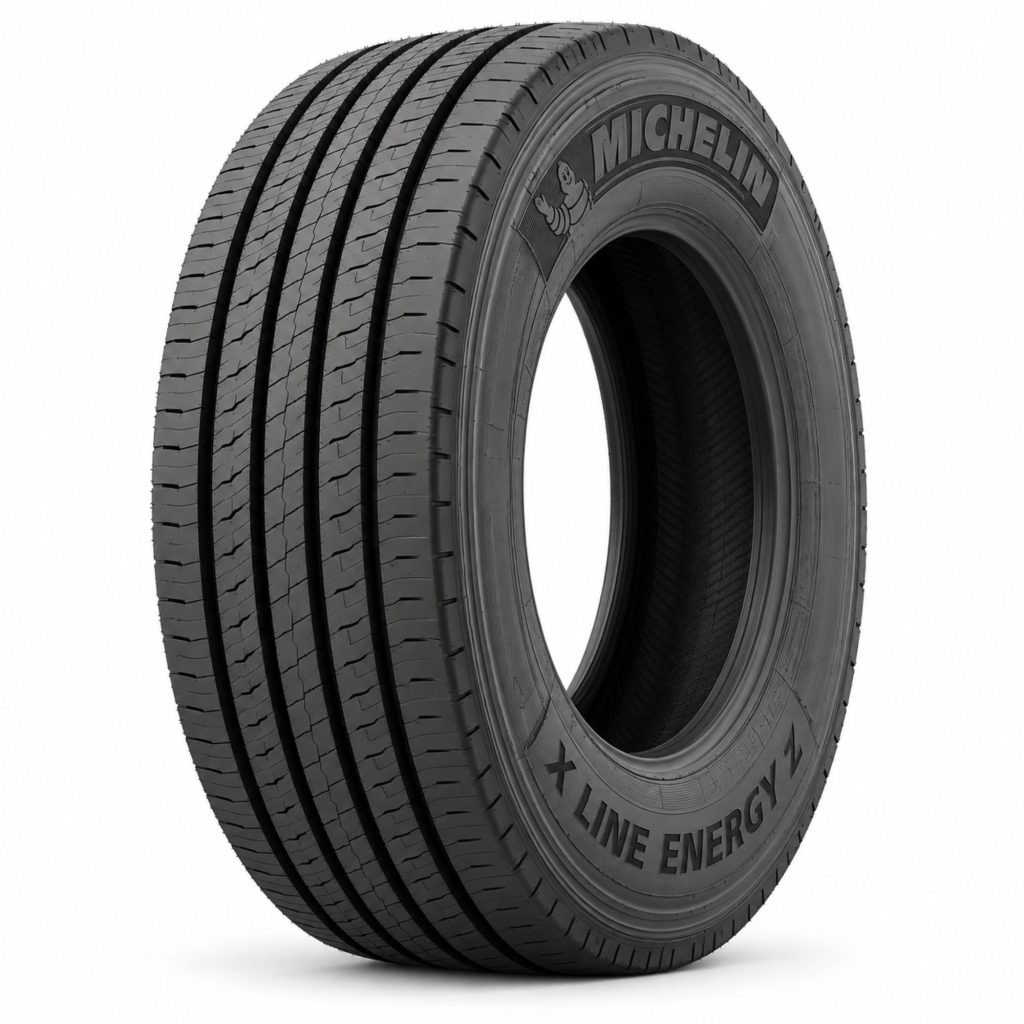
The Michelin X Line Energy Z is a fuel-efficient commercial truck tire developed primarily for steer-axle and approved all-position use in long-haul transportation. It combines a rib-style highway tread with technologies intended to control irregular wear, reduce rolling resistance, maintain traction, and extend the useful life of the casing.
Michelin positions the X Line Energy Z as a replacement for the earlier Michelin XZA3+ Evertread. According to Michelin, the X Line Energy Z provides five percent better rolling resistance than the tire it replaced and is covered by a mileage guarantee offering twenty percent more mileage than identified competing line-haul steer tires, subject to the terms of Michelin’s guarantee.
The tire uses directional groove-wall microsipes, decoupling grooves, and dual-compound tread construction. These features are designed to promote even wear while balancing tread durability, traction, operating temperature, and fuel efficiency.
The X Line Energy Z is offered in several commercial sizes and load ranges. Exact load capacity, inflation pressure, wheel compatibility, dimensions, and speed rating must be confirmed for the specific tire size and Michelin product number.
Key Characteristics
- Designed primarily for long-haul steer and all-position service
- Radial tubeless commercial tire construction
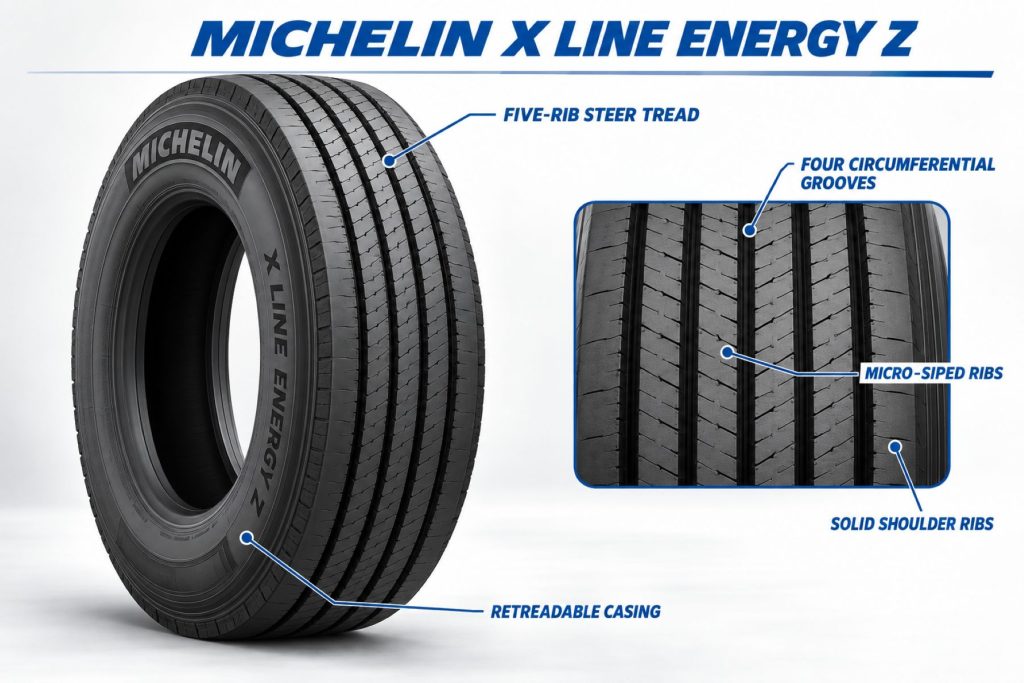
- Five-rib highway tread design on common North American configurations
- Decoupling grooves intended to help control shoulder wear
- Directional groove-wall microsipes designed to reduce irregular wear
- Microsiping provides additional biting edges for traction
- Dual-compound tread balances wear, grip, operating temperature, and rolling resistance
- Developed for fuel-efficient highway operation
- Retreadable commercial casing
- Multiple sizes and load ranges available
- Suitable for heavy trucks, tractors, motorcoaches, and approved recreational-vehicle applications when correctly specified
- Designed for fleets prioritizing total tire cost and casing value
Major Components
- Five-rib highway tread on common configurations
- Continuous center tread ribs
- Outer shoulder ribs
- Decoupling grooves
- Directional groove-wall microsipes
- Dual-compound tread package
- Steel belt package
- Radial casing
- Sidewalls
- Bead assemblies
- Inner liner
- Sidewall identification and DOT markings
Product Type and Construction
The X Line Energy Z is a radial, tubeless commercial tire. Its radial casing allows the tread area and sidewalls to respond differently to road forces, supporting highway ride quality, footprint stability, heat management, and casing durability.
Steel belts reinforce the tread area and help maintain the contact patch. The casing supports the vehicle load through correctly regulated inflation pressure, while the tread compound and rib arrangement manage road contact, steering response, braking forces, and water evacuation.
The tire’s tread combines two compound layers. Michelin describes the upper layer as supporting wear and grip, while the lower layer helps control heat and reduce rolling resistance.
How the Tire Works
Compressed air inside the tire supports the vehicle load. The tire’s casing, belts, beads, and tread work together to transfer steering, braking, and cornering forces between the vehicle and road.
The continuous rib-style tread creates a stable highway contact patch. Circumferential grooves help channel water away from the tread, while microsipes create additional edges for traction and help reduce the development of irregular wear.
Decoupling grooves separate the sacrificial outer rib from the primary tread ribs. This creates a barrier intended to prevent shoulder wear from progressing into the main tread area.
The dual-compound tread allows the road-contacting layer and underlying compound to perform different functions. This helps the tire balance mileage, traction, temperature control, and rolling resistance.
Position and Function Within the Vehicle
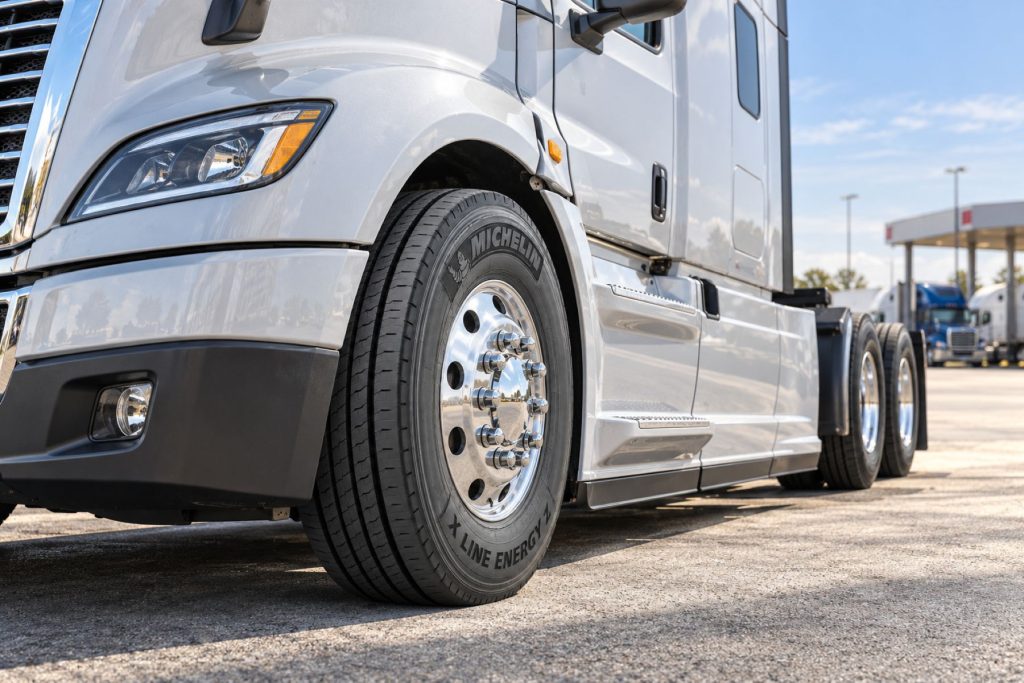
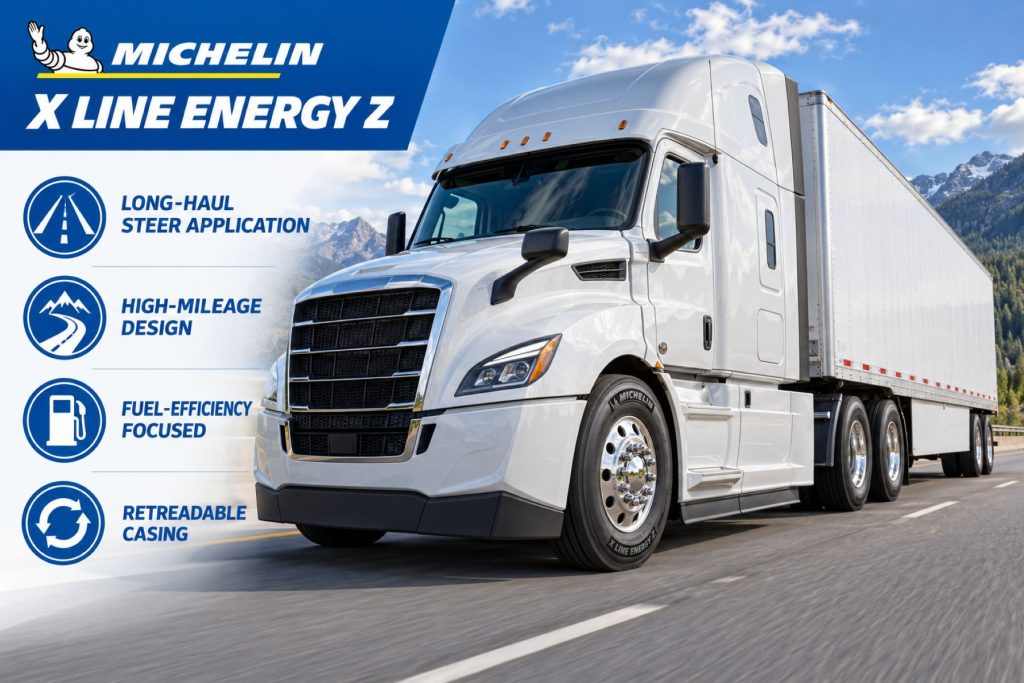
The Michelin X Line Energy Z is primarily intended for the steer axle of a highway tractor or heavy commercial vehicle. Steer tires influence directional control, steering response, braking stability, ride quality, and driver confidence.
The tire may also be used in approved all-position applications when its size, load range, inflation requirements, and service designation match the vehicle. The tire should not be moved into another wheel position without confirming that the intended application is approved.
Because steer-axle tires are critical to vehicle control, they require careful inflation, alignment, balancing, inspection, and replacement practices.
Common Specifications
- Service Type: Long-haul steer and all-position
- Construction: Radial and tubeless
- Common Rim Diameter: 22.5 or 24.5 inches, depending on tire size
- Common Sizes: 11R22.5, 275/80R22.5, 11R24.5, and 275/80R24.5
- Additional Sizes: Application-specific low-profile, coach, recreational-vehicle, and international-market configurations may be available
- Common Load Ranges: G and H, depending on size
- Common Original Tread Depth: Approximately 19/32 inch on major North American sizes
- Recommended Wheel Width: Size-dependent; 8.25-inch wheels are commonly recommended for 11R22.5 configurations
- Maximum Speed: Size-dependent; many configurations are rated up to 75 mph
- Inflation Pressure: Determined by tire size, load range, actual axle weight, wheel rating, and Michelin load-and-inflation information
- Retreadability: Retreadable when the casing passes inspection
Specifications vary significantly between sizes and product numbers. The tire sidewall, Michelin data book, and current application information should be used before purchasing, mounting, or establishing inflation pressure.
Size, Load Ratings, and Operating Capacity
The tire’s operating capacity depends on its complete size, load range, service description, inflation pressure, and approved wheel. Tires carrying the same product-family name may have different maximum loads and required pressures.
Common North American X Line Energy Z sizes include 11R22.5 and 275/80R22.5 in different load ranges. Additional sizes are available for 24.5-inch wheels and specialized applications.
Maximum sidewall pressure should not be treated as the automatic operating pressure for every vehicle. Fleets should weigh the vehicle in normal operating condition and use the current Michelin load-and-inflation information to establish the required cold inflation pressure.
The selected pressure must support the actual load without exceeding the tire, wheel, axle, suspension, or vehicle ratings.
Intended Axle and Wheel Position
The X Line Energy Z is designed primarily for steer-axle use in long-distance transportation. Its ribbed tread, wear-control features, and fuel-efficient compound package are suited to highway tractors that accumulate high annual mileage.
Approved all-position use may be possible in certain vehicle and tire configurations. Fleets should verify application suitability before using the tire on drive, trailer, tag, pusher, coach, or recreational-vehicle axles.
A tire selected for a steer axle must meet the complete axle-load requirement while remaining compatible with the wheel, vehicle clearances, steering geometry, and operating speed.
Tread Design and Traction
The tire uses a rib-style tread developed for long-haul highway service. Continuous ribs provide directional stability and maintain a broad road-contact area, while longitudinal grooves help evacuate water from beneath the tread.
Directional groove-wall microsipes provide small biting edges intended to support traction. Michelin also uses the microsipes to help prevent the early development of irregular wear.
Decoupling grooves help isolate the outer sacrificial rib from the main tread ribs. This design is intended to control shoulder wear in applications where steer tires wear slowly over long highway distances.
The X Line Energy Z is not an aggressive drive or off-road traction tire. Fleets regularly operating in deep snow, mud, construction sites, or severe mixed-service conditions may require a different tread design.
Casing, Sidewall, and Structural Design
The radial casing supports the tire’s load and provides the structural foundation for the tread and belt package. Proper inflation allows the casing to maintain the intended shape and footprint while flexing during operation.
Steel belts reinforce the tread area and help stabilize the road-contact surface. The beads secure the tire to the approved wheel, while the inner liner retains inflation air in the tubeless assembly.
Michelin developed the casing for continued service through retreading when it remains structurally sound. Casing value depends on preventing underinflation, overloading, impact damage, excessive heat, moisture intrusion, and improper repairs.
Inflation Pressure and Load Management
Correct cold inflation pressure is essential to the X Line Energy Z tire’s load capacity, tread footprint, casing life, steering response, and rolling resistance.
Underinflation increases casing flex and heat generation. It can contribute to shoulder wear, poor fuel economy, steering instability, casing damage, and tire failure.
Excessive inflation can reduce ride quality, concentrate wear near the tread center, reduce impact absorption, and alter the size of the road-contact patch.
Pressure should be established using actual loaded axle weights and current Michelin load-and-inflation tables. Pressure should be measured when the tire is cold and checked with an accurate commercial tire gauge or properly maintained tire-pressure monitoring system.
Rolling Resistance and Fuel Efficiency
The X Line Energy Z is engineered for fleets seeking lower rolling resistance in long-haul operation. Rolling resistance represents energy consumed as the tire deforms and recovers while traveling under load.
Michelin states that the X Line Energy Z provides five percent better rolling resistance than the Michelin XZA3+ Evertread tire it replaced, based on Michelin’s specified comparison and test conditions.
Actual fuel performance depends on tire pressure, axle alignment, vehicle aerodynamics, speed, route, temperature, traffic, driver behavior, vehicle weight, tread depth, and maintenance practices. Installing a fuel-efficient tire cannot correct losses caused by poor inflation or mechanical problems.
Weather, Terrain, and Service Conditions
The X Line Energy Z is best suited to long-distance paved-road operation. Its highway tread supports steady-speed interstate and line-haul service where fuel efficiency, mileage, even wear, and directional stability are priorities.
The circumferential grooves and microsipes support wet-road performance, but drivers must still adjust speed and following distance for water, snow, ice, and reduced visibility.
Repeated curb contact, sharp turns, severe urban scrub, construction debris, loose rock, mud, and off-road operation may accelerate damage or wear. Regional, urban, mixed-service, or severe-service tires may be better suited to those conditions.
Mounting and Installation
The tire should be mounted by trained commercial tire personnel using approved equipment and safety procedures. The technician must confirm the tire size, wheel size, load range, service description, wheel condition, valve equipment, and application before inflation.
The wheel should be inspected for cracks, corrosion, distortion, worn mounting surfaces, damaged bead seats, and incorrect identification. Tire beads and the wheel should be properly lubricated with an approved mounting lubricant.
Commercial truck tire inflation during mounting can be hazardous. The assembly should be restrained with approved equipment, and personnel should remain outside the potential trajectory area while following applicable tire-industry and workplace-safety procedures.
Vehicle, Axle, and Wheel Compatibility
Compatibility depends on the vehicle’s axle rating, wheel size, wheel width, steering and suspension clearances, fender clearance, brake equipment, and required load capacity.
The selected tire must meet or exceed the load carried by the wheel position at the established cold inflation pressure. The tire cannot increase the axle, wheel, suspension, or vehicle rating.
Changes in tire diameter may affect ride height, speedometer readings, electronic safety systems, gear ratios, turning clearance, and vehicle handling. Replacement sizes should comply with vehicle and tire-manufacturer recommendations.
Tire and Wheel Compatibility
Each X Line Energy Z size has an approved range of wheel widths and a recommended wheel width. For example, Michelin identifies an 8.25-inch wheel as the recommended width for common 11R22.5 configurations, while certain other approved widths may be permitted.
The wheel must match the tire’s bead-seat diameter and have sufficient load and inflation-pressure capacity. The valve stem, extension, tire-pressure sensor, balancing equipment, and wheel cover must also be compatible.
Aluminum and steel wheels may be used when properly specified. Wheel offset, mounting type, fastener design, hub compatibility, and vehicle clearance must be confirmed independently of tire fitment.
Common Applications
- Long-haul highway tractors
- Over-the-road sleeper tractors
- High-mileage fleet tractors
- Line-haul straight trucks
- Motorcoaches when correctly specified
- Recreational vehicles using an approved size and application
- Commercial vehicles requiring a fuel-efficient steer tire
- Fleets using retread programs
- Operations prioritizing long original-tread mileage
- Vehicles operating primarily on paved highways
Advantages
- Designed for high-mileage long-haul service
- Fuel-efficient tread and compound design
- Stable rib-style highway tread
- Decoupling grooves help control shoulder wear
- Microsipes help resist irregular wear
- Additional biting edges support traction
- Dual-compound tread balances multiple performance goals
- Multiple commercial sizes and load ranges
- Retreadable casing
- Supports fleet total-cost-of-ownership strategies
- Suitable for steer and approved all-position applications
- Backed by Michelin commercial tire support and warranty programs
Limitations or Considerations
- Designed primarily for long-haul paved-road operation
- Not intended to replace an aggressive drive-traction tire
- May not be ideal for severe off-road or construction service
- Steer-tire performance depends heavily on alignment and inflation
- Incorrect pressure can reduce mileage and casing life
- Improper wheel balance can create vibration and irregular wear
- Actual fuel savings vary by vehicle and operation
- Exact specifications differ between sizes and load ranges
- Retreadability depends on casing condition
- The tire does not increase the vehicle’s certified axle or weight ratings
- Specialized low-profile sizes may serve different applications from common line-haul sizes
- Purchase price may be higher than some economy-tier alternatives
Driver and Operator Experience
A properly selected and maintained X Line Energy Z tire should provide stable highway tracking, predictable steering response, and controlled ride quality. The rib-style tread is designed for continuous highway travel rather than aggressive off-road traction.
Drivers should report steering-wheel vibration, pulling, wandering, shimmy, changes in road noise, pressure warnings, or visible irregular wear. These symptoms may indicate inflation, balance, alignment, suspension, wheel, bearing, or tire problems.
The vehicle should not be driven normally after rapid pressure loss, impact damage, exposed casing material, a sidewall bulge, tread separation, or another potentially unsafe tire condition is discovered.
Inspection and Wear Points
- Cold inflation pressure
- Remaining tread depth
- Shoulder wear
- Center-rib wear
- One-sided wear
- Cupping or scalloped wear
- Feathered tread edges
- Heel-and-toe wear
- Cuts, punctures, and embedded objects
- Sidewall cracks, abrasions, and bulges
- Exposed cords or belt material
- Bead-area damage
- Valve stem and valve core condition
- Wheel cracks, corrosion, or distortion
- Loose or missing wheel fasteners
- Signs of excessive heat
Tire Rotation and Position Management
Steer tires should be monitored as a matched pair with compatible size, construction, load range, tread design, wear level, and inflation pressure. Significant differences between the left and right steer tires can affect vehicle tracking and handling.
Rotation practices depend on the vehicle, tire condition, tread-wear pattern, fleet policy, and Michelin recommendations. Rotation should not be used to hide an unresolved alignment, suspension, inflation, or wheel-end problem.
Before moving a used steer tire to another axle position, confirm that its condition, load capacity, tread depth, and service designation are appropriate for the new position.
Balancing, Alignment, and Runout
Wheel balance, tire uniformity, mounting accuracy, and radial or lateral runout can affect steering-wheel vibration and tread wear. The tire and wheel assembly should be checked when vibration appears or after tire or wheel service.
Steer-axle alignment is especially important. Incorrect toe, camber, caster, thrust angle, or axle alignment can cause rapid and irregular tread wear.
Alignment should be inspected after suspension or steering repairs, collision damage, curb impacts, ride-height changes, or the appearance of abnormal wear. Worn kingpins, wheel bearings, tie-rod ends, shocks, bushings, or other chassis components should be corrected before final alignment.
Retreadability and Casing Life
The X Line Energy Z uses a retreadable commercial casing. Michelin provides a limited casing warranty for eligible tires covering up to three retreads, 700,000 casing miles, or seven years when the tire meets the program’s requirements and is retreaded through an authorized Michelin Retread Technologies process.
This warranty does not mean that every casing will automatically qualify for three retreads or reach 700,000 miles. Each casing must pass inspection before repair or retreading.
Proper inflation, load management, alignment, repair practices, and removal timing help preserve casing value. Tires operated flat, severely underinflated, overloaded, overheated, contaminated, or damaged may be rejected for retreading.
Maintenance and Ownership Notes
Check cold inflation pressure regularly and investigate unexplained pressure loss. A tire-pressure monitoring system can provide additional visibility but does not replace manual inspections.
Record tread depth at consistent measurement points across the tire. Comparing inside shoulder, center, and outside shoulder measurements can reveal alignment, inflation, or suspension problems before the casing is permanently damaged.
Maintain steer-axle alignment, wheel balance, bearing adjustment, shock absorbers, steering linkage, and suspension components. Correct mechanical problems promptly when abnormal wear appears.
Use approved repair methods and trained commercial tire technicians. The casing should be inspected before repair, continued service, or retreading.
Common Tire Problems
- Shoulder wear: Underinflation, excessive cornering, alignment problems, suspension wear, or severe service may wear the shoulders faster than the center.
- Center wear: Excessive inflation, light loading, wheel-width mismatch, or application factors may concentrate wear near the center ribs.
- One-sided wear: Incorrect toe or camber, bent components, worn kingpins, or axle misalignment may cause one side to wear rapidly.
- Cupping or scalloping: Worn shock absorbers, wheel imbalance, excessive runout, loose wheel bearings, or suspension problems may create repeating depressions in the tread.
- Feathered wear: Incorrect toe or alignment can leave tread ribs smooth in one direction and sharp in the other.
- Steering vibration: Imbalance, runout, tire damage, improper mounting, wheel distortion, or worn steering and suspension components may cause vibration.
- Rapid pressure loss: A puncture, damaged valve, cracked wheel, bead leak, impact break, or casing damage may cause air loss.
- Heat damage: Underinflation, overloading, brake drag, bearing problems, or extended high-speed operation can create excessive heat.
- Tread or belt separation: Impact damage, heat, underinflation, overloading, improper repair, or casing deterioration may contribute to separation.
Safety and Service Precautions
Commercial tire service should be performed by trained personnel using approved equipment. Tire-and-wheel assemblies can release tremendous energy if they fail during inflation or service.
Never exceed the tire or wheel manufacturer’s limits. Do not use a damaged, corroded, improperly sized, or unidentified wheel. Tire and wheel diameters must match exactly.
A tire operated severely underinflated or flat may have hidden internal damage even after pressure is restored. It should be removed and inspected according to commercial tire-service procedures.
Do not attempt to repair sidewall damage, exposed cords, bead damage, belt separation, or another condition outside approved repair limits. When safety is uncertain, remove the tire from service and have it evaluated professionally.
Identification Information
Identification information is molded into the tire’s sidewalls. Record the complete markings rather than relying only on the X Line Energy Z family name.
- Michelin manufacturer name
- X Line Energy Z product designation
- Complete tire size
- Load range or ply rating
- Service description
- Maximum load and pressure markings
- Radial and tubeless identification
- DOT tire identification number
- Manufacturing plant code
- Manufacturing date code
- Michelin product or part number when available
- Applicable certification and service markings
The final four digits of the complete DOT identification number indicate the week and year of manufacture. The complete DOT code may appear on only one sidewall.
Buying Considerations
- Confirm the complete tire size.
- Confirm the required load range and service description.
- Verify maximum axle loading.
- Match the tire to the approved wheel width.
- Confirm steer or all-position suitability.
- Review the vehicle’s normal routes and operating conditions.
- Compare expected mileage and fuel efficiency.
- Review retread plans and casing-credit policies.
- Check production date and storage condition.
- Confirm current warranty and mileage-guarantee requirements.
- Compare acquisition price with projected cost per mile.
- Confirm local dealer and roadside-service availability.
- Ensure paired steer tires are compatible.
- Use current Michelin technical information for final selection.
Variants and Configurations
- 11R22.5 configurations
- 275/80R22.5 configurations
- 11R24.5 configurations
- 275/80R24.5 configurations
- Load Range G versions
- Load Range H versions
- Additional low-profile sizes
- Application-specific coach and recreational-vehicle sizes
- Specialized auto-hauler configurations
- Different Michelin product numbers for individual size and load specifications
The similarly named Michelin X Line Energy Z+ Steer Tire is a separate product generation with different performance claims and specifications. Buyers should not assume that X Line Energy Z and X Line Energy Z+ versions are interchangeable.
Comparison to Similar Equipment
Compared with the Michelin X Line Energy Z+ Steer Tire, the X Line Energy Z is the earlier product design. The Z+ introduces a newer casing and updated mileage and rolling-resistance performance claims.
Compared with the Bridgestone R284 Ecopia Steer Tire, both products target fuel-efficient line-haul steer service but use different tread compounds, wear-control features, casing designs, warranty programs, and dealer networks.
Compared with the Goodyear Fuel Max RSA Steer Tire, the Michelin uses its own dual-compound, microsiping, and decoupling-groove technologies. Fleet performance should be compared using cost-per-mile records from similar vehicles and routes.
Compared with a regional or vocational steer tire, the X Line Energy Z prioritizes long-haul mileage and rolling efficiency. A regional or severe-service tire may offer greater resistance to curb damage, high scrub, or mixed-surface operation.
Best Fit For
- Long-haul trucking fleets
- Highway tractors accumulating high annual mileage
- Fleets focused on fuel efficiency
- Operators prioritizing long original-tread mileage
- Vehicles operating primarily on paved roads
- Fleets with structured alignment and inflation programs
- Fleets using casing inspection and retreading programs
- Operators tracking tire cost per mile
- Heavy trucks requiring an approved steer or all-position tire
- Applications supported by Michelin commercial tire dealers
Related Vehicle and Trailer Types
- Complete Guide to Semi Truck Types
- Day Cab Trucks
- Sleeper Trucks
- Dry Van Trailers
- Refrigerated Trailers
- Flatbed Trailers
- Motorcoaches
- Class 8 Trucks
Related Truck and Trailer Models
- Freightliner Cascadia
- Kenworth T680
- Peterbilt 579
- Volvo VNL
- International LT Series
- Mack Anthem
- Western Star 57X
- Freightliner Coronado
Related Tire and Wheel Types
- Steer & All-Position Truck Tires
- Drive Tires
- Trailer Tires
- Vocational & Severe-Service Tires
- Commercial Truck Wheels
- Tire Pressure Monitoring & Inflation Systems
Related Tire and Wheel Products
- Michelin X Line Energy Z+ Steer Tire
- Bridgestone R284 Ecopia Steer Tire
- Goodyear Fuel Max RSA Steer Tire
- Continental EcoPlus HS3 Steer Tire
- Yokohama 716R Steer Tire
- Michelin X Line Energy D Drive Tire
- Michelin X Line Energy T Trailer Tire
- Alcoa Ultra ONE Aluminum Wheel
- Continental ContiConnect Live Tire-Monitoring System
- Aperia Halo Connect Tire Inflation System
Related Equipment Systems
- Tires & Wheels
- Suspension Systems
- Axles & Differentials
- Brake Systems
- Electrical Systems
- Telematics & ELD Systems
- Safety Systems
- Equipment Systems
Related Guides
- Tire & Wheel Guides
- Commercial Truck Tire Types Explained
- Steer vs Drive vs Trailer Tires
- How to Read Commercial Truck Tire Sizes and Ratings
- How to Inspect and Maintain Commercial Truck Tires
- Aluminum vs Steel Commercial Truck Wheels
Regulatory and Compliance Notes
Commercial tires must meet applicable tire identification, load, inflation, condition, and minimum tread-depth requirements. Regulations can vary by vehicle type, operating jurisdiction, and axle position.
Steer-axle tires are subject to particularly important condition and tread-depth requirements. Fleets must follow the regulations applicable to the locations in which their vehicles operate.
The tire’s maximum load does not override the ratings of the axle, wheel, suspension, hub, brake system, or completed vehicle. Tire size or capacity changes may require engineering review and vehicle-certification consideration.
Retreaded steer-tire use may be restricted in certain vehicle applications. Operators should verify applicable federal, state, provincial, and fleet requirements before installing a retreaded tire on a steering axle.
Real World Operating Notes
Long-haul steer tires often deliver their best results when fleets combine accurate pressure management with regular alignment checks and documented tread-depth measurements. Tire selection alone cannot overcome poor chassis maintenance.
Steer-tire wear should be evaluated across the full tread width. Small differences between the inside shoulder, center ribs, and outside shoulder can reveal developing problems before they become severe.
Cost per mile should include the original tire price, mileage, fuel performance, repairs, downtime, casing credit, retread mileage, and final casing disposition. A higher acquisition price may still produce a lower lifetime cost if the tire delivers strong mileage and retains casing value.
The X Line Energy Z and newer X Line Energy Z+ are separate products. Fleets should record the complete sidewall designation and product number rather than referring to both tires simply as Michelin Energy steer tires.
Frequently Asked Questions
What is the Michelin X Line Energy Z?
It is a fuel-efficient radial commercial tire designed primarily for steer and approved all-position use in long-haul transportation.
Is the X Line Energy Z a steer tire?
Yes. Its primary application is the steer axle, although approved all-position use may be possible in certain configurations.
Is it the same tire as the X Line Energy Z+?
No. The Michelin X Line Energy Z+ is a newer and separate product with different specifications, casing technology, and performance claims.
What sizes are available?
Common North American sizes include 11R22.5, 275/80R22.5, 11R24.5, and 275/80R24.5. Other application-specific sizes may also be offered.
What is the tire’s original tread depth?
Many major North American configurations have approximately 19/32 inch of original tread depth, but the exact specification depends on the size and product number.
What pressure should be used?
Pressure should be determined from the actual loaded axle weight and the current Michelin load-and-inflation information for the exact tire size and load range.
Is the X Line Energy Z retreadable?
Yes. The commercial casing is designed for retreading when it remains in acceptable condition and passes inspection.
What helps the tire resist irregular wear?
The tread uses directional groove-wall microsipes and decoupling grooves intended to control irregular and shoulder wear.
Is it suitable for construction or off-road use?
Its primary application is paved-road long-haul service. A vocational or severe-service tire may be more appropriate for construction sites, high-scrub routes, and regular off-road operation.
How can the correct replacement tire be identified?
Use the complete sidewall size, load range, service description, DOT information, Michelin product number, wheel specification, and vehicle axle requirements.
Availability and Where to Find
The Michelin X Line Energy Z may be available through Michelin commercial tire dealers, truck-tire service centers, fleet tire programs, commercial vehicle dealerships, heavy-duty parts suppliers, and authorized online retailers.
Availability depends on tire size, load range, product number, production status, market, and local inventory. Some fleets may compare the X Line Energy Z with the newer Michelin X Line Energy Z+ before ordering.
Before purchasing, confirm the manufacturing date, complete tire specification, wheel compatibility, warranty eligibility, mileage-guarantee requirements, retread program, installation services, and disposal or casing-credit policies.
Current product specifications, technical documents, warranty information, tire-selection tools, and dealer resources are available through the Michelin X Line Energy Z product page.
Support Trucking Families
Truck Equipment Atlas supports the mission of Grey Cross, a nonprofit dedicated to helping families of truck drivers who lose their lives while on the road. As the site grows, part of its mission is to bring awareness and support to these families.
Podcast or Video Section
Learn More Through Audio and Video
Truck Equipment Atlas will continue expanding with podcast episodes, interviews, and equipment breakdowns to help drivers and fleets better understand trucks and equipment.
Follow the Growth of Truck Equipment Atlas
Truck Equipment Atlas continues to expand with new truck profiles, trailer coverage, diesel engine pages, equipment system resources, manufacturer information, and educational guides.
Visit our Site Updates page to explore recent additions, project milestones, and upcoming resources as we continue building one of the industry’s growing commercial trucking equipment reference libraries.
View the Latest Site Updates: Truck Equipment Atlas Site Updates