
Haldex PLC Select Trailer ABS
Quick Facts
- Manufacturer: Haldex
- Product Name: PLC Select Trailer ABS
- PLC Meaning: Power Line Carrier
- Product Type: Electronic trailer antilock braking system
- Brake-System Category: Trailer ABS and pneumatic brake control
- Primary Function: Helps prevent monitored trailer wheels from locking during braking
- Common Configurations: 2S/1M, 2S/2M, and 4S/2M
- System Versions: PLC Select 1M, PLC Select 2M, PLC Select Plus, and PLC Select Full Function ABS
- Wheel-Speed Sensors: Two or four, depending on configuration
- Modulator Channels: One or two, depending on configuration
- Communication: ABS status and diagnostic information transmitted through the trailer’s existing power circuit
- Foundation-Brake Compatibility: Approved trailer air-disc and S-cam drum-brake systems
- Primary Applications: Air-braked semitrailers, full trailers, converter dollies, and specialty trailers
- Product Status: Established platform with continuing replacement-parts and technical support dependent on configuration
- Primary Benefit: Provides configurable trailer ABS with PLC communication and application-specific pneumatic-control options
Overview
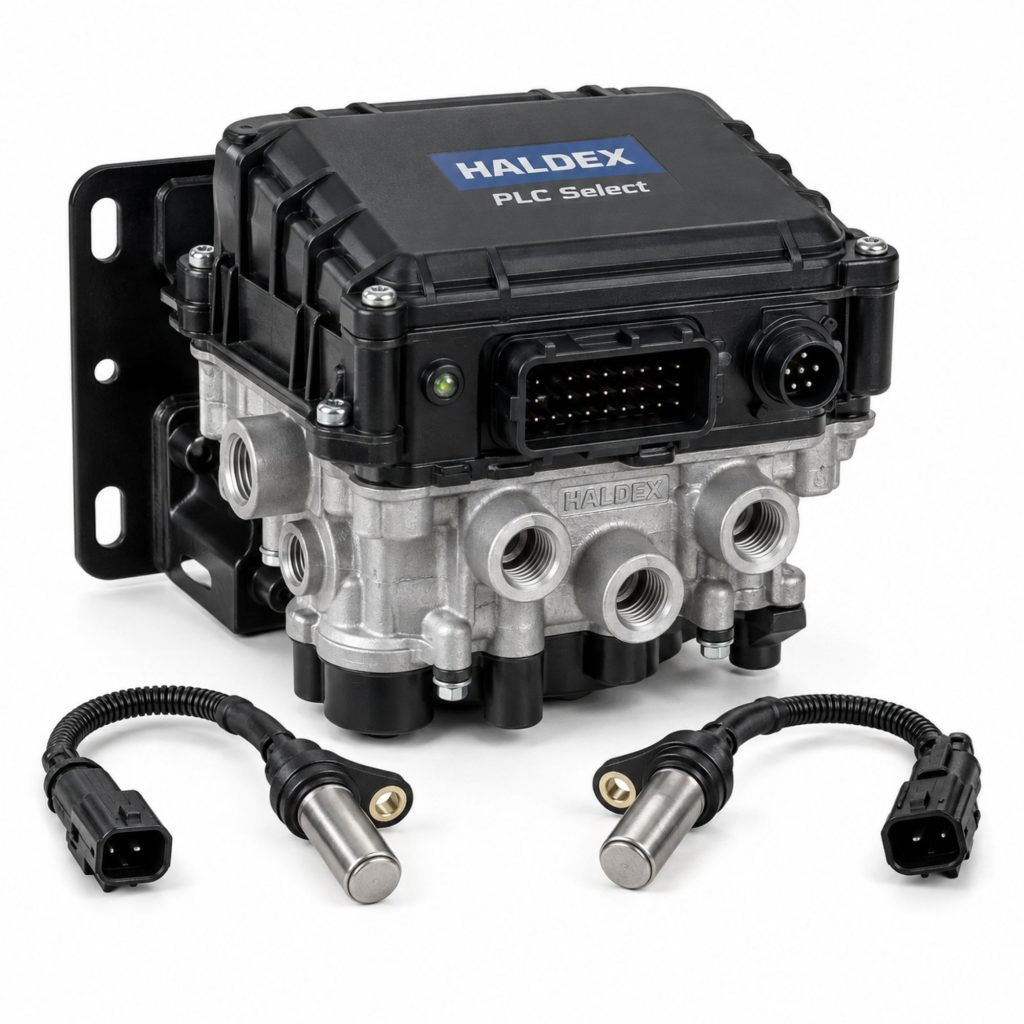
The Haldex PLC Select Trailer ABS is an electronic antilock braking system developed for air-braked commercial trailers. It monitors trailer wheel speed and adjusts service-brake pressure when one or more monitored wheels begin approaching lockup.
PLC Select was offered in multiple configurations ranging from basic 2S/1M single-channel ABS to 4S/2M multichannel systems. The first number identifies the quantity of wheel-speed sensors, while the second identifies the number of independently controlled modulator channels.
The system uses Power Line Carrier technology to send trailer ABS status and diagnostic information through the trailer’s existing permanent-power circuit. This supports communication with the tractor’s in-cab trailer ABS warning lamp without requiring a separate communication cable.
Haldex also offered PLC Select Full Function ABS. The Full Function valve combines service-brake control, spring-brake control, anticompounding, and ABS modulation within a more integrated pneumatic assembly. Other PLC Select installations use a basic ABS relay valve with separate spring-brake control equipment.
PLC Select is an established Haldex platform, while newer trailers may use Haldex ITCM or other later-generation control systems. Current service work requires careful identification because PLC Select versions, valves, sensors, connectors, and configurations are not universally interchangeable.
Haldex literature identifies both basic PLC Select ABS and PLC Select Full Function ABS arrangements for applications ranging from 2S/1M through 4S/2M. Haldex PLC Select ABS Platform Guide
Key Characteristics
- Electronic self-monitoring trailer ABS
- Power Line Carrier communication
- Supports in-cab trailer ABS warning indication
- Available in single-channel and multichannel configurations
- Two- or four-wheel-speed sensor arrangements
- One- or two-modulator control
- Basic ABS relay-valve configurations
- Full Function ABS valve configurations
- PLC Select Low/High control logic
- Direct sensor connections on applicable ECUs
- Direct trailer-power connection
- External second-modulator connection on 2M systems
- Diagnostic trouble-code storage
- Blink-code diagnostic capability
- PLC Info Center compatibility
- PC-based diagnostic support
- Auxiliary functions on PLC Select Plus systems
- Designed for multiple trailer axle arrangements
Major Components
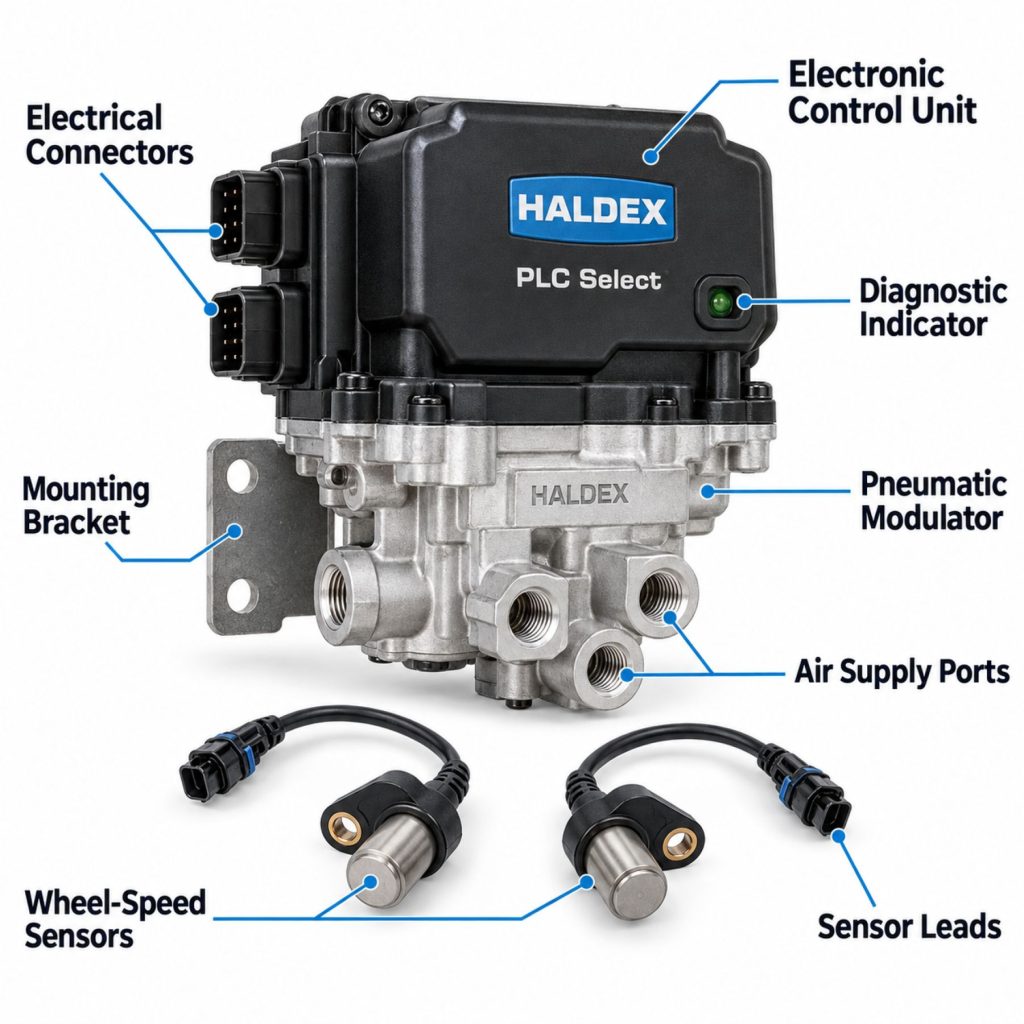
- PLC Select electronic control unit
- Integrated ECU and ABS relay-valve assembly
- Full Function ABS valve where equipped
- External second ABS relay valve on 2M systems
- Spring-brake control valve on basic systems
- Wheel-speed sensors
- Sensor retaining clips
- Wheel-end exciter rings
- Sensor extension cables where required
- Trailer ABS power cable
- External modulator-valve cable
- Trailer-mounted ABS warning lamp
- Tractor in-cab trailer ABS warning lamp
- PLC communication circuit
- Trailer air reservoirs
- Trailer service-brake chambers
- Trailer spring-brake chambers
- Service-control air line
- Supply and emergency air lines
- Pneumatic hoses and fittings
- Diagnostic connector or interface cable
- Mounting bracket and hardware
How the Brake Component or System Works
Wheel-speed sensors mounted at selected trailer wheel ends produce electrical signals as the exciter-ring teeth pass their sensor tips. The PLC Select ECU uses these signals to calculate wheel speed and compare the behavior of the monitored wheels.
During normal braking, the trailer’s pneumatic system supplies air to the service-brake chambers through the ABS relay valve or Full Function ABS valve.
If the ECU determines that a monitored wheel is decelerating too rapidly and may lock, it energizes the appropriate modulator solenoids.
The valve can:
- Increase brake pressure
- Hold the existing pressure
- Reduce brake pressure
Once the wheel begins rotating normally, the system restores braking pressure. This cycle can occur repeatedly during a hard stop.
In a 1M system, one modulator channel controls the connected trailer brakes. A 2M system provides two separately controlled channels, commonly allowing side-by-side or application-specific axle control.
If an electrical ABS fault is detected, the ECU stores a diagnostic code and illuminates the appropriate warning lamp. Normal pneumatic braking generally remains available, but the affected antilock function may be disabled.
Position and Function Within the Brake System
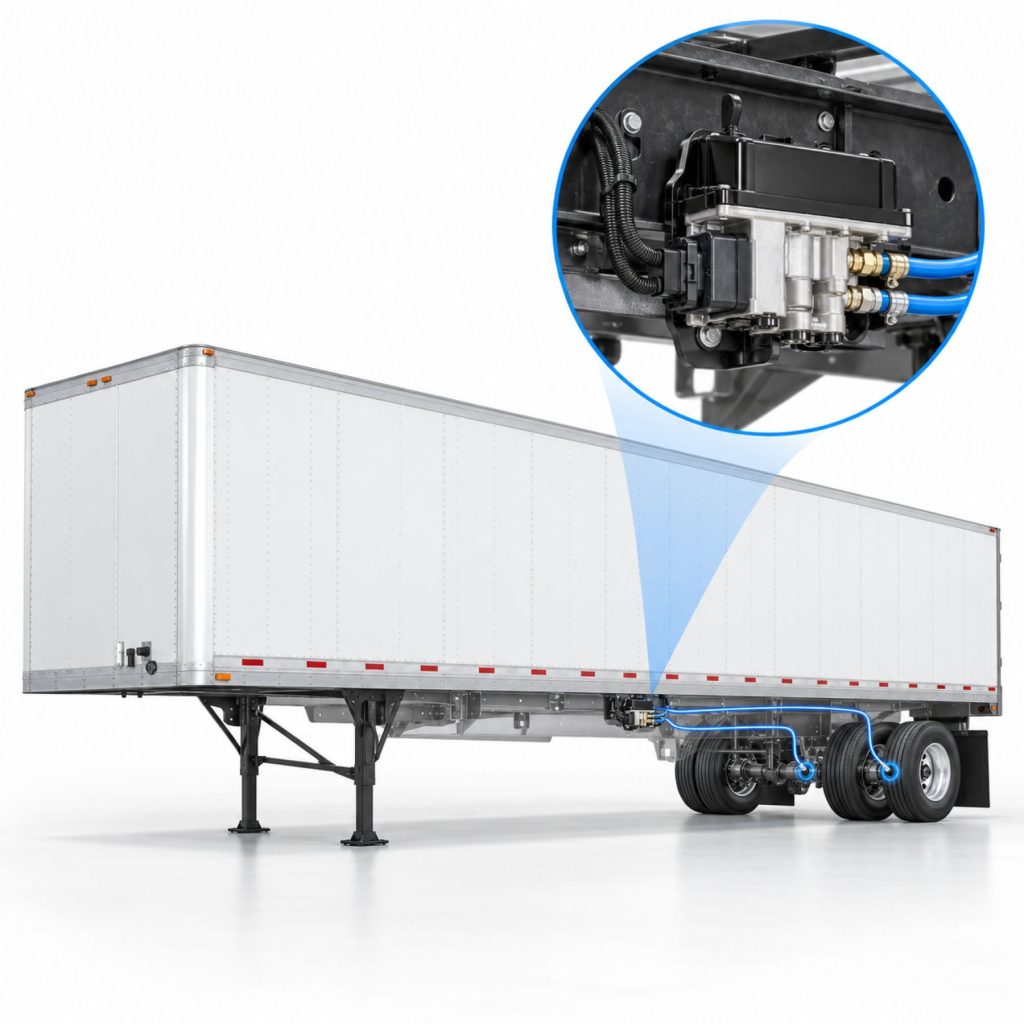
PLC Select is installed in the trailer’s service-brake delivery system. It operates between the tractor’s pneumatic service-brake command and the trailer’s brake chambers.
The ECU receives wheel-speed and electrical information. The associated ABS relay valve uses trailer reservoir air to supply the brake chambers.
On a basic PLC Select installation, separate pneumatic valves may handle spring-brake control, emergency operation, and anticompounding.
On a PLC Select Full Function ABS installation, one integrated valve can perform several functions that might otherwise require multiple components:
- Service-brake relay operation
- ABS pressure modulation
- Spring-brake control
- Anticompounding
- Service-brake priority or spring-brake priority, depending on configuration
The exact pneumatic arrangement must be confirmed from the trailer diagram and valve identification.
Common Specifications
- System Type: Electronic trailer ABS
- Common Voltage: 12-volt North American trailer system
- Communication: Power Line Carrier through the permanent-power circuit
- Common Configurations: 2S/1M, 2S/2M, and 4S/2M
- Sensor Count: Two or four
- Modulator Channels: One or two
- Controller Arrangement: ECU with integrated or connected ABS relay valve
- Second Modulator: External valve used on applicable 2M systems
- Foundation Brakes: Approved trailer air-disc or drum brakes
- Warning Indicators: Trailer-mounted lamp and PLC-compatible in-cab lamp
- Diagnostics: Blink codes, PLC Info Center, and compatible PC software
- Mounting: Frame, crossmember, or approved reservoir arrangement, depending on valve
- Primary Service Literature: Haldex PLC Select installation and service manuals
- System Versions: 1M, 2M, Plus, and Full Function ABS
Exact voltage limits, valve port sizes, connectors, sensor assignments, control logic, and replacement parts depend on the identified ECU and valve assembly.
Operating Specifications and Performance
PLC Select monitors wheel-speed information whenever the system has electrical power and the trailer is operating.
At system startup, the ECU performs a self-check. The trailer ABS warning lamp normally illuminates for a brief bulb check and then turns off when no active fault is present.
Some systems also perform a valve blow-down or solenoid activation test at power-up. A brief exhaust sound can indicate that the ECU and valve are completing their initial check.
ABS performance depends on:
- Reliable electrical power
- Valid wheel-speed signals
- Correct sensor placement
- Proper exciter-ring condition
- Functional valve solenoids
- Correct sensor-to-valve configuration
- Adequate air pressure
- Correct pneumatic plumbing
- Balanced foundation brakes
- Proper tire and wheel dimensions
The Haldex Select Low/High control strategy evaluates wheel behavior to balance stability and available braking force. Actual control logic depends on system configuration.
PLC Select does not necessarily reduce stopping distance on every road surface. Its principal purpose is to help prevent wheel lock and maintain stability during braking.
Braking Performance and System Integration
A 2S/1M system uses two sensors and one modulator channel. Both sides of the connected brake circuit are controlled through the same modulation channel.
A 2S/2M system uses two wheel-speed sensors and two modulator channels. This can provide separate control for the roadside and curbside brake circuits.
A 4S/2M system uses four wheel-speed sensors and two modulator channels. It monitors additional wheel positions while controlling two pneumatic circuits.
System configuration affects braking response, tire-slip management, and installation complexity. The most sophisticated arrangement is not automatically the correct one for every trailer.
Effective ABS operation also depends on foundation-brake condition. The system cannot compensate for:
- Excessive chamber stroke
- Worn friction material
- Sticking camshafts
- Seized calipers
- Cracked drums or rotors
- Contaminated linings or pads
- Air leaks
- Mismatched brake chambers
Air Supply, Controls, and Electronic Integration
PLC Select uses the trailer’s existing pneumatic supply and service-brake circuits. Depending on the selected valve platform, it may integrate ABS modulation with additional parking and emergency-brake functions.
The system may interact with:
- Trailer supply line
- Trailer service-control line
- Air reservoirs
- ABS relay valves
- Spring-brake control valves
- Full Function ABS valve
- Service-brake chambers
- Spring-brake chambers
- SAE J560 electrical connector
- Permanent trailer-power circuit
- Trailer ABS warning lamp
- Tractor in-cab trailer ABS lamp
- PLC diagnostic equipment
- Auxiliary trailer devices
PLC communication places electronic ABS information on the trailer’s existing power wire. This allows a compatible tractor to receive trailer ABS status without adding a separate conductor to the seven-way cable.
PLC Select Plus versions can also support application-specific auxiliary inputs and outputs. These may be used for approved trailer monitoring or control functions.
Installation, Adjustment, and Brake Balance
PLC Select components must be installed according to the system configuration and trailer schematic. Sensor connections, valve assignments, and pneumatic routing differ between 1M and 2M systems.
Installation should verify:
- Correct ECU and valve assembly
- Sensor quantity
- Modulator quantity
- Roadside and curbside sensor assignments
- Correct valve-solenoid connections
- Power and ground integrity
- PLC communication
- Trailer warning-lamp operation
- Tractor warning-lamp operation
- Correct air-line routing
- Exhaust-port clearance
- Secure cable routing
- Balanced foundation brakes
Haldex generally recommends placing sensors on the axle or wheel positions most likely to lock first during braking. The correct locations depend on axle loading, suspension, brake design, and trailer configuration.
Sensors must be pushed firmly toward their exciter rings during installation. Normal wheel rotation establishes the operating air gap.
After installation, the system should receive an approved end-of-line test that verifies wheel-speed sensor identification, valve operation, warning lamps, configuration, and pneumatic response.
Foundation Brake, Axle, and Wheel-End Compatibility
PLC Select can work with approved trailer air-disc or S-cam drum brakes. The electronic system monitors wheel behavior and controls pneumatic pressure independently of the specific approved foundation-brake style.
Compatibility depends on:
- Trailer axle count
- Tandem, tridem, or specialty arrangement
- Fixed- or lift-axle design
- Sensor-block locations
- Exciter-ring tooth count
- Hub and bearing design
- Brake chamber size
- Modulator-valve plumbing
- Tire rolling circumference
- Suspension loading
- ECU configuration
- Full Function or basic pneumatic architecture
Different tire sizes may require different exciter rings or system considerations. Haldex service information should be consulted before changing tire diameter or wheel-end components.
Excessive wheel-bearing movement can change the sensor-to-ring gap and create intermittent wheel-speed faults.
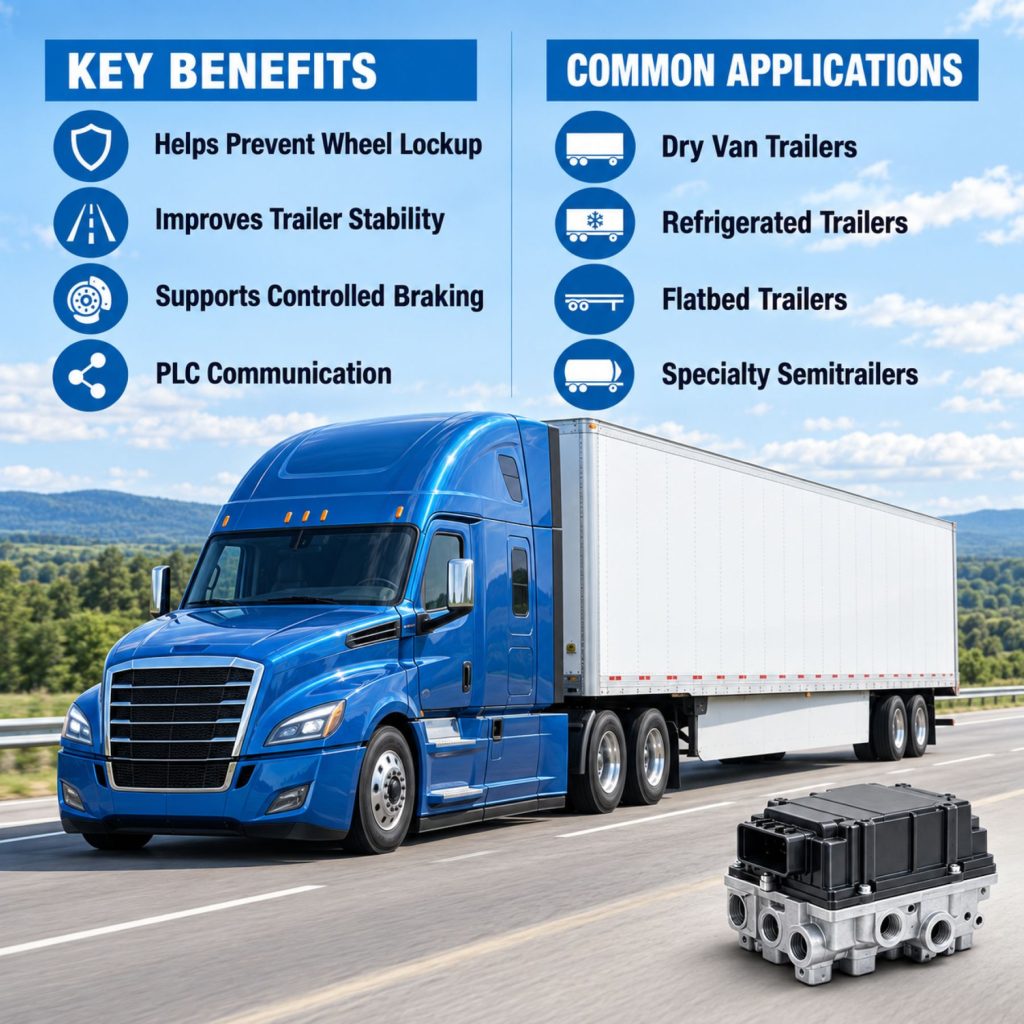
Common Applications
- Dry-van trailers
- Refrigerated trailers
- Flatbed trailers
- Step-deck trailers
- Tank trailers
- Hopper trailers
- Dump trailers
- Container chassis
- Lowboy trailers
- Converter dollies
- Full trailers
- Logging trailers
- Livestock trailers
- Lift-axle trailers
- Multi-axle specialty trailers
Vehicle and Brake-System Compatibility
PLC Select was designed for air-braked commercial trailers and converter dollies requiring federally compliant trailer ABS.
Compatible configurations may include:
- Single-axle trailers
- Tandem-axle trailers
- Tridem trailers
- Full trailers
- Converter dollies
- Spread-axle trailers
- Lift-axle trailers
- Multi-trailer combinations
- Specialty axle arrangements
The correct system cannot be selected from trailer make and model alone. Identification requires the ECU number, valve arrangement, sensor count, modulator count, connector style, and pneumatic schematic.
A 1M ECU or valve should not be substituted for a 2M system without an approved conversion. PLC Select, PLC Select Plus, and Full Function ABS components may have different capabilities even when their housings appear similar.
Advantages
- Helps prevent trailer wheel lock
- Supports trailer stability during braking
- Uses existing power wiring for communication
- Provides in-cab trailer ABS warning capability
- Available in multiple configurations
- Supports basic and multichannel applications
- Compatible with many trailer types
- Works with drum and air-disc brakes
- Stores diagnostic faults
- Supports blink-code troubleshooting
- Compatible with PLC Info Center diagnostics
- Supports PC-based diagnostics
- Available Full Function ABS valve
- Full Function version reduces separate valve count
- Can reduce pneumatic plumbing complexity
- Auxiliary functions available on selected versions
- Replacement and upgrade kits may be available
Limitations or Considerations
- Older platform compared with current Haldex ITCM systems
- Exact functions vary by version
- Components are not universally interchangeable
- Sensor and valve assignments must be correct
- Second modulator requires correct cable and plumbing
- PLC faults can affect in-cab warning operation
- Low voltage can trigger diagnostic faults
- Wheel-bearing looseness can affect sensor signals
- Incorrect tire or exciter-ring combinations can create faults
- Normal braking may remain after an ABS fault while antilock control is lost
- Full Function ABS requires application-specific plumbing
- Older harnesses and connectors may be difficult to identify
- Corrosion and road contamination can damage wiring
- Replacement may require adapter cables or conversion kits
- ABS does not correct mechanical brake defects
Driver and Operator Experience
PLC Select normally operates without driver involvement. The driver may notice ABS pressure modulation during hard braking on a slippery surface.
The brake pedal should be applied according to the driving situation. Pumping the brakes is generally unnecessary and can interfere with effective braking.
The trailer-mounted ABS warning lamp and tractor’s in-cab trailer ABS lamp provide the primary driver indications.
Drivers should report:
- Trailer ABS lamp remaining on
- In-cab trailer ABS warning
- Lamp failing to illuminate during its check
- Trailer wheel lock
- Trailer pulling during braking
- Flat-spotted tires
- Intermittent warning lamps
- Damaged seven-way connector
- Air leakage
- Recent wheel-end repairs followed by ABS faults
An illuminated warning lamp does not necessarily mean all trailer braking has been lost. It does mean that the ABS requires inspection.
Maintenance and Ownership Notes
- Inspect wheel-speed sensor cables.
- Check sensor connectors for corrosion.
- Inspect exciter rings for damaged teeth.
- Remove excessive debris from exciter rings.
- Verify sensor placement.
- Check wheel-bearing end play.
- Inspect ECU and valve mounting.
- Check external modulator-valve cables.
- Inspect the ABS power cord.
- Check the SAE J560 connector.
- Verify trailer electrical power.
- Test trailer ABS warning-lamp operation.
- Test in-cab trailer ABS indication.
- Verify PLC communication.
- Inspect pneumatic lines for leakage.
- Check valve exhaust ports.
- Inspect spring-brake control components.
- Measure brake chamber stroke.
- Inspect slack adjusters and camshafts.
- Inspect drums, rotors, linings, pads, and calipers.
- Retrieve active and stored diagnostic faults.
- Perform an end-of-line test after major repairs.
Common Brake-System Problems
- Trailer ABS lamp remains illuminated: A wheel-speed sensor, valve solenoid, wiring, power, ground, ECU, configuration, or communication fault may be active.
- ABS lamp does not illuminate: A failed lamp, open circuit, missing power, poor ground, damaged harness, or ECU fault may prevent the bulb check.
- Intermittent sensor fault: Excessive sensor gap, loose wheel bearing, damaged exciter ring, debris, corrosion, or broken wiring may interrupt the wheel-speed signal.
- Modulator-valve fault: Open or shorted solenoid wiring, damaged valve cables, contamination, internal valve failure, or incorrect connections can prevent pressure modulation.
- No PLC communication: Damaged trailer wiring, excessive resistance, poor seven-way connector contact, incompatible tractor equipment, or ECU failure may block the signal.
- Trailer wheels lock during braking: ABS may be disabled, sensor information may be invalid, valves may not modulate, or mechanical brake problems may be present.
- Uneven braking: Incorrect 2M plumbing, reversed valve assignments, brake-adjustment differences, contaminated friction material, or mismatched components may create imbalance.
- Configuration fault: Incorrect sensor quantity, wrong modulator connections, incomplete wiring, or insufficient power may prevent the ECU from recognizing the installed system.
- Fault returns after sensor replacement: Exciter-ring damage, bearing looseness, cable problems, incorrect sensor location, or connector damage may remain.
- Full Function valve problem: Air leakage, incorrect plumbing, internal valve damage, or spring-brake control faults may affect service, parking, or anticompounding operation.
Safety and Service Precautions
PLC Select includes electrical and compressed-air components. Service should be performed by technicians trained in commercial trailer brakes and ABS.
Before beginning work:
- Park the vehicle on a level surface.
- Apply the parking brakes.
- Block the wheels.
- Support the trailer with properly rated stands.
- Drain all air reservoirs.
- Disconnect electrical power when required.
- Record diagnostic fault codes.
- Identify the sensor and modulator configuration.
- Label electrical connectors and air lines.
- Follow the correct Haldex manual.
Never work beneath a trailer supported only by jacks. Never remove pneumatic valves or fittings while the system remains pressurized.
Use eye protection when releasing air or working near brake components. Keep hands clear of brake chambers, pushrods, slack adjusters, and moving wheel-end parts.
Protect the ECU from welding current. Follow Haldex and trailer-manufacturer procedures before welding on the frame.
Identification Information
PLC Select identification is normally located on the ECU or valve assembly label.
Record the following information:
- Trailer manufacturer
- Vehicle identification number
- Trailer model and year
- Haldex ECU part number
- Valve assembly part number
- System serial number
- Production date
- PLC Select version
- 1M or 2M configuration
- Number of wheel-speed sensors
- Number of modulator channels
- PLC Select Plus status
- Full Function ABS status
- Basic ABS relay-valve status
- External modulator-valve number
- Spring-brake control-valve type
- Power-cable configuration
- Sensor-port assignments
- Valve-solenoid assignments
- Foundation-brake type
- Active diagnostic fault codes
- Stored diagnostic fault codes
Do not identify the system solely from the Haldex name or housing appearance. PLC Select components may look similar while having different functions and internal programming.
Buying Considerations
- Confirm that the trailer uses PLC Select.
- Record the complete ECU number.
- Identify the ABS valve number.
- Determine whether the system is 1M or 2M.
- Count the wheel-speed sensors.
- Identify the modulator channels.
- Confirm PLC Select Plus functions.
- Determine whether Full Function ABS is installed.
- Match the spring-brake control arrangement.
- Check connector style.
- Verify external modulator-cable length.
- Compare pneumatic ports.
- Inspect the existing harness.
- Retrieve fault codes before ordering parts.
- Determine whether an upgrade kit is available.
- Confirm diagnostic-tool compatibility.
- Use the correct installation schematic.
- Test the system after installation.
Variants and Configurations
- PLC Select 1M ABS
- PLC Select 2M ABS
- PLC Select Plus ABS
- PLC Select Full Function ABS
- 2S/1M configuration
- 2S/2M configuration
- 4S/2M configuration
- Basic ABS relay-valve system
- Integrated Full Function valve system
- Service-brake priority configuration
- Spring-brake priority configuration
- Separate spring-brake control valve
- External second ABS modulator valve
- Single-axle trailer application
- Tandem-axle trailer application
- Tridem trailer application
- Full-trailer application
- Converter-dolly application
- Multi-trailer configuration
- Original-equipment installation
- Universal replacement or upgrade kit
Comparison to Similar Equipment
Compared with the Meritor WABCO Enhanced Easy-Stop Trailer ABS, PLC Select uses Haldex-specific controllers, valves, diagnostics, wiring, and braking logic. Both support PLC communication and multiple trailer ABS configurations.
Compared with the Bendix TABS-8 Trailer ABS, standard PLC Select primarily provides antilock braking. TABS-8 Advanced combines 2S/1M ABS with an integrated trailer roll-stability program.
Compared with Haldex ITCM, PLC Select is an earlier-generation platform. ITCM combines newer electronic architecture, CAN-based capabilities, diagnostics, and expanded auxiliary integration.
Compared with a basic relay-valve trailer ABS, PLC Select Full Function ABS can combine ABS modulation, service-brake control, spring-brake control, and anticompounding in one valve platform.
Compared with a trailer roll-stability system, PLC Select ABS reacts to wheel-lock conditions during braking but does not automatically provide rollover mitigation unless paired with a separate or differently specified stability system.
Best Fit For
- Trailers originally equipped with PLC Select
- Fleets maintaining established Haldex trailer ABS
- Dry-van trailers
- Refrigerated trailers
- Flatbed trailers
- Tank trailers
- Dump trailers
- Hopper trailers
- Converter dollies
- Full trailers
- Multi-axle trailers
- Fleets requiring PLC warning-lamp communication
- Applications needing 1M or 2M control
- Replacement of compatible older trailer ABS systems
- Repair facilities familiar with Haldex diagnostics
Related Vehicle and Trailer Types
- Complete Guide to Semi Trailer Types
- Dry-van trailers
- Refrigerated trailers
- Flatbed trailers
- Step-deck trailers
- Tank trailers
- Dump trailers
- Hopper trailers
- Container chassis
- Lowboy trailers
- Logging trailers
- Livestock trailers
- Converter dollies
- Full trailers
- Specialty trailers
Related Truck and Trailer Models
- Great Dane Champion Dry Van Trailer
- Great Dane Everest Reefer Trailer
- Utility 3000D Dry Van Trailer
- Utility 3000R Reefer Trailer
- Wabash DuraPlate Dry Van Trailer
- Wabash ArcticLite Reefer Trailer
- Polar Tank Trailer
- Heil Tank Trailer
- Timpte Super Hopper
- Wilson Pacesetter Hopper Trailer
Related Brake System Types
- Brake Systems
- Air Brake Systems
- ABS & Electronic Braking Systems
- Trailer Brake Systems
- Air Disc Brake Systems
- Drum Brake Systems
- Trailer antilock braking systems
- Power Line Carrier systems
- Trailer roll-stability systems
- Trailer spring-brake control systems
Related Brake Products
- Bendix TABS-8 Trailer ABS
- Meritor WABCO Enhanced Easy-Stop Trailer ABS
- Haldex ModulT Air Disc Brake
- Haldex Gold Seal Spring Brake
- Haldex Life Seal Spring Brake
- Hendrickson MAXX22T Trailer Air Disc Brake
- Haldex PLC Select ECUs
- Haldex ABS relay valves
- Haldex Full Function ABS valves
- Haldex wheel-speed sensors
- Haldex PLC Info Center
- Trailer ABS indicator lamps
Related Equipment Systems
- Equipment Systems
- Axles & Differentials
- Suspension Systems
- Tires & Wheels
- Trailer air systems
- Trailer electrical systems
- Trailer axle systems
- Wheel-end systems
- Lift-axle controls
- Trailer telematics systems
Related Guides
- Brake System Guides
- Air Brake Systems Explained
- How Truck ABS and Electronic Stability Control Work
- How to Inspect and Maintain Commercial Truck Brakes
- Tractor vs Trailer Brake Systems
- Air Disc Brakes vs Drum Brakes
- Commercial Truck Brake Components Explained
Regulatory and Compliance Notes
Commercial trailers must maintain compliant service brakes, parking brakes, ABS equipment, warning lamps, and electrical connections under applicable federal, state, provincial, and motor-carrier requirements.
PLC Select supports the in-cab trailer ABS warning function required for applicable North American trailers through Power Line Carrier communication.
An active ABS fault may disable some or all antilock functionality while leaving conventional pneumatic braking available. The warning lamp should not be ignored simply because the trailer still appears to stop normally.
ABS does not correct mechanical defects such as:
- Excessive pushrod stroke
- Worn linings or pads
- Damaged drums or rotors
- Air leakage
- Defective spring brakes
- Incorrect slack-adjuster geometry
- Unsafe tires
- Overloaded axles
System conversions must preserve the trailer’s certified braking performance. The trailer manufacturer or qualified engineering authority remains responsible for confirming regulatory compliance after significant modifications.
Real World Operating Notes
PLC Select systems are commonly found on trailers that have accumulated years of road exposure. Wiring, connectors, sensor cables, valve cables, mounting brackets, and pneumatic fittings should be inspected before an ECU is condemned.
Many wheel-speed faults begin after hub, bearing, or brake service. The sensor may not have been pushed fully against the exciter ring, or excessive bearing movement may create an inconsistent air gap.
A brief valve exhaust sound during startup can be part of the system’s normal self-test. The warning lamp should complete its prescribed sequence and turn off when no active fault exists.
The Full Function ABS version must be identified correctly because it performs spring-brake and anticompounding functions in addition to ABS modulation. Replacing it with a basic ABS relay valve would require an entirely different pneumatic design.
Frequently Asked Questions
What is Haldex PLC Select Trailer ABS?
It is an electronic trailer antilock braking system that monitors wheel speed and modulates pneumatic brake pressure to help prevent wheel lock.
What does PLC mean?
PLC means Power Line Carrier. It allows trailer ABS information to travel through the trailer’s existing electrical power circuit.
What does 2S/1M mean?
It means the system uses two wheel-speed sensors and one modulator channel.
What does 4S/2M mean?
It means the system uses four wheel-speed sensors and two modulator channels.
What is PLC Select Full Function ABS?
It is an integrated Haldex valve platform that can combine ABS modulation, service-brake relay operation, spring-brake control, and anticompounding.
Does PLC Select include roll stability?
Standard PLC Select is primarily an antilock braking platform. Roll-stability functionality should not be assumed unless a separate stability system or specifically identified configuration is installed.
Can it work with air disc brakes?
Yes, when installed on an approved trailer air-disc brake configuration.
Can it work with drum brakes?
Yes. PLC Select is also used with trailer S-cam drum brakes.
Will the trailer still brake if ABS develops a fault?
Conventional pneumatic braking generally remains available, but the affected antilock functions may be disabled.
Why does the ABS lamp remain on?
Possible causes include a sensor fault, damaged exciter ring, valve-solenoid problem, low voltage, wiring damage, incorrect configuration, PLC communication problem, or ECU fault.
Are PLC Select 1M and 2M components interchangeable?
No. Their sensor inputs, valve controls, cables, programming, and pneumatic arrangements differ.
How can the correct replacement be identified?
Use the complete ECU and valve numbers, system version, sensor count, modulator count, connector style, pneumatic configuration, and trailer information.
Availability and Where to Find
Haldex PLC Select ECUs, ABS relay valves, Full Function valves, wheel-speed sensors, sensor extensions, external modulator cables, power cords, warning lamps, diagnostic equipment, and replacement kits may be available through Haldex distributors, trailer dealers, heavy-duty parts suppliers, fleet-parts departments, and trailer brake specialists.
Availability depends on the exact PLC Select generation, ECU, valve, wiring, sensor configuration, and trailer application. Some older components may be superseded by kits requiring adapter cables or installation changes.
Haldex has offered universal 2S/1M PLC Select replacement kits for specified legacy trailer ABS applications. Compatibility must be confirmed before treating one as a direct replacement.
Current parts listings, technical documents, and support resources are available through the Haldex Trailer ABS product section and the Haldex PLC Select 1M and 2M page.
Support Trucking Families
Truck Equipment Atlas supports the mission of Grey Cross, a nonprofit dedicated to helping families of truck drivers who lose their lives while on the road. As the site grows, part of its mission is to bring awareness and support to these families.
Podcast or Video Section
Learn More Through Audio and Video
Truck Equipment Atlas will continue expanding with podcast episodes, interviews, and equipment breakdowns to help drivers and fleets better understand trucks and equipment.
Follow the Growth of Truck Equipment Atlas
Truck Equipment Atlas continues to expand with new truck profiles, trailer coverage, diesel engine pages, equipment system resources, manufacturer information, and educational guides.
Visit our Site Updates page to explore recent additions, project milestones, and upcoming resources as we continue building one of the industry’s growing commercial trucking equipment reference libraries.
View the Latest Site Updates: Truck Equipment Atlas Site Updates