
Haldex Life Seal Spring Brake
Quick Facts
- Manufacturer: Haldex
- Product Name: LifeSeal+ Spring Brake
- Former/Common Name: Life Seal Spring Brake
- Product Type: Sealed double-diaphragm spring-brake actuator
- Brake-System Category: Brake chamber and actuator
- Primary Functions: Service-brake actuation, parking braking, and emergency braking
- Foundation-Brake Compatibility: S-cam drum brakes and selected air-disc brake applications
- Common Chamber Sizes: Type 24/30 and Type 30/30, depending on configuration
- Available Stroke Options: Standard and long-stroke configurations
- Available Assemblies: Complete combination chambers and piggyback replacement units
- Primary Applications: Heavy trucks, tractors, trailers, buses, and specialty commercial vehicles
- Current Product Identity: LifeSeal+ is the current Haldex branding associated with the Life Seal actuator family
- Primary Benefit: A permanently sealed spring chamber designed to resist contamination, corrosion, and air leakage
Overview
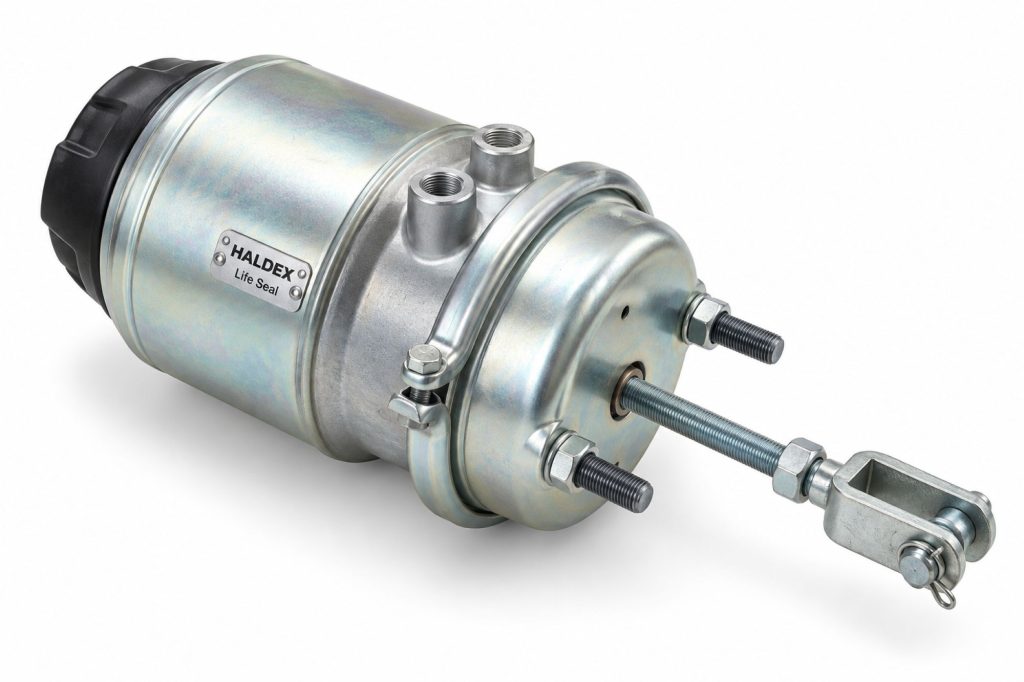
The Haldex Life Seal Spring Brake is a double-diaphragm air-brake actuator designed to operate a commercial vehicle’s service, parking, and emergency brakes. The product is now commonly presented under the LifeSeal+ name, although Life Seal remains widely used when identifying earlier actuators, replacement parts, and existing vehicle installations.
The actuator combines two chambers in one assembly. The service chamber converts normal brake-system air pressure into pushrod movement whenever the driver applies the brakes. The spring chamber contains a powerful mechanical spring that applies the parking brake when air pressure is released.
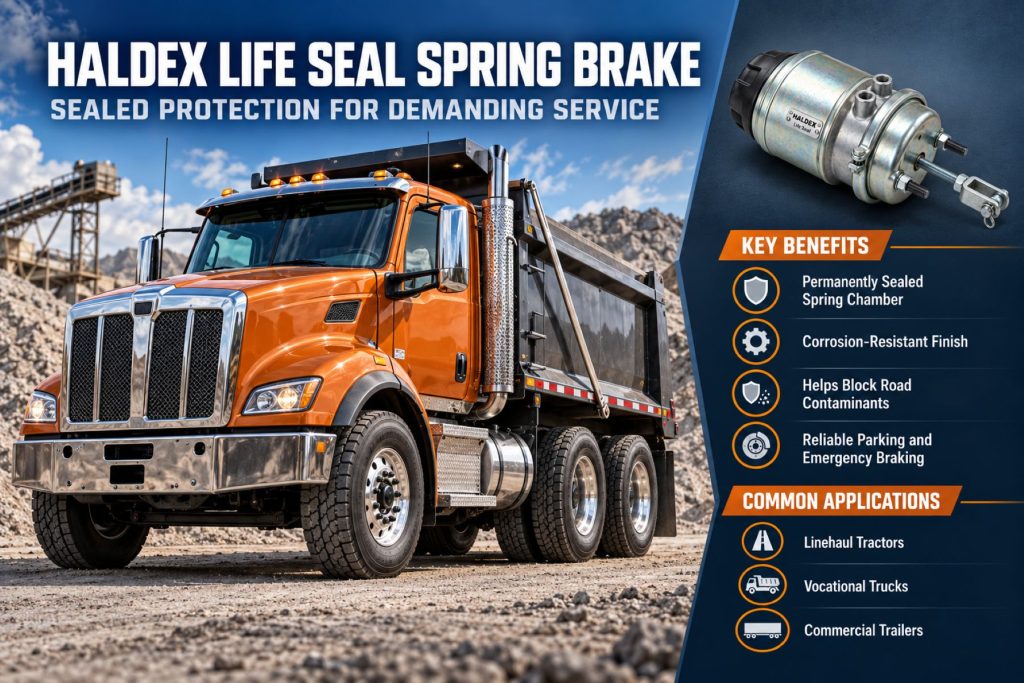
LifeSeal’s defining feature is its sealed spring-chamber construction. The design helps prevent water, road salt, dirt, and chemicals from reaching the power spring and other internal components. This is especially useful on trailers and vocational vehicles that operate in wet, corrosive, or high-mileage environments.
Haldex describes LifeSeal+ as a truly sealed double-diaphragm spring brake. Its current actuator literature lists configurations for drum and disc brakes, complete chambers and piggyback units, different pushrod arrangements, and standard or high-output power springs. Haldex’s actuator guide should be checked for the exact configuration presently available.
Key Characteristics
- Sealed double-diaphragm spring-brake design
- Provides service, parking, and emergency-brake actuation
- Permanently attached spring chamber
- Designed to reduce entry of moisture and road contaminants
- Available for drum-brake and selected disc-brake applications
- Available as complete combination chambers
- Available as piggyback replacement units
- Standard- and long-stroke configurations
- Standard and high-output power-spring options
- Threaded, welded-clevis, and application-specific pushrod arrangements
- Mechanical fail-safe braking when air pressure is lost
- Application-specific chamber sizes
- Corrosion-resistant exterior treatment
- Integrated or retained manual-release equipment, depending on version
- Date marking and part-number identification for traceability
- Designed and tested for commercial-vehicle service
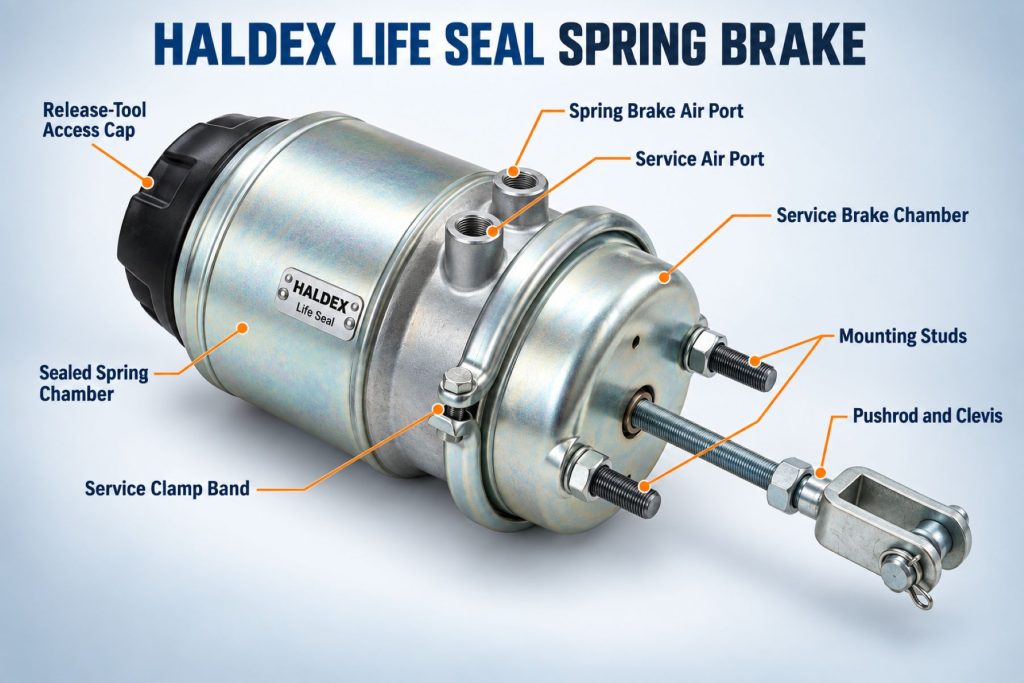
Major Components
- Service-brake housing
- Service diaphragm
- Service return spring
- Service-pressure port
- Service pushrod
- Clevis or welded pushrod connection
- Spring-brake housing
- Parking-brake diaphragm
- Power spring
- Parking-pressure port
- Sealed center section
- Pushrod seal
- Mounting studs
- Mounting nuts and washers
- Service-side clamp band
- Manual-release or caging mechanism
- Dust boot where required
- Identification label or stamped markings
How the Brake Component or System Works
During normal driving, compressed air enters the parking side of the actuator and holds the power spring in its compressed position. This keeps the parking brake released.
When the driver presses the brake pedal, the foot valve directs air into the service chamber. Air pressure acts against the service diaphragm, moving the pushrod outward. The pushrod then operates the slack adjuster and S-cam on a drum brake or acts through the appropriate input mechanism on a compatible air-disc brake.
When the driver releases the brake pedal, service pressure is exhausted. The return spring and foundation brake move the pushrod back toward its released position.
To apply the parking brake, the vehicle’s parking-brake control releases air from the spring chamber. The stored force of the power spring moves the pushrod outward and mechanically applies the brake.
If parking-circuit pressure is lost because of a major air leak or system failure, the power spring begins applying the brake. This provides the emergency fail-safe function associated with spring-brake systems.
Position and Function Within the Brake System
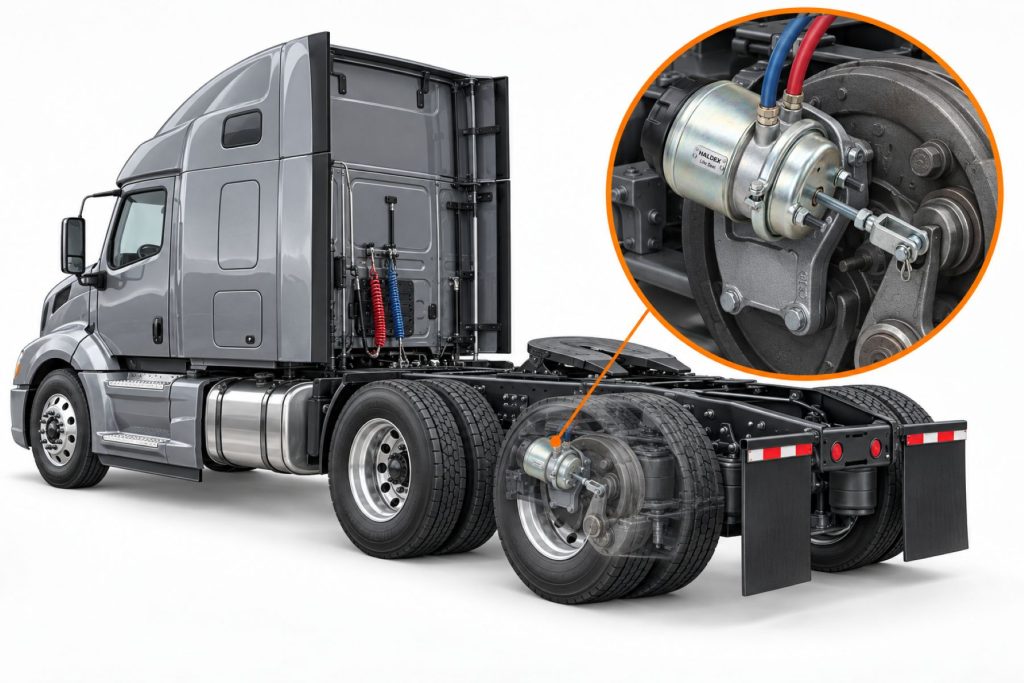
LifeSeal actuators are mounted at air-braked wheel positions that require parking and emergency-brake capability. They are commonly installed on tractor drive axles and trailer axles, although specific configurations may also be used on buses and specialty vehicles.
The actuator is positioned between the vehicle’s pneumatic controls and its foundation brake. It converts air pressure or stored spring force into mechanical movement.
Within the complete system, the actuator performs three related functions:
- It converts service air pressure into foundation-brake application force.
- It uses stored mechanical spring force to hold the vehicle when parked.
- It applies braking mechanically if parking-circuit pressure falls below the level needed to contain the power spring.
The LifeSeal actuator does not generate compressed air or control brake timing by itself. Those functions are handled by the compressor, reservoirs, brake valves, relay valves, modulating valves, ABS components, and associated air lines.
Common Specifications
- Actuator Type: Double-diaphragm spring brake
- Common Size Designations: 24/30 and 30/30
- Service-Chamber Stroke: Configuration-specific
- Common Stroke Classes: Standard and long stroke
- Foundation-Brake Applications: S-cam drum brake and selected air-disc brake systems
- Assembly Types: Complete combination chamber or piggyback unit
- Service-Brake Input: Compressed air
- Parking-Brake Input: Mechanical power spring controlled by air pressure
- Fail-Safe Function: Spring application following substantial parking-circuit pressure loss
- Pushrod Connection: Threaded, welded clevis, or application-specific arrangement
- Air-Port Configuration: Part-number specific
- Power-Spring Output: Standard or high output, depending on model
- Mounting Orientation: Determined by the chamber, bracket, ports, clearance, and vehicle application
- Testing Standard: Haldex literature references SAE J1469 testing for its actuator range
Exact chamber dimensions, stroke, pushrod length, clevis position, port orientation, output force, and mounting specifications must be verified using the full Haldex part number.
Operating Specifications and Performance
The actuator’s service output depends on service-chamber size and applied air pressure. A larger effective diaphragm area generally produces greater pushrod force at the same pressure.
The parking side uses a compressed power spring rather than application air pressure. Parking-system air holds the spring brake released. When that pressure is exhausted, the spring expands and applies the foundation brake.
Important performance variables include:
- Service-chamber size
- Rated stroke
- Applied air pressure
- Power-spring specification
- Foundation-brake geometry
- Slack-adjuster length
- Brake adjustment
- Brake lining or pad condition
- Drum or rotor condition
- Mechanical efficiency of the foundation brake
A LifeSeal chamber must not be substituted based only on its general appearance or a partial size designation. Stroke, pushrod length, clevis dimensions, chamber clocking, power-spring output, and mounting clearance can differ.
Braking Performance and System Integration
LifeSeal actuators form part of a complete pneumatic and mechanical braking system. Their performance depends on proper integration with the vehicle’s valves, tubing, foundation brakes, automatic slack adjusters, ABS controls, axles, and wheel ends.
On an S-cam drum brake, pushrod movement rotates the slack adjuster and camshaft. The S-cam forces the brake shoes outward against the drum.
On an approved air-disc brake installation, actuator movement is transmitted into the caliper’s operating mechanism. The caliper then clamps the brake pads against the rotor.
Balanced braking requires the chambers on an axle to have compatible:
- Chamber sizes
- Stroke ratings
- Pushrod geometry
- Slack-adjuster lengths
- Power-spring outputs
- Foundation-brake specifications
- Air-delivery characteristics
Installing unmatched actuators can contribute to unequal pushrod travel, brake imbalance, steering pull, wheel lockup, or uneven component wear.
Air Supply, Controls, and Electronic Integration
The LifeSeal spring brake relies on the vehicle’s compressed-air system. The service and parking sections use separate pneumatic circuits and must be connected to the correct ports.
Supporting components may include:
- Engine-driven air compressor
- Air dryer
- Supply reservoirs
- Service-brake reservoirs
- Foot brake valve
- Parking-brake control valve
- Tractor-protection valve
- Trailer-supply valve
- Relay valve
- Spring-brake modulating valve
- Quick-release valve
- ABS modulator valve
- Electronic stability-control system
- Air-pressure gauges and warning devices
ABS and stability-control systems regulate air pressure through modulator valves. They do not directly control the chamber’s mechanical power spring during ordinary parking-brake operation.
Correct hose routing is important. Air lines must be protected from heat, abrasion, crushing, sharp bends, and interference throughout axle and suspension travel.
Installation, Adjustment, and Brake Balance
A replacement LifeSeal actuator must match the original chamber size, stroke rating, mounting pattern, pushrod arrangement, clevis position, and power-spring specification.
Before installation, the technician should compare:
- Complete part number
- Chamber size
- Stroke designation
- Pushrod length
- Pushrod thread
- Clevis type and pin size
- Mounting-stud spacing
- Air-port locations
- Clamp-band orientation
- Power-spring output
- Available installation clearance
Pushrod and clevis dimensions affect foundation-brake geometry. Cutting or setting the pushrod incorrectly can create insufficient stroke, excessive stroke, brake drag, delayed application, or reduced braking force.
After installation, the vehicle’s brakes should be applied and released several times while pushrod travel, clearance, air leakage, hose movement, and brake balance are checked. Any required stroke measurement must follow the vehicle manufacturer’s service procedure and applicable inspection rules.
Foundation Brake, Axle, and Wheel-End Compatibility
LifeSeal actuators are offered in multiple configurations because commercial foundation brakes do not all use the same mounting geometry.
Compatibility depends on:
- Drum- or disc-brake design
- Brake size
- Axle manufacturer and model
- Chamber-mounting bracket
- Chamber size
- Rated stroke
- Slack-adjuster length
- Camshaft geometry
- Pushrod length and thread
- Clevis dimensions
- Air-port orientation
- Wheel and suspension clearance
The actuator must be approved for the specific foundation brake. An actuator intended for an S-cam drum brake should not automatically be used with an air-disc brake, even if the chamber size appears similar.
Common Applications
- Class 8 highway tractors
- Semi-trailers
- Dry vans
- Refrigerated trailers
- Flatbed trailers
- Tank trailers
- Dump trailers
- Vocational trucks
- Refuse vehicles
- Construction trucks
- Transit buses
- Motor coaches
- Specialty commercial vehicles
- Heavy equipment transporters
- Vehicles operating in wet or corrosive environments
Vehicle and Brake-System Compatibility
LifeSeal chambers are not selected by vehicle make and model alone. Commercial vehicles may use different axles, foundation brakes, chamber sizes, stroke ratings, and mounting arrangements within the same model family.
Compatibility should be confirmed using:
- Original actuator part number
- Vehicle identification number
- Axle identification
- Foundation-brake manufacturer and model
- Chamber size
- Stroke designation
- Pushrod and clevis dimensions
- Air-port orientation
- Mounting-bracket dimensions
- Brake manufacturer’s service information
The replacement actuator should maintain the original brake-system engineering. Changing chamber size or slack-adjuster geometry can alter output force and brake balance.
Advantages
- Sealed spring chamber helps resist contamination
- Reduces exposure of the power spring to water and road salt
- Provides service, parking, and emergency functions in one assembly
- Mechanical fail-safe operation during significant air-pressure loss
- Available in common commercial-vehicle configurations
- Standard- and long-stroke options
- Complete and piggyback replacement choices
- Drum- and selected disc-brake applications
- Multiple pushrod and clevis arrangements
- Standard and high-output power-spring choices
- Corrosion-resistant design features
- Part-number and date identification support traceability
- Designed for demanding truck and trailer service
- Extended warranty coverage may apply to qualifying current products
Limitations or Considerations
- Exact specifications vary substantially by part number
- Not every LifeSeal actuator fits every axle or foundation brake
- Incorrect stroke selection can create an unsafe installation
- Pushrod length may require application-specific setup
- Power-spring housing must never be opened improperly
- The sealed spring chamber is generally replaced as an assembly
- Air leaks elsewhere in the system can cause unintended spring-brake application
- Contamination can still affect exposed service-side components
- Mounting clearance must account for suspension and axle movement
- Older Life Seal and current LifeSeal+ numbers may differ
- Warranty terms depend on product, market, installation, and purchase date
- Actuator replacement does not correct worn foundation-brake components
- Brake balance can be affected by mismatched chambers
Driver and Operator Experience
A properly installed LifeSeal actuator should operate without noticeable delay, dragging, or unequal braking. The vehicle’s parking brakes should apply firmly when the parking control is activated and release completely after adequate system pressure is restored.
Drivers should report:
- Slow parking-brake release
- Vehicle pulling during braking
- Weak parking-brake holding
- Brake drag
- Air leakage
- Low-air warnings
- Uneven brake response
- Excessive compressor cycling
- Burning odors or wheel-end heat
- A vehicle that moves after the parking brakes are applied
A delayed spring-brake release may be caused by inadequate air pressure, restricted air delivery, a malfunctioning valve, damaged hoses, internal actuator problems, or a dragging foundation brake.
Maintenance and Ownership Notes
- Inspect the actuator housing for corrosion, dents, cracks, and impact damage.
- Check the service-side clamp band and fasteners.
- Inspect mounting studs, nuts, brackets, and welds.
- Check air hoses for abrasion, heat damage, and restricted routing.
- Test fittings and chamber ports for leakage.
- Inspect the pushrod, clevis, clevis pin, and retaining hardware.
- Confirm that the pushrod operates in proper alignment.
- Measure chamber stroke according to the applicable inspection procedure.
- Inspect automatic slack-adjuster operation.
- Check drum, lining, rotor, and pad condition.
- Verify complete brake release after pressure is restored.
- Keep the manual-release mechanism properly secured.
- Replace damaged or questionable chambers using approved procedures.
- Use the exact actuator part number when ordering replacement components.
Common Brake-System Problems
- Air leakage: Leakage can originate at a diaphragm, hose, fitting, valve, chamber port, or center seal. The complete circuit should be tested before the chamber is condemned.
- Excessive pushrod stroke: Worn brake components, incorrect adjustment, improper chamber selection, damaged slack adjusters, or excessive drum-to-lining clearance can increase stroke.
- Brake will not release: Low air pressure, restricted air delivery, a defective relay or parking valve, damaged actuator components, or a seized foundation brake may prevent release.
- Brake drag: Incorrect pushrod setup, binding linkage, a faulty return spring, foundation-brake corrosion, restricted exhaust flow, or damaged actuator components can keep the brake partially applied.
- Weak parking-brake holding: Incorrect chamber size, a damaged power spring, excessive foundation-brake clearance, worn friction material, or an unsuitable replacement actuator may reduce holding ability.
- Uneven braking: Mismatched chambers, unequal stroke, contaminated friction material, different slack-adjuster lengths, air-delivery problems, or foundation-brake wear can cause imbalance.
- Corrosion damage: Road salt, moisture, damaged coatings, and long-term chemical exposure can weaken external housings, mounting hardware, and brackets.
- Bent pushrod: Misalignment, impact damage, an incorrect bracket, or unsuitable clevis geometry can place side load on the pushrod.
- Frequent low-air warnings: Chamber leakage may contribute, but compressors, dryers, reservoirs, valves, tubing, and other actuators must also be inspected.
Safety and Service Precautions
The spring chamber contains a powerful compressed spring capable of causing severe injury or death. The spring housing must not be cut, drilled, heated, struck, or disassembled unless the work is specifically authorized by Haldex service information and performed with approved equipment.
Before servicing the actuator:
- Park the vehicle on a level surface.
- Block the wheels securely.
- Follow the vehicle manufacturer’s lockout procedure.
- Drain or isolate air pressure as required.
- Confirm whether the spring brake is applied or mechanically caged.
- Use only the specified release tool and procedure.
- Never rely solely on air pressure to restrain a spring brake during removal.
- Keep hands and tools away from moving pushrods and brake linkage.
Caging the power spring mechanically releases the spring brake for service or emergency vehicle movement. It does not repair the air system and does not make a vehicle safe for unrestricted road operation.
The service-side clamp may be serviceable on certain configurations. That does not mean the sealed power-spring housing may be opened.
Identification Information
LifeSeal identification may be stamped, engraved, or printed on the actuator housing or product label.
Record the following information before ordering:
- Manufacturer name
- Complete Haldex part number
- Product family marking
- Chamber-size designation
- Rated stroke
- Standard- or long-stroke marking
- Complete chamber or piggyback configuration
- Pushrod length
- Pushrod thread size
- Clevis type
- Clevis-pin dimensions
- Mounting-stud pattern
- Air-port orientation
- Power-spring specification
- Drum- or disc-brake application
- Production or date code
- Vehicle identification number
- Axle and foundation-brake information
Do not identify a replacement by housing diameter alone. Several actuators may look nearly identical while having different stroke ratings or internal specifications.
Buying Considerations
- Confirm the complete original Haldex part number.
- Determine whether the application requires Life Seal or current LifeSeal+ specifications.
- Verify the chamber-size combination.
- Match the rated stroke exactly.
- Confirm standard- or high-output power-spring requirements.
- Choose between a complete actuator and piggyback unit.
- Match the pushrod length and thread.
- Confirm the clevis type and pin size.
- Check mounting-stud spacing.
- Compare air-port locations and clocking.
- Verify drum- or disc-brake compatibility.
- Check clearance around the axle and suspension.
- Confirm matching chambers will be used across the axle where required.
- Review current warranty terms.
- Buy through a reputable commercial-vehicle parts source.
- Have safety-critical installation performed by a qualified brake technician.
Variants and Configurations
- LifeSeal+ 24/30 standard-stroke actuator
- LifeSeal+ 24/30 long-stroke actuator
- LifeSeal+ 30/30 standard-stroke actuator
- LifeSeal+ 30/30 long-stroke actuator
- Complete combination chamber
- Piggyback spring-brake unit
- Threaded pushrod configuration
- Welded-clevis configuration
- No-clevis application-specific configuration
- Standard power spring
- High-output power spring
- Standard service housing
- Heavy-duty service housing
- S-cam drum-brake actuator
- Air-disc brake actuator
- Application-specific port orientation
- Application-specific pushrod length
- Part-number availability varies by market and production period. Haldex’s North American quick-reference literature lists numerous LifeSeal+ configurations, including 24/30 and 30/30 assemblies, standard and long strokes, piggyback units, and selected disc-brake offerings. Haldex LifeSeal+ Quick Reference Guide
Comparison to Similar Equipment
Compared with the Haldex Gold Seal Spring Brake, LifeSeal is positioned as Haldex’s more comprehensively sealed actuator family. Gold Seal provides a broad range of durable replacement configurations, while LifeSeal emphasizes protection of the spring chamber from external contamination.
Compared with the Bendix EverSure Spring Brake, both products combine service and spring-brake functions and are available in multiple heavy-vehicle configurations. Their sealing systems, pushrod arrangements, product numbers, warranties, and service procedures differ.
Compared with the Bendix EnduraSure Pro Spring Brake, LifeSeal uses Haldex-specific construction and identification. Replacement selection must be based on complete application specifications rather than chamber size alone.
Compared with a conventional clamp-style spring brake, the sealed LifeSeal power-spring housing offers greater protection against contamination and discourages unsafe field disassembly. The sealed portion is normally replaced rather than rebuilt.
Best Fit For
- Vehicles originally equipped with Haldex Life Seal or LifeSeal+ actuators
- Fleets seeking a sealed spring-brake chamber
- High-mileage tractor-trailer operations
- Trailers exposed to rain, snow, and road salt
- Refrigerated and dry-van fleets
- Vocational vehicles working in contaminated environments
- Vehicles requiring standard or long-stroke chambers
- Applications needing complete or piggyback assemblies
- Fleets standardizing on Haldex brake actuators
- Operators prioritizing corrosion resistance and long service life
Related Vehicle and Trailer Types
- Complete Guide to Semi Truck Types
- Class 6 vs Class 7 vs Class 8 Trucks
- Highway tractors
- Dry-van trailers
- Refrigerated trailers
- Flatbed trailers
- Tank trailers
- Dump trailers
- Vocational trucks
- Refuse vehicles
- Transit buses
- Motor coaches
- Specialty commercial vehicles
Related Truck and Trailer Models
- Freightliner Cascadia
- Kenworth T680
- Peterbilt 579
- Volvo VNL
- International LT Series
- Mack Anthem
- Utility dry-van trailers
- Great Dane trailers
- Wabash trailers
- Hyundai Translead trailers
- Fontaine flatbed trailers
Related Brake System Types
- Brake Systems
- Air Brake Systems
- Drum Brake Systems
- Air Disc Brake Systems
- Brake Chambers & Actuators
- Trailer Brake Systems
- Spring-brake systems
- Parking-brake systems
- Emergency-brake systems
- S-cam foundation brakes
- Pneumatic brake-control systems
Related Brake Products
- Haldex Gold Seal Spring Brake
- Bendix EverSure Spring Brake
- Bendix EnduraSure Pro Spring Brake
- Haldex ModulT Air Disc Brake
- Meritor Q Plus Cam Brake
- Meritor Q Plus LX500 Cam Brake
- Bendix SR-7 Spring Brake Modulating Valve
- Automatic slack adjusters
- Relay valves
- Spring-brake control valves
- Air-brake diaphragms
- Clevis and mounting-hardware kits
Related Equipment Systems
- Equipment Systems
- Axles & Differentials
- Suspension Systems
- Tires & Wheels
- Compressed-air systems
- Trailer air-control systems
- Wheel-end systems
- Electronic stability systems
Related Guides
- Brake System Guides
- Air Brake Systems Explained
- Air Disc Brakes vs Drum Brakes
- How to Inspect and Maintain Commercial Truck Brakes
- Tractor vs Trailer Brake Systems
- How Truck ABS and Electronic Stability Control Work
- Commercial Truck Brake Components Explained
Regulatory and Compliance Notes
Commercial brake actuators must comply with applicable vehicle-safety requirements and inspection standards. In the United States, these may include Federal Motor Vehicle Safety Standards and Federal Motor Carrier Safety Regulations governing air-brake operation, warning systems, parking brakes, component condition, and brake adjustment.
Inspectors may evaluate actuator condition, air leakage, pushrod travel, mounting security, chamber compatibility, brake adjustment, and parking-brake operation.
Long-stroke chambers must be correctly identified and matched with the appropriate foundation-brake geometry. Stroke markings, chamber size, and inspection limits should not be assumed from appearance.
Replacing an actuator with a different size can change braking force. Changing slack-adjuster length can also alter brake torque and available stroke. Any deviation from the original configuration requires approved engineering and brake-system evaluation.
Local regulations, manufacturer instructions, and fleet maintenance policies may impose additional inspection or replacement requirements.
Real World Operating Notes
LifeSeal actuators are particularly useful where spring-brake chambers are exposed to road spray, deicing chemicals, and repeated temperature changes. A sealed chamber can reduce contamination reaching the internal power spring, but it does not eliminate the need for routine exterior inspection.
Many actuator complaints are caused by other parts of the braking system. Before replacing a chamber, technicians should check air pressure, valve operation, line restrictions, pushrod alignment, slack-adjuster function, and the mechanical condition of the foundation brake.
Replacing both actuators on the same axle may help preserve consistent stroke and output when the existing chambers differ in age, type, or specification. The correct repair decision depends on inspection findings and manufacturer guidance.
Current Haldex literature uses the LifeSeal+ name. Earlier units and replacement references may use Life Seal or LifeSeal without the plus symbol. The complete part number remains more reliable than the family name when identifying a replacement.
Frequently Asked Questions
What is the Haldex Life Seal Spring Brake?
It is a sealed double-diaphragm actuator that provides service-brake, parking-brake, and emergency-brake functions on air-braked commercial vehicles.
Is Life Seal the same as LifeSeal+?
LifeSeal+ is the current branding used in Haldex actuator literature. Earlier chambers, catalogs, and replacement references may use Life Seal or LifeSeal. Parts should always be matched by complete specifications and part number.
What makes the LifeSeal actuator different?
Its spring chamber is permanently attached and sealed to help protect the power spring and internal components from water, salt, dirt, and chemicals.
Does it work with drum brakes?
Yes. LifeSeal configurations are available for S-cam drum-brake applications.
Can it be used with air disc brakes?
Selected LifeSeal configurations are intended for air-disc brake applications. A drum-brake actuator should not be substituted without confirming compatibility.
What does 30/30 mean?
The first number identifies the nominal service-chamber size, and the second identifies the spring-brake chamber size. It does not provide all information needed to select a replacement.
Are standard-stroke and long-stroke chambers interchangeable?
No. Stroke rating affects brake geometry, inspection limits, and available actuator travel. The replacement should match the approved original specification.
What is a piggyback spring brake?
A piggyback unit is the spring-brake portion supplied for installation onto a compatible service chamber. It must match the service housing and be installed according to approved procedures.
Can the sealed spring chamber be opened?
It should not be opened through ordinary field-service procedures. The compressed power spring can cause severe injury or death.
Why does a spring brake apply when air pressure is lost?
Air pressure normally holds the power spring compressed. When pressure is released or lost, the spring expands and mechanically applies the brake.
Can a caged spring brake be driven normally?
No. Caging mechanically disables the spring-brake function at that wheel position. It is intended for controlled service procedures or emergency movement under applicable rules.
How is the correct replacement identified?
Use the complete part number, chamber size, rated stroke, pushrod length, clevis dimensions, mounting pattern, power-spring output, port orientation, and foundation-brake information.
Availability and Where to Find
Haldex LifeSeal+ complete chambers, piggyback units, service components, and related hardware may be available through Haldex distributors, commercial-truck dealers, trailer dealers, fleet-parts suppliers, and heavy-duty brake specialists.
Availability depends on chamber size, stroke, pushrod configuration, clevis type, power-spring output, foundation-brake design, and regional product support.
Haldex’s published quick-reference guide lists multiple LifeSeal+ 24/30 and 30/30 configurations and identifies a standard eight-year warranty for the cataloged LifeSeal+ range. Buyers should verify the current warranty and product availability for the exact part number at the time of purchase. Haldex LifeSeal+ and GoldSeal Actuator Guide
Current product information, technical documents, part identification, and distributor resources are available through the Haldex website.
Support Trucking Families
Truck Equipment Atlas supports the mission of Grey Cross, a nonprofit dedicated to helping families of truck drivers who lose their lives while on the road. As the site grows, part of its mission is to bring awareness and support to these families.
Podcast or Video Section
Learn More Through Audio and Video
Truck Equipment Atlas will continue expanding with podcast episodes, interviews, and equipment breakdowns to help drivers and fleets better understand trucks and equipment.
Follow the Growth of Truck Equipment Atlas
Truck Equipment Atlas continues to expand with new truck profiles, trailer coverage, diesel engine pages, equipment system resources, manufacturer information, and educational guides.
Visit our Site Updates page to explore recent additions, project milestones, and upcoming resources as we continue building one of the industry’s growing commercial trucking equipment reference libraries.
View the Latest Site Updates: Truck Equipment Atlas Site Updates