
ZF WABCO MAXXUS L2.0 Air Disc Brake
Quick Facts
- Manufacturer: ZF
- Brand: WABCO
- Product Model: MAXXUS™ L2.0
- Product Type: Lightweight pneumatic air disc brake
- Brake Category: Foundation brake
- Brake Design: Floating-caliper air disc brake
- Actuation Design: Single-piston clamping unit
- Primary Applications: Heavy-duty trucks, tractors, trailers, and specialty vehicles
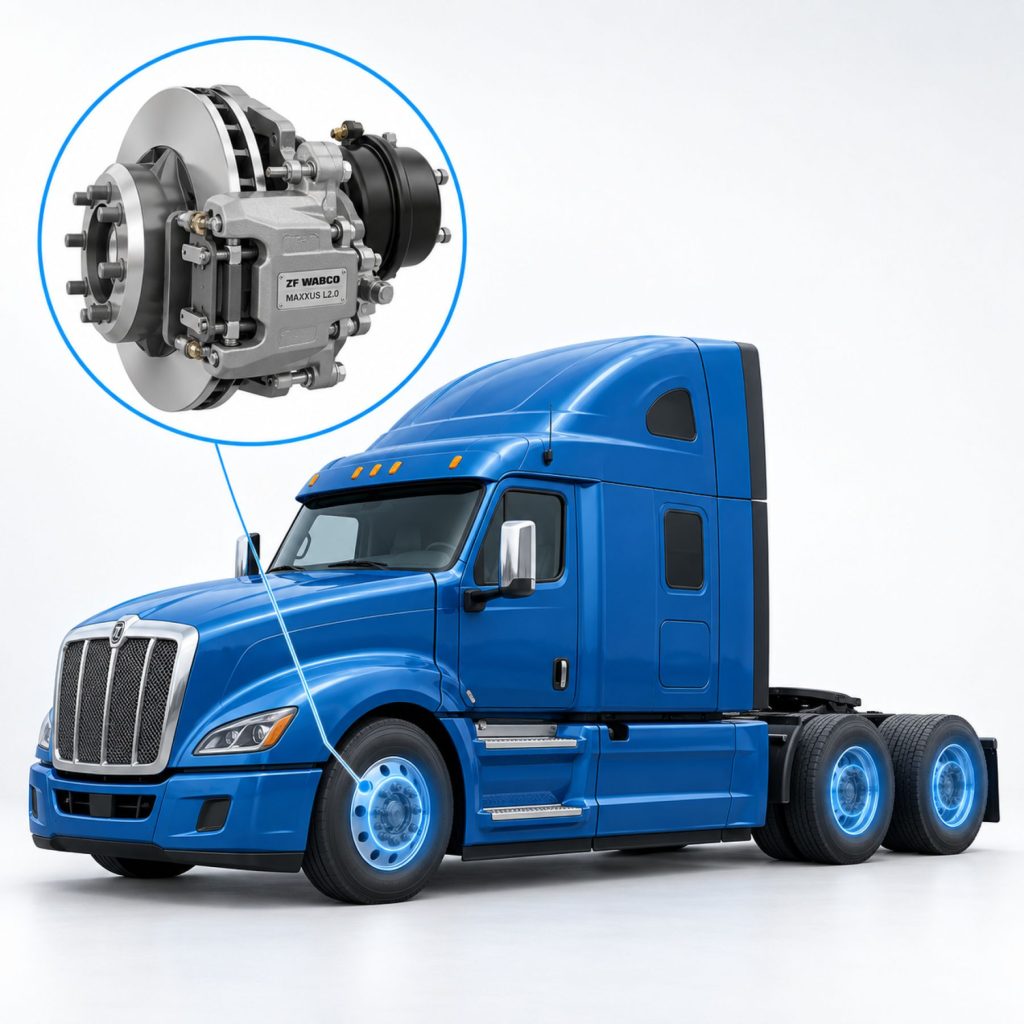
- Common Positions: Steer, drive, and trailer axles, depending on configuration
- Approximate Brake Weight: 67 pounds in applicable configurations
- Weight Advantage: Approximately four pounds lighter than certain competing air disc brakes
- Potential Vehicle Weight Savings: Up to approximately 24 pounds across six wheel ends
- Application Coverage: Designed to support more than 90 percent of standard truck and trailer applications
- Adjustment: Integrated automatic adjustment mechanism
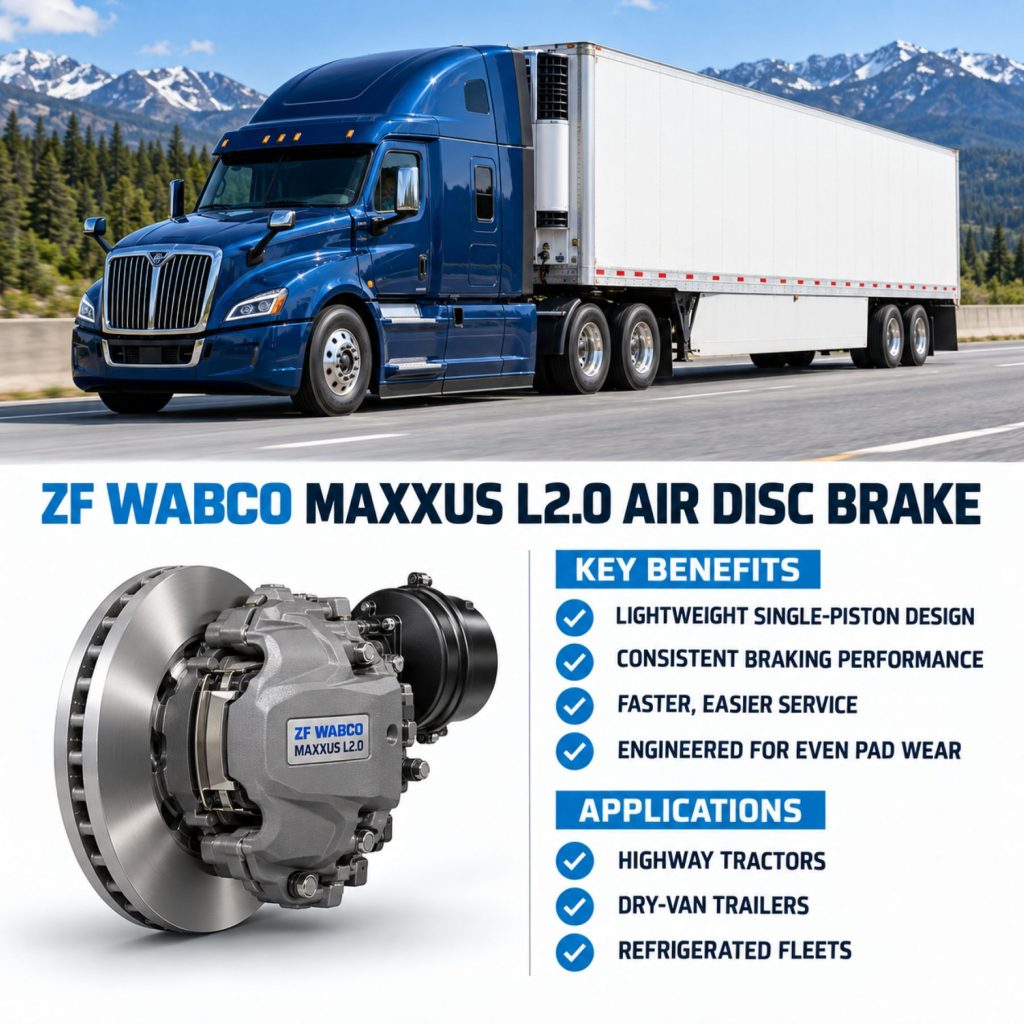
- Primary Benefit: Combines low weight, broad application coverage, and controlled brake-pad wear
Overview
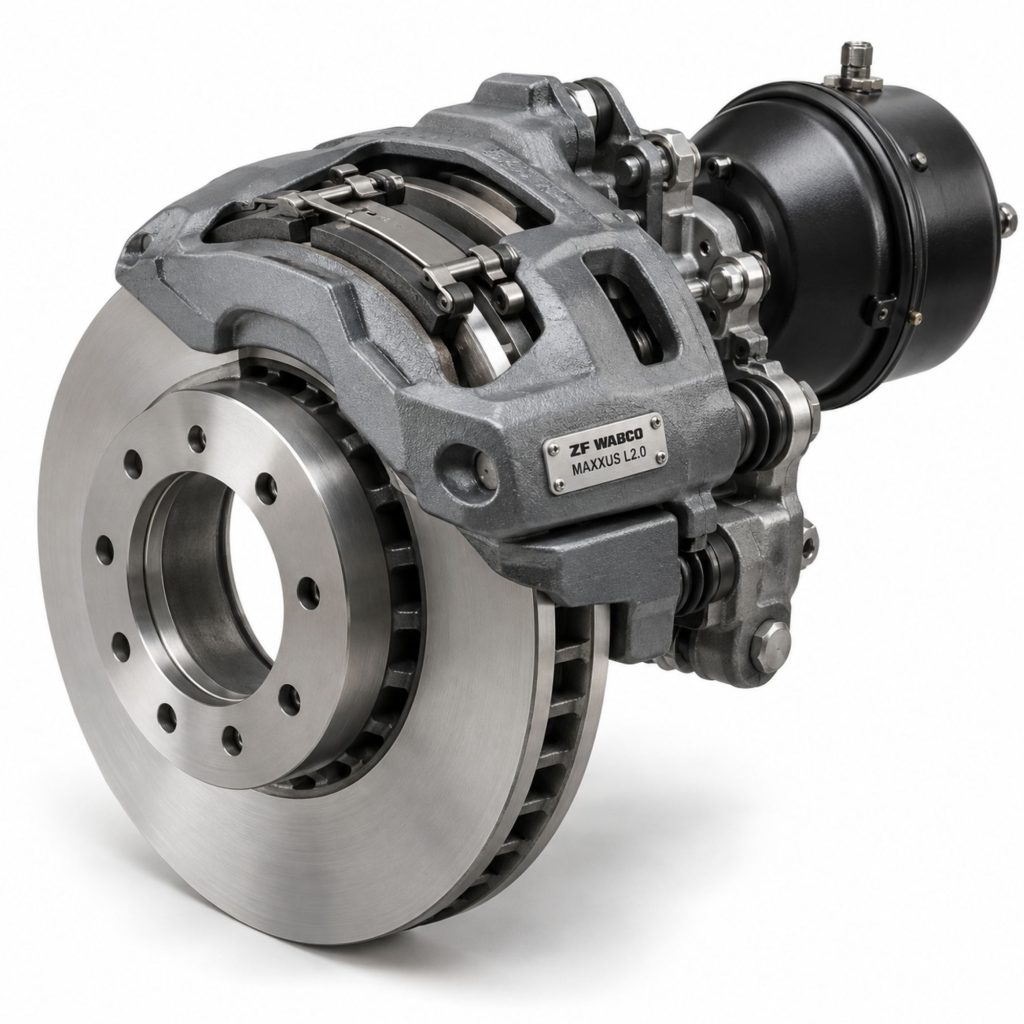
The ZF WABCO MAXXUS L2.0 is a lightweight, single-piston air disc brake developed for North American commercial trucks and trailers. It provides the consistent braking response and fade resistance associated with air disc brakes while reducing wheel-end weight.
The MAXXUS L2.0 weighs approximately 67 pounds in applicable configurations. ZF identifies it as approximately four pounds lighter than certain competing air disc brakes, potentially reducing total vehicle weight by as much as 24 pounds across six wheel ends.
The brake uses an offset integrated pressure plate and a single-piston clamping mechanism. This design distributes braking force across the friction material while helping control tapered brake-pad wear.
The MAXXUS L2.0 is related to the standard MAXXUS 2.0 but uses additional weight-saving design features. Its broad mounting and application range allows it to serve many standard tractor and trailer configurations.
Key Characteristics
- Lightweight air disc brake
- Single-piston clamping mechanism
- Floating-caliper design
- Approximately 67-pound brake assembly
- Offset integrated pressure plate
- Taper-wear mitigation design
- Even brake-pad force distribution
- Integrated automatic adjustment
- Steer-axle applications
- Drive-axle applications
- Trailer-axle applications
- Broad truck and trailer compatibility
- Consistent braking response
- Strong resistance to brake fade
- Simplified brake-pad inspection
- Reduced wheel-end weight
- North American commercial-vehicle design
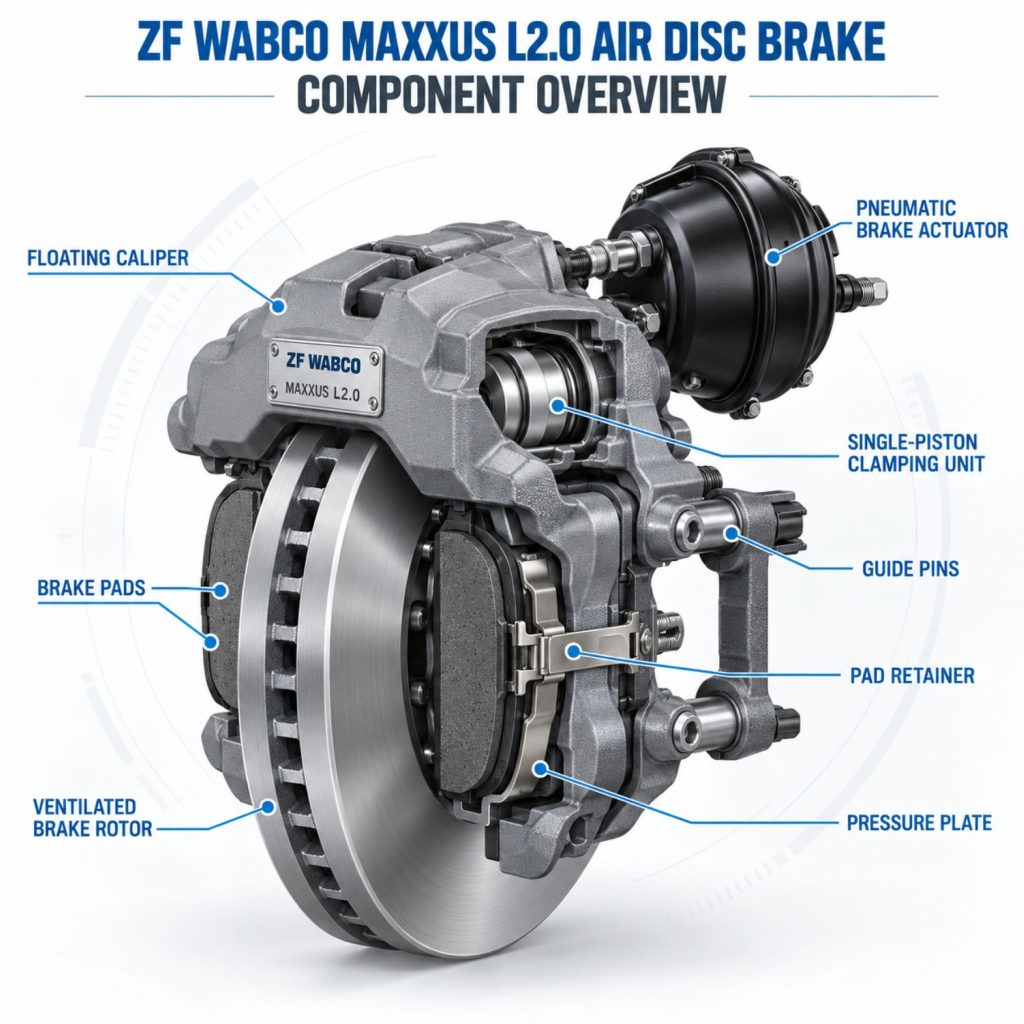
Major Components
- Brake caliper
- Brake carrier
- Single-piston clamping unit
- Offset integrated pressure plate
- Operating lever
- Internal actuation mechanism
- Automatic adjuster
- Adjuster access cover
- Inboard brake pad
- Outboard brake pad
- Brake-pad backing plates
- Pad-retaining system
- Brake-pad springs
- Ventilated brake rotor
- Guide pins
- Guide-pin bushings
- Guide-pin boots
- Caliper seals
- Service brake chamber
- Combination spring-brake actuator where equipped
- Axle torque plate
- Caliper mounting fasteners
- Air hose and fitting
- Mechanical wear indicator
- Optional electronic wear-monitoring components
How the Brake Component or System Works
When the driver presses the brake pedal, compressed air enters the service brake chamber mounted on the MAXXUS L2.0. Air pressure moves the chamber diaphragm and pushrod.
The pushrod acts on the brake’s internal operating mechanism. This mechanism multiplies the force and transfers it to the single piston and integrated pressure plate.
The pressure plate moves the inboard brake pad against the rotating rotor. The reaction force causes the floating caliper to slide along its guide pins, bringing the outboard pad into contact with the other side of the rotor.
Both pads clamp the rotor. Friction converts the vehicle’s motion into heat and slows the wheel. The ventilated rotor and surrounding airflow help dissipate this heat.
When the brake is released, air pressure leaves the chamber and the clamping force is removed. The integrated adjuster maintains the running clearance needed to compensate for normal pad and rotor wear.
Position and Function Within the Brake System
The MAXXUS L2.0 is installed at the wheel end and serves as the foundation brake. It creates the friction that physically slows or stops the wheel.
The complete braking sequence involves several components:
- The air compressor produces compressed air.
- The air dryer removes moisture and contaminants.
- The reservoirs store the air.
- The foot brake valve responds to driver input.
- Relay valves and ABS modulators regulate air delivery.
- The brake chamber converts air pressure into pushrod movement.
- The MAXXUS L2.0 converts pushrod movement into rotor-clamping force.
- The tires transfer the braking force to the road.
On drive and trailer axles, the brake may use a combination spring-brake actuator. The service section provides normal braking, while the mechanical spring section supplies parking and emergency braking functions.
Common Specifications
- Brake Type: Pneumatically actuated air disc brake
- Caliper Design: Floating caliper
- Actuation: Single-piston clamping mechanism
- Primary Market: North American commercial vehicles
- Applications: Truck, tractor, trailer, and specialty vehicle
- Wheel-End Positions: Steer, drive, and trailer axles where approved
- Approximate Weight: 67 pounds in applicable configurations
- Weight Savings: Approximately four pounds per wheel end compared with certain competing brakes
- Potential Six-Wheel-End Savings: Up to approximately 24 pounds
- Application Coverage: More than 90 percent of standard truck and trailer applications, according to ZF
- Brake Pads: Application-approved commercial-vehicle friction material
- Rotor Type: Ventilated commercial-vehicle brake rotor
- Adjustment: Integrated automatic adjustment mechanism
- Actuator: Service chamber or combination spring-brake chamber
- ABS Compatibility: Approved tractor and trailer ABS systems
- Stability Compatibility: Properly configured electronic stability systems
Exact weight, mounting, actuator size, pad compound, rotor dimensions, fasteners, and wheel clearances depend on the specific axle and vehicle configuration.
Operating Specifications and Performance
The MAXXUS L2.0 is engineered to provide high braking performance while reducing wheel-end weight.
The offset integrated pressure plate helps distribute force across the brake pad. Its design reduces the tendency for one section of the pad to receive more pressure than another, helping control tapered wear.
Brake performance depends on:
- Available air pressure
- Correct brake-chamber size
- Proper chamber installation
- Free caliper movement
- Guide-pin condition
- Automatic adjuster operation
- Approved brake-pad friction
- Remaining pad thickness
- Rotor thickness and condition
- Axle loading
- Tire traction
- ABS and stability-system operation
The brake’s mechanical capacity does not increase the vehicle’s certified axle, tire, wheel, suspension, or gross vehicle weight ratings.
Braking Performance and System Integration
The MAXXUS L2.0 produces the wheel-end braking force requested by the vehicle’s pneumatic and electronic control systems.
Air disc brakes provide exposed friction surfaces and efficient rotor cooling. This helps maintain consistent braking response during repeated applications and reduces susceptibility to the fade associated with expanding brake drums.
The MAXXUS L2.0 may operate with:
- Dual-circuit tractor air brakes
- Trailer air-brake systems
- Tractor ABS
- Trailer ABS
- Automatic traction control
- Electronic stability control
- Trailer roll-stability systems
- Collision-mitigation braking
- Adaptive cruise braking
- Electronic brake-pad monitoring
Brake balance depends on correct friction material, rotor dimensions, actuator sizes, valve timing, and electronic system configuration.
Brake pads should normally be replaced at both wheel ends of the same axle to preserve balanced friction performance.
Air Supply, Controls, and Electronic Integration
The MAXXUS L2.0 uses a pneumatic brake chamber for normal foundation-brake operation. The brake does not require electrical power to create basic braking force.
Electronic systems can regulate air pressure delivered to the chambers. These systems may include:
- Antilock braking
- Automatic traction control
- Electronic stability control
- Trailer roll-stability control
- Collision mitigation
- Adaptive cruise control
Wheel-speed sensors provide information to the ABS or stability controller. When the system detects wheel lockup or instability, pneumatic modulators adjust the pressure delivered to the brake chambers.
Application-specific wear-monitoring equipment may also provide maintenance information. Electronic monitoring supplements rather than replaces direct inspection of the pads, rotors, calipers, chambers, guide components, and mounting hardware.
Installation, Adjustment, and Brake Balance
The MAXXUS L2.0 must be installed on an approved axle and torque plate using the correct hardware, procedures, and fastener torque.
Installation requirements may include:
- Confirming the MAXXUS L2.0 model
- Identifying left- or right-hand orientation
- Matching the caliper and carrier
- Verifying the axle torque plate
- Using approved mounting fasteners
- Following the required tightening sequence
- Installing the correct brake chamber
- Confirming pushrod engagement
- Checking rotor alignment
- Verifying free caliper movement
- Inspecting guide-pin boots
- Installing approved brake pads
- Securing pad-retaining components
- Checking wheel and valve-stem clearance
- Performing a complete function test
The brake uses an internal automatic adjuster. Technicians should follow ZF WABCO service procedures when checking or resetting the mechanism.
Brake balance must be preserved across each axle. Calipers, carriers, pads, rotors, chambers, and mounting components must match the approved vehicle specification.
Foundation Brake, Axle, and Wheel-End Compatibility
The MAXXUS L2.0 was developed for broad commercial-vehicle application coverage. It may be used on approved steer, drive, and trailer axles.
Compatibility depends on:
- Vehicle manufacturer
- Axle manufacturer
- Axle model
- Torque-plate design
- Caliper orientation
- Left- or right-hand position
- Rotor dimensions
- Hub design
- Brake-chamber type
- Brake-chamber size
- Wheel diameter
- Wheel offset
- Valve-stem location
- Suspension clearance
- ABS sensor arrangement
- Tire and wheel capacity
ZF indicates that the MAXXUS L2.0 can support more than 90 percent of standard truck and trailer applications. This does not mean one brake part number fits every axle or vehicle.
The specific caliper, carrier, torque plate, rotor, actuator, and mounting hardware must be confirmed for each application.
Common Applications
- Class 8 highway tractors
- Regional-haul tractors
- Day cab tractors
- Sleeper tractors
- Heavy-duty straight trucks
- Line-haul trucks
- Pickup-and-delivery vehicles
- Dry van trailers
- Refrigerated trailers
- Flatbed trailers
- Tank trailers
- Container chassis
- Curtain-side trailers
- Commercial trailer fleets
- Weight-sensitive truck configurations
- Weight-sensitive trailer configurations
- Vehicles equipped with advanced braking systems
Vehicle and Brake-System Compatibility
The MAXXUS L2.0 must match the vehicle’s axle, torque plate, rotor, hub, actuator, wheel, and electronic brake-system configuration.
Compatibility should be confirmed using:
- Vehicle identification number
- Trailer serial number
- Vehicle manufacturer
- Model and model year
- Axle manufacturer
- Axle model
- WABCO brake model
- Complete brake part number
- Caliper part number
- Carrier part number
- Left- or right-hand orientation
- Chamber type and size
- Rotor part number
- Brake-pad specification
- Wheel size and offset
- Valve-stem design
- ABS configuration
- Wear-monitoring equipment
A replacement brake should not be selected solely by appearance. Similar MAXXUS and other WABCO brake assemblies may use different carriers, internal mechanisms, mounting interfaces, or service components.
Advantages
- Low brake assembly weight
- Approximately 67-pound configuration
- Potential vehicle weight savings
- Single-piston design
- Offset integrated pressure plate
- Taper-wear mitigation
- Even brake-pad force distribution
- Integrated automatic adjustment
- Broad truck and trailer application coverage
- Steer-, drive-, and trailer-axle configurations
- Consistent braking response
- Strong fade resistance
- Simplified pad inspection
- Reduced foundation-brake component count
- Compatibility with ABS
- Compatibility with stability systems
- North American service support
Limitations or Considerations
- Requires exact model identification
- Different applications use different carriers
- Must match the approved torque plate
- Requires the correct brake-chamber size
- Requires compatible wheels and valve stems
- Guide components and seals require inspection
- Road contamination can affect exposed components
- Improper mounting can restrict caliper movement
- Incorrect pads can change braking performance
- Rotor service may require wheel-end disassembly
- Weight varies by configuration
- Actual weight savings depend on the comparison brake
- Not every part number fits every standard application
- Requires technicians familiar with air disc brakes
- Does not increase certified vehicle ratings
Driver and Operator Experience
Drivers may notice consistent braking response and reduced fade during repeated brake applications. Properly maintained air disc brakes can provide predictable performance across changing wheel-end temperatures.
Operators should report:
- Vehicle pulling during braking
- Increased stopping distance
- ABS warning lights
- Stability-system warnings
- Grinding or scraping noises
- Burning odors
- Smoke near a wheel end
- Excessive heat at one wheel
- Parking brakes that do not hold
- Parking brakes that release slowly
- Visible rotor damage
- Uneven brake-pad wear
- Abnormal brake vibration
A lack of noticeable symptoms does not confirm that the pads and rotors remain within their inspection limits.
Maintenance and Ownership Notes
- Inspect both brake pads.
- Measure the remaining friction material.
- Check for tapered pad wear.
- Inspect the rotor.
- Measure rotor thickness.
- Look for rotor cracks and heat damage.
- Verify free caliper movement.
- Inspect guide pins.
- Check guide-pin boots and seals.
- Inspect the automatic adjuster.
- Check the adjuster cover.
- Inspect pad-retaining hardware.
- Check the brake chamber.
- Inspect the chamber mounting nuts.
- Check air hoses and fittings.
- Inspect the carrier and torque plate.
- Check mounting fasteners.
- Verify wheel and valve-stem clearance.
- Monitor wear sensors when equipped.
- Replace friction components across the axle.
- Follow ZF WABCO maintenance procedures.
Common Brake-System Problems
Uneven or tapered pad wear: Restricted caliper movement, worn guide pins, damaged bushings, rotor misalignment, incorrect mounting, or a problem with the pressure plate may be responsible.
Brake dragging: Possible causes include:
- Restricted caliper movement
- Damaged guide components
- Automatic adjuster problems
- Incorrect chamber installation
- Improper running clearance
- Parking-brake release problems
- Internal mechanism damage
- Contaminated components
Brake will not apply: Low air pressure, a damaged brake chamber, disconnected pushrod, restricted air hose, failed operating mechanism, or brake-control problem may prevent application.
Excessive stopping distance: Possible causes include:
- Worn brake pads
- Incorrect friction material
- Contaminated pads
- Damaged rotors
- Low brake-chamber pressure
- Incorrect chamber size
- Air-system leakage
- Brake imbalance
- Poor tire traction
Excessive wheel-end heat: Dragging pads, restricted caliper movement, parking-brake release problems, incorrect actuator installation, wheel-bearing problems, or repeated severe braking may be responsible.
Brake noise: Loose pad-retaining hardware, pad movement, rotor damage, contamination, worn guide components, incorrect friction, or wheel-end problems may produce squealing, rattling, scraping, or grinding.
Rotor cracking: Possible causes include:
- Excessive heat
- Severe braking cycles
- Prolonged brake application
- Brake drag
- Worn friction material
- Thermal stress
- Operation beyond service limits
Automatic adjuster malfunction: Internal contamination, mechanical damage, improper manual adjustment, excessive wear, or damaged sealing components may affect adjustment.
Premature pad wear: Brake drag, unsuitable friction, unbalanced braking, damaged guide components, severe service, rotor problems, or improper installation may shorten pad life.
Safety and Service Precautions
Air disc brake service exposes technicians to stored air pressure, powerful spring brakes, heavy wheel-end components, and potentially hazardous brake dust.
Before servicing the MAXXUS L2.0:
- Park the vehicle on a level surface.
- Apply the parking brakes.
- Block the wheels.
- Shut down the engine or towing vehicle.
- Remove the ignition key.
- Drain the applicable air reservoirs.
- Cage or release spring brakes according to approved procedures.
- Support raised equipment with properly rated stands.
- Wear appropriate personal protective equipment.
- Follow ZF WABCO and vehicle manufacturer instructions.
Do not clean the brake with compressed air or dry brushing. Use approved wet-cleaning or filtered-vacuum methods to limit airborne brake dust.
Never disassemble a sealed spring-brake actuator. Its internal power spring can cause severe injury.
Use only the approved pads, rotors, chambers, calipers, carriers, fasteners, wheels, and valve stems for the application.
Identification Information
Identification information may be found on the caliper label, carrier, actuator, axle tag, or vehicle build record.
Record the following:
- WABCO MAXXUS L2.0 designation
- Complete ZF WABCO part number
- Caliper part number
- Carrier part number
- Serial or production information
- Left- or right-hand orientation
- Steer-, drive-, or trailer-axle position
- Axle manufacturer
- Axle model
- Brake-chamber type
- Brake-chamber size
- Brake-pad part number
- Rotor part number
- Torque-plate configuration
- Wear-sensor equipment
- Vehicle identification number
- Trailer serial number
The complete part number should be used when ordering replacement components. Product appearance alone may not distinguish every MAXXUS configuration.
Buying Considerations
- Confirm the MAXXUS L2.0 model.
- Record the complete ZF WABCO part number.
- Verify truck or trailer application.
- Determine the axle position.
- Confirm left- or right-hand orientation.
- Match the caliper and carrier.
- Verify the axle torque plate.
- Match the brake-chamber type.
- Confirm the brake-chamber size.
- Verify the rotor specification.
- Select approved brake pads.
- Check wear-monitoring equipment.
- Confirm wheel and valve-stem compatibility.
- Determine whether the caliper is new or remanufactured.
- Check whether the carrier is included.
- Check whether mounting hardware is included.
- Determine whether a core charge applies.
- Verify warranty coverage.
- Replace axle-matched friction components.
Variants and Configurations
- MAXXUS L2.0 lightweight brake
- MAXXUS 2.0 standard brake
- Steer-axle configurations
- Drive-axle configurations
- Trailer-axle configurations
- Left-hand brake assemblies
- Right-hand brake assemblies
- Service-brake chambers
- Combination spring-brake actuators
- Different chamber sizes
- Different axle-specific carriers
- Different torque plates
- Different rotor configurations
- Application-specific friction materials
- Wear-sensor configurations
- New caliper assemblies
- Remanufactured calipers
- Complete caliper-and-carrier assemblies
Comparison to Similar Equipment
Compared with the standard ZF WABCO MAXXUS 2.0, the MAXXUS L2.0 uses a lighter configuration. ZF lists the MAXXUS 2.0 at approximately 69 pounds and the MAXXUS L2.0 at approximately 67 pounds in comparable configurations.
Compared with the Meritor EX+ LS Air Disc Brake, the MAXXUS L2.0 uses ZF WABCO’s single-piston mechanism and offset integrated pressure plate. Both target lightweight truck and trailer applications.
Compared with the Haldex ModulT Air Disc Brake, the MAXXUS L2.0 uses a different caliper, pressure-plate, guide, carrier, and adjustment design. Components are not interchangeable.
Compared with the Bendix ADB22X-LT Air Disc Brake, the MAXXUS L2.0 provides another lightweight North American air disc brake option with different mounting and service components.
Compared with an S-cam drum brake, the MAXXUS L2.0 provides simplified pad inspection, effective rotor cooling, internal adjustment, and resistance to fade. Drum brakes may have a lower initial cost.
Best Fit For
- Vehicles originally equipped with the MAXXUS L2.0
- Class 8 highway tractors
- Line-haul trucks
- Regional-haul tractors
- Dry van trailers
- Refrigerated trailers
- Flatbed trailers
- Tank trailers
- Weight-sensitive equipment
- Fleets seeking a lightweight air disc brake
- Steer-axle applications
- Drive-axle applications
- Trailer-axle applications
- Vehicles equipped with ABS
- Vehicles equipped with stability systems
- Fleets standardizing ZF WABCO brake components
Related Vehicle and Trailer Types
- Complete Guide to Semi Truck Types
- Class 6 vs Class 7 vs Class 8 Trucks
- Line-haul tractors
- Regional-haul tractors
- Day cab tractors
- Sleeper tractors
- Heavy-duty straight trucks
- Dry van trailers
- Refrigerated trailers
- Flatbed trailers
- Tank trailers
- Container chassis
- Curtain-side trailers
- Commercial trailer fleets
Related Truck and Trailer Models
- International LT Series
- Freightliner Cascadia
- Kenworth T680
- Peterbilt 579
- Mack Anthem
- Volvo VNL
- Great Dane Champion Dry Van Trailer
- Great Dane Everest Reefer Trailer
- Wabash DuraPlate Dry Van Trailer
- Wabash ArcticLite Reefer Trailer
- Utility 3000D Dry Van Trailer
- Utility 3000R Reefer Trailer
- MAC Aluminum Flatbed
- Polar Tank Trailer
Related Brake System Types
- Brake Systems
- Air Brake Systems
- Air Disc Brake Systems
- Drum Brake Systems
- Brake Chambers & Actuators
- ABS & Electronic Braking Systems
- Trailer Brake Systems
- Foundation brake systems
- Tractor air-brake systems
- Trailer air-brake systems
- Parking-brake systems
Related Brake Products
- Meritor EX+ LS Air Disc Brake
- Haldex ModulT Air Disc Brake
- Bendix ADB22X Air Disc Brake
- Bendix ADB22X-LT Air Disc Brake
- Bendix Tu-Flo 550 Air Compressor
- Bendix AD-9 Air Dryer
- Bendix SR-7 Spring Brake Modulating Valve
- ZF WABCO MAXXUS 2.0 Air Disc Brake
- ZF WABCO MAXX 22 Air Disc Brake
- ZF WABCO MAXX 22T Trailer Air Disc Brake
- ZF WABCO Brake Chambers
- ZF WABCO ABS Components
- ZF WABCO Brake Pads
Related Equipment Systems
- Equipment Systems
- Axles & Differentials
- Suspension Systems
- Commercial-vehicle air systems
- Steer axles
- Drive axles
- Trailer axles
- Wheel hubs and bearings
- Tires and wheels
- Trailer ABS systems
- Electronic stability systems
- Advanced driver-assistance systems
Related Guides
- Brake System Guides
- Air Brake Systems Explained
- Air Disc Brakes vs Drum Brakes
- How to Inspect and Maintain Commercial Truck Brakes
- Tractor vs Trailer Brake Systems
- How Truck ABS and Electronic Stability Control Work
- Commercial Truck Brake Components Explained
Regulatory and Compliance Notes
Commercial-vehicle foundation brakes must satisfy applicable federal, state, provincial, and local requirements. In the United States, vehicle manufacturers certify applicable braking systems under Federal Motor Vehicle Safety Standard No. 121.
Replacement calipers, carriers, pads, rotors, chambers, and mounting components must preserve the approved brake configuration.
Brake service must not interfere with:
- Required stopping performance
- Axle-to-axle brake balance
- Parking-brake operation
- Emergency braking
- ABS operation
- Stability-system operation
- Wheel and valve-stem clearance
- Required inspection limits
- Axle weight ratings
- Vehicle weight ratings
The MAXXUS L2.0’s weight savings do not increase the vehicle’s certified axle or gross vehicle weight ratings.
A brake with loose, missing, contaminated, cracked, worn, mismatched, or incorrectly installed components may place the vehicle out of service.
Real World Operating Notes
The MAXXUS L2.0’s lower weight can help offset other vehicle equipment, but actual payload benefits depend on the complete truck or trailer specification.
Both the inboard and outboard pads must be inspected. A visible outboard pad may remain within limits while restricted caliper movement causes accelerated wear of the inboard pad.
A hotter wheel end may indicate brake drag, guide-pin restriction, automatic adjuster problems, parking-brake release trouble, or wheel-bearing damage.
Replacing worn pads without correcting caliper, guide, actuator, or rotor problems can result in repeated uneven wear.
ZF WABCO offers several MAXXUS and MAXX brake configurations. The precise model and part number must be established before replacement components are ordered.
Frequently Asked Questions
What is the ZF WABCO MAXXUS L2.0?
The MAXXUS L2.0 is a lightweight, single-piston air disc brake developed for North American commercial trucks and trailers.
How much does the MAXXUS L2.0 weigh?
ZF identifies an applicable MAXXUS L2.0 configuration at approximately 67 pounds. Exact weight depends on the complete brake and mounting configuration.
How much weight can it save?
ZF states that it can be approximately four pounds lighter per wheel end than certain competing air disc brakes, potentially saving up to 24 pounds across six wheel ends.
What does the single-piston design do?
The single piston and integrated pressure plate convert brake-chamber force into pad-clamping force while distributing pressure across the friction material.
How does it control tapered pad wear?
The brake uses an offset integrated pressure plate designed to distribute force across the pad and reduce uneven loading.
Can it be used on trucks and trailers?
Yes. Application-specific configurations support approved truck, tractor, and trailer axles.
Does it use a conventional slack adjuster?
No. It uses an integrated internal automatic adjustment mechanism.
Can it provide parking-brake operation?
Yes. Approved drive- and trailer-axle configurations may use combination spring-brake actuators.
Does the MAXXUS L2.0 require electricity?
Basic braking is pneumatic. Electrical connections may be used by related ABS, stability, or wear-monitoring systems.
Why are the pads wearing unevenly?
Possible causes include restricted caliper movement, guide-pin damage, rotor misalignment, incorrect mounting, adjuster problems, unsuitable friction, or brake drag.
Are MAXXUS 2.0 and MAXXUS L2.0 parts interchangeable?
Parts should not be assumed interchangeable. The exact model, caliper, carrier, axle, actuator, rotor, and part number must be verified.
How can the correct replacement brake be identified?
Use the ZF WABCO model and part numbers, caliper and carrier information, axle model, chamber size, wheel-end specification, and vehicle VIN or trailer serial number.
Availability and Where to Find
ZF WABCO MAXXUS L2.0 brakes and replacement components may be available through ZF distributors, WABCO service providers, commercial-truck dealerships, trailer dealers, fleet-maintenance facilities, brake specialists, and heavy-duty parts suppliers.
Available components may include:
- Complete caliper-and-carrier assemblies
- Service calipers
- Remanufactured calipers
- Brake-pad kits
- Ventilated rotors
- Guide-pin kits
- Sealing kits
- Automatic adjuster components
- Pad-retaining hardware
- Service brake chambers
- Combination spring-brake actuators
- Wear-monitoring components
- Mounting hardware
Before ordering, confirm the MAXXUS L2.0 designation, complete part number, axle position, left- or right-hand orientation, carrier, torque plate, chamber size, rotor, pad package, and wear-monitoring equipment.
Current aftermarket product information and technical resources are available through the ZF Aftermarket MAXXUS 2.0 and L2.0 page and the ZF WABCO Customer Centre.
Support Trucking Families
Truck Equipment Atlas supports the mission of Grey Cross, a nonprofit dedicated to helping families of truck drivers who lose their lives while on the road. As the site grows, part of its mission is to bring awareness and support to these families.
Podcast or Video Section
Learn More Through Audio and Video
Truck Equipment Atlas will continue expanding with podcast episodes, interviews, and equipment breakdowns to help drivers and fleets better understand trucks and equipment.
Follow the Growth of Truck Equipment Atlas
Truck Equipment Atlas continues to expand with new truck profiles, trailer coverage, diesel engine pages, equipment system resources, manufacturer information, and educational guides.
Visit our Site Updates page to explore recent additions, project milestones, and upcoming resources as we continue building one of the industry’s growing commercial trucking equipment reference libraries.
View the Latest Site Updates: Truck Equipment Atlas Site Updates