
Bendix AD-9 Air Dryer
Quick Facts
- Manufacturer: Bendix Commercial Vehicle Systems
- Product Series: AD Series
- Model: AD-9
- Product Type: Desiccant-type commercial air dryer
- Brake-System Category: Air supply and air management
- Primary Function: Removes moisture, oil, and solid contamination from compressed air before it enters the brake reservoirs
- Operating Cycles: Charge cycle and purge cycle
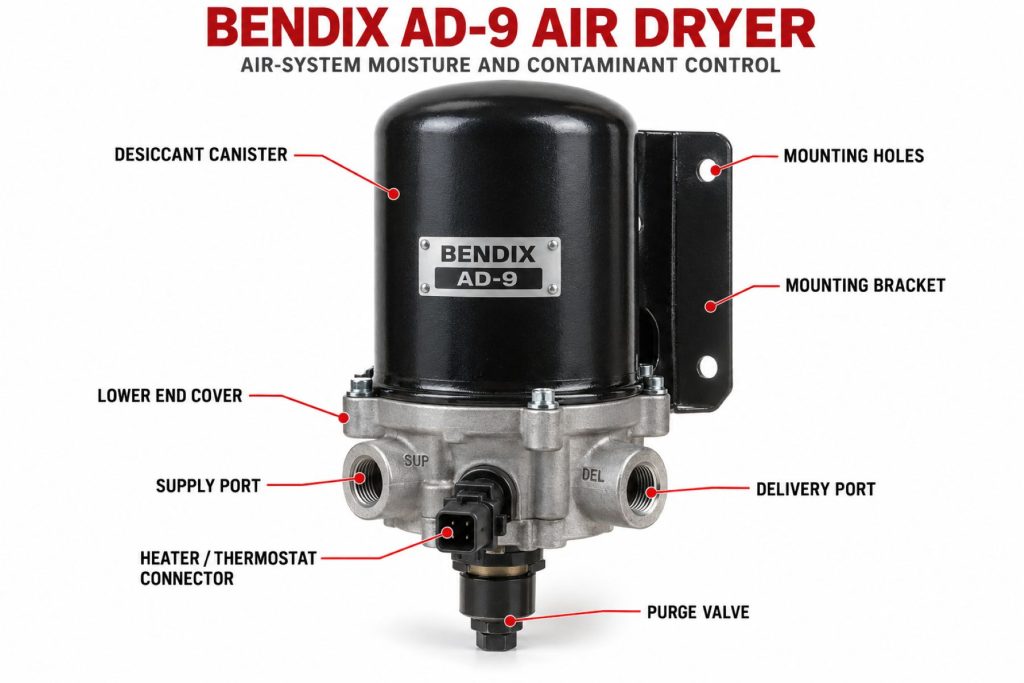
- Primary Components: Desiccant cartridge, outer shell, aluminum end cover, purge valve, delivery check valve, heater, and thermostat
- Available Configurations: Standard purge, extended purge, and application-specific PuraGuard oil-coalescing versions
- Electrical Options: Application-specific 12- or 24-volt heater and thermostat
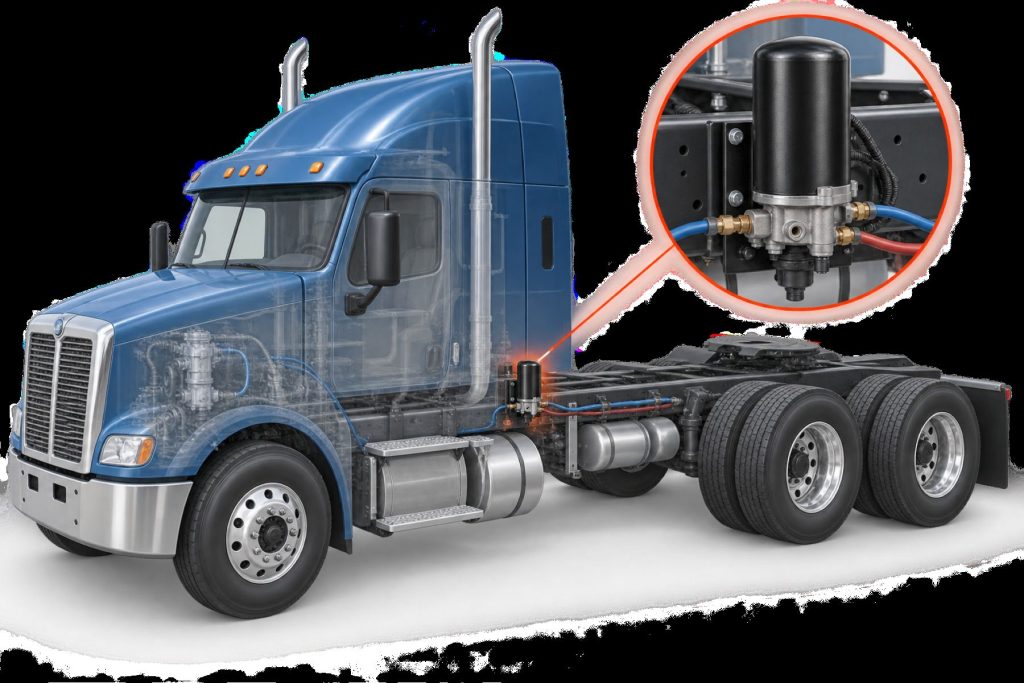
- Typical Mounting: Vertical chassis mounting between the air compressor and supply reservoir
- Primary Applications: Medium-duty and heavy-duty trucks, tractors, buses, vocational vehicles, and specialty commercial equipment
- Primary Benefit: Supplies cleaner and drier compressed air to help protect air-brake components
Overview
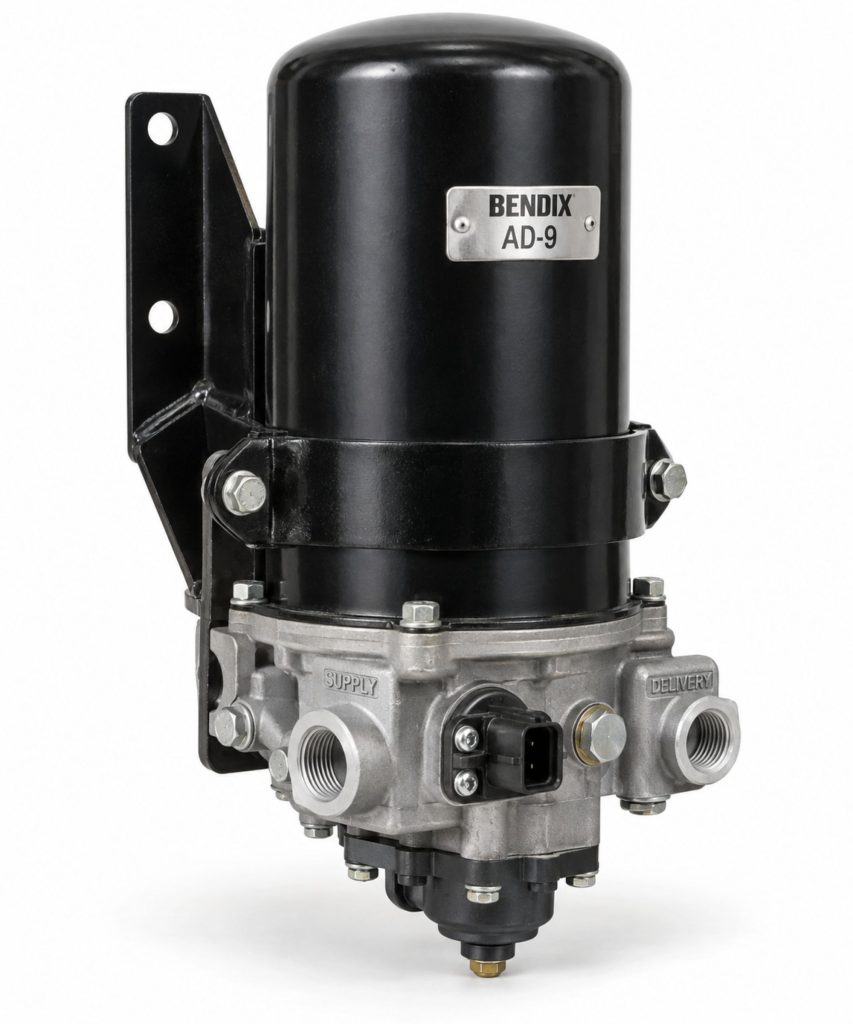
The Bendix AD-9 is a desiccant-type air dryer designed to collect and remove solid, liquid, and vapor contaminants from a commercial vehicle’s compressed-air system before those contaminants enter the brake reservoirs.
The air dryer is installed between the engine-driven air compressor and the first supply reservoir. During the charging cycle, compressed air passes through an oil-separation area and desiccant bed. Moisture and contamination collect inside the dryer while clean, dry air continues to the vehicle reservoirs.
When the governor unloads the compressor at system cut-out pressure, the AD-9 begins its purge cycle. Stored purge air expands backward through the desiccant bed and exits through the purge valve, carrying accumulated water, oil, and contamination out of the dryer.
The AD-9 has been used across a broad range of commercial trucks, tractors, buses, vocational vehicles, and specialty equipment. Multiple configurations have been produced, so the complete Bendix part number, purge-volume arrangement, heater voltage, ports, and mounting must be verified before replacement.
Key Characteristics
- Desiccant-type commercial air dryer
- Installed between the compressor and supply reservoir
- Alternates between charge and purge cycles
- Removes moisture from compressed air
- Separates oil aerosols and solid contamination
- Replaceable screw-in desiccant cartridge
- Serviceable purge-valve assembly
- Serviceable delivery check valve
- Integrated safety valve
- Turbo cut-off function
- Heater and thermostat for cold-weather operation
- Available with 12- or 24-volt electrical equipment
- Standard and extended-purge configurations
- PuraGuard oil-coalescing configurations may be available
- Vertical chassis-mounted design
- Designed for commercial air-brake systems
Major Components
- Cylindrical steel outer shell
- Die-cast aluminum end cover
- Desiccant cartridge
- Desiccant material
- Oil separator
- Sump area
- Purge-volume area
- Purge valve
- Purge-valve housing
- Purge piston
- Turbo cut-off valve
- Delivery check valve
- Safety valve
- Heater element
- Thermostat
- Electrical connector
- Supply port
- Delivery port
- Control port
- Exhaust opening
- Upper mounting bracket
- Mounting strap
- Lower mounting bracket
- Cap screws and locknuts
- O-rings
- Gaskets and seals
How the Brake Component or System Works
The AD-9 operates through two primary cycles:
- Charge cycle
- Purge cycle
During the charge cycle, the vehicle’s air compressor sends hot compressed air through the discharge line and into the AD-9 supply port.
As the air enters the dryer, its direction and velocity change. Liquid water, oil droplets, and heavier contamination collect in the sump area.
The air then moves through the desiccant cartridge. The desiccant adsorbs water vapor while additional filtering helps prevent contamination from entering the brake reservoirs.
Clean, dry air passes through the delivery check valve and exits the delivery port. From there, it flows into the vehicle’s supply reservoir.
When reservoir pressure reaches the governor’s cut-out setting, the governor unloads the compressor and sends a pneumatic control signal to the AD-9 control port.
The control pressure opens the purge valve. Purge air stored within the dryer expands backward through the desiccant bed.
This reverse airflow removes moisture from the desiccant and carries water, oil, and contamination out through the exhaust opening.
The delivery check valve prevents air stored in the vehicle’s reservoirs from flowing backward through the dryer during the purge cycle.
After purging, the purge valve remains open until system pressure falls to the governor’s cut-in setting. The compressor then reloads, the purge valve closes, and another charge cycle begins.
Position and Function Within the Brake System
The AD-9 is part of the vehicle’s air-supply and air-management system.
The normal air-flow sequence is:
- Engine-driven air compressor
- Compressor discharge line
- Bendix AD-9 air dryer
- Supply or wet reservoir
- Primary and secondary reservoirs
- Brake control valves
- Brake chambers and actuators
- Foundation brakes
The air dryer does not produce compressed air and does not directly apply the brakes.
Its job is to condition the air before it reaches:
- Supply reservoir
- Primary reservoir
- Secondary reservoir
- Foot brake valve
- Relay valves
- Spring-brake valves
- Brake chambers
- Antilock braking components
- Trailer air-supply system
- Air suspension
- Approved pneumatic accessories
Removing moisture and contamination helps protect the entire downstream air system.
Common Specifications
- Air-Dryer Type: Desiccant cartridge
- Operating Modes: Charge and purge
- Primary Air Ports: Supply, delivery, and control
- Supply Port Marking: SUP
- Delivery Port Marking: DEL
- Control Port Marking: CON
- Cartridge Design: Replaceable screw-in cartridge
- Purge System: Integrated purge valve and purge-volume arrangement
- Check Valve: Integrated delivery check valve
- Turbo Protection: Turbo cut-off feature
- Heater Voltage: Application-specific 12 or 24 volts
- Typical Heater Output: Approximately 75 watts, depending on configuration
- Mounting Position: Vertical with purge exhaust facing downward
- Compressor Compatibility: Commonly used with compressors rated up to approximately 17 cubic feet per minute; larger-compressor applications require verification
- Reservoir Compatibility: Standard or extended-purge configuration selected according to total reservoir volume and application
Exact specifications must be confirmed using the complete Bendix part number and current service information for the installed dryer.
Operating Specifications and Performance
The AD-9 is designed to provide clean, dry compressed air during normal vehicle operation.
Air-dryer performance depends on:
- Compressor output
- Compressor duty cycle
- Discharge-line size
- Discharge-line length
- Inlet-air temperature
- Air-system leakage
- Reservoir volume
- Vehicle air consumption
- Purge volume
- Desiccant condition
- Purge-valve condition
- Delivery check-valve condition
- Heater operation
- Ambient temperature
- Vehicle duty cycle
The standard AD-9 is commonly used on vehicles with less than approximately 9,000 cubic inches of total reservoir volume.
Extended-purge configurations may be used on applications with approximately 9,000 to 12,500 cubic inches of reservoir volume.
Applications exceeding those ranges or using unusually high-output compressors should be verified with Bendix technical information.
Under normal conditions, the purge process generally lasts approximately 15 to 30 seconds.
Air-dryer selection must account for the complete vehicle rather than reservoir volume alone.
Braking Performance and System Integration
The AD-9 does not create braking force, but it helps protect the components that control and apply the brakes.
Moisture and contamination inside the air system can contribute to:
- Frozen air lines
- Restricted valves
- Internal corrosion
- Sticking control valves
- Damaged seals
- Slow brake response
- Air leakage
- Premature component wear
- Reservoir contamination
- ABS modulator-valve problems
- Spring-brake control problems
Removing contamination can help improve reliability throughout the air system.
The AD-9 may support vehicles equipped with:
- S-cam drum brakes
- Air disc brakes
- Antilock braking systems
- Electronic stability control
- Automatic traction control
- Spring brakes
- Trailer air brakes
- Air suspension
- Air-operated accessories
Brake performance still depends on adequate compressor output, stored air pressure, functioning valves, serviceable chambers, properly maintained foundation brakes, suitable tires, and correct vehicle loading.
Air Supply, Controls, and Electronic Integration
The AD-9 works with the vehicle’s compressor governor.
When system pressure reaches cut-out, the governor:
- Unloads the compressor
- Sends control pressure to the AD-9
- Causes the purge valve to open
- Initiates desiccant regeneration
When system pressure falls to cut-in, the governor:
- Reloads the compressor
- Removes the purge-control signal
- Allows the purge valve to close
- Returns the dryer to the charging cycle
The AD-9 may be integrated with:
- Bendix air compressors
- Compressor governors
- Supply reservoirs
- Primary and secondary reservoirs
- Pressure-protection valves
- Air-pressure gauges
- Low-air warning devices
- Electronic pressure sensors
- Vehicle diagnostic systems
- Air-suspension systems
- Trailer air-supply controls
The heater and thermostat use the vehicle’s electrical system to reduce the risk of ice interfering with purge-valve operation.
The dryer’s heater voltage must match the vehicle electrical system.
Installation, Adjustment, and Brake Balance
The AD-9 should be mounted vertically with the purge exhaust facing the road surface.
Important installation considerations include:
- Correct AD-9 part number
- Standard or extended-purge configuration
- Correct heater voltage
- Vertical mounting
- Adequate airflow around the dryer
- Protection from direct wheel splash
- Distance from exhaust-system heat
- Clearance from the driveshaft
- Clearance from suspension movement
- Clearance from steering components
- Access for servicing
- Correct upper and lower brackets
- Correct mounting-fastener torque
- Proper discharge-line size
- Proper discharge-line length
- Downward discharge-line slope where possible
- Freedom from water traps and restrictions
- Correct supply-port connection
- Correct delivery-port connection
- Correct control-port connection
- Proper electrical wiring and grounding
The air dryer does not directly control brake balance. However, a restriction or severe leak in the charging system can reduce available air pressure across the vehicle’s brake circuits.
After installation, the system should be tested through multiple compressor charge and purge cycles.
Foundation Brake, Axle, and Wheel-End Compatibility
The AD-9 can support vehicles using various foundation brakes and axle arrangements when the complete air system is properly designed.
Possible applications include:
- Air disc brakes
- S-cam drum brakes
- Steer axles
- Single drive axles
- Tandem drive axles
- Multiple rear axles
- Pusher axles
- Tag axles
- Lift axles
- Trailer axles
- Bus brake systems
- Specialty-vehicle brake systems
The dryer is selected according to the vehicle’s total compressed-air requirements rather than a specific wheel-end brake design.
Compatibility depends on:
- Compressor capacity
- Total reservoir volume
- Number of axles
- Number and size of brake chambers
- Trailer operation
- Air-suspension demand
- Pneumatic accessory demand
- Vehicle duty cycle
- Ambient temperature
- Available mounting space
- Discharge-line requirements
- Required purge volume
Common Applications
- Class 6 commercial trucks
- Class 7 commercial trucks
- Class 8 highway tractors
- Regional-haul tractors
- Vocational trucks
- Dump trucks
- Concrete mixers
- Refuse trucks
- Construction trucks
- Logging trucks
- Utility trucks
- Municipal vehicles
- School buses
- Transit buses
- Motor coaches
- Fire apparatus
- Emergency vehicles
- Recovery vehicles
- Terminal tractors
- Specialty commercial vehicles
The AD-9 has been produced in multiple configurations. Its use on one vehicle does not confirm that the same part number fits another vehicle in the same model family.
Vehicle and Brake-System Compatibility
The correct AD-9 configuration must match the vehicle’s charging system, electrical system, reservoir volume, and operating application.
Compatibility depends on:
- Vehicle manufacturer
- Vehicle model
- Model year
- Vehicle identification number
- Air-compressor model
- Compressor output
- Compressor duty cycle
- Governor configuration
- Discharge-line size
- Discharge-line length
- Total reservoir volume
- Standard or extended-purge requirement
- PuraGuard requirement
- Supply-port configuration
- Delivery-port configuration
- Control-port configuration
- Heater voltage
- Electrical connector
- Mounting brackets
- Available service clearance
- Vehicle air demand
- Operating climate
An AD-9 should not be selected only because another dryer has a similar cylindrical appearance.
Advantages
- Removes moisture from compressed air
- Separates liquid contamination
- Helps capture solid contamination
- Protects downstream air-brake components
- Replaceable desiccant cartridge
- Serviceable purge-valve assembly
- Serviceable delivery check valve
- Integrated heater and thermostat
- Turbo cut-off protection
- Standard and extended-purge configurations
- PuraGuard oil-coalescing versions may be available
- Broad commercial-vehicle application history
- Established maintenance procedures
- Replacement and remanufactured units may be available
- Can reduce routine reservoir moisture accumulation
- Supports trucks, tractors, buses, and vocational vehicles
Limitations or Considerations
- Requires periodic desiccant-cartridge replacement
- Purge valves can wear or leak
- Heater and thermostat can fail
- Improper mounting can affect operation
- Incorrect heater voltage can damage components
- Direct wheel splash can shorten service life
- Excessive compressor oil carryover can overload the dryer
- High air-system leakage increases dryer cycling
- High compressor duty cycle can reduce drying performance
- Incorrect discharge-line routing can increase inlet temperature
- Standard and extended-purge models are not always interchangeable
- Multiple AD-9 configurations and part numbers exist
- Severe applications may require more frequent maintenance
- The AD-9 does not correct compressor defects or downstream air leaks
Driver and Operator Experience
A properly operating AD-9 normally produces a brief, noticeable discharge of air when system pressure reaches governor cut-out.
Drivers should monitor:
- Normal purge sound
- Primary air-pressure gauge
- Secondary air-pressure gauge
- Air-pressure buildup time
- Governor cut-in and cut-out
- Frequency of purge cycles
- Low-air warnings
- Reservoir moisture
- Visible contamination near the purge exhaust
- Air leakage
- Cold-weather brake operation
A normal purge occurs after the compressor completes a charging cycle. Repeated purging within short intervals may indicate an air-system leak, governor problem, compressor-control problem, or excessive pneumatic demand.
Drivers should report slow pressure buildup, continuous air leakage, failure to purge, excessive purging, unusually large amounts of oil or water, or air-system freezing.
Maintenance and Ownership Notes
- Inspect the air dryer for external damage.
- Check upper and lower mounting brackets.
- Inspect the mounting strap.
- Verify that the dryer remains vertical.
- Inspect the outer shell for corrosion.
- Check air lines and fittings.
- Inspect the compressor discharge line.
- Check the control line.
- Inspect the delivery line.
- Check the electrical connector.
- Test heater and thermostat operation.
- Inspect the purge-valve exhaust area.
- Listen for excessive air leakage.
- Check delivery check-valve operation.
- Replace the desiccant cartridge at the required interval.
- Service the purge-valve assembly as needed.
- Inspect the turbo cut-off function.
- Drain and inspect air reservoirs.
- Monitor moisture and oil accumulation.
- Check compressor condition.
- Check governor operation.
- Perform air-system leakage tests.
- Use approved Bendix service kits and replacement components.
- Maintenance intervals vary according to mileage, operating hours, compressor duty cycle, climate, air consumption, and contamination level.
Common Brake-System Problems
- Air dryer does not purge: A missing governor signal, restricted control line, damaged purge valve, sticking unloader system, low system pressure, or incorrect plumbing may be responsible.
- Air dryer purges constantly: Air-system leakage, governor problems, control-line leakage, a damaged purge valve, faulty delivery check valve, or excessive compressor cycling may cause repeated purging.
- Air leaks from the purge exhaust: A damaged purge-valve seal, contamination, worn purge piston, delivery check-valve leakage, or system-control problem may be responsible.
- Water in the reservoirs: A saturated desiccant cartridge, excessive compressor duty cycle, high inlet temperature, incorrect purge volume, damaged purge valve, or air-system leakage may reduce drying performance.
- Excessive oil at the purge valve: Compressor oil carryover, high duty cycle, engine problems, discharge-line issues, or an overdue cartridge may cause contamination.
- Air pressure builds slowly: A leaking purge valve, restricted discharge line, damaged check valve, air-system leakage, compressor problems, or incorrect installation may reduce charging performance.
- Purge valve freezes: A failed heater, incorrect heater voltage, damaged wiring, excessive moisture, or severe contamination may allow ice formation.
- Heater does not operate: A blown fuse, damaged wiring, failed thermostat, failed heater element, poor ground, or incorrect electrical connection may be responsible.
- Reservoir air flows backward through the dryer: A leaking or damaged delivery check valve may allow reverse airflow.
- Compressor safety valve opens: A restricted discharge line, blocked dryer inlet, frozen component, or excessive pressure between the compressor and dryer may be responsible.
- Desiccant contamination: Excessive oil, coolant contamination, high temperature, or an overdue service interval can reduce cartridge performance.
Safety and Service Precautions
Commercial air-brake systems store compressed air that can cause injury if released unexpectedly.
Before servicing the AD-9:
- Park the vehicle on a level surface.
- Apply approved parking procedures.
- Chock the wheels.
- Drain all reservoirs to zero pressure.
- Confirm that stored air pressure has been released.
- Shut down the engine.
- Disconnect electrical power when required.
- Allow the compressor discharge line and dryer to cool.
- Wear appropriate personal protective equipment.
- Do not loosen pressurized fittings.
- Do not place hands near the purge exhaust during operation.
- Do not operate the heater with incorrect voltage.
- Do not use an open flame to thaw a frozen air dryer.
- Do not use unapproved chemicals inside the air system.
- Do not disassemble components beyond approved service procedures.
- Compressed air, contamination, and debris can discharge forcefully from the purge exhaust.
After service, the charging system should be tested for pressure buildup, governor cut-in and cut-out, purge operation, leakage, heater operation, warning devices, and normal brake performance.
Identification Information
Identification information may be located on a tag, label, end cover, cartridge, or dryer housing.
Record the following:
- Bendix AD-9 model designation
- Complete Bendix part number
- Serial number
- Standard or extended-purge configuration
- Standard or PuraGuard cartridge
- Heater voltage
- Electrical connector type
- Supply-port configuration
- Delivery-port configuration
- Control-port configuration
- Mounting-bracket arrangement
- Vehicle manufacturer
- Vehicle identification number
- Vehicle model and model year
- Air-compressor model
- Governor model
- Total reservoir volume
- Desiccant-cartridge part number
- Purge-valve kit number
Do not identify the dryer only by appearance. Several Bendix and aftermarket air dryers use similar cylindrical housings.
Buying Considerations
- Confirm that the original dryer is a Bendix AD-9.
- Record the complete Bendix part number.
- Determine whether it uses standard or extended purge.
- Verify whether a PuraGuard oil-coalescing cartridge is required.
- Confirm the vehicle’s reservoir volume.
- Record the compressor model and output.
- Verify heater voltage.
- Match the electrical connector.
- Confirm supply, delivery, and control-port locations.
- Check mounting brackets and strap.
- Verify available chassis and service clearance.
- Determine whether a new, remanufactured, or service unit is appropriate.
- Check whether the desiccant cartridge is included.
- Check whether the purge valve is included.
- Confirm whether mounting hardware is included.
- Inspect the compressor discharge line.
- Check the compressor for excessive oil carryover.
- Correct air-system leakage before replacing the dryer.
- Use the current Bendix application and service information.
Variants and Configurations
The AD-9 family includes multiple application-specific configurations.
Variations may include:
- Standard AD-9 air dryer
- Extended-purge AD-9 air dryer
- AD-9 PuraGuard oil-coalescing air dryer
- New dryer assembly
- Remanufactured dryer assembly
- Different Bendix part numbers
- Different heater voltages
- Different electrical connectors
- Different port orientations
- Different mounting brackets
- Different desiccant cartridges
- Different purge-valve assemblies
- Different check-valve arrangements
- Different vehicle applications
The complete Bendix part number and vehicle information should be used when comparing air dryers or ordering components.
Comparison to Similar Equipment
Compared with the Bendix AD-HF Air Dryer, the AD-9 is an established stand-alone desiccant dryer used across many conventional commercial-vehicle applications. The AD-HF is designed for higher-flow air systems and newer air-management requirements.
Compared with an integrated air dryer and reservoir system, the AD-9 is a stand-alone dryer connected to separately mounted reservoirs and protection valves.
Compared with older non-desiccant moisture separators, the AD-9 removes water vapor as well as liquid and solid contamination.
Compared with an AD-9 PuraGuard version, a standard AD-9 cartridge provides conventional drying and contamination control. The PuraGuard configuration adds enhanced oil-coalescing capability.
Different Bendix air dryers should not be assumed interchangeable. Airflow, purge volume, pressure protection, mounting, electrical equipment, and reservoir integration may differ.
Best Fit For
- Vehicles originally equipped with a Bendix AD-9
- Medium-duty commercial trucks
- Heavy-duty highway tractors
- Regional-haul trucks
- Vocational vehicles
- Commercial buses
- School buses
- Transit buses
- Dump trucks
- Concrete mixers
- Construction trucks
- Fire apparatus
- Recovery vehicles
- Specialty commercial chassis
- Fleets maintaining established Bendix air systems
- Vehicles requiring a serviceable stand-alone desiccant dryer
- Applications with compatible compressor output and reservoir capacity
- The AD-9 is best treated as an application-specific replacement rather than a universal air-dryer conversion.
Related Vehicle and Trailer Types
- Complete Guide to Semi Truck Types
- Class 6 vs Class 7 vs Class 8 Trucks
- Highway tractors
- Regional tractors
- Day cab trucks
- Sleeper trucks
- Straight trucks
- Dump trucks
- Concrete mixers
- Refuse trucks
- Construction trucks
- Utility trucks
- Municipal trucks
- School buses
- Transit buses
- Fire apparatus
- Emergency vehicles
- Recovery vehicles
- Specialty commercial vehicles
Related Truck and Trailer Models
- Freightliner Cascadia
- Freightliner M2 106
- International LT Series
- International MV Series
- Kenworth T680
- Kenworth T800
- Peterbilt 389
- Peterbilt 579
- Mack Granite
- Volvo VNL
Related Brake System Types
- Air Brake Systems
- Air Disc Brake Systems
- Drum Brake Systems
- Brake Chambers & Actuators
- ABS & Electronic Braking Systems
- Trailer Brake Systems
Related Brake Products
- Bendix Tu-Flo 550 Air Compressor
- Bendix BA-921 Air Compressor
- Bendix AD-HF Air Dryer
- Bendix SR-7 Spring Brake Modulating Valve
- Bendix ADB22X Air Disc Brake
- Bendix EverSure Spring Brake
- Bendix ESP Full-Stability System
Related Equipment Systems
- Brake Systems
- Engines
- Transmissions
- Axles & Differentials
- Suspension Systems
- Electrical Systems
- Equipment Systems
- Air compressors
- Compressor governors
- Air reservoirs
- Pressure-protection valves
- Air lines and fittings
- Vehicle air-management systems
Related Guides
- Brake System Guides
- Air Brake Systems Explained
- How to Inspect and Maintain Commercial Truck Brakes
- Commercial Truck Brake Components Explained
- Tractor vs Trailer Brake Systems
- How Truck ABS and Electronic Stability Control Work
Regulatory and Compliance Notes
An air dryer is part of the vehicle’s safety-critical air-brake charging system.
The complete air system must maintain applicable requirements for:
- Air-pressure buildup
- System recovery
- Governor cut-in and cut-out
- Low-air warning operation
- Reservoir capacity
- Air-system leakage
- Service-brake operation
- Parking-brake operation
- Emergency-brake operation
- Trailer air supply
- Cold-weather performance
Installing an air dryer does not eliminate required inspections or reservoir maintenance.
Replacement dryers should preserve the vehicle’s approved charging-system configuration, airflow, purge capacity, electrical compatibility, and reservoir protection.
Real World Operating Notes
Frequent air-dryer purging is often caused by an air-system leak rather than a failed dryer.
Replacing the AD-9 without correcting excessive system leakage can cause the replacement dryer and compressor to cycle too frequently.
Water in the reservoirs may be caused by a saturated desiccant cartridge, but it can also result from high compressor duty cycle, excessive inlet temperature, incorrect purge volume, poor discharge-line routing, or a damaged purge valve.
Oil around the purge exhaust does not automatically prove that the dryer has failed. Compressor oil carryover and overall air-system condition must also be evaluated.
The discharge line should be inspected whenever the dryer is serviced or replaced. Carbon restriction or incorrect routing can overheat both the compressor and dryer.
Frequently Asked Questions
What is the Bendix AD-9?
The Bendix AD-9 is a desiccant-type commercial air dryer that removes moisture, oil, and solid contamination from compressed air before it enters the brake reservoirs.
Where is the AD-9 installed?
It is installed between the vehicle’s air compressor and first supply reservoir.
Does the AD-9 produce compressed air?
No. The engine-driven compressor produces the air. The AD-9 cleans and dries it.
What happens during the purge cycle?
Stored purge air expands backward through the desiccant bed and carries accumulated moisture and contamination out through the purge valve.
How long does a normal purge last?
A typical purge cycle generally lasts approximately 15 to 30 seconds.
Why does the AD-9 make a loud air-release sound?
The sound normally occurs when the governor reaches cut-out pressure and initiates the dryer’s purge cycle.
Why does the air dryer purge repeatedly?
Common causes include air-system leakage, governor problems, control-line leakage, a leaking check valve, high air demand, or a damaged purge valve.
Does the AD-9 have a heater?
Yes. Application-specific versions use a 12- or 24-volt heater and thermostat to help protect the purge valve from freezing.
What is an extended-purge AD-9?
It provides additional purge volume for vehicles with larger reservoir systems or greater drying requirements.
What is the AD-9 PuraGuard version?
It uses oil-coalescing media to provide enhanced removal of oil aerosols compared with a conventional desiccant cartridge.
Can every AD-9 cartridge be used in every AD-9 dryer?
No. The cartridge must match the dryer configuration and oil-coalescing requirements. PuraGuard-equipped systems should use approved like-for-like replacement components.
Why is water collecting in the air reservoirs?
Possible causes include an overdue cartridge, high duty cycle, air-system leakage, excessive inlet temperature, incorrect purge volume, damaged purge components, or improper installation.
Can an AD-9 be replaced with an AD-HF?
Not automatically. Compressor output, airflow, reservoir arrangement, mounting, plumbing, electrical equipment, and vehicle requirements must be evaluated.
How can the correct replacement be identified?
Use the Bendix part number, heater voltage, purge configuration, cartridge type, port arrangement, mounting brackets, vehicle VIN, compressor model, and reservoir information.
Availability and Where to Find
The Bendix AD-9 may be available as a new assembly, genuine remanufactured unit, aftermarket replacement, or serviceable original component, depending on the application.
Replacement components may include:
- Desiccant cartridges
- PuraGuard cartridges
- Purge-valve kits
- Heater and thermostat assemblies
- Delivery check valves
- Safety valves
- Mounting brackets
- Mounting straps
- Seals and gaskets
- Complete dryer assemblies
Parts and complete air dryers may be available through Bendix distributors, commercial-truck dealerships, bus dealers, heavy-duty parts suppliers, fleet maintenance facilities, commercial air-brake specialists, and online heavy-duty parts suppliers.
Before ordering, confirm the complete Bendix part number, standard or extended-purge configuration, cartridge type, heater voltage, electrical connector, port arrangement, and mounting hardware.
Current technical support, parts identification, documentation, and distributor resources are available through the Bendix Services and Support website.
Support Trucking Families
Truck Equipment Atlas supports the mission of Grey Cross, a nonprofit dedicated to helping families of truck drivers who lose their lives while on the road. As the site grows, part of its mission is to bring awareness and support to these families.
Podcast or Video Section
Learn More Through Audio and Video
Truck Equipment Atlas will continue expanding with podcast episodes, interviews, and equipment breakdowns to help drivers and fleets better understand trucks and equipment.
Follow the Growth of Truck Equipment Atlas
Truck Equipment Atlas continues to expand with new truck profiles, trailer coverage, diesel engine pages, equipment system resources, manufacturer information, and educational guides.
Visit our Site Updates page to explore recent additions, project milestones, and upcoming resources as we continue building one of the industry’s growing commercial trucking equipment reference libraries.
View the Latest Site Updates: Truck Equipment Atlas Site Updates