
SAF-Holland CBX25 AeroBeam
Quick Facts
- Manufacturer: SAF-Holland
- Product Family: CBX AeroBeam Series
- Product Type: Integrated single-axle sliding trailer suspension
- Suspension Category: Trailer air suspension
- Primary Position: Rear trailer axle
- Nominal Suspension Capacity: 25,000 lbs
- Axle Configuration: Single non-driven trailer axle
- Primary Applications: Specialty, vocational, multi-temperature, and higher-capacity single-axle trailers
- Suspension Medium: Air springs
- Slider Function: Allows the axle assembly to be repositioned beneath the trailer
- Primary Benefit: Provides greater single-axle capacity than the CBX23 while retaining an integrated air-ride slider design
Overview
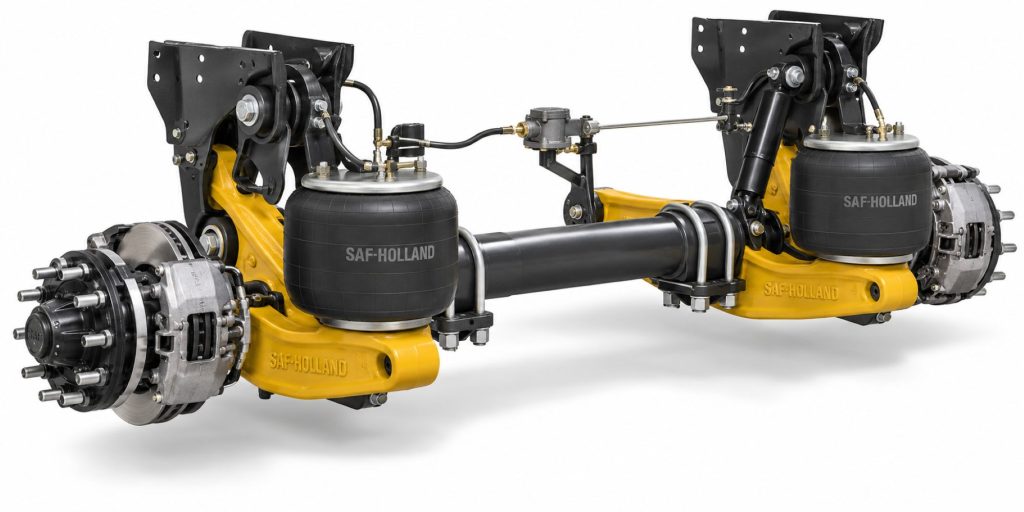
The SAF-Holland CBX25 AeroBeam is an integrated single-axle sliding air-suspension system intended for commercial trailers requiring a higher-capacity single-axle arrangement. It combines the slider subframe, suspension, axle, brakes, and wheel-end equipment into a coordinated assembly.
With a nominal suspension capacity of 25,000 pounds, the CBX25 is positioned above the CBX23 within the single-axle portion of the CBX family. It may be used in specialty trailers, multi-temperature refrigerated trailers, vocational equipment, and other applications where a conventional tandem slider is unnecessary.
The AeroBeam design uses a cast-steel trailing arm intended to provide a favorable balance of strength, durability, and system weight. Its movable subframe allows operators to adjust axle position for weight distribution, trailer wheelbase, maneuverability, and regulatory requirements.
Exact specifications and availability depend on the trailer manufacturer, production year, ride height, axle track, brake package, and wheel-end configuration.
Key Characteristics
- Single-axle sliding trailer suspension
- Nominal 25,000-pound suspension capacity
- Integrated suspension, axle, brake, and wheel-end package
- Air-ride design for cargo protection
- AeroBeam cast-steel trailing-arm construction
- Movable axle position
- Designed for higher-capacity single-axle applications
- Application-specific ride heights and axle tracks
- Adjustable axle-alignment system
- Manual or air-assisted pin release, depending on configuration
- Drum- or air-disc-brake options may be available
- Optional tire-inflation equipment
- Corrosion-protection options for demanding environments
Major Components
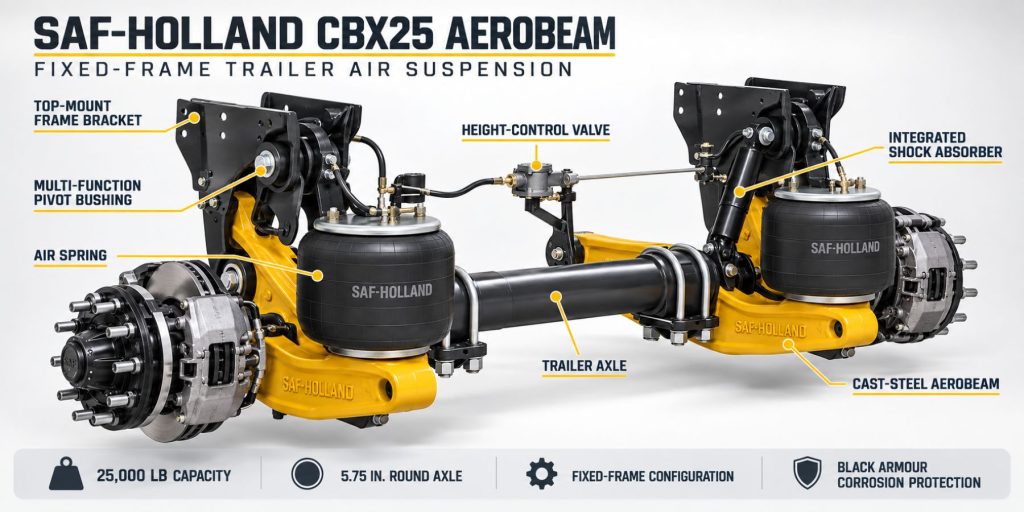
- Sliding subframe
- Slider rails and locking pins
- Pull-pin handle and linkage
- Frame brackets
- AeroBeam trailing arms
- Pivot connections and bushings
- Air springs
- Shock absorbers
- Height-control valve
- Ride-height linkage
- Air lines and fittings
- Single trailer axle
- Brake chambers and actuators
- Foundation brakes
- Hubs, bearings, seals, and lubrication components
- Axle-alignment hardware
- Optional tire-inflation components
How the Suspension System Works
Compressed air inside the suspension’s air springs supports the trailer and its cargo. When additional cargo lowers the trailer body, the height-control valve supplies air until the trailer returns to its designed ride height.
When weight is removed, the height-control valve releases excess air. This maintains a relatively consistent trailer height across changing loaded and unloaded conditions.
The AeroBeam trailing arms guide the axle through its vertical travel while managing braking, cornering, and road forces. Shock absorbers slow rapid suspension movement and help prevent repeated bouncing.
The suspension and axle assembly is mounted within a sliding subframe. Releasing the slider pins allows the assembly to move forward or rearward beneath the trailer. The pins must fully reengage the trailer rails before road operation.
Suspension Position and Function
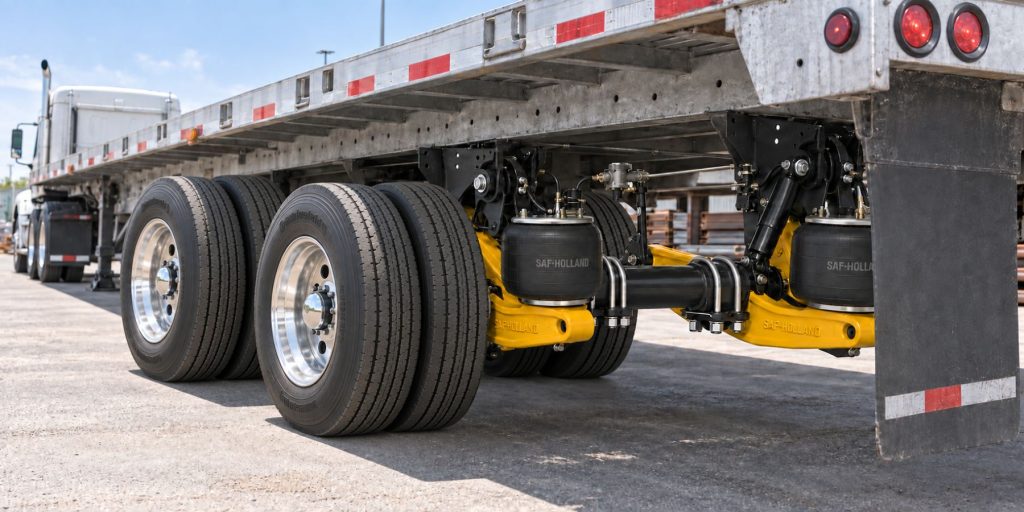
The CBX25 AeroBeam is installed beneath the rear portion of a compatible commercial trailer. It supports the trailer body while controlling the movement and position of one non-driven axle.
The suspension performs several functions:
- Supports the trailer and payload
- Maintains the specified ride height
- Allows controlled vertical axle travel
- Reduces shock transmitted into the trailer body
- Supports the brake and wheel-end systems
- Provides an adjustable axle position
- Maintains axle alignment
- Helps the trailer track correctly
- Allows changes to weight distribution and effective wheelbase
Moving the axle forward or rearward can significantly affect tractor and trailer axle weights because the system uses only one trailer axle.
Common Specifications
- Nominal Suspension Capacity: 25,000 lbs
- Suspension Type: Single-axle air ride
- Slider Type: Movable trailer subframe
- Axle Arrangement: One non-driven trailer axle
- Ride Height: Application-specific
- Slider Width: Determined by the trailer configuration
- Axle Track: Application-specific
- Brake Options: Drum or air disc brakes when offered for the configuration
- Alignment: SAF-Holland adjustment system appropriate to the suspension
- Air-System Requirement: Trailer compressed-air supply
- Wheel Ends: Application-specific SAF-Holland packages
The exact model number and identification tag should be used to verify capacity, ride height, slider dimensions, axle track, brake equipment, and replacement components.
Capacity, Ride Height, and Axle Travel
The CBX25 has a nominal suspension capacity of 25,000 pounds. The trailer’s actual allowable weight may be lower because of axle, frame, tire, wheel, brake, or legal limits.
A 25,000-pound suspension rating does not automatically permit 25,000 pounds on the axle in every jurisdiction. Single-axle road limits are frequently lower unless a permit or specialized operating rule applies.
Ride height is selected according to the trailer frame, floor height, tire size, axle placement, and required suspension travel. Operating at the incorrect height can affect:
- Jounce and rebound travel
- Air-spring shape
- Shock-absorber position
- Axle alignment
- Tire clearance
- Brake and air-line clearance
- Trailer stability
- Cargo-floor height
The suspension should be returned to its approved ride height before normal road operation.
Ride Quality and Load Distribution
Air springs help isolate the trailer body and cargo from road shock. This can benefit temperature-controlled freight, packaged products, electronics, beverages, machinery, and other cargo sensitive to vibration.
Because the CBX25 uses one axle, it does not distribute weight between two trailer axles like a tandem suspension. Instead, moving the slider changes weight distribution between the single trailer axle and the tractor’s axle groups.
Proper cargo placement is especially important. The slider cannot correct every loading problem, and the axle must remain within the lowest applicable rating or legal limit.
Suspension Controls and Adjustment Options
The CBX25 uses a height-control valve to maintain its designed operating height. Application-specific controls may include:
- Manual suspension dump
- Automatic suspension dump
- Manual slider pin release
- Air-assisted slider pin release
- Loading-height control
- Automatic tire-inflation equipment
- Antilock braking controls
- Electronic tire-pressure monitoring
- Body or loading-system interlocks
The locking pins must be completely engaged before the trailer is moved on public roads. Drivers should visually inspect every pin after repositioning the axle.
Alignment and Suspension Geometry
The trailer axle must be correctly aligned with the trailer centerline. Misalignment can cause poor tracking, increased rolling resistance, and rapid tire wear.
The AeroBeam trailing arms, pivot bushings, frame brackets, and alignment hardware maintain axle position. Worn bushings, loose fasteners, or structural damage can allow the axle to shift.
Alignment should be inspected after:
- Pivot-bushing replacement
- Axle replacement
- Suspension repair
- Curb strikes
- Collision damage
- Slider-subframe repair
- Ride-height correction
- Appearance of abnormal tire wear
Ride height, wheel bearings, tires, bushings, and structural components should be checked before completing the final alignment.
Axle, Brake, and Wheel-End Options
The CBX25 is designed as an integrated suspension-and-axle system. Available equipment depends on production year and trailer specification.
Possible equipment includes:
- SAF-Holland trailer axle
- Drum brakes
- P89-family air disc brakes
- Automatic slack adjusters
- Antilock braking system components
- Conventional wheel ends
- Extended-service wheel-end packages
- Preset bearing systems
- Parallel or tapered spindles
- Automatic tire-inflation systems
- Tire-pressure monitoring equipment
- Wheel-end condition monitoring
Replacement parts must match the axle identification, track width, spindle type, brake package, and wheel-end configuration.
Common Applications
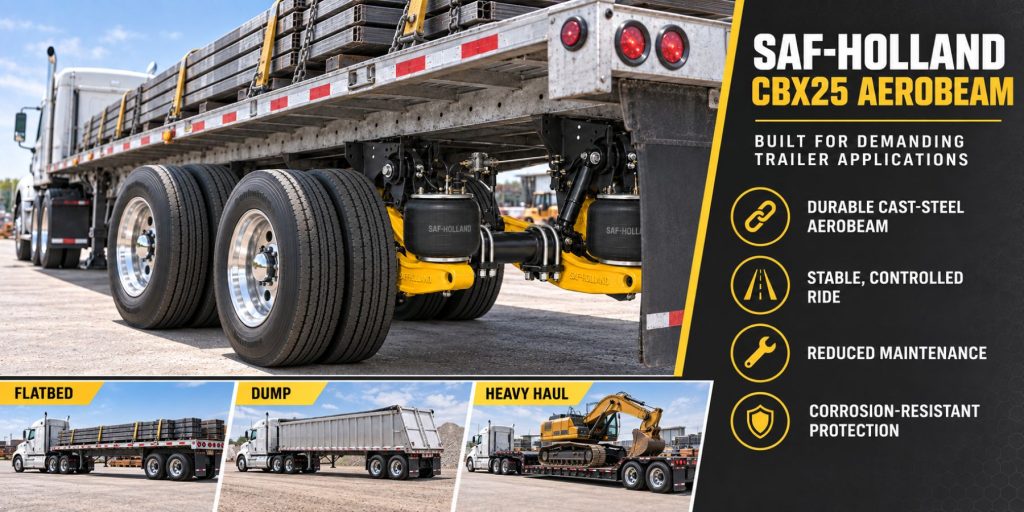
- Single-axle commercial trailers
- Specialty freight trailers
- Multi-temperature refrigerated trailers
- Pup trailers
- Regional distribution equipment
- Food-service trailers
- Vocational trailers
- Equipment trailers
- Weight-sensitive trailers
- Higher-capacity single-axle applications
- Cargo requiring air-ride protection
Vehicle, Axle, and Frame Compatibility
The CBX25 AeroBeam requires a compatible trailer frame, slider-rail arrangement, air system, axle track, brake system, wheel package, and structural rating.
Compatibility depends on:
- Trailer rail dimensions
- Slider width
- Suspension ride height
- Axle track
- Trailer frame capacity
- Gross axle weight rating
- Tire and wheel capacity
- Brake configuration
- Axle-to-body clearance
- Suspension travel
- Landing-gear clearance
- Air-tank and valve placement
- Rear-impact-guard location
- Cargo-body configuration
A 25,000-pound suspension should not be installed solely because its capacity appears adequate. Trailer structure, rail geometry, braking, tire capacity, and legal operating limits must also be verified.
Advantages
- Higher capacity than the CBX23 single-axle system
- Lower system complexity than many tandem arrangements
- Air-ride design helps protect cargo
- Sliding axle permits weight-distribution adjustments
- Integrated suspension, axle, brake, and wheel-end package
- AeroBeam construction balances strength and weight
- Can support specialized single-axle trailer applications
- Multiple brake and wheel-end options may be available
- Air-assisted pin release may reduce driver effort
- Automatic height control responds to payload changes
Limitations or Considerations
- Lower total capacity than the CBX40 tandem system
- Single axle does not provide tandem load equalization
- Legal single-axle limits may be lower than the suspension rating
- Air suspension requires a reliable compressed-air supply
- Air leaks can lower the trailer or prevent normal operation
- Slider pins and rails require regular inspection
- Ride height must match the trailer specification
- Load is concentrated on one axle and two wheel ends
- Availability may be limited to specific trailer applications
- Replacement components must match the exact configuration
Driver and Operator Experience
The CBX25 generally provides smoother trailer operation than a mechanical single-axle suspension. Its air springs reduce some of the vibration and impact transmitted into the cargo body.
Repositioning the single axle can noticeably change tractor axle weights, trailer handling, turning behavior, and rear swing. Drivers should use actual scale weights when determining the correct position.
Operators should report:
- Trailer leaning to one side
- Slow suspension inflation
- Frequent air loss
- Excessive bouncing
- Unusual suspension noise
- Poor trailer tracking
- Irregular tire wear
- Slider pins that do not fully engage
Maintenance and Ownership Notes
- Inspect air springs for cracks, cuts, abrasion, and leaks.
- Check air lines, fittings, valves, and reservoirs.
- Measure ride height at scheduled intervals.
- Inspect height-control linkage for damage.
- Check shock absorbers for leaks and worn mounts.
- Inspect pivot bushings and connections.
- Check slider rails, locking pins, and release linkage.
- Clean and lubricate the slider according to service instructions.
- Inspect the subframe and crossmembers for damage.
- Check AeroBeam trailing arms and axle connections.
- Monitor tires for alignment-related wear.
- Service brakes and wheel ends according to their schedules.
- Inspect tire-inflation equipment when installed.
- Verify alignment after suspension repairs.
- Repair damaged corrosion-protection coatings.
Common Suspension Problems
- Air leaks: Damaged air springs, hoses, fittings, valves, or reservoirs can cause the trailer to settle.
- Incorrect ride height: A faulty height-control valve, damaged linkage, air restriction, or improper adjustment can limit suspension travel.
- Slider pins that will not release: Pin tension, corrosion, debris, damaged linkage, or insufficient air pressure may prevent release.
- Pins that fail to engage: Misaligned rail holes, damaged pins, weak springs, or contaminated linkage may prevent secure locking.
- Worn pivot bushings: Bushing wear can allow axle movement and contribute to tire wear or poor tracking.
- Excessive bouncing: Worn shock absorbers, incorrect ride height, damaged air springs, or improper loading can reduce suspension control.
- Uneven tire wear: Alignment problems, incorrect tire pressure, wheel-end looseness, or axle damage may be responsible.
- Trailer leaning: Uneven loading, an air restriction, valve failure, or structural damage can cause side-to-side height differences.
- Structural damage: Curb strikes, overloading, drag turns, or collision damage can bend or crack the slider structure.
Identification Information
Identification information is normally located on a tag attached to the suspension, slider, or axle assembly. Trailer build records may also be needed.
Record the following information:
- Trailer manufacturer
- Trailer vehicle identification number
- Trailer model and production date
- Complete suspension model
- Suspension serial or assembly number
- Rated capacity
- Designed ride height
- Slider width
- Axle track
- Axle identification number
- Brake type and size
- Wheel-end configuration
- Air-spring part number
- Shock-absorber part number
- Pin-release configuration
Do not identify the system by appearance alone. Similar CBX assemblies may have different capacities, dimensions, brake packages, or service parts.
Buying Considerations
- Confirm that a 25,000-pound single-axle slider is appropriate.
- Check legal single-axle weight limits for the intended operation.
- Verify trailer frame and rail capacity.
- Match the correct suspension ride height.
- Confirm slider width and rail compatibility.
- Verify axle track and tire clearance.
- Choose the appropriate brake package.
- Review wheel-end maintenance requirements.
- Consider air-assisted pin release.
- Evaluate tire-inflation and monitoring options.
- Compare system weight with tandem alternatives.
- Review replacement-parts availability.
- Inspect used assemblies for structural damage and corrosion.
- Verify the complete model through SAF-Holland or the trailer manufacturer.
Variants and Configurations
CBX25 AeroBeam configurations may differ according to the trailer manufacturer and intended application.
Differences may include:
- Ride height
- Slider width
- Axle track
- Slider travel
- Brake type
- Wheel-end package
- Spindle configuration
- Manual pin release
- Air-assisted pin release
- Suspension dump control
- Tire-inflation equipment
- Corrosion-protection package
- Application-specific frame brackets
- Trailer manufacturer integration
Specifications and available equipment may change by production year. The complete suspension identification number should be used when comparing configurations.
Comparison to Similar Equipment
Compared with the SAF-Holland CBX23 AeroBeam, the CBX25 provides a higher nominal suspension capacity. Both are intended for application-specific single-axle trailer installations.
Compared with the SAF-Holland CBX40, the CBX25 uses one axle rather than a tandem group. The CBX40 provides greater total suspension capacity for conventional dry-van and refrigerated-trailer applications.
Compared with the Hendrickson ULTRAA-K Slider System, the CBX25 is a single-axle system for specialized applications. ULTRAA-K is primarily a tandem slider for full-size van and refrigerated trailers.
Compared with the Hendrickson INTRAAX, the CBX25 includes a sliding subframe that allows axle repositioning. INTRAAX is commonly installed as a fixed-position integrated suspension and axle system.
Best Fit For
- Higher-capacity single-axle trailers
- Specialty commercial trailers
- Vocational trailer applications
- Multi-temperature refrigerated trailers
- Regional distribution equipment
- Pup trailers
- Weight-sensitive fleet applications
- Cargo requiring air-ride protection
- Trailers requiring adjustable axle positioning
- Vehicles with an approved CBX25 installation
Related Vehicle and Trailer Types
- Complete Guide to Trailer Types
- Dry Van vs Refrigerated Trailer
- Choosing the Right Trailer for Your Freight
- Single-axle trailers
- Pup trailers
- Refrigerated trailers
- Specialty dry vans
- Multi-temperature trailers
- Regional distribution trailers
- Vocational trailers
Related Truck and Trailer Models
- Great Dane Champion Dry Van Trailer
- Great Dane Everest Reefer Trailer
- Wabash DuraPlate Dry Van Trailer
- Wabash ArcticLite Reefer Trailer
- Utility 3000D Dry Van Trailer
- Utility 3000R Reefer Trailer
- Hyundai Translead Dry Van
Related Suspension Types
- Trailer Suspension Systems
- Air Suspension Systems
- SAF-Holland CBX23 AeroBeam
- SAF-Holland CBX40
- Hendrickson ULTRAA-K Slider System
- Hendrickson INTRAAX
- Single-axle air suspensions
- Sliding trailer suspensions
- Integrated axle and suspension systems
- Fixed-position trailer air suspensions
Related Equipment Systems
- Suspension Systems
- Axles & Differentials
- Air Brake Systems Explained
- Trailer slider systems
- Trailer axles
- Air disc brakes
- Drum brakes
- Wheel-end systems
- Automatic tire-inflation systems
- Antilock braking systems
- Tires and wheels
Related Guides
- Suspension System Guides
- How Commercial Truck Suspension Systems Work
- Air Suspension vs Leaf Spring Suspension
- How to Choose a Commercial Truck Suspension
- Truck Suspension Components Explained
- Truck vs Trailer Suspension Systems
- Complete Guide to Freight Types
- Choosing the Right Trailer for Your Freight
Regulatory and Compliance Notes
The CBX25’s nominal 25,000-pound rating does not automatically establish the legal weight permitted on a public road. Single-axle limits may be lower and vary by jurisdiction, axle spacing, tire width, permits, and vehicle configuration.
The slider must be positioned so the complete tractor-trailer combination complies with applicable axle-weight, bridge, and length regulations.
All locking pins must be fully engaged before the trailer is operated. Suspension components, brakes, tires, wheel ends, air lines, and structural mounting points must remain in serviceable condition.
Changes to ride height, axle position, slider rails, brake configuration, or suspension structure should receive appropriate manufacturer or engineering approval.
Real World Operating Notes
The difference between suspension capacity and legal axle weight is especially important with a 25,000-pound single-axle system. Operators should confirm the rules for every jurisdiction in which the trailer will operate.
Moving the axle can significantly change weight distribution. Actual scale weights should be used when adjusting the trailer for a heavy or concentrated load.
A forward axle position shortens the effective trailer wheelbase and may improve maneuverability. A rearward position can change stability, rear swing, and tractor axle loading.
Corrosion, ice, mud, and road debris can prevent the slider pins from moving freely. Regular inspection, cleaning, and lubrication are important.
Frequently Asked Questions
What is the SAF-Holland CBX25 AeroBeam?
The CBX25 AeroBeam is an integrated single-axle sliding air-suspension system for commercial trailers.
What is its suspension capacity?
The nominal suspension capacity is 25,000 pounds. Legal single-axle limits may be lower.
Is the CBX25 a tandem suspension?
No. It is a single-axle system. The SAF-Holland CBX40 is the tandem slider within this group.
What is the difference between the CBX23 and CBX25?
The primary distinction is nominal suspension capacity. The CBX23 is rated at approximately 23,000 pounds, while the CBX25 is designed around a 25,000-pound rating.
What trailers use the CBX25?
It may be used on specialty, vocational, multi-temperature, pup, and other higher-capacity single-axle trailers.
Can the axle be repositioned?
Yes. The axle and suspension are mounted within a sliding subframe that moves along compatible trailer rails.
Does the CBX25 use air suspension?
Yes. Air springs support the trailer and help isolate its cargo from road shock.
Why is correct ride height important?
Correct ride height preserves suspension travel, air-spring shape, axle alignment, tire clearance, and trailer handling.
Can the trailer legally carry 25,000 pounds on the axle?
Not necessarily. Legal single-axle limits may be lower than the mechanical suspension rating unless a permit or special operating rule applies.
How can the correct replacement parts be identified?
Use the suspension tag, axle tag, trailer VIN, ride height, slider width, axle track, brake type, and wheel-end configuration.
Availability and Where to Find
The SAF-Holland CBX25 AeroBeam may be available for approved single-axle trailer applications through participating manufacturers and specialty trailer builders. Availability depends on the trailer design, production year, ride height, axle track, brake package, and regional market.
Replacement components may be available through SAF-Holland distributors, commercial-trailer dealers, heavy-duty parts suppliers, fleet service facilities, and suspension repair shops.
Because this is an application-specific system, buyers should confirm current production and parts support directly with SAF-Holland before specifying a new trailer or purchasing a used assembly.
Product support, technical literature, parts information, and distributor resources are available through the SAF-Holland website.
Support Trucking Families
Truck Equipment Atlas supports the mission of Grey Cross, a nonprofit dedicated to helping families of truck drivers who lose their lives while on the road. As the site grows, part of its mission is to bring awareness and support to these families.
Podcast or Video Section
Learn More Through Audio and Video
Truck Equipment Atlas will continue expanding with podcast episodes, interviews, and equipment breakdowns to help drivers and fleets better understand trucks and equipment.
Follow the Growth of Truck Equipment Atlas
Truck Equipment Atlas continues to expand with new truck profiles, trailer coverage, diesel engine pages, equipment system resources, manufacturer information, and educational guides.
Visit our Site Updates page to explore recent additions, project milestones, and upcoming resources as we continue building one of the industry’s growing commercial trucking equipment reference libraries.
View the Latest Site Updates: Truck Equipment Atlas Site Updates