
PACCAR TX-8 Transmission
Quick Facts
- Manufacturer: PACCAR
- Transmission Type: Medium-Duty Automatic Transmission
- Forward Speeds: Eight
- Reverse Speeds: Two Selectable Reverse Modes or Ratios depending on vehicle programming
- Maximum Input Torque: Up to 1,050 lb-ft
- Maximum Operating Weight: 57,000 pounds GCWR
- Gear Ratio Spread: 7.65:1
- First-Gear Ratio: 4.89:1
- Top-Gear Ratio: 0.64:1 Overdrive
- Reverse Ratio: 4.25:1
- Torque Converter: Lockup Torque Converter with Twin Torsional Damper
- Driver Controls: PACCAR Column-Mounted Shift Selector
- Operating Modes: Drive, Neutral, Reverse, Manual, and application-specific modes
- Park System: Auto Park Lock
- PTO Availability: Optional Engine-Driven PTO
- PTO Mounting: 8-Bolt Openings at the 3- and 9-O’Clock Positions
- Maximum Single-PTO Torque: 516 lb-ft
- Compatible PTO Families: Chelsea 272 and Z35 depending on configuration
- Dry Weight: Approximately 328 pounds
- Approximate Length: 29.7 inches
- Oil Capacity: Approximately 4.49 gallons or 17 liters
- Oil-Change Interval: Up to 150,000 miles depending on duty cycle
- Oil-Filter Interval: Described by PACCAR as a lifetime filter under normal approved service
- Common Engines: PACCAR PX-7 and PACCAR PX-9
- Common Truck Classes: Class 5 through Class 8 Medium-Duty and Vocational Trucks
- Common Applications: Pickup and Delivery, Box Trucks, Utility Trucks, Tow Trucks, Municipal Vehicles, Refuse, Construction Support, and Vocational Service
- Production Status: Active Production
Overview
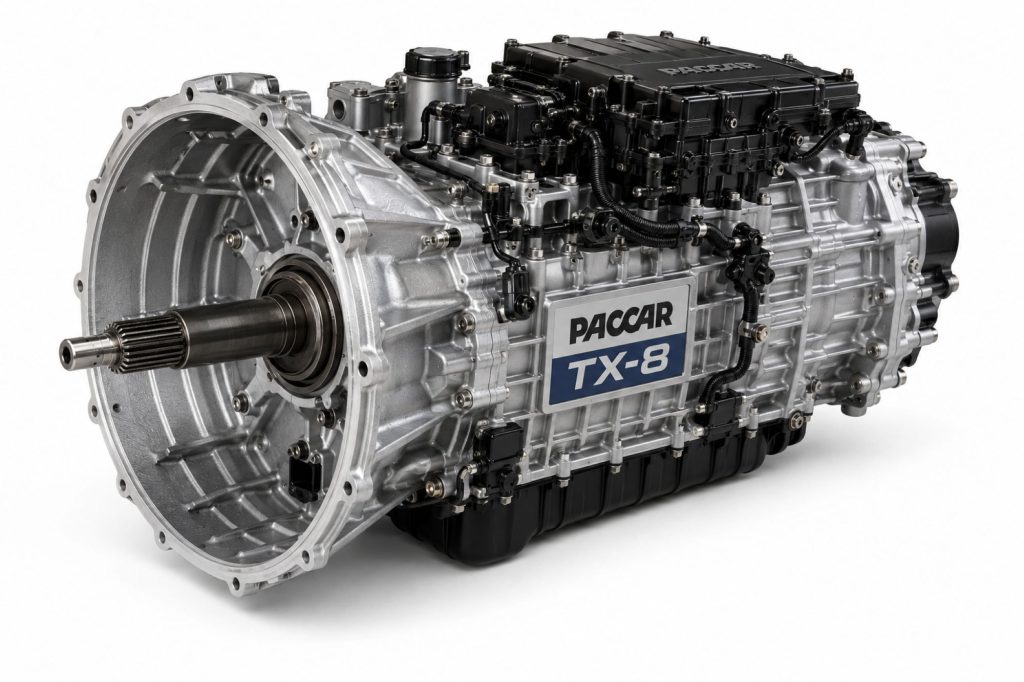
The PACCAR TX-8 is an eight-speed automatic transmission developed for PACCAR’s medium-duty Kenworth and Peterbilt trucks.
It is designed to operate as part of an integrated PACCAR powertrain with the PACCAR PX-7 and PX-9 diesel engines. The transmission’s electronic controls monitor road grade, acceleration, torque demand, vehicle weight, throttle position, and engine load to select an efficient gear.
The TX-8 is a conventional automatic transmission rather than an automated manual transmission. It uses a torque converter, automatic gear changes, an internal hydraulic and electronic mechatronic control system, and a park-lock mechanism.
A Twin Torsional Damper allows the torque-converter lockup clutch to engage early in first gear. Early lockup reduces converter slip, improves acceleration, and can increase fuel efficiency.
The TX-8 is available in Kenworth T180, T280, T380, and T480 models and Peterbilt Models 535, 536, 537, and 548. Exact availability depends on engine, truck class, model year, vocation, GCWR, and PTO requirements.
The transmission supports trucks operating at gross combination weights up to 57,000 pounds. It can also be equipped with an engine-driven PTO for utility, towing, recovery, refuse, and other vocational applications.
Key Characteristics
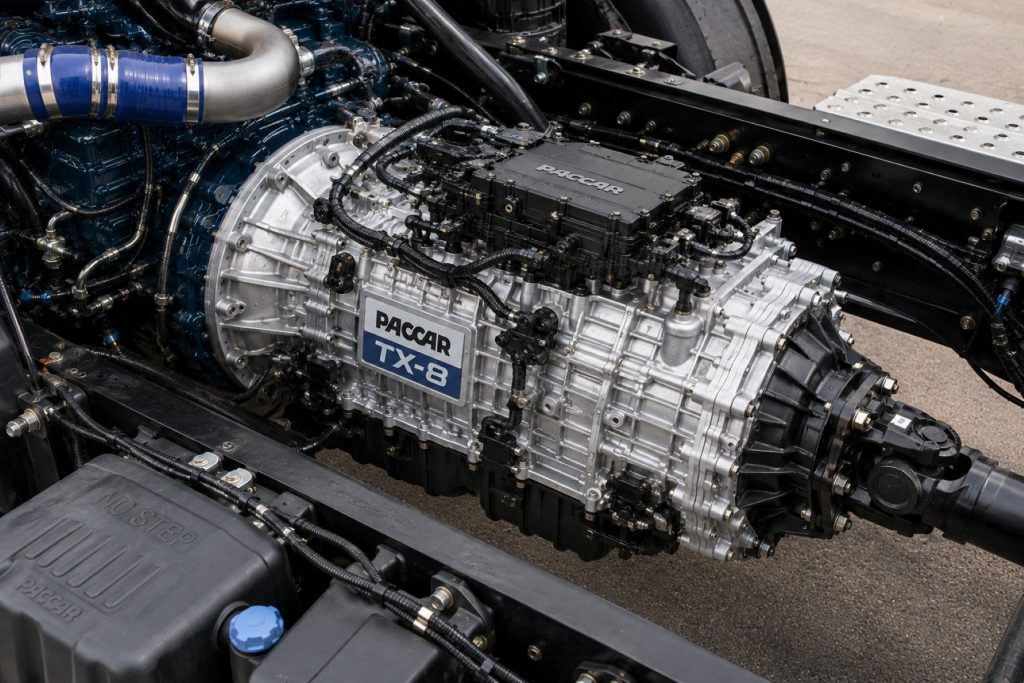
The TX-8 provides eight forward ratios ranging from 4.89:1 in first gear to 0.64:1 in eighth gear.
Its 7.65:1 overall ratio spread combines strong starting performance with two overdrive ratios for efficient highway operation.
The torque converter provides smooth movement from a stop and uninterrupted torque multiplication during initial acceleration.
The Twin Torsional Damper reduces engine and drivetrain vibration. This allows the lockup clutch to engage early in first gear without transmitting excessive torsional vibration through the drivetrain.
The integrated mechatronic unit combines the transmission control unit with hydraulic control components inside the oil pan. This reduces the number of external components and connections.
Auto Park Lock automatically engages the transmission’s park mechanism under specified conditions if the driver fails to select park.
The PACCAR column-mounted selector gives the driver access to drive, neutral, reverse, and manual functions without using a floor-mounted shift lever.
PTO-equipped versions can support mobile PTO operation in compatible Peterbilt and Kenworth vocational configurations.
How the Transmission Works
The TX-8 uses a torque converter to transfer engine power into the automatic transmission during vehicle launch.
When the truck is stopped in drive, the torque converter allows the engine to remain running while the vehicle is held with the brake.
As the driver releases the brake and presses the accelerator, the torque converter transfers and multiplies engine torque to move the truck.
The transmission’s electronic control system monitors engine speed, vehicle speed, load, throttle position, road grade, and torque demand.
Hydraulic pressure applies internal clutches and brakes to select the appropriate planetary-gear combination for each ratio.
The Twin Torsional Damper reduces vibration sufficiently for the lockup clutch to engage early in first gear.
Once locked, the torque converter establishes a more direct mechanical connection between the engine and transmission. This reduces slip, heat generation, and fuel loss.
As road speed changes, the mechatronic unit directs hydraulic pressure to the appropriate clutch packs. One ratio is released while the next is applied.
Manual mode allows the driver to request a lower or higher gear when additional control is needed. The transmission may refuse a request that would over-speed or lug the engine.
When reverse is selected, the transmission applies the reverse gear elements while the torque converter provides smooth low-speed control.
The Auto Park Lock system engages the park mechanism when programmed safety conditions are met.
Common Specifications
Transmission Type
The PACCAR TX-8 is an electronically controlled, torque-converter automatic transmission.
It should not be classified as an automated manual transmission.
Forward Speeds
The transmission provides eight forward gears.
The additional ratios allow closer matching between engine speed, vehicle load, and road conditions than many older four-, five-, or six-speed medium-duty automatics.
Gear Ratios
- First Gear — 4.89:1
- Second Gear — 3.12:1
- Third Gear — 2.03:1
- Fourth Gear — 1.64:1
- Fifth Gear — 1.25:1
- Sixth Gear — 1.00:1 Direct Drive
- Seventh Gear — 0.84:1 Overdrive
- Eighth Gear — 0.64:1 Overdrive
- Reverse — 4.25:1
Overall Ratio
The overall ratio spread is 7.65:1.
This is calculated from the 4.89 first gear and 0.64 overdrive top gear.
Maximum Input Torque
The current published maximum torque capacity is 1,050 lb-ft.
Earlier PACCAR descriptions listed up to 1,000 lb-ft when the TX-8 was introduced.
The approved rating depends on engine, truck model, vocation, GCWR, and transmission specification.
Maximum Operating Weight
The maximum published operating weight is 57,000 pounds GCWR.
This does not mean every TX-8-equipped truck is rated to 57,000 pounds. The truck’s GVWR, axle ratings, frame, brakes, hitch, tires, and manufacturer certification determine its actual legal and mechanical limits.
Torque Converter
The torque converter provides smooth launch behavior and initial torque multiplication.
It also permits low-speed maneuvering without the clutch engagement behavior associated with an automated manual transmission.
Twin Torsional Damper
The Twin Torsional Damper reduces vibration between the engine and transmission.
This enables early first-gear lockup for more direct power transfer, faster acceleration, reduced heat, and improved efficiency.
Automatic Lockup
The torque-converter clutch locks during appropriate operating conditions.
Lockup reduces converter slip and creates a more direct mechanical connection between the engine and transmission.
Mechatronic Control Unit
The TX-8 combines the electronic transmission control unit with the hydraulic mechatronic system inside the oil pan.
This design reduces external components and places major control functions in a single serviceable assembly.
Driver Controls
The PACCAR column-mounted selector provides access to:
- Drive
- Neutral
- Reverse
- Manual Mode
- Up- and downshift requests
Application-specific functions where equipped
Auto Park Lock
Auto Park Lock is designed to engage the park mechanism when programmed conditions indicate that the vehicle should be secured.
Drivers must still follow normal parking procedures, including applying the parking brake.
Park-Lock Capacity
The published maximum park-lock operating weight is 33,000 pounds GCW.
Vehicles above that weight require careful adherence to PACCAR parking procedures and use of the parking brake.
PTO Mounting
PTO-equipped transmissions provide mounting at the 3- and 9-o’clock positions.
The openings use an 8-bolt pattern.
PTO Capacity
Maximum published single-PTO output torque is 516 lb-ft.
The PTO is engine-driven.
Compatible PTO models include Chelsea 272 or Z35 families depending on the truck and application.
Mobile PTO
Mobile PTO functionality allows compatible equipment to remain powered beyond first gear.
This can support utility, towing, recovery, refuse, and other applications requiring hydraulic power while the truck moves.
Mobile PTO availability depends on truck model, programming, PTO hardware, and body-equipment integration.
Oil Capacity
Published transmission oil capacity is approximately 4.49 gallons or 17 liters.
The actual fill amount can be affected by installation angle, PTO configuration, cooling equipment, and service procedure.
Oil-Change Interval
PACCAR lists an oil-change interval of up to 150,000 miles.
The correct interval depends on duty cycle and should be confirmed using the applicable maintenance manual.
Oil Filter
PACCAR describes the internal oil filter as a lifetime filter under normal approved operating conditions.
Contamination, internal damage, or transmission disassembly can require additional service.
Transmission Weight
Dry weight is approximately 328 pounds.
Installed weight increases after adding oil, PTO equipment, mounting hardware, cooling lines, and controls.
Transmission Length
Published length is approximately 29.7 inches.
Installation clearance must also account for the torque converter housing, output connection, PTO equipment, cooler lines, wiring, and driveshaft.
Common Applications
- Pickup and delivery trucks
- Box trucks
- Lease and rental trucks
- Utility trucks
- Tow trucks
- Recovery vehicles
- Municipal trucks
- Refuse vehicles
- Construction-support trucks
- Beverage-delivery trucks
- Flatbed delivery trucks
- Stake trucks
- Service trucks
- Landscaping trucks
- Light dump trucks
- Fire and emergency-support vehicles
- Vocational trucks requiring mobile PTO operation
Truck and Engine Compatibility
The PACCAR TX-8 is designed primarily for PACCAR’s medium-duty Kenworth and Peterbilt truck families.
Confirmed Kenworth applications include:
- Kenworth T180
- Kenworth T280
- Kenworth T380
- Kenworth T480
The TX-8 is standard or available across portions of Kenworth’s current medium-duty lineup depending on engine, vocation, weight, and model configuration.
Confirmed Peterbilt applications include:
- Peterbilt 535
- Peterbilt 536
- Peterbilt 537
- Peterbilt 548
Mobile PTO capability is documented for Peterbilt Models 536, 537, and 548.
The primary engine pairings are:
The PX-7 is commonly used in lighter Class 5 through Class 7 applications.
The PX-9 supports heavier medium-duty and vocational trucks with higher horsepower and torque requirements.
The engine, transmission, rear axle, tire size, GCWR, PTO, and electronic programming must be approved as a complete PACCAR powertrain.
Advantages
- Eight forward gears
- Two overdrive ratios
- Smooth torque-converter launches
- No clutch pedal
- Automotive-style operation
- Maximum torque capacity of 1,050 lb-ft
- Maximum GCWR of 57,000 pounds
- Integrated PACCAR engine and transmission controls
- Twin Torsional Damper
- Early first-gear lockup
- Auto Park Lock
- Column-mounted shift selector
- Manual gear-selection mode
- Compact design
- Low dry weight
- Integrated mechatronic controls
- Up to 150,000-mile oil-change interval
- Optional PTO capability
- Mobile PTO availability
- Strong fit for medium-duty and vocational trucks
- Can improve driver recruitment and training
Limitations or Considerations
- Primarily limited to Kenworth and Peterbilt trucks
- Optimized for PACCAR PX engines
- Maximum GCWR is 57,000 pounds
- Maximum torque is 1,050 lb-ft
- Not designed for heavy Class 8 highway tractors
- Not suitable for extreme heavy-haul service
- Park-lock capacity is lower than maximum transmission GCWR
- PTO availability depends on the transmission configuration
- Mobile PTO requires correct programming and body integration
- Electronic and hydraulic controls require specialized diagnostics
- Mechatronic-unit repairs can be expensive
- Incorrect fluid can damage internal components
- Oil service interval depends on duty cycle
- Torque-converter heat must be controlled in severe low-speed operation
- A transmission cooler may be required in certain applications
Driver and Operator Experience
The TX-8 is designed to feel similar to a passenger-vehicle automatic transmission.
The driver selects drive or reverse with the column-mounted selector and then controls the truck with the accelerator and brake pedals.
The torque converter allows the vehicle to move smoothly from a stop without clutch engagement.
Early lockup reduces the extended slipping sensation found in some older automatic transmissions.
The transmission automatically selects gears according to load, grade, vehicle speed, and throttle demand.
Manual mode allows the driver to request a lower gear for descending hills, approaching turns, operating with a load, or increasing engine-braking effect.
The system may refuse a requested shift that would over-speed or lug the engine.
Auto Park Lock adds protection if the driver fails to select park under qualifying conditions. It does not replace the parking brake or normal vehicle-securement procedures.
PTO-equipped drivers must understand the approved engagement conditions, engine-speed limits, mobile-PTO controls, and body-equipment interlocks.
Maintenance and Ownership Notes
The TX-8 holds approximately 4.49 gallons of approved transmission fluid.
PACCAR publishes an oil-change interval of up to 150,000 miles, but vocational duty cycles may require application-specific service planning.
Transmission-fluid level and condition should be checked according to the PACCAR service procedure.
Leaks should be inspected around the oil pan, cooler lines, torque-converter housing, output seal, PTO mounting, electrical connectors, and case joints.
The integrated mechatronic unit depends on clean transmission fluid. Contamination can affect hydraulic valves, pressure control, shift timing, and clutch application.
The electrical system should be checked for battery voltage, charging performance, grounds, wiring damage, connector corrosion, and communication faults.
PTO-equipped transmissions require inspection of the PTO mounting, seals, fasteners, pump, hydraulic lines, and control system.
Cooling lines and the transmission heat exchanger should be inspected when equipped.
Software updates and diagnostic procedures should be completed using approved PACCAR tools and service information.
Common Transmission Problems
Harsh Shifting
Harsh shifts can result from incorrect fluid level, contaminated fluid, software calibration, pressure-control problems, speed-sensor faults, or mechatronic-unit problems.
Delayed Engagement
A delay when selecting drive or reverse may indicate low fluid, hydraulic-pressure loss, valve-body problems, torque-converter issues, or internal clutch wear.
Transmission Slipping
Slipping may result from low fluid, worn clutch packs, hydraulic-pressure problems, torque-converter clutch failure, or internal damage.
Torque-Converter Shudder
Shudder during lockup can be caused by fluid deterioration, damper problems, torque-converter clutch wear, driveline vibration, or incorrect calibration.
Transmission Overheating
Heavy low-speed operation, repeated converter slipping, excessive weight, inadequate cooling, low fluid, or PTO operation can increase temperature.
Mechatronic-Unit Faults
The integrated electronic and hydraulic controller can develop sensor, solenoid, valve, pressure-control, wiring, or module faults.
Auto Park Lock Problems
A park-lock warning can result from sensor faults, actuator problems, programming, wiring, or a mechanical park-system issue.
PTO Will Not Engage
Possible causes include incorrect vehicle conditions, failed interlocks, programming problems, hydraulic overload, wiring damage, or incompatible PTO equipment.
Oil Leaks
Leaks may develop at the oil pan, cooler connections, output seal, torque-converter housing, PTO mount, or case joints.
Communication Faults
The engine and transmission must exchange torque and operating information. Data-network, wiring, power, ground, or controller faults can interrupt normal operation.
Buying Considerations
- Confirm the truck is approved for the PACCAR TX-8.
- Verify PX-7 or PX-9 engine compatibility.
- Confirm the maximum engine torque.
- Check the truck’s GVWR and GCWR.
- Do not exceed the 57,000-pound transmission limit.
- Confirm rear-axle and tire gearing.
- Determine whether a PTO is required.
- Confirm the 3- or 9-o’clock PTO mounting position.
- Calculate PTO torque requirements.
- Determine whether mobile PTO is needed.
- Verify Chelsea 272 or Z35 compatibility.
- Inspect transmission fluid condition.
- Check for active and inactive fault codes.
- Road-test all forward gears.
- Test reverse engagement.
- Test manual mode.
- Verify Auto Park Lock operation.
- Check torque-converter lockup behavior.
- Inspect the mechatronic unit and wiring.
- Review oil-change records.
- Confirm software and calibration status.
- Check PACCAR warranty and dealer support.
Variants and Configurations
- PX-7 Powertrain Configuration
- PX-9 Powertrain Configuration
- Non-PTO Configuration
- 3-O’Clock PTO Configuration
- 9-O’Clock PTO Configuration
- Chelsea 272 PTO Configuration
- Chelsea Z35 PTO Configuration
- Mobile PTO Configuration
- Pickup and Delivery Calibration
- Utility-Truck Configuration
- Tow and Recovery Configuration
- Municipal Configuration
- Refuse Configuration
- Construction Configuration
- Kenworth Medium-Duty Configuration
- Peterbilt Medium-Duty Configuration
Comparison to Similar Equipment
Compared with the PACCAR TX-12, the TX-8 is a conventional eight-speed automatic designed for medium-duty trucks. The TX-12 is a heavy-duty automated manual transmission designed for higher torque and highway applications.
Compared with an Allison 1000 or 2000 Series transmission, the TX-8 provides eight forward gears and close integration with PACCAR PX engines. Allison transmissions have broader availability across multiple truck manufacturers.
Compared with the Allison 3000 Series, the TX-8 is lighter and intended for lower torque and weight classes. The Allison 3000 supports heavier vocational applications and a wider selection of PTO configurations.
Compared with Eaton UltraShift medium-duty models, the TX-8 uses a torque converter and automatic planetary gearsets rather than a dry centrifugal clutch and automated mechanical gearbox. The TX-8 generally provides smoother low-speed operation.
Compared with a six-speed medium-duty automatic, the TX-8’s additional ratios can keep the engine closer to its efficient operating range and provide two overdrive gears.
Best Fit For
- Kenworth medium-duty fleets
- Peterbilt medium-duty fleets
- PACCAR PX-7-powered trucks
- PACCAR PX-9-powered trucks
- Pickup and delivery operations
- Box-truck fleets
- Utility companies
- Tow and recovery operators
- Municipal fleets
- Refuse operations
- Construction-support vehicles
- Lease and rental fleets
- Vocational trucks requiring mobile PTO operation
- Operations below 57,000 pounds GCWR
- Drivers needing automotive-style operation
Related Truck Types
Related Truck Models
- Kenworth T280
- Peterbilt 535
- Peterbilt 536
- Kenworth T180
- Kenworth T380
- Kenworth T480
- Peterbilt 537
- Peterbilt 548
Related Engines
Related Transmission Types
- Automatic Transmissions
- Medium-Duty Transmissions
- Vocational Transmissions
- Automated Manual Transmissions
- Heavy-Duty Transmissions
Related Equipment Systems
- Torque Converters
- Planetary Gearsets
- Automatic Transmission Clutch Packs
- Transmission Mechatronic Systems
- Transmission Control Units
- Transmission Cooling Systems
- Vehicle Data Networks
- Electrical Systems
- Driveshafts
- Axles and Differentials
- PTO Systems
Related Guides
Understand the operating principles in How Commercial Truck Transmissions Work, compare drivetrain designs in Manual vs Automated Manual vs Automatic Transmissions, and evaluate gearing, application, and compatibility in How to Choose a Commercial Truck Transmission.
Regulatory and Compliance Notes
The TX-8 must be installed in a Kenworth or Peterbilt configuration approved by PACCAR.
The engine’s maximum torque must remain within the transmission’s approved rating.
The truck must remain within its certified GVWR, axle ratings, GCWR, tire ratings, brake capacity, and the TX-8’s 57,000-pound maximum operating-weight limit.
The park lock is rated for a maximum of approximately 33,000 pounds GCW. Drivers must apply the parking brake and follow PACCAR vehicle-securing procedures.
PTO installations must use approved hardware, controls, hydraulic equipment, programming, and safety interlocks.
Mobile PTO operation must comply with vehicle, body-builder, and equipment-manufacturer requirements.
Changes to tire size, rear-axle ratio, controllers, or programming can affect shift operation, speedometer accuracy, engine controls, PTO behavior, and regulatory compliance.
Real World Operating Notes
The TX-8 is intended to provide passenger-car-like operation in a commercial medium-duty truck.
The torque converter makes backing, docking, maneuvering, and starting on grades easier than with many dry-clutch automated manual transmissions.
The 4.89 first gear provides strong initial reduction, while seventh and eighth are overdrive ratios.
Drivers should allow the transmission to select gears automatically during normal operation. Manual mode is most useful on grades, in traffic, or when additional engine-speed control is needed.
Auto Park Lock adds safety protection but should never be used as a substitute for the parking brake.
PTO-equipped trucks require driver training because PTO engagement conditions and mobile operation vary by body and equipment type.
Frequently Asked Questions
What is the PACCAR TX-8?
It is an eight-speed torque-converter automatic transmission designed for PACCAR medium-duty Kenworth and Peterbilt trucks.
Is the TX-8 an automatic or automated manual?
It is a conventional automatic transmission with a torque converter, planetary gearing, hydraulic controls, and electronic management.
How much torque can it handle?
The current published maximum torque capacity is 1,050 lb-ft.
What is its maximum GCWR?
The maximum published operating weight is 57,000 pounds GCWR.
What trucks use the TX-8?
It is available in Kenworth T180, T280, T380, and T480 trucks and Peterbilt Models 535, 536, 537, and 548.
What engines work with the TX-8?
The primary engine pairings are the PACCAR PX-7 and PX-9.
Does the TX-8 have a PTO?
PTO-equipped configurations are available with 8-bolt mounting at the 3- and 9-o’clock positions.
Can the PTO operate while the truck is moving?
Mobile PTO functionality is available in approved truck, PTO, and body-equipment configurations.
What is Auto Park Lock?
It is a safety feature designed to engage the transmission’s park mechanism when programmed conditions indicate the vehicle should be secured.
How often is the transmission oil changed?
PACCAR lists an interval of up to 150,000 miles, depending on duty cycle and maintenance requirements.
Availability and Where to Find
The PACCAR TX-8 is available through Kenworth and Peterbilt commercial truck dealers.
It can be ordered in approved Kenworth T180, T280, T380, and T480 configurations and Peterbilt Models 535, 536, 537, and 548.
Used TX-8-equipped trucks may also be available through PACCAR dealers, commercial truck dealerships, fleet-equipment sales, auctions, and used-truck marketplaces.
Buyers should confirm the engine, transmission torque rating, GCWR, PTO requirements, software, warranty, and body-equipment compatibility before ordering or purchasing.
Current specifications, warranty information, PTO details, and dealer support are available through the official PACCAR TX-8 page.
Support Trucking Families
Truck Equipment Atlas supports the mission of Grey Cross, a nonprofit dedicated to helping families of truck drivers who lose their lives while on the road. As the site grows, part of its mission is to bring awareness and support to these families.
Podcast or Video Section
Learn More Through Audio and Video
Truck Equipment Atlas will continue expanding with podcast episodes, interviews, and equipment breakdowns to help drivers and fleets better understand trucks and equipment.
Follow the Growth of Truck Equipment Atlas
Truck Equipment Atlas continues to expand with new truck profiles, trailer coverage, diesel engine pages, equipment system resources, manufacturer information, and educational guides.
Visit our Site Updates page to explore recent additions, project milestones, and upcoming resources as we continue building one of the industry’s growing commercial trucking equipment reference libraries.
View the Latest Site Updates: Truck Equipment Atlas Site Updates