
Ford 7.3L Gas V8
Quick Facts
- Manufacturer: Ford Motor Company
- Component Type: Heavy-Duty Gasoline Engine
- Common Applications: Super Duty Pickup Trucks, Chassis Cab Trucks, Utility Fleets, Service Trucks, RV Applications
- Power Range: 335–430 horsepower
- Torque Range: Up to 485 lb-ft
- Fuel Type: Gasoline
- Common Pairings: Ford TorqShift 10-Speed Automatic Transmission
- Production Status: Current Production
Overview
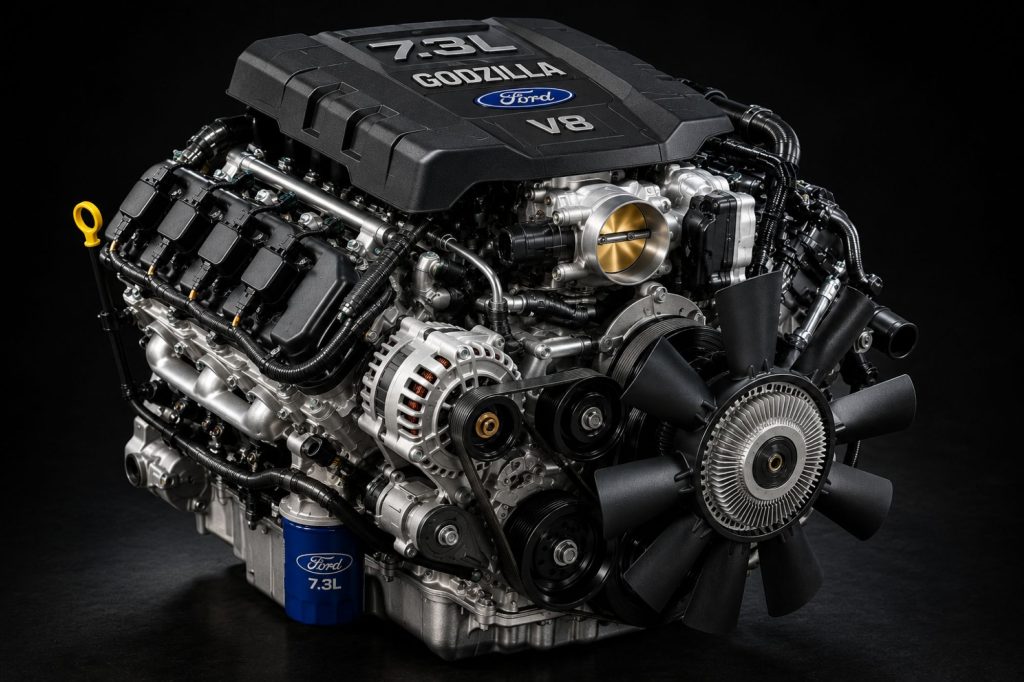
The Ford 7.3L Gas V8, commonly known as the “Godzilla” engine, is Ford’s largest modern gasoline engine designed specifically for heavy-duty truck applications. Introduced for Super Duty pickups and commercial chassis platforms, the engine was developed to provide strong low-end torque, long-term durability, and lower ownership costs compared to diesel alternatives.
The 7.3L quickly gained popularity among contractors, municipalities, utility companies, RV owners, and fleets that require substantial towing and hauling capability without the added complexity of diesel emissions systems.
Unlike many modern gasoline engines that focus heavily on turbocharging, the Ford 7.3L relies on large displacement and traditional V8 architecture to deliver dependable power and simplicity.
Key Characteristics
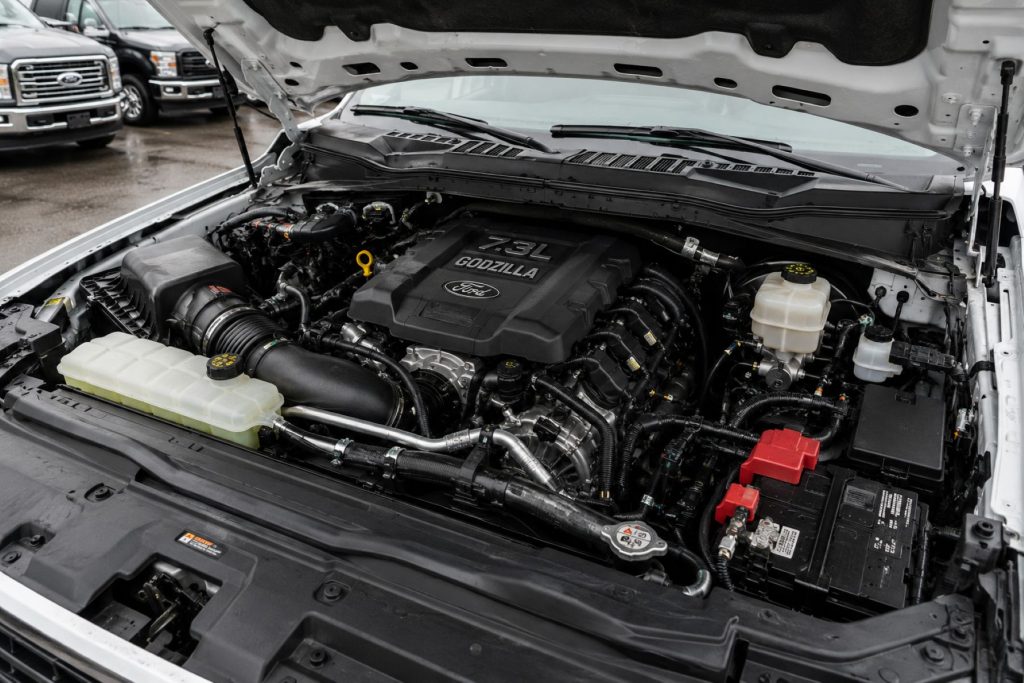
The Ford 7.3L Gas V8 is designed around durability, simplicity, and strong real-world performance. Its pushrod design helps reduce overall engine complexity while maintaining excellent low-end torque for towing and hauling applications.
One of the engine’s defining characteristics is its ability to provide diesel-like pulling performance without requiring diesel fuel, DEF systems, diesel particulate filters, or expensive emissions equipment.
The engine has developed a strong reputation among fleet operators seeking long-term reliability and reduced maintenance costs.
Technical Specifications
Power Ratings
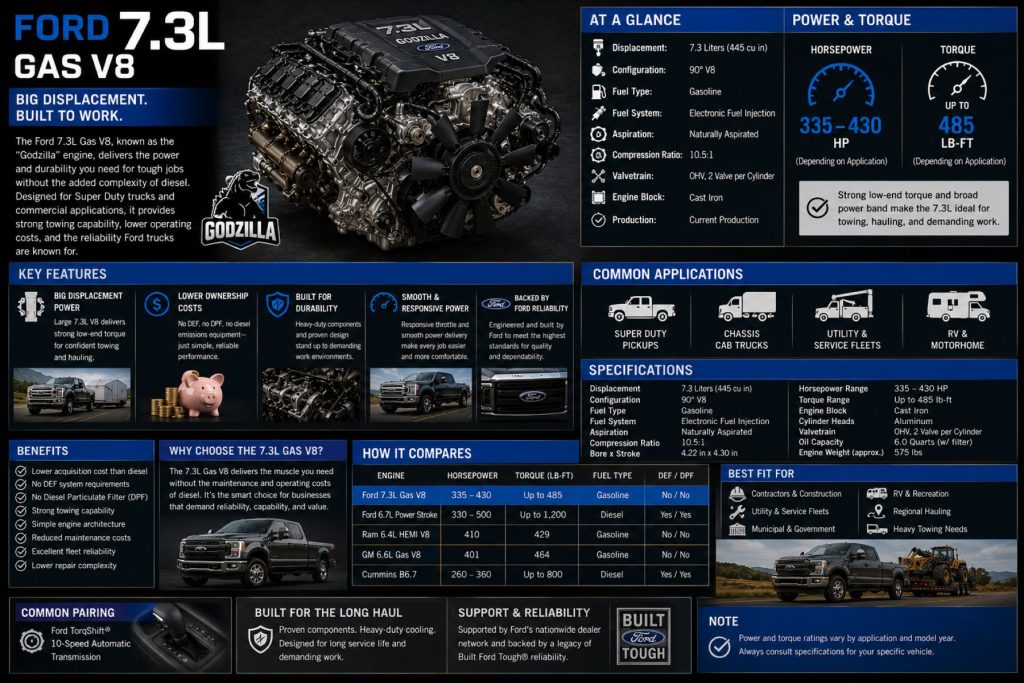
The Ford 7.3L Gas V8 is commonly available in horsepower ratings ranging from 335 to 430 horsepower depending on application and model year.
Torque Output
Torque ratings can reach up to 485 lb-ft.
Engine Configuration
The 7.3L is a naturally aspirated V8 gasoline engine.
Fuel System
The engine uses electronic fuel injection and advanced engine management controls.
Cooling System
Heavy-duty cooling systems support towing, hauling, and commercial fleet operation.
Engine Weight
The 7.3L is lighter than many comparable diesel engines, helping improve payload capacity.
Common Applications
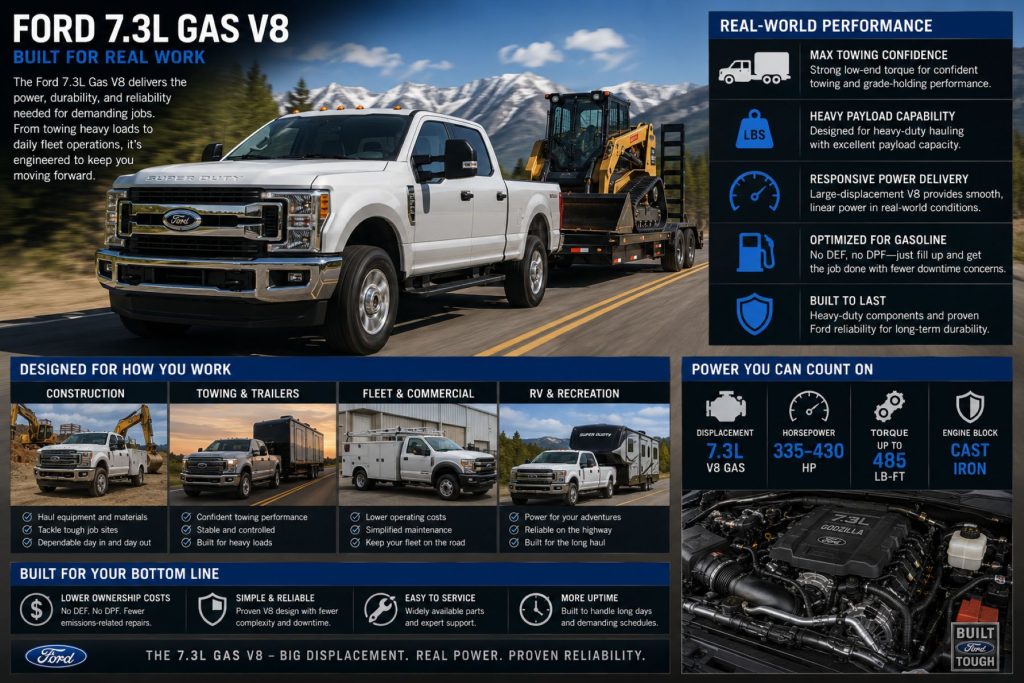
The Ford 7.3L Gas V8 is commonly used in:
- Super Duty pickup trucks
- Medium-duty chassis cab trucks
- Utility fleets
- Municipal fleets
- RV and motorhome applications
- Contractor service trucks
- Towing operations
Advantages
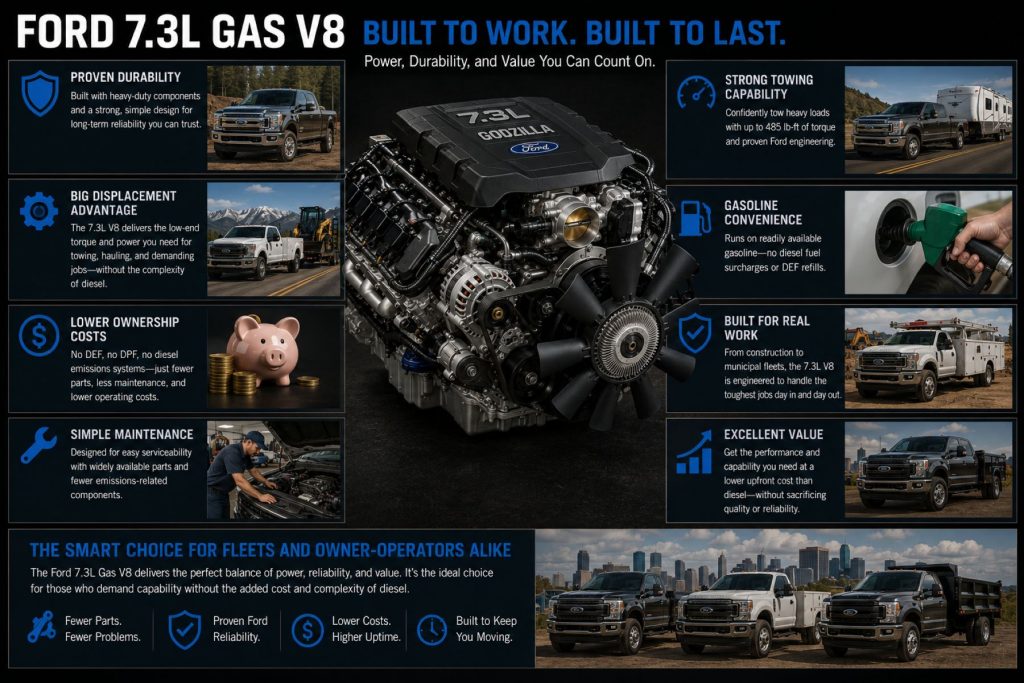
The Ford 7.3L Gas V8 provides several advantages for fleets and owner-operators.
- Lower acquisition cost than diesel engines
- No DEF system requirements
- No diesel particulate filter (DPF)
- Strong towing capability
- Simple engine architecture
- Reduced maintenance costs
- Excellent fleet reliability
- Lower repair complexity
Limitations and Considerations
While highly capable, the 7.3L does have operational considerations.
- Lower torque than comparable diesel engines
- Reduced fuel economy under heavy loads
- Less suitable for extreme heavy-haul applications
- Higher engine RPM during towing compared to diesel platforms
- Gasoline fuel costs vary by region
Maintenance and Ownership Notes
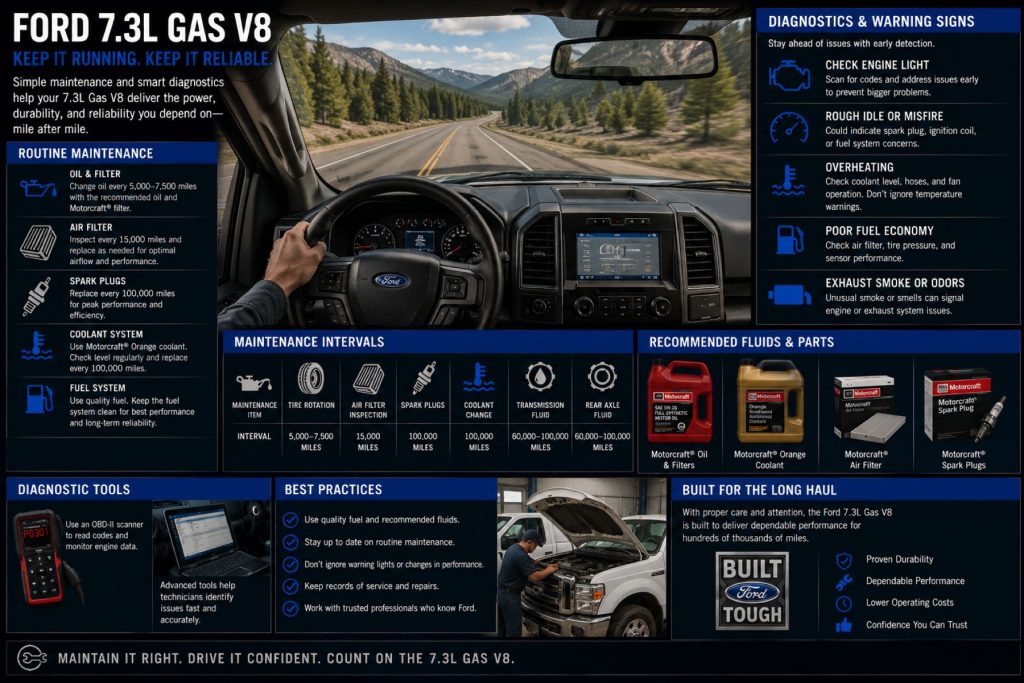
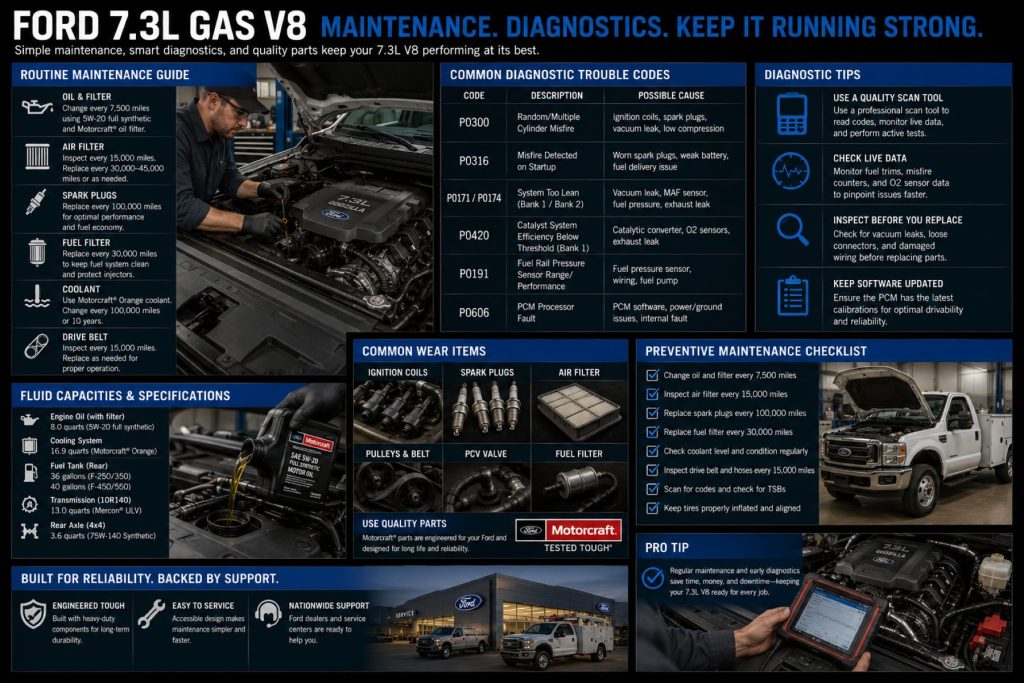
Routine maintenance for the Ford 7.3L includes oil changes, spark plug replacement, air filter service, cooling system inspections, and fuel system maintenance.
Because the engine lacks diesel emissions equipment, owners often experience lower maintenance complexity and fewer emissions-related repair concerns compared to modern diesel platforms.
Many fleet operators select the 7.3L specifically to simplify maintenance operations.
Performance and Fuel Efficiency
The Ford 7.3L is designed to balance towing capability, payload performance, and operating costs. While fuel economy generally falls behind smaller gasoline engines, it often compares favorably when considering the total ownership costs associated with diesel alternatives.
The engine performs especially well in regional operations, utility fleets, service truck applications, and moderate towing environments.
Driver and Operator Considerations
Drivers often appreciate the Ford 7.3L for its responsive throttle, smooth power delivery, and straightforward operation. The engine provides strong acceleration while avoiding many of the maintenance concerns associated with modern diesel engines.
Many operators also appreciate the quiet operation and lower ownership costs compared to diesel-powered trucks.
Buying Considerations
When selecting a Ford 7.3L-powered truck, buyers should evaluate towing requirements, payload demands, operating environment, maintenance expectations, and total ownership costs.
For fleets not requiring maximum diesel torque, the 7.3L often provides a strong balance of performance, reliability, and affordability.
Buyers should also evaluate axle ratios and transmission configurations based on intended use.
Compatibility and Related Systems
The Ford 7.3L Gas V8 is commonly paired with:
- Ford TorqShift 10-Speed Automatic Transmission
- Heavy-duty cooling systems
- Electronic engine management systems
- Integrated towing packages
- Advanced trailer brake systems
- Fleet telematics systems
Variants and Configurations
The Ford 7.3L is available in multiple configurations designed for different applications.
- Super Duty pickup applications
- Commercial chassis cab configurations
- Motorhome and RV chassis applications
- Municipal fleet specifications
- Utility service truck configurations
- Different horsepower calibrations
Comparison to Similar Equipment
The Ford 7.3L Gas V8 is commonly compared to engines such as the GM 6.6L Gas V8, Ram 6.4L HEMI, Ford 6.7L Power Stroke Diesel, and Cummins B6.7.
Compared to diesel engines, the 7.3L offers lower acquisition and maintenance costs. Compared to other gasoline truck engines, it provides exceptional displacement, towing capability, and fleet durability.
Each engine offers different strengths depending on operating requirements and ownership priorities.
Best Fit For
The Ford 7.3L Gas V8 is best suited for:
- Commercial fleets
- Utility operations
- Municipal fleets
- RV applications
- Contractor service trucks
- Regional hauling
- Heavy towing without diesel ownership costs
Related Truck Types
Related Freight Types
Related Equipment Systems
Related Guides
- Understanding Horsepower vs Torque
- How to Choose the Right Commercial Truck
- Class 6 vs Class 7 vs Class 8 Trucks
Regulatory and Compliance Notes
The Ford 7.3L Gas V8 complies with current gasoline emissions regulations and avoids many of the emissions technologies required on modern diesel engines.
Maintenance requirements are generally simpler than comparable diesel platforms.
Real World Operating Notes
In real-world fleet operations, the Ford 7.3L has become one of the most respected gasoline truck engines available today. Many contractors, municipalities, and commercial operators appreciate its combination of durability, towing capability, and lower maintenance complexity.
Its strong reputation has earned the “Godzilla” engine widespread popularity among both fleet buyers and individual truck owners.
Frequently Asked Questions
Why is the Ford 7.3L called the Godzilla engine?
The nickname comes from the engine’s large displacement, strong power output, and reputation for durability.
Is the Ford 7.3L better than a diesel?
It depends on the application. The 7.3L offers lower ownership costs, while diesel engines typically provide greater torque and fuel economy under heavy loads.
Does the Ford 7.3L require DEF fluid?
No. The 7.3L is a gasoline engine and does not use DEF.
What transmission is commonly paired with the 7.3L?
The Ford TorqShift 10-Speed Automatic Transmission is the most common pairing.
Availability and Where to Find
Availability and Where to Find
The Ford 7.3L Gas V8 is available through Ford Super Duty dealerships, commercial truck dealers, fleet purchasing programs, and the used truck marketplace throughout North America.
Support Trucking Families
Truck Equipment Atlas supports the mission of Grey Cross, a nonprofit dedicated to helping families of truck drivers who lose their lives while on the road. As the site grows, part of its mission is to bring awareness and support to these families.
Podcast or Video Section
Learn More Through Audio and Video
Truck Equipment Atlas will continue expanding with podcast episodes, interviews, and equipment breakdowns to help drivers and fleets better understand trucks and equipment.
Follow the Growth of Truck Equipment Atlas
Truck Equipment Atlas continues to expand with new truck profiles, trailer coverage, diesel engine pages, equipment system resources, manufacturer information, and educational guides.
Visit our Site Updates page to explore recent additions, project milestones, and upcoming resources as we continue building one of the industry’s growing commercial trucking equipment reference libraries.
View the Latest Site Updates: Truck Equipment Atlas Site Updates