
SAF-Holland NEWAY ADZ
Quick Facts
- Manufacturer: SAF-Holland
- Brand: NEWAY
- Product Type: Heavy-duty drive-axle air suspension
- Suspension Category: Vocational and severe-duty air suspension
- Primary Position: Rear drive axle or tandem drive-axle group
- Common Configurations: Single, tandem, and multiple-axle arrangements depending on application
- Primary Applications: Construction, refuse, logging, mining, heavy haul, and other vocational operations
- Suspension Medium: Air springs
- Axle Type: Driven rear axle
- Primary Benefit: Combines air-ride characteristics with the strength required for demanding vocational service
Overview
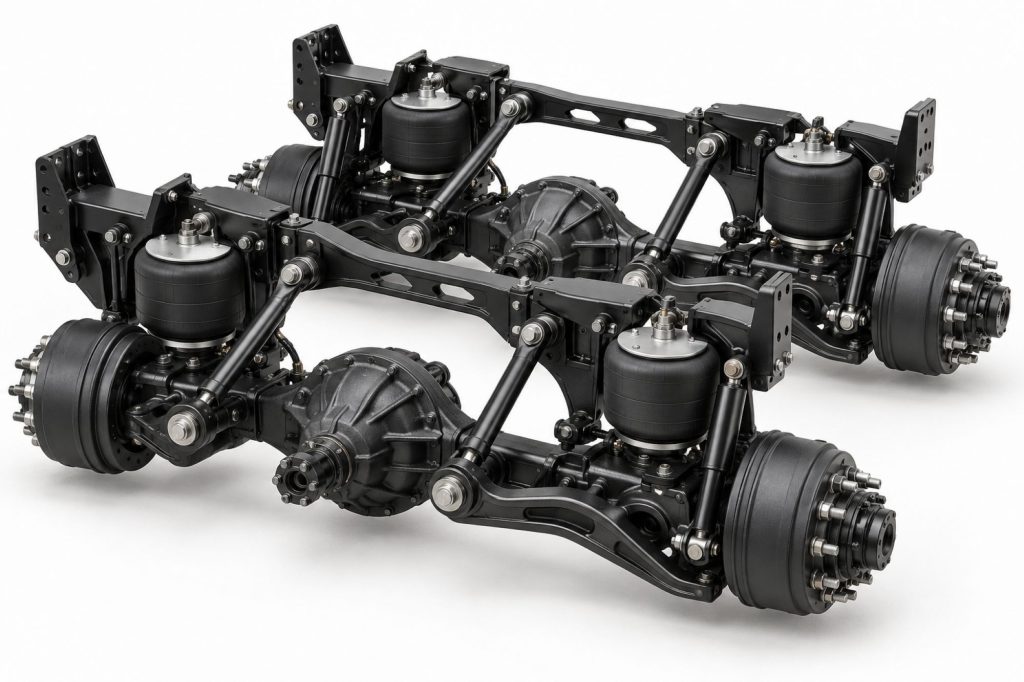
The SAF-Holland NEWAY ADZ is a heavy-duty drive-axle air suspension developed for vocational trucks that operate under demanding load, terrain, and duty-cycle conditions. It provides the ride and load-equalization benefits of an air suspension while supporting applications that may encounter rough jobsites, repeated loading cycles, uneven surfaces, and high axle loads.
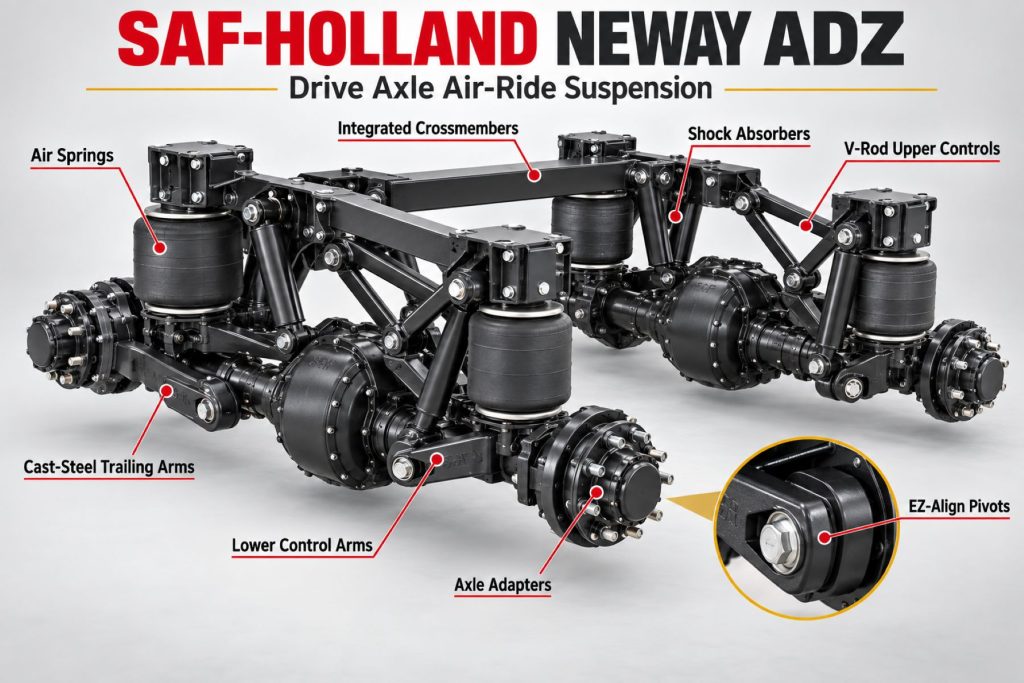
The ADZ uses structural suspension beams, large air springs, shock absorbers, torque-control components, and frame-mounted brackets to connect the drive axle to the chassis. Its geometry controls axle movement while allowing the air springs to absorb road impacts and maintain the vehicle’s designed ride height.
The suspension is available in application-specific configurations. Capacity, ride height, axle spacing, driveline clearance, brake compatibility, and mounting arrangements depend on the truck manufacturer and complete vehicle specification.
Key Characteristics
- Heavy-duty drive-axle air suspension
- Designed for vocational and severe-duty trucks
- Supports single- and tandem-drive configurations, depending on specification
- Air springs provide load support and ride isolation
- Suspension geometry controls axle movement and driveline position
- Designed to maintain consistent ride height as payload changes
- Provides load equalization across compatible tandem configurations
- Available in multiple capacities and installation arrangements
- Can support demanding on-road and off-highway operating conditions
- Designed for integration with commercial drive axles and heavy-duty truck frames
Major Components
- Frame brackets
- Suspension beams or trailing arms
- Air springs
- Shock absorbers
- Axle connections
- Torque rods
- Transverse control components
- Height-control valve
- Air lines and fittings
- Ride-height linkage
- Rebound-control components
- Crossmember or lateral-support structures
- Mounting fasteners and bushings
- Optional suspension dump controls
How the Suspension System Works
The NEWAY ADZ uses compressed air inside flexible air springs to support the truck chassis and payload. The air springs are positioned between the suspension structure and vehicle frame, allowing them to compress and expand as the axles move over uneven surfaces.
A height-control valve monitors the relationship between the axle and frame. When additional payload lowers the chassis, the valve adds air to the springs until the designed ride height is restored. When weight is removed, the valve releases excess air.
The suspension beams and torque-control components guide axle movement and manage acceleration, braking, and cornering forces. Shock absorbers slow rapid suspension movement and help prevent excessive bouncing after the truck encounters a bump or depression.
On tandem configurations, the air system helps distribute load between the drive axles. Proper air pressure, ride height, axle alignment, and suspension geometry are necessary for the system to equalize loads correctly.
Suspension Position and Function
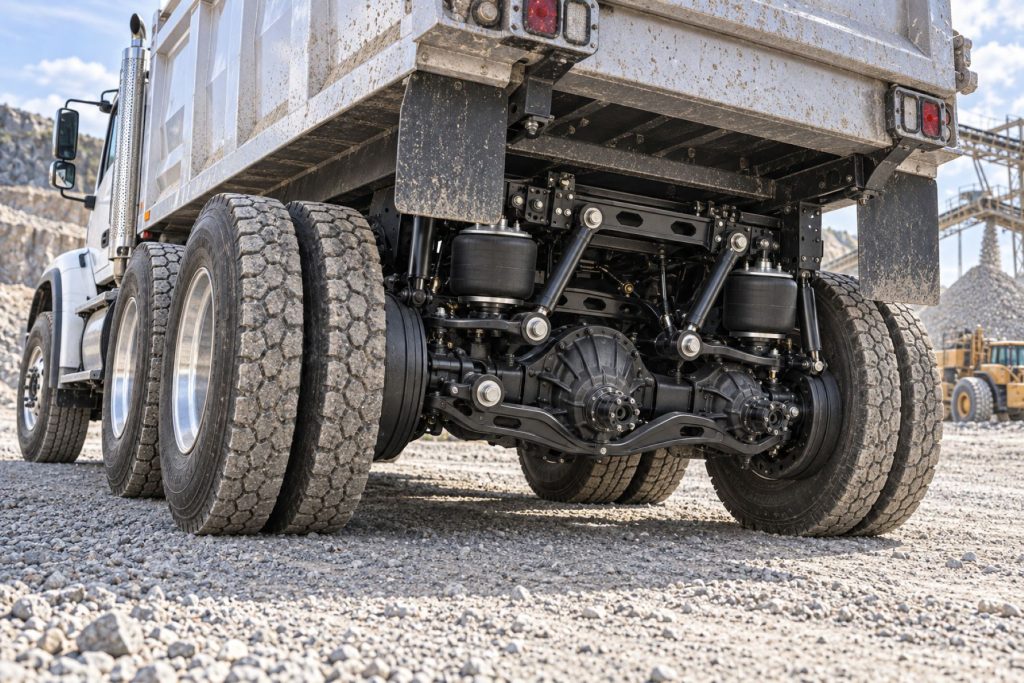
The NEWAY ADZ is installed beneath the rear section of a vocational truck chassis. It connects one or more driven rear axles to the frame while carrying vehicle weight, controlling axle movement, maintaining driveline geometry, and absorbing road and jobsite impacts.
In a tandem-drive configuration, the suspension supports both rear drive axles and helps distribute weight across the tandem group. It must also permit enough vertical articulation for the axles to follow uneven terrain without allowing excessive frame movement or driveline-angle changes.
Common Specifications
- Suspension Type: Drive-axle air suspension
- Configuration: Single, tandem, or application-specific multi-axle arrangement
- Duty Classification: Heavy-duty vocational and severe service
- Suspension Capacity: Varies by ADZ model and vehicle application
- Ride Height: Application-specific
- Axle Spacing: Determined by chassis and suspension configuration
- Axle Compatibility: Heavy-duty commercial drive axles selected by the vehicle manufacturer
- Air-System Requirement: Engine-driven compressor and vehicle air supply
- Damping: Heavy-duty shock absorbers
- Lateral Control: Torque rods or application-specific control members
- Braking Compatibility: Drum or air disc brakes when approved for the axle and chassis configuration
Exact capacities, ride heights, axle spacing, and mounting dimensions must be confirmed using the suspension model number, vehicle build records, and current SAF-Holland technical information.
Capacity, Ride Height, and Axle Travel
NEWAY ADZ capacity depends on the suspension model, number of axles, axle ratings, tire and wheel ratings, frame design, and complete vehicle specification. The suspension’s mechanical rating does not automatically establish the truck’s legal carrying capacity.
Ride height is measured between specified points on the frame and axle or suspension assembly. It must remain within the manufacturer’s approved range to preserve suspension travel, driveline angles, axle alignment, and air-spring performance.
Adequate jounce and rebound travel allow the drive axles to follow uneven surfaces. Incorrect ride height can place the suspension near the top or bottom of its travel, increasing the likelihood of harsh impacts, damaged air springs, poor traction, or driveline vibration.
Ride Quality and Load Distribution
The ADZ provides a more controlled ride than many traditional heavy-duty mechanical suspensions. Its air springs isolate the frame, cab, cargo body, and mounted equipment from a portion of the shock generated at the tires.
On tandem configurations, connected air springs help balance the supported load between the drive axles. This can improve tire contact, traction, braking stability, and component life when the system is operating at its specified ride height.
Load equalization cannot compensate for improper loading, incorrect air pressure, damaged suspension components, mismatched tires, or an overloaded vehicle.
Suspension Controls and Adjustment Options
The standard suspension system uses one or more height-control valves to maintain the correct chassis height. Available vehicle controls may include:
- Suspension dump valve
- Automatic air-suspension dump
- Manual dump control
- Electronic height control
- Temporary traction-assist programming
- Auxiliary axle coordination
- Body-equipment interlocks
- Work-mode or loading-height controls
Control availability depends on the truck manufacturer and body-equipment installation. Operators should not use suspension controls in ways that exceed axle, tire, frame, or legal weight limits.
Alignment and Suspension Geometry
Correct axle alignment is essential for predictable handling, proper driveline operation, and acceptable tire life. Tandem axles must be aligned with the chassis centerline and properly positioned relative to each other.
Torque rods, suspension beams, bushings, frame brackets, and axle connections help maintain the designed geometry. Wear or damage in these components can allow the axle to shift under acceleration, braking, or cornering.
Ride height should be inspected before completing an alignment because an incorrect chassis height can change driveline and suspension geometry. Alignment should also be checked after collision damage, suspension repair, axle replacement, or the appearance of unusual tire-wear patterns.
Axle, Brake, and Wheel-End Options
The NEWAY ADZ can be integrated with heavy-duty drive axles selected by the truck manufacturer. The complete configuration may include:
- Single-reduction drive axles
- Heavy-duty tandem drive axles
- Driver-controlled differential locks
- Inter-axle differential locks
- Drum brakes
- Air disc brakes
- Conventional wheel ends
- Preset or unitized wheel-end systems
- Automatic lubrication equipment
- Tire-pressure monitoring systems
- Automatic tire-inflation systems where applicable
Axle, brake, and wheel-end options must match the truck’s gross axle weight ratings, wheel size, intended speed, duty cycle, and operating environment.
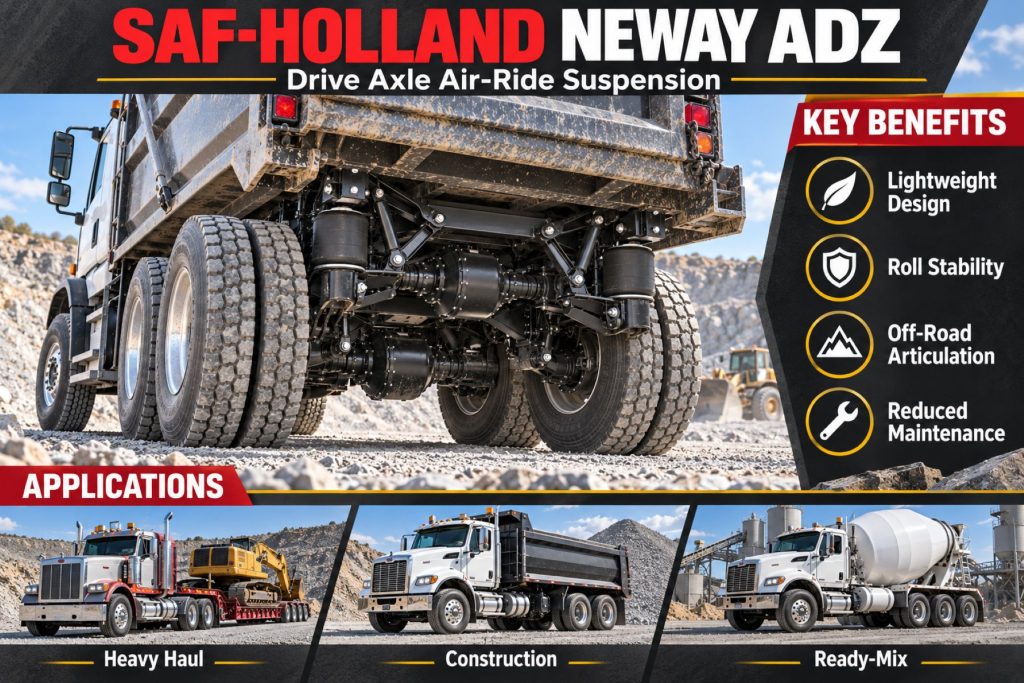
Common Applications
- Construction trucks
- Dump trucks
- Refuse trucks
- Logging trucks
- Heavy-haul tractors
- Mining-support vehicles
- Concrete mixers
- Municipal trucks
- Oilfield trucks
- Severe-duty tractors
- Specialized vocational vehicles
- On-road and off-highway combination service
Vehicle, Axle, and Frame Compatibility
The NEWAY ADZ requires a compatible truck frame, drive axle, driveline layout, brake system, air supply, wheel and tire package, and body installation.
Compatibility depends on:
- Frame width and rail strength
- Suspension capacity
- Ride height
- Axle spacing
- Drive-axle model
- Driveshaft angles
- Brake configuration
- Tire and wheel clearance
- Fuel-tank and battery-box placement
- Body and equipment clearance
- Exhaust and emissions-system placement
- Gross axle and vehicle weight ratings
The suspension should not be installed or substituted solely because another system has a similar capacity. Mounting geometry and chassis loads must be reviewed by the truck manufacturer, body builder, or qualified engineer.
Advantages
- Air-ride performance for vocational trucks
- Improved isolation of the chassis, body, and cargo from road shock
- Load equalization between compatible tandem drive axles
- Consistent ride height across changing payload conditions
- Better ride characteristics than many traditional mechanical suspensions
- Can help maintain tire contact on uneven surfaces
- Suitable for demanding vocational applications
- Multiple capacities and configurations support different truck requirements
- Suspension dump and electronic-control options may be integrated
- Designed for use with heavy-duty commercial drive axles
Limitations or Considerations
- More air-system components than a mechanical suspension
- Air leaks can lower the chassis and reduce suspension performance
- Ride height must be checked and adjusted correctly
- Bushings, torque rods, shocks, and air springs require regular inspection
- Severe off-road use may accelerate component wear
- Specifications differ among ADZ models and vehicle installations
- Replacement parts must match the exact suspension configuration
- Air suspension does not increase the truck’s legal weight limit
- Improper body installation can interfere with suspension travel
- Loss of air pressure may require special recovery or towing procedures
Driver and Operator Experience
Drivers may notice reduced harshness and vibration compared with many heavy-duty mechanical suspensions. The air springs help isolate the cab and body from repeated road impacts, which can improve comfort during long workdays.
The suspension can also provide controlled handling as payload changes because it automatically restores the chassis to its designed ride height. On tandem configurations, load equalization helps the drive tires remain in contact with uneven surfaces.
Drivers should watch for a leaning chassis, excessive air-compressor cycling, unusual suspension noise, poor traction, driveline vibration, or a truck that does not return to normal ride height.
Maintenance and Ownership Notes
- Inspect air springs for cracking, abrasion, cuts, and leaks.
- Check air lines, valves, fittings, and reservoirs for air loss.
- Verify ride height at scheduled maintenance intervals.
- Inspect shock absorbers for fluid leakage, damage, and worn bushings.
- Check torque rods and their bushings for looseness or movement.
- Inspect suspension beams and frame brackets for cracks or distortion.
- Confirm that axle mounting connections remain secure.
- Inspect fastener torque according to the service schedule.
- Check driveline angles after ride-height or suspension changes.
- Monitor tires for alignment-related wear.
- Drain air tanks and maintain the truck’s air dryer.
- Inspect the suspension after severe impacts, overloading, or off-road incidents.
- Use the correct lifting and support procedures before working beneath the vehicle.
Common Suspension Problems
- Air loss: Leaking air springs, lines, fittings, valves, or reservoirs can cause the chassis to settle or remain below normal ride height.
- Incorrect ride height: A damaged height-control valve, bent linkage, incorrect adjustment, or air restriction can place the suspension outside its intended operating range.
- Worn torque-rod bushings: Worn bushings may allow axle movement, steering corrections, clunking, and irregular tire wear.
- Damaged shock absorbers: Failed shocks can cause excessive bouncing, poor body control, and accelerated air-spring movement.
- Air-spring damage: Abrasion, contamination, overextension, incorrect installation, or operation at the wrong ride height can damage an air spring.
- Uneven vehicle height: Air restrictions, valve problems, uneven loading, structural damage, or incorrect adjustment may cause the truck to lean.
- Driveline vibration: Incorrect ride height, worn suspension components, or improper axle position can change driveline angles.
- Cracked brackets or structural components: Severe impacts, overloading, loose fasteners, corrosion, or improper installation can damage suspension mounting structures.
- Irregular tire wear: Misalignment, worn bushings, incorrect air pressure, mismatched tires, or bent axle components may cause rapid tire wear.
Identification Information
NEWAY suspension identification information may be located on a tag or plate attached to the suspension assembly. Vehicle build records and axle identification tags may also be needed.
Record the following before ordering parts:
- Truck manufacturer
- Vehicle identification number
- Truck model and model year
- Suspension model number
- Suspension serial or assembly number
- Rated capacity
- Designed ride height
- Axle spacing
- Drive-axle manufacturer and model
- Brake type
- Wheel-end configuration
- Air-spring part number
- Shock-absorber part number
- Torque-rod length and configuration
Do not identify replacement parts by appearance alone. Similar-looking NEWAY suspensions may use different air springs, brackets, bushings, shocks, or mounting dimensions.
Buying Considerations
- Confirm the complete model designation rather than ordering by the ADZ name alone.
- Verify suspension capacity and axle configuration.
- Match the correct ride height and axle spacing.
- Confirm frame and crossmember compatibility.
- Review drive-axle and driveline requirements.
- Choose brake and wheel-end equipment for the intended duty cycle.
- Evaluate available suspension controls and dump functions.
- Compare installed weight with alternative air and mechanical suspensions.
- Review parts availability in the truck’s operating region.
- Consider corrosion protection for winter, refuse, mining, and coastal service.
- Inspect used systems for cracks, distortion, corrosion, and worn mounting points.
- Confirm warranty requirements and approved installation procedures.
Variants and Configurations
The NEWAY ADZ family may be configured for different truck manufacturers, axle capacities, ride heights, axle spacings, and vocational applications.
Configuration differences may include:
- Single-drive-axle arrangement
- Tandem-drive-axle arrangement
- Suspension capacity
- Ride height
- Axle spacing
- Frame mounting arrangement
- Torque-rod configuration
- Shock-absorber placement
- Air-spring specification
- Brake type
- Wheel-end equipment
- Suspension control package
- Application-specific structural components
Availability and specifications can change by truck manufacturer and production year. The complete suspension model number should be used when comparing systems or sourcing parts.
Comparison to Similar Equipment
Compared with the SAF-Holland NEWAY ADL, the ADZ is positioned for heavier vocational and severe-duty applications. The ADL is generally associated with lighter-weight or line-haul-oriented configurations, depending on the exact model.
Compared with the SAF-Holland NEWAY AD Series, the ADZ represents a newer heavy-duty suspension design with application-specific structural and service differences. Parts should not be assumed interchangeable.
Compared with the Hendrickson PRIMAAX EX, both systems provide air-ride performance for heavy-duty drive axles. Selection depends on the truck manufacturer, suspension capacity, frame design, ride requirements, and vocational duty cycle.
Compared with the Hendrickson HAULMAAX EX, the ADZ uses air springs as its primary load-support medium. HAULMAAX EX is an elastomer-based mechanical suspension intended for demanding vocational service.
Best Fit For
- Vocational fleets wanting air-ride performance
- Construction trucks operating on roads and jobsites
- Refuse and municipal vehicles
- Heavy-haul tractors
- Logging and resource-industry trucks
- Concrete mixers and specialized body installations
- Trucks carrying equipment sensitive to shock and vibration
- Applications requiring changing loaded and unloaded ride conditions
- Fleets that prioritize load equalization and driver comfort
- Operations able to support regular air-system and suspension maintenance
Related Vehicle and Trailer Types
- Complete Guide to Semi Truck Types
- Class 6 vs Class 7 vs Class 8 Trucks
- Vocational trucks
- Dump trucks
- Refuse trucks
- Concrete mixers
- Logging trucks
- Heavy-haul tractors
- Municipal trucks
- Mining-support vehicles
Related Truck and Trailer Models
- Mack Granite
- Kenworth T880
- Peterbilt 567
- Freightliner 114SD
- Freightliner 122SD
- Western Star 47X
- Western Star 49X
- International HX Series
- Volvo VHD
Related Suspension Types
- Air Suspension Systems
- Vocational & Severe-Duty Suspensions
- SAF-Holland NEWAY ADL
- SAF-Holland NEWAY AD Series
- Hendrickson PRIMAAX EX
- Hendrickson HAULMAAX EX
- Drive-axle air suspensions
- Tandem rear suspensions
- Vocational mechanical suspensions
- Walking-beam suspensions
Related Equipment Systems
- Suspension Systems
- Axles & Differentials
- Air Brake Systems Explained
- How Commercial Truck Transmissions Work
- Steering systems
- Tires and wheels
- Drivelines and driveshafts
- Truck air systems
- Brake systems
Related Guides
- Suspension System Guides
- How Commercial Truck Suspension Systems Work
- Air Suspension vs Leaf Spring Suspension
- How to Choose a Commercial Truck Suspension
- Truck Suspension Components Explained
- Truck vs Trailer Suspension Systems
- Single Axle vs Tandem Axle Trucks
- Common Truck Axle and Differential Problems
Regulatory and Compliance Notes
Suspension capacity does not override the truck’s gross axle weight rating, gross vehicle weight rating, tire ratings, wheel ratings, bridge-formula limits, or jurisdictional road-weight regulations.
Modifications to ride height, axle spacing, suspension controls, frame brackets, or driveline geometry should be approved by the vehicle manufacturer or a qualified engineer.
Air lines, suspension components, axles, brakes, tires, wheels, and structural mounting points must remain in serviceable condition under applicable federal, state, provincial, and local inspection requirements.
Vehicles used off-highway, in mining operations, or with specialized vocational bodies may be subject to additional workplace, equipment, and operating regulations.
Real World Operating Notes
A vocational air suspension should be inspected more frequently when the truck regularly operates through mud, gravel, construction debris, corrosive material, or uneven jobsites.
Ride-height problems can sometimes appear to be driveline, alignment, or tire problems. The suspension’s air supply and ride height should be checked before replacing driveline or steering components.
Dumping the suspension may help during loading, unloading, or certain stationary operations when permitted by the vehicle manufacturer. The truck should normally return to its designed ride height before road operation.
Body builders must preserve clearance around air springs, shocks, torque rods, axles, tires, and driveline components throughout the suspension’s full range of movement.
Frequently Asked Questions
What is the SAF-Holland NEWAY ADZ?
The NEWAY ADZ is a heavy-duty drive-axle air suspension designed for vocational and severe-duty commercial trucks.
Is the NEWAY ADZ a front or rear suspension?
It is a rear drive-axle suspension. It may be used with single or tandem drive axles depending on the model and vehicle specification.
Is the NEWAY ADZ an air suspension?
Yes. It uses air springs to support the chassis and maintain the designed ride height.
What trucks use the NEWAY ADZ?
It may be specified on vocational trucks such as dump trucks, refuse vehicles, concrete mixers, logging trucks, heavy-haul tractors, and municipal equipment. Availability varies by manufacturer and model year.
Does the ADZ improve ride quality?
Its air springs generally provide better isolation from road shock and vibration than many traditional mechanical vocational suspensions.
Can the NEWAY ADZ be used off-road?
It is designed for demanding vocational applications that may include jobsites and limited off-highway travel. Suitability depends on the exact model, capacity, vehicle configuration, and operating conditions.
What causes an ADZ-equipped truck to sit low?
Possible causes include insufficient air pressure, an air leak, damaged air spring, restricted air line, faulty height-control valve, incorrect adjustment, or structural damage.
Why is correct ride height important?
Correct ride height preserves suspension travel, axle alignment, driveline angles, air-spring shape, and vehicle handling.
Are NEWAY AD, ADL, and ADZ parts interchangeable?
They should not be assumed interchangeable. Parts must be selected using the complete suspension model, serial information, ride height, capacity, and vehicle application.
How can I identify the correct ADZ suspension?
Check the suspension identification tag and vehicle build records. Record the model number, capacity, ride height, axle spacing, and component identification before ordering parts.
Availability and Where to Find
The SAF-Holland NEWAY ADZ may be found as original or previously installed equipment on vocational trucks configured for demanding rear-drive-axle applications. New-system availability depends on the truck manufacturer, chassis configuration, production year, and current SAF-Holland product offering.
Replacement components may be available through SAF-Holland distributors, commercial-truck dealers, independent heavy-duty parts suppliers, vocational equipment dealers, and suspension repair facilities.
Used suspension assemblies should be inspected for cracks, corrosion, damaged brackets, worn bushings, air-system problems, and altered mounting points before installation. Compatibility should be confirmed through the suspension identification information and vehicle manufacturer.
Current product support, technical literature, and distributor information are available through the SAF-Holland website.
Support Trucking Families
Truck Equipment Atlas supports the mission of Grey Cross, a nonprofit dedicated to helping families of truck drivers who lose their lives while on the road. As the site grows, part of its mission is to bring awareness and support to these families.
Podcast or Video Section
Learn More Through Audio and Video
Truck Equipment Atlas will continue expanding with podcast episodes, interviews, and equipment breakdowns to help drivers and fleets better understand trucks and equipment.
Follow the Growth of Truck Equipment Atlas
Truck Equipment Atlas continues to expand with new truck profiles, trailer coverage, diesel engine pages, equipment system resources, manufacturer information, and educational guides.
Visit our Site Updates page to explore recent additions, project milestones, and upcoming resources as we continue building one of the industry’s growing commercial trucking equipment reference libraries.
View the Latest Site Updates: Truck Equipment Atlas Site Updates