
Hendrickson HTB Rear Air Suspension
Quick Facts
- Manufacturer: Hendrickson
- Product Type: Rear drive-axle air suspension
- Suspension Family: HTB
- Primary Configurations: Single- and tandem-drive axle systems
- Common Models: HTB 210 and HTB LT
- HTB 210 Capacity: Up to 21,000 pounds
- HTB LT Capacity: 40,000 pounds
- Suspension Design: Non-torque-reactive air suspension with an integrated torque-box system
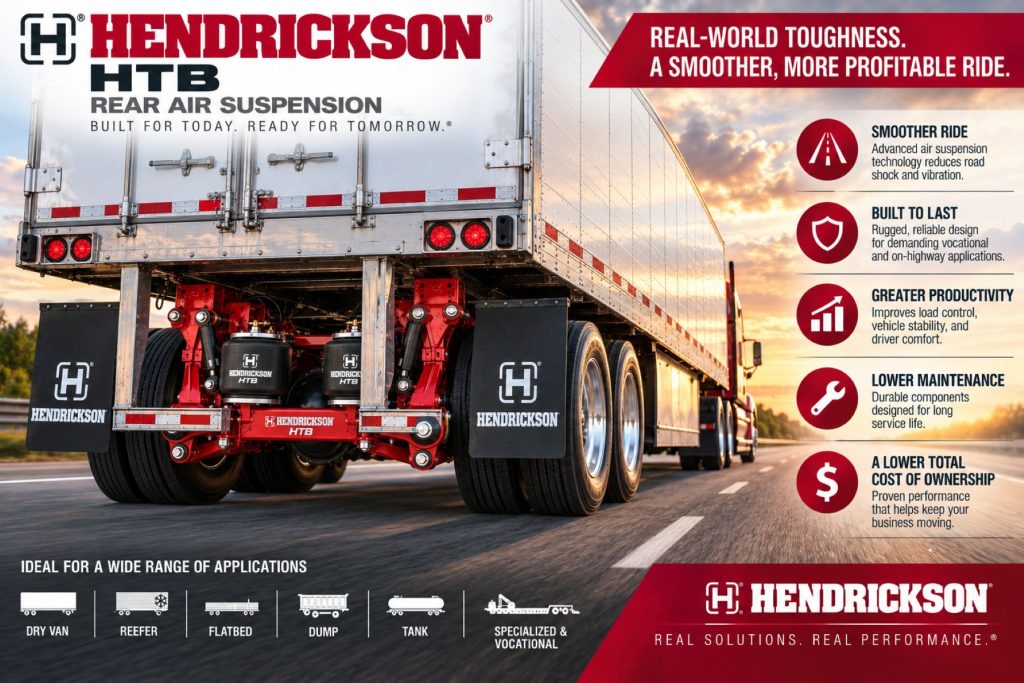
- Primary Applications: Trucks, tractors, motorhomes, specialty vehicles, and selected vocational equipment
- Primary Benefits: Improved ride, driveline-angle control, reduced frame rise, stability, and lower weight
- Off-Highway Rating: Up to 10 percent in listed configurations
- Page Slug: hendrickson-htb-rear-air-suspension
Overview
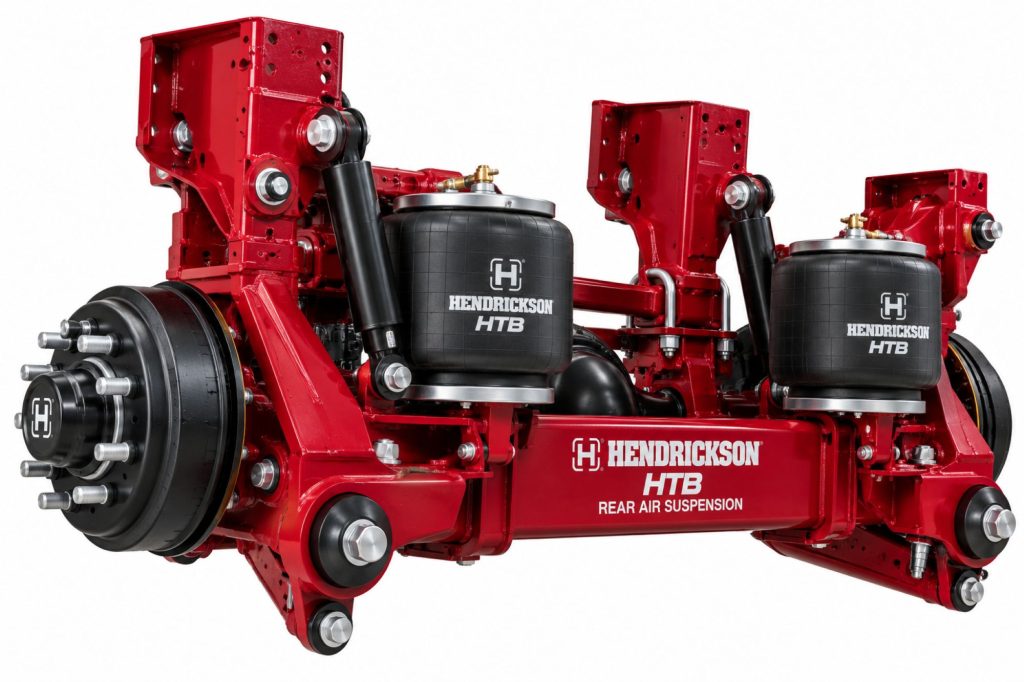
The Hendrickson HTB is a lightweight, non-torque-reactive rear air suspension designed to provide improved ride quality, stability, driveline control, and reduced maintenance. Its defining feature is a torque-box system that forms a controlled parallelogram between the axle and frame.
This geometry limits suspension windup and frame rise during acceleration and braking. By maintaining more consistent axle pinion angles throughout suspension travel, HTB can reduce suspension-induced driveline vibration and stress on driveshaft components.
The HTB family includes the single-axle HTB 210, commonly associated with motorhome and specialty chassis, and the tandem-axle HTB LT 40K used in selected truck applications.
Key Characteristics
- Non-torque-reactive rear air suspension
- Single- and tandem-drive axle configurations
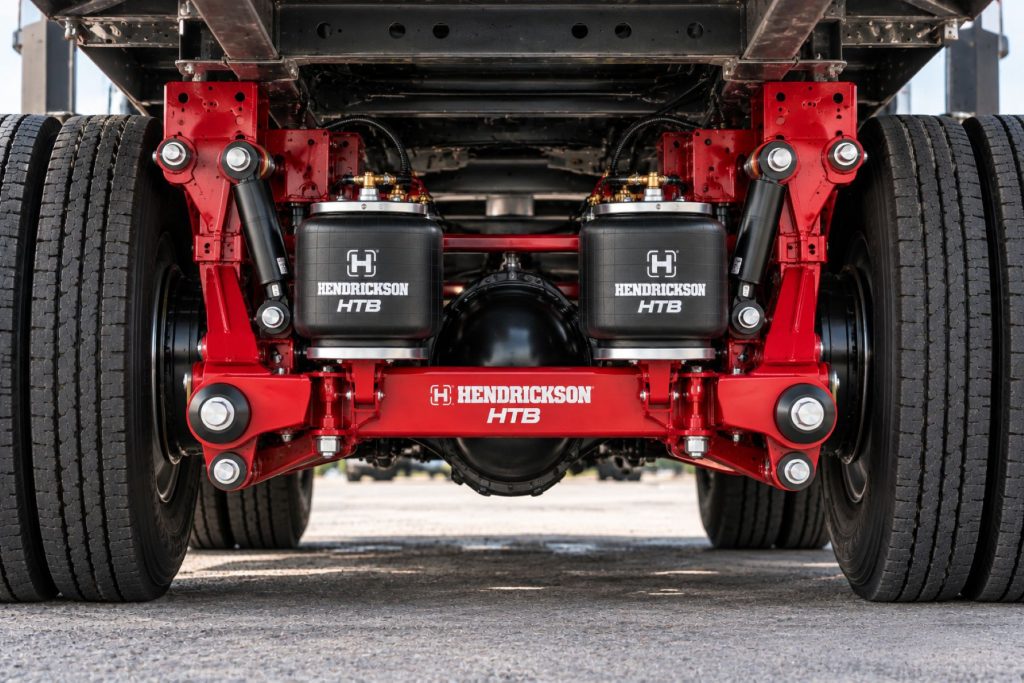
- Large-volume air springs support the vertical load
- Torque-box system controls axle rotation and suspension windup
- Designed to maintain consistent driveline pinion angles
- Reduced frame rise during acceleration
- Lightweight construction compared with many conventional rear suspensions
- Rubber bushings require no lubrication in applicable configurations
- Axle alignment is controlled through torque-box, torque-rod, and clamp-group connections
- Suitable for approved on-highway and limited off-highway applications
- No published engine-torque restriction in listed HTB 210 and HTB LT configurations
Major Components
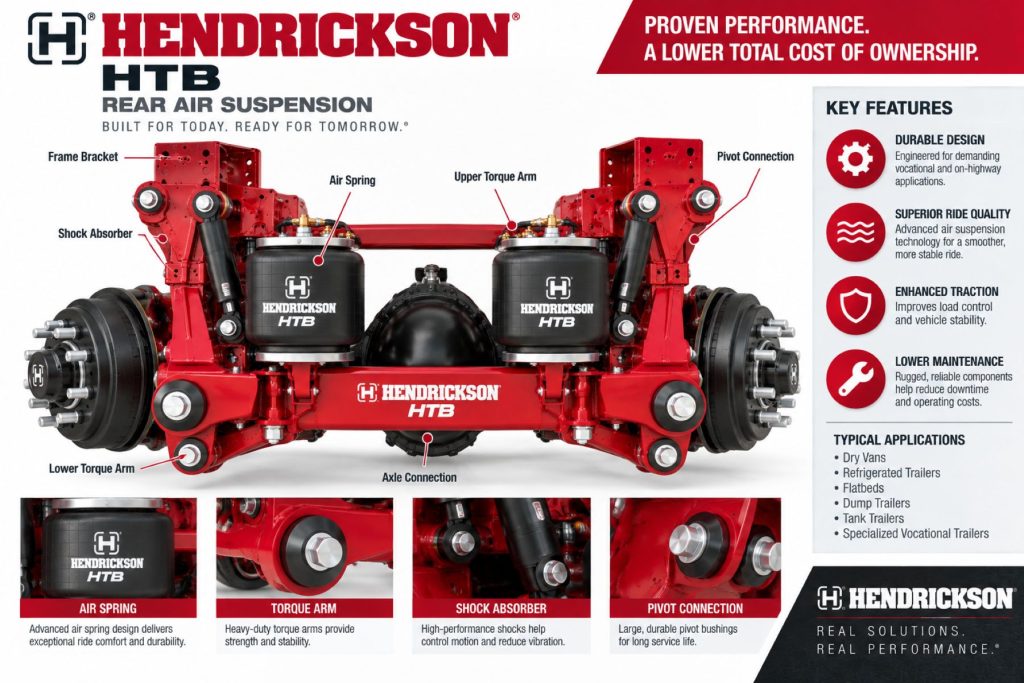
- Large-volume air springs
- Torque-box assemblies
- Torque-box bushings
- Longitudinal torque rods
- Transverse torque rods where used
- Axle brackets
- Bar-pin clamps
- Bar-pin bushings
- Adjustable axle-bracket spacers
- Frame hangers
- Shock absorbers
- U-bolt clamp groups
- Axle top pads and lower brackets
- Height-control valves
- Height-control linkages
- Air lines and fittings
- Aluminum components in selected lightweight configurations
- Tandem drive axles or single drive axle supplied with the chassis
How the Suspension System Works
The HTB uses large-volume air springs to support the vehicle’s rear weight. The air springs compress and expand as the axle moves over road irregularities, reducing the amount of shock transferred into the frame and body.
A height-control valve adds or releases air to maintain the specified chassis ride height as vehicle loading changes.
The torque box and torque rods control axle rotation and maintain the relationship between the axle and frame. Their parallelogram-style geometry limits the tendency of the axle housing to rotate during acceleration or braking.
Controlling axle rotation helps maintain the intended pinion and driveshaft angles throughout suspension travel. This can reduce driveline vibration, universal-joint stress, frame rise, and changes in vehicle attitude.
Shock absorbers damp repeated suspension movement and serve as rebound travel stops in applicable HTB configurations.
Suspension Position and Function
The HTB is installed beneath the rear of a truck, tractor, motorhome, or specialty chassis. Depending on the model, it supports either a single drive axle or a tandem drive-axle group.
The suspension performs several functions:
- Supports the rear chassis and payload
- Maintains the specified ride height
- Absorbs bumps and road irregularities
- Controls axle rotation during acceleration and braking
- Maintains driveline pinion angles
- Limits suspension-induced frame rise
- Provides lateral and longitudinal axle control
- Improves stability and handling
- Reduces vibration reaching the chassis and body
- Maintains drive-axle alignment
Common Specifications
- HTB 210 Capacity: Up to 21,000 pounds
- HTB 210 Axle Configuration: Single axle
- HTB 210 Drive-Tag Installed Weight: Approximately 333 pounds in the listed Spartan configuration
- HTB 210 Mid-Engine Installed Weight: Approximately 371 pounds
- HTB 210 Rear-Engine Installed Weight: Approximately 370 pounds
- HTB 210 Off-Highway Rating: Up to 10 percent
- HTB 210 GVW Approval: Up to 55,000 pounds
- HTB 210 GCW Approval: Up to 120,000 pounds
- HTB 210 Ride Height: Approximately 8.5 inches
- HTB 210 Drive-Tag Axle Spacing: Approximately 48 inches
- HTB 210 Engine-Torque Restriction: None listed
- HTB LT Capacity: 40,000 pounds
- HTB LT Axle Configuration: Tandem
- HTB LT Installed Weight: Approximately 810 pounds
- HTB LT Off-Highway Rating: Up to 10 percent
- HTB LT GVW Approval: Up to 55,000 pounds in the referenced configuration
- HTB LT GCW Approval: Up to 120,000 pounds
- HTB LT Ride Height: Approximately 9.25 inches
- HTB LT Axle Spacing: Approximately 52 inches
- HTB LT Engine-Torque Restriction: None listed
Specifications vary by chassis, engine location, axle configuration, body, application, and vehicle manufacturer.
Capacity, Ride Height, and Axle Travel
HTB 210 is a single-axle suspension rated up to 21,000 pounds. HTB LT is a tandem configuration rated at 40,000 pounds in the referenced International truck application.
Correct ride height is necessary for maintaining suspension travel, air-spring geometry, shock-absorber travel, torque-box position, and driveline angles. The published HTB 210 ride height is approximately 8.5 inches, while the referenced HTB LT configuration uses approximately 9.25 inches.
Available axle travel depends on the exact suspension, shock absorbers, frame, air springs, torque-box geometry, axle spacing, and vehicle installation.
The shock absorbers serve as rebound travel stops on listed HTB systems. The axle should not be allowed to hang with the shock absorbers disconnected because the air springs could overextend or separate from their pistons.
Ride Quality and Load Distribution
Large-volume air springs support the vertical suspension load and isolate the chassis from road inputs. This allows HTB to provide a smoother ride than many mechanical spring suspensions.
The torque-box system controls axle rotation without relying on spring windup to react to drive and brake torque. This helps the suspension retain its ride characteristics during acceleration and braking.
HTB 210 carries the rear load through a single axle. HTB LT distributes weight across a tandem drive-axle group. Actual axle loading depends on vehicle configuration, cargo position, body equipment, axle spacing, and any auxiliary axles.
Suspension Controls and Adjustment Options
The principal suspension control is the automatic height-control valve. It regulates air-spring pressure to maintain the specified ride height.
Depending on the vehicle, additional controls may include:
- Suspension dump valve
- Air-pressure gauge
- Auxiliary-axle controls
- Vehicle-leveling controls on motorhome chassis
- Electronic or manual leveling functions
- Air-pressure retention systems
Service adjustments can include ride height, height-control linkage, axle alignment, lateral torque-box position, and driveline geometry.
All adjustments must follow the procedure for the exact HTB model and chassis.
Alignment and Suspension Geometry
HTB uses the torque box, torque rods, bar-pin clamps, axle brackets, and clamp groups to maintain axle position. Correct alignment is essential for tire life, driveline performance, and suspension stability.
The torque box should be centered laterally beneath the frame. An offset or rotated torque box can tilt the air springs, create component interference, affect axle alignment, and damage bushings.
Important alignment checks include:
- Ride height
- Axle thrust angle
- Tandem axle spacing
- Torque-box lateral position
- Torque-box rotation
- Bar-pin clamp position
- Axle-bracket spacers
- Longitudinal torque-rod length and condition
- Transverse torque-rod condition
- Air-spring vertical alignment
- Driveline pinion angles
- Drive-tire wear
Ride height and torque-box position should be checked before making final driveline or axle-alignment corrections.
Axle, Brake, and Wheel-End Options
HTB is used with compatible single or tandem rear drive axles. Drive-axle model, gearing, differential equipment, brakes, hubs, bearings, seals, wheels, and tires are selected as part of the complete chassis.
Approved configurations can use drum brakes or air disc brakes, depending on the axle and vehicle manufacturer.
Wheel-end and brake clearances must be maintained around the air springs, torque boxes, axle brackets, shocks, and torque rods.
The lowest-rated component determines the usable capacity. A 40,000-pound suspension does not authorize loading above the ratings of the axles, brakes, tires, wheels, frame, or complete vehicle.
Common Applications
- Motorhomes
- Rear-engine specialty vehicles
- Mid-engine specialty vehicles
- Drive-tag motorhome configurations
- On-highway tractors
- General freight trucks
- Refrigerated trucks
- Car carriers
- Liquid and dry bulk haulers
- Beverage vehicles
- Selected dump applications
- Specialty commercial chassis
- Vehicles prioritizing reduced driveline vibration
Vehicle, Axle, and Frame Compatibility
HTB compatibility depends on the exact suspension model, chassis manufacturer, engine position, axle rating, frame dimensions, ride height, axle spacing, driveline geometry, brakes, and intended application.
HTB 210 service information covers selected Spartan drive-tag, mid-engine, and rear-engine motorhome chassis. HTB LT was used in selected International truck configurations.
The referenced HTB LT application permits general freight, refrigerated, car-carrier, bulk-haul, beverage, and selected dump operations. It is not approved in that configuration for rock-body dump or mobile-mixer applications.
Applications using lift axles require vehicle-manufacturer approval. Load-transfer devices can increase the weight carried by the drive suspension and must not overload the HTB system.
Advantages
- Improved ride quality from large-volume air springs
- Non-torque-reactive suspension geometry
- Controls suspension windup
- Reduces frame rise during acceleration
- Maintains more consistent pinion angles
- Can reduce suspension-induced driveline vibration
- Lightweight construction
- Single- and tandem-axle configurations
- Rubber bushings require no lubrication in applicable locations
- Torque-box design provides multi-axis stability
- Consistent axle alignment when properly maintained
- No listed engine-torque restriction in referenced configurations
- Reduced road shock reaching the chassis and body
- Suitable for rear-engine and specialty vehicle layouts
Limitations or Considerations
- Requires a reliable compressed-air supply
- Air leaks can lower the chassis or produce uneven ride height
- Torque boxes are critical structural suspension components
- Worn torque-box bushings generally require replacement of the complete torque-box assembly
- Incorrect torque-box position can cause air-spring tilt and component interference
- Shock absorbers serve as rebound travel stops in applicable configurations
- The axle must not hang with the shocks disconnected
- Vehicle-specific parts may have limited interchangeability
- Primarily intended for on-highway use
- Listed configurations are limited to 10 percent off-highway operation
- HTB LT is not approved for every dump or severe vocational application
- Suspension capacity does not determine legal payload
- Some aluminum components require special care during service
Driver and Operator Experience
HTB provides a smooth ride while limiting the frame rise and driveline-angle changes that can occur with torque-reactive suspensions. Drivers may notice more consistent vehicle attitude during acceleration and braking.
The system can also reduce driveline vibration when ride height, torque-box position, axle alignment, and driveline angles are correct.
Drivers should report unusual vibration, air-spring lean, chassis lean, clunking, slow suspension inflation, excessive compressor cycling, or changes in acceleration behavior. These symptoms may indicate an air leak, torque-box problem, alignment issue, failed shock, or worn bushing.
Maintenance and Ownership Notes
- Inspect air springs for cracking, abrasion, contamination, bulging, and vertical alignment.
- Check air lines, fittings, and height-control valves for leakage.
- Verify ride height using the correct chassis procedure.
- Inspect torque boxes for cracks, damage, shifted bushings, and looseness.
- Check torque-box lateral alignment.
- Look for contact or interference between suspension components.
- Inspect bar-pin clamps, axle-bracket spacers, and related fasteners.
- Check longitudinal and transverse torque rods and bushings.
- Inspect U-bolt clamp groups for alignment and correct clamping force.
- Check shock absorbers for leakage, damage, and secure mounting.
- Keep shocks connected when the axle is suspended.
- Inspect drive tires for lateral offset and alignment-related wear.
- Use new fasteners where Hendrickson requires their replacement during service.
- Completely deflate the suspension before loosening structural components.
- Do not heat aluminum or other structural suspension components with a cutting torch.
Common Suspension Problems
- Air leaks from air springs, lines, fittings, or valves
- Vehicle sitting below the specified ride height
- Uneven side-to-side chassis height
- Bent or disconnected height-control linkage
- Air springs leaning away from vertical
- Torque-box bushing walkout
- Torque box shifted laterally beneath the frame
- Torque box rotated out of position
- Component interference caused by misalignment
- Cracked or damaged torque-box assembly
- Loose torque-box clamp bolts
- Incorrect axle-bracket spacers
- Loose or misaligned U-bolt clamp group
- Worn torque-rod bushings
- Leaking or ineffective shock absorbers
- Driveline vibration
- Frame rise or axle windup caused by damaged control components
- Irregular drive-tire wear
- Air-spring separation caused by excessive rebound travel
Identification Information
Begin identification with the vehicle identification number, manufacturer build sheet, suspension model, axle configuration, engine position, ride height, and axle spacing.
Important identification information includes:
- Vehicle identification number
- Vehicle or chassis manufacturer
- Model and model year
- HTB 210 or HTB LT designation
- Single- or tandem-axle configuration
- Drive-tag, mid-engine, or rear-engine arrangement
- Suspension capacity
- Ride height
- Axle spacing
- Drive-axle model
- Torque-box part number
- Torque-rod part numbers
- Air-spring part number
- Shock-absorber number
- Axle-bracket and spacer configuration
- Existing component numbers
HTB components should not be selected by appearance alone because similar systems can use different torque boxes, axle brackets, spacers, and control rods.
Buying Considerations
- Confirm whether the vehicle has HTB 210 or HTB LT.
- Identify the engine and axle configuration.
- Verify the suspension capacity and ride height.
- Check the permitted off-highway duty cycle.
- Determine whether a lift axle or load-transfer device is installed.
- Inspect all air springs for cracking, leakage, or tilt.
- Check the torque boxes for bushing movement, cracks, or lateral offset.
- Inspect torque rods, bar-pin clamps, and axle-bracket spacers.
- Check U-bolt clamp groups and structural fasteners.
- Inspect shock absorbers and confirm they limit rebound correctly.
- Examine drive tires for lateral offset or irregular wear.
- Road-test the vehicle for driveline vibration, clunking, leaning, and harshness.
- Confirm that the application is approved for the installed suspension.
- Verify replacement-part availability using the complete vehicle and suspension identification.
Variants and Configurations
- HTB 210 Drive Tag: Single-drive-axle suspension used in selected drive-tag motorhome configurations.
- HTB 210 Mid Engine: Single-drive-axle system configured for selected mid-engine chassis.
- HTB 210 Rear Engine: Single-drive-axle system configured for selected rear-engine chassis.
- HTB LT 40K: Lightweight tandem rear air suspension with a nominal 40,000-pound rating.
- Motorhome Configuration: Application-specific system designed for ride comfort, stability, and driveline control.
- Truck Configuration: Tandem suspension used in selected freight, refrigerated, bulk-haul, beverage, car-carrier, and approved dump applications.
- Lift-Axle Configuration: Vehicle installation requiring specific approval to ensure the HTB is not overloaded by transferred weight.
Comparison to Similar Equipment
Compared with the Hendrickson COMFORT AIR, HTB places greater emphasis on torque-box control of axle rotation, driveline angles, and frame rise. COMFORT AIR focuses primarily on ride comfort and vehicle protection.
The Hendrickson HAS Air Suspension uses trailing-arm-style support members and is available across several single- and tandem-axle truck applications. HTB uses a distinctive torque-box structure to provide non-torque-reactive performance.
Compared with the Hendrickson PRIMAAX EX, HTB is primarily an on-highway and specialty-vehicle suspension. PRIMAAX EX is engineered for severe vocational and heavy off-highway duty.
The Hendrickson HN Vocational Suspension is a mechanical rubber suspension that requires no suspension air supply. HTB provides better ride isolation and maintained ride height but adds pneumatic components.
Best Fit For
- Motorhomes and specialty passenger vehicles
- Rear-engine or mid-engine chassis
- On-highway vehicles needing improved driveline-angle control
- Fleets seeking a lightweight rear air suspension
- Vehicles where frame rise and suspension windup are concerns
- General freight and refrigerated operations using approved HTB LT configurations
- Bulk, beverage, and car-carrier applications
- Operators prioritizing ride comfort and reduced driveline vibration
- Vehicles remaining within the approved limited off-highway duty cycle
Related Vehicle and Trailer Types
- Complete Guide to Semi Truck Types
- Motorhomes
- On-highway tractors
- General freight trucks
- Refrigerated trucks
- Car carriers
- Liquid bulk trucks
- Dry bulk trucks
- Beverage vehicles
- Specialty commercial chassis
- Approved dump trucks
Related Truck and Trailer Models
- International truck chassis
- Spartan motorhome chassis
- Rear-engine motorhomes
- Mid-engine motorhomes
- Drive-tag motorhome chassis
Related Suspension Types
- Air Suspension Systems
- Hendrickson COMFORT AIR
- Hendrickson HAS Air Suspension
- Hendrickson PRIMAAX EX
- Hendrickson HN Vocational Suspension
- Single-drive-axle air suspensions
- Tandem rear air suspensions
- Torque-box suspensions
- Motorhome suspensions
- Non-torque-reactive suspensions
Related Equipment Systems
Related Guides
- Suspension System Guides
- How Commercial Truck Suspension Systems Work
- Air Suspension vs Leaf Spring Suspension
- How to Choose a Commercial Truck Suspension
- Truck Suspension Components Explained
- Truck vs Trailer Suspension Systems
- Single Axle vs Tandem Axle Trucks
Regulatory and Compliance Notes
An HTB-equipped vehicle must remain within its gross vehicle, axle, tire, wheel, brake, frame, and roadway limits. Suspension capacity does not establish the vehicle’s legal payload.
The referenced HTB configurations are approved for up to 10 percent off-highway operation. Applications exceeding this duty cycle require additional approval.
Lift axles and load-transfer devices can increase the weight carried by the drive suspension. The approved HTB capacity must not be exceeded.
All applications must comply with Hendrickson and vehicle-manufacturer requirements in the vehicle’s original as-built configuration.
Real World Operating Notes
HTB’s torque-box architecture distinguishes it from conventional trailing-arm air suspensions. When correctly maintained, it helps control axle rotation and maintains more consistent driveline geometry during acceleration and suspension movement.
A driveline vibration complaint should be investigated as a complete system. Ride height, torque-box position, axle alignment, pinion angles, driveshaft condition, universal joints, tires, and wheel balance can all contribute.
Torque-box bushing movement should not be ignored. A shifted bushing can move the torque box out of position, tilt the air spring, create component interference, and compromise axle control.
Frequently Asked Questions
Is the Hendrickson HTB an air suspension?
Yes. HTB is a rear drive-axle air suspension using large-volume air springs and a torque-box control system.
What does HTB’s torque box do?
It controls axle rotation, suspension windup, frame rise, and changes in driveline pinion angle.
What is the capacity of HTB 210?
HTB 210 is rated up to 21,000 pounds in the referenced single-axle configurations.
What is the capacity of HTB LT?
The referenced HTB LT tandem suspension has a nominal capacity of 40,000 pounds.
Is HTB a single- or tandem-axle suspension?
Both configurations exist. HTB 210 is a single-axle suspension, while HTB LT is a tandem suspension.
Can HTB operate off-highway?
The listed HTB 210 and HTB LT configurations are approved for up to 10 percent off-highway operation.
Does HTB maintain a constant ride height?
The height-control system adjusts air-spring pressure to return the suspension to its specified ride height as loading changes.
Why is HTB called non-torque-reactive?
Its torque-box geometry controls axle rotation rather than allowing drive or brake torque to significantly wind up the suspension and alter chassis height.
What are common HTB problems?
Common problems include air leaks, incorrect ride height, torque-box bushing movement, air-spring tilt, loose clamp bolts, failed shocks, worn torque rods, and axle misalignment.
Can an HTB torque box be rebuilt?
The torque box is treated as a non-serviceable assembly in the referenced service information. A damaged unit or one with worn bushings is replaced as an assembly.
Why must the shock absorbers remain connected when the axle hangs?
They serve as rebound travel stops. Disconnecting them while the axle is suspended can overextend the air springs and cause separation or damage.
Is HTB suitable for severe dump or mixer service?
The referenced HTB LT application permits selected dump use but excludes rock-body and mobile-mixer applications. Severe vocational work requires a suspension approved for that specific duty.
Availability and Where to Find
HTB systems are found on existing International trucks, Spartan motorhome chassis, and other approved specialty vehicles. Current factory availability depends on the manufacturer, model year, axle configuration, engine placement, and available suspension options.
Replacement air springs, torque boxes, torque rods, shocks, bushings, valves, brackets, spacers, clamp components, and hardware are available through Hendrickson distributors, commercial truck dealers, motorhome service centers, suspension specialists, and heavy-duty parts suppliers.
Technical details can be checked through Hendrickson’s official HTB 210 service publication, HTB LT technical procedure, and HTB LT torque-box inspection guide.
Support Trucking Families
Truck Equipment Atlas supports the mission of Grey Cross, a nonprofit dedicated to helping families of truck drivers who lose their lives while on the road. As the site grows, part of its mission is to bring awareness and support to these families.
Podcast or Video Section
Learn More Through Audio and Video
Truck Equipment Atlas will continue expanding with podcast episodes, interviews, and equipment breakdowns to help drivers and fleets better understand trucks and equipment.
Follow the Growth of Truck Equipment Atlas
Truck Equipment Atlas continues to expand with new truck profiles, trailer coverage, diesel engine pages, equipment system resources, manufacturer information, and educational guides.
Visit our Site Updates page to explore recent additions, project milestones, and upcoming resources as we continue building one of the industry’s growing commercial trucking equipment reference libraries.
View the Latest Site Updates: Truck Equipment Atlas Site Updates