
Reyco Granning 240AR Air Suspension
Quick Facts
- Manufacturer: Reyco Granning
- Product Series: 240AR
- Product Type: Air-ride drive-axle suspension
- Suspension Category: Truck and recreational-vehicle air suspension
- Axle Configurations: Single or tandem drive axle
- Suspension Layout: Four-point single-axle or eight-point tandem-axle configuration
- Air Springs: Two air springs per axle
- Structural Members: Two trailing taper-leaf spring beams per axle
- Standard Ride Height: 8.5 inches on the standard configuration
- Standard Tandem Axle Spacing: 52 inches
- Optional Tandem Axle Spacing: 54 inches
- Height-Control System: One height-control valve for single- or tandem-axle configurations
- Lateral Control: Track rod required for each axle
- Production Status: Legacy suspension system
- Primary Applications: Recreational vehicles, motorhomes, front-engine specialty chassis, and application-specific commercial vehicles
- Primary Benefit: Combines air springs, taper-leaf beams, torque arms, and track rods to provide ride comfort and controlled drive-axle positioning
Overview
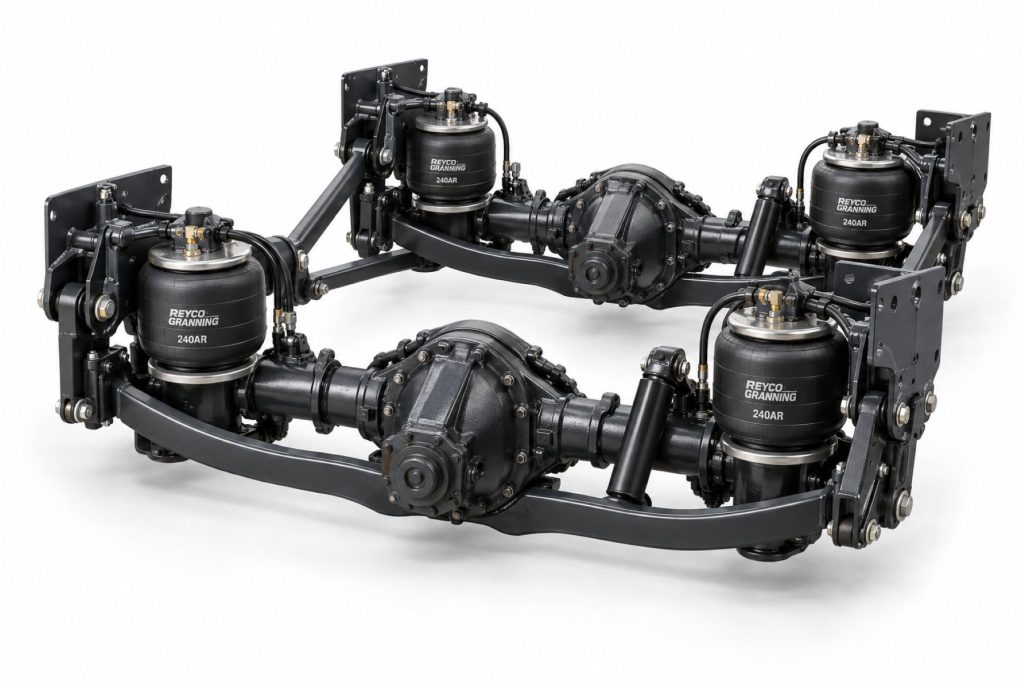
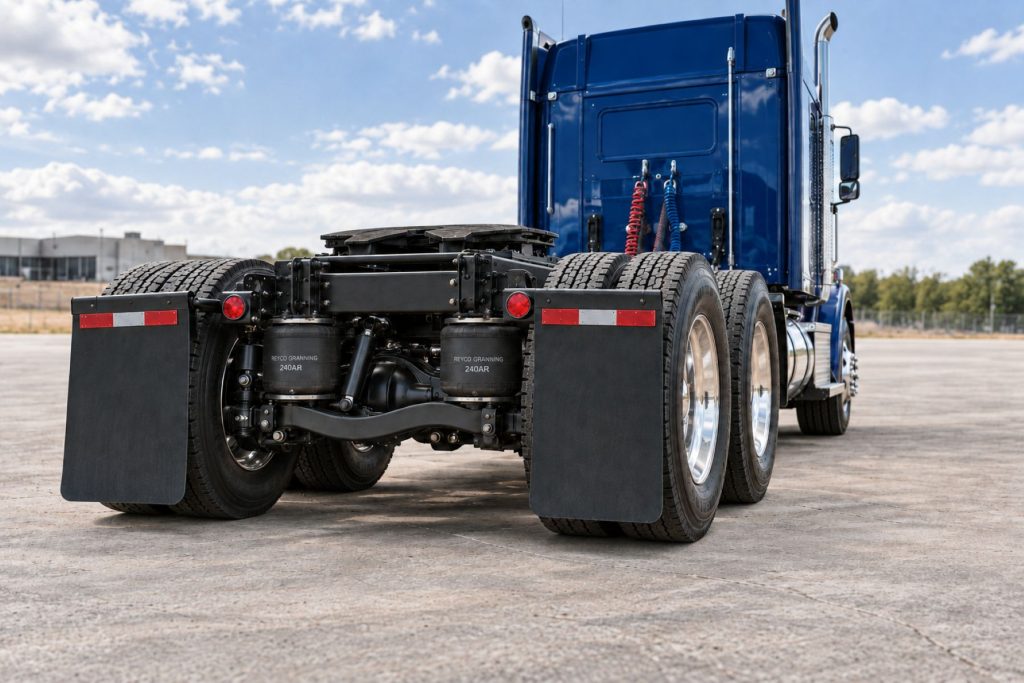
The Reyco Granning 240AR is a legacy air-ride drive-axle suspension used on recreational vehicles, motorhomes, specialty chassis, and application-specific commercial vehicles. It was manufactured in single- and tandem-drive-axle configurations.
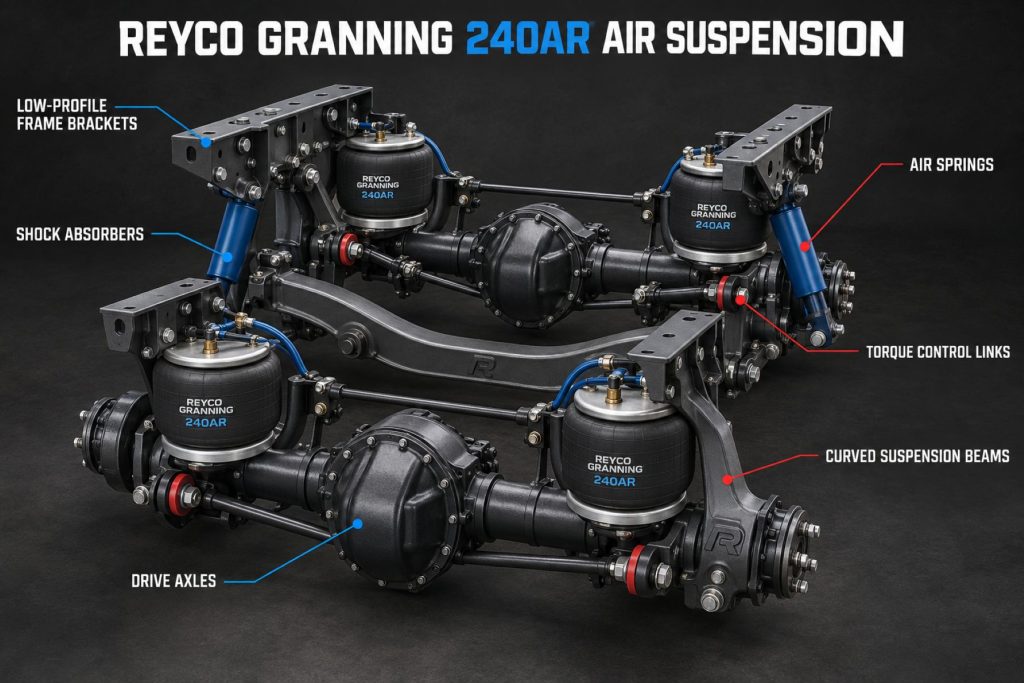
The single-axle version uses a four-point air-spring arrangement, while the tandem version uses an eight-point arrangement. Each axle is supported by two air springs connected to two trailing taper-leaf spring beams.
The taper-leaf beams carry structural loads and help guide the axle through its suspension travel. Torque arms position and align the drive axle or axles, while a track rod on each axle controls lateral movement beneath the frame.
A standard 240AR installation uses an 8.5-inch ride height. The tandem configuration was offered with standard 52-inch axle spacing and an optional 54-inch spacing. Reyco Granning produced other application-specific versions, making complete suspension identification important when ordering replacement parts.
The 240AR is now classified by Reyco Granning as a legacy recreational-vehicle suspension. Many remaining systems are installed on older motorhomes and specialty vehicles that require continued inspection, maintenance, and replacement-part support.
Key Characteristics
- Legacy air-ride suspension system
- Designed for drive-axle applications
- Single- and tandem-axle configurations
- Four-point single-axle arrangement
- Eight-point tandem-axle arrangement
- Two air springs per axle
- Two trailing taper-leaf beams per axle
- Torque arms position and align the axles
- Track rod required for every axle
- One height-control valve operates the suspension
- Standard 8.5-inch ride height
- Standard 52-inch tandem axle spacing
- Optional 54-inch tandem axle spacing
- Designed for front-engine and specialty chassis configurations
- Provides air-ride comfort for recreational and commercial vehicles
- Application-specific versions were manufactured
Major Components
- Frame hangers
- Frame crossmembers
- Trailing taper-leaf spring beams
- Air springs
- Upper air-spring brackets
- Axle seats
- Spring liners
- Top plates
- Bottom plates
- Axle U-bolts
- Rigid torque arms
- Adjustable torque arms
- Torque-arm bushings
- Track rods
- Track-rod axle brackets
- Track-rod frame brackets
- Shock absorbers
- Upper shock-absorber brackets
- Lower shock-absorber brackets
- Height-control valve
- Height-control valve linkage
- Pressure-protection valve
- Air filter
- Air lines and fittings
- Suspension fasteners
- Drive axle or tandem drive axles
How the Suspension System Works
Compressed air inside the suspension’s air springs supports the chassis, vehicle body, passengers, cargo, fluids, and onboard equipment.
When additional weight causes the chassis to move below its specified ride height, the height-control valve supplies air to the springs. When weight is removed and the chassis rises, the valve releases air from the system.
The 240AR uses one height-control valve regardless of whether the vehicle has a single- or tandem-axle suspension. The air springs on each side of the vehicle are connected through the suspension’s air-line system.
Two trailing taper-leaf beams are used on each axle. These beams connect the axle assembly to the frame hangers and move with the axle as the suspension travels over road irregularities.
Torque arms control forward and rearward axle position. Adjustable torque arms allow the axle alignment to be corrected, while rigid torque arms maintain the suspension’s structural relationship on the opposite side.
A track rod is required for each axle. The track rod limits side-to-side movement and helps keep the axle centered beneath the vehicle frame.
Shock absorbers slow rapid suspension movement and reduce repeated bouncing after the vehicle travels over bumps, pavement joints, driveway transitions, or uneven road surfaces.
Suspension Position and Function
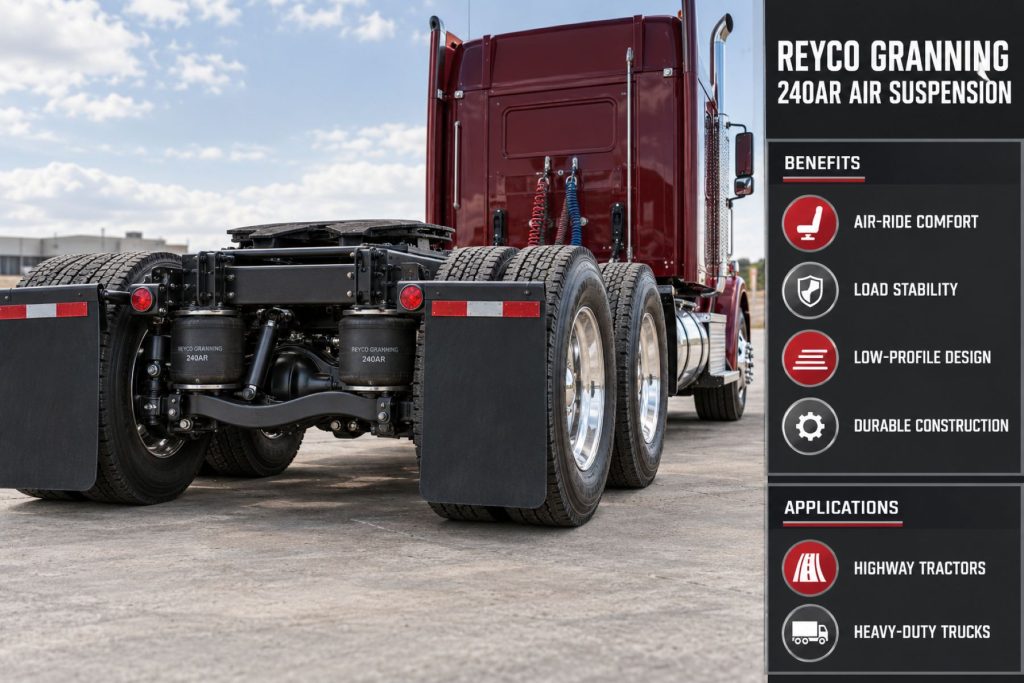
The 240AR is installed between the vehicle frame and a rear drive axle or tandem drive-axle group.
The suspension’s functions include:
- Supporting the rear chassis and vehicle body
- Maintaining the specified ride height
- Allowing controlled vertical axle movement
- Reducing road shock transmitted into the vehicle
- Controlling forward and rearward axle movement
- Limiting side-to-side axle movement
- Maintaining drive-axle alignment
- Maintaining driveshaft and pinion geometry
- Helping the tires remain in contact with the road
- Supporting consistent vehicle handling
- Improving passenger and occupant comfort
- Protecting interior equipment from excessive vibration
The suspension’s frame hangers require properly positioned crossmembers. These crossmembers support the suspension mounting locations and help transfer loads across the vehicle frame.
Common Specifications
- Suspension Type: Air-ride drive-axle suspension
- Axle Arrangement: Single or tandem drive axle
- Single-Axle Layout: Four-point air suspension
- Tandem-Axle Layout: Eight-point air suspension
- Air Springs: Two per axle
- Spring Beams: Two trailing taper-leaf beams per axle
- Standard Ride Height: 8.5 inches
- Standard Tandem Axle Spacing: 52 inches
- Optional Tandem Axle Spacing: 54 inches
- Axle Positioning: Rigid and adjustable torque arms
- Lateral Control: One track rod per axle
- Height-Control Valves: One valve for the complete suspension
- Minimum Air-Line Diameter: 3/8 inch for the height-control and air-spring connections
- Frame Support: Crossmember required at each hanger location
- Production Status: Legacy recreational-vehicle suspension
Reyco Granning manufactured additional versions of the 240AR. Exact dimensions, components, axle arrangements, and installation requirements must be confirmed using the suspension identification and vehicle records.
Capacity, Ride Height, and Axle Travel
The 240AR was produced for application-specific vehicle and axle ratings. The suspension must be matched to the vehicle frame, drive axles, brakes, tires, wheels, and completed vehicle weight.
Its mechanical capacity does not automatically increase the vehicle’s gross axle weight rating or gross vehicle weight rating. The completed vehicle remains limited by its lowest-rated structural or operating component.
The standard installation information identifies an 8.5-inch ride height. Other application-specific versions may use different dimensions and should not be adjusted according to the standard measurement without confirmation.
Correct ride height is necessary for:
- Proper air-spring shape
- Available upward and downward suspension travel
- Correct shock-absorber position
- Proper torque-arm geometry
- Correct track-rod position
- Drive-axle alignment
- Driveshaft and pinion angles
- Tire and body clearance
- Stable vehicle handling
- Consistent floor and body height
A vehicle operating below its specified height may have insufficient upward travel. A vehicle operating too high may have limited rebound travel and excessive driveline or suspension angles.
Ride Quality and Load Distribution
The air springs help isolate the vehicle frame and body from road impacts. This can improve comfort for drivers, passengers, and motorhome occupants compared with many conventional steel-spring arrangements.
A more controlled ride can also reduce vibration affecting:
- Interior cabinets
- Furniture and appliances
- Windows and body panels
- Electrical equipment
- Generators
- Water and holding tanks
- Passenger seating
- Cargo restraints
- Chassis-mounted components
On tandem configurations, suspension condition and axle alignment affect how the tires contact the road. Actual axle loading also depends on body layout, fuel, water, cargo, storage compartments, passengers, and installed equipment.
The vehicle should be weighed in its normal operating condition to verify individual axle weights. Suspension air pressure alone does not provide a complete or certified weight measurement.
Suspension Controls and Adjustment Options
The standard 240AR system uses one height-control valve for the complete suspension. On tandem configurations, the valve is mounted in connection with the forward drive axle.
The height-control valve supplies or releases air as the chassis moves away from its specified ride height.
Application-specific controls may include:
- Mechanical height-control valve
- Suspension dump control
- Temporary chassis lowering
- Low-air warning
- Dash-mounted air control
- Automatic leveling
- Manual inflation connection
- Motorhome leveling-system integration
- Body-equipment interlocks
- Service inflation connection
The pressure-protection valve helps preserve air pressure for essential vehicle systems while supplying the suspension. An air filter helps protect the height-control system from contamination.
The vehicle should return to its specified ride height before road operation unless its original operating instructions state otherwise.
Alignment and Suspension Geometry
The 240AR uses torque arms and track rods to control drive-axle position.
Adjustable torque arms are normally installed on the left side of the vehicle, while rigid torque arms are used on the right side. The adjustable arms allow technicians to correct axle position during alignment.
On a single-axle installation, one track rod supports and laterally locates the drive axle. On a tandem suspension, each axle requires its own track rod.
Reyco Granning’s standard tandem arrangement positions the track rods from opposite sides of the frame. This helps control the lateral position of both axles while accommodating surrounding suspension and driveline components.
Correct alignment is important for:
- Straight vehicle tracking
- Even tire wear
- Correct axle spacing
- Proper tandem axle relationship
- Reduced tire scrub
- Stable braking
- Correct driveshaft angles
- Reduced rolling resistance
- Predictable handling
Alignment should be inspected after:
- Initial installation
- Torque-arm replacement
- Track-rod replacement
- Spring-beam replacement
- Bushing replacement
- Drive-axle replacement
- Ride-height adjustment
- Frame repair
- Collision damage
- Severe curb impacts
- Appearance of irregular tire wear
Ride height should be verified before final alignment measurements are performed.
Axle, Brake, and Wheel-End Options
The 240AR was installed with application-specific drive axles, brakes, and wheel-end equipment.
Possible equipment includes:
- Single rear drive axle
- Tandem rear drive axles
- Single-reduction drive axles
- Application-specific axle ratios
- Air drum brakes
- Hydraulic brake equipment on applicable chassis
- Dual rear wheels
- Conventional wheel ends
- Oil-lubricated wheel bearings
- Antilock braking systems
- Application-specific hubs and seals
- Automatic lubrication equipment
- Tire-pressure monitoring equipment
The installation manual notes that brake camshafts must be positioned on the forward side of the axle for clearance in the standard configuration.
Axle seats and related components must provide adequate clearance for the brake chambers, camshafts, suspension beams, shock absorbers, and surrounding chassis equipment.
Common Applications
- Class A motorhomes
- Recreational vehicles
- Front-engine motorhome chassis
- Specialty recreational-vehicle chassis
- Commercial vehicle conversions
- Mobile medical vehicles
- Mobile command centers
- Specialty passenger vehicles
- Commercial straight trucks
- Specialty vocational vehicles
- Vehicles carrying sensitive interior equipment
- Legacy vehicles originally equipped with the 240AR
Vehicle, Axle, and Frame Compatibility
The 240AR must be matched to the exact vehicle frame, drive axle, ride height, and original suspension arrangement.
Compatibility depends on:
- Vehicle manufacturer
- Vehicle model and model year
- Vehicle identification number
- Single- or tandem-axle arrangement
- Frame width
- Frame rail strength
- Crossmember location
- Suspension hanger position
- Designed ride height
- Drive-axle manufacturer and model
- Drive-axle rating
- Tandem axle spacing
- Driveshaft geometry
- Pinion angle
- Brake system
- Brake chamber clearance
- Wheel and tire equipment
- Fuel-tank placement
- Battery-box location
- Exhaust-system clearance
- Generator location
- Body and floor structure
- Completed vehicle weight distribution
Reyco Granning’s installation information states that crossmembers are required at all suspension hanger locations. Frame and crossmember modifications should only be completed using properly engineered procedures.
A replacement suspension should not be selected solely because its dimensions or axle capacity appear similar.
Advantages
- Air springs improve ride quality
- Maintains consistent chassis height as loading changes
- Available in single- and tandem-axle configurations
- Two air springs support each axle
- Taper-leaf beams provide structural axle control
- Torque arms maintain forward and rearward axle position
- Adjustable torque arms support axle alignment
- Track rod controls lateral axle movement
- One height-control valve operates the suspension
- Can reduce vibration reaching the vehicle body
- Can improve motorhome occupant comfort
- Supports application-specific vehicle configurations
- Standard 52-inch tandem axle spacing
- Optional 54-inch tandem axle spacing
- Established service history in recreational vehicles
Limitations or Considerations
- The 240AR is a legacy suspension
- Complete new suspension assemblies may have limited availability
- Replacement parts may have been superseded
- Requires a dependable compressed-air supply
- Air leaks can cause the chassis to settle
- Ride height requires periodic inspection
- Track rods are required for all axles
- Frame crossmembers are required at hanger locations
- Torque-arm and track-rod bushings are wear components
- Taper-leaf beams require inspection for cracks and damage
- Incorrect ride height can change pinion angles
- Incorrect alignment can cause rapid tire wear
- Older identification labels may be missing or unreadable
- Does not automatically increase certified vehicle weight ratings
- Body equipment may restrict access to suspension components
Driver and Operator Experience
A correctly maintained 240AR can provide a smoother ride than many conventional mechanical suspensions. This is particularly important in motorhomes and specialty vehicles with large bodies, interior furnishings, and sensitive onboard equipment.
Operators may notice changes in ride and handling when air pressure, ride height, shock absorbers, bushings, or axle alignment deteriorate.
Drivers and owners should report:
- Vehicle leaning to one side
- Rear chassis sitting too low
- Slow suspension inflation
- Frequent air-compressor cycling
- Audible air leakage
- Excessive bouncing
- Harsh ride quality
- Unusual body roll
- Clunking from the rear suspension
- Poor vehicle tracking
- Driveline vibration
- Irregular rear tire wear
- Uneven tandem tire wear
- Movement of interior cabinets or equipment
The suspension should be inspected before continued operation if a sudden change in ride height, handling, or axle position occurs.
Maintenance and Ownership Notes
- Inspect air springs for cracks, cuts, abrasion, and leaks.
- Check air lines and fittings for damage.
- Inspect the height-control valve and linkage.
- Verify that the suspension maintains its specified ride height.
- Inspect the pressure-protection valve and air filter.
- Check the air reservoirs and compressor system.
- Inspect shock absorbers for leakage or damage.
- Check upper and lower shock mounts.
- Inspect taper-leaf spring beams for cracks or deformation.
- Check spring liners and axle seats.
- Inspect U-bolts and axle-attachment hardware.
- Verify U-bolt and alignment fastener torque.
- Inspect rigid and adjustable torque arms.
- Check torque-arm bushings for deterioration.
- Inspect each axle’s track rod and mounting brackets.
- Examine frame hangers and crossmembers for cracking.
- Monitor tires for alignment-related wear.
- Check driveshaft and pinion angles.
- Inspect the suspension after overloading or severe impacts.
- Use the service information for the exact suspension configuration.
- Reyco Granning’s legacy manual emphasizes rechecking critical bolt and nut torque after the first 1,000 to 3,000 loaded miles following installation and during annual inspections thereafter.
Common Suspension Problems
- Air leakage: Damaged air springs, air lines, fittings, valves, or reservoirs can cause the chassis to settle or prevent normal inflation.
- Incorrect ride height: A faulty height-control valve, damaged linkage, restricted air line, or improper adjustment can position the chassis too high or too low.
- Vehicle leaning: Uneven loading, restricted air flow, damaged springs, valve problems, or structural damage can create different side-to-side heights.
- Excessive bouncing: Worn shock absorbers, incorrect ride height, damaged air springs, or improper vehicle loading can reduce suspension control.
- Harsh ride: Low air pressure, incorrect ride height, restricted suspension travel, binding components, or overinflated tires may increase harshness.
- Irregular tire wear: Incorrect axle alignment, worn torque-arm bushings, worn track-rod bushings, or wheel-end problems may cause abnormal wear.
- Tandem tire scrub: Incorrect axle spacing or misalignment between the two drive axles can cause the tires to work against each other.
- Driveline vibration: Incorrect ride height, altered pinion angle, shifted axle position, or worn torque-arm components can change driveshaft geometry.
- Side-to-side axle movement: Worn track-rod bushings, damaged brackets, loose fasteners, or a bent track rod can allow lateral movement.
- Loose axle attachment: Improperly tightened U-bolts or damaged axle seats can allow the axle to move against the spring beams.
- Structural cracking: Corrosion, overloading, impacts, loose fasteners, or improper repairs can damage beams, hangers, brackets, or crossmembers.
- Difficulty locating parts: Legacy configurations may require original vehicle records, component measurements, and individual part numbers.
Identification Information
Identification information may be located on a suspension tag, frame bracket, spring beam, drive axle, or vehicle chassis label.
Record the following information:
- Vehicle manufacturer
- Vehicle identification number
- Vehicle model and model year
- Complete suspension model
- Suspension serial or assembly number
- Single- or tandem-axle configuration
- Designed ride height
- Tandem axle spacing
- Frame width
- Drive-axle manufacturer
- Drive-axle model
- Drive-axle rating
- Brake type
- Wheel and tire configuration
- Air-spring part numbers
- Spring-beam part numbers
- Torque-arm part numbers
- Track-rod part numbers
- Shock-absorber part numbers
- Height-control valve number
- Axle-seat and bracket arrangement
If the original identification tag is unavailable, vehicle build records, measurements, component numbers, and photographs may be necessary.
Do not identify replacement parts by appearance alone. Different 240AR configurations may use similar-looking components with different dimensions or operating characteristics.
Buying Considerations
- Confirm that the suspension is a Reyco Granning 240AR.
- Determine whether it is a single- or tandem-axle system.
- Record the complete suspension identification.
- Verify the original ride height.
- Measure the tandem axle spacing when applicable.
- Confirm the vehicle frame width.
- Identify the drive-axle manufacturer and model.
- Verify the brake configuration.
- Record air-spring and spring-beam numbers.
- Inspect torque arms and track rods.
- Check all bushings for wear.
- Inspect hangers and crossmembers for cracks.
- Examine the spring beams for corrosion or damage.
- Check replacement-parts availability.
- Determine whether original parts have been superseded.
- Inspect used systems for unauthorized welding or modifications.
- Compare repair costs with a professionally engineered suspension replacement.
- Use a suspension shop familiar with legacy motorhome systems.
Variants and Configurations
The 240AR was manufactured in multiple application-specific configurations.
Variations may include:
- Four-point single-axle suspension
- Eight-point tandem-axle suspension
- Standard 8.5-inch ride height
- Other application-specific ride heights
- Standard 52-inch tandem axle spacing
- Optional 54-inch tandem axle spacing
- Different vehicle frame widths
- Different drive-axle models
- Different axle ratings
- Different frame-hanger arrangements
- Different taper-leaf spring beams
- Different air-spring specifications
- Rigid and adjustable track rods
- Application-specific shock absorbers
- Different brake-system arrangements
- Front-engine motorhome configurations
- Specialty commercial-vehicle configurations
The complete suspension and component numbers should be confirmed before replacement parts are purchased.
Comparison to Similar Equipment
Compared with the Reyco Granning 102AR Air Suspension, the 240AR is a legacy suspension associated primarily with recreational-vehicle and motorhome applications. The two systems use different installation arrangements and should not be treated as interchangeable.
Compared with the Reyco Granning 79KB Suspension, the 240AR uses air springs to support the chassis. The 79KB is a single-drive-axle steel-spring suspension.
Compared with the Link UltraRide Suspension, both systems may be found on recreational vehicles and specialty chassis. UltraRide includes application-specific conversion and rear-suspension solutions, while the 240AR is an older drive-axle air-suspension design.
Compared with a conventional leaf-spring suspension, the 240AR can provide a softer ride and more consistent chassis height. However, it requires an air supply, height-control equipment, and additional air-system maintenance.
Compared with a modern integrated motorhome chassis suspension, the 240AR uses a more traditional combination of air springs, taper-leaf beams, torque arms, and track rods.
Best Fit For
- Vehicles originally equipped with a Reyco Granning 240AR
- Legacy Class A motorhomes
- Front-engine recreational vehicles
- Single-drive-axle motorhome chassis
- Tandem-drive-axle specialty vehicles
- Commercial vehicle conversions
- Specialty vehicles requiring air-ride comfort
- Vehicles carrying sensitive interior equipment
- Owners maintaining older recreational vehicles
- Fleets with access to legacy suspension service
- Applications where original suspension geometry must be preserved
Related Vehicle and Trailer Types
- Class 6 vs Class 7 vs Class 8 Trucks
- Commercial straight trucks
- Recreational vehicles
- Class A motorhomes
- Front-engine motorhomes
- Mobile medical vehicles
- Mobile command vehicles
- Specialty passenger vehicles
- Commercial vehicle conversions
- Specialty vocational vehicles
Related Truck and Trailer Models
- Freightliner Custom Chassis vehicles
- Spartan motorhome chassis
- Workhorse motorhome chassis
- Gillig motorhome chassis
- Front-engine recreational vehicles
- Specialty commercial chassis
- Mobile command vehicles
- Mobile medical vehicles
Related Suspension Types
- Air Suspension Systems
- Reyco Granning 102AR Air Suspension
- Link UltraRide Suspension
- Single-drive-axle air suspensions
- Tandem-drive-axle air suspensions
- Motorhome air suspensions
- Recreational-vehicle suspensions
- Trailing-beam air suspensions
- Taper-leaf beam suspensions
- Mechanical rear suspensions
Related Equipment Systems
- Suspension Systems
- Axles & Differentials
- Air Brake Systems Explained
- Drive axles
- Driveshafts and drivelines
- Truck air systems
- Height-control systems
- Brake systems
- Tires and wheels
- Vehicle leveling systems
- Motorhome chassis systems
Related Guides
- Suspension System Guides
- How Commercial Truck Suspension Systems Work
- Air Suspension vs Leaf Spring Suspension
- How to Choose a Commercial Truck Suspension
- Truck Suspension Components Explained
- Truck vs Trailer Suspension Systems
- Single Axle vs Tandem Axle Trucks
Regulatory and Compliance Notes
The suspension’s mechanical capability does not override the vehicle’s gross axle weight rating, gross vehicle weight rating, tire capacity, wheel capacity, brake rating, or legal road-weight limits.
Suspension repairs and modifications must preserve:
- Brake-system operation
- Steering and handling stability
- Drive-axle alignment
- Driveshaft and pinion geometry
- Tire and wheel clearance
- Fuel-system protection
- Exhaust-system clearance
- Electrical-system protection
- Body and equipment clearance
- Frame structural integrity
- Required ground clearance
Motorhomes and specialty vehicles may be subject to additional final-stage manufacturing, passenger safety, accessibility, electrical, fuel, and body-construction requirements.
Frame welding, hanger relocation, crossmember modification, or conversion to another suspension should be supported by qualified engineering.
Real World Operating Notes
Many remaining 240AR systems are installed on older motorhomes and specialty vehicles. Identification tags may have been painted over, damaged, or removed during previous repairs.
Motorhome weight can increase significantly through added appliances, generators, batteries, water tanks, slide-outs, storage equipment, and personal cargo. The vehicle should be weighed in its normal travel condition.
Ride-height problems should be corrected before diagnosing axle alignment or driveline vibration. Aligning a vehicle at the wrong ride height may not correct the underlying handling problem.
Track rods are required for all 240AR axles. Operating with worn track-rod bushings can allow the axle to shift sideways and affect handling, tire clearance, and driveline position.
Reyco Granning specifies that the spring beams and air springs must be protected from welding spatter and grinder sparks during nearby chassis repairs.
Frequently Asked Questions
What is the Reyco Granning 240AR?
The 240AR is a legacy air-ride drive-axle suspension used primarily on recreational vehicles, motorhomes, and specialty vehicle chassis.
Is the 240AR a single- or tandem-axle suspension?
It was available in both configurations. The single-axle version uses a four-point arrangement, while the tandem version uses an eight-point arrangement.
How many air springs does the 240AR use?
It uses two air springs per axle.
What type of spring beams does it use?
The suspension uses two trailing taper-leaf spring beams per axle.
What is the standard ride height?
The standard installation described by Reyco Granning uses an 8.5-inch ride height. Other application-specific versions may differ.
What tandem axle spacings were available?
The standard tandem axle spacing is 52 inches, with a 54-inch optional configuration identified in the legacy service information.
How many height-control valves does it use?
The standard system uses one height-control valve regardless of whether the suspension has one or two axles.
Does every axle require a track rod?
Yes. Reyco Granning’s installation information states that track rods are required for all axles.
Why is correct ride height important?
Correct ride height preserves air-spring shape, suspension travel, axle alignment, pinion angles, driveshaft geometry, tire clearance, and vehicle handling.
What causes a 240AR-equipped vehicle to sit low?
Possible causes include an air leak, weak compressor, faulty height-control valve, damaged linkage, restricted air line, failed air spring, or excessive vehicle weight.
What causes driveline vibration?
Incorrect ride height, altered pinion angles, worn torque-arm bushings, shifted axle position, or driveshaft problems may cause vibration.
Are all 240AR parts interchangeable?
No. Different vehicle applications may use different beams, brackets, air springs, track rods, torque arms, shocks, and mounting dimensions.
Is the 240AR still a current suspension?
Reyco Granning identifies the 240AR documentation as legacy recreational-vehicle literature. Parts and technical-support availability should be confirmed for the exact configuration.
How can the correct replacement parts be identified?
Use the suspension identification, vehicle VIN, ride height, frame width, axle spacing, axle information, and individual component numbers.
Availability and Where to Find
The Reyco Granning 240AR may be found on existing recreational vehicles, motorhomes, commercial conversions, and specialty chassis.
Replacement air springs, shocks, bushings, torque arms, track rods, valves, beams, and mounting components may be available through Reyco Granning distributors, recreational-vehicle parts suppliers, motorhome service centers, suspension specialists, and heavy-duty parts suppliers.
Because the 240AR is a legacy system, buyers should confirm whether original components have been superseded. The complete suspension model, vehicle VIN, ride height, axle arrangement, axle spacing, and component numbers should be recorded before ordering.
Legacy service information and technical-support resources are available through the Reyco Granning 240AR literature page.
Support Trucking Families
Truck Equipment Atlas supports the mission of Grey Cross, a nonprofit dedicated to helping families of truck drivers who lose their lives while on the road. As the site grows, part of its mission is to bring awareness and support to these families.
Podcast or Video Section
Learn More Through Audio and Video
Truck Equipment Atlas will continue expanding with podcast episodes, interviews, and equipment breakdowns to help drivers and fleets better understand trucks and equipment.
Follow the Growth of Truck Equipment Atlas
Truck Equipment Atlas continues to expand with new truck profiles, trailer coverage, diesel engine pages, equipment system resources, manufacturer information, and educational guides.
Visit our Site Updates page to explore recent additions, project milestones, and upcoming resources as we continue building one of the industry’s growing commercial trucking equipment reference libraries.
View the Latest Site Updates: Truck Equipment Atlas Site Updates