
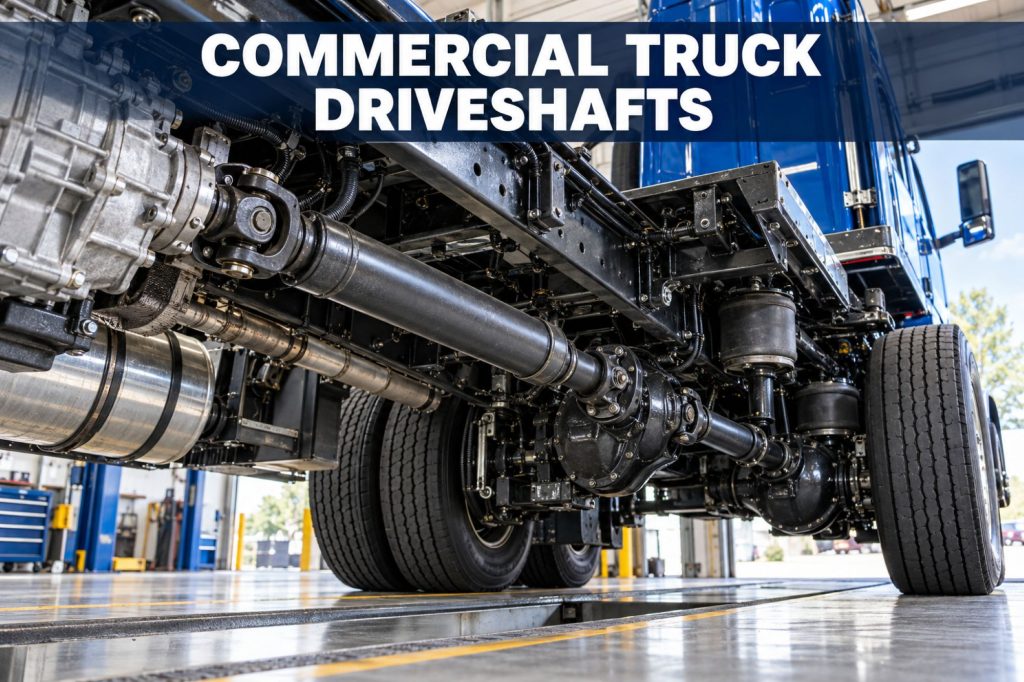
Commercial truck driveshafts transfer rotational power from the transmission or transfer case to the vehicle’s drive axle or axles. They must carry substantial torque while accommodating changes in driveline angle, suspension position, axle movement, and vehicle loading.
Commercial vehicles may use single-piece, two-piece, or multi-piece driveshaft systems depending on wheelbase, chassis layout, axle configuration, operating speed, and application.
Truck Equipment Atlas covers heavy-duty driveshaft assemblies, driveline series, universal joints, slip assemblies, center bearings, yokes, flanges, interaxle shafts, maintenance considerations, compatibility requirements, and related product families.
How Commercial Truck Driveshafts Work
The transmission converts engine power through the selected gear ratio and sends rotational output into the driveshaft. The driveshaft carries that rotation to the drive axle, where the differential distributes torque to the axle shafts and wheels.
Universal joints allow the shaft to operate through changing angles. Slip assemblies permit changes in effective shaft length as the suspension and axles move. Center bearings support intermediate sections of multi-piece driveshafts.
Correct driveshaft length, balance, phasing, working angles, slip travel, and component capacity are necessary for smooth and reliable power transfer.
Major Driveshaft Components
- Driveshaft tube
- Universal joints
- End yokes
- Tube yokes
- Flange yokes
- Companion flanges
- Slip yokes
- Slip splines
- Center bearings
- Center-bearing brackets
- Interaxle driveshafts
- Retaining straps and fasteners
- Grease fittings on serviceable assemblies
- Dust seals and protective components
- Balancing weights
Single-Piece Driveshafts
A single-piece driveshaft connects two drivetrain components without an intermediate center bearing. This arrangement uses fewer components and may be appropriate when shaft length, operating speed, torque capacity, tube diameter, and working angles remain within the manufacturer’s limits.
Single-piece driveshafts are commonly used on vehicles where the transmission and drive axle are sufficiently close together. Longer shafts may require larger tubing or a multi-piece arrangement to control critical speed and vibration.
Multi-Piece Driveshafts
Multi-piece driveshafts divide a long driveline into two or more shaft sections. Center bearings mounted to the frame or crossmembers support the intermediate sections.
This arrangement is common on long-wheelbase straight trucks, buses, vocational vehicles, recreational vehicles, and specialized chassis.
Proper center-bearing placement, support-bracket alignment, shaft phasing, working angles, and slip travel are essential for reliable multi-piece driveline operation.
Interaxle and Auxiliary Driveshafts
Tandem-drive trucks normally use an interaxle driveshaft between the forward and rear drive axles. This shaft transfers torque through the tandem axle group and must accommodate axle movement and changing operating angles.
All-wheel-drive and specialized vehicles may use additional driveshafts between the transmission, transfer case, front axle, rear axles, or auxiliary driven equipment.
Each driveshaft position may require a different length, universal-joint series, yoke, flange, slip arrangement, and torque capacity.
Common Driveshaft Configurations
- Single-piece driveshaft
- Two-piece driveshaft
- Multi-piece driveshaft
- Interaxle driveshaft
- Transfer-case driveshaft
- Front-axle driveshaft
- Greaseable universal-joint assembly
- Permanently lubricated driveline
- Flange-connected driveshaft
- Yoke-connected driveshaft
- Highway-service driveline
- Vocational and severe-duty driveline
Driveshaft Capacity and Operating Requirements
Driveshaft capacity depends on more than the engine’s published torque. Transmission gearing, axle gearing, vehicle weight, traction, grade, road conditions, shock loading, shaft length, operating speed, and driveline angles also affect component requirements.
Important operating considerations include:
- Engine and transmission torque
- Transmission gear ratios
- Vehicle gross weight
- Gross combination weight
- Driveshaft length
- Tube diameter and construction
- Universal-joint series
- Maximum operating speed
- Driveline working angles
- Slip travel
- Highway or vocational service
- Expected shock loading
Driveline Angles, Phasing, and Balance
Universal-joint working angles must remain within the driveshaft manufacturer’s limits. Excessive or unequal angles can cause vibration, heat, noise, and accelerated joint wear.
Driveshaft phasing describes the rotational alignment of the yokes on opposite ends of the shaft. Incorrect phasing can create vibration even when the shaft is properly balanced.
The complete assembly must also be dynamically balanced. Bent tubing, missing balance weights, damaged welds, accumulated debris, or improper repairs can affect balance and operating stability.
Common Applications
- Long-haul highway tractors
- Regional-haul tractors
- Commercial straight trucks
- Dump trucks
- Concrete mixers
- Refuse trucks
- Heavy-haul tractors
- Logging trucks
- Recovery and towing vehicles
- Utility trucks
- Crane trucks
- Fire apparatus
- School and transit buses
- Motorcoaches
- Recreational vehicles
- All-wheel-drive commercial vehicles
- Specialized multi-axle equipment
Installation and Vehicle Compatibility
A commercial driveshaft must match the transmission, axle, suspension, chassis, and complete vehicle application.
Compatibility can depend on:
- Truck manufacturer and model
- Vehicle identification number
- Engine and transmission combination
- Transmission output connection
- Drive-axle model
- Axle-input connection
- Single or tandem drive configuration
- Wheelbase
- Suspension type and ride height
- Universal-joint series
- Driveshaft length
- Tube diameter
- Slip travel
- Center-bearing arrangement
- Torque and operating-speed requirements
A driveshaft should not be selected solely by overall length or visual appearance. The complete assembly must satisfy the dimensional, torque, speed, balance, and mounting requirements of the vehicle.
Inspection and Maintenance
Commercial driveshafts should be inspected during scheduled maintenance and whenever a driver reports vibration, clunking, squeaking, grinding, or other unusual driveline behavior.
Important inspection points include:
- Universal-joint looseness or binding
- Loose yoke straps and fasteners
- Cracked or distorted yokes
- Dented or bent driveshaft tubing
- Missing balance weights
- Damaged welds
- Slip-spline wear
- Insufficient or excessive slip engagement
- Center-bearing deterioration
- Loose support brackets
- Grease leakage or contamination
- Contact with surrounding chassis components
Serviceable universal joints and slip assemblies should receive the specified lubricant at the manufacturer’s recommended interval. Permanently lubricated assemblies still require regular visual and physical inspection.
Common Driveshaft Problems
- Driveline vibration: Incorrect working angles, improper phasing, shaft imbalance, worn universal joints, damaged tubing, or center-bearing problems may cause vibration.
- Clunking during acceleration or deceleration: Worn universal joints, loose yokes, excessive slip-spline wear, or loose mounting hardware may create noticeable movement.
- Squeaking or grinding: Dry universal joints, damaged bearing seals, inadequate lubrication, or failing center bearings may cause repeating driveline noise.
- Center-bearing failure: Misalignment, damaged support rubber, incorrect installation, shaft imbalance, or excessive driveline angles can damage the bearing assembly.
- Driveshaft damage: Road debris, component contact, improper lifting, driveline separation, or unapproved repairs can bend, dent, or weaken the shaft.
Benefits
- Transfers transmission torque to the drive axles
- Accommodates suspension and axle movement
- Supports single and tandem drive configurations
- Supports long-wheelbase vehicles
- Available for highway and severe-duty applications
- Supports high-output engines and heavy vehicle weights
- Available with extended-lubrication or maintenance-free designs
- Provides replaceable and serviceable components
Limitations and Considerations
- Driveshaft capacity is application-specific.
- Torque capacity does not establish safe operating speed.
- Long shafts may require multiple shaft sections.
- Incorrect angles can cause vibration and wear.
- Improper phasing can create cyclic vibration.
- Center-bearing alignment is critical.
- Serviceable joints require correct lubrication.
- Maintenance-free joints still require inspection.
- Ride-height changes can alter driveline geometry.
- Damaged tubing requires professional evaluation.
- Similar-looking components may not be interchangeable.
Commercial Driveshaft Products
Dana Spicer
- Dana Spicer Life Series Commercial Driveshaft
- Dana Spicer SPL High-Torque Series Driveshaft
- Dana Spicer SPL 140 Driveshaft
- Dana Spicer SPL 250 High-Torque Driveshaft
- Dana Spicer SPL 350 Driveshaft
- Dana Spicer Compact Series PLUS Driveshaft
- Dana Spicer Wing Series Driveshaft
- Dana Spicer ReadyShaft Commercial Driveshaft
Cummins-Meritor
- Meritor Permalube RPL10 Driveline
- Meritor Permalube RPL14 Driveline
- Meritor Permalube RPL20 Driveline
- Meritor Permalube RPL25 Driveline
- Meritor Permalube RPL35 Driveline
- Meritor XTended Lube MXL Driveline
Additional highway, regional, vocational, heavy-haul, all-wheel-drive, and specialty driveshaft products will be added as the Truck Equipment Atlas Commercial Truck Driveshaft Library continues to expand.
Related Driveline and Steering Categories
- Drivelines & Steering Systems
- Universal Joints, Slip Yokes & Center Bearings
- Steering Gears & Steering Linkage
- Power Steering Pumps & Hydraulic Assist
- Steering Columns & Driver Controls
- Advanced Steering & Lane-Keeping Systems
Related Driveline and Steering Guides
- Driveline & Steering System Guides
- How Commercial Truck Driveline Systems Work
- How Commercial Truck Steering Systems Work
- Single-Piece vs Multi-Piece Truck Driveshafts
- How to Inspect and Maintain Driveshafts and Universal Joints
- Hydraulic vs Electric-Assisted Commercial Truck Steering
- Common Commercial Truck Driveline Vibrations and Steering Problems
Related Equipment Systems
- Equipment Systems
- Transmissions
- Axles & Differentials
- Suspension Systems
- Brake Systems
- Tires & Wheels
- PTO & Hydraulic Systems
- Safety Systems
Expanding the Commercial Driveshaft Library
Truck Equipment Atlas will continue expanding this section with additional driveshaft systems, universal-joint series, yokes, slip assemblies, center bearings, interaxle shafts, replacement assemblies, service components, and specialized driveline applications.
Future coverage will include products for medium-duty trucks, highway tractors, vocational vehicles, heavy-haul equipment, buses, motorcoaches, all-wheel-drive vehicles, and specialized commercial chassis.
Explore the Complete Drivelines and Steering Systems Library
Visit the Drivelines & Steering Systems hub to explore commercial driveshafts, universal joints, slip yokes, center bearings, steering gears, steering linkage, power-steering pumps, hydraulic-assist systems, advanced steering technologies, product profiles, and educational guides.
Follow the Growth of Truck Equipment Atlas
Truck Equipment Atlas continues to expand with new truck profiles, trailer coverage, diesel engine pages, equipment-system resources, manufacturer information, product profiles, and educational guides.
Visit our Site Updates page to explore recent additions, project milestones, and upcoming resources as we continue building one of the industry’s growing commercial trucking equipment reference libraries.
View the Latest Site Updates: Truck Equipment Atlas Site Updates