
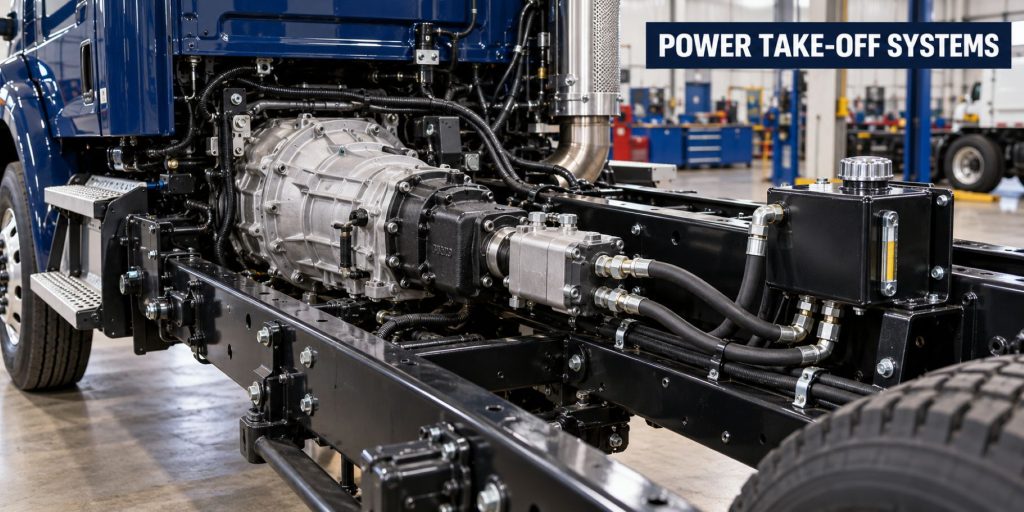
Power take-off systems allow commercial trucks to transfer mechanical power from the engine or transmission to hydraulic pumps, generators, compressors, winches, blowers, and other vocational equipment.
Commonly called PTOs, these systems are essential to dump trucks, refuse vehicles, tow trucks, utility trucks, tankers, service vehicles, concrete equipment, specialized trailers, and many other work-truck applications.
Truck Equipment Atlas covers commercial power take-off models, configurations, controls, mounting systems, and application requirements from major PTO and hydraulic-equipment manufacturers.
Power Take-Off Models on Truck Equipment Atlas
Explore the commercial truck power take-off models currently covered on Truck Equipment Atlas:
- Parker Chelsea 280 Series Power Take-Off
- Parker Chelsea 442 Series Power Take-Off
- Parker Chelsea 489 Series Power Take-Off
- Parker Chelsea 590 Series Power Take-Off
- Parker Chelsea 870 Series Power Take-Off
- Muncie TG Series Power Take-Off
- Muncie CS6 Series Power Take-Off
- Muncie FR6Q Power Take-Off
Additional PTO models, control systems, mounting configurations, and manufacturer product families will be added as the Truck Equipment Atlas PTO & Hydraulic Systems Library continues to expand.
How Commercial Truck Power Take-Off Systems Work
A power take-off connects to an approved drive opening on a transmission, engine, transfer case, or other powertrain component. Internal PTO gears engage with a driving gear and transfer mechanical power to an output shaft.
The output can drive a hydraulic pump directly or transfer power through a shaft to remotely mounted equipment. The driven component then operates the truck body, trailer, accessory, or vocational system.
A typical PTO-powered hydraulic system can include:
- Engine
- Transmission
- Power take-off
- Hydraulic pump
- Hydraulic reservoir
- Control valves
- Hydraulic hoses and fittings
- Filters and breathers
- Hydraulic cylinders or motors
- Air, mechanical, or electronic controls
The PTO must be properly matched to the transmission, pump, required operating speed, torque demand, horsepower requirement, mounting space, and equipment duty cycle.
Common Power Take-Off Configurations
Commercial power take-offs are available in numerous configurations designed for different transmissions, vehicles, and equipment applications.
Common configurations include:
- Transmission-mounted PTOs
- Engine-driven PTO systems
- Split-shaft PTO systems
- Side-mount PTOs
- Rear-mount PTOs
- Top-mount PTOs
- Mechanical-shift PTOs
- Air-shift PTOs
- Hydraulic-shift PTOs
- Electric-over-air controls
- Constant-mesh PTOs
- Hot-shift PTOs
- Clutch-shift PTOs
- Direct-mount pump configurations
- Remote-mount pump configurations
The correct configuration depends on the transmission design, available PTO openings, vehicle packaging, hydraulic-system requirements, operating procedure, and equipment manufacturer’s specifications.
Transmission-Mounted Power Take-Offs
Transmission-mounted PTOs are among the most common designs used on commercial trucks. They attach to a compatible opening in the transmission housing and engage with a transmission drive gear.
Compatibility depends on several factors:
- Transmission manufacturer
- Transmission model
- PTO opening location
- Number of mounting bolts
- Drive-gear design
- Required gear pitch
- Gear direction of rotation
- Available clearance
- Lubrication requirements
- Required PTO speed ratio
A PTO should never be selected solely because its bolt pattern appears to match the transmission opening. The complete transmission model, input gearing, rotation, speed, torque capacity, and approved application must be confirmed.
Engine-Driven and Split-Shaft PTO Systems
Some applications require hydraulic or mechanical power under conditions that are not well suited to a conventional transmission-mounted PTO.
An engine-driven system can supply power independently of the transmission output. This can be useful for equipment requiring continuous operation or hydraulic power while the vehicle is moving.
A split-shaft PTO is installed within the driveline and can redirect power from the engine and transmission to auxiliary equipment. These systems may be used in specialized emergency, utility, pumping, drilling, and severe-duty applications.
Engine-driven and split-shaft systems require careful engineering because they affect driveline layout, operating procedures, available power, vehicle movement, and equipment safety.
PTO Speed Ratios
The PTO speed ratio determines how fast the PTO output shaft turns in relation to the transmission input or engine speed.
A PTO may operate slower than, close to, or faster than the transmission input speed. The proper ratio depends on the required hydraulic-pump speed and the engine RPM used during equipment operation.
PTO speed affects:
- Hydraulic-pump speed
- Hydraulic flow rate
- Equipment operating speed
- Heat generation
- Noise
- Pump service life
- Available torque
- Overall system efficiency
Operating a hydraulic pump above its approved speed can cause excessive heat, noise, cavitation, premature wear, or component failure. Operating too slowly may prevent the system from producing the required flow.
PTO Torque and Horsepower Ratings
Every PTO has limits governing the amount of torque and horsepower it can transfer.
The required capacity depends on:
- Hydraulic-pump displacement
- System operating pressure
- PTO output speed
- Equipment startup load
- Continuous or intermittent operation
- Shock loading
- Vehicle operating environment
- Driven equipment requirements
The PTO, transmission gear, pump, shafting, couplings, and driven equipment must all be rated for the expected load. The lowest-rated component can limit the complete system.
PTO Shift and Control Systems
Commercial PTOs can use mechanical, pneumatic, hydraulic, or electronic controls.
Possible control features include:
- Mechanical cable engagement
- Air-shift control
- Hydraulic-shift control
- Electric-over-air control
- Dash-mounted switches
- PTO engagement indicator lights
- Transmission-neutral interlocks
- Parking-brake interlocks
- Clutch-position interlocks
- Engine-speed controls
- Remote equipment controls
- Electronic body-controller integration
Interlocks can help prevent PTO engagement or equipment movement unless required operating conditions have been met. Control logic varies by vehicle, transmission, PTO, body, and application.
Stationary and Mobile PTO Operation
Some PTO systems are designed primarily for stationary operation. The vehicle is stopped, the parking brake is applied, the transmission is placed in the required position, and the PTO powers the equipment.
Other applications require mobile PTO operation while the vehicle is moving. Examples can include refuse collection, road maintenance, snow and ice equipment, street sweeping, concrete equipment, and specialized utility vehicles.
Mobile operation requires an approved PTO, transmission configuration, hydraulic system, control strategy, and vehicle integration. A PTO intended only for stationary use should not be assumed suitable for mobile operation.
Common Power Take-Off Applications
Power take-off systems are used throughout commercial trucking and vocational equipment.
Common applications include:
- Dump trucks
- Dump trailers
- Refuse and recycling trucks
- Tow trucks and recovery vehicles
- Utility trucks
- Service trucks
- Crane trucks
- Concrete mixers
- Vacuum trucks
- Tank trucks
- Bulk-material blowers
- Snowplows and spreaders
- Street sweepers
- Roll-off trucks
- Hooklift trucks
- Forestry equipment
- Oilfield service vehicles
- Agricultural trucks
- Fire and emergency apparatus
- Specialized transport equipment
Each application creates different requirements for PTO speed, torque, operating duration, shift method, hydraulic flow, system pressure, cooling, controls, and safety interlocks.
Advantages of Power Take-Off Systems
Depending on the application, commercial truck PTO systems can provide several advantages:
- Uses the truck’s existing engine power
- Eliminates the need for a separate engine in many applications
- Supports hydraulic, mechanical, pneumatic, and electrical equipment
- Available in numerous speed and torque configurations
- Can support stationary or approved mobile operation
- Integrates with manual, automated manual, and automatic transmissions
- Can be controlled mechanically, pneumatically, hydraulically, or electronically
- Supports a wide range of vocational truck applications
- Can directly drive a compatible hydraulic pump
- Provides a compact source of auxiliary power
These advantages make PTOs one of the most widely used equipment-power solutions in vocational trucking.
Limitations and Considerations
Power take-off systems also have important limitations and installation considerations:
- The PTO must match the exact transmission configuration
- Incorrect gear engagement can damage the PTO or transmission
- Available mounting space may be limited
- Exhaust, frame, suspension, fuel-tank, and battery-box clearance must be checked
- Incorrect output speed can damage the hydraulic pump
- Improper backlash can cause noise or gear failure
- Leaks can develop at seals, gaskets, hoses, and fittings
- Continuous operation can create significant heat
- Improper controls can create safety risks
- PTO operation increases fuel use and engine operating hours
- Vehicle and equipment interlocks may be required
- Installation may require transmission-specific hardware and procedures
Complete system requirements should be reviewed before selecting or installing a PTO.
Driver and Operator Considerations
Safe PTO operation requires the driver or equipment operator to follow the correct engagement, engine-speed, transmission-position, and equipment-control procedures.
Operators should understand:
- When the PTO may be engaged
- Whether the vehicle must be stationary
- Required transmission position
- Required clutch procedure
- Approved engine operating speed
- PTO indicator-light operation
- Hydraulic pressure and temperature limits
- Equipment interlocks
- Emergency shutdown procedures
- Safe disengagement procedures
The operator should never assume that all PTO-equipped vehicles use the same engagement procedure. Controls and operating requirements can differ significantly between trucks.
Maintenance and Ownership
Commercial PTO systems are durable, but they require proper installation, inspection, lubrication, and operation.
Important maintenance areas include:
- PTO mounting fasteners
- Gear backlash
- Transmission lubricant level
- PTO lubrication system
- Seals and gaskets
- Output shaft and bearings
- Pump mounting hardware
- Remote driveshafts and universal joints
- Air lines and shift cylinders
- Electrical wiring and switches
- Control interlocks
- Hydraulic hoses and fittings
- Unusual noise or vibration
- Signs of overheating
Changes in PTO noise, engagement behavior, hydraulic performance, operating temperature, or fluid leakage should be investigated before the system is returned to normal service.
Power Take-Off Manufacturers
Commercial PTO systems and related components are produced by manufacturers serving the global truck, transmission, hydraulic, and vocational-equipment industries.
Manufacturers represented in the expanding Truck Equipment Atlas library include:
- Parker Chelsea
- Muncie Power Products
- Bezares
- ZF
- Hydrocar
- Kozanoğlu Kozmaksan
Available PTO models and applications vary by transmission manufacturer, transmission series, vehicle configuration, geographic market, and equipment requirement.
Power Take-Off Systems and Hydraulic Pumps
Many commercial PTOs are installed specifically to power hydraulic pumps.
A direct-mount configuration connects the pump directly to the PTO output. This arrangement can reduce the need for a separate driveshaft and provide a compact installation when adequate chassis clearance is available.
A remote-mount configuration uses a driveshaft or coupling system between the PTO and pump. This can provide more flexibility when the pump cannot be mounted directly beside the transmission.
Readers can explore the Hydraulic Pumps & Motors section for additional information about the pumps and motors used with commercial PTO systems.
Related PTO and Hydraulic Categories
Explore additional commercial PTO and hydraulic-equipment categories:
- Hydraulic Pumps & Motors
- Wet Kits & Complete Hydraulic Systems
- Hydraulic Cylinders & Dump Hoists
- Hydraulic Valves, Controls & Reservoirs
- Hydraulic Hoses, Fittings & Filtration
Related PTO and Hydraulic Guides
Explore educational resources covering power take-off and hydraulic-system operation, selection, inspection, and maintenance:
- How Commercial Truck PTO and Hydraulic Systems Work
- Commercial Truck Power Take-Off Types Explained
- How to Choose a PTO and Hydraulic Pump
- Commercial Truck Wet Kits Explained
- How to Inspect and Maintain Truck Hydraulic Systems
Visit the PTO & Hydraulic System Guides page to explore the complete educational guide collection.
Explore the Complete PTO & Hydraulic Systems Library
Power take-offs represent one part of the larger commercial truck hydraulic and vocational-equipment system.
Visit the Truck Equipment Atlas PTO & Hydraulic Systems Library to explore power take-offs, pumps, motors, wet kits, cylinders, hoists, valves, controls, reservoirs, hoses, fittings, filters, and complete hydraulic systems from manufacturers serving the commercial trucking industry.
Additional PTO models, hydraulic components, application guides, and educational resources will be added as Truck Equipment Atlas continues to expand.
Support Trucking Families
Truck Equipment Atlas supports the mission of Grey Cross, a nonprofit dedicated to helping families of truck drivers who lose their lives while on the road. As the site grows, part of its mission is to bring awareness and support to these families.
Follow the Growth of Truck Equipment Atlas
Truck Equipment Atlas continues to expand with new truck profiles, trailer coverage, diesel engine pages, equipment-system resources, manufacturer information, and educational guides.
Visit our Site Updates page to explore recent additions, project milestones, and upcoming resources as we continue building one of the industry’s growing commercial trucking equipment reference libraries.