
Bendix SmarTire Trailer-Link TPMS
Quick Facts
- Manufacturer: Bendix Commercial Vehicle Systems
- Product Name: SmarTire Trailer-Link TPMS
- Product Type: Wireless commercial-trailer tire-pressure monitoring system
- System Category: Tire-pressure and tire-temperature monitoring
- Primary Position: Commercial trailer tires and wheel assemblies
- Measurements: Tire pressure and temperature
- Communication: Wireless wheel-sensor transmission with trailer-to-tractor communication
- Driver Interface: Compatible SmarTire display, integrated vehicle display, or trailer warning lamp depending on configuration
- Service Interface: Compatible handheld reader and Bendix diagnostic equipment
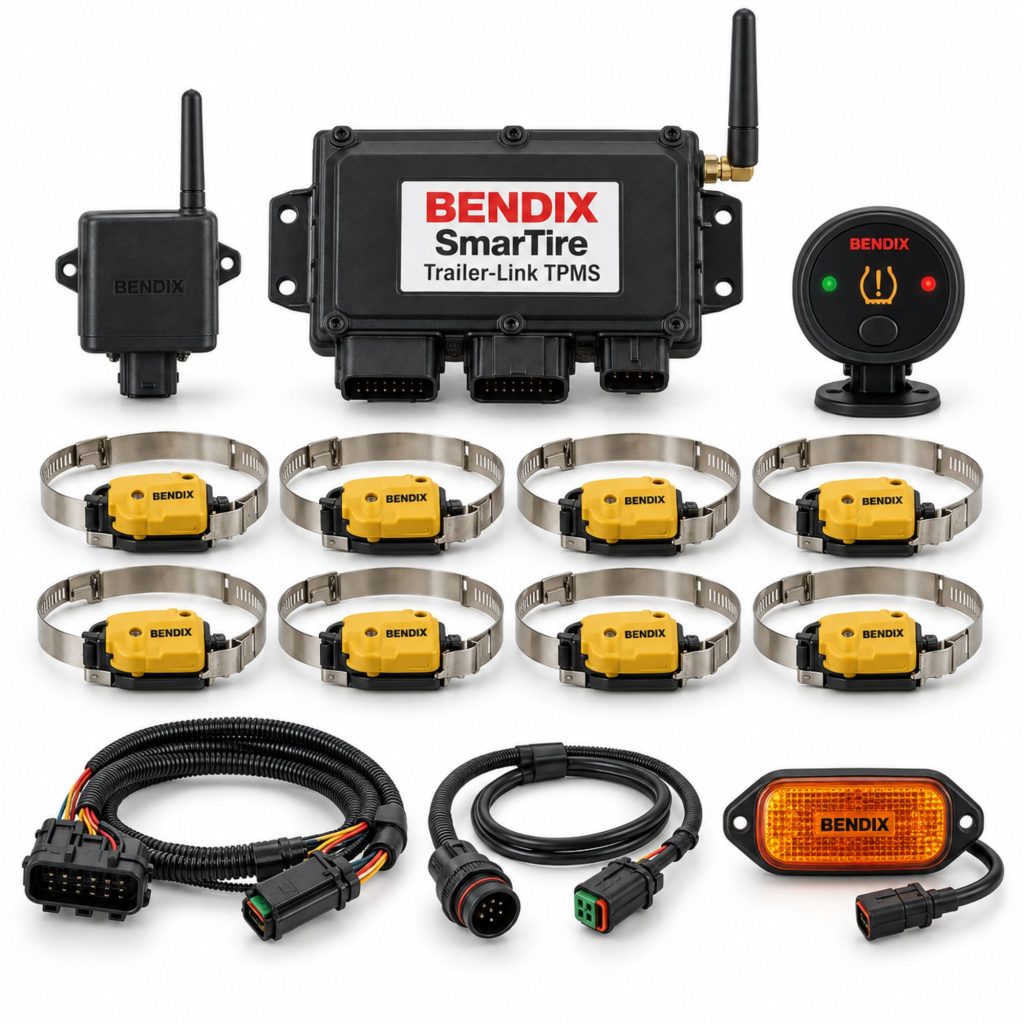
- Typical Retrofit Equipment: Wheel sensors, trailer receiver or ECU, wiring harnesses, antennas, and display or warning equipment
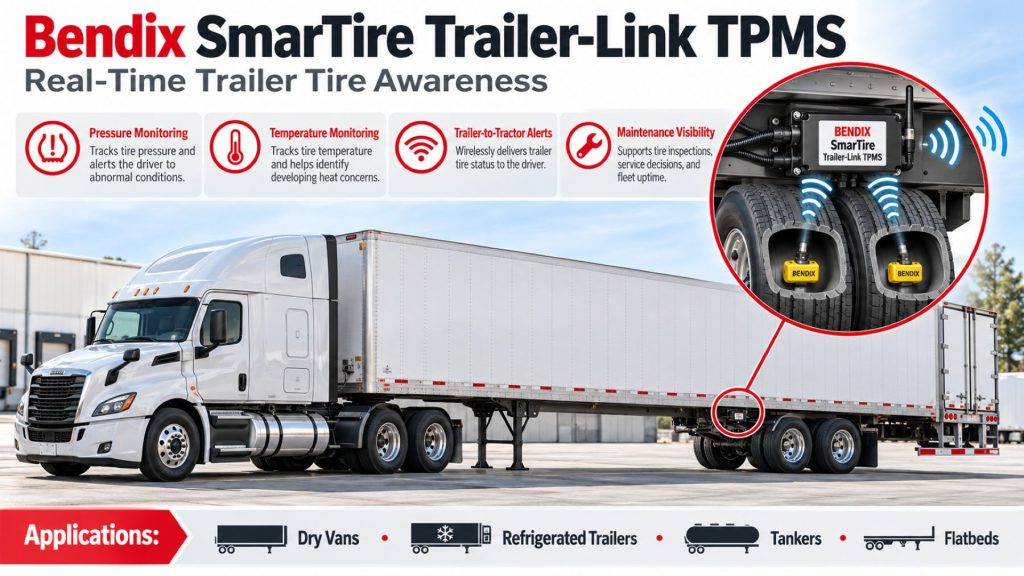
- Common Applications: Dry vans, refrigerated trailers, flatbeds, tank trailers, and specialized commercial trailers
- Inflation Capability: Monitoring only; does not automatically add air
- Production and Support Status: Confirm current kit and component availability with Bendix
- Primary Benefit: Provides real-time trailer-tire pressure and temperature information to the driver and maintenance personnel
Overview
The Bendix SmarTire Trailer-Link TPMS is a wireless tire-pressure monitoring system designed to extend SmarTire monitoring from a tractor to its connected commercial trailer. Sensors installed at the trailer wheels measure tire pressure and temperature and transmit that information to a trailer receiver or electronic control unit.
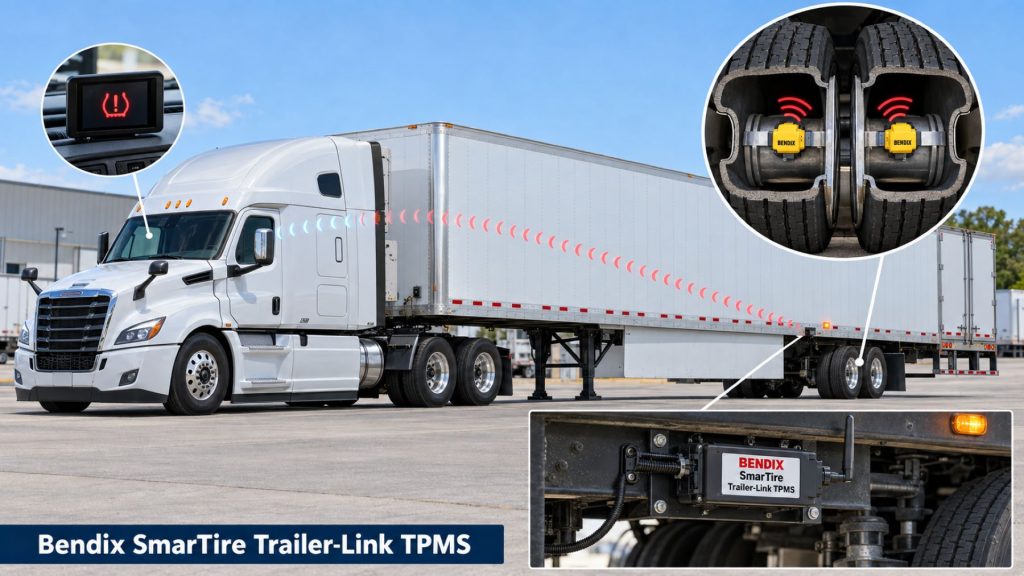
The trailer system communicates tire alerts and operating information to the tractor. Depending on the vehicle and installation, the driver may view the data through a SmarTire display, an integrated original-equipment dashboard, or another compatible interface.
Trailer-Link helps identify underinflation, rapid pressure loss, excessive temperature, and other developing tire conditions before they cause additional damage or roadside downtime. It is a monitoring system rather than an automatic inflation system and cannot add air to a low tire.
Key Characteristics
- Wireless trailer-tire pressure monitoring
- Wireless trailer-tire temperature monitoring
- Individual wheel-position identification
- Trailer-to-tractor tire-data communication
- Real-time driver warnings
- Compatible SmarTire display integration
- Original-equipment dashboard integration where supported
- Trailer warning-lamp capability in applicable configurations
- Handheld maintenance-reader compatibility
- Programmable pressure and temperature thresholds
- Supports original-equipment and retrofit installations
- Does not require trailer axle air passages
- Can complement an automatic tire-inflation system
Major Components
- Wireless wheel-mounted pressure and temperature sensors
- Sensor mounting straps or approved attachment hardware
- Trailer receiver or electronic control unit
- Trailer antenna
- Trailer wiring harnesses
- Power and ground connections
- Trailer-to-tractor communication hardware
- Compatible tractor receiver
- SmarTire dashboard display where equipped
- Integrated original-equipment instrument display where supported
- Trailer warning lamp where specified
- Diagnostic connector
- Handheld sensor reader or programming tool
- Bendix diagnostic software and interface equipment
- Identification labels and wheel-position records
System Type and Design
SmarTire Trailer-Link is a direct tire-pressure monitoring system. Sensors installed inside the trailer tires measure actual tire pressure and internal temperature instead of estimating pressure through wheel-speed differences.
Each sensor has an identification code assigned to a specific trailer wheel position. The trailer receiver processes the wireless transmissions and determines whether the measured conditions require a warning.
Trailer-Link then sends the applicable tire information or alerts forward to the tractor. This allows a compatible tractor display to identify problems on both the tractor and connected trailer.
How the TPMS Works
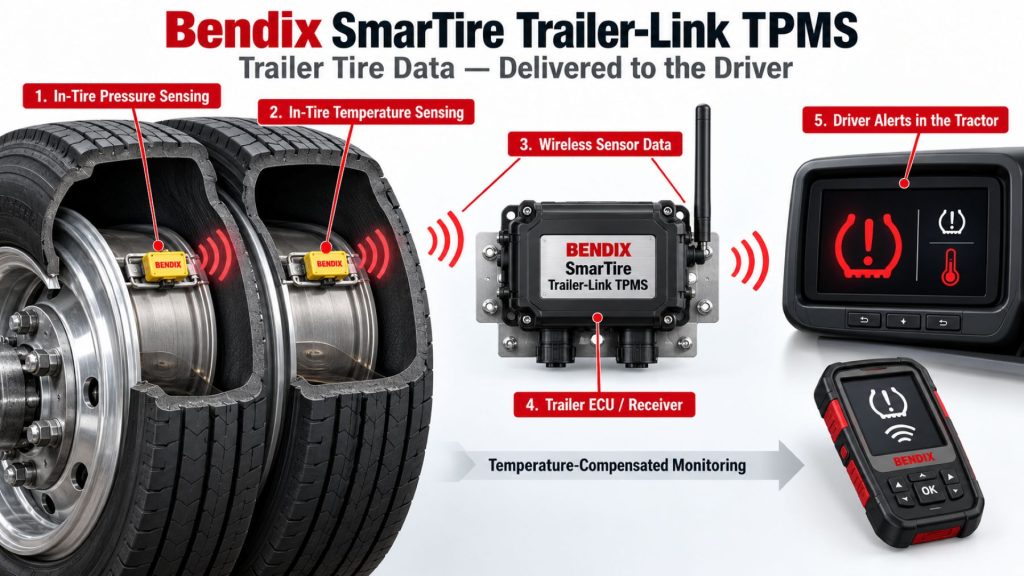
Each wheel sensor measures tire pressure and temperature at regular intervals. The sensor transmits its identification code and tire data wirelessly to the trailer receiver.
The receiver compares the reported values with the programmed cold inflation pressure and warning thresholds for that wheel position. If pressure becomes too low, pressure drops rapidly, or temperature becomes excessive, the system creates an alert.
The trailer system communicates the alert to the tractor through its configured wireless or wired communication path. The driver can then identify the affected trailer position and respond before the condition produces additional tire damage.
When the trailer is parked, technicians may use compatible diagnostic equipment or a handheld reader to retrieve sensor information and confirm tire condition without relying only on a manual pressure gauge.
Position and Function Within the Vehicle
Trailer-Link sensors are installed at individual trailer wheel positions. The receiver, antenna, wiring, and related electronic equipment are mounted on the trailer, while the primary driver interface is located in the tractor.
The system performs several functions:
- Measures pressure inside each monitored trailer tire
- Measures tire temperature
- Identifies each sensor by wheel position
- Transmits tire information wirelessly
- Compares measurements with programmed thresholds
- Warns of underinflation
- Warns of rapid pressure loss
- Warns of excessive tire temperature
- Communicates trailer alerts to a compatible tractor
- Supports yard and maintenance diagnostics
- Creates additional visibility into trailer-tire condition
Common Specifications
- System Type: Direct wireless commercial-trailer TPMS
- Measurements: Tire pressure and temperature
- Sensor Location: Inside the tire and mounted to the wheel using the approved hardware
- Sensor Identification: Unique electronic identification assigned to a wheel position
- Trailer Communication: Wireless sensor transmission to trailer receiver or ECU
- Tractor Communication: Configuration-specific trailer-to-tractor data connection
- Driver Display: SmarTire display, compatible integrated instrument panel, or warning interface
- Diagnostic Support: Compatible handheld reader and Bendix diagnostic equipment
- Wheel Coverage: Application-specific; common trailer kits may monitor eight wheel positions
- Pressure Range: Sensor- and application-specific
- Temperature Range: Sensor- and application-specific
- Alert Thresholds: Programmable according to tire and fleet requirements
- Power Supply: Trailer electrical system for receiver and communication components
- Inflation Function: None
Pressure and Temperature Monitoring
The system evaluates pressure relative to the programmed cold inflation pressure for each tire position. This permits alerts to reflect the tire’s intended operating pressure rather than applying one universal threshold to every application.
Temperature measurement adds information that pressure-only systems cannot provide. Excessive temperature may indicate underinflation, overloading, tire damage, brake heat, bearing problems, or another developing wheel-end condition.
Pressure naturally increases as a tire warms during operation. SmarTire system logic uses pressure and temperature data to provide more meaningful alerts, but tire and wheel-end problems must still be confirmed through physical inspection.
Alert Thresholds and Warning Functions
Alert thresholds are configured around the fleet’s specified cold inflation pressure and system requirements. Available warnings may include:
- Low-pressure warning
- Critical low-pressure warning
- Rapid pressure-loss warning
- High-temperature warning
- Sensor communication warning
- Low sensor-battery condition where supported
- Trailer communication fault
- Unassigned or incorrectly assigned sensor
Drivers should treat every warning as a reason to inspect the affected position as soon as it is safe. The urgency depends on the warning type, tire condition, pressure-loss rate, temperature, vehicle loading, and operating environment.
Wireless and Electronic Integration
The wheel sensors use radio-frequency communication to send pressure and temperature data to the trailer receiver. Sensor placement, antenna position, trailer construction, electrical interference, and component condition can affect communication quality.
A compatible Trailer-Link installation forwards trailer information to the tractor so the driver can view alerts without leaving the cab. Certain tractors can automatically recognize a connected SmarTire-equipped trailer.
Depending on the equipment generation, tire data may be displayed through a dedicated SmarTire gauge, an integrated original-equipment dashboard, compatible diagnostics, or a connected fleet portal.
Installation and Configuration
Installation requires correct sensor attachment, receiver placement, antenna orientation, wiring, power and ground connections, trailer-to-tractor communication, and system programming.
The tires must normally be removed from the wheels to install internal sensors and mounting hardware. Sensor assemblies must be positioned so they do not interfere with tire mounting, valve equipment, balancing components, brake hardware, or wheel-end service.
After installation, every sensor must be assigned to the correct wheel position. The technician must also program the cold inflation pressure, warning thresholds, axle layout, and display configuration before verifying communication throughout the complete tractor-trailer combination.
Trailer, Tire, and Wheel Compatibility
Compatibility depends on the complete trailer, tire, wheel, tractor, and display configuration. Selection must account for:
- Trailer manufacturer and model
- Number of trailer axles
- Number of monitored wheel positions
- Dual or wide-base single tires
- Tire size and cold inflation pressure
- Steel or aluminum wheels
- Wheel diameter and rim width
- Internal sensor mounting requirements
- Valve and balancing equipment
- Trailer receiver and antenna placement
- Trailer electrical system
- Tractor receiver and display compatibility
- Original-equipment dashboard integration
- Diagnostic and programming-tool availability
Common Applications
- Dry van trailers
- Refrigerated trailers
- Flatbed trailers
- Tank trailers
- Drop-deck trailers
- Automotive transport trailers
- Specialized commercial trailers
- Long-haul tractor-trailer fleets
- Regional delivery fleets
- Drop-and-hook fleet operations
- Dual-tire trailer configurations
- Wide-base single-tire trailer configurations
- Trailers requiring pressure and temperature visibility
Advantages
- Monitors actual tire pressure directly
- Monitors internal tire temperature
- Identifies individual trailer wheel positions
- Provides tire alerts to the driver while traveling
- Can display trailer data through a compatible tractor interface
- Helps identify slow leaks before severe pressure loss occurs
- Can warn of rapid pressure loss
- Can warn of excessive tire temperature
- Supports improved tire maintenance planning
- May help extend tread and casing life
- May reduce tire-related roadside downtime
- Can complement automatic tire-inflation systems
- Supports handheld yard and maintenance checks
Limitations or Considerations
- Monitors pressure but does not inflate a low tire
- Internal sensors normally require tire removal for installation or replacement
- Sensor batteries have a finite service life
- Each sensor must be assigned to the correct wheel position
- Incorrect programming can create inaccurate or misleading warnings
- Wireless communication can be affected by component placement or damage
- Trailer-to-tractor functionality requires compatible equipment
- Older components may have limited availability
- Sensor condition should be checked during tire service
- Temperature warnings do not identify the exact mechanical cause
- Manual tire and wheel inspections remain necessary
- The system does not increase tire, wheel, axle, or trailer ratings
Driver and Operator Experience
When connected to compatible equipment, Trailer-Link allows the driver to view trailer-tire warnings without stopping to check every tire manually. Displays may identify the affected wheel position and show pressure, temperature, or warning status.
A low-pressure or rapid-loss alert requires the driver to reduce risk and inspect the affected tire at the earliest safe opportunity. A high-temperature warning may involve the tire, brake, bearing, seal, lubrication, or another wheel-end component.
The absence of an alert does not prove that a tire is structurally sound. Drivers must continue looking for cuts, bulges, exposed cords, tread separation, embedded objects, wheel damage, and loose fasteners.
Sensor Programming and Tire-Position Assignment
Every SmarTire sensor has a unique identification code that must be assigned to its actual trailer wheel position. Correct programming allows the display to identify which tire is producing an alert.
Programming should be checked after:
- Initial system installation
- Sensor replacement
- Tire and wheel rotation
- Wheel-position changes
- Axle replacement
- Trailer receiver replacement
- Display or tractor communication changes
- Repeated missing-sensor warnings
- Incorrect wheel-position alerts
The programmed cold inflation pressure and warning thresholds must match the tire manufacturer’s requirements and fleet specification. Records should identify every sensor code, trailer position, installation date, and replacement history.
Inspection and Wear Points
Routine inspection should include:
- Internal wheel sensors during tire service
- Sensor mounting straps and attachment hardware
- Sensor housings for impact or corrosion damage
- Trailer receiver or ECU mounting
- Antenna placement and condition
- Wiring harnesses and connectors
- Power and ground connections
- Trailer-to-tractor communication equipment
- Display or warning-lamp operation
- Diagnostic connector condition
- Missing-sensor or communication faults
- Incorrect tire-position assignments
- Sensor-battery status where available
- Physical tire and wheel condition
Maintenance and Ownership Notes
- Continue manual tire-pressure verification on the fleet schedule
- Inspect sensors whenever tires are removed
- Protect sensors during tire mounting and demounting
- Maintain accurate wheel-position programming
- Verify the specified cold inflation pressure
- Inspect receiver and antenna mounting
- Check electrical connectors for corrosion or damage
- Test trailer-to-tractor communication
- Confirm display and warning operation
- Investigate missing-sensor messages promptly
- Replace failed or depleted sensors with compatible components
- Reprogram the system after sensor replacement
- Maintain trailer and sensor records
- Use approved Bendix diagnostic procedures and equipment
Common TPMS Problems
- Missing-sensor warning: A depleted sensor battery, damaged sensor, incorrect programming, receiver problem, radio interference, or excessive distance may prevent communication.
- Incorrect tire-position alert: Sensor IDs may have been assigned incorrectly or wheels may have been moved without updating the programming.
- False low-pressure warning: Incorrect cold-pressure programming, major temperature changes, an inaccurate manual comparison gauge, or a sensor problem may be responsible.
- Rapid-pressure-loss warning: A puncture, damaged valve, cracked wheel, bead leak, or failing tire may be releasing air quickly.
- High-temperature warning: Underinflation, overloading, dragging brakes, bearing problems, tire damage, or high ambient and operating temperatures may be responsible.
- No trailer information in the tractor: Incompatible equipment, communication loss, receiver failure, wiring damage, pairing problems, or a display configuration error may prevent data transfer.
- Intermittent warnings: Loose electrical connections, damaged wiring, antenna placement, sensor signal problems, or developing battery failure can cause intermittent operation.
- Sensor damaged during tire service: Improper tool placement or failure to identify the sensor location can damage the housing or mounting hardware.
Safety and Service Precautions
- Respond promptly to low-pressure, rapid-loss, and high-temperature warnings
- Stop in a safe location before inspecting a trailer tire
- Do not touch a wheel end that may be dangerously hot
- Do not assume a tire is safe because pressure remains within range
- Deflate the tire completely before removing it from the wheel
- Use trained commercial tire-service personnel
- Identify sensor location before using tire tools
- Protect internal sensors during mounting and demounting
- Use replacement sensors and hardware approved for the system
- Reprogram every replacement sensor correctly
- Verify tire pressure with an accurate gauge when diagnosing alerts
- Follow Bendix, tire-manufacturer, wheel-manufacturer, and fleet procedures
Identification Information
System information may be located on the trailer receiver, ECU, wiring harnesses, sensors, display, diagnostic records, or installation documentation. Record the following information before ordering components:
- Trailer manufacturer, model, and VIN
- SmarTire system generation
- Trailer-Link receiver or ECU part number
- Wheel-sensor part numbers
- Sensor identification codes
- Sensor installation dates
- Programmed wheel positions
- Cold inflation pressure setting
- Pressure and temperature thresholds
- Number of monitored tires
- Trailer antenna and harness part numbers
- Tractor display or receiver type
- Diagnostic-tool compatibility
- Tire and wheel specifications
Buying Considerations
- Confirm current Bendix support and component availability
- Identify the exact SmarTire system generation
- Determine the number of trailer wheel positions
- Verify dual or wide-base single tire requirements
- Confirm tire pressure and temperature ranges
- Check steel- or aluminum-wheel compatibility
- Verify internal sensor mounting requirements
- Confirm trailer receiver and antenna requirements
- Check tractor receiver and display compatibility
- Determine dashboard or warning-lamp integration
- Confirm diagnostic and programming-tool availability
- Review sensor-battery replacement strategy
- Check wiring-harness and connector availability
- Compare monitoring-only operation with automatic inflation
- Use an installer familiar with commercial-vehicle TPMS equipment
Variants and Configurations
- Original-equipment trailer installations
- Aftermarket retrofit kits
- Dual-tire configurations
- Wide-base single-tire configurations
- Two-axle trailer configurations
- Multi-axle trailer configurations
- Dedicated SmarTire display integration
- Original-equipment dashboard integration
- Trailer warning-lamp configurations
- Tractor and trailer combined monitoring
- Handheld maintenance-reader support
- Bendix diagnostic-software support
- Remote data or portal integration where equipped
Configuration and replacement-part availability depend on the system generation, vehicle integration, sensor type, trailer layout, and production date. Complete part numbers should be verified before ordering.
Comparison to Similar Equipment
Compared with the Continental ContiPressureCheck TPMS, SmarTire Trailer-Link provides Bendix-specific sensors, receivers, diagnostics, and tractor-trailer integration. The appropriate system depends on fleet equipment and support requirements.
Compared with the Hendrickson TIREMAAX PRO-LB Tire Inflation System, Trailer-Link monitors pressure and temperature but does not add or release air. TIREMAAX PRO-LB automatically adjusts tire pressure according to trailer axle load.
Compared with the Meritor Tire Inflation System by P.S.I., Trailer-Link directly reports pressure and temperature for individual tire positions. MTIS automatically supplies air to tires below a preset pressure.
Compared with the Aperia HALO Tire Inflator, Trailer-Link is an electronic monitoring system. HALO uses wheel rotation to generate inflation pressure and maintain a mechanical target.
Best Fit For
- Fleets wanting individual trailer-tire pressure data
- Fleets wanting trailer-tire temperature monitoring
- Tractors already equipped with compatible SmarTire equipment
- Drop-and-hook operations using compatible trailers
- Long-haul dry van and refrigerated fleets
- Tank, flatbed, and specialized trailer fleets
- Fleets seeking early slow-leak detection
- Operations needing rapid-pressure-loss warnings
- Maintenance departments using handheld tire-data readers
- Vehicles requiring monitoring without automatic inflation
- Trailers combining TPMS with an automatic inflation system
Related Vehicle and Trailer Types
- Dry Van Trailers
- Refrigerated Trailers
- Flatbed Trailers
- Tank Trailers
- Step Deck Trailers
- Dump Trailers
- Car Hauler Trailers
- Heavy Haul Trailers
Related Truck and Trailer Models
- Wabash DuraPlate Dry Van
- Great Dane Champion Dry Van
- Utility 4000D-X Composite Dry Van
- Hyundai Translead Composite XT Dry Van
- Great Dane Everest Reefer
- Utility 3000R Refrigerated Trailer
- Fontaine Revolution Flatbed
Related Tire and Wheel Types
- Tire Pressure Monitoring & Inflation Systems
- Trailer Tires
- Commercial Truck Wheels
- Aluminum Commercial Truck Wheels
- Steel Commercial Truck Wheels
- Wide-Base Commercial Wheels
Related Tire and Wheel Products
- Continental ContiPressureCheck TPMS
- Hendrickson TIREMAAX PRO-LB Tire Inflation System
- Hendrickson TIREMAAX PRO Tire Inflation System
- Meritor Tire Inflation System by P.S.I.
- STEMCO AerisIS Tire Inflation System
- Aperia HALO Tire Inflator
- P.S.I. TireView LIVE
Related Equipment Systems
- Tires & Wheels
- Telematics & ELD Systems
- Electrical Systems
- Safety Systems
- Trailer Suspension Systems
- Axles & Differentials
- Brake Systems
- Equipment Systems
Related Guides
- Tire & Wheel Guides
- How Tire Pressure Monitoring and Inflation Systems Work
- How to Read Commercial Truck Tire Sizes and Ratings
- How to Inspect and Maintain Commercial Truck Tires
- Commercial Truck Tire Types Explained
- Steer vs Drive vs Trailer Tires
- How Commercial Truck Telematics Systems Work
- Commercial Truck Wheel Sizes, Offset, and Mounting Explained
Regulatory and Compliance Notes
SmarTire Trailer-Link does not change the tire, wheel, axle, suspension, or trailer load ratings. Programmed pressures must remain within the approved limits of every component and meet the tire manufacturer’s requirements for the actual vehicle load.
Commercial tires must still comply with applicable inflation, tread-depth, condition, load, and inspection requirements. A TPMS does not make a damaged, overloaded, or worn tire compliant.
Installation and service must preserve wheel integrity, tire balance, brake clearance, wheel-end operation, trailer electrical systems, ABS communication, and other required safety equipment.
Real World Operating Notes
Trailer-Link is particularly useful in drop-and-hook operations because it can communicate trailer-tire status to a compatible tractor without requiring the driver to inspect every position before receiving an initial electronic status indication.
The programmed wheel-position map must remain accurate. If tires and wheels are rotated without updating sensor assignments, the system may warn the driver about the wrong trailer position.
Temperature alerts should be treated seriously because the cause may extend beyond the tire. Dragging brakes, bearing damage, or inadequate wheel-end lubrication can create dangerous temperatures while tire pressure remains near its normal range.
TPMS data should supplement physical inspections and accurate manual gauges. It provides earlier visibility but cannot evaluate every aspect of tread, casing, wheel, valve, brake, and bearing condition.
Frequently Asked Questions
What is Bendix SmarTire Trailer-Link TPMS?
It is a wireless monitoring system that sends trailer-tire pressure, temperature, and alert information to a compatible tractor or service interface.
Does Trailer-Link add air to low tires?
No. It monitors and reports tire conditions but does not inflate the tires.
Does it monitor tire temperature?
Yes. Compatible SmarTire sensors measure both tire pressure and temperature.
Can the driver see which trailer tire has a problem?
Yes, when sensors are assigned correctly and the tractor uses a compatible display capable of showing individual trailer wheel positions.
Can Trailer-Link work with different trailers?
A compatible tractor may communicate with different properly equipped trailers. Exact automatic detection and display behavior depend on the installed system generation and vehicle integration.
Where are the sensors installed?
The sensors are normally installed inside the tires and attached to the wheels using approved mounting hardware.
What causes a missing-sensor warning?
Possible causes include a depleted battery, damaged sensor, incorrect programming, receiver or antenna problems, electrical faults, or radio communication interference.
Can it be used with an automatic tire-inflation system?
Potentially, yes. TPMS can provide individual pressure and temperature information while a compatible inflation system adds air. The combined installation must be approved and configured correctly.
Does Trailer-Link replace manual tire inspections?
No. Drivers and technicians must continue checking pressure, tread, sidewalls, wheels, valves, fasteners, brakes, and wheel ends.
How are replacement parts identified?
Use the trailer VIN, SmarTire system generation, receiver or ECU number, sensor number, wiring-harness numbers, display type, wheel-position map, and diagnostic information.
Availability and Where to Find
Bendix SmarTire Trailer-Link TPMS equipment may be found on existing commercial tractors and trailers and through original-equipment, aftermarket, or fleet retrofit installations.
Replacement sensors, receivers, harnesses, displays, diagnostic equipment, and related components may be available through Bendix distributors, commercial-truck dealers, trailer dealers, heavy-duty parts suppliers, tire dealers, and TPMS specialists.
Because multiple generations and vehicle integrations exist, buyers should confirm current availability and superseded part numbers with Bendix before ordering. Current system information and support resources are available through the Bendix SmarTire website.
Support Trucking Families
Truck Equipment Atlas supports the mission of Grey Cross, a nonprofit dedicated to helping families of truck drivers who lose their lives while on the road. As the site grows, part of its mission is to bring awareness and support to these families.
Podcast or Video Section
Learn More Through Audio and Video
Truck Equipment Atlas will continue expanding with podcast episodes, interviews, and equipment breakdowns to help drivers and fleets better understand trucks and equipment.
Follow the Growth of Truck Equipment Atlas
Truck Equipment Atlas continues to expand with new truck profiles, trailer coverage, diesel engine pages, equipment system resources, manufacturer information, and educational guides.
Visit our Site Updates page to explore recent additions, project milestones, and upcoming resources as we continue building one of the industry’s growing commercial trucking equipment reference libraries.
View the Latest Site Updates: Truck Equipment Atlas Site Updates