
Quick Facts
- Manufacturer: Continental
- Product Name: Conti EcoPlus HT3
- Product Type: Commercial trailer tire
- Recommended Position: Free-rolling trailer axle
- Primary Applications: Long-haul, refrigerated, dry-van, tanker, and specialized trailer operations
- Tire Construction: Radial commercial-truck tire
- Tread Design: Four longitudinal grooves with reduced tread void
- Efficiency Focus: Reduced rolling resistance and fuel consumption
- Casing Technology: Continental Conti 3G casing
- Retreadability: Designed for multiple-life commercial service when the casing remains eligible
- Primary Benefit: Combines trailer-tire fuel efficiency with uniform wear and casing value
Overview
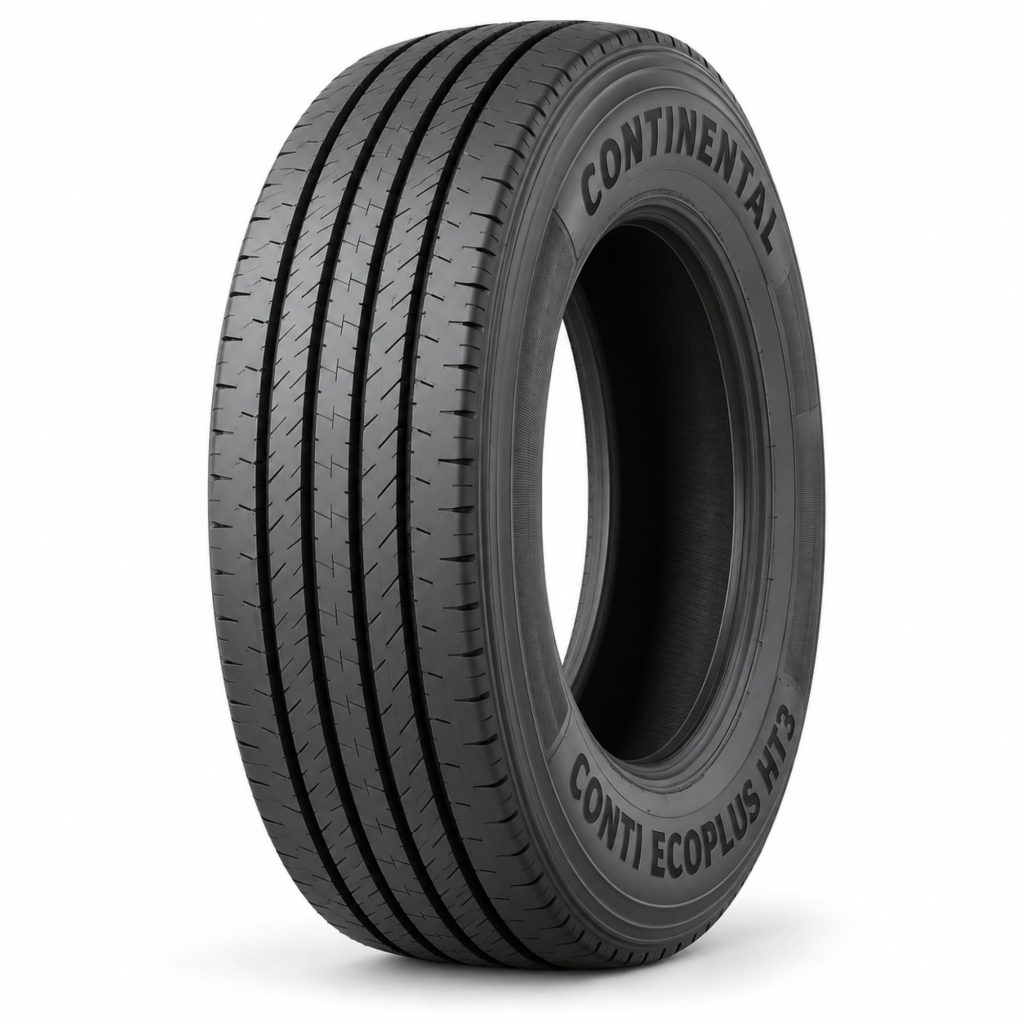
The Continental Conti EcoPlus HT3 is a commercial trailer tire developed for fleets seeking lower rolling resistance, dependable mileage, and a casing suitable for continued service through retreading. It is intended primarily for free-rolling trailer axles in long-distance transportation.
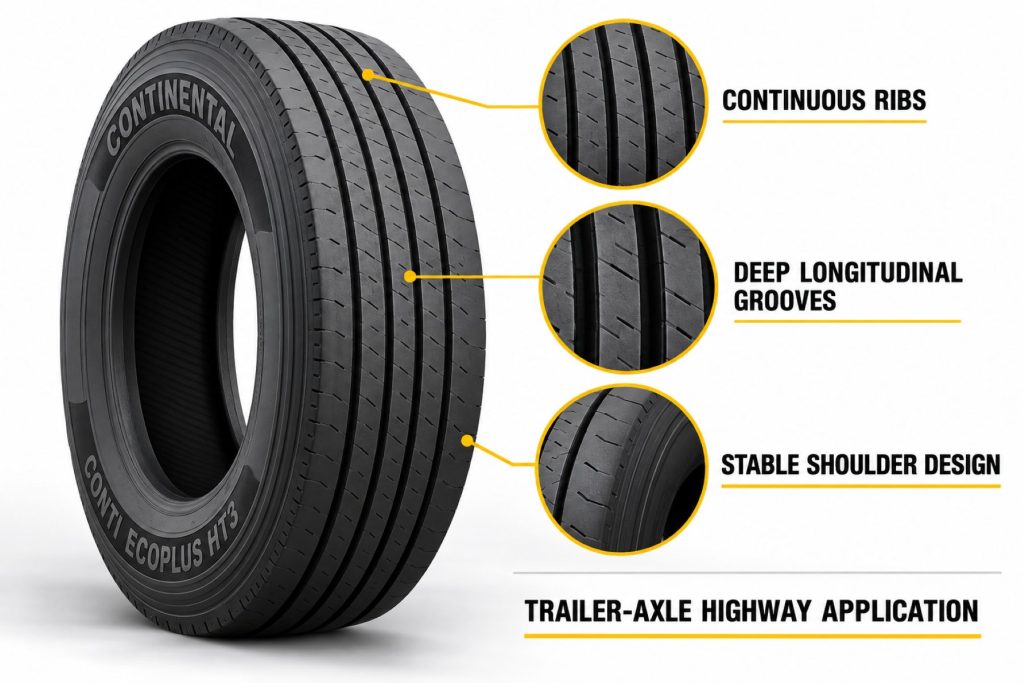
The tire uses four longitudinal grooves and a reduced tread-void design to limit energy loss while maintaining the water evacuation and tracking characteristics required in trailer service. Continental combines this pattern with specialized tread and sidewall compounds intended to reduce rolling resistance.
A two-layer tread separates the road-contacting cap compound from the underlying base compound. The cap is formulated for wear and mileage, while the base compound helps limit heat generation around the crown and belt package.
The exact size, load index, speed rating, approved rim, inflation requirement, and regional availability must be confirmed for the individual tire being purchased.
Key Characteristics
- Free-rolling commercial trailer tire
- Designed for fuel-efficient highway operation
- Four longitudinal tread grooves
- Reduced tread-void area
- Two-layer cap-and-base tread construction
- Low-rolling-resistance tread and sidewall compounds
- Groove geometry designed to distribute contact pressure
- Conti 3G commercial casing
- AirKeep inner-liner technology
- Designed for uniform wear and long casing life
- Regroovable where permitted and correctly identified
- Retreadable when the casing passes inspection
Major Components
- Tread cap compound
- Low-heat tread base compound
- Four longitudinal grooves
- Shoulder ribs
- Intermediate tread ribs
- Belt package
- Belt-cord and skim compounds
- Radial casing
- Sidewalls
- AirKeep inner liner
- Bead bundles
- Bead fillers
- Regrooving indicators
Product Type and Construction
The Conti EcoPlus HT3 is a radial trailer tire. Its casing uses body cords extending radially between the beads, while steel belts stabilize the crown and support the tread across the road-contact area.
The tire’s two-layer tread construction allows the road-contacting compound and heat-controlling base compound to perform different functions. This approach supports both mileage and energy efficiency without relying on one compound to satisfy every operating requirement.
How the Tire Works
The tire supports its assigned share of the trailer’s weight through compressed air contained inside the casing. Its tread transmits braking, cornering, and lateral forces between the trailer and road while allowing the wheel to roll with limited energy loss.
The four-groove pattern channels water away from the footprint. Reduced tread void and specialized compounds help limit casing deformation and heat generation, contributing to lower rolling resistance during highway operation.
Position and Function Within the Vehicle
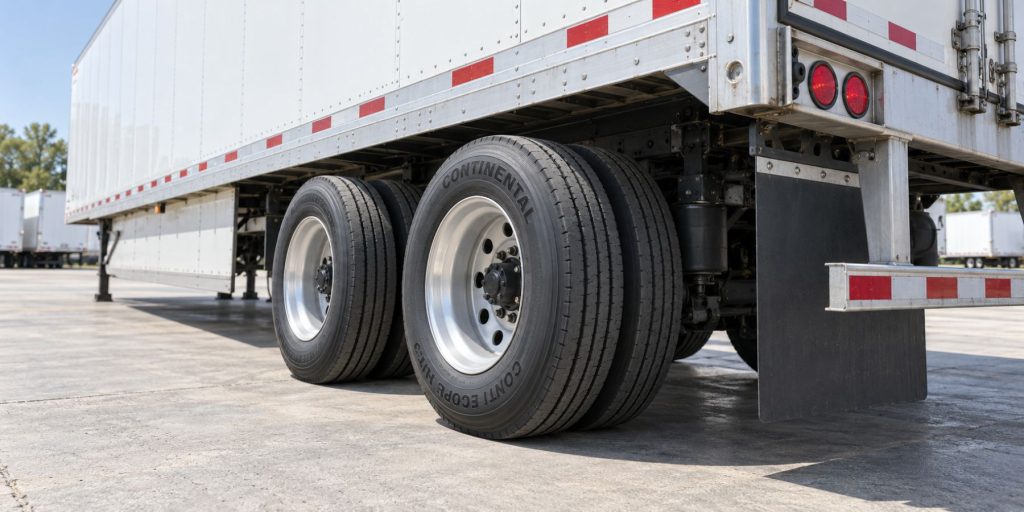
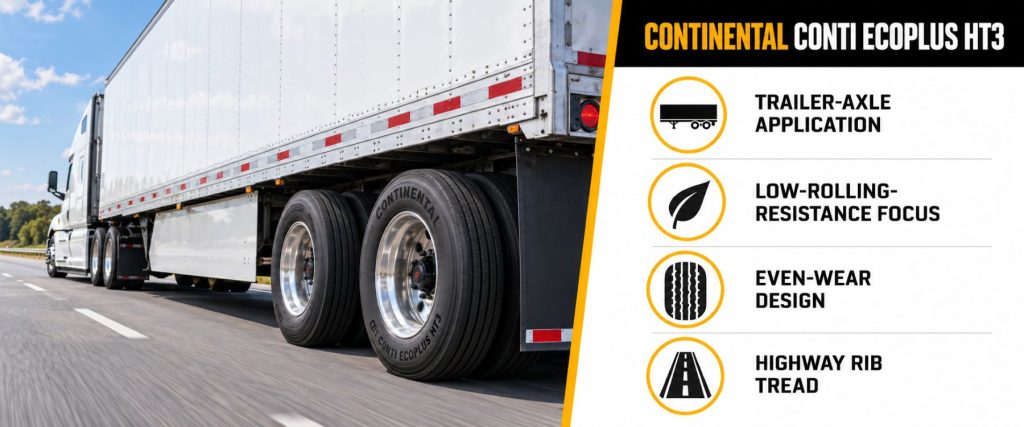
The Conti EcoPlus HT3 is intended for trailer axles rather than powered drive positions. Trailer tires carry the trailer and cargo, track behind the tractor, respond to braking forces, and tolerate lateral scrub created by turns and tandem-axle geometry.
A trailer tire should not be installed on a steer or drive position unless that use is specifically approved by the tire manufacturer and appropriate for the vehicle.
Common Specifications
- Service Position: Trailer axle
- Construction: Radial
- Tread Pattern: Ribbed design with four longitudinal grooves
- Tread Construction: Two-layer cap-and-base compound system
- Casing: Continental Conti 3G commercial casing
- Inner Liner: Continental AirKeep technology
- Regrooving: Permitted on correctly marked and eligible tires according to Continental instructions and applicable regulations
- Retreading: Eligible casings may be retreaded after professional inspection
- Documented Global Sizes: Selected configurations include 385/55R19.5, 385/55R22.5, and 385/65R22.5; regional offerings may differ
- Load Capacity, Speed Rating, Approved Rim, Tread Depth, and Inflation Pressure: Size- and market-specific; verify the tire sidewall and current Continental technical data
Size, Load Capacity, and Speed Rating
The Conti EcoPlus HT3 is offered in selected commercial trailer sizes, but availability and specifications differ by market. The installed tire must provide sufficient capacity for the maximum load carried by its wheel position at the cold inflation pressure specified by the applicable Continental load-and-inflation table.
Operators must verify tire size, load index, speed symbol, service description, approved rim width, and axle rating. Neither the tire’s maximum sidewall rating nor the suspension rating automatically determines the trailer’s legal carrying capacity.
Intended Axle Position and Service
This tire is designed for free-rolling trailer service, particularly operations where highway mileage and fuel efficiency are priorities. Application suitability depends on trailer type, axle spacing, load, speed, turning frequency, road surface, and exposure to curb or jobsite damage.
Tread Design and Traction
Four continuous longitudinal grooves provide channels for water evacuation while the ribbed pattern supports directional stability. The reduced void area places more rubber in the footprint and helps reduce tread movement that would otherwise consume energy.
Updated groove geometry is designed to distribute pressure evenly across the contact patch. Correct inflation, axle alignment, wheel condition, and load distribution remain essential for achieving uniform wear.
Casing and Sidewall Design
The Conti 3G casing is designed to preserve structural integrity and support retreadability. Improved belt materials and compounds help manage heat in the crown, while the sidewall compound is formulated to limit energy loss as the casing flexes.
Continental’s AirKeep inner liner is intended to reduce air diffusion through the casing. It supports pressure retention but does not eliminate the need for scheduled inflation checks.
Inflation Pressure and Load Management
Cold inflation pressure should be established from verified axle or wheel-position weights and the correct Continental load-and-inflation data. Pressure should not be selected solely from the tire’s maximum sidewall value.
Underinflation increases casing flex, heat generation, rolling resistance, and shoulder wear. Overinflation can reduce impact compliance, concentrate wear, and make the tire more vulnerable to certain road hazards.
Rolling Resistance and Fuel Efficiency
The Conti EcoPlus HT3 is engineered around reduced rolling resistance. Its tread geometry, cap-and-base compounds, sidewall materials, and belt package work together to limit energy lost through repeated tire deformation.
Actual fuel savings vary with inflation pressure, load, speed, alignment, trailer configuration, aerodynamics, road surface, weather, driving practices, and the tires installed at other vehicle positions.
Weather, Road, and Terrain Performance
The four-groove rib pattern is suited to paved-road trailer operation in wet and dry conditions. Performance in snow, ice, deep mud, construction debris, or severe off-road environments depends on tread condition, speed, loading, and the exact tire specification.
Fleets working extensively on rough jobsites or debris-covered roads may require a more damage-resistant vocational trailer tire.
Mounting and Installation
Commercial tires should be mounted by trained personnel using approved equipment and procedures. The tire, wheel diameter, rim width, contour, load rating, valve equipment, and inflation system must be compatible.
Before installation, inspect the wheel, valve, tire interior, bead area, and casing for damage or contamination. Inflation should occur in a restraining device whenever required by commercial-tire service procedures.
Vehicle and Trailer Compatibility
Compatibility depends on the trailer manufacturer’s approved tire size, axle rating, wheel specification, brake clearance, suspension geometry, tire spacing, and intended operating load. Tire diameter must also provide sufficient clearance throughout suspension travel.
Tire, Wheel, and Inflation-System Compatibility
The tire must be paired with a wheel of the correct diameter, width, contour, offset, and capacity. Valve stems, extensions, tire-pressure monitoring sensors, and automatic tire-inflation components must be suitable for the wheel and operating pressure.
Common Applications
- Long-haul dry-van trailers
- Refrigerated trailers
- Highway tanker trailers
- Specialized highway trailers
- Heavy-load and special-load trailer operations
- Fleets emphasizing fuel economy
- High-mileage trailer applications
- Operations using casing-management and retread programs
Advantages
- Designed to reduce trailer-tire rolling resistance
- Four-groove pattern supports highway tracking and water evacuation
- Two-layer tread balances wear and heat management
- Groove geometry supports even footprint pressure
- AirKeep liner supports pressure retention
- Conti 3G casing supports retreadability
- Regrooving indicators aid professional casing management
- Suitable for fuel-conscious long-haul fleets
Limitations or Considerations
- Not designed as a powered drive-axle tire
- Exact sizes and ratings vary by market
- Fuel-economy results depend on the complete vehicle and operation
- Trailer scrub can still cause rapid wear
- Incorrect inflation can negate efficiency benefits
- Low-rolling-resistance construction does not prevent impact or road-hazard damage
- Severe off-road applications may require a vocational tire
- Regrooving and retreading require professional casing inspection
Driver and Operator Experience
Drivers may not feel trailer-tire changes as directly as changes at the steer axle, but properly inflated and evenly worn HT3 tires can support stable trailer tracking and predictable highway operation.
Operators should report visible underinflation, vibration, trailer pull, irregular wear, exposed cords, bulges, cuts, missing tread, overheated wheel ends, or repeated inflation-system warnings.
Inspection and Wear Points
- Tread depth across every major groove
- Shoulder and center-rib wear
- Heel-and-toe or diagonal wear
- Flat spotting
- Cuts, punctures, and embedded objects
- Sidewall cracking, scuffing, or bulges
- Bead damage
- Exposed belt or casing material
- Valve-stem and extension leakage
- Dual-tire spacing and matching
- Wheel and fastener condition
- Signs of heat or overloaded operation
Tire Rotation and Position Management
Trailer-tire position management can help control irregular wear caused by axle geometry, road crown, turning scrub, and load distribution. Rotation decisions should be based on measured tread depth, wear pattern, tire condition, and fleet policy.
Tires moved between positions must remain compatible in size, construction, load capacity, diameter, and tread condition. Dual assemblies require appropriately matched overall diameters.
Balancing, Alignment, and Runout
Excessive tire or wheel runout can produce vibration and uneven wear. Bent wheels, improper bead seating, wheel-end looseness, tire irregularity, and mounting errors should be corrected before balancing is used as the final remedy.
Trailer axle alignment is especially important because misalignment can drag the tires sideways for thousands of highway miles. Toe, axle parallelism, thrust angle, suspension bushings, and wheel-bearing condition should be checked when abnormal wear appears.
Retreadability and Casing Life
The Conti 3G casing is designed for continued value through retreading when it remains structurally sound. Casing eligibility depends on age, operating history, repairs, heat exposure, impact damage, moisture intrusion, bead condition, and professional inspection results.
Correct inflation and timely removal before excessive wear or damage are essential for preserving casing value. Regrooving must only be performed on an eligible tire by qualified personnel following Continental specifications.
Maintenance and Ownership Notes
Check cold inflation pressure regularly, inspect the tread and sidewalls during pre-trip inspections, measure tread depth across the tire, and investigate pressure loss instead of repeatedly adding air.
Fleets should maintain alignment records, repair documentation, removal mileage, casing history, and retread information. These records help determine whether wear originates from the tire, trailer, route, maintenance program, or operating conditions.
Common Tire Problems
- Rapid shoulder wear: Underinflation, excessive loads, turning scrub, or alignment problems may increase wear at the shoulders.
- Center wear: Excessive inflation for the actual load or an unsuitable wheel-and-tire combination may concentrate wear near the center.
- Diagonal or irregular wear: Trailer misalignment, loose wheel ends, suspension wear, runout, or imbalance may create repeating wear patterns.
- Flat spotting: Brake lockup, extended parking under load, or localized skidding can produce flat areas.
- Heat damage: Underinflation, overloading, dragging brakes, or failing wheel bearings can overheat the casing.
- Air loss: Punctures, valve leakage, damaged rims, bead problems, or casing injuries may reduce pressure.
- Sidewall damage: Curb contact, debris, improper dual spacing, and impact events can cut or weaken the sidewall.
Safety and Service Precautions
Never service an inflated commercial tire-and-wheel assembly that shows signs of separation, severe impact damage, overheating, bead displacement, or wheel failure. Demounting, mounting, inflation, regrooving, and repair should be performed by trained personnel using approved procedures and equipment.
Do not exceed the lowest-rated tire, wheel, valve, axle, suspension, or vehicle component. Tires with exposed cords, structural bulges, prohibited repairs, or other removal conditions must be taken out of service.
Identification Information
Identification is molded into the tire sidewall. Record the manufacturer, product name, complete size, load index, speed symbol, service description, load range where used, DOT tire-identification number, production date code, country of manufacture, and regroovable or retreadable markings.
Do not order a replacement using the tread pattern alone. Similar-looking tires may have different dimensions, ratings, compounds, and approved applications.
Buying Considerations
- Confirm the complete tire size and service description
- Verify trailer-axle application
- Match the required load capacity and operating pressure
- Confirm wheel width, contour, diameter, offset, and capacity
- Review expected annual highway mileage
- Consider fuel savings across the entire trailer fleet
- Evaluate alignment and tire-inflation maintenance
- Review retread and casing-credit programs
- Confirm regional availability and warranty terms
- Compare acquisition cost with projected cost per mile
Variants and Configurations
- Different commercial trailer tire sizes
- Different load indices and service descriptions
- Different approved rim widths
- Regional specification differences
- Original tread and approved retread configurations
- Regrooved configurations where permitted
- Valve and inflation-system arrangements
Comparison to Similar Equipment
Compared with the Michelin X Line Energy T2 Trailer Tire, the Conti EcoPlus HT3 provides Continental’s own combination of a two-layer tread, AirKeep inner liner, four-groove pattern, and Conti 3G casing.
Compared with the Bridgestone R197 Ecopia Trailer Tire, it represents an alternative fuel-efficient trailer design with different tread compounds, groove geometry, casing construction, and size availability.
Compared with the Goodyear Fuel Max LHT Trailer Tire, selection should be based on available size, load capacity, operating route, dealer support, casing program, and measured fleet cost per mile.
Compared with the Continental Conti Hybrid HT3 Trailer Tire, the EcoPlus HT3 places greater emphasis on fuel-efficient highway service, while the Hybrid HT3 is intended for a broader combination of long-haul and regional use.
Best Fit For
- Long-haul trailer fleets
- Fuel-conscious highway carriers
- Dry-van and refrigerated operations
- High-mileage paved-road service
- Fleets monitoring tire cost per mile
- Operations using automatic tire-inflation systems
- Fleets preserving casings for retreading
- Trailers requiring a wide-base tire in an approved size
Related Vehicle and Trailer Types
- Dry Van Trailers
- Refrigerated Trailers
- Tanker Trailers
- Container Chassis
- Drop-Frame Trailers
- Complete Guide to Semi-Trailer Types
Related Truck and Trailer Models
- Wabash DuraPlate Dry Van
- Great Dane Champion Dry Van
- Hyundai Translead Dry Van
- Utility 4000D-X Composite Dry Van
- Great Dane Everest Reefer
- Utility 3000R Refrigerated Trailer
- Hyundai Translead ThermoTech Reefer
Related Tire Types
- Trailer Tires
- Steer and All-Position Truck Tires
- Drive Tires
- Vocational and Severe-Service Tires
- Commercial Truck Wheels
- Tire Pressure Monitoring and Inflation Systems
Related Tire Products
- Continental Conti EcoPlus HS3+ Steer Tire
- Continental Conti EcoPlus HD3 Drive Tire
- Continental Conti HTL 3 Trailer Tire
- Continental HTL1 Wide-Base Trailer Tire
- Continental Conti Hybrid HT3 Trailer Tire
- Michelin X Line Energy T2 Trailer Tire
- Bridgestone R197 Ecopia Trailer Tire
- Goodyear Fuel Max LHT Trailer Tire
Related Equipment Systems
- Tires and Wheels
- Suspension Systems
- Brake Systems
- Axles and Differentials
- Tire Pressure Monitoring and Inflation Systems
- Telematics and ELD Systems
- Safety Systems
- Equipment Systems
Related Guides
- Tire and Wheel Guides
- Commercial Truck Tire Types Explained
- Steer vs Drive vs Trailer Tires
- How to Read Commercial Truck Tire Sizes and Ratings
- How to Inspect and Maintain Commercial Truck Tires
- Aluminum vs Steel Commercial Truck Wheels
Regulatory and Compliance Notes
Commercial tires must comply with applicable federal, state, provincial, and local requirements governing tread depth, inflation, load capacity, condition, repairs, and roadside operation.
The tire’s rating does not override the trailer’s gross axle weight rating, gross vehicle weight rating, wheel capacity, suspension capacity, or legal road limits. Fleets must also comply with workplace-safety requirements governing commercial tire servicing.
Real World Operating Notes
Trailer tires often develop irregular wear from misalignment, tandem scrub, brake lockup, and inconsistent inflation before their tread compound reaches its expected mileage. Correcting the mechanical cause early protects both tread life and casing value.
A low-rolling-resistance tire delivers its best results when inflation, alignment, wheel ends, brakes, and suspension components are maintained correctly. Fleet testing should compare cost per mile, fuel use, removal mileage, casing acceptance, and retread performance rather than purchase price alone.
Frequently Asked Questions
What is the Continental Conti EcoPlus HT3?
It is a fuel-efficient radial tire designed primarily for free-rolling commercial trailer axles.
Is the Conti EcoPlus HT3 a steer or drive tire?
No. It is principally designed for trailer-axle service.
What makes the tire fuel efficient?
Its reduced-void rib pattern, two-layer tread, sidewall compounds, belt materials, and casing design are engineered to reduce energy loss and heat generation.
Does the tire use four longitudinal grooves?
Yes. The four-groove design supports water evacuation, tracking, and an efficient highway footprint.
Can the Conti EcoPlus HT3 be regrooved?
Eligible tires carrying the correct markings may be regrooved by trained personnel according to Continental specifications and applicable regulations.
Can its casing be retreaded?
Yes, provided the casing passes a professional inspection and remains suitable for retreading.
What is AirKeep technology?
AirKeep is Continental’s inner-liner technology designed to help limit pressure loss through the casing. Routine pressure inspections are still required.
How should the correct inflation pressure be selected?
Use verified axle or wheel-position weights and the current Continental load-and-inflation table for the exact tire size and service description.
What commonly causes irregular trailer-tire wear?
Common causes include improper inflation, trailer-axle misalignment, tandem scrub, worn suspension components, wheel-end looseness, runout, brake lockup, and uneven loading.
How can the correct replacement tire be identified?
Record the complete tire size, load index, speed symbol, service description, wheel specification, axle rating, and operating application before ordering.
Availability and Where to Find
Continental Conti EcoPlus HT3 tires may be available through Continental commercial-tire dealers, fleet-service providers, truck and trailer tire centers, and regional distributors. Size and market availability may change.
Before ordering, confirm the full tire size, service description, load capacity, approved wheel, intended axle position, manufacturing date, warranty coverage, and casing program. Current product and dealer information is available through the Continental Conti EcoPlus HT3 product page.
Support Trucking Families
Truck Equipment Atlas supports the mission of Grey Cross, a nonprofit dedicated to helping families of truck drivers who lose their lives while on the road. As the site grows, part of its mission is to bring awareness and support to these families.
Podcast or Video Section
Learn More Through Audio and Video
Truck Equipment Atlas will continue expanding with podcast episodes, interviews, and equipment breakdowns to help drivers and fleets better understand trucks and equipment.
Follow the Growth of Truck Equipment Atlas
Truck Equipment Atlas continues to expand with new truck profiles, trailer coverage, diesel engine pages, equipment system resources, manufacturer information, and educational guides.
Visit our Site Updates page to explore recent additions, project milestones, and upcoming resources as we continue building one of the industry’s growing commercial trucking equipment reference libraries.
View the Latest Site Updates: Truck Equipment Atlas Site Updates