
Bendix AD-HF Air Dryer
Quick Facts
- Manufacturer: Bendix Commercial Vehicle Systems
- Product Model: AD-HF®
- Product Type: High-flow desiccant air dryer
- System Category: Air-supply and air-treatment system
- Primary Function: Removes moisture, oil aerosols, and contaminants from compressed air
- Air-Dryer Configuration: Integrated air-dryer assembly
- Cartridge Type: Bendix PuraGuard® oil-coalescing spin-on cartridge
- Governor Type: Mechanical governor
- Related Electronic Model: Bendix AD-HFi™ air dryer
- Primary Applications: Medium- and heavy-duty commercial vehicles with demanding air-system requirements
- Common Vehicle Types: Highway tractors, vocational trucks, buses, and specialty vehicles
- Primary Benefit: Provides clean, dry compressed air while supporting higher air demand and multiple protected air circuits
Overview
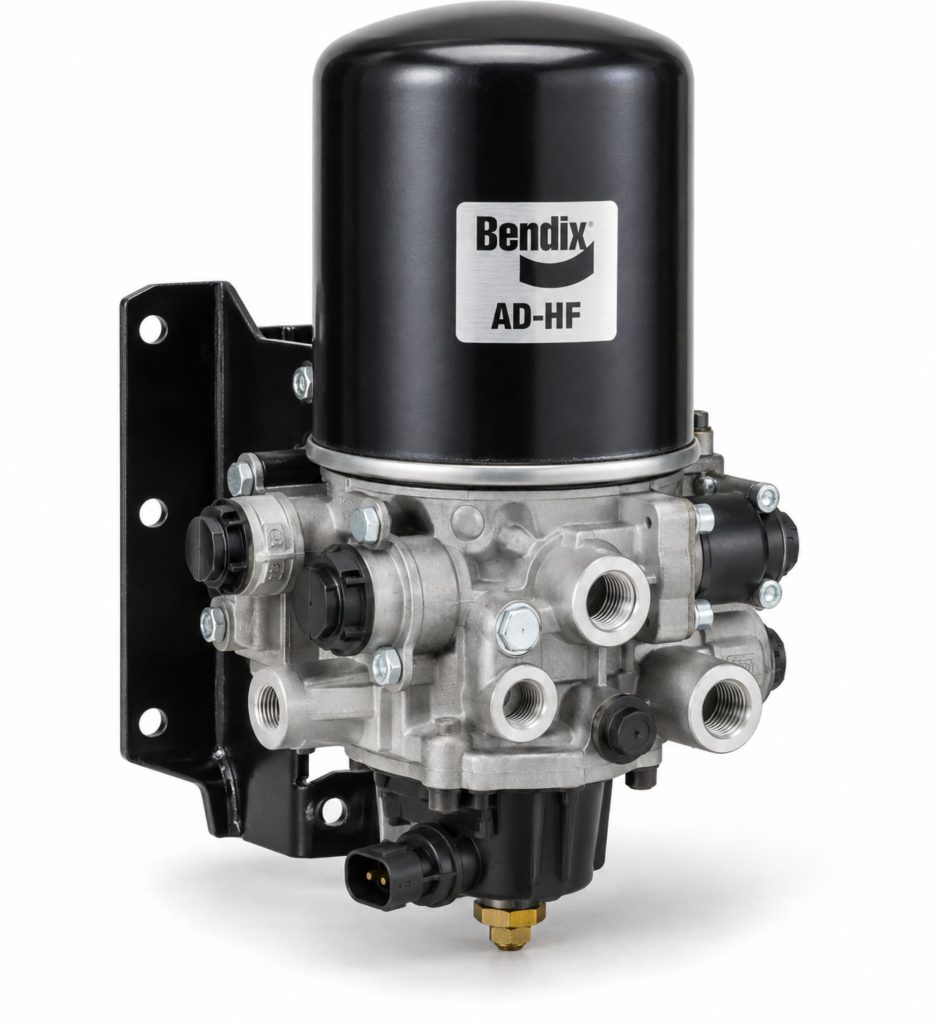
The Bendix AD-HF is a high-flow air dryer designed for commercial vehicles with demanding compressed-air requirements. It removes moisture, oil aerosols, and other contaminants before compressed air reaches the vehicle’s reservoirs, brake controls, suspension components, and other pneumatic equipment.
The AD-HF combines air drying, oil-aerosol removal, pressure regulation, system purging, pressure protection, and air distribution within an integrated assembly.
The system uses a Bendix PuraGuard oil-coalescing spin-on cartridge. Its oil-coalescing media captures oil aerosols before the air reaches the desiccant material, helping protect the desiccant and downstream pneumatic components.
The AD-HF is particularly suited to vehicles equipped with multiple air-operated systems or operating under demanding compressor duty cycles.
Key Characteristics
- High-flow commercial-vehicle air dryer
- Designed for demanding air-system duty cycles
- Removes water vapor from compressed air
- Separates liquid moisture and solid contaminants
- Captures oil aerosols
- Uses a replaceable spin-on cartridge
- Incorporates PuraGuard oil-coalescing technology
- Uses serviceable cartridge-style pressure-protection valves
- Includes purge and regeneration functions
- Supports multiple protected air circuits
- Helps protect brake valves and pneumatic components
- Supports vehicles with extensive air-operated equipment
- Available in application-specific configurations
- Related to the electronically controlled Bendix AD-HFi
Major Components
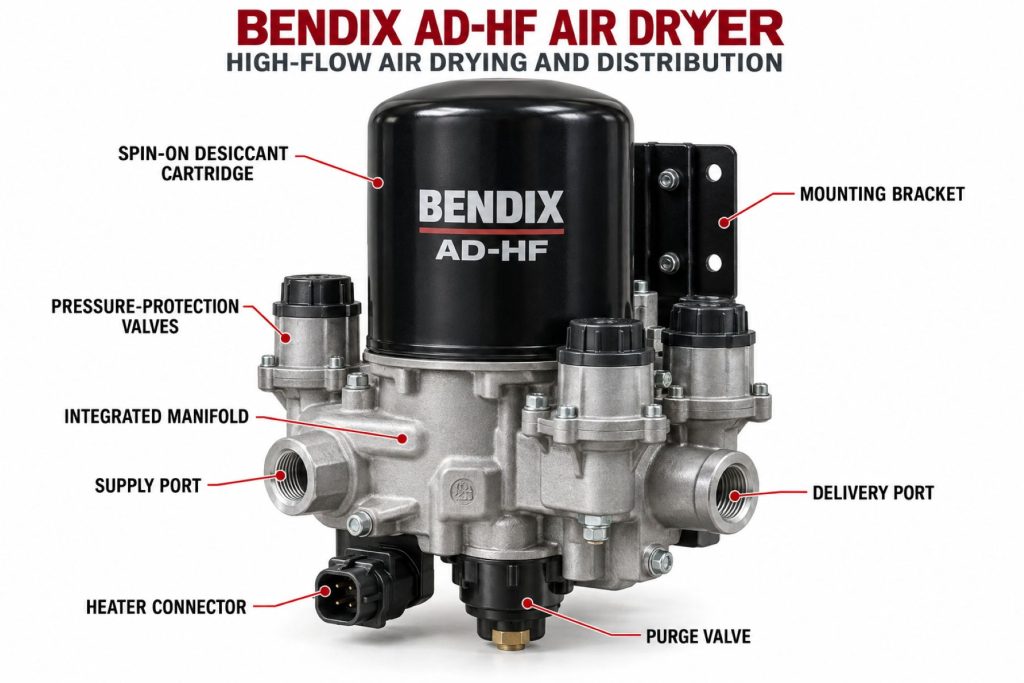
- Die-cast air-dryer body
- Bendix PuraGuard oil-coalescing cartridge
- Desiccant material
- Oil-coalescing filter media
- Purge reservoir
- Purge-valve assembly
- Turbocharger cut-off mechanism
- Mechanical governor
- Pressure-protection valves
- Delivery check valve
- Safety valve
- Heater and thermostat assembly
- Air-inlet connection
- Primary reservoir delivery port
- Secondary reservoir delivery port
- Auxiliary delivery ports
- Governor and control ports
- Mounting bracket
- Seals and O-rings
- Electrical connector
- Air lines and fittings
How the Brake Component or System Works
The AD-HF operates through repeating charge and regeneration cycles.
During the charge cycle, the engine-driven air compressor sends compressed air to the dryer. This incoming air may contain:
- Water vapor
- Condensed moisture
- Compressor oil aerosols
- Carbon particles
- Dirt
- Other air-system contaminants
The PuraGuard oil-coalescing media captures fine oil aerosols and combines them into larger droplets. Gravity helps move the separated oil away from the filter media.
The compressed air then passes through the desiccant material. The desiccant removes water vapor before the cleaned and dried air is directed toward the vehicle’s reservoirs.
When system pressure reaches the governor’s cut-out setting, the governor signals the compressor to unload and initiates the dryer’s regeneration cycle. Stored purge air flows backward through the cartridge, carrying accumulated moisture and contaminants out through the purge valve.
When system pressure falls to the governor’s cut-in setting, the compressor resumes pumping and the dryer begins another charge cycle.
Position and Function Within the Brake System
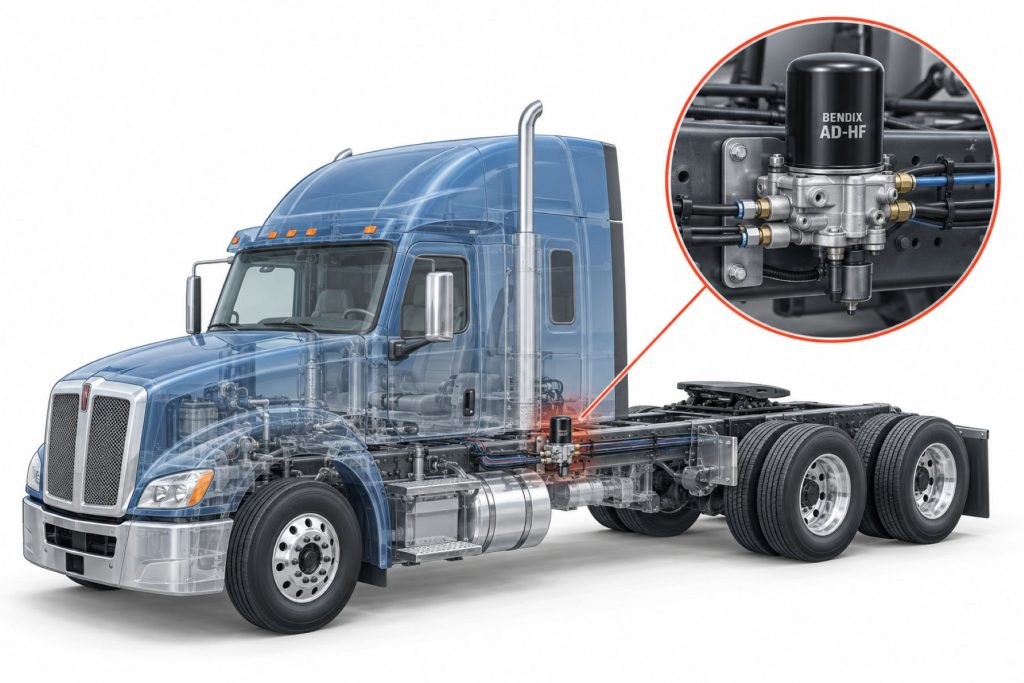
The AD-HF is installed between the air compressor and the vehicle’s compressed-air reservoirs.
The normal airflow path is:
- Engine-driven air compressor
- Compressor discharge line
- Bendix AD-HF air dryer
- Primary and secondary reservoirs
- Brake-system valves
- Brake chambers and foundation brakes
The dryer can also supply clean, dry air to other pneumatic systems, including:
- Air suspension
- Transmission controls
- Clutch controls
- Lift axles
- Air horns
- Fifth-wheel release systems
- Cab accessories
- Emissions-system controls
- Other air-operated equipment
Removing contamination before it reaches these components can reduce freezing, corrosion, restricted airflow, valve sticking, and premature seal deterioration.
Common Specifications
- Air-Dryer Type: High-flow desiccant dryer
- Cartridge: Bendix PuraGuard oil-coalescing spin-on cartridge
- Governor Configuration: Mechanical governor
- Air-System Functions: Drying, oil coalescing, purging, pressure protection, and distribution
- Operating Cycles: Charge and regeneration
- Pressure-Protection Valves: Field-serviceable cartridge-style valves
- Purge System: Integrated purge reservoir and purge-valve system
- Electrical System: Application-specific 12- or 24-volt heater configuration
- Mounting Position: Vehicle- and chassis-specific
- Vehicle Class: Primarily medium- and heavy-duty commercial vehicles
- Compressor Compatibility: Must be confirmed for the compressor, air demand, duty cycle, and vehicle application
Exact specifications vary by Bendix part number and original vehicle configuration. Consult the correct Bendix and vehicle service information before replacement or installation.
Operating Specifications and Performance
The AD-HF is designed for commercial vehicles with substantial compressed-air requirements. Air demand may increase when a vehicle includes:
- Multiple air reservoirs
- Additional axles
- Air suspension
- Lift axles
- Pneumatic transmission controls
- Frequent brake applications
- Trailer air systems
- Bus-door controls
- Vocational equipment
- Other air-operated accessories
Dryer performance depends on compressor output, total reservoir volume, air consumption, discharge-line temperature, ambient conditions, purge frequency, cartridge condition, and system leakage.
The AD-HF should be selected using the appropriate Bendix application information. A high-output compressor does not automatically make every air dryer suitable for the vehicle.
Braking Performance and System Integration
The AD-HF does not apply the brakes or directly create braking force. Its role is to protect the compressed-air supply used by the braking system.
Clean, dry air helps support reliable operation of:
- Foot brake valves
- Relay valves
- Quick-release valves
- Spring-brake valves
- ABS modulators
- Brake chambers
- Trailer-control valves
- Air reservoirs
- Electronic pneumatic components
Moisture inside the air system can cause corrosion, freezing, valve restrictions, and seal deterioration. Oil contamination may also affect seals, valve response, and electronically controlled pneumatic components.
A dryer problem may sometimes originate elsewhere in the charging system. Excessive compressor oil passage, an overheated discharge line, high compressor duty cycle, air leakage, improper governor operation, and incorrect plumbing should all be considered during diagnosis.
Air Supply, Controls, and Electronic Integration
The AD-HF normally works with a mechanical governor, such as an application-approved Bendix D-2 governor. The governor controls compressor cut-in and cut-out operation and coordinates the dryer’s purge cycle.
The dryer may distribute air through several protected delivery circuits, including:
- Primary reservoir
- Secondary reservoir
- Air suspension
- Auxiliary equipment
- Additional protected circuits
Pressure-protection valves help prioritize the brake reservoirs before allowing air to reach certain auxiliary circuits. This helps prevent a major accessory-system leak from immediately exhausting the primary braking reservoirs.
The related Bendix AD-HFi uses electronic pressure control instead of a traditional mechanical governor. The standard AD-HF should not be assumed to include the AD-HFi model’s electronic control, vehicle-network communication, or diagnostic functions.
Installation, Adjustment, and Brake Balance
The dryer must be installed according to the vehicle manufacturer’s requirements and the Bendix service information for the exact part number.
Installation requirements may include:
- Correct mounting orientation
- Adequate cartridge-removal clearance
- Protection from road debris
- Protection from direct wheel spray
- Adequate ventilation
- Proper compressor discharge-line routing
- Correct air-line sizes
- Correct governor plumbing
- Proper electrical voltage
- Secure electrical connections
- Purge-exhaust clearance
- Access for future maintenance
- Correct delivery-port connections
The compressor discharge line helps cool compressed air before it enters the dryer. Incorrect routing or insufficient cooling can expose the dryer to excessive inlet temperatures.
The AD-HF does not determine brake balance. Brake balance depends on brake sizes, actuator selection, slack-adjuster geometry, relay-valve timing, ABS programming, tractor-and-trailer compatibility, and foundation-brake condition.
Foundation Brake, Axle, and Wheel-End Compatibility
The AD-HF operates upstream from the foundation brakes and can support vehicles equipped with:
- S-cam drum brakes
- Air disc brakes
- Combination disc-and-drum systems
- Antilock braking systems
- Automatic traction control
- Electronic stability control
- Spring parking brakes
- Tractor-protection systems
- Trailer air-brake connections
The dryer is not selected according to axle or foundation-brake model alone. Compatibility depends on compressor output, reservoir capacity, accessory air demand, operating climate, electrical voltage, original plumbing, and the complete vehicle air-system design.
Common Applications
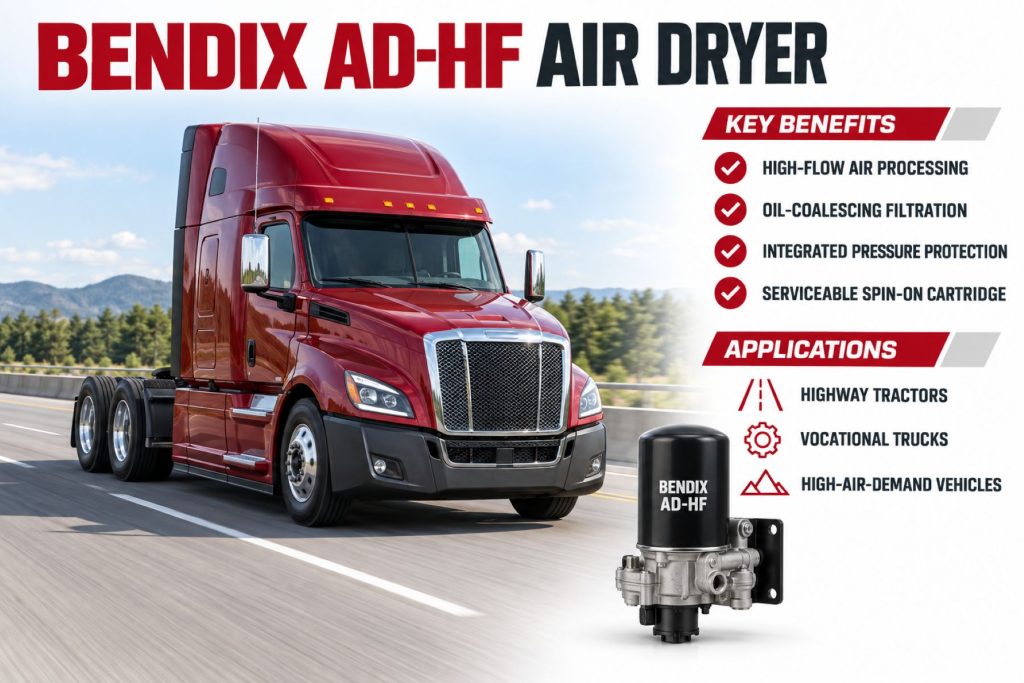
- Highway tractors
- Regional-haul tractors
- Heavy-duty straight trucks
- Dump trucks
- Concrete mixers
- Refuse trucks
- Roll-off trucks
- Heavy-haul tractors
- Recovery vehicles
- Municipal trucks
- Transit buses
- Motor coaches
- School buses
- Fire apparatus
- Utility trucks
- Crane trucks
- Multiple-axle vocational vehicles
- Specialty commercial vehicles
- Vehicles with high pneumatic demand
- Vehicles with multiple protected air circuits
Vehicle and Brake-System Compatibility
The AD-HF must match the vehicle’s original charging-system design.
Compatibility should be confirmed using:
- Vehicle manufacturer
- Vehicle identification number
- Truck model and model year
- Engine model
- Air-compressor model
- Dryer part number
- Governor type
- Electrical voltage
- Heater connection
- Delivery-port configuration
- Reservoir arrangement
- Total reservoir volume
- Number of protected circuits
- Vehicle duty cycle
- Accessory air consumption
- Mounting location
A dryer should not be substituted simply because its ports appear to connect to the existing air lines. Internal valving, pressure-protection settings, purge volume, heater voltage, mounting geometry, and airflow capacity may differ.
Advantages
- High-flow compressed-air treatment
- Oil-coalescing filtration
- Effective moisture removal
- Replaceable spin-on cartridge
- Serviceable pressure-protection valves
- Integrated purge reservoir
- Multiple protected air circuits
- Protection for brake-system components
- Support for demanding pneumatic systems
- Reduced reservoir contamination
- Improved cold-weather reliability
- Compact integration of several air-management functions
- Compatibility with numerous heavy-duty applications
- Mechanical governor control
Limitations or Considerations
- Requires correct application selection
- Requires periodic cartridge replacement
- Must use the correct oil-coalescing cartridge
- Must be matched to compressor output
- Must be matched to total vehicle air demand
- Incorrect plumbing can affect reservoir charging
- System leaks can cause excessive purge cycling
- Compressor oil passage can shorten cartridge life
- Incorrect heater voltage can damage components
- Failed heater equipment may cause cold-weather freezing
- Requires sufficient mounting and service clearance
- Pressure-protection settings vary by application
- Conversion from another dryer may require system modifications
- Must not be confused with the electronic AD-HFi
Driver and Operator Experience
The AD-HF normally operates without driver input. The driver may hear a brief release of air when the dryer purges after system pressure reaches the governor’s cut-out setting.
Operators should watch for:
- Slow pressure buildup
- Failure to reach normal cut-out pressure
- Continuous purge-valve leakage
- Extremely frequent purge cycles
- Failure to purge
- Excessive water in the reservoirs
- Excessive oil in the reservoirs
- Low-air warnings
- Frozen air lines or valves
- Auxiliary circuits that fail to charge
Frequent dryer cycling often indicates excessive air consumption or leakage elsewhere in the vehicle rather than a defective dryer alone.
Maintenance and Ownership Notes
- Drain the air reservoirs according to the vehicle maintenance schedule.
- Monitor drained material for excessive water or oil.
- Replace the dryer cartridge at the recommended interval.
- Use the correct Bendix PuraGuard cartridge.
- Inspect the purge valve for leakage and contamination.
- Verify that the dryer purges at governor cut-out.
- Inspect the heater and thermostat before cold-weather operation.
- Check the electrical connector and wiring.
- Inspect air lines for abrasion, heat damage, and restrictions.
- Check fittings for leakage.
- Inspect the compressor discharge line.
- Check the dryer mounting bracket and fasteners.
- Inspect the safety valve.
- Test pressure-protection-valve operation when required.
- Confirm that every reservoir circuit charges correctly.
- Investigate excessive compressor oil passage.
- Correct air-system leaks promptly.
- Follow the service schedule for the specific vehicle application.
Common Brake-System Problems
Continuous leakage from the purge exhaust: A contaminated purge valve, damaged seal, faulty governor signal, delivery check-valve problem, internal dryer leakage, or incorrect control-line plumbing may be responsible.
Frequent purging: Possible causes include:
- Vehicle air-system leakage
- High accessory air demand
- Governor problems
- Control-line leakage
- Pressure-protection-valve problems
- Compressor-control problems
Excessive water in the reservoirs: Possible causes include:
- Saturated dryer cartridge
- Excessive compressor duty cycle
- Incorrect dryer application
- High dryer inlet temperature
- Improper discharge-line routing
- Air demand exceeding dryer capacity
- Internal dryer damage
Excessive oil downstream from the dryer: A worn compressor, saturated oil-coalescing cartridge, damaged cartridge seal, incorrect cartridge, or excessive compressor duty cycle may be responsible.
Slow pressure buildup: Possible causes include:
- Air-system leakage
- Restricted compressor discharge line
- Dryer leakage
- Pressure-protection-valve malfunction
- Compressor wear
- Incorrect governor operation
- Improper plumbing
Accessory circuit does not charge: Pressure may be below the protection-valve opening setting, or the vehicle may have a faulty protection valve, restricted delivery line, incorrect connection, or major accessory-system leak.
Cold-weather freezing: A failed heater, incorrect voltage, damaged wiring, saturated cartridge, thermostat failure, or excessive moisture may allow the purge valve or nearby air lines to freeze.
Safety and Service Precautions
Before servicing the AD-HF:
- Park the vehicle on a level surface.
- Apply the parking brakes.
- Block the wheels.
- Shut down the engine.
- Remove the ignition key.
- Drain every air reservoir.
- Drain the dryer’s purge reservoir.
- Confirm that no air pressure remains.
- Disconnect electrical power when required.
- Wear appropriate eye protection.
Never disconnect a pressurized air line or remove a cartridge, valve, plug, or fitting until the entire system has been depressurized.
The air dryer is part of a safety-critical braking system. Repairs involving altered ports, damaged threads, cracked castings, machining, or welding should not be improvised.
Identification Information
Identification information may be located on the dryer body, cartridge, component label, or vehicle build record.
Record the following:
- Bendix model designation
- Bendix part number
- Serial or production information
- Vehicle identification number
- Vehicle manufacturer
- Truck model and model year
- Air-compressor model
- Governor type
- Electrical voltage
- Heater-connector style
- Cartridge part number
- Mounting orientation
- Delivery-port arrangement
- Pressure-protection-valve configuration
- Reservoir arrangement
- Original equipment cross-reference number
Do not identify an AD-HF solely by its appearance. The AD-HF and AD-HFi are related products but use different governor-control strategies.
Buying Considerations
- Confirm the original dryer model.
- Record the complete Bendix part number.
- Verify whether the vehicle requires an AD-HF or AD-HFi.
- Match the mechanical governor configuration.
- Match the heater voltage.
- Match the electrical connector.
- Confirm the delivery-port arrangement.
- Verify the pressure-protection-valve configuration.
- Confirm the mounting bracket and orientation.
- Check air-compressor compatibility.
- Review total vehicle air demand.
- Verify the correct PuraGuard cartridge.
- Determine whether the replacement is new or remanufactured.
- Check whether fittings and plugs are included.
- Check whether mounting hardware is included.
- Confirm warranty coverage.
- Compare the replacement with the vehicle manufacturer’s parts information.
Variants and Configurations
- Different Bendix part numbers
- Application-specific mounting brackets
- Different port orientations
- Different delivery-circuit arrangements
- Application-specific pressure-protection valves
- Different pressure-protection settings
- Mechanical governor configurations
- Different heater voltages
- Different electrical connectors
- Original equipment configurations
- New replacement assemblies
- Remanufactured assemblies
- Related electronically controlled AD-HFi model
Comparison to Similar Equipment
Compared with the Bendix AD-9 Air Dryer, the AD-HF is a more highly integrated, high-flow air-management system. The AD-9 is a widely used standalone dryer with a simpler installation architecture.
Compared with the Bendix AD-HFi, the AD-HF uses conventional mechanical pressure control. The AD-HFi adds electronic pressure control, vehicle-network communication, and software-managed charging functions.
Compared with the Bendix AD-IS air-dryer system, the AD-HF is designed for more demanding high-flow applications. Exact selection depends on compressor output, reservoir volume, pneumatic equipment, and vehicle duty cycle.
Compared with a standard non-coalescing dryer cartridge, the PuraGuard cartridge is designed to capture oil aerosols in addition to moisture and larger contaminants.
Best Fit For
- Vehicles originally equipped with the Bendix AD-HF
- Trucks with demanding compressed-air requirements
- Multiple-axle vocational vehicles
- Tractors with substantial trailer air demand
- Vehicles with extensive air suspension equipment
- Vehicles with several pneumatic accessories
- Fleets requiring oil-coalescing air treatment
- Vehicles with electronically controlled pneumatic components
- Commercial buses with extensive air-operated equipment
- Heavy-duty vehicles requiring multiple protected circuits
- Applications using mechanical governor control
- Fleets seeking an integrated air-management system
Related Vehicle and Trailer Types
- Complete Guide to Semi Truck Types
- Class 6 vs Class 7 vs Class 8 Trucks
- Highway tractors
- Regional-haul tractors
- Heavy-haul tractors
- Vocational trucks
- Dump trucks
- Refuse trucks
- Concrete mixers
- Commercial buses
- Tank trailers
- Dry van trailers
- Refrigerated trailers
- Heavy-haul trailers
- Multiple-trailer combinations
Related Truck and Trailer Models
- Freightliner Cascadia
- Freightliner 114SD
- Freightliner 122SD
- Kenworth T680
- Kenworth T880
- Peterbilt 579
- Peterbilt 567
- Mack Anthem
- Mack Granite
- Volvo VNL
- Volvo VHD
- International HX Series
- Western Star 47X
- Western Star 49X
Related Brake System Types
- Brake Systems
- Air Brake Systems
- Air Disc Brake Systems
- Drum Brake Systems
- Brake Chambers & Actuators
- ABS & Electronic Braking Systems
- Trailer Brake Systems
- Air-supply systems
- Air-treatment systems
- Dual-circuit air-brake systems
- Tractor air-brake systems
- Vocational-truck brake systems
Related Brake Products
- Bendix Tu-Flo 550 Air Compressor
- Bendix BA-921 Air Compressor
- Bendix AD-9 Air Dryer
- Bendix ADB22X Air Disc Brake
- Bendix SR-7 Spring Brake Modulating Valve
- Bendix EverSure Spring Brake
- Bendix ESP Full Stability System
- Bendix AD-HFi Air Dryer
- Bendix AD-IS Air Dryer System
- Bendix D-2 Governor
- Bendix PuraGuard Oil-Coalescing Cartridge
Related Equipment Systems
- Equipment Systems
- Suspension Systems
- Transmissions
- Axles & Differentials
- Truck air compressors
- Air reservoirs
- Pneumatic transmission controls
- Air-suspension controls
- Lift-axle controls
- Vehicle electrical systems
- Engine accessory drives
- Trailer air systems
Related Guides
- Brake System Guides
- Air Brake Systems Explained
- Air Disc Brakes vs Drum Brakes
- How to Inspect and Maintain Commercial Truck Brakes
- Tractor vs Trailer Brake Systems
- How Truck ABS and Electronic Stability Control Work
- Commercial Truck Brake Components Explained
Regulatory and Compliance Notes
Commercial-vehicle air-brake systems must meet applicable federal, state, provincial, and local requirements. In the United States, vehicle manufacturers must certify applicable braking systems under Federal Motor Vehicle Safety Standard No. 121.
Replacing or modifying an air dryer must not interfere with:
- Required air-pressure buildup
- Reservoir priority
- Low-air warning operation
- Brake-release timing
- Compressor cut-in and cut-out operation
- Emergency braking
- Parking-brake operation
- ABS and stability-control operation
- Trailer air supply
- Required reservoir capacity
The dryer’s airflow capacity does not increase the legal weight rating or braking capacity of the vehicle.
Real World Operating Notes
The presence of moisture in an air reservoir does not automatically identify the dryer as the source of the problem. Technicians should also inspect the compressor, discharge line, air-system leakage, vehicle duty cycle, accessory demand, cartridge age, and purge operation.
A dryer that purges frequently may simply be responding to air lost elsewhere in the vehicle. Replacing the dryer without correcting the leak may leave the original problem unresolved.
Oil inside a reservoir may indicate excessive compressor oil carryover, a saturated cartridge, or both. Installing a new cartridge without inspecting the compressor may result in shortened cartridge life.
In cold climates, heater and thermostat operation should be verified before freezing weather arrives. A functioning desiccant cartridge cannot prevent purge-valve freezing if the heater circuit has failed and moisture remains around the valve.
Frequently Asked Questions
What is the Bendix AD-HF?
The Bendix AD-HF is a high-flow air dryer and air-management system used on commercial vehicles. It removes moisture, oil aerosols, and contaminants before compressed air enters the brake reservoirs and other pneumatic circuits.
What does HF mean?
HF identifies the dryer’s high-flow design for vehicles with demanding compressed-air requirements.
Does the AD-HF use an oil-coalescing cartridge?
Yes. The AD-HF uses a Bendix PuraGuard oil-coalescing spin-on cartridge.
What is the difference between the AD-HF and AD-HFi?
The AD-HF normally uses a mechanical governor. The AD-HFi uses electronic pressure control and Bendix Electronic Air Control software.
Does the AD-HF operate the truck’s brakes?
No. It treats and distributes the compressed air used by the braking system. Brake applications are controlled by the vehicle’s brake valves, electronic controls, actuators, and foundation brakes.
Why does the dryer purge?
The purge cycle releases collected moisture and contaminants and regenerates the desiccant material.
Is a loud burst of air normal?
A brief air release when the compressor reaches governor cut-out pressure is normally part of the purge cycle. Continuous leakage is not normal.
Why does the AD-HF purge repeatedly?
Common causes include air-system leaks, high accessory demand, governor problems, control-line leakage, or pressure-protection-valve problems.
Can an AD-HF replace an AD-9?
It should not be treated as a direct replacement based only on appearance or port size. The mounting, plumbing, pressure protection, electrical system, purge arrangement, and required airflow capacity must be evaluated.
Can an AD-HFi replace an AD-HF?
Only when the vehicle manufacturer and Bendix approve the conversion. The AD-HFi requires electronic controls and vehicle integration that a conventional AD-HF installation may not provide.
How can the correct replacement dryer be identified?
Use the Bendix part number, vehicle VIN, original equipment number, heater voltage, port arrangement, governor type, and pressure-protection-valve configuration.
Availability and Where to Find
Bendix AD-HF dryers and replacement components may be available through Bendix distributors, commercial-truck dealerships, fleet-maintenance providers, brake-system specialists, and heavy-duty parts suppliers.
Available service components may include:
- PuraGuard cartridges
- Purge-valve kits
- Pressure-protection valves
- Heater and thermostat assemblies
- Seals
- Fittings
- Mounting components
- New dryer assemblies
- Remanufactured dryer assemblies
Before ordering, confirm the dryer model, complete Bendix part number, heater voltage, port arrangement, governor configuration, mounting design, and pressure-protection settings.
Current product information, technical documentation, parts support, and distributor resources are available through Bendix Services and Support.
Support Trucking Families
Truck Equipment Atlas supports the mission of Grey Cross, a nonprofit dedicated to helping families of truck drivers who lose their lives while on the road. As the site grows, part of its mission is to bring awareness and support to these families.
Podcast or Video Section
Learn More Through Audio and Video
Truck Equipment Atlas will continue expanding with podcast episodes, interviews, and equipment breakdowns to help drivers and fleets better understand trucks and equipment.
Follow the Growth of Truck Equipment Atlas
Truck Equipment Atlas continues to expand with new truck profiles, trailer coverage, diesel engine pages, equipment system resources, manufacturer information, and educational guides.
Visit our Site Updates page to explore recent additions, project milestones, and upcoming resources as we continue building one of the industry’s growing commercial trucking equipment reference libraries.
View the Latest Site Updates: Truck Equipment Atlas Site Updates