
Bendix BA-921 Air Compressor
Quick Facts
- Manufacturer: Bendix Commercial Vehicle Systems
- Product Series: BA Series
- Model: BA-921
- Product Type: Engine-driven reciprocating air compressor
- Brake-System Category: Air supply and air management
- Compressor Design: Single-cylinder, single-stage reciprocating compressor
- Rated Displacement: Approximately 15.8 cubic feet per minute at 1,250 rpm
- Cooling: Water-cooled cylinder head with an air-cooled integral crankcase
- Lubrication: Vehicle engine lubrication system
- Typical Weight: Approximately 28 pounds, depending on configuration
- Primary Function: Produces compressed air for commercial-vehicle air-brake and approved auxiliary-air systems
- Primary Applications: Medium-duty and heavy-duty trucks, tractors, buses, vocational vehicles, and specialty equipment
- Primary Benefit: High air output from a compact single-cylinder compressor design
Overview
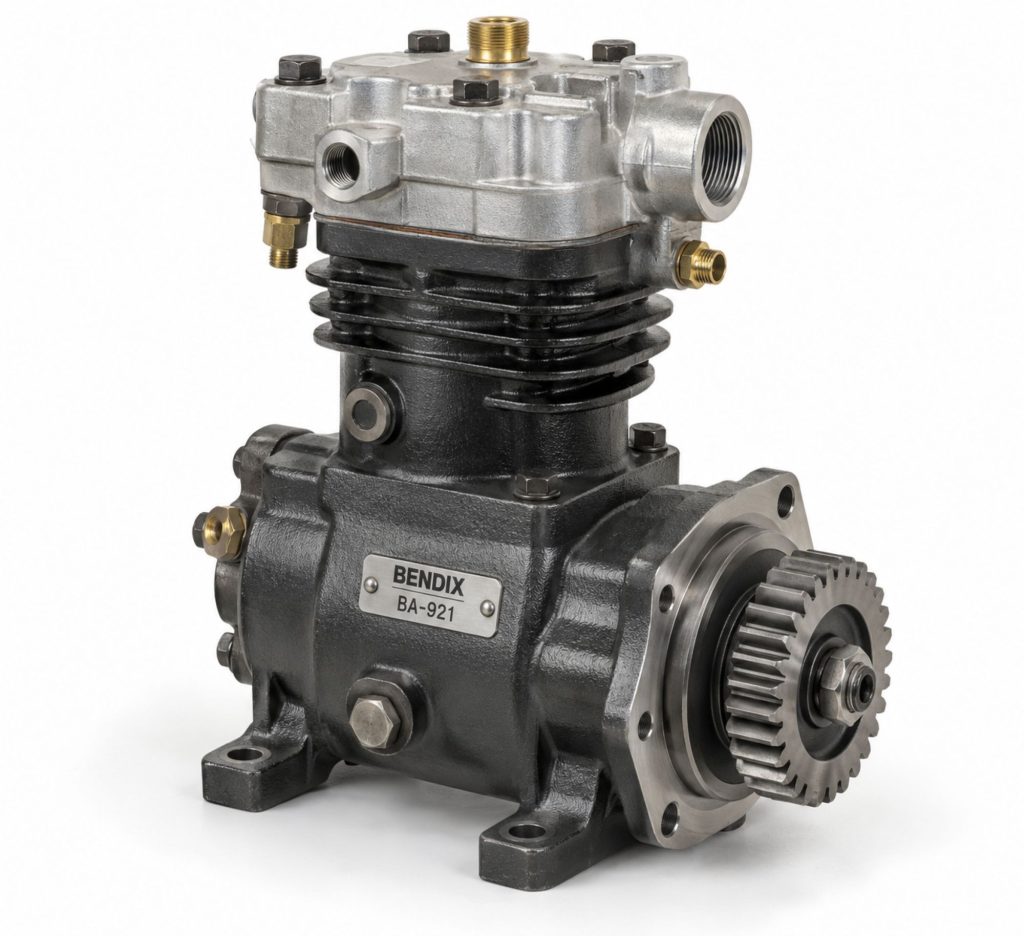
The Bendix BA-921 is a single-cylinder, engine-driven reciprocating air compressor designed to produce and maintain compressed air for commercial-vehicle air-brake and approved auxiliary-air systems.
The compressor has a rated displacement of approximately 15.8 cubic feet per minute at 1,250 rpm. This output supports vehicles with substantial air demand while using a compact single-cylinder design.
The BA-921 uses a water-cooled cylinder head and an integral air-cooled crankcase and cylinder-block assembly. It normally receives pressurized lubrication from the engine and is mechanically driven through an application-specific gear arrangement.
Bendix produced Standard and Closed Room versions of the BA-921. These versions have different air-induction requirements and should not be treated as interchangeable without confirming the exact engine and vehicle application.
The Standard version was introduced for several Caterpillar ACERT and Detroit Diesel Series 60 EGR engine applications. The Closed Room version was introduced later for naturally aspirated compressor-air induction and eliminated the external inlet check valve used in certain Standard installations.
Key Characteristics
- Single-cylinder reciprocating compressor
- Single-stage air compression
- Rated displacement of approximately 15.8 cubic feet per minute at 1,250 rpm
- Compact high-output design
- Engine-driven operation
- Engine-supplied lubrication
- Water-cooled cylinder head
- Air-cooled integral crankcase
- Integrated unloader mechanism
- External governor control
- Standard and Closed Room configurations
- Application-specific crankcase and mounting designs
- Designed for medium-duty and heavy-duty commercial vehicles
- Supports air-brake and approved auxiliary-air equipment
- New and genuine remanufactured service options may be available
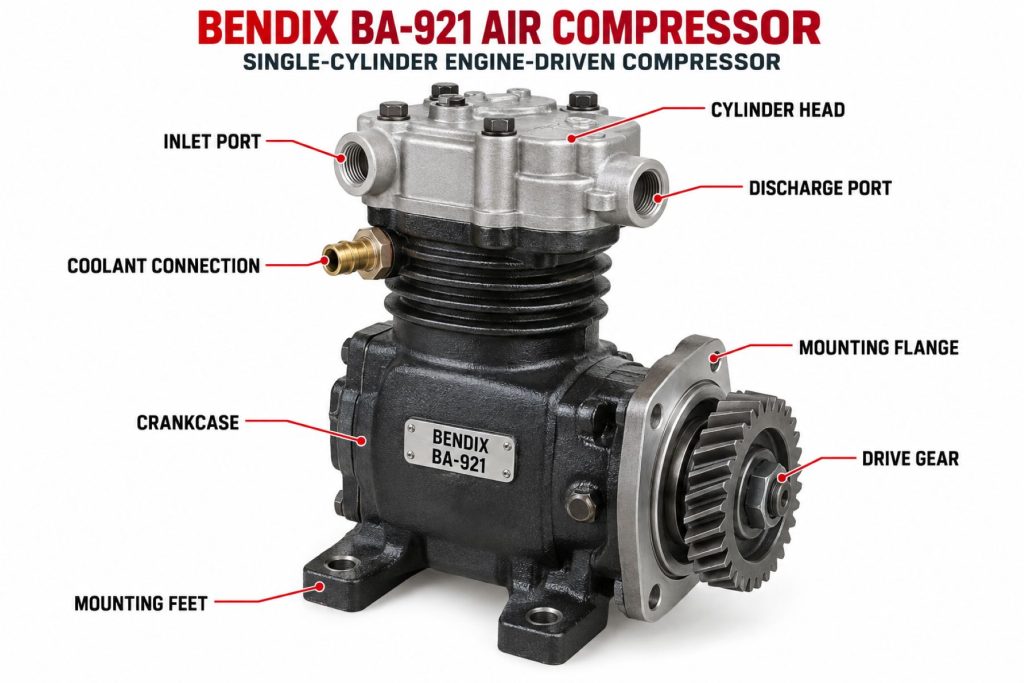
Major Components
- Cylinder head
- Cooling plate
- Valve plate assembly
- Air-inlet port
- Discharge ports
- Inlet valve
- Discharge valves
- Unloader piston
- Balance piston
- Unloader spring
- Unloader cover
- Safety valve
- Piston
- Piston rings
- Connecting rod
- Crankshaft
- Crankshaft bearings
- Integral crankcase and cylinder block
- Application-specific crankcase cover
- Oil-supply port
- Oil-drain passages
- Coolant inlet and outlet ports
- Drive gear
- Mounting flange
- Governor-control port
- Gaskets
- O-rings
- Seals
- Mounting fasteners
How the Brake Component or System Works
The vehicle’s engine mechanically rotates the compressor crankshaft. The crankshaft and connecting rod move the single compressor piston up and down within the cylinder.
During the piston’s downward stroke, low pressure develops above the piston. The inlet valve opens and allows filtered air to enter the cylinder.
During the upward stroke, the inlet valve closes. The rising piston compresses the trapped air.
When cylinder pressure exceeds the pressure in the discharge passage, the discharge valves open. Compressed air moves through the discharge port and into the compressor discharge line.
The discharge line carries the hot compressed air to the air dryer. The dryer removes moisture, oil aerosols, and contamination before the air enters the supply reservoir.
The BA-921 does not continuously deliver air at full output. A governor monitors air-system pressure and controls the compressor’s unloader mechanism.
When system pressure falls to the governor’s cut-in setting, the unloader allows the compressor to pump air.
When pressure reaches the governor’s cut-out setting, control air moves the unloader piston. The compressor stops delivering air even though its crankshaft and piston continue moving with the engine.
Position and Function Within the Brake System
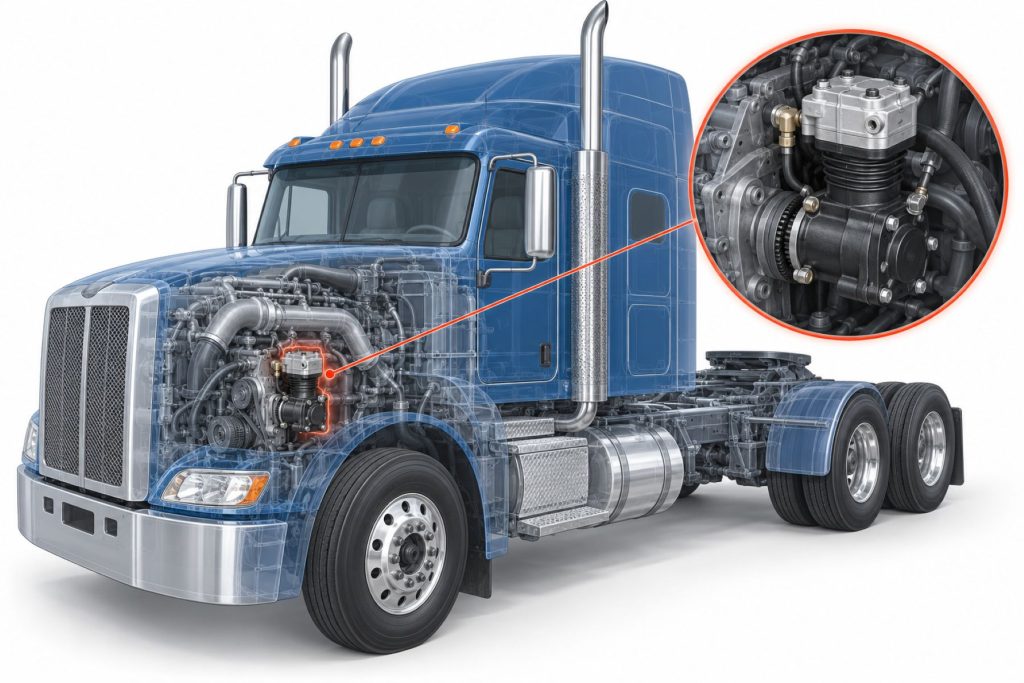
The BA-921 is located in the air-supply and charging portion of the commercial air-brake system.
The normal air-flow sequence is:
- Engine-driven BA-921 compressor
- Compressor discharge line
- Air dryer
- Supply or wet reservoir
- Primary and secondary reservoirs
- Brake-system control valves
- Brake chambers and actuators
- Foundation brakes
- The compressor produces compressed air but does not directly apply the brakes.
- Air produced by the BA-921 may support:
- Service-brake applications
- Spring-brake release
- Parking-brake control
- Emergency-brake operation
- Trailer air supply
- Air suspension
- Automated transmission controls
- Central tire-inflation equipment
- Bulk unloading equipment
- Air-operated accessories
- Other approved pneumatic systems
The compressor and complete charging system must be sized for the vehicle’s total air demand.
Common Specifications
- Compressor Type: Single-cylinder reciprocating air compressor
- Compression Stages: Single stage
- Rated Displacement: Approximately 15.8 cubic feet per minute at 1,250 rpm
- Typical Weight: Approximately 28 pounds, depending on configuration
- Cylinder Head Cooling: Engine coolant
- Crankcase Cooling: Air cooled
- Lubrication: Pressure lubrication from the vehicle engine
- Drive Type: Engine-driven gear arrangement
- Pressure Control: External governor controlling the unloader mechanism
- Air Induction: Naturally aspirated or application-specific Standard configuration
- Cylinder-Head Construction: Application-specific aluminum or cast-iron components
- Safety Equipment: Cylinder-head safety valve
- Mounting: Engine- and application-specific crankcase and flange
- Replacement Availability: New or genuine remanufactured, depending on part number and application
Exact specifications, mounting dimensions, port locations, gearing, and service requirements must be confirmed using the complete Bendix part number and engine application.
Operating Specifications and Performance
The BA-921’s rated displacement provides substantial air delivery from a single-cylinder compressor. Actual installed performance depends on compressor speed, drive ratio, inlet restriction, discharge pressure, system leakage, temperature, and compressor condition.
Performance can be affected by:
- Engine idle speed
- Compressor rotational speed
- Drive ratio
- Governor settings
- Air-inlet configuration
- Air-filter condition
- Inlet check valve condition where equipped
- Discharge-line length
- Discharge-line diameter
- Discharge-line restriction
- Air-dryer condition
- Reservoir capacity
- Air-system leakage
- Accessory air demand
- Piston and ring condition
- Valve-plate condition
- Unloader operation
- Engine oil pressure
- Engine coolant flow
The compressor should be evaluated as part of the complete charging system. Slow pressure buildup does not automatically mean the compressor has failed.
Braking Performance and System Integration
The BA-921 does not create braking friction at the wheels, but it supplies the compressed air required by the braking system.
Insufficient compressor performance may result in:
- Slow air-pressure buildup
- Extended recovery after repeated brake applications
- Frequent low-air warnings
- Delayed spring-brake release
- Reduced stored-air reserve
- Frequent compressor loading
- Difficulty maintaining trailer air supply
- Reduced availability of approved pneumatic accessories
The BA-921 may support vehicles equipped with:
- S-cam drum brakes
- Air disc brakes
- Antilock braking systems
- Electronic stability control
- Automatic traction control
- Electronic parking-brake controls
- Single or tandem drive axles
- Multiple trailer axles
- Auxiliary and lift axles
Brake performance still depends on the air dryer, reservoirs, valves, chambers, foundation brakes, ABS, tires, loading, and driver operation.
Air Supply, Controls, and Electronic Integration
The BA-921 works with an air-compressor governor that monitors reservoir pressure.
The governor provides two primary commands:
- Cut in when system pressure falls
- Cut out when system pressure reaches the upper operating range
During cut-in operation, the compressor is loaded and supplies compressed air.
During cut-out operation, governor control pressure activates the unloader mechanism and stops normal delivery.
The BA-921 may be integrated with:
- Bendix air dryers
- Compressor governors
- Supply reservoirs
- Primary and secondary reservoirs
- Pressure-protection valves
- Safety valves
- Low-air warning devices
- Mechanical pressure gauges
- Electronic pressure sensors
- Engine control modules
- Vehicle diagnostic systems
- Air-system monitoring equipment
The compressor is primarily mechanical and pneumatic. However, the completed vehicle may use electronic sensors, warning systems, and networked controllers to monitor air-system operation.
Installation, Adjustment, and Brake Balance
Correct installation is required for reliable operation and appropriate compressor life.
Important installation considerations include:
- Correct BA-921 version
- Complete Bendix part number
- Approved engine application
- Correct crankcase and mounting flange
- Drive-gear compatibility
- Gear backlash
- Correct compressor rotation
- Mounting-fastener torque
- Oil-supply connection
- Oil-drain alignment
- Coolant-line routing
- Air-induction configuration
- Inlet check valve where required
- Discharge-line size
- Discharge-line length
- Governor-control plumbing
- Clearance from exhaust components
- Clearance from moving engine components
- Correct gaskets and seals
- Freedom from oil, coolant, and air leaks
The compressor does not directly control left-to-right or axle-to-axle brake balance. However, inadequate air pressure can affect all brake circuits.
After installation, the charging system should be tested for pressure buildup, governor operation, air-dryer purging, leakage, low-air warnings, and normal brake-system performance.
Foundation Brake, Axle, and Wheel-End Compatibility
The BA-921 can support commercial vehicles using different foundation-brake and axle configurations when the complete air system is properly engineered.
Possible brake and axle applications include:
- Air disc brakes
- S-cam drum brakes
- Steer axles
- Single drive axles
- Tandem drive axles
- Multiple rear axles
- Pusher axles
- Tag axles
- Lift axles
- Trailer axles
- Bus brake systems
- Specialty-vehicle braking systems
Compressor selection depends on more than the foundation-brake design.
Compatibility also depends on:
- Number of axles
- Number and size of brake chambers
- Trailer operation
- Reservoir capacity
- Air-suspension demand
- Vehicle accessories
- Engine mounting
- Compressor speed
- Air-system recovery requirements
- Vehicle duty cycle
- Applicable braking requirements
Common Applications
- Class 6 commercial trucks
- Class 7 commercial trucks
- Class 8 highway tractors
- Regional-haul tractors
- Vocational trucks
- Dump trucks
- Refuse trucks
- Concrete mixers
- Construction trucks
- Logging trucks
- Utility trucks
- Municipal vehicles
- School buses
- Transit buses
- Motor coaches
- Fire apparatus
- Emergency vehicles
- Terminal tractors
- Bulk-hauling equipment
- Specialty commercial vehicles
- High-air-use applications where properly specified
The BA-921 has been produced for specific engines and vehicle installations. Its use within a vehicle family does not confirm compatibility with every model or production year.
Vehicle and Brake-System Compatibility
The correct BA-921 compressor must match the vehicle’s engine, mounting arrangement, air-induction system, and total pneumatic demand.
Compatibility depends on:
- Vehicle manufacturer
- Vehicle model
- Model year
- Vehicle identification number
- Engine manufacturer
- Engine model
- Engine serial number
- Standard or Closed Room compressor design
- Compressor part number
- Crankcase configuration
- Mounting flange
- Drive gear
- Compressor rotation
- Cylinder-head design
- Air-inlet arrangement
- Inlet check valve requirements
- Discharge-port position
- Governor-control connection
- Oil-supply arrangement
- Oil-drain arrangement
- Coolant-port configuration
- Air-dryer capacity
- Reservoir capacity
- Accessory air demand
A replacement should not be ordered only by the BA-921 model name. Similar-looking BA-921 compressors can have different crankcases, heads, ports, gears, and engine applications.
Advantages
- High rated air output from a single-cylinder design
- Approximately 15.8 cubic feet per minute at 1,250 rpm
- Compact compressor arrangement
- Engine-driven reliability
- Engine-supplied lubrication
- Water-cooled cylinder head
- Integrated air-cooled crankcase
- Established commercial-vehicle service history
- Supports high-air-use applications when correctly specified
- Compatible with modern commercial air-brake systems
- Works with air dryers and governor controls
- New and remanufactured availability for certain applications
- Service kits may be available
- Broad technical-support resources
- Supports trucks, tractors, buses, and vocational equipment
Limitations or Considerations
- Single-cylinder design creates distinct operating characteristics
- Multiple application-specific configurations exist
- Standard and Closed Room versions have different induction requirements
- Part numbers may not be interchangeable
- Requires proper engine-oil pressure
- Requires proper coolant flow
- Discharge air becomes extremely hot
- Incorrect inlet plumbing can affect performance
- Standard versions may require an external inlet check valve
- Closed Room versions are restricted to approved naturally aspirated operation
- Air leaks can create excessive compressor duty cycle
- High duty cycle can increase heat and oil carryover
- Carbon can accumulate in the discharge line
- Mounting and drive components are engine specific
- Some applications may be older or superseded
- Replacing the compressor does not correct leaks or restrictions elsewhere in the system
Driver and Operator Experience
A properly operating BA-921 should build pressure within the vehicle manufacturer’s required time and maintain sufficient pressure during normal operation.
Drivers should monitor:
- Primary air-pressure gauge
- Secondary air-pressure gauge
- Low-air warning light
- Low-air warning buzzer
- Air-pressure buildup time
- Governor cut-in
- Governor cut-out
- Air-dryer purge operation
- Frequency of compressor cycling
- Parking-brake release
- Trailer air-supply operation
- Visible or audible air leaks
- Air-system warning messages
Frequent compressor loading may indicate leakage or high pneumatic demand rather than an internal compressor problem.
Drivers should report slow pressure buildup, repeated low-air warnings, excessive air-dryer purging, coolant loss, oil leakage, burning odors, or unusual compressor and engine-gear noises.
Maintenance and Ownership Notes
- Inspect the compressor for air, oil, and coolant leakage.
- Check compressor mounting fasteners.
- Inspect the compressor drive for abnormal noise.
- Maintain the engine lubrication system.
- Verify appropriate engine-oil pressure.
- Maintain the engine cooling system.
- Inspect coolant hoses and fittings.
- Check the air-inlet system.
- Maintain the engine air filter.
- Inspect the external inlet check valve where equipped.
- Check the compressor discharge line.
- Inspect for carbon buildup and restriction.
- Maintain the air dryer.
- Replace the air-dryer cartridge as required.
- Drain and inspect the air reservoirs.
- Monitor oil and moisture contamination.
- Check governor operation.
- Measure pressure-buildup time.
- Perform air-system leakage tests.
- Inspect air lines and fittings.
- Monitor compressor duty cycle.
- Investigate excessive oil carryover.
- Use the correct Bendix maintenance kits.
- Follow Bendix and engine-manufacturer service procedures.
- Maintenance intervals depend on the vehicle, compressor configuration, air consumption, duty cycle, climate, and operating environment.
Common Brake-System Problems
- Slow pressure buildup: Air leaks, a restricted inlet, damaged inlet check valve, restricted discharge line, worn compressor components, low engine speed, governor problems, or air-dryer restrictions may be responsible.
- Compressor fails to load: A faulty governor, restricted control line, sticking unloader piston, incorrect plumbing, or internal compressor damage may prevent normal delivery.
- Compressor fails to unload: Governor failure, control-line leakage, a blocked control passage, or sticking unloader components may cause continuous pumping.
- Excessive compressor cycling: System leakage, high accessory demand, governor problems, unloader leakage, or incorrect pressure settings may cause repeated loading and unloading.
- Excessive oil carryover: High duty cycle, inlet restriction, compressor wear, engine crankcase pressure, excessive oil temperature, low oil pressure, or improper oil drainage may contribute.
- Compressor overheating: Restricted coolant flow, discharge-line restriction, high duty cycle, improper installation, or inadequate airflow may increase temperature.
- Carbon buildup in the discharge line: Excessive discharge temperature, oil carryover, incorrect line size, improper routing, or continuous compressor operation may create deposits.
- Coolant leakage: Damaged gaskets, cracked castings, loose fittings, corrosion, or overtightened fittings may allow coolant to escape.
- External oil leakage: Damaged seals, loose lines, worn gaskets, excessive crankcase pressure, or mounting problems may cause leakage.
- Unusual compressor noise: Drive-gear wear, bearing damage, loose mounting, piston damage, or engine gear-train problems may create knocking or grinding.
- Cylinder-head safety valve releases: A restricted or blocked discharge line may create excessive pressure at the compressor head.
- Air dryer purges frequently: Air-system leakage, governor malfunction, high accessory demand, or compressor-control problems may cause repeated purging.
Safety and Service Precautions
- The commercial air-brake system stores compressed air that can cause injury if released unexpectedly.
- Before servicing the compressor:
- Park the vehicle on a level surface.
- Apply approved parking procedures.
- Chock the wheels.
- Drain all air reservoirs.
- Confirm stored air pressure has been released.
- Shut down the engine.
- Follow applicable lockout procedures.
- Allow the compressor and discharge line to cool.
- Drain engine coolant when required.
- Disconnect air, oil, and coolant lines safely.
- Wear appropriate personal protective equipment.
- Do not loosen pressurized fittings.
- Do not work near exposed moving gears.
- Do not operate the engine with the compressor drive exposed.
- Do not overtighten fittings in the cylinder head.
- Do not substitute unapproved hoses, tubing, fittings, or fasteners.
- The discharge line and cylinder head may become hot enough to cause severe burns.
- After service, test air-pressure buildup, leakage, governor operation, air-dryer purging, safety-valve operation, warning devices, and the completed brake system.
Identification Information
BA-921 identification information is commonly stamped on the compressor crankcase cover or shown on an attached identification area.
Record the following:
- Bendix BA-921 model designation
- Standard or Closed Room version
- Bendix part number
- Customer piece number
- Serial number
- Remanufactured part number when applicable
- Vehicle manufacturer
- Vehicle identification number
- Vehicle model and model year
- Engine manufacturer
- Engine model
- Engine serial number
- Compressor crankcase configuration
- Mounting-flange design
- Drive-gear information
- Cylinder-head design
- Air-inlet arrangement
- Inlet check valve equipment
- Discharge-port location
- Coolant-port arrangement
- Oil-supply connection
- Governor-control arrangement
Photographs of the identification markings, mounting flange, drive gear, cylinder head, ports, and connected lines can help verify the correct replacement.
Buying Considerations
- Confirm that the compressor is a Bendix BA-921.
- Determine whether it is the Standard or Closed Room version.
- Record the complete Bendix part number.
- Record the customer piece number.
- Check for superseded part numbers.
- Verify the vehicle identification number.
- Record the engine model and serial number.
- Confirm the crankcase and mounting flange.
- Verify drive-gear compatibility.
- Confirm compressor rotation.
- Match the cylinder-head design.
- Verify air-induction requirements.
- Determine whether an external inlet check valve is required.
- Confirm discharge-port location.
- Match oil-supply and oil-drain connections.
- Verify coolant-port locations.
- Confirm governor compatibility.
- Determine whether a new or remanufactured unit is appropriate.
- Check whether the drive gear is included.
- Check whether fittings, gaskets, and hardware are included.
- Inspect the discharge line and air dryer before installation.
- Correct air-system leakage before replacing the compressor.
Variants and Configurations
The BA-921 family includes multiple engine- and vehicle-specific configurations.
Important versions include:
- Standard BA-921 compressor
- Closed Room BA-921 compressor
- New compressor assemblies
- Genuine remanufactured compressor assemblies
Additional differences may include:
- Bendix part number
- Customer part number
- Crankcase design
- Mounting flange
- Drive gear
- Compressor rotation
- Cylinder-head material
- Cylinder-head configuration
- Air-inlet port
- External inlet check valve
- Discharge-port position
- Coolant-port arrangement
- Oil-supply connection
- Oil-drain arrangement
- Governor connection
- Rear-cover design
- Engine application
- Vehicle manufacturer application
The complete part number and application information must be used when comparing compressors or ordering replacements.
Comparison to Similar Equipment
Compared with the Bendix Tu-Flo 550 Air Compressor, the BA-921 uses a single-cylinder design while providing higher nominal displacement. The Tu-Flo 550 uses a two-cylinder compressor architecture and serves a different group of applications.
Compared with the Bendix BA-922, the BA-921 generally provides lower air delivery. The BA-922 may be used in applications with even greater compressed-air demand.
Compared with smaller commercial air compressors, the BA-921 provides higher output that can support vehicles with more axles, frequent brake applications, or air-operated accessories.
Compared with an electric compressor, the BA-921 is mechanically driven by the engine and normally shares the engine’s lubrication and cooling systems.
Different Bendix compressor families should not be considered interchangeable without verifying mounting, drive, output, air induction, cooling, lubrication, and vehicle requirements.
Best Fit For
- Vehicles originally equipped with a Bendix BA-921
- Medium-duty and heavy-duty commercial vehicles
- Vehicles requiring high air delivery from a compact compressor
- Highway tractors
- Vocational trucks
- Commercial buses
- School buses
- Transit buses
- Refuse vehicles
- Construction trucks
- Dump trucks
- Concrete mixers
- Fire apparatus
- Specialty commercial chassis
- Fleets seeking genuine remanufactured replacement availability
- Applications with compatible engine mounting and air-induction requirements
- The BA-921 is best treated as an application-specific replacement rather than a universal compressor conversion.
Related Vehicle and Trailer Types
- Complete Guide to Semi Truck Types
- Class 6 vs Class 7 vs Class 8 Trucks
- Highway tractors
- Regional tractors
- Day cab trucks
- Sleeper trucks
- Straight trucks
- Dump trucks
- Concrete mixers
- Refuse trucks
- Construction trucks
- Logging trucks
- Municipal trucks
- Commercial buses
- School buses
- Transit buses
- Fire apparatus
- Emergency vehicles
- Terminal tractors
- Specialty commercial vehicles
Related Truck and Trailer Models
- Freightliner Cascadia
- Freightliner M2 106
- International LT Series
- International MV Series
- Kenworth T680
- Kenworth T800
- Peterbilt 389
- Peterbilt 579
- Mack Granite
- Volvo VNL
Related Brake System Types
- Air Brake Systems
- Air Disc Brake Systems
- Drum Brake Systems
- Brake Chambers & Actuators
- ABS & Electronic Braking Systems
- Trailer Brake Systems
Related Brake Products
- Bendix Tu-Flo 550 Air Compressor
- Bendix AD-9 Air Dryer
- Bendix AD-HF Air Dryer
- Bendix SR-7 Spring Brake Modulating Valve
- Bendix ADB22X Air Disc Brake
- Bendix EverSure Spring Brake
- Bendix ESP Full-Stability System
Related Equipment Systems
- Brake Systems
- Engines
- Transmissions
- Axles & Differentials
- Suspension Systems
- Electrical Systems
- Equipment Systems
- Air dryers
- Air reservoirs
- Compressor governors
- Pressure-protection valves
- Vehicle air-management systems
- Engine lubrication systems
- Engine cooling systems
Related Guides
- Brake System Guides
- Air Brake Systems Explained
- How to Inspect and Maintain Commercial Truck Brakes
- Commercial Truck Brake Components Explained
- Tractor vs Trailer Brake Systems
- How Truck ABS and Electronic Stability Control Work
Regulatory and Compliance Notes
The air compressor is part of a safety-critical commercial-vehicle braking system.
The completed air system must meet applicable requirements for:
- Pressure buildup
- Air-system recovery
- Governor cut-in and cut-out
- Low-air warnings
- Reservoir capacity
- Air leakage
- Service-brake operation
- Parking-brake operation
- Emergency-brake operation
- Trailer air supply
Replacement components should preserve the vehicle’s approved air-system configuration.
Installing a compressor with greater rated displacement does not automatically increase the vehicle’s braking capability or certified weight ratings.
Commercial air-brake repairs may be subject to technician qualifications, inspection requirements, and service regulations depending on the jurisdiction.
Real World Operating Notes
The BA-921 is frequently used in vehicles with substantial compressed-air demand. However, uncontrolled air leakage can still make a correctly operating compressor run excessively.
Air-system leakage is a common reason compressors experience high duty cycles, excessive heat, and increased oil carryover.
Before replacing the compressor, technicians should inspect the air system, governor, air dryer, discharge line, reservoirs, and pneumatic accessories.
The discharge line should be inspected whenever a compressor is replaced. A carbon-restricted line can cause high cylinder-head temperature, activate the compressor safety valve, or damage a replacement compressor.
Standard and Closed Room compressors must be identified correctly. Connecting a Closed Room version to an unapproved turbocharged air source can create improper compressor operation.
Frequently Asked Questions
What is the Bendix BA-921?
The Bendix BA-921 is a single-cylinder, engine-driven reciprocating compressor that supplies compressed air for commercial-vehicle air brakes and approved pneumatic accessories.
What is the BA-921’s rated displacement?
Bendix service information lists approximately 15.8 cubic feet per minute at 1,250 rpm.
How many cylinders does the BA-921 have?
It uses one compressor cylinder.
Is the BA-921 water cooled?
Its cylinder head is cooled by engine coolant. Its integral crankcase and cylinder block are air cooled.
Is the BA-921 lubricated by the engine?
Yes. It normally receives pressurized lubricating oil from the engine.
What is the difference between Standard and Closed Room versions?
The versions use different cylinder-head and air-induction arrangements. Certain Standard installations require an external inlet check valve. The Closed Room version is intended for approved naturally aspirated operation.
Can the Closed Room BA-921 use turbocharged intake air?
Bendix service information specifies that the Closed Room version should only use its approved naturally aspirated air-induction arrangement.
What controls the BA-921’s pressure?
An external governor monitors system pressure and controls the compressor’s unloader mechanism.
Why does the compressor run frequently?
Air leaks, high accessory demand, governor problems, unloader leakage, or an demanding duty cycle may cause frequent operation.
What causes slow pressure buildup?
Possible causes include air-system leakage, inlet restriction, discharge-line restriction, worn compressor components, low engine speed, governor problems, or air-dryer restrictions.
What causes the compressor safety valve to open?
A restricted or blocked discharge line can create excessive pressure in the compressor cylinder head.
Are all BA-921 compressors interchangeable?
No. Standard and Closed Room versions, crankcases, gears, mounting arrangements, ports, and engine applications can differ.
Is a remanufactured BA-921 available?
Bendix has expanded genuine remanufactured BA-921 availability through authorized dealers and distributors for supported applications. Availability still depends on the exact part number. Bendix BA-921 remanufactured-compressor information.
How can the correct replacement be identified?
Use the Bendix part number, customer piece number, serial number, compressor version, vehicle VIN, engine model, engine serial number, crankcase, drive gear, and port configuration.
Availability and Where to Find
Bendix BA-921 compressors may be available as new service units, genuine Bendix remanufactured units, aftermarket replacements, used assemblies, or rebuildable cores, depending on the application.
Replacement compressors and service parts may be available through:
- Authorized Bendix distributors
- Commercial-truck dealerships
- Engine dealerships
- Heavy-duty parts suppliers
- Fleet maintenance facilities
- Commercial air-brake specialists
- Authorized remanufacturers
- Online heavy-duty parts suppliers
Before ordering, confirm the complete part number, Standard or Closed Room configuration, engine application, crankcase, mounting flange, drive gear, air induction, discharge ports, coolant connections, and oil connections.
Current product support, technical documentation, parts identification, and distributor information are available through the Bendix Services and Support website.
Support Trucking Families
Truck Equipment Atlas supports the mission of Grey Cross, a nonprofit dedicated to helping families of truck drivers who lose their lives while on the road. As the site grows, part of its mission is to bring awareness and support to these families.
Podcast or Video Section
Learn More Through Audio and Video
Truck Equipment Atlas will continue expanding with podcast episodes, interviews, and equipment breakdowns to help drivers and fleets better understand trucks and equipment.
Follow the Growth of Truck Equipment Atlas
Truck Equipment Atlas continues to expand with new truck profiles, trailer coverage, diesel engine pages, equipment system resources, manufacturer information, and educational guides.
Visit our Site Updates page to explore recent additions, project milestones, and upcoming resources as we continue building one of the industry’s growing commercial trucking equipment reference libraries.
View the Latest Site Updates: Truck Equipment Atlas Site Updates