
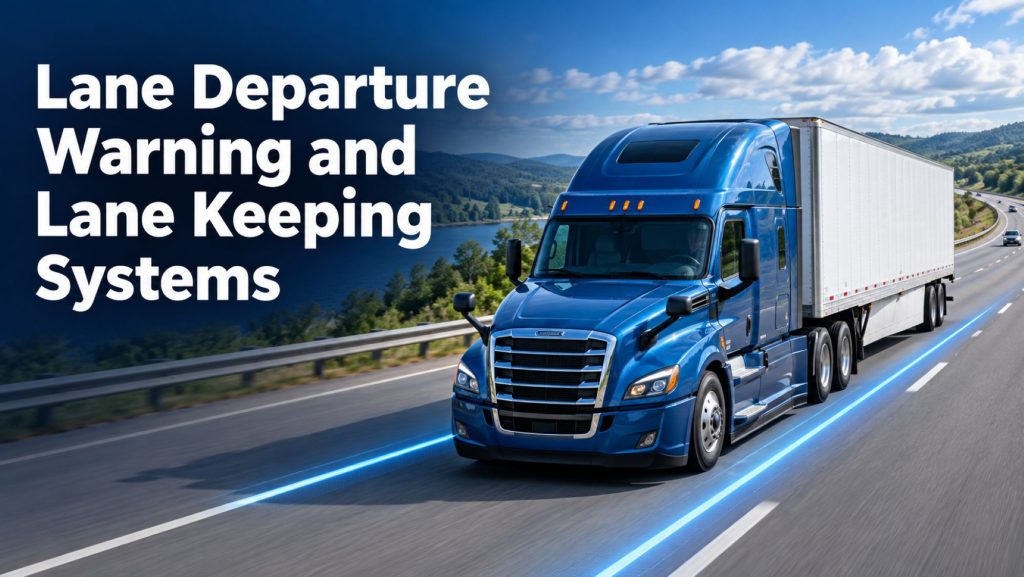
Lane departure warning and lane keeping systems help commercial truck drivers recognize unintended lane movement. Warning systems alert the driver when the vehicle approaches or crosses a detected lane boundary under supported conditions. Active lane keeping systems add steering assistance where the vehicle and equipment support it.
These technologies are not interchangeable. A truck equipped with lane departure warning does not automatically have steering intervention, continuous lane centering, or automated lane changes.
Truck Equipment Atlas covers lane-monitoring cameras, driver alerts, active steering integration, operating conditions, installation, calibration, maintenance, and individual commercial truck safety-system platforms.
Lane Warning and Lane Keeping Systems on Truck Equipment Atlas
Explore the product profiles being added to this category. Individual profiles distinguish warning functions from supported steering assistance.
ZF WABCO
- ZF WABCO OnLaneALERT Lane Departure Warning System
- ZF WABCO OnLaneASSIST Lane Keeping Assistance System
Bendix
- Bendix Wingman Fusion Collision Mitigation System — Includes lane-warning capabilities in documented configurations; active steering requires the appropriate vehicle package.
Detroit
- Detroit Assurance with Active Brake Assist 6 — Related safety suite with lane functions determined by the installed configuration and optional equipment.
Additional warning systems, steering-assistance platforms, and vehicle-specific configurations will be added as the Safety Systems Library expands.
How Lane Departure Warning Works
A lane-monitoring camera observes the road ahead. Supported processing electronics identify visible lane markings and evaluate the vehicle’s position relative to those boundaries.
When the system detects a departure condition that meets its activation rules, it provides the installed driver warning. Alert timing, operating speeds, and interaction with turn signals vary by product.
A warning-only system informs the driver; it does not steer the truck back into the lane. The driver remains responsible for maintaining the vehicle’s path.
Lane Departure Warning vs Lane Keeping Assistance
Lane Departure Warning
Lane departure warning identifies a supported lane-departure condition and alerts the driver. The warning may use sound, a dashboard indication, or another interface specified by the manufacturer.
Lane Keeping Assistance
Lane keeping assistance can provide a supported steering response when its operating conditions are met. The response may be intended to help correct developing lane drift rather than continuously control the vehicle’s position.
Lane Centering
Lane centering describes assistance intended to maintain a position within a detected lane during supported operation. Do not assume a departure-correction system also provides continuous centering.
Lane Change Assistance
Lane change assistance addresses a different maneuver. Blind-spot warnings or supported lane-change functions should be evaluated separately from lane departure monitoring and lane keeping.
Major Lane-Monitoring Components
Depending on the system, the complete installation may include:
- A forward-facing lane-monitoring camera.
- Image-processing electronics and software.
- Approved camera mounting hardware.
- Driver warning speakers or other alert interfaces.
- Dashboard status indicators.
- Vehicle-speed and turn-signal inputs.
- Electrical supply and vehicle-network connections.
- Active steering equipment where supported.
- Diagnostic and calibration tools.
Component requirements vary. A camera installation alone does not establish active steering capability.
Camera-Based Lane Detection
Lane detection depends on the system identifying the road features it is designed to use. Clear markings and an unobstructed camera view are important, but recognition can also vary with lighting, weather, road geometry, and the product’s processing capabilities.
Drivers should understand the difference between a system detecting a lane and merely being powered on. Check the installed status indicators to identify when lane functions are available.
Highway Lane Warning Applications
Highway applications involve extended travel, lane boundaries, curves, changing road widths, and merging traffic. Evaluate the documented lane functions against the routes on which the truck operates.
- Lane-departure alerts.
- Left-side and right-side warning identification.
- Supported steering correction.
- Lane-detection status.
- Driver controls and system availability messages.
Lane alerts do not replace attentive driving, appropriate rest, or direct control of the truck.
Regional, Urban, and Work-Zone Conditions
Regional and urban routes may include intersections, frequent turns, faded markings, narrow lanes, and irregular road layouts. Temporary markings and construction diversions can also differ from normal highway lane geometry.
Follow the vehicle’s instructions for using lane assistance in these conditions. Do not assume the system will interpret every temporary lane, road edge, or construction path correctly.
Vocational and Specialized Applications
Vocational vehicles may alternate between marked roads, customer facilities, and unmarked worksites. Lane monitoring should be evaluated according to the vehicle’s approved application and documented operating conditions.
Equipment suited to highway lane awareness does not automatically provide guidance on gravel roads, loading yards, or sites without recognizable lane markings.
Common Specifications and Operating Conditions
Important information to confirm for the exact installation includes:
- Product name, generation, and software configuration.
- Approved vehicle models and model years.
- Warning-only or active steering functions.
- Activation and operating speed ranges.
- Lane-marking recognition requirements.
- Turn-signal interaction.
- Driver controls and warning types.
- Steering-system compatibility where applicable.
- Camera mounting and calibration requirements.
- Fault indications and diagnostic procedures.
Active Steering and Vehicle Integration
Active lane assistance requires compatible steering hardware, controls, and vehicle integration. ZF describes OnLaneASSIST as combining a forward-looking camera with active steering gear.
When evaluating an installation, identify how assistance is enabled, how the driver remains in control, and which conditions limit the response. Adding a warning camera to a truck does not create an approved steering-assistance installation.
Mounting, Windshield Work, and Calibration
Install the camera using the approved location, bracket, and alignment procedure. Avoid changes that obstruct its view or alter the intended mounting geometry.
After windshield replacement, camera service, bracket work, or other relevant repairs, check the manufacturer’s calibration requirements. Complete any specified checks before returning affected functions to service.
Operating Limitations and Driver Responsibilities
Lane monitoring and steering assistance operate within defined limits. Drivers must maintain awareness of lane position, road edges, surrounding vehicles, and changing conditions.
- Review limitations involving missing or unclear markings.
- Understand the effects of camera obstruction and visibility conditions.
- Learn how the system behaves during intentional lane changes.
- Recognize unavailable or faulted lane functions.
- Follow the vehicle’s driver-control requirements.
- Do not assume lane assistance monitors the entire truck-and-trailer combination.
Common Lane Warning and Lane Keeping Problems
- Obstructed camera view.
- Damaged or displaced mounting hardware.
- Incomplete calibration after repairs.
- Unavailable lane detection on unsuitable road markings.
- Electrical or vehicle-network faults.
- Incorrect component replacement or configuration.
- Misunderstanding warning-only and active steering functions.
- Recurring alerts that require documented investigation.
Record the displayed warning and road conditions before diagnosis. A lane-related alert does not establish the underlying cause by itself.
Inspection and Maintenance
- Check lane-function status and fault messages.
- Inspect the camera view for obstruction.
- Inspect accessible brackets, wiring, and connectors.
- Use approved cleaning procedures.
- Maintain the vehicle’s steering, suspension, and tires.
- Complete calibration required after relevant repairs.
- Record configuration changes and service work.
Use qualified technicians and supported procedures for functional testing. Do not deliberately drift toward traffic or a road edge to test the system.
Driver Alerts and Operator Training
Training should explain the actual truck’s warning sounds, display indicators, controls, and steering-assistance behavior. Drivers should know which functions are installed and how to identify when they are unavailable.
Review the equipment when changing vehicles. Similar product names or dashboard symbols do not establish identical operating speeds, alerts, or steering responses.
Common Applications
- Long-haul highway tractors.
- Regional and day-cab tractors.
- Distribution trucks with supported safety equipment.
- Vocational trucks with an approved configuration.
- Fleets comparing warning-only and active lane-assistance packages.
Selecting a Lane Warning or Lane Keeping System
Begin with verified vehicle compatibility and the functions the operation needs. Evaluate the complete installation rather than the camera or product name alone.
- Identify warning, departure-correction, and centering capabilities separately.
- Confirm supported vehicle and steering configurations.
- Review operating speeds and lane-detection requirements.
- Assess routes, road markings, and typical operating conditions.
- Review driver controls and training needs.
- Confirm approved retrofit or upgrade eligibility.
- Check installation, calibration, and repair support.
- Compare installed cost and ongoing ownership requirements.
Related Safety System Categories
- Collision Warning and Automatic Emergency Braking Systems
- Adaptive Cruise Control Systems
- Blind-Spot and Vulnerable Road User Detection Systems
- Reversing Safety and Audible Warning Systems
- Camera Monitor and Surround-View Systems
Related Safety System Guides
- Safety System Guides
- How Commercial Truck Safety Systems Work
- Lane Departure Warning and Lane Keeping Assistance Explained
- Collision Warning and Automatic Emergency Braking Explained
- Adaptive Cruise Control for Commercial Trucks Explained
- Blind-Spot Detection and Camera Monitor Systems Explained
- How to Choose a Commercial Truck Safety System
Related Truck and Equipment Resources
- Safety Systems
- Commercial Trucks
- Commercial Trailers
- Drivelines & Steering Systems
- Suspension Systems
- Tires & Wheels
- Electrical Systems
- Telematics & ELD Systems
- Equipment Systems
Lane Warning and Lane Keeping Library Expansion
Truck Equipment Atlas will expand this category with additional warning systems, steering-assistance platforms, vehicle-specific configurations, and supporting component information.
- Additional lane departure warning products.
- Active lane keeping and centering configurations.
- Camera and steering-component profiles.
- Factory-installed and approved retrofit packages.
- Calibration and service resources.
- Comparisons of warning and steering-assistance capabilities.
Explore the Complete Safety Systems Library
Visit the Safety Systems hub to explore collision mitigation, adaptive cruise control, lane assistance, blind-spot detection, reversing equipment, camera monitor systems, product profiles, and educational guides.
Follow the Growth of Truck Equipment Atlas
Truck Equipment Atlas continues to expand with new truck profiles, trailer coverage, diesel engine pages, equipment-system resources, manufacturer information, and educational guides.
Visit the Truck Equipment Atlas Site Updates page to explore recent additions, project milestones, and upcoming resources.