
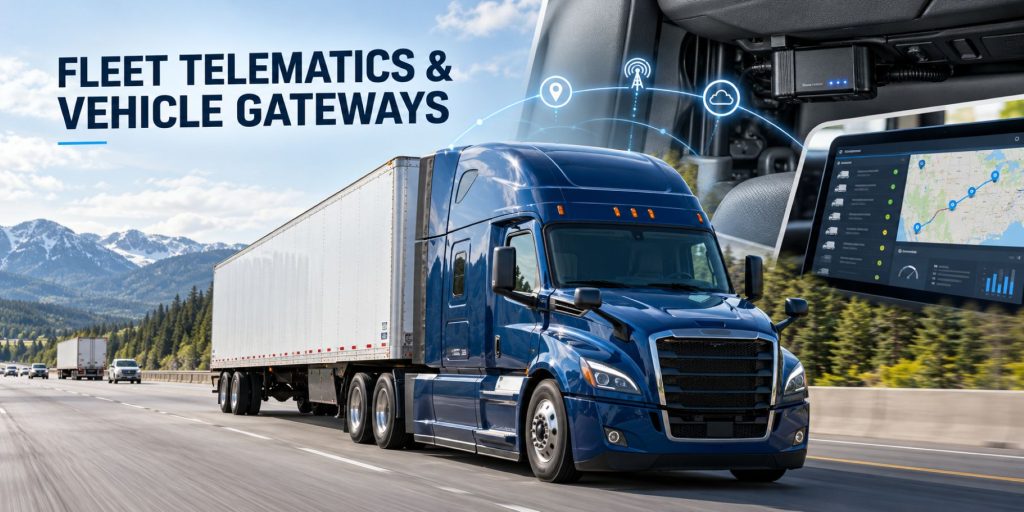
Fleet telematics systems and vehicle gateways connect commercial trucks, buses, vocational vehicles, service equipment, drivers, and fleet-management personnel through vehicle data, GPS location, wireless communication, sensors, software, and connected applications.
A vehicle gateway can collect information from the vehicle’s diagnostic network, engine electronic control module, positioning receiver, internal motion sensors, cameras, and connected accessories. The gateway transmits supported information to a fleet platform where authorized users can monitor location, vehicle operation, utilization, fuel consumption, diagnostic information, driver activity, and maintenance needs.
Truck Equipment Atlas covers vehicle gateways, telematics control units, ruggedized tracking devices, GPS hardware, diagnostic connections, wireless communications, fleet dashboards, installation requirements, vehicle compatibility, maintenance considerations, and individual telematics products used throughout commercial transportation.
Fleet Telematics and Vehicle Gateways on Truck Equipment Atlas
Explore the fleet telematics devices and vehicle gateways being added to Truck Equipment Atlas:
Samsara
Motive
Geotab
Omnitracs
ISAAC Instruments
EROAD
Zonar
Additional vehicle gateways, telematics control units, ruggedized trackers, GPS devices, remote-diagnostic systems, fleet-management platforms, and connected-vehicle products will be added as the Truck Equipment Atlas Telematics and ELD Systems Library continues to expand.
How Fleet Telematics Systems Work
A fleet telematics system collects information from a vehicle or connected asset and transfers that information to a software platform. The system may combine vehicle-network data, GPS location, motion sensing, wireless communication, driver information, camera events, and data from attached sensors.
The vehicle gateway processes the supported information and transmits it through a cellular, satellite, Wi-Fi, or Bluetooth connection. Authorized fleet personnel can then view available information through a web dashboard, mobile application, maintenance platform, dispatch system, or integrated transportation-management system.
The information available depends on the installed device, vehicle connection, model year, engine network, sensor package, communications coverage, software subscription, system permissions, and fleet configuration.
Vehicle Gateway Position and Function
A vehicle gateway is commonly installed inside the cab, beneath the dashboard, near the diagnostic connection, or in another protected location specified by the manufacturer. Ruggedized telematics devices may be installed on vocational equipment, construction machinery, powered assets, or in exterior locations when the hardware is designed for that environment.
The gateway provides the connection between the vehicle and the fleet-management platform. Its functions may include collecting vehicle data, determining location, identifying movement, recording operational events, storing information temporarily, and transmitting supported data to the cloud.
Some gateways also support electronic logging, camera integration, in-cab Wi-Fi, driver identification, auxiliary inputs, remote diagnostics, maintenance reporting, or connected sensors.
Major Vehicle-Gateway Components
A commercial vehicle gateway or telematics control unit may contain or connect with several components:
- Gateway or telematics control unit
- Vehicle-specific diagnostic cable
- GPS or satellite-positioning receiver
- Cellular modem
- Internal antenna or external antenna connection
- Accelerometer and gyroscope
- Internal memory
- Power-management circuitry
- Bluetooth or Wi-Fi connectivity
- Auxiliary inputs and outputs
- Camera connection
- Driver display or mobile application
- Fleet-management dashboard
- Mounting hardware
Component design varies considerably. Some products are compact plug-in devices, while others use permanently mounted hardware, dedicated displays, external antennas, accessory hubs, or ruggedized enclosures.
Vehicle and Engine Data Collection
A compatible gateway can collect supported information from the vehicle’s diagnostic network or electronic control modules. The exact information depends on the vehicle, engine, model year, communication protocol, installed sensors, gateway, and software package.
Available vehicle information may include:
- Engine speed
- Vehicle speed
- Engine operating hours
- Odometer information
- Fuel consumption
- Idle time
- Battery voltage
- Engine temperature
- Diagnostic trouble codes
- Power take-off operation
- Selected accessory operation
- Vehicle movement and ignition status
A gateway may not receive every available vehicle parameter. Data access can vary between truck manufacturers, engines, electronic architectures, gateway models, cables, software plans, and third-party integrations.
GPS Location and Vehicle Tracking
GPS and other satellite-positioning technologies allow the gateway to determine the vehicle’s approximate location, direction, and movement. Location information can be transmitted to the fleet platform at scheduled intervals or when supported events occur.
Fleet-location functions may support:
- Current vehicle location
- Historical trip review
- Dispatch visibility
- Estimated arrival information
- Route comparison
- Geofence alerts
- Unauthorized vehicle movement alerts
- Customer-arrival confirmation
- Job-site arrival and departure records
- Vehicle recovery assistance
Location accuracy and reporting frequency can be affected by antenna placement, surrounding structures, tunnels, terrain, device power, communications coverage, hardware configuration, and software settings.
Cellular, Satellite, Wi-Fi, and Bluetooth Communication
Most fleet telematics gateways use cellular service to transmit information between the vehicle and the fleet platform. Some systems may support multiple cellular carriers, satellite communication, Wi-Fi, Bluetooth, or a combination of technologies.
When a vehicle operates outside the supported communications area, the gateway may store information and transmit it after communication is restored. The amount of information retained and the length of offline operation depend on the product and configuration.
Bluetooth may connect the gateway with a driver’s mobile device, nearby sensors, or supported accessories. Wi-Fi may provide local device communication, data transfer, software updates, or an in-cab hotspot when offered by the system and service plan.
Motion and Driver-Event Detection
Many telematics devices contain accelerometers, gyroscopes, or other motion sensors. These components can identify changes in vehicle movement that may be associated with braking, acceleration, cornering, impact, or other operating events.
Supported event categories may include:
- Hard braking
- Rapid acceleration
- Harsh cornering
- Speed-related events
- Possible collisions
- Unexpected vehicle movement
- Excessive idling
- Unauthorized operation
An automatically identified event should be reviewed in context. Road conditions, vehicle loading, sensor mounting, calibration, traffic, avoidance maneuvers, and other circumstances can affect the recorded information.
Electronic Logging and Driver Integration
Some vehicle gateways also serve as part of an electronic logging device system. The gateway collects engine and vehicle-movement information while the driver interacts with the system through a mobile application or dedicated display.
Driver-related functions may include:
- Driver authentication
- Hours-of-service records
- Duty-status management
- Log certification
- Roadside inspection mode
- Electronic vehicle inspections
- Dispatch messaging
- Document capture
- Driver coaching
- Navigation integration
The exact functions depend on the gateway, driver application, operating jurisdiction, fleet subscription, and software configuration.
Camera and Sensor Integration
A vehicle gateway may connect with road-facing cameras, dual-facing cameras, auxiliary cameras, temperature sensors, door sensors, cargo sensors, tire-monitoring systems, identification readers, and other supported equipment.
Combining vehicle and sensor information can give fleet personnel additional context. For example, a braking event may be reviewed alongside vehicle speed, location, camera footage, and driver information.
Sensor and camera compatibility should be confirmed before purchasing equipment. Similar connectors do not guarantee that hardware from different manufacturers can communicate or operate through the same platform.
Remote Diagnostics and Maintenance Information
Compatible telematics gateways may collect diagnostic trouble codes, warning information, engine data, battery condition, mileage, engine hours, and other information used for maintenance planning.
Remote information can help maintenance personnel determine whether a condition requires immediate attention, monitor recurring faults, prepare parts, schedule repairs, and coordinate service before the vehicle returns to the shop.
A telematics alert is not a complete mechanical diagnosis. Technicians may still need physical inspections, diagnostic testing, manufacturer service information, operating history, and additional troubleshooting before authorizing repairs.
Installation and Vehicle Connections
A gateway may connect to a vehicle through a diagnostic port, manufacturer-specific harness, direct electrical connection, prewired mounting location, or approved original-equipment connection.
Installation considerations include:
- Correct vehicle-specific cable
- Vehicle data protocol
- Electrical-system voltage
- Protected mounting location
- Secure cable routing
- Driver visibility and control clearance
- Antenna position
- Moisture and contamination exposure
- Heat and vibration
- Access to the diagnostic connection
- Required device orientation
- Software activation and vehicle assignment
Improper installation can cause communication failures, inaccurate motion information, electrical problems, loose cables, intermittent power, damaged connectors, or interference with normal vehicle operation.
Standard and Ruggedized Telematics Devices
Standard vehicle gateways are generally intended for protected installation inside a truck cab or another enclosed location. They may connect through the diagnostic port and operate from vehicle electrical power.
Ruggedized devices are designed for more demanding environments involving dirt, moisture, vibration, impacts, temperature changes, and exterior installation. They may be used on construction equipment, utility vehicles, agricultural machinery, oilfield equipment, powered trailers, generators, and other specialized assets.
A rugged enclosure does not make a device suitable for every location. Environmental rating, mounting method, electrical protection, antenna placement, operating-temperature range, cable sealing, and manufacturer installation requirements must still be verified.
Vehicle and Fleet Compatibility
A telematics device should be selected for the exact vehicle, fleet platform, operating environment, and information requirements.
Compatibility can depend on:
- Vehicle manufacturer and model
- Vehicle model year
- Engine manufacturer
- Diagnostic-port design
- Vehicle-network protocol
- Electrical-system voltage
- Available mounting location
- Required vehicle information
- ELD and driver-display requirements
- Camera and sensor integration
- Fleet-management software
- Third-party platform integration
- Cellular coverage and operating area
A device that operates correctly in one truck model may require a different cable, mounting arrangement, configuration, or data subscription when installed in another vehicle.
Common Applications
- Long-haul highway tractors
- Regional and dedicated fleets
- Pickup-and-delivery trucks
- Private fleets
- Owner-operator trucks
- Construction vehicles
- Dump trucks
- Concrete mixers
- Refuse trucks
- Utility and service vehicles
- Municipal fleets
- School and transit buses
- Emergency vehicles
- Construction and agricultural equipment
- Specialized commercial vehicles
Advantages of Fleet Telematics
- Improved vehicle-location visibility
- More efficient dispatch coordination
- Trip and route information
- Fuel and idle-time reporting
- Remote diagnostic information
- Maintenance-planning support
- Driver and vehicle-event reporting
- Electronic logging integration
- Camera and sensor integration
- Vehicle-utilization analysis
- Geofence and unauthorized-movement alerts
- Improved communication between vehicles and fleet personnel
The actual benefits depend on correct installation, compatible vehicles, accurate data, driver participation, fleet policies, software configuration, communications coverage, system integration, and consistent use by fleet personnel.
Limitations and Considerations
- Hardware purchase or lease cost
- Monthly subscription fees
- Vehicle-specific installation requirements
- Dependence on communications coverage
- Software and platform compatibility
- Driver and employee privacy concerns
- Data ownership and retention policies
- Cybersecurity and account security
- Hardware replacement and support
- False or incomplete event information
- Training requirements
- Compatibility with older vehicles
- Third-party integration limitations
- Contract and cancellation requirements
Telematics information should be reviewed in context. A single data point or automatically generated event may not provide a complete explanation of vehicle condition, driver actions, route circumstances, or mechanical problems.
Inspection and Maintenance
Telematics hardware should be inspected periodically even when it has no conventional mechanical service interval.
Important inspection and maintenance areas include:
- Gateway mounting security
- Diagnostic and power cables
- Connector condition
- Wire routing and abrasion protection
- Antenna condition and placement
- Moisture or contamination damage
- Device status lights
- GPS and cellular communication
- Firmware and software updates
- Vehicle assignment in the fleet platform
- Connected cameras and sensors
- User accounts and access permissions
A loose cable, poor connection, damaged harness, incorrect vehicle assignment, failed antenna, software problem, or interrupted power supply can result in missing or inaccurate information.
Selecting a Fleet Telematics System
Telematics selection should begin with the information the fleet needs to collect and how that information will be used.
Important selection factors include:
- Fleet size and vehicle types
- Highway, regional, urban, or vocational operation
- Required vehicle and engine information
- Vehicle and diagnostic compatibility
- GPS reporting frequency
- Cellular or satellite coverage
- ELD requirements
- Camera and sensor compatibility
- Remote-diagnostic capabilities
- Driver application and display requirements
- Fleet-dashboard usability
- Software integrations
- Data access and retention
- Installation and training support
- Hardware warranty
- Subscription and contract costs
The lowest initial price may not provide the lowest total operating cost. Fleets should also consider installation, subscriptions, replacement hardware, technical support, software integration, training, data accessibility, and the operational consequences of system downtime.
Related Telematics and ELD Categories
- Electronic Logging Devices & HOS Compliance
- AI Dash Cameras & Video Telematics
- Trailer & Asset Tracking Systems
- Driver Communication & Workflow Systems
- Remote Diagnostics & Fleet Intelligence
Related Telematics and ELD Guides
- Telematics & ELD System Guides
- How Commercial Truck Telematics Systems Work
- Electronic Logging Devices and Hours-of-Service Compliance Explained
- How to Choose a Commercial Truck ELD and Telematics System
- GPS Fleet Tracking and Vehicle Telematics Explained
- AI Dash Cameras and Video Telematics Explained
- Commercial Trailer and Asset Tracking Systems Explained
Related Truck and Equipment Resources
- Telematics & ELD Systems
- Electrical Systems
- Safety Systems
- Commercial Trucks
- Commercial Trailers
- Equipment Systems
Fleet Telematics and Vehicle Gateway Library Expansion
Truck Equipment Atlas will continue expanding its fleet telematics and vehicle-gateway coverage as additional manufacturers, hardware platforms, vehicle connections, diagnostic functions, sensors, applications, and fleet integrations are added.
Future coverage may include:
- Additional commercial vehicle gateways
- Ruggedized telematics control units
- Original-equipment telematics systems
- Remote-diagnostic gateways
- Electric-commercial-vehicle telematics
- Mixed-fleet tracking systems
- Construction-equipment telematics
- Bus and motorcoach fleet systems
- Camera and sensor integrations
- Fleet-telematics product comparisons
The goal is to build an organized commercial telematics reference that helps drivers, owner-operators, fleets, dispatchers, safety personnel, technicians, students, and equipment buyers understand how vehicle gateways collect and transmit information and where individual products fit within the trucking industry.
Explore the Complete Telematics and ELD Systems Library
Visit the Telematics & ELD Systems hub to explore electronic logging devices, vehicle gateways, fleet telematics, AI dash cameras, trailer and asset tracking, driver communication systems, remote diagnostics, individual product profiles, and educational guides.
Follow the Growth of Truck Equipment Atlas
Truck Equipment Atlas continues to expand with new truck profiles, trailer coverage, diesel engine pages, equipment-system resources, manufacturer information, and educational guides.
Visit our Site Updates page to explore recent additions, project milestones, and upcoming resources.