
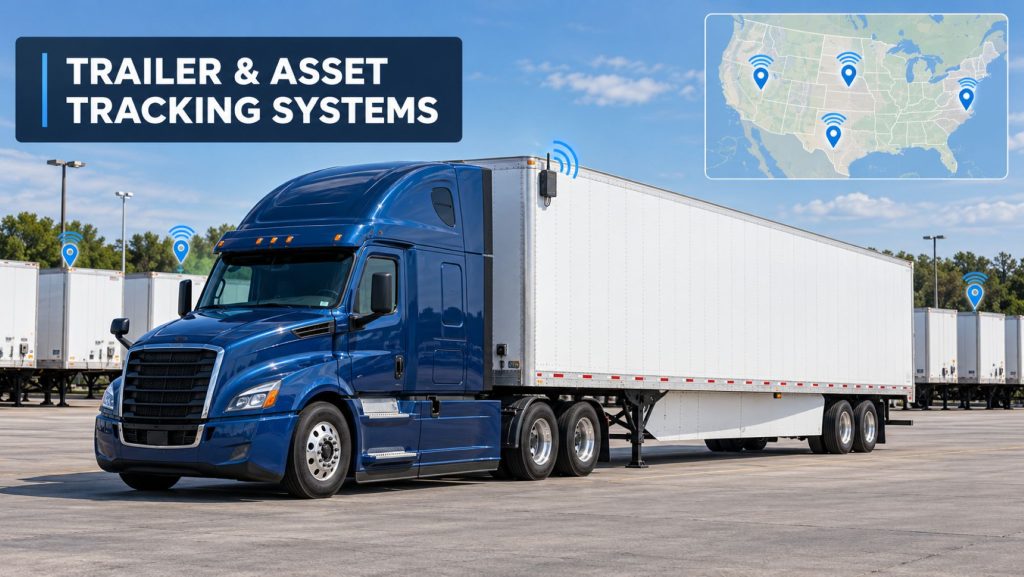
Trailer and asset tracking systems help commercial fleets monitor the location, movement, utilization, security, and operating condition of trailers, containers, chassis, construction equipment, and other mobile assets.
These systems combine GPS location data, cellular or satellite communication, onboard sensors, cloud-based software, alerts, and fleet-management tools. Depending on the equipment, fleets may monitor powered and unpowered assets, door activity, cargo status, temperature, tire condition, unauthorized movement, and maintenance needs.
Truck Equipment Atlas covers trailer-tracking gateways, solar-powered asset trackers, battery-operated tracking devices, smart-trailer systems, cargo sensors, door sensors, tire-monitoring integrations, and the software platforms used to manage connected equipment.
Trailer and Asset Tracking Products on Truck Equipment Atlas
Explore the trailer and asset tracking products being added to the Truck Equipment Atlas library:
Samsara
Motive
SkyBitz
Phillips Connect
Powerfleet
Additional trailer gateways, asset trackers, cargo sensors, door sensors, environmental monitors, smart-trailer systems, and equipment-management platforms will be added as the Truck Equipment Atlas Telematics and ELD Systems Library continues to expand.
How Trailer and Asset Tracking Systems Work
A tracking device installed on a trailer or mobile asset determines its location using GPS or another supported positioning network. The device transmits location and equipment-status information to a cloud-based fleet platform through cellular, satellite, or other wireless communication.
Fleet personnel can use a computer or mobile application to view the asset’s current location, movement history, utilization, dwell time, and operating status. The system may generate alerts when the asset enters or leaves a designated area, moves without authorization, remains idle too long, or experiences a monitored equipment problem.
Advanced smart-trailer systems can collect information from additional sensors installed throughout the trailer. These sensors may monitor cargo presence, door position, tire pressure, inflation-system operation, temperature, light status, braking-system faults, and other conditions.
Powered and Unpowered Asset Tracking
Powered tracking systems receive electrical power from the trailer, truck, machine, or equipment on which they are installed. A backup battery may preserve tracking and reporting when the primary power source is disconnected.
Unpowered tracking devices use an internal battery, rechargeable battery, or solar-charging system. These trackers can be used on equipment that does not have a dependable electrical supply, including containers, chassis, storage trailers, generators, construction equipment, and other remote assets.
The correct design depends on the asset, reporting frequency, available power supply, installation location, operating environment, expected service life, and communication coverage.
Major System Components
- GPS receiver
- Cellular or satellite modem
- Tracking gateway
- Internal or backup battery
- Solar charging panel when equipped
- External or integrated antenna
- Wiring harness and power connections
- Door, cargo, temperature, and motion sensors
- Tire-pressure and inflation-system sensors
- Brake and ABS monitoring connections
- Cloud-based fleet-management platform
- Mobile application
- Geofence and alert-management tools
- Application programming interface integrations
GPS Location and Movement History
GPS tracking allows authorized fleet personnel to locate trailers and other equipment without relying entirely on driver reports or manual yard checks.
Depending on the device and service plan, the platform may display current location, previous stops, route history, mileage, movement events, ignition or power status, and the time an asset entered or departed a location.
Reporting frequency can affect data detail, communication use, and battery life. A device reporting frequently while moving may provide more detailed location information but consume more power than a tracker using longer reporting intervals.
Geofences and Fleet Alerts
A geofence is a virtual boundary created around a customer location, terminal, yard, service facility, construction site, or other operating area.
The system can notify fleet personnel when an asset enters or leaves the boundary. Geofence information can support arrival and departure records, detention management, unauthorized-movement detection, yard organization, and customer-service updates.
Available alerts may include:
- Geofence entry or departure
- Unauthorized movement
- Extended dwell time
- Low device battery
- Loss of primary power
- Trailer-door opening or closing
- Cargo-status change
- Temperature outside an established range
- Tire or inflation-system warning
- Trailer mismatch or incorrect assignment
Trailer Utilization and Dwell-Time Management
Tracking information helps fleets determine which trailers are moving, parked, loaded, empty, available, assigned, or awaiting maintenance.
Utilization reports can identify equipment that remains idle for extended periods or spends excessive time at customer locations. This information can help dispatchers recover underused trailers, reduce unnecessary equipment purchases, improve trailer-to-tractor ratios, and support detention discussions.
Tracking data should be reviewed with dispatch, maintenance, customer, and operational information. Location alone may not confirm whether a trailer is loaded, available, safe to operate, or ready for assignment.
Cargo, Door, and Environmental Monitoring
Sensor-equipped trailer systems can provide information beyond basic GPS location.
Cargo sensors may help determine whether usable space remains inside a trailer. Door sensors can record opening and closing events or generate alerts when a door opens outside an approved location. Temperature and environmental sensors can help monitor sensitive freight when the system is correctly configured.
Sensor readings must be interpreted according to the equipment design, installation, calibration, communication status, and cargo environment. A telematics alert does not replace required physical inspections or approved cargo-handling procedures.
Tire, Brake, and Trailer-Health Monitoring
Advanced trailer telematics can connect with tire-pressure monitoring systems, automatic tire-inflation equipment, ABS controllers, brake systems, wheel-end sensors, lighting systems, and other trailer components.
These integrations may help fleets identify low tire pressure, inflation-system leaks, temperature concerns, ABS fault information, electrical problems, or other conditions before the trailer reaches its next scheduled inspection.
Remote condition data can support maintenance planning, but technicians must still inspect the trailer and verify the cause of an alert before returning equipment to service.
Common Applications
- Dry-van trailers
- Refrigerated trailers
- Flatbed trailers
- Tank trailers
- Intermodal containers and chassis
- Trailer leasing fleets
- Construction equipment
- Generators and compressors
- Mobile storage equipment
- Service and utility equipment
- Rental equipment
- Specialized mobile assets
Advantages
- Improves visibility of trailers and remote equipment
- Reduces time spent performing manual yard searches
- Supports equipment-utilization analysis
- Helps identify excessive dwell time
- Provides movement and location history
- Can generate unauthorized-movement alerts
- Supports cargo and door monitoring
- Can provide remote trailer-health information
- Helps dispatchers identify available equipment
- May support theft recovery and cargo-security efforts
Limitations and Considerations
- Requires dependable communication coverage
- Battery-powered devices require power-management planning
- Solar charging depends on installation and operating conditions
- Hardware and subscription costs vary
- Incorrect installation can reduce GPS or cellular performance
- Sensor readings may require calibration and physical verification
- Data must be integrated into fleet workflows to provide full value
- Devices may be damaged by impacts, corrosion, water, debris, or tampering
- Cybersecurity and authorized data access must be managed
- Tracking data does not replace required vehicle and trailer inspections
Installation and Device Placement
Tracking hardware must be mounted where it remains protected without unnecessarily restricting GPS reception, cellular communication, sensor operation, trailer service, or cargo access.
Installation considerations include:
- Primary and backup power availability
- GPS and cellular signal exposure
- Solar-panel orientation when equipped
- Protection from road debris and water intrusion
- Protection from cargo and loading equipment
- Access for inspection and replacement
- Wiring-harness routing
- Sensor range and mounting position
- Protection against tampering or theft
- Compatibility with trailer and equipment structures
Inspection and Maintenance
Tracking devices and sensors should be inspected with the trailer or asset’s other electrical and structural equipment.
Maintenance may include checking mounting hardware, wiring, connectors, antennas, solar panels, batteries, seals, sensor alignment, communication status, and software configuration. Damaged wiring or loose mounting can produce intermittent reporting or inaccurate equipment information.
Fleets should also monitor device-health reports and identify units that have stopped communicating, lost primary power, developed weak batteries, or failed to report expected sensor information.
Selecting a Trailer or Asset Tracking System
The correct tracking system depends on the assets being monitored, available power, reporting requirements, communication coverage, operating environment, sensor needs, software integrations, and total ownership cost.
Important selection factors include:
- Powered or unpowered asset design
- Battery life and charging method
- Location-reporting frequency
- Cellular or satellite coverage
- Geofence and alert capabilities
- Cargo, door, tire, brake, and temperature sensor support
- Installation requirements
- Weather and impact resistance
- Fleet-management software compatibility
- Application programming interface availability
- Hardware, activation, and subscription costs
- Warranty and technical support
Related Telematics and ELD System Categories
- Electronic Logging Devices & HOS Compliance
- Fleet Telematics & Vehicle Gateways
- AI Dash Cameras & Video Telematics
- Driver Communication & Workflow Systems
- Remote Diagnostics & Fleet Intelligence
Related Guides
- How Commercial Truck Telematics Systems Work
- Electronic Logging Devices and Hours-of-Service Compliance Explained
- How to Choose a Commercial Truck ELD and Telematics System
- GPS Fleet Tracking and Vehicle Telematics Explained
- AI Dash Cameras and Video Telematics Explained
- Commercial Trailer and Asset Tracking Systems Explained
Related Equipment Systems
Trailer and Asset Tracking Library Expansion
Truck Equipment Atlas will continue expanding this section with profiles covering GPS trailer trackers, smart-trailer gateways, solar-powered asset trackers, cargo sensors, door sensors, environmental monitors, tire and wheel-end integrations, trailer-health systems, and fleet-management platforms.
Future pages will examine hardware construction, power requirements, reporting capabilities, sensor compatibility, installation, communication methods, software integration, maintenance, and real-world fleet applications.
Explore the Complete Telematics and ELD Systems Hub
Visit the Telematics & ELD Systems hub to explore electronic logging devices, fleet gateways, AI dash cameras, trailer tracking systems, driver communication platforms, remote diagnostics, fleet intelligence tools, individual product profiles, and educational guides.
Follow the Growth of Truck Equipment Atlas
Truck Equipment Atlas continues to expand with new truck profiles, trailer coverage, diesel engine pages, equipment-system resources, manufacturer information, and educational guides.
Visit our Site Updates page to explore recent additions, project milestones, and upcoming resources as we continue building one of the industry’s growing commercial trucking equipment reference libraries.
View the Latest Site Updates: Truck Equipment Atlas Site Updates