
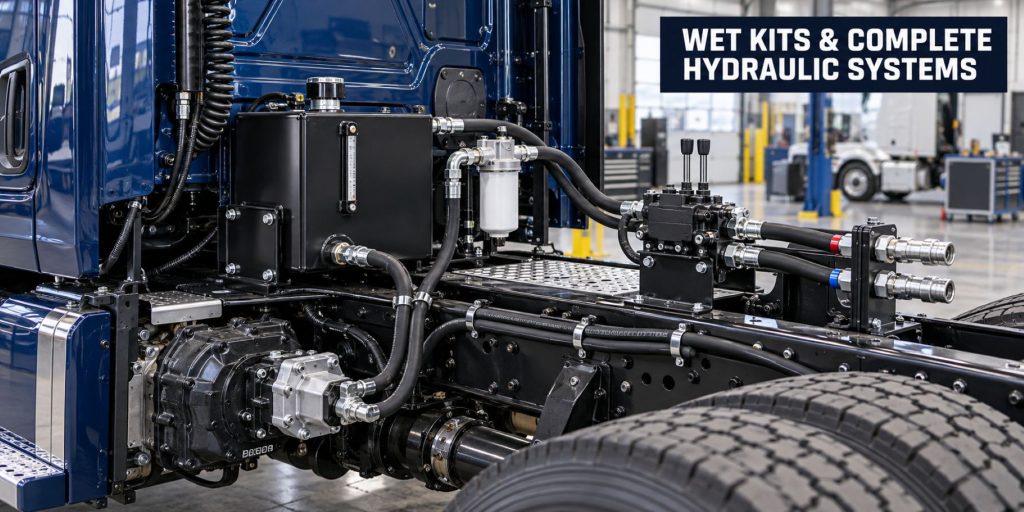
Commercial truck wet kits combine the components needed to supply hydraulic power from a tractor or vocational truck to a trailer, body, or other piece of working equipment.
A typical wet kit can include a power take-off, hydraulic pump, reservoir, control valve, hoses, fittings, filters, controls, and mounting hardware. The exact configuration depends on the equipment being powered and its required flow, pressure, fluid capacity, and duty cycle.
Truck Equipment Atlas covers complete wet kits, application-specific hydraulic packages, and the individual components used throughout commercial truck and trailer hydraulic systems.
Wet Kits and Complete Hydraulic Systems on Truck Equipment Atlas
Explore the commercial truck wet kits and complete hydraulic systems currently covered on Truck Equipment Atlas:
Additional single-line, two-line, three-line, dump-trailer, walking-floor, lowboy, tanker, and vocational hydraulic packages will be added as the Truck Equipment Atlas PTO & Hydraulic Systems Library continues to expand.
How Commercial Truck Wet Kits Work
A wet kit transfers mechanical power from the truck’s engine or transmission into hydraulic power that can operate trailer or body equipment.
In a common transmission-driven system, the PTO engages a compatible transmission gear and turns the hydraulic pump. The pump draws fluid from the reservoir and sends it through the pressure side of the hydraulic circuit.
Hydraulic fluid travels through valves, hoses, fittings, cylinders, or motors before returning to the reservoir. The circuit design determines whether the system can raise a dump trailer, operate a walking floor, detach a lowboy gooseneck, drive a blower, or perform another hydraulic function.
A typical wet kit can include:
- Power take-off
- Hydraulic pump
- Hydraulic reservoir
- Directional-control valve
- Pressure-relief valve
- Suction hose
- Pressure hose
- Return hose
- Hydraulic fittings and adapters
- Quick-connect couplers
- Filters, strainers, and breathers
- Air, mechanical, or electronic controls
- Mounting brackets and hardware
- Hydraulic-fluid cooler where required
Every component must be compatible with the complete system’s flow, pressure, fluid, temperature, operating speed, and duty-cycle requirements.
Common Wet-Kit Configurations
Commercial truck wet kits are available in several configurations. The correct design depends on how hydraulic fluid must travel between the truck and the powered equipment.
Common configurations include:
- Single-line wet kits
- Two-line wet kits
- Three-line wet kits
- Dump-trailer wet kits
- Walking-floor wet kits
- Lowboy and detachable-gooseneck wet kits
- Liquid-product pump systems
- Dry-bulk blower systems
- Combination hydraulic systems
- Continuous-duty hydraulic systems
- Self-contained hydraulic power units
- Truck-body hydraulic packages
The number of hydraulic lines does not by itself determine whether a wet kit is suitable for an application. Pump design, valve configuration, reservoir capacity, filtration, cooling, and equipment requirements must also be evaluated.
Single-Line Wet Kits
A single-line wet kit commonly uses one main hydraulic hose between the tractor and trailer. The same line can serve different functions as the control valve changes the direction of fluid movement.
Single-line systems are frequently associated with end-dump and dump-trailer applications. Depending on the circuit, hydraulic pressure extends the trailer cylinder, while gravity lowers the body and returns fluid through the same line.
A single-line system can be relatively simple, but it must be correctly matched to the trailer cylinder, pump, control valve, reservoir, hose size, couplers, and required operating pressure.
Two-Line Wet Kits
A two-line wet kit uses separate pressure and return connections between the truck and the powered equipment.
The pump sends pressurized fluid through the pressure line. After passing through the trailer valve, motor, cylinder, or other hydraulic equipment, the fluid returns to the truck’s reservoir through a separate return line.
Two-line systems may be used with:
- Walking-floor trailers
- Hydraulic motors
- Specialized dump systems
- Detachable-gooseneck trailers
- Hydraulic conveyors
- Augers
- Trailer-mounted equipment
The return circuit must be large enough to carry the required flow without creating excessive restriction, heat, or backpressure.
Three-Line Wet Kits
A three-line wet kit typically uses separate suction, pressure, and return circuits. The pump receives fluid through a dedicated suction line, sends it to the powered equipment through the pressure line, and receives returning fluid through a separate return line.
This arrangement can improve fluid circulation, reduce pump-inlet restriction, support effective filtration, and help manage heat in demanding applications.
Three-line systems are often considered for:
- Walking-floor trailers
- Continuous-duty hydraulic motors
- High-flow hydraulic systems
- Multiple trailer functions
- Applications requiring return-line filtration
- Equipment with demanding cooling requirements
The complete system must still be matched to the trailer or body manufacturer’s hydraulic specifications.
Dump-Trailer Wet Kits
Dump-trailer wet kits provide the hydraulic power needed to extend the trailer’s hoist cylinder and raise the body.
A typical system can include a transmission-mounted PTO, dump pump, hydraulic reservoir, control valve, pressure hose, quick-connect coupler, return plumbing where required, and cab-mounted controls.
Important selection factors include:
- Trailer cylinder displacement
- Maximum operating pressure
- Required pump flow
- Reservoir capacity
- Single-line or multi-line circuit design
- PTO speed ratio
- Pump rotation
- Hydraulic hose size
- Coupler compatibility
- Body-raising time
- Duty cycle
The tractor wet kit and trailer hydraulic system must use compatible pressure ratings, fluid, fittings, couplers, and operating procedures.
Walking-Floor Wet Kits
Walking-floor trailers use hydraulic cylinders and control systems to move floor slats in a repeating sequence. This allows material to be loaded or unloaded without raising the trailer body.
These systems can require sustained hydraulic flow, effective filtration, suitable reservoir capacity, unrestricted return plumbing, and adequate heat control.
A walking-floor wet kit may require:
- Two-line or three-line plumbing
- Continuous-duty hydraulic pump
- High-capacity reservoir
- Return-line filtration
- Temperature monitoring
- Hydraulic-fluid cooler where required
- Correct pressure and return couplers
- Trailer-specific flow and pressure settings
A dump-trailer wet kit should not be assumed suitable for a walking-floor trailer without confirming the complete hydraulic specification.
Lowboy and Detachable-Gooseneck Wet Kits
Hydraulic detachable-gooseneck trailers use hydraulic power to connect, disconnect, raise, lower, or position the gooseneck during loading and unloading.
Some trailers receive hydraulic power from the tractor wet kit, while others use a self-contained power unit mounted on the trailer.
Compatibility depends on:
- Trailer manufacturer
- Gooseneck design
- Required pressure
- Required flow
- Hydraulic-fluid capacity
- Valve arrangement
- Coupler type and size
- Control-system requirements
- Hydraulic-line routing
- Operating procedure
The wet kit must also provide enough clearance for tractor movement, trailer articulation, and changes in deck or gooseneck position.
Dry-Bulk and Liquid-Product Systems
Tank and bulk-hauling applications can use PTO-driven hydraulic systems to operate product pumps, compressors, blowers, hose reels, valves, and unloading equipment.
These applications may have different requirements from conventional trailer wet kits. Some systems use hydraulic motors to drive product-handling equipment, while others use a PTO-driven shaft, pump, compressor, or blower.
Product compatibility, equipment speed, system temperature, contamination control, grounding, hazardous-material requirements, and unloading procedures must be considered when specifying these systems.
Hydraulic Flow, Pressure, and Reservoir Capacity
Wet-kit performance depends on correctly matching hydraulic flow, system pressure, and fluid capacity.
Flow affects how quickly a cylinder moves or a hydraulic motor turns. Pressure reflects the resistance created by the load and determines the force or torque available from the actuator.
Reservoir capacity affects:
- Available hydraulic-fluid volume
- Fluid cooling
- Air separation
- Contaminant settling
- Expansion space
- System operating time
- Cylinder displacement capacity
A reservoir that is too small can contribute to overheating, aeration, fluid starvation, overflow, and inconsistent equipment operation.
Hydraulic Fluid, Filtration, and Cooling
The hydraulic fluid must meet the requirements of the pump, valves, cylinders, motors, trailer, truck body, and expected operating temperatures.
Clean fluid is critical because contamination can damage pumps, score valve surfaces, wear cylinder seals, restrict small passages, and reduce system reliability.
Fluid-management components can include:
- Suction strainers
- Pressure filters
- Return-line filters
- Reservoir breathers
- Magnetic drain plugs
- Temperature gauges
- Level indicators
- Hydraulic-fluid coolers
- Thermostatic controls
Continuous-duty and high-flow systems may require more filtration and cooling capacity than an intermittent dump-body system.
Wet-Kit Controls and Safety Interlocks
Wet-kit controls can be mounted in the cab, on the truck frame, on the trailer, or through a remote-control system.
Possible controls and interlocks include:
- PTO engagement switch
- PTO indicator light
- Raise and lower control
- Hydraulic-motor control
- Engine-speed control
- Transmission-neutral interlock
- Parking-brake interlock
- Body-up warning
- Tailgate interlock
- Pressure warning
- Temperature warning
- Emergency stop
- Remote equipment control
The system must be configured so the operator can control equipment safely without creating unintended vehicle or trailer movement.
Common Wet-Kit Applications
Wet kits and complete hydraulic systems are used throughout commercial trucking and vocational equipment.
Common applications include:
- End-dump trailers
- Side-dump trailers
- Dump trucks
- Walking-floor trailers
- Detachable-gooseneck trailers
- Lowboy trailers
- Liquid tank trailers
- Dry-bulk trailers
- Refuse trucks
- Roll-off and hooklift trucks
- Tow trucks and recovery vehicles
- Utility and service trucks
- Truck-mounted cranes
- Concrete equipment
- Forestry equipment
- Agricultural trucks
- Specialized transport equipment
Each application requires a wet kit matched to the powered equipment rather than a one-size-fits-all hydraulic package.
Advantages of Complete Wet-Kit Systems
Depending on the application, a properly specified wet kit can provide several advantages:
- Packages compatible hydraulic components together
- Uses the truck’s engine and transmission as the power source
- Can power multiple truck and trailer applications
- Reduces the need for a separate trailer engine
- Supports compact chassis installation
- Can simplify component selection
- Provides application-specific flow and pressure
- Can include matched controls and safety interlocks
- Provides centralized fluid storage and filtration
- Can be configured for intermittent or continuous duty
A complete package can simplify installation, but the system must still be verified against the truck, transmission, trailer, and powered equipment.
Limitations and Considerations
Wet kits and complete hydraulic systems also have important limitations and installation considerations:
- No single wet kit is suitable for every trailer or body
- The PTO must match the exact transmission
- The pump must provide the correct flow and rotation
- Reservoir capacity must match the hydraulic circuit
- Incorrect hose sizing can cause restriction and heat
- Contamination can damage pumps, valves, cylinders, and motors
- Hydraulic leaks can create safety and environmental hazards
- Continuous-duty systems may require additional cooling
- Truck frame space may be limited
- Fuel tanks, battery boxes, exhaust systems, and aftertreatment can restrict installation
- Quick-connect couplers must match the trailer
- Improper operation can damage the truck or trailer
The complete hydraulic specification should be confirmed before purchasing or installing a wet kit.
Driver and Operator Considerations
Safe wet-kit operation requires the driver to understand the PTO, transmission, engine-speed, trailer, hydraulic-control, and equipment procedures for the complete system.
Operators should monitor:
- PTO engagement
- Engine operating speed
- Hydraulic pressure
- Hydraulic-fluid temperature
- Reservoir fluid level
- Hose and coupler condition
- Body or trailer position
- Equipment warning indicators
- Leaks or unusual noise
- Overhead and side clearance
- Ground stability and trailer position
The operator should never move a vehicle with raised equipment unless the complete system and operating procedure specifically permit it.
Maintenance and Ownership
Wet-kit reliability depends on correct installation, clean hydraulic fluid, proper filtration, secure hose routing, and routine inspection.
Important maintenance areas include:
- Hydraulic-fluid level and condition
- Reservoir, filler cap, and breather
- PTO and pump mounting
- Suction, pressure, and return hoses
- Quick-connect couplers
- Hydraulic fittings and adapters
- Filters and strainers
- Control valves
- Pressure-relief valve settings
- Air and electrical controls
- Mounting brackets and fasteners
- Fluid temperature
- Hydraulic leaks
- Unusual pump noise or vibration
Slow operation, overheating, foaming fluid, pump noise, pressure loss, leaks, or erratic equipment movement should be investigated before the system is returned to normal service.
Wet-Kit and Hydraulic-System Manufacturers
Commercial wet kits and hydraulic-system components are produced by manufacturers serving the commercial vehicle, mobile hydraulic, trailer, and vocational-equipment industries.
Manufacturers represented in the expanding Truck Equipment Atlas library include:
- Muncie Power Products
- Parker Chelsea
- Parker Hannifin
- Permco
- Bezares
- Hydro Leduc
- Sunfab
- Danfoss
Complete packages can also include components supplied by multiple manufacturers and assembled by truck dealers, body builders, trailer dealers, hydraulic installers, and vocational-equipment specialists.
Related PTO and Hydraulic Categories
Explore additional commercial PTO and hydraulic-equipment categories:
- Power Take-Off Systems
- Hydraulic Pumps & Motors
- Hydraulic Cylinders & Dump Hoists
- Hydraulic Valves, Controls & Reservoirs
- Hydraulic Hoses, Fittings & Filtration
Related PTO and Hydraulic Guides
Explore educational resources covering PTO operation, hydraulic systems, component selection, wet kits, inspection, and maintenance:
- How Commercial Truck PTO and Hydraulic Systems Work
- Commercial Truck Power Take-Off Types Explained
- How to Choose a PTO and Hydraulic Pump
- Commercial Truck Wet Kits Explained
- How to Inspect and Maintain Truck Hydraulic Systems
Visit the PTO & Hydraulic System Guides page to explore the complete educational guide collection.
Explore the Complete PTO & Hydraulic Systems Library
Wet kits represent one part of the larger commercial truck hydraulic and vocational-equipment system.
Visit the Truck Equipment Atlas PTO & Hydraulic Systems Library to explore power take-offs, pumps, motors, wet kits, cylinders, hoists, valves, controls, reservoirs, hoses, fittings, filters, and complete hydraulic systems.
Additional wet-kit profiles, hydraulic packages, application guides, and educational resources will be added as Truck Equipment Atlas continues to expand.
Support Trucking Families
Truck Equipment Atlas supports the mission of Grey Cross, a nonprofit dedicated to helping families of truck drivers who lose their lives while on the road. As the site grows, part of its mission is to bring awareness and support to these families.
Follow the Growth of Truck Equipment Atlas
Truck Equipment Atlas continues to expand with new truck profiles, trailer coverage, diesel engine pages, equipment-system resources, manufacturer information, and educational guides.
Visit our Site Updates page to explore recent additions, project milestones, and upcoming resources as we continue building one of the industry’s growing commercial trucking equipment reference libraries.