
Accuride Commercial-Vehicle Steel Wheel
Quick Facts
- Manufacturer: Accuride Corporation
- Product Type: Commercial-vehicle steel wheel family
- Wheel Category: Medium- and heavy-duty truck, trailer, bus, and vocational wheel
- Material: Formed high-strength steel
- Construction: Disc wheel with welded rim and disc assembly
- Common Diameters: Application-specific, including 17.5-, 19.5-, 22.5-, and 24.5-inch configurations
- Common Widths: Application-specific standard-width and wide-base configurations
- Mounting Types: Hub-piloted, stud-piloted, and application-specific mounting
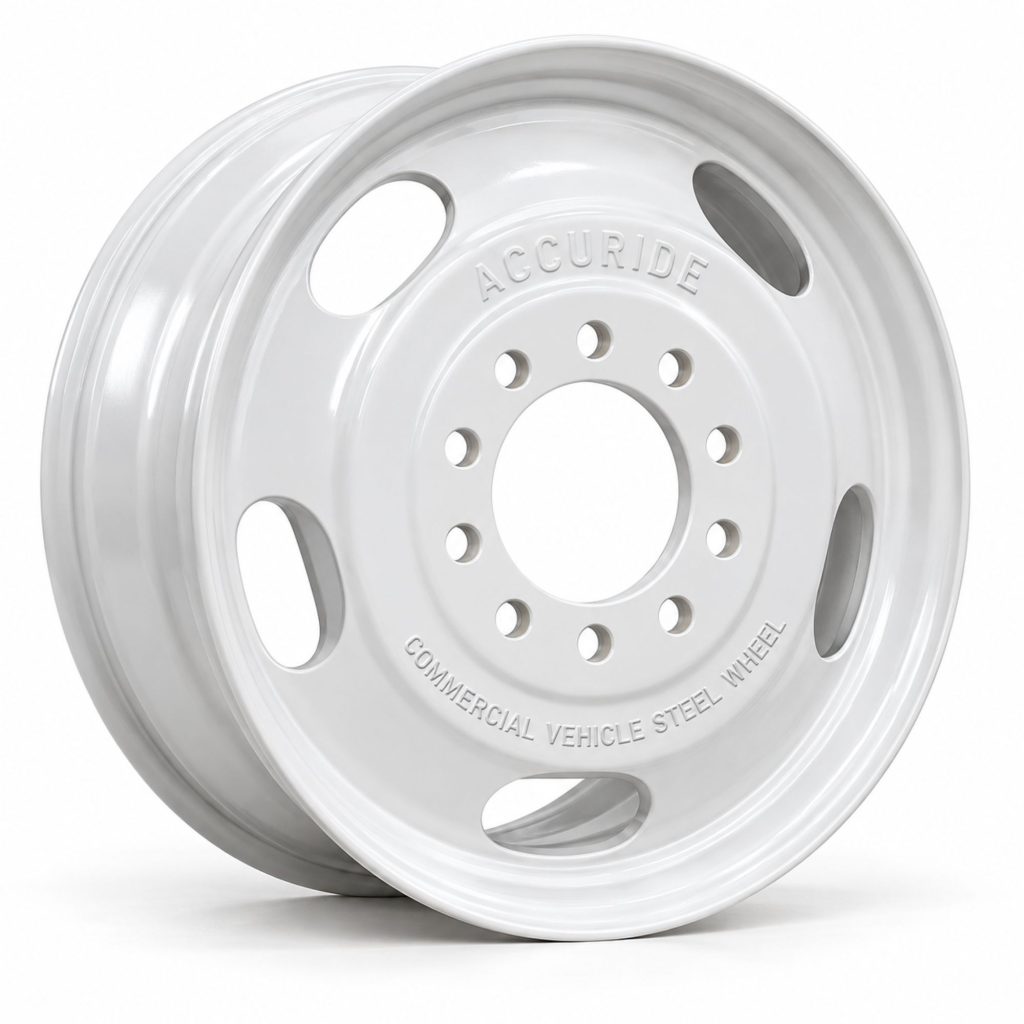
- Available Hand-Hole Patterns: Part-number-specific, including two-, five-, and ten-hand-hole designs
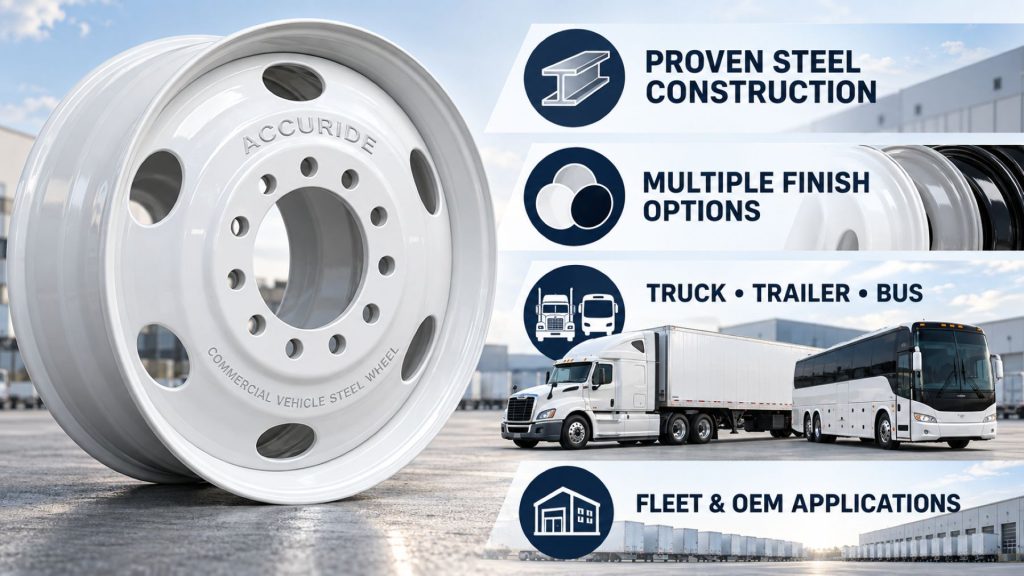
- Finish Options: Application-specific powder coatings and protective treatments, including Steel Armor
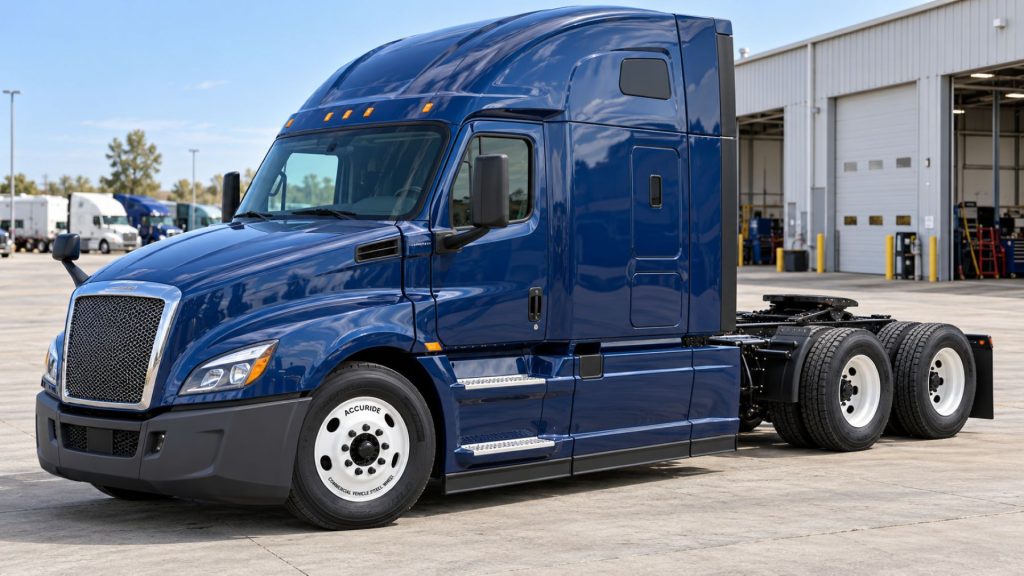
- Primary Applications: Highway tractors, straight trucks, trailers, buses, vocational vehicles, and severe-service equipment
- Production Status: Current family with legacy and superseded part numbers also in service
- Primary Benefit: Durable, cost-effective commercial wheel offered across a broad range of vehicle applications
Overview
Accuride Commercial-Vehicle Steel Wheels are used throughout the medium- and heavy-duty truck, trailer, bus, and vocational markets. The company offers a broad selection of steel wheels for different tire sizes, axle positions, bolt patterns, center bores, offsets, load ratings, and mounting systems.
Steel wheels provide a durable and economical alternative to forged-aluminum wheels. They are commonly selected for fleet standardization, demanding operating environments, painted-wheel applications, and vehicles where initial purchase cost is a major consideration.
This page covers the wider Accuride commercial steel-wheel family rather than one individual part number. Exact weight, capacity, dimensions, inflation rating, hand-hole pattern, valve, finish, and intended application must be confirmed using the complete wheel identification.
Key Characteristics
- Commercial-grade formed-steel construction
- Broad medium- and heavy-duty application coverage
- Hub-piloted and stud-piloted configurations
- Standard-width and wide-base wheel options
- Multiple diameters, widths, offsets, and capacities
- Different hand-hole patterns for weight, airflow, and service access
- Truck, tractor, trailer, bus, and vocational applications
- Painted and protective coating options
- Steel Armor finish available on selected configurations
- Accu-Lite lightweight steel models within the wider family
- Serviceable through established commercial-wheel procedures
- Part-number-specific tire and vehicle compatibility
Major Components
- Formed-steel rim
- Stamped-steel wheel disc
- Disc-to-rim weld
- Inboard and outboard rim flanges
- Tire bead seats
- Drop center
- Hub mounting face
- Center bore
- Bolt holes
- Hand holes or ventilation openings
- Valve-stem opening
- Valve stem and sealing components
- Wheel-nut contact surfaces
- Identification and rating markings
- Paint, powder coating, or protective surface treatment
Wheel Type and Design
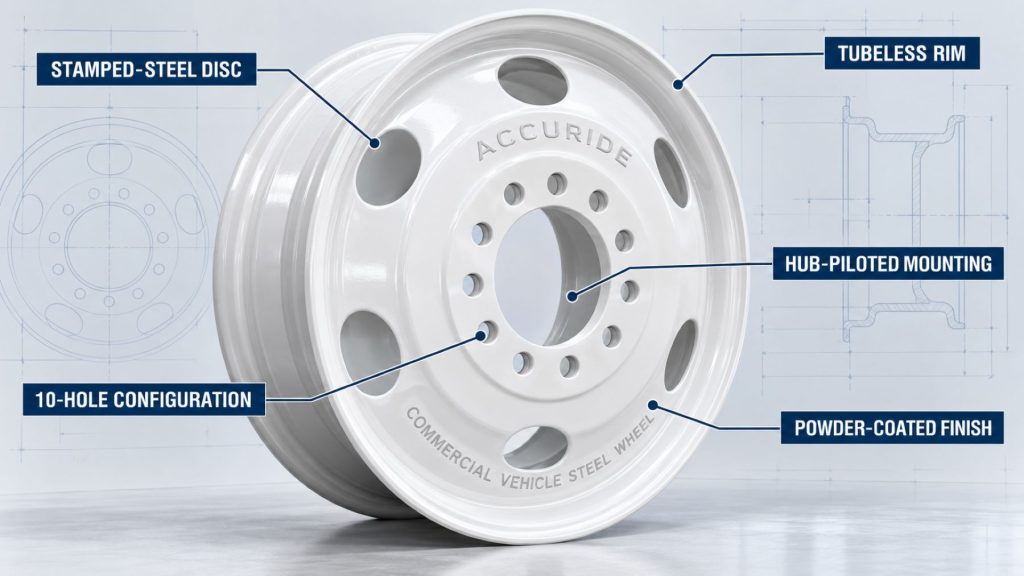
Accuride steel wheels typically combine a formed rim with a stamped center disc. The disc is positioned within the rim to establish the required offset and is permanently joined to the rim through controlled welding.
The disc carries the bolt holes, center bore, mounting face, and hand holes. Its thickness and shape are engineered for the wheel’s intended load, hub, brake system, and operating environment.
Different designs may be optimized for highway use, transit service, vocational operation, wide-base tires, reduced weight, increased capacity, or specific original-equipment mounting systems.
How the Wheel Supports the Vehicle
The wheel connects the tire to the vehicle’s hub and axle. Vehicle and cargo weight passes through the axle, hub, wheel disc, rim, and inflated tire before reaching the road.
Acceleration and braking torque also pass through the wheel-to-hub connection. Correct fastener clamping force keeps the mounting face firmly seated against the hub so these forces can be transferred without unwanted wheel movement.
The rim supports the tire beads and contains the tire’s inflation pressure. Its size, contour, load rating, and inflation rating must match the tire and operating application.
Position and Function Within the Vehicle
Depending on the part number, an Accuride steel wheel may be installed at a steer, drive, trailer, tag, pusher, or bus axle position. Some models support single mounting, some support dual mounting, and others are designed for wide-base single tires.
The wheel performs several functions:
- Supports the tire and inflation pressure
- Transfers vehicle and cargo weight
- Transfers acceleration and braking torque
- Maintains the tire beads in their operating position
- Establishes axle track width and dual spacing
- Provides clearance around brakes and wheel-end components
- Provides ventilation and service access through the hand holes
- Connects the tire assembly securely to the hub
Common Specifications
- Material: Commercial-grade steel
- Construction: Formed rim with welded stamped-steel disc
- Wheel Diameter: Part-number-specific, commonly including 17.5, 19.5, 22.5, and 24.5 inches
- Wheel Width: Application-specific standard-width and wide-base configurations
- Mounting: Hub-piloted, stud-piloted, or application-specific
- Bolt Pattern: Part-number-specific
- Center Bore: Part-number-specific
- Hand Holes: Commonly two, five, or ten, depending on model
- Offset: Application-specific
- Load Rating: Application-specific
- Maximum Inflation: Application-specific
- Valve Equipment: Part-number-specific commercial valve stem
- Finish: Painted, powder-coated, Steel Armor, or another approved Accuride finish
- Tire Compatibility: Determined by rim size, load, inflation, and approved tire dimensions
Load Ratings and Operating Capacity
Accuride steel-wheel capacity varies considerably across the product family. Published 22.5 × 8.25-inch examples include ratings from approximately 7,400 to 8,000 pounds per wheel, while selected 22.5 × 9.00-inch wheels may carry ratings of 9,000, 10,000 pounds, or more.
Wide-base and specialized steel wheels may have still different capacities. The wheel’s stamped load and inflation ratings must be checked instead of applying one family-level specification to every model.
The safe capacity of the completed assembly is controlled by its lowest-rated component, which may be the wheel, tire, valve, hub, axle, suspension, brake system, or completed vehicle.
Wheel Size, Offset, and Dual Spacing
Wheel diameter and rim width must match an approved tire size. Offset establishes the relationship between the rim centerline and the hub mounting face and affects track width, bearing loading, brake clearance, suspension clearance, and tire position.
Dual-mounted wheels must provide sufficient space between the inflated and loaded tires. Incorrect offset, mismatched tires, low inflation, or overloading can allow the sidewalls to contact each other and generate damaging heat.
Wheels with similar diameters and bolt patterns may still use different offsets, disc thicknesses, center bores, load ratings, or mounting systems. Similar appearance does not establish interchangeability.
Hub, Fastener, and Mounting System
Many modern Accuride steel wheels use hub-piloted mounting with two-piece flange nuts. The hub pilots center the wheel, while the flange nuts provide the clamping force needed to secure it.
Older and specialized vehicles may use stud-piloted wheels with inner and outer cap nuts. Stud-piloted and hub-piloted wheels require different wheel designs and mounting hardware and should not be interchanged.
Mounting faces must be clean, flat, and free of rust scale, debris, excessive paint, oil, and damaged material. Fasteners must be tightened in the correct sequence to the required torque using calibrated equipment.
Tire and Valve Compatibility
The tire must be approved for the wheel’s diameter, width, contour, load rating, and inflation capacity. An otherwise compatible tire must not require more pressure or load capacity than the wheel and valve can safely support.
Valve-stem style depends on the wheel part number, mounting position, tire-pressure system, and required service access. Dual-mounted wheels require valve orientation that permits pressure checks and inflation without damaging the stems or extensions.
Wide-base steel wheels require approved wide-base tires, offsets, hubs, and axle arrangements. A standard dual wheel should not be substituted solely because it shares the same nominal diameter.
Brake and Wheel-End Compatibility
The wheel must provide adequate clearance for the brake drum or air-disc-brake rotor and caliper. Disc shape, offset, hand-hole design, and mounting-face location can affect available clearance.
The wheel must also match the hub, wheel studs, nuts, bearings, axle rating, and tire-pressure equipment. Brake, steering, suspension, and hub components must not contact the wheel during normal travel, steering, or thermal expansion.
Steel wheels can retain and transfer heat differently from aluminum wheels. Operators must still correct dragging brakes, bearing problems, underinflated tires, overloading, and other conditions that generate excessive wheel-end temperature.
Installation and Mounting
Installation should be performed by trained commercial tire and wheel personnel. Before mounting, technicians should verify the part number, wheel dimensions, mounting system, offset, tire size, load rating, inflation rating, valve equipment, and brake clearance.
Important installation practices include:
- Inspecting the wheel for cracks, distortion, corrosion, and damaged welds
- Confirming the tire and rim sizes match
- Using approved tire-mounting lubricant
- Cleaning the wheel and hub mounting faces
- Using the correct wheel studs and nuts
- Confirming adequate thread engagement
- Tightening fasteners in the specified sequence
- Applying the required torque with calibrated equipment
- Checking valve clearance and accessibility
- Verifying dual-tire spacing where applicable
- Checking brake, suspension, steering, and body clearance
- Following fleet procedures for post-installation inspection
Vehicle, Axle, and Wheel-End Compatibility
Compatibility depends on the complete wheel part number and vehicle specification. Selection must account for:
- Vehicle manufacturer, model, and model year
- Axle position and gross axle weight rating
- Hub-piloted or stud-piloted mounting
- Bolt pattern and center bore
- Wheel-stud length and thread specification
- Required wheel-nut design
- Wheel diameter and rim width
- Offset, inset, or outset
- Single, dual, or wide-base mounting
- Tire size, load range, and inflation pressure
- Brake-drum or air-disc-brake clearance
- Valve and tire-pressure system
- Suspension, steering, body, and chassis clearance
Common Applications
- Long-haul highway tractors
- Regional-haul tractors
- Commercial straight trucks
- Dry van trailers
- Refrigerated trailers
- Flatbed trailers
- Tank trailers
- Dump trucks
- Refuse vehicles
- Concrete mixers
- Transit and school buses
- Municipal trucks
- Construction vehicles
- Emergency and specialty equipment
Advantages
- Broad range of commercial-vehicle applications
- Generally lower initial cost than forged-aluminum wheels
- Durable construction for demanding fleet use
- Multiple sizes, offsets, capacities, and mounting systems
- Hub-piloted and stud-piloted availability
- Standard-width and wide-base configurations
- Multiple hand-hole designs
- Protective coating options for corrosion resistance
- Accu-Lite lightweight steel configurations available
- Familiar service procedures and widespread parts support
- Can be refinished when permitted and properly inspected
- Supports fleet standardization across many vehicle types
Limitations or Considerations
- Generally heavier than a comparable forged-aluminum wheel
- Damaged coating can expose steel to corrosion
- Rust scale can develop on neglected mounting surfaces
- Specifications vary widely across the product family
- Similar-looking wheels may not be interchangeable
- Excessive paint thickness can affect mounting security
- Incorrect fasteners or torque can allow wheel movement
- Severe corrosion can weaken critical areas
- Bent, cracked, or damaged wheels require proper evaluation
- Wide-base configurations require exact axle and offset matching
- Legacy part numbers may have current replacements or supersessions
- The wheel does not increase certified vehicle weight ratings
Driver and Operator Experience
A correctly installed steel wheel should operate without noticeable vibration, movement, or noise. Compared with aluminum, its additional weight may slightly increase unsprung and rotating mass, although the practical difference depends on the wheel design and vehicle application.
Drivers should report steering shake, repeated pressure loss, unusual wheel-end heat, visible wheel movement, damaged valve equipment, missing fasteners, or abnormal tire wear. These symptoms may indicate a tire, wheel, mounting, brake, hub, or suspension problem.
Inspection and Wear Points
Routine inspection should include:
- Inboard and outboard rim flanges
- Tire bead seats
- Rim and disc welds
- Bolt holes
- Center bore and hub-pilot contact surfaces
- Mounting face
- Hand holes and ventilation openings
- Valve-stem hole and valve hardware
- Wheel-nut contact surfaces
- Paint or coating condition
- Rust scale and corrosion
- Cracks, impact damage, bending, or distortion
- Evidence of loose-wheel operation
- Air leakage around the bead or valve
A wheel involved in a collision, severe pothole impact, curb strike, tire failure, loose-wheel event, fire, or wheel-end overheating should receive a detailed inspection before reuse.
Cleaning and Finish Care
Steel wheels should be cleaned regularly to remove road salt, mud, brake dust, oil, and other contamination. Keeping the finish intact helps prevent moisture and deicing chemicals from reaching the underlying steel.
Cleaning products must be compatible with the wheel’s paint, powder coating, or protective treatment. Aggressive chemicals and abrasive tools can damage the finish and accelerate corrosion.
Mounting surfaces require particular attention. Loose rust, dirt, excess paint, and corrosion buildup must not remain between the wheel, hub, or adjacent dual wheel because these materials can reduce clamping force after installation.
Balancing, Alignment, and Runout
Correct balance helps control vibration, tire wear, and driver fatigue. Before adding balance weight, technicians should confirm proper tire seating, clean mounting surfaces, correct wheel centering, and acceptable tire, wheel, and hub runout.
Persistent vibration may result from tire nonuniformity, a bent wheel, improper mounting, hub runout, brake-drum or rotor imbalance, bearing problems, suspension wear, steering issues, or driveline vibration.
Axle alignment and steering geometry have a major effect on tire wear. Irregular wear should prompt inspection of inflation pressure, alignment, bearings, suspension components, wheel runout, and vehicle loading.
Wheel Service Life and Refinishing
Service life depends on loading, inflation pressure, operating environment, corrosion exposure, impact history, wheel-end temperature, mounting practices, and maintenance quality. There is no single replacement interval for every Accuride steel wheel.
A steel wheel may be cleaned and refinished when its structure remains serviceable and the procedure complies with manufacturer guidance. Critical mounting dimensions, identification markings, welds, and inspection surfaces must remain visible and undamaged.
Cracked, severely corroded, distorted, improperly repaired, or excessively worn wheels must be removed from service. Welding, heating, uncontrolled straightening, drilling, or other unauthorized modification can change the wheel’s strength.
Maintenance and Ownership Notes
- Maintain tire pressure according to load and tire requirements
- Inspect the wheel whenever the tire is removed
- Keep mounting surfaces clean and flat
- Use the correct fasteners and service tools
- Follow the specified tightening sequence and torque
- Inspect bolt holes for movement or elongation
- Check welds and hand holes for cracking
- Monitor paint and protective coating condition
- Remove loose rust and corrosion from mounting surfaces
- Check valves and pressure-system hardware for leaks
- Investigate vibration and repeated pressure loss promptly
- Record complete wheel part numbers
- Verify superseded numbers before ordering replacements
- Follow Accuride’s wheel safety and service instructions
Common Wheel Problems
- Corrosion: Damaged coating, road salt, moisture, and neglected cleaning can cause surface rust or more serious material loss.
- Loose fasteners: Incorrect torque, dirty mounting faces, excessive paint, wrong hardware, or damaged components can reduce clamping force.
- Elongated bolt holes: Wheel movement caused by insufficient clamping force can damage the bolt holes and mounting face.
- Cracked disc or weld: Overloading, fatigue, severe impacts, corrosion, loose-wheel operation, or improper repairs can create structural cracks.
- Bent rim: Potholes, curb strikes, road debris, and tire failures can distort the rim and create runout or air leakage.
- Air leakage: Valve damage, bead-seat corrosion, tire-bead problems, rim damage, or improper mounting may cause pressure loss.
- Vibration: Tire imbalance, wheel runout, improper centering, hub problems, brake imbalance, or suspension wear may be responsible.
- Dual-tire contact: Incorrect offset, mismatched tires, underinflation, overloading, or insufficient spacing can allow the sidewalls to touch.
Safety and Service Precautions
- Deflate the tire completely before disassembling the tire-and-wheel assembly
- Use trained personnel and approved commercial tire-service equipment
- Never exceed the wheel’s stamped load or inflation rating
- Never use uncontrolled heat to loosen, straighten, or repair a wheel
- Do not weld, drill, machine, or modify the wheel without manufacturer approval
- Use the correct fasteners for the wheel and hub system
- Keep wheel and hub mating surfaces clean
- Follow the specified fastener sequence and torque
- Use an inflation restraint and remote inflation equipment when required
- Remove cracked, distorted, severely corroded, or fire-damaged wheels from service
- Investigate evidence of loose-wheel operation immediately
- Follow Accuride, tire-manufacturer, vehicle-manufacturer, and industry procedures
Identification Information
Wheel identification and rating information is normally stamped into the rim or disc. Record the complete markings before ordering a replacement.
- Accuride manufacturer identification
- Complete wheel part number
- Wheel diameter and rim width
- Maximum load rating
- Maximum inflation rating
- Offset, inset, or outset
- Bolt-circle diameter
- Center-bore diameter
- Hub-piloted or stud-piloted design
- Manufacturing date or production code
- Finish or coating designation
- Applicable certification markings
Do not identify a replacement by color, hand-hole count, or appearance alone. Similar wheels may use different disc thicknesses, offsets, center bores, load ratings, or mounting systems.
Buying Considerations
- Confirm the complete Accuride part number
- Verify diameter and rim width
- Match the bolt pattern and center bore
- Confirm hub-piloted or stud-piloted mounting
- Verify offset and disc position
- Check wheel load and inflation ratings
- Confirm tire-size compatibility
- Verify single, dual, or wide-base use
- Check brake and wheel-end clearance
- Confirm valve-stem requirements
- Select the proper hand-hole design
- Choose a suitable paint or protective finish
- Verify wheel-stud length and fastener requirements
- Check whether an older part number has been superseded
- Inspect used wheels for cracks, rust, distortion, and unauthorized repairs
Variants and Configurations
- Medium-duty steel wheels
- Heavy-duty steel wheels
- Accu-Lite lightweight steel wheels
- Standard-width tubeless wheels
- DupleX wide-base wheels
- Hub-piloted wheels
- Stud-piloted wheels
- Two-hand-hole designs
- Five-hand-hole designs
- Ten-hand-hole designs
- Different bolt circles and center bores
- Different offsets and disc thicknesses
- Painted and powder-coated finishes
- Steel Armor protective coating
- Highway, transit, vocational, and specialty configurations
Model availability and specifications can change. The current Accuride catalog and individual product page should be checked before ordering or approving a replacement.
Comparison to Similar Equipment
Compared with the Accuride Accu-Lite Aluminum Wheel, the steel-wheel family generally has a lower initial cost but greater weight. The aluminum wheel provides additional weight savings and different corrosion and appearance characteristics.
Compared with the Alcoa Ultra ONE Aluminum Wheel, an Accuride steel wheel is heavier but may better fit fleets prioritizing purchase cost, painted finishes, and established steel-wheel inventories.
Compared with the Maxion Steel Commercial Truck Wheel, the Accuride family offers an alternative range of sizes, offsets, capacities, hand-hole designs, and coatings. Selection depends on the exact vehicle and part-number requirements.
Compared with the Accuride Accu-Lite Steel Wheel, this page covers Accuride’s broader steel-wheel catalog. Accu-Lite models are specifically optimized to reduce weight within selected common configurations.
Best Fit For
- Fleets prioritizing durability and initial purchase cost
- Highway tractors and commercial trailers
- Medium- and heavy-duty straight trucks
- Vocational and municipal vehicles
- Transit and school buses
- Vehicles originally equipped with Accuride steel wheels
- Fleets standardizing around steel-wheel inventories
- Applications requiring hub-piloted or stud-piloted wheels
- Vehicles needing painted or protective wheel coatings
- Operators requiring broad replacement-part availability
Related Vehicle and Trailer Types
- Complete Guide to Semi Truck Types
- Day Cab Semi Trucks
- Sleeper Cab Semi Trucks
- Dry Van Trailers
- Refrigerated Trailers
- Flatbed Trailers
- Tank Trailers
- Dump Trucks
Related Truck and Trailer Models
- Freightliner Cascadia
- Kenworth T680
- Peterbilt 579
- Volvo VNL
- International LT Series
- Mack Anthem
- Western Star 57X
Related Tire and Wheel Types
- Commercial Truck Wheels
- Steel Commercial Truck Wheels
- Aluminum Commercial Truck Wheels
- Wide-Base Commercial Wheels
- Steer & All-Position Truck Tires
- Drive Tires
- Trailer Tires
- Vocational & Severe-Service Tires
Related Tire and Wheel Products
- Accuride Accu-Lite Aluminum Wheel
- Accuride Accu-Lite Steel Wheel
- Accuride Steel Armor Wheel
- Accuride DupleX-One Wide-Base Wheel
- Maxion Steel Commercial Truck Wheel
- Alcoa Ultra ONE Aluminum Wheel
- Alcoa Dura-Bright EVO Aluminum Wheel
- Alcoa LvL ONE Aluminum Wheel
Related Equipment Systems
- Tires & Wheels
- Axles & Differentials
- Brake Systems
- Suspension Systems
- Tire Pressure Monitoring & Inflation Systems
- Safety Systems
- Equipment Systems
Related Guides
- Tire & Wheel Guides
- Aluminum vs Steel Commercial Truck Wheels
- How to Read Commercial Truck Tire Sizes and Ratings
- How to Inspect and Maintain Commercial Truck Tires
- Commercial Truck Tire Types Explained
- Steer vs Drive vs Trailer Tires
- How to Inspect Commercial Truck Wheels
- Commercial Truck Wheel Sizes, Offset, and Mounting Explained
Regulatory and Compliance Notes
The wheel, tire, valve, axle, hub, and fasteners must meet the load and inflation requirements of the completed vehicle. Installing a higher-rated steel wheel does not increase the vehicle’s certified gross axle weight rating, gross vehicle weight rating, or legal road-weight allowance.
Commercial tire and wheel service must follow applicable workplace-safety requirements, manufacturer instructions, fleet procedures, and industry standards. Wheel condition, tire inflation, fastener security, and mounting integrity may be reviewed during roadside and preventive-maintenance inspections.
Replacement or conversion wheels must preserve tire clearance, brake clearance, bearing loading, steering function, track width, and vehicle stability.
Real World Operating Notes
The Accuride name and wheel color are not enough to identify a correct replacement. The complete stamped part number remains essential because the company offers many visually similar wheels with different ratings and dimensions.
Rust on an exposed surface does not automatically condemn a steel wheel, but corrosion at the mounting face, bolt holes, welds, bead seats, or rim structure requires careful evaluation. Heavy scale can interfere with mounting and conceal material loss.
When switching between steel and aluminum wheels, verify stud length, fastener style, disc thickness, dual spacing, track width, valve access, and brake clearance. The two materials should not be treated as automatically interchangeable.
Replacement decisions should rely on current Accuride technical data. Some older wheels remain in service even though their original part numbers have been superseded or discontinued.
Frequently Asked Questions
What is an Accuride Commercial-Vehicle Steel Wheel?
It is part of Accuride’s broad family of steel wheels for medium- and heavy-duty trucks, tractors, trailers, buses, and vocational vehicles.
Is this one specific wheel model?
No. The name covers numerous Accuride wheel sizes and configurations. Exact specifications depend on the individual part number.
Are Accuride steel wheels hub-piloted?
Many current models are hub-piloted, but Accuride also offers or has produced stud-piloted and specialized configurations. The mounting system must be verified before installation.
What is an Accu-Lite steel wheel?
Accu-Lite is Accuride’s lightweight steel-wheel family. Selected 22.5 × 8.25-inch configurations weigh approximately 65 to 67 pounds while retaining a published 7,400-pound load rating.
What is Steel Armor?
Steel Armor is Accuride’s protective powder-coating technology for selected steel wheels. Its purpose is to improve finish durability and corrosion protection.
Can a steel wheel replace an aluminum wheel?
Only when the size, bolt pattern, center bore, offset, load rating, tire, mounting hardware, brake clearance, and axle requirements are compatible.
Can rusty steel wheels remain in service?
Light surface corrosion may be serviceable after proper inspection and treatment. Severe corrosion, structural material loss, damaged mounting areas, or hidden defects can require wheel replacement.
Can a bent steel wheel be straightened?
Unsafe or improvised straightening should not be attempted. The wheel should be evaluated under Accuride’s service criteria, and damaged wheels should be removed when required.
Does a higher-capacity wheel increase the vehicle’s rating?
No. The completed vehicle remains limited by its certified axle, suspension, brake, tire, frame, and gross vehicle ratings.
How is the correct replacement wheel identified?
Use the complete Accuride part number together with the wheel size, bolt pattern, center bore, offset, mounting system, load rating, inflation rating, valve, and finish.
Availability and Where to Find
Accuride commercial-vehicle steel wheels are available through Accuride distributors, commercial-truck dealers, trailer dealers, tire dealers, wheel specialists, fleet-service facilities, bus-parts suppliers, and heavy-duty parts distributors.
Availability depends on wheel size, mounting system, offset, load rating, hand-hole pattern, finish, market, and production status. Buyers should confirm whether an older part number has a current replacement before ordering.
Current wheel specifications, product catalogs, coating information, service manuals, and distributor resources are available through the Accuride product website.
Support Trucking Families
Truck Equipment Atlas supports the mission of Grey Cross, a nonprofit dedicated to helping families of truck drivers who lose their lives while on the road. As the site grows, part of its mission is to bring awareness and support to these families.
Podcast or Video Section
Learn More Through Audio and Video
Truck Equipment Atlas will continue expanding with podcast episodes, interviews, and equipment breakdowns to help drivers and fleets better understand trucks and equipment.
Follow the Growth of Truck Equipment Atlas
Truck Equipment Atlas continues to expand with new truck profiles, trailer coverage, diesel engine pages, equipment system resources, manufacturer information, and educational guides.
Visit our Site Updates page to explore recent additions, project milestones, and upcoming resources as we continue building one of the industry’s growing commercial trucking equipment reference libraries.
View the Latest Site Updates: Truck Equipment Atlas Site Updates