
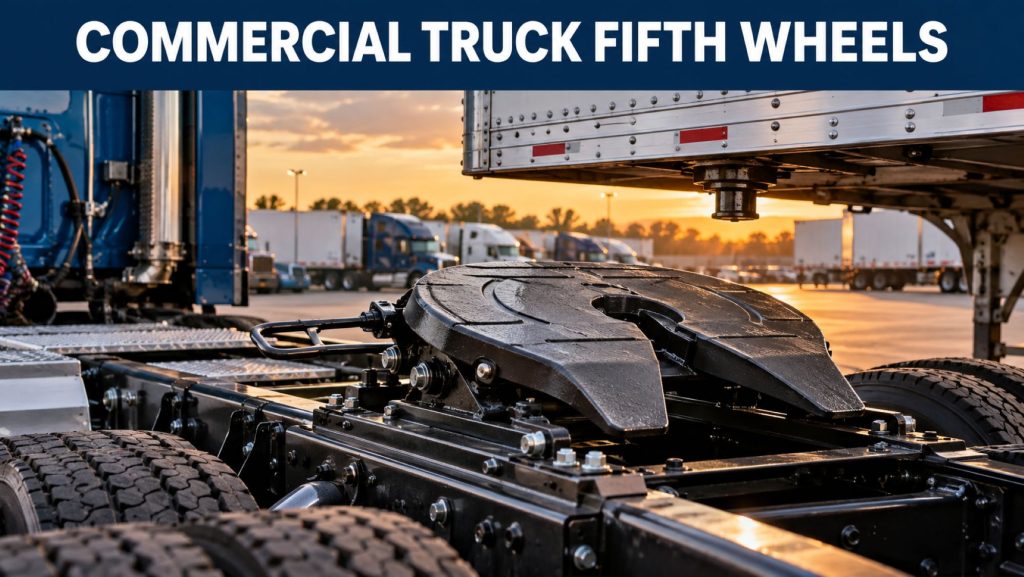
Commercial truck fifth wheels are coupling devices mounted to tractor frames that connect road tractors to semitrailers. The fifth wheel supports the front portion of the trailer, captures the trailer kingpin, transfers vertical and pulling forces, and allows the tractor and trailer to articulate during turns.
Fifth wheels are used throughout long-haul, regional, vocational, heavy-haul, tanker, construction, agricultural, and specialized transportation applications. Their designs vary according to vertical-load capacity, drawbar-pull rating, mounting configuration, release system, oscillation requirements, lubrication method, and operating environment.
Truck Equipment Atlas covers fixed and sliding fifth wheels, air-release systems, heavy-duty and severe-duty models, low-lube designs, mounting assemblies, locking mechanisms, maintenance considerations, and individual fifth-wheel products from major commercial-equipment manufacturers.
Commercial Truck Fifth-Wheel Products on Truck Equipment Atlas
Explore the commercial fifth wheels and related coupling products being added to Truck Equipment Atlas:
SAF-Holland
- SAF-Holland FW35 Fifth Wheel
- SAF-Holland FW17 Fifth Wheel
- SAF-Holland FWAL Aluminum Fifth Wheel
- SAF-Holland FW33 Low-Lube Fifth Wheel
Fontaine
- Fontaine 7000 Series Fifth Wheel
- Fontaine 6000 Series Fifth Wheel
- Fontaine H7 Heavy-Duty Fifth Wheel
Additional fixed fifth wheels, sliding fifth wheels, heavy-duty models, low-lube designs, air-release systems, mounting brackets, sliders, locking components, and coupling equipment will be added as the Truck Equipment Atlas Fifth Wheels & Coupling Equipment Library continues to expand.
How Commercial Truck Fifth Wheels Work
A semitrailer uses a vertical kingpin mounted beneath its upper coupler plate. When the tractor backs beneath the trailer, the fifth wheel’s angled ramps guide the kingpin toward the center of the coupling plate.
The kingpin enters the fifth-wheel throat and activates the locking mechanism. Depending on the fifth-wheel design, locking jaws, a locking bar, or another approved mechanism closes around the kingpin.
Once properly coupled, the fifth wheel supports the trailer’s vertical load while allowing the tractor and trailer to pivot horizontally during turns. The fifth wheel also tilts forward and backward to accommodate changes in road angle, loading surfaces, ramps, and uneven terrain.
The coupling must be visually inspected before operation. The locking mechanism must fully engage the kingpin, the trailer apron must sit flat against the fifth-wheel plate, and no visible gap should remain between the mating surfaces.
Major Commercial Fifth-Wheel Components
A complete commercial fifth-wheel assembly may include:
- Fifth-wheel top plate
- Coupling throat
- Locking jaws
- Locking bar
- Locking wedge
- Release handle and mechanism
- Safety latch
- Pivot and bracket pins
- Mounting brackets
- Fixed or sliding mounting plate
- Slider rails and stops
- Slider locking plungers
- Air-release and slider cylinders
- Air lines and fittings
- Lubrication grooves and grease fittings
- Replaceable wear plates or low-lube inserts
- Frame mounting hardware
Exact component arrangements vary according to the manufacturer, fifth-wheel series, mounting style, release system, capacity, tractor frame, and intended application.
Fifth-Wheel Top Plate
The top plate is the primary structure that supports the trailer apron and contains the kingpin locking mechanism. Its upper surface must allow the trailer to rotate smoothly as the tractor turns. Conventional fifth wheels require grease across the contact surface to reduce friction between the fifth wheel and trailer upper coupler.
Some fifth wheels use replaceable low-lube or no-lube inserts instead of conventional top-plate grease. These inserts reduce direct metal-to-metal contact and may help control grease-related contamination.
The top plate must be inspected for:
- Cracks or distortion
- Excessive wear
- Damaged throat areas
- Worn pivot points
- Missing lubrication
- Damaged low-lube inserts
- Loose mounting components
- Improper repairs or welding
A damaged or severely worn top plate can interfere with coupling, load support, articulation, and kingpin retention.
Fifth-Wheel Locking Mechanisms
The locking mechanism secures the trailer kingpin inside the fifth wheel. Common locking designs may use dual jaws, single jaws, locking bars, locking wedges, adjustment wedges, spring-loaded components, and replaceable wear parts.
The precise operating sequence depends on the manufacturer and model. The locking system should close automatically when the kingpin enters the fifth wheel correctly.
A properly closed release handle does not, by itself, confirm that the trailer is securely coupled. The driver must visually inspect the locking mechanism and perform a controlled tug test according to approved procedures.
Locking components should never be modified, welded, ground, or substituted without manufacturer approval.
Trailer Kingpins and Upper Couplers
The kingpin is attached to the semitrailer’s upper coupler structure and enters the fifth wheel during coupling. It transfers pulling and braking forces between the tractor and trailer. Its dimensions, wear condition, mounting, and alignment directly affect coupling security.
Important kingpin considerations include:
- Kingpin diameter and length
- Upper and lower shoulder condition
- Wear limits
- Cracks or distortion
- Secure attachment
- Vertical alignment
- Upper coupler condition
- Trailer apron flatness
- Compatibility with the fifth wheel
A worn, damaged, bent, or improperly positioned kingpin can prevent correct locking or create excessive movement inside the coupling. The trailer upper coupler plate must also remain structurally sound.
Fixed Fifth Wheels
A fixed fifth wheel is mounted in one established position on the tractor frame. It does not move forward or backward during normal vehicle operation.
Fixed fifth wheels can offer:
- Lower weight than many sliding assemblies
- Fewer moving components
- Reduced maintenance complexity
- Strong frame integration
- Consistent trailer position
- Suitability for dedicated operations
Fixed fifth wheels are commonly used when the tractor operates with consistent trailer types, loads, axle positions, and weight-distribution requirements. A fixed mounting position provides less flexibility for adjusting steer-axle and drive-axle loading.
Sliding Fifth Wheels
A sliding fifth wheel allows the coupling plate to move forward or backward along rails mounted to the tractor frame. Moving the fifth wheel changes the relationship between the trailer kingpin, tractor drive axles, and steer axle. This can help redistribute weight between the tractor’s axle groups.
A sliding fifth-wheel assembly may include:
- Slide rails
- Mounting plate
- Locking plungers
- Release mechanism
- Air-operated release cylinder
- Mechanical release handle
- Positioning notches
- End stops
- Mounting brackets and crossmembers
The slider must be locked before road operation. All locking plungers should engage completely in the rail positions specified by the manufacturer. Drivers should inspect both sides of the sliding mechanism.
Manual and Air-Release Systems
Traditional fifth wheels use a mechanical release handle that the driver pulls to unlock the coupling mechanism. Air-release fifth wheels use a pneumatic cylinder and control system to operate the release mechanism.
Air-release systems may reduce the need for drivers to reach beneath the trailer, but they do not eliminate normal coupling inspections. The driver must still confirm that the tractor and trailer are safely positioned and that the locking mechanism has released correctly.
Fifth-Wheel Mounting Systems
The fifth wheel transfers substantial vertical, pulling, braking, and twisting forces into the tractor frame.
Common mounting arrangements include:
- Fixed angle brackets
- Outboard or inboard mounting brackets
- Sliding mounting assemblies
- Stationary mounting plates
- Low-profile mounting systems
- Heavy-duty mounting structures
- Application-specific frame brackets
Mounting hardware must match the tractor frame, fifth-wheel rating, frame width, rail configuration, and intended service. Improper drilling, welding, spacing, fastener selection, or bracket placement can weaken the frame or allow movement between the fifth wheel and chassis.
Fifth-Wheel Height
Fifth-wheel height is measured from the tractor frame or mounting surface to the top of the fifth-wheel plate, depending on the specification being used.
The selected height affects trailer ride height, tractor-to-trailer clearance, landing-gear clearance, trailer roof height, trailer frame angle, suspension operation, and aerodynamic alignment.
A fifth wheel that is too high can raise the front of the trailer and increase overall vehicle height. A fifth wheel that is too low can reduce clearance between the trailer and tractor frame, tires, fenders, or other equipment.
Vertical Load and Pull Capacity
Fifth wheels carry vertical trailer load and transmit horizontal pulling and braking forces. Two important ratings are maximum vertical load and maximum drawbar-pull or gross-trailer-weight capacity.
The fifth wheel must be rated for the complete application. Its capacity does not override the ratings of the tractor frame, axles, suspension, tires, wheels, kingpin, trailer structure, or complete vehicle.
Heavy-haul and severe-duty operations may require fifth wheels with higher vertical-load and pull ratings than conventional highway applications. Capacity should never be determined by appearance alone.
Fifth-Wheel Position and Weight Distribution
The fifth wheel’s position affects how trailer weight is distributed across the tractor’s steer and drive axles. Moving a sliding fifth wheel forward generally transfers more weight toward the steer axle. Moving it rearward generally transfers weight away from the steer axle and toward the drive axles.
The actual weight transfer depends on the tractor wheelbase, drive-axle spacing, fifth-wheel travel, trailer kingpin position, trailer axle position, cargo location, suspension characteristics, fuel load, mounted equipment, and overall vehicle geometry.
Certified scales should be used to confirm axle weights. Fifth-wheel position alone cannot guarantee legal or safe weight distribution.
Tractor and Trailer Clearance
Adequate clearance must remain between the tractor and trailer throughout normal operation. Clearance must be checked around the cab, sleeper fairings, frame rails, drive tires, mud flaps, landing gear, exhaust system, fuel tanks, toolboxes, fenders, and hydraulic equipment.
A tractor-trailer combination that clears on level pavement may still make contact during sharp turns, driveway transitions, loading-ramp movement, suspension travel, or off-highway operation.
Coupling Procedure
The tractor should approach the trailer in a straight line with the fifth wheel aligned beneath the trailer kingpin.
Before coupling, the driver should verify:
- The trailer is secured against movement
- The trailer height is correct
- The fifth wheel is ready to couple
- The locking mechanism is open
- The fifth-wheel plate is properly lubricated
- The kingpin and upper coupler are not damaged
- The tractor and trailer are aligned
- Air and electrical connections are clear
The trailer should be low enough that the tractor slightly lifts it as the fifth wheel moves beneath the upper coupler. This helps prevent high coupling.
After the kingpin enters the locking mechanism, the driver should perform a controlled tug test, visually inspect the lock, connect the air and electrical lines, raise the landing gear, and complete the required pre-trip inspection.
High Coupling and False Coupling
High coupling occurs when the trailer is positioned too high above the fifth wheel. The kingpin may pass over or fail to enter the locking mechanism correctly. False coupling can occur when the fifth-wheel mechanism appears closed without securely capturing the kingpin.
Warning signs may include:
- A visible gap between the trailer and fifth wheel
- Locking jaws positioned around the wrong portion of the kingpin
- An incompletely closed release handle
- A kingpin outside the locking mechanism
- Trailer movement during the tug test
- Abnormal resistance during coupling
- Uneven contact between the top plate and trailer apron
A trailer should never be operated until the driver has visually confirmed correct coupling.
Uncoupling Procedure
Before uncoupling, the tractor and trailer should be positioned on firm, level ground whenever possible.
The driver should:
- Apply the trailer parking brakes
- Secure the tractor
- Lower the landing gear
- Disconnect the air lines and electrical cable
- Disconnect auxiliary connections
- Release the fifth-wheel locking mechanism
- Move the tractor forward carefully
- Confirm the trailer remains properly supported
The exact procedure should follow the tractor, trailer, and fifth-wheel manufacturers’ instructions.
Fifth-Wheel Lubrication
Conventional fifth wheels require lubrication at the trailer-contact surface, pivot points, locking mechanism, and other specified locations.
Proper lubrication can reduce metal-to-metal wear, steering resistance, binding during articulation, locking-mechanism wear, corrosion, trailer-apron damage, and difficulty coupling or uncoupling.
Excess grease can collect dirt, sand, road debris, and other abrasive material. The fifth wheel should be cleaned before inspection and relubrication when required.
Low-Lube and No-Lube Fifth Wheels
Low-lube fifth wheels use replaceable wear pads or inserts on the top plate to reduce or eliminate conventional grease between the fifth wheel and trailer apron.
Potential benefits may include reduced grease use, cleaner tractor frames, less grease contamination, simplified routine servicing, replaceable wear surfaces, and reduced trailer-apron friction.
Low-lube designs may still require lubrication at locking components, pivots, brackets, or other specified service points. Wear inserts must be inspected and replaced according to their service limits.
Highway Fifth-Wheel Applications
Long-haul and regional tractors require dependable coupling performance across high annual mileage, repeated trailer changes, varying weather, and multiple loading conditions.
Important considerations include reliable automatic locking, trailer compatibility, fifth-wheel height, sliding adjustment, air-release capability, lubrication requirements, inspection access, corrosion resistance, replacement-parts availability, and maintenance intervals.
Vocational Fifth-Wheel Applications
Vocational tractors can place different demands on fifth wheels than conventional highway trucks.
Common applications include:
- Dump and end-dump trailers
- Construction equipment
- Logging trailers
- Refuse trailers
- Oilfield equipment
- Tank trailers
- Agricultural trailers
- Municipal and recovery equipment
- Severe-service and off-highway applications
These vehicles may experience twisting, uneven terrain, contamination, shock loading, steep grades, frequent coupling cycles, and higher structural loads.
Heavy-Haul Fifth-Wheel Applications
Heavy-haul tractors require fifth wheels and mounting systems designed for high vertical and pulling loads.
Important considerations include gross combination weight, vertical kingpin load, drawbar-pull rating, multiple drive axles, frame strength, mounting-system capacity, trailer compatibility, oscillation requirements, kingpin condition, weight distribution, terrain, and permitting requirements.
The complete coupling system must be evaluated. Installing a higher-rated fifth wheel does not automatically increase the tractor or trailer’s certified capacity.
Oscillating and Compensating Fifth Wheels
Standard highway fifth wheels primarily pivot forward and backward while allowing the trailer to rotate horizontally around the kingpin. Oscillating or compensating fifth wheels may provide additional side-to-side movement for uneven terrain and specialized applications.
These designs can be useful in construction, mining, logging, oilfield, heavy-haul, off-highway, and specialized low-speed applications.
Additional oscillation can reduce twisting forces transferred between the tractor and trailer on uneven surfaces. The selected design must still provide the control, stability, capacity, and mounting strength required for the complete vehicle.
Advantages of Commercial Truck Fifth Wheels
- Secure tractor-to-trailer coupling
- Support for vertical trailer load
- Controlled articulation during turns
- Transfer of pulling and braking forces
- Compatibility with standardized semitrailer kingpins
- Fixed and sliding mounting options
- Manual and air-release configurations
- Highway, vocational, and heavy-haul designs
- Low-lube configurations
- Replaceable wear components
- Adjustable tractor weight distribution
Actual performance depends on correct selection, installation, coupling, inspection, lubrication, maintenance, and vehicle operation.
Fifth-Wheel Limitations and Considerations
- Incorrect, high, or false coupling
- Worn locking components
- Kingpin or trailer-apron damage
- Insufficient lubrication or contaminated grease
- Worn low-lube inserts
- Loose mounting hardware or damaged brackets
- Incomplete slider-plunger engagement
- Air-release problems
- Insufficient tractor-to-trailer clearance
- Incorrect fifth-wheel height or weight distribution
- Corrosion or structural cracking
- Capacity and replacement-parts limitations
A fifth wheel should not be modified or repaired outside the manufacturer’s approved procedures.
Driver and Operator Considerations
Drivers should understand the fifth wheel’s locking, release, sliding, lubrication, and inspection procedures.
Important operating considerations include:
- Approaching the trailer in alignment
- Confirming correct trailer height
- Preventing high coupling
- Performing a controlled tug test
- Visually inspecting the lock and release handle
- Inspecting the kingpin and trailer-apron contact
- Connecting air and electrical lines
- Raising the landing gear completely
- Verifying slider-plunger engagement
- Monitoring tractor-to-trailer clearance
- Completing required pre-trip inspections
A tug test does not replace a visual inspection. Both steps are important before operating the vehicle.
Maintenance and Ownership
Commercial fifth wheels require regular inspection and preventive maintenance.
Important maintenance areas can include:
- Top-plate condition and throat wear
- Locking jaws, bars, and wedges
- Release handle and safety latch
- Pivot and bracket pins
- Mounting brackets and fasteners
- Slider rails and locking plungers
- Slider and air-release cylinders
- Air lines and fittings
- Grease fittings and lubrication grooves
- Low-lube inserts
- Kingpin contact areas and trailer upper coupler
- Tractor frame and structural crossmembers
Maintenance requirements vary among manufacturers, fifth-wheel models, duty cycles, coupling frequency, load levels, road conditions, climates, and operating environments.
Common Fifth-Wheel Problems
Difficult coupling: Incorrect trailer height, misalignment, damaged locking components, contamination, insufficient lubrication, or kingpin wear may prevent normal coupling.
Fifth wheel will not release: Pressure against the locking mechanism, damaged release linkage, corrosion, contamination, insufficient lubrication, or an air-system problem may prevent release.
Excessive movement: Worn jaws, locking components, pivot points, brackets, kingpin surfaces, or mounting hardware may create excessive movement between the tractor and trailer.
Slider will not move or lock: Loaded or damaged plungers, corrosion, damaged rails, air-cylinder failure, misalignment, or frame distortion may prevent adjustment or full engagement.
Uneven top-plate wear: Improper lubrication, a distorted trailer apron, incorrect fifth-wheel height, frame problems, or misalignment may cause uneven contact.
Air-release failure: Low air pressure, leaking lines, damaged cylinders, faulty controls, or binding linkage may prevent normal operation.
Structural cracking: Overloading, collision damage, improper mounting, corrosion, loose fasteners, or unauthorized welding may damage the fifth wheel or mounting structure.
Choosing a Commercial Truck Fifth Wheel
Selecting a commercial fifth wheel requires identifying the complete tractor, trailer, load, and operating application.
Important factors include:
- Tractor manufacturer, model, model year, and VIN
- Frame width and strength
- Fixed or sliding installation
- Required fifth-wheel height
- Vertical-load and drawbar-pull ratings
- Gross combination weight
- Trailer type and kingpin configuration
- Highway, vocational, or heavy-haul operation
- Oscillation requirements
- Manual or air release
- Conventional or low-lube design
- Available frame space and trailer clearance
- Slider travel and weight-distribution needs
- Replacement-parts availability
- Manufacturer support and regulatory requirements
A fifth wheel should not be selected solely because it appears similar to the original equipment. Mounting dimensions, capacity, height, locking design, and application must all be verified.
Related Fifth-Wheel and Coupling Categories
Explore additional fifth-wheel and coupling categories:
- Commercial Truck Fifth Wheels
- Sliding Fifth-Wheel Systems
- Fifth-Wheel Mounting and Slider Systems
- Kingpins and Upper Couplers
- Pintle Hooks and Drawbar Couplings
Related Fifth-Wheel Guides
- Fifth-Wheel Systems Explained
- Fixed vs Sliding Fifth Wheels
- How to Couple and Uncouple a Semitrailer
- How to Inspect and Maintain a Commercial Fifth Wheel
- Fixed vs Sliding Fifth Wheels
- Fifth Wheels & Coupling Equipment
Related Truck Equipment Resources
- Commercial Trucks
- Commercial Trailers
- Axles & Differentials
- Suspension Systems
- Brake Systems
- Tires & Wheels
- Equipment Systems
Understanding how the fifth wheel, kingpin, upper coupler, tractor frame, suspension, axles, tires, brakes, trailer structure, vehicle weight, and driver procedures work together is essential when evaluating a commercial tractor-trailer coupling system.
Explore the Complete Fifth Wheels & Coupling Equipment Library
Commercial truck fifth wheels represent one part of the larger tractor-and-trailer coupling-equipment category.
Visit the Fifth Wheels & Coupling Equipment Library to explore commercial fifth wheels, sliding systems, mounting assemblies, kingpins, upper couplers, pintle hooks, drawbar couplings, individual product profiles, and educational guides.
Additional fifth wheels, sliders, mounting systems, kingpins, upper couplers, release systems, coupling components, manufacturers, historical products, and educational resources will be added as Truck Equipment Atlas continues to expand.