
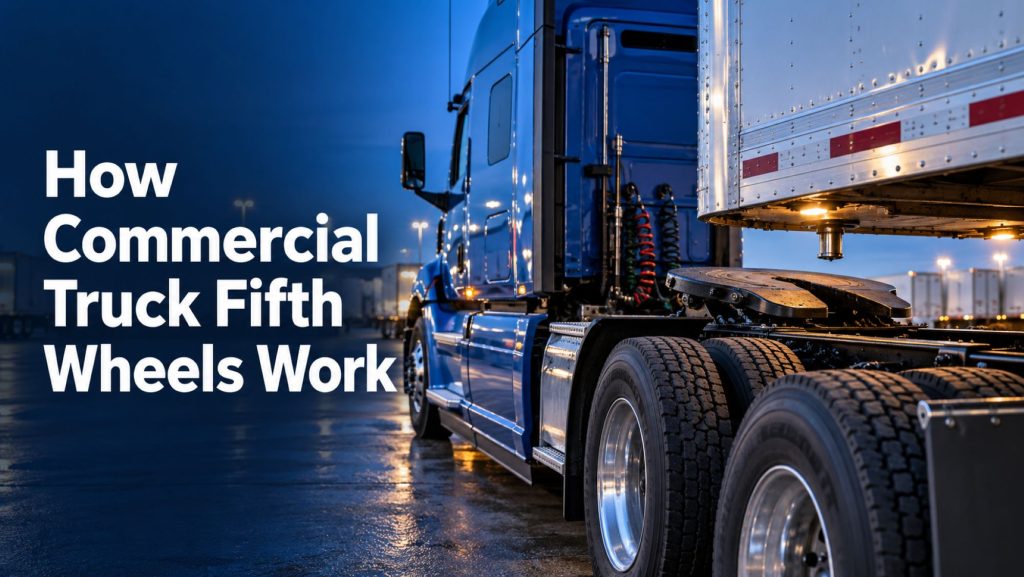
A commercial truck fifth wheel is the primary coupling device that connects a road tractor to a semitrailer. It supports part of the trailer’s weight, allows the tractor and trailer to pivot through turns, and locks around the trailer kingpin so the two vehicles can operate as one combination.
Although the fifth wheel appears to be a simple steel plate, it performs several demanding jobs at the same time. It must carry vertical load, withstand acceleration and braking forces, permit controlled articulation, and maintain a secure connection across changing road and operating conditions.
This guide explains how commercial truck fifth wheels work, identifies their major components, describes the coupling sequence, compares fixed and sliding designs, and outlines the inspection and maintenance practices that help keep tractor-trailer combinations operating safely.
What Is a Commercial Truck Fifth Wheel?
A fifth wheel is a heavy-duty coupling assembly mounted above the tractor frame, normally over or near the drive axles. Its horseshoe-shaped top plate contains a rear-facing throat that guides the trailer kingpin into an internal locking mechanism.
The mating component is the kingpin, a vertical steel pin attached to the semitrailer’s upper coupler structure. When the tractor backs beneath the trailer, the kingpin enters the open throat from the rear of the fifth wheel. The locking jaws then close around the narrow section of the kingpin.
The trailer’s upper coupler plate rests directly on the fifth-wheel surface. The two greased surfaces slide against one another as the combination turns.
Why Is It Called a Fifth Wheel?
The name comes from earlier pivoting coupling platforms used on horse-drawn vehicles. Those circular or partially circular assemblies acted like an additional horizontal wheel that allowed the front axle or connected vehicle to turn. Modern tractor fifth wheels use a different mechanical design, but the traditional name remains.
Major Fifth-Wheel Components
Several structural and locking components work together to support the trailer and retain its kingpin.
Top Plate
The top plate is the large cast-steel coupling surface visible above the tractor frame. It carries the vertical trailer load and contains the throat, locking mechanism, pivot points, and release components.
Throat and Approach Ramps
The V-shaped throat faces the rear of the tractor. As the tractor backs toward the trailer, the throat guides the kingpin toward the center of the locking mechanism. The sloped rear portions of the plate also help the tractor move beneath a correctly positioned trailer.
Locking Jaws
The locking jaws close around the kingpin and prevent it from leaving the fifth wheel. Designs vary by manufacturer and model. Some use a single rotating jaw, while others use a jaw-and-wedge or double-jaw arrangement.
Locking Wedge or Plunger
A wedge, plunger, or similar mechanism holds the jaw in its locked position and helps control clearance around the kingpin. The exact construction and adjustment procedure depend on the fifth-wheel manufacturer.
Release Handle
The release handle allows the driver or technician to open the locking mechanism for uncoupling. Many designs include a secondary lock or latch that must be disengaged before the handle can move fully into the release position.
Mounting Brackets
Mounting brackets connect the fifth-wheel assembly to the tractor frame or slider system. They support the top plate while allowing it to pivot forward and rearward as the tractor and trailer travel over grades, dips, and uneven surfaces.
Pivot Pins and Bushings
Pivot pins and bushings allow controlled fore-and-aft movement of the top plate. Wear in these areas can produce excessive movement, noise, poor handling, or an uneven coupling surface.
Slider Assembly
A sliding fifth wheel is mounted on rails and can move forward or rearward. Locking pins secure the assembly in the selected position. Air-operated or manual mechanisms may be used to retract the pins for repositioning.
The Trailer Kingpin and Upper Coupler
The kingpin is part of the trailer rather than the tractor. It extends downward from the trailer’s upper coupler plate and serves as the central connection point between the two vehicles.
During coupling, the fifth-wheel jaws lock around the kingpin’s designated locking area. During turns, the kingpin rotates within the locked fifth wheel while the trailer plate slides across the fifth-wheel surface.
The upper coupler is more than the visible plate. It is a structural assembly that transfers loads from the trailer into the kingpin and fifth wheel. Damage, cracking, distortion, loose hardware, or excessive wear in this area can affect the entire connection.
How a Commercial Truck Fifth Wheel Works
The coupling process combines alignment, controlled contact, mechanical locking, and verification.
Step 1: The Tractor Aligns with the Trailer
The tractor is positioned directly in front of the trailer so the fifth-wheel throat is centered with the kingpin. Straight alignment reduces side loading and helps the kingpin enter the locking mechanism correctly.
Step 2: Trailer Height Is Checked
The trailer should be at the height specified by the equipment manufacturer and operating procedure. In a normal coupling approach, the trailer’s upper coupler contacts the fifth wheel and the tractor lifts the trailer slightly as it backs underneath.
If the trailer is too high, the kingpin may pass over or above the locking jaws instead of entering them. This dangerous condition is commonly called high coupling.
Step 3: The Kingpin Enters the Throat
As the tractor backs slowly, the rear-facing V-shaped throat guides the kingpin into the center of the fifth wheel. The trailer plate moves onto the lubricated top plate, transferring part of the trailer’s weight to the tractor.
Step 4: The Locking Mechanism Closes
When the kingpin reaches the correct position, it activates the locking mechanism. The jaw rotates or closes around the kingpin, and the wedge, plunger, or secondary lock holds the mechanism in place.
Step 5: The Connection Is Verified
A coupling is not complete merely because the driver hears the mechanism close. The connection must be verified according to the applicable operating procedure. Verification commonly includes checking the release handle position, confirming that the kingpin is inside the closed lock, ensuring there is no improper gap between the trailer plate and fifth wheel, and performing a controlled tug or pull test.
Drivers must follow the tractor, trailer, and fifth-wheel manufacturers’ instructions and their carrier’s approved coupling procedure.
How the Fifth Wheel Supports the Trailer
A semitrailer does not have a front axle supporting its entire front section. When coupled, a portion of the trailer and cargo weight is transferred through the upper coupler and fifth wheel into the tractor frame and drive axles.
The fifth wheel also transmits horizontal forces created during acceleration, braking, turning, backing, and travel over uneven roads. Its mounting system must distribute these loads into the tractor frame without allowing uncontrolled movement.
How the Tractor and Trailer Turn
The kingpin acts as the primary vertical pivot between the tractor and trailer. As the tractor turns, the trailer rotates horizontally around the kingpin while its upper coupler plate slides across the fifth-wheel top plate.
The fifth-wheel top plate also pivots fore and aft on its mounting brackets. This movement allows the combination to cross hills, loading-dock approaches, railroad crossings, and other changes in road angle.
Some specialized fifth wheels allow additional articulation, but standard highway fifth wheels are primarily designed for horizontal rotation at the kingpin and fore-and-aft tilting at the mounting brackets.
Fixed vs Sliding Fifth Wheels
Fixed Fifth Wheels
A fixed fifth wheel is mounted in one position on the tractor frame. It has fewer positioning components and is common where tractor configuration, trailer type, bridge requirements, and load distribution remain relatively consistent.
Sliding Fifth Wheels
A sliding fifth wheel can move along frame-mounted rails. Moving it changes how trailer weight is distributed between the tractor’s steer axle and drive axles and can also change tractor-to-trailer clearance.
Moving the fifth wheel forward generally transfers more weight toward the steer axle. Moving it rearward generally reduces steer-axle loading and transfers more weight toward the drive axles. Actual results depend on the tractor, trailer, axle spacing, cargo position, and suspension configuration.
After repositioning, every slider locking pin must fully engage. The driver must confirm legal axle weights and adequate clearance before operating the vehicle.
Why Fifth-Wheel Position Matters
- Steer-axle and drive-axle weight distribution
- Compliance with axle-weight and bridge requirements
- Clearance between the tractor cab and trailer
- Clearance between the tractor frame, mudflaps, and trailer landing gear
- Turning performance and maneuverability
- Ride and handling characteristics
- Compatibility with different trailer designs
A position that corrects axle weight but creates insufficient cab or landing-gear clearance is not acceptable. Weight distribution and physical clearance must be evaluated together.
Common Fifth-Wheel Coupling Problems
High Coupling
High coupling occurs when the trailer is too high and the kingpin passes over the fifth-wheel locking mechanism. The connection may appear close from a distance while the kingpin is not actually secured inside the jaws.
False or Incomplete Locking
Dirt, ice, damaged parts, improper alignment, a worn kingpin, incorrect trailer height, or a binding mechanism can prevent the jaws from closing completely.
Excessive Kingpin-to-Lock Clearance
Wear in the kingpin, locking jaw, wedge, or related components can create excessive movement between the tractor and trailer. Symptoms may include clunking, harsh engagement, or noticeable movement during acceleration and braking.
Insufficient Lubrication
In conventional greased fifth wheels, insufficient lubrication increases friction between the top plate and trailer upper coupler. This can accelerate wear and affect steering or handling. Lubrication-free or low-lube systems require their own manufacturer-specified inspection procedures.
Slider Pins Not Fully Engaged
A sliding fifth wheel must not be operated unless all required locking pins are fully engaged in the slider rails. Damaged pins, misalignment, contamination, or air-system problems can prevent secure engagement.
Fifth-Wheel Inspection Areas
A pre-trip or maintenance inspection should be appropriate for the specific fifth wheel, tractor, trailer, and operating conditions. Common inspection areas include:
- Secure mounting to the tractor frame or slider assembly
- Cracks, distortion, or damaged welds
- Condition of the top plate and throat
- Proper lubrication or condition of replaceable wear surfaces
- Locking-jaw condition and complete movement
- Release-handle and secondary-lock operation
- Pivot pins, brackets, cushions, and bushings
- Slider rails, stops, locking pins, and air cylinder
- Kingpin wear, damage, and alignment
- Upper-coupler condition
- Proper contact between the trailer plate and fifth wheel
- A secure lock around the kingpin after coupling
- Adequate cab, frame, tire, and landing-gear clearance
Inspection limits, measurements, adjustment methods, and replacement criteria must come from the equipment manufacturer and applicable regulations.
Fifth-Wheel Maintenance
Maintenance helps the fifth wheel lock, articulate, release, and carry load as designed. Depending on the model, service may include cleaning, lubrication, fastener inspection, lock testing, wear measurement, slider servicing, and replacement of worn components.
Fifth wheels should not be adjusted solely to hide wear. A worn kingpin, jaw, wedge, bracket, bushing, or top plate must be correctly identified and repaired using approved parts and procedures.
Because locking systems vary, technicians should never assume that an adjustment procedure for one fifth-wheel model applies to another.
Fifth Wheels Used in Specialized Applications
Fifth wheels are produced for many operating environments, including highway tractors, heavy-haul tractors, terminal tractors, vocational vehicles, and severe-service equipment.
- Standard-duty highway fifth wheels
- Heavy-duty and severe-service fifth wheels
- Low-profile fifth wheels
- Air-release fifth wheels
- No-tilt or restricted-tilt configurations
- Terminal-tractor fifth wheels
- Weight-sensitive cast or fabricated designs
- Sensor-equipped coupling systems
- Low-lube and lubrication-free top-plate systems
The correct model depends on gross combination weight, vertical load, frame height, trailer design, articulation requirements, duty cycle, operating environment, release method, and mounting system.
Fifth Wheel vs Kingpin
| Component | Location | Primary Function |
|---|---|---|
| Fifth wheel | Mounted on the tractor | Supports the trailer plate and locks around the kingpin |
| Kingpin | Mounted beneath the trailer | Enters the fifth wheel and forms the central coupling pivot |
| Upper coupler | Structural underside of the trailer front | Transfers trailer loads into the kingpin and fifth-wheel surface |
| Slider assembly | Between the fifth wheel and tractor frame | Allows fore-and-aft fifth-wheel positioning |
Frequently Asked Questions
Which direction should the fifth-wheel throat face?
The open V-shaped throat faces the rear of the tractor. This allows the kingpin to enter the fifth wheel as the tractor backs under the trailer.
Does the fifth wheel carry the entire trailer weight?
No. When coupled, the fifth wheel supports part of the trailer and cargo weight. The trailer axles support the remaining portion.
Why does a fifth wheel pivot?
The top plate pivots fore and aft so the tractor and trailer can move across changes in road angle. Horizontal turning occurs primarily around the kingpin as the trailer plate rotates over the fifth wheel.
Why do drivers slide a fifth wheel?
Drivers reposition a sliding fifth wheel to adjust weight distribution between the steer and drive axles or to change tractor-to-trailer clearance. The final position must provide legal axle weights and safe clearance.
Can every fifth wheel couple to every semitrailer?
No. Compatibility depends on the fifth wheel, kingpin size, trailer design, load rating, mounting height, articulation, application, and applicable standards. Specialized equipment may require a specific coupling system.
Final Thoughts
The fifth wheel is the structural and mechanical connection that allows a road tractor to support, pull, brake, and steer a semitrailer. Its rear-facing throat guides the trailer kingpin into the locking mechanism. The jaws secure the kingpin, the top plate carries vertical load, and the pivoting assembly allows the combination to move through turns and changes in road angle.
Correct alignment, trailer height, locking, verification, lubrication, inspection, and maintenance are all essential. Understanding how the system works helps drivers, technicians, fleet managers, CDL students, and equipment buyers recognize problems and make better operating and maintenance decisions.
Continue Exploring Fifth Wheel and Coupling Equipment
- Fifth Wheel & Coupling Equipment Guides
- Fixed vs Sliding Fifth Wheels
- How to Couple and Uncouple a Semi-Trailer Safely
- How to Inspect and Maintain a Fifth Wheel and Kingpin
- How to Choose a Commercial Truck Fifth Wheel
- Fifth Wheels & Coupling Equipment
Important note: This guide provides general educational information. Coupling, uncoupling, inspection, adjustment, maintenance, and repair must follow applicable regulations, company procedures, and the instructions published by the tractor, trailer, kingpin, upper-coupler, and fifth-wheel manufacturers.