
SAF-Holland P89 Plus Trailer Air Disc Brake
Quick Facts
- Manufacturer: SAF-Holland
- Product Name: SAF P89 Plus
- Product Type: Premium trailer air-disc brake and integrated wheel-end system
- Brake-System Category: Trailer foundation brake
- Primary Position: Trailer axle wheel ends
- Brake Design: Pneumatically actuated sliding-caliper disc brake
- Rotor Design: SAF Integral bi-metallic rotor-and-hub system
- Rotor Type: Heavy-duty internally vented disc
- Wheel-End Design: Premium sealed-bearing assembly
- Bearing Arrangement: Large inner and outer bearings with controlled preload
- Traditional Wheel Seal: Eliminated by the sealed-bearing design
- Brake Actuation: Trailer service or spring-brake chamber, depending on axle position and configuration
- Primary Applications: Dry vans, refrigerated trailers, flatbeds, tank trailers, dump trailers, and other commercial semitrailers
- Suspension Compatibility: Available on approved SAF-Holland trailer axle and suspension systems
- Primary Benefit: Combines air-disc braking with a low-maintenance sealed wheel end
Overview
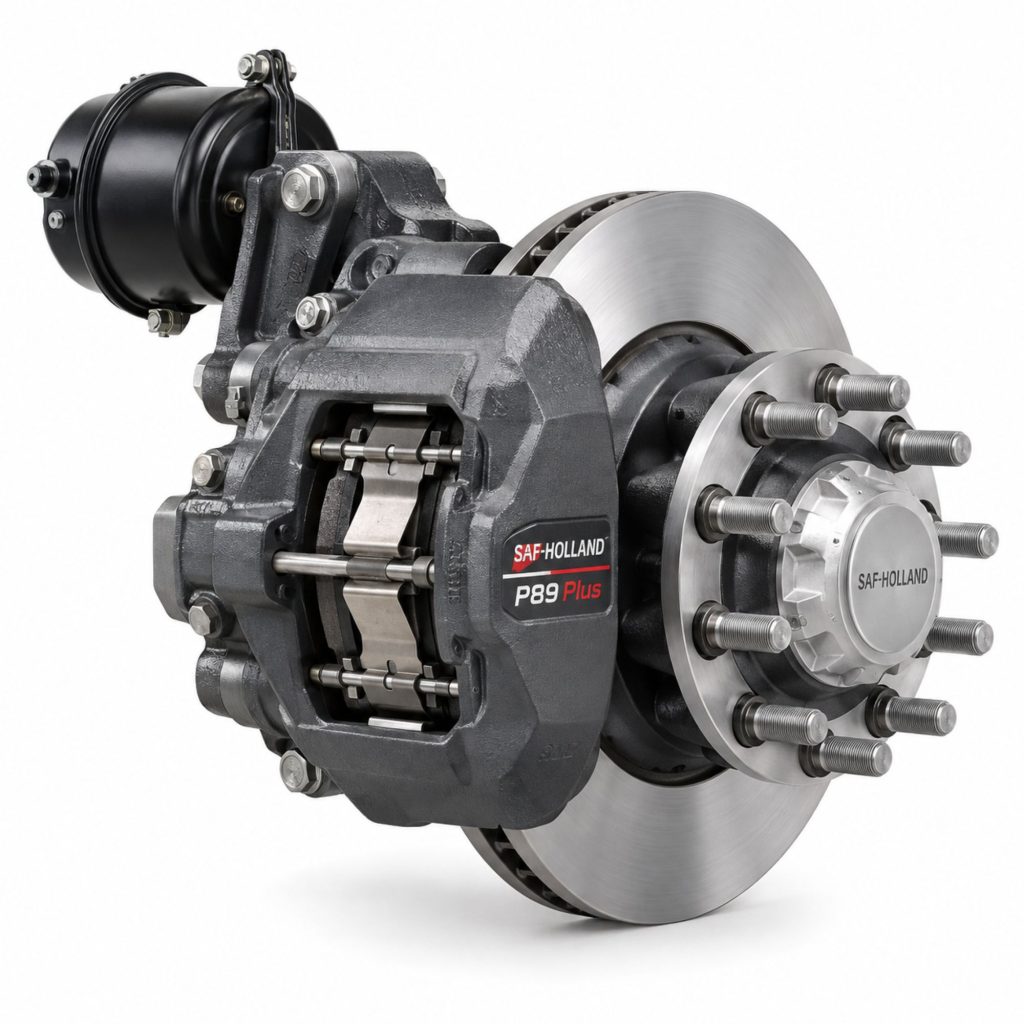
The SAF-Holland P89 Plus is a premium trailer air-disc brake and wheel-end package designed to combine consistent disc-brake performance with reduced wheel-end maintenance.
The system uses an air-operated caliper to clamp brake pads against a heavy-duty vented rotor. Unlike a conventional rotor attached to a separately serviced hub, the P89 Plus uses the SAF Integral rotor-and-hub design.
The Integral design combines steel braking surfaces with the wheel-end structure in a way that allows the braking ring to expand radially as it heats. This is intended to keep the braking surfaces flatter and reduce the distortion sometimes called the umbrella effect.
The P89 Plus wheel end uses large, individually sealed bearings lubricated with long-life grease. A precision spacer controls bearing preload. Because the bearings are sealed individually, the design eliminates the traditional hub seal used in many conventional trailer wheel ends.
The result is a complete brake and wheel-end package designed for long-haul and other commercial trailer operations where braking consistency, wheel-end durability, and reduced maintenance are priorities.
Current SAF-Holland service-parts literature describes P89 Plus as using the Integral rotor, long-life sealed bearings, premium brake chambers, and Haldex calipers and actuators. SAF-Holland Air Disc Brake Service Parts Guide
Key Characteristics
- Trailer air-disc brake system
- Integrated brake and wheel-end package
- SAF Integral rotor-and-hub design
- Heavy-duty vented rotor
- Bi-metallic rotor construction
- Premium sealed wheel bearings
- Large inner and outer bearings
- Precision bearing spacer
- Controlled bearing preload
- No conventional wheel seal
- Pneumatic brake actuation
- Automatic internal brake adjustment
- Replaceable brake pads
- Left- and right-hand caliper assemblies
- ABS wheel-speed sensor compatibility
- Designed for SAF-Holland trailer axles
- Long-life wheel-end configuration
- Application-specific commercial warranty
Major Components
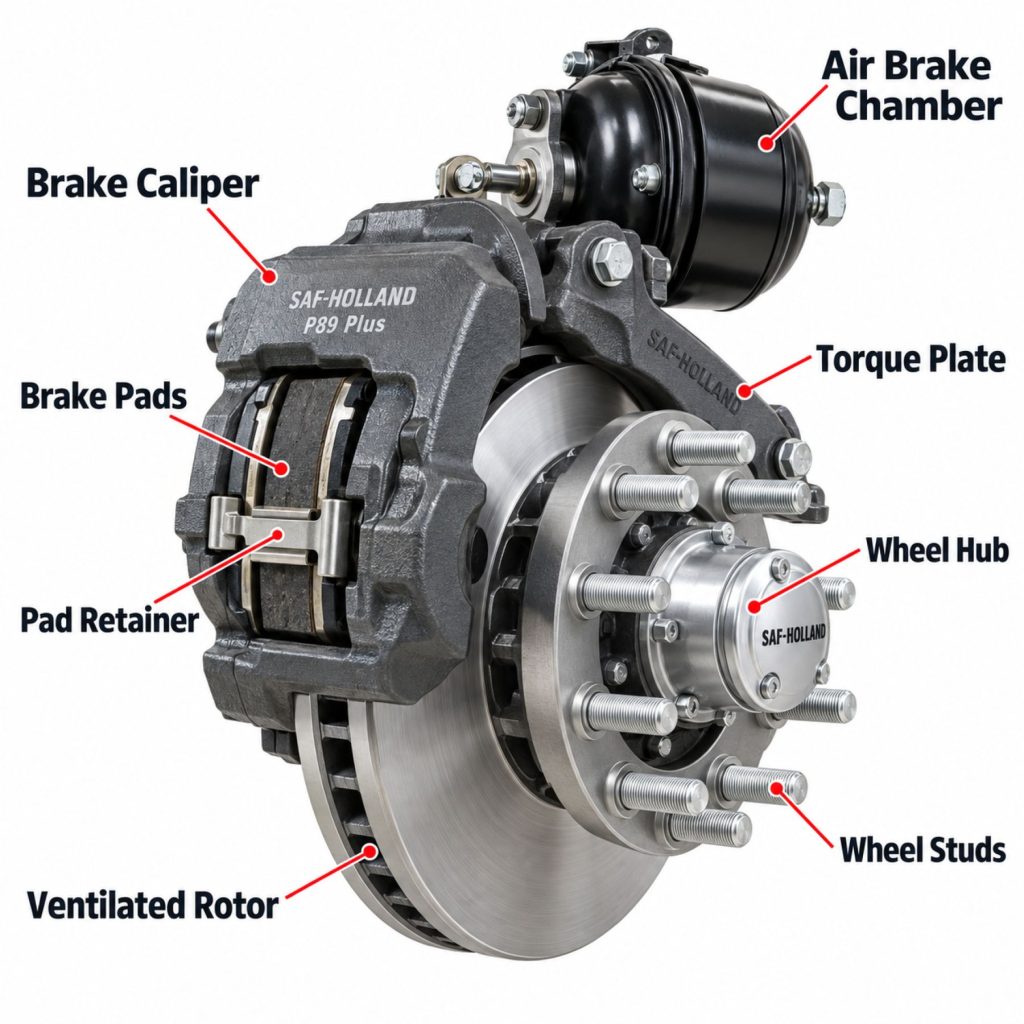
- Air-disc brake caliper
- Caliper carrier
- Caliper slide pins
- Slide-pin bushings
- Protective boots
- Internal adjustment mechanism
- Tappets or thrust elements
- Brake pads
- Pad-retaining hardware
- Pad-wear indicators where equipped
- Air-brake chamber
- Brake chamber mounting hardware
- Actuating lever
- SAF Integral rotor-and-hub assembly
- Internally vented braking ring
- Inner sealed bearing
- Outer sealed bearing
- Precision bearing spacer
- Spindle
- Spindle nut
- Hub cap
- Wheel studs
- ABS tone ring
- ABS wheel-speed sensor
- Dust shield where equipped
- Caliper mounting bolts
- Rotor and hub mounting hardware
How the Brake Component or System Works
When the driver applies the service brakes, compressed air enters the brake chamber. Air pressure moves the chamber’s internal diaphragm or piston and drives the actuator pushrod.
The pushrod operates the caliper’s actuating lever. Internal caliper components multiply and transmit this force to the brake pads.
The inboard pad moves toward the rotor first. Reaction force then causes the sliding caliper to move across its guide system, bringing the outboard pad into contact with the opposite side of the rotor.
Both pads clamp the rotating disc. Friction converts the trailer’s motion into heat, slowing the wheel and vehicle.
When the driver releases the brakes, chamber pressure is exhausted. The actuator and caliper mechanism relax enough to provide running clearance between the pads and rotor.
The internal adjustment mechanism compensates for normal pad and rotor wear. This helps maintain the correct operating clearance without the external slack adjuster used on an S-cam drum brake.
Position and Function Within the Brake System
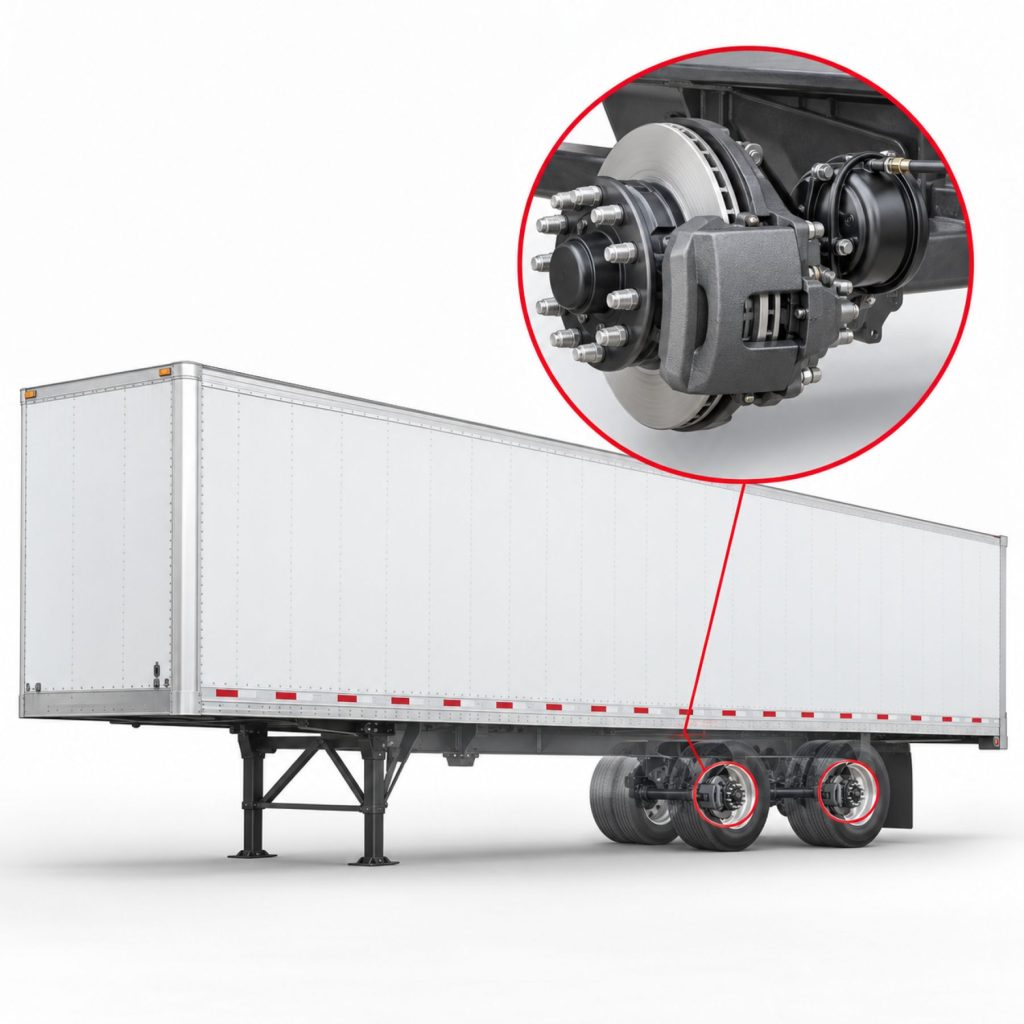
The P89 Plus is installed at the trailer axle wheel end. Each brake assembly is mounted around the rotor and connected to a pneumatic brake actuator.
The brake system receives its service command through the trailer’s air-control system. This may include:
- Tractor service-brake control line
- Trailer relay or emergency valve
- Trailer ABS modulator
- Service-brake chamber
- Spring-brake chamber where parking capability is required
- P89 Plus caliper and rotor
During ordinary braking, the pneumatic system delivers pressure to the brake chamber. During an ABS event, the trailer ABS controller can reduce, hold, or restore pressure at the affected brake circuit.
The P89 Plus is the foundation brake that physically creates braking torque. ABS, stability control, relay valves, and driver controls determine when and how much pneumatic pressure reaches it.
Common Specifications
- Brake Type: Pneumatically actuated trailer air-disc brake
- Caliper Type: Application-specific sliding caliper
- Rotor Type: SAF Integral heavy-duty vented rotor
- Common Rotor Diameter: Approximately 430 millimeters on applicable P89-series configurations
- Wheel-End Type: Integrated rotor and hub
- Bearing Type: Individually sealed, long-life bearings
- Bearing Preload: Controlled by a precision spacer
- Wheel Seal: Conventional hub seal not used in the P89 Plus sealed-bearing design
- Wheel Compatibility: Application-specific commercial trailer wheel configurations
- Brake Chambers: Application-specific service or spring-brake chambers
- ABS Compatibility: Wheel-speed sensor and tone-ring compatible
- Spindle Design: Robust application-specific spindle
- Caliper Position: Left- and right-hand assemblies
- Primary Axle Use: SAF-Holland trailer axles
Exact caliper, actuator, rotor, hub, bearing, wheel-stud, mounting, and brake-chamber specifications must be confirmed using the axle serial number and complete wheel-end identification.
Operating Specifications and Performance
The air-disc design provides a direct clamping action against both sides of the rotor. This can produce consistent response and stable braking across repeated applications.
The vented rotor allows cooling air to move through internal passages. Heat management is important because excessive temperatures can shorten pad, rotor, boot, bearing, and lubricant life.
The Integral rotor’s bi-metallic construction allows the braking ring to expand and contract radially. SAF-Holland designed this arrangement to help the friction surfaces remain flat as rotor temperature changes.
Braking performance depends on:
- Brake chamber size
- Applied air pressure
- Caliper condition
- Pad friction material
- Rotor thickness
- Rotor temperature
- Tire traction
- Trailer loading
- ABS operation
- Brake balance across the trailer
The P89 Plus cannot compensate for inadequate air pressure, oil- or grease-contaminated pads, seized caliper slides, worn actuators, unsafe tires, or improperly configured ABS.
Braking Performance and System Integration
The P89 Plus foundation brake works with the trailer’s pneumatic control and ABS systems. It does not include the complete trailer air-control system by itself.
Correct integration requires compatible:
- Relay and emergency valves
- ABS controller
- ABS modulator valves
- Wheel-speed sensors
- Service-brake chambers
- Spring-brake chambers
- Air lines and fittings
- Foundation-brake components
- Tires and wheels
Air-disc brakes generally provide more direct brake response than traditional S-cam drum brakes. They can also offer consistent performance during repeated applications because the exposed rotor releases heat more readily than an enclosed drum.
Brake torque must remain balanced across the axle and trailer. Mixing different chamber sizes, caliper types, pad materials, rotor dimensions, or foundation-brake designs can create uneven braking.
Air Supply, Controls, and Electronic Integration
The P89 Plus is actuated by the trailer’s compressed-air system. Service pressure reaches the brake chamber through the trailer relay and ABS control circuits.
The brake may be integrated with:
- Trailer service reservoirs
- Relay or emergency valves
- Spring-brake control valves
- Trailer ABS
- Trailer roll-stability systems
- Wheel-speed sensors
- Tire-inflation systems
- Brake-pad wear sensors where equipped
- Trailer telematics
- Electronic inspection systems
The ABS tone ring and wheel-speed sensor provide rotational information to the trailer ABS controller. During an impending wheel-lock event, the ABS modulator adjusts chamber pressure.
Electronic stability systems may also command automatic service-brake application. The P89 Plus supplies the physical braking force requested by those systems.
Installation, Adjustment, and Brake Balance
P89 Plus components must be installed on an approved SAF-Holland axle and wheel-end arrangement. Calipers, carriers, rotors, hubs, bearings, brake chambers, and mounting hardware must match the axle specification.
The brake includes an internal automatic adjuster. Technicians should not attempt to compensate for an underlying mechanical fault by repeatedly forcing the adjuster.
Installation and service should verify:
- Correct left- or right-hand caliper
- Correct rotor-and-hub assembly
- Approved brake pads
- Proper caliper mounting
- Correct mounting-bolt torque
- Slide-pin movement
- Boot condition
- Correct chamber size
- Correct actuator setup
- Pad-to-rotor clearance
- Rotor runout and thickness
- Bearing condition
- Wheel-stud configuration
- ABS sensor position
Both brakes on an axle should use compatible components. Pad and rotor condition should be evaluated across the complete axle rather than at only one wheel end.
Foundation Brake, Axle, and Wheel-End Compatibility
The P89 Plus is an integrated SAF-Holland brake and wheel-end package. It should not be selected from caliper appearance or rotor diameter alone.
Compatibility depends on:
- Axle model
- Axle serial number
- Suspension model
- Axle capacity
- Spindle configuration
- Wheel-end package
- Rotor-and-hub assembly
- Wheel-stud length
- Wheel type
- Brake chamber specification
- ABS tone ring
- Wheel-speed sensor
- Underslung or overslung installation
- Trailer duty cycle
P89 and P89 Plus may use related caliper and pad components, but their hubs, bearings, seals, rotor kits, and wheel-end service procedures differ.
SAF-Holland’s current parts guide lists separate rotor replacement kits for P89 and P89 Plus. Components should not be assumed interchangeable merely because the brakes share a similar caliper family.
Common Applications
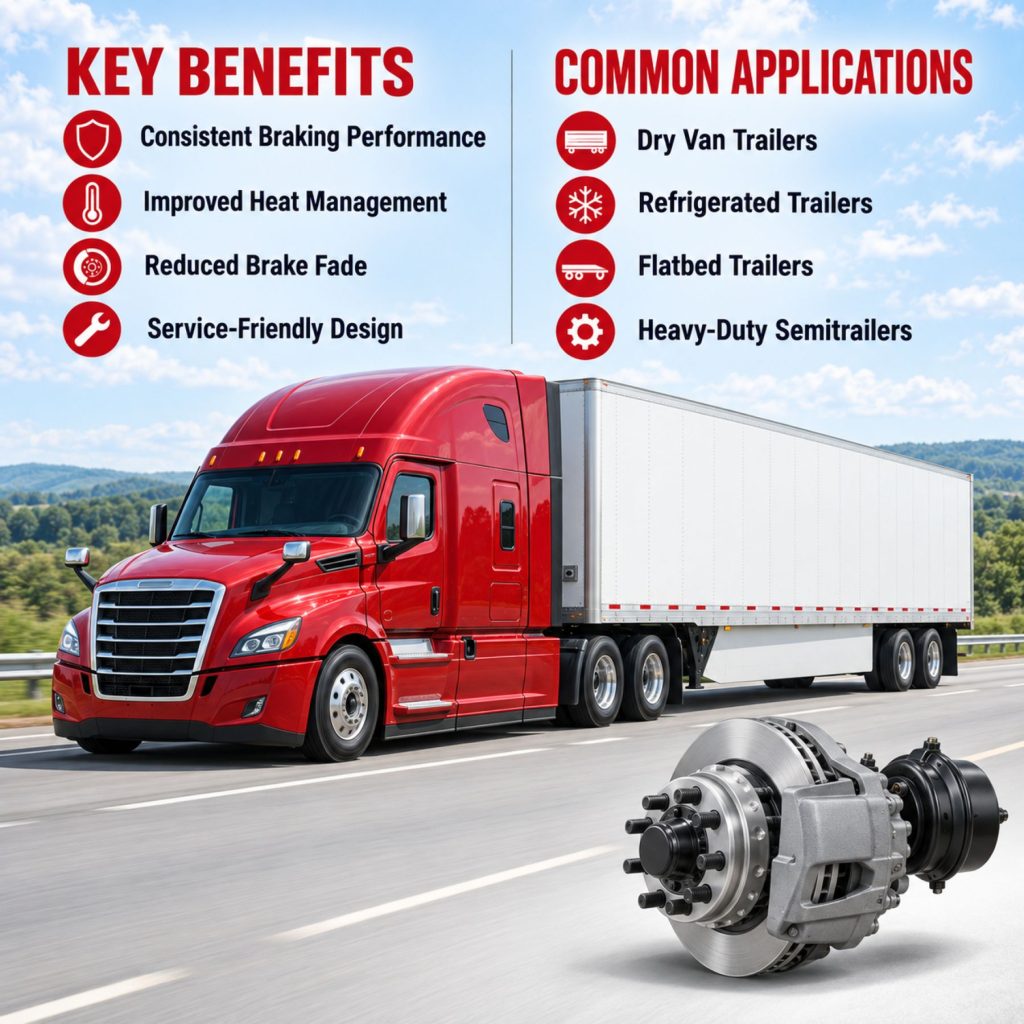
- Dry-van trailers
- Refrigerated trailers
- Flatbed trailers
- Step-deck trailers
- Tank trailers
- Hopper trailers
- Dump trailers
- Container chassis
- Lowboy trailers
- Car-hauler trailers
- Livestock trailers
- Logging trailers
- High-mileage fleet trailers
- Vocational semitrailers
- Specialty air-braked trailers
Vehicle and Brake-System Compatibility
P89 Plus was offered on approved SAF-Holland trailer axle and suspension configurations, including applications associated with SAF CBX air-ride and ULX mechanical suspension systems.
Compatibility is determined by the complete axle and wheel-end assembly rather than trailer brand alone.
A trailer may use:
- P89 standard wheel ends
- P89 Plus sealed-bearing wheel ends
- P89 Integral configurations
- SAF C88 air-disc brakes
- Another manufacturer’s air-disc brake
- S-cam drum brakes
The serial tag located on or near the axle tube should be used to identify the original build. Trailer VIN information and manufacturer build records may also be needed.
Advantages
- Consistent air-disc brake response
- Strong repeated-stop performance
- Improved heat dissipation compared with many drum brakes
- Integrated rotor-and-hub construction
- Bi-metallic rotor design
- Reduced rotor distortion
- Long-life sealed bearings
- No conventional wheel seal
- Controlled bearing preload
- Reduced routine wheel-end maintenance
- Replaceable brake pads
- Automatic internal brake adjustment
- Compatible with trailer ABS
- Available service kits
- Long commercial warranty for qualifying applications
- Designed as a complete SAF-Holland axle solution
Limitations or Considerations
- Restricted to compatible SAF-Holland applications
- Higher initial cost than some drum-brake systems
- Requires air-disc brake service knowledge
- Calipers have left- and right-hand versions
- Special tools may be required
- Seized slide components can cause uneven wear
- Protective boots are vulnerable to heat and physical damage
- Rotor-and-hub replacement can be more expensive than pad service
- Wheel-end parts differ from standard P89 configurations
- Incorrect parts can affect bearing preload
- Pads and rotors remain wear components
- Warranty coverage varies by duty cycle
- Severe-duty operation requires shorter inspection intervals
- Road salt can corrode exposed brake components
- Air-disc brake drag can create substantial wheel-end heat
Driver and Operator Experience
A properly operating P89 Plus system should provide smooth, predictable trailer braking without pulling, vibration, or delayed application.
Drivers may notice more immediate brake response than with some drum-brake systems. The trailer’s overall feel still depends on tractor-to-trailer brake balance, loading, ABS operation, and road traction.
Operators should report:
- Trailer pulling during braking
- Grinding or scraping noises
- Brake vibration
- Burning odors
- Smoke from a wheel end
- One wheel running hotter than the others
- ABS warning lamps
- Reduced braking response
- Air leakage
- Visible rotor cracking
- Unusual pad or rotor wear
A hot wheel end can indicate brake drag, caliper binding, bearing problems, insufficient running clearance, or improper repair. The trailer should be inspected before continued operation.
Maintenance and Ownership Notes
- Inspect brake-pad thickness.
- Compare inboard and outboard pad wear.
- Inspect rotor thickness.
- Check rotor surfaces for cracking and scoring.
- Inspect the caliper for free sliding movement.
- Check slide-pin boots.
- Inspect tappet and adjuster boots.
- Verify correct running clearance.
- Inspect brake chambers for corrosion and leakage.
- Check actuator mounting hardware.
- Inspect caliper mounting bolts.
- Check wheel-end temperature patterns.
- Inspect sealed bearings according to SAF-Holland procedures.
- Check the spindle nut and hub cap.
- Inspect wheel studs and nuts.
- Verify ABS sensor position.
- Inspect the tone ring.
- Check dust shields where equipped.
- Use approved SAF-Holland service tools.
- Use the correct replacement kits.
- Reduce service intervals for severe operating conditions.
Common Brake-System Problems
- Uneven pad wear: Binding slide pins, damaged boots, a seized caliper, incorrect running clearance, or misaligned components may cause one pad to wear faster.
- Brake drag: Caliper-adjuster problems, restricted actuator return, seized slides, damaged chamber components, contaminated mechanisms, or incorrect installation can keep the pads against the rotor.
- Rotor cracking: Excessive heat, severe duty, dragging brakes, repeated high-energy stops, or operation below allowable rotor thickness can contribute to cracking.
- Rotor scoring: Worn pads, embedded debris, damaged friction material, or delayed pad replacement may cut grooves into the rotor surfaces.
- Brake vibration: Rotor thickness variation, excessive runout, uneven pad deposits, loose mounting components, or wheel-end problems may produce vibration.
- Caliper will not slide: Corrosion, damaged guide components, torn boots, improper lubrication, or physical damage can restrict movement.
- Automatic adjustment problem: Internal adjuster damage, improper manual adjustment, seized tappets, or excessive component wear may produce incorrect clearance.
- Wheel-end overheating: Brake drag, bearing damage, incorrect preload, overloaded axles, low tire pressure, or repeated severe braking may be responsible.
- ABS warning lamp: Sensor gap, tone-ring damage, bearing movement, wiring faults, or ABS controller problems can trigger a warning.
- Air leakage: Damaged brake chambers, hoses, fittings, valves, or seals may reduce available actuation pressure.
Safety and Service Precautions
The P89 Plus is a safety-critical brake and wheel-end system. Service should be performed by technicians trained in commercial air-disc brakes and trailer wheel ends.
Before service:
- Park the trailer on a level surface.
- Apply the parking brakes.
- Block the wheels.
- Support the trailer with properly rated stands.
- Drain the air system when disconnecting brake chambers or hoses.
- Cage spring brakes according to the approved procedure.
- Allow hot brake components to cool.
- Wear eye protection and appropriate gloves.
- Follow the correct SAF-Holland service manual.
- Use properly rated lifting equipment.
Never work beneath a trailer supported only by jacks. Never remove a spring-brake chamber without safely controlling its power spring.
Brake dust should not be cleaned using compressed air. Follow approved dust-control and cleaning procedures.
Do not apply lubricant to pad friction surfaces or the rotor. Contaminated friction material must be replaced according to the service procedure.
Identification Information
P89 Plus identification may be found on the axle serial tag, caliper markings, hub information, brake chamber label, and trailer build records.
Record the following information:
- Trailer manufacturer
- Vehicle identification number
- Trailer model and year
- SAF-Holland axle model
- Axle serial number
- Suspension model
- Axle capacity
- P89 Plus designation
- Caliper manufacturer and model
- Left- or right-hand caliper
- Caliper assembly number
- Rotor-and-hub part number
- Brake-pad part number
- Brake chamber type and size
- Spindle configuration
- Wheel-stud length
- Wheel type
- ABS sensor number
- Tone-ring specification
- Overslung or underslung installation
Do not identify replacement parts only by measuring the rotor or comparing photographs. P89, P89 Plus, P89 Integral, and other SAF air-disc brake systems use different wheel-end components.
Buying Considerations
- Confirm the axle serial number.
- Verify the P89 Plus designation.
- Identify the suspension model.
- Confirm axle capacity.
- Determine left- or right-hand caliper position.
- Match the caliper assembly number.
- Confirm the rotor-and-hub kit.
- Verify brake-pad compatibility.
- Identify the brake chamber size.
- Check spindle configuration.
- Confirm wheel-stud length.
- Verify wheel and tire equipment.
- Check ABS sensor compatibility.
- Determine whether the trailer uses overslung or underslung suspension.
- Review current service-kit availability.
- Inspect the opposite wheel end.
- Confirm current warranty coverage.
- Use a qualified air-disc brake repair facility.
Variants and Configurations
- Left-hand P89 Plus brake
- Right-hand P89 Plus brake
- Service-brake chamber configuration
- Spring-brake chamber configuration
- Different chamber sizes
- Short wheel-stud hub assembly
- Long wheel-stud hub assembly
- Overslung suspension installation
- Underslung suspension installation
- Air-ride suspension application
- Mechanical suspension application
- ABS sensor-equipped wheel end
- Dust-shield-equipped brake
- Application-specific axle capacity
- Original Integral rotor-and-hub assembly
- Replacement rotor-and-hub kit
Configuration and part availability depend on the axle build. The complete axle serial number should be used before ordering parts.
Comparison to Similar Equipment
Compared with the standard SAF P89 air-disc brake, P89 Plus uses the premium Integral rotor-and-hub assembly and individually sealed bearing system. Standard P89 configurations use different hub, bearing, seal, and rotor arrangements.
Compared with the Hendrickson MAXX22T Trailer Air Disc Brake, P89 Plus is integrated into SAF-Holland’s trailer axle and wheel-end architecture. Calipers, rotors, hubs, bearings, and mounting components are not interchangeable.
Compared with the Haldex ModulT Air Disc Brake, P89 Plus represents a complete SAF-Holland axle, brake, rotor, hub, and sealed-bearing package. ModulT refers primarily to the Haldex caliper and foundation-brake family used in multiple applications.
Compared with the Meritor EX+ LS Air Disc Brake, P89 Plus uses SAF-Holland-specific wheel-end integration and service parts.
Compared with an S-cam drum brake, P89 Plus offers exposed rotor cooling, direct pad clamping, and automatic internal adjustment. Drum brakes may have lower initial cost and broader familiarity among service facilities.
Best Fit For
- Trailers originally equipped with P89 Plus
- High-mileage trailer fleets
- Dry-van trailers
- Refrigerated trailers
- Flatbed trailers
- Tank trailers
- Vocational semitrailers
- Fleets prioritizing wheel-end durability
- Operators seeking reduced wheel-seal maintenance
- Fleets wanting integrated axle and brake support
- Trailers using compatible SAF-Holland suspensions
- Operations requiring consistent repeated-stop performance
- Fleets with trained air-disc brake technicians
- Applications eligible for extended P89 Plus warranty coverage
Related Vehicle and Trailer Types
- Complete Guide to Semi Trailer Types
- Dry-van trailers
- Refrigerated trailers
- Flatbed trailers
- Step-deck trailers
- Tank trailers
- Hopper trailers
- Dump trailers
- Container chassis
- Lowboy trailers
- Car-hauler trailers
- Livestock trailers
- Logging trailers
- Specialty semitrailers
Related Truck and Trailer Models
- Great Dane Champion Dry Van Trailer
- Great Dane Everest Reefer Trailer
- Utility 3000D Dry Van Trailer
- Utility 3000R Reefer Trailer
- Wabash DuraPlate Dry Van Trailer
- Wabash ArcticLite Reefer Trailer
- Polar Tank Trailer
- Heil Tank Trailer
- Fontaine Revolution Flatbed Trailer
- Wilson Pacesetter Hopper Trailer
Related Brake System Types
- Brake Systems
- Air Brake Systems
- Air Disc Brake Systems
- Trailer Brake Systems
- Brake Chambers & Actuators
- ABS & Electronic Braking Systems
- Trailer foundation brakes
- Integrated trailer wheel ends
- Sealed-bearing wheel ends
- Pneumatic disc brakes
Related Brake Products
- Hendrickson MAXX22T Trailer Air Disc Brake
- Haldex ModulT Air Disc Brake
- Meritor EX+ LS Air Disc Brake
- ZF WABCO MAXXUS L2.0 Air Disc Brake
- Bendix TABS-8 Trailer ABS
- Haldex PLC Select Trailer ABS
- SAF P89 air-disc brake
- SAF P89 Integral wheel end
- SAF C88 air-disc brake
- Haldex air-disc brake chambers
- Trailer ABS wheel-speed sensors
Related Equipment Systems
- Equipment Systems
- Axles & Differentials
- Suspension Systems
- Tires & Wheels
- Trailer axle systems
- Wheel-end systems
- Trailer air systems
- Trailer ABS
- Tire-inflation systems
- Axle lubrication systems
Related Guides
- Brake System Guides
- Air Brake Systems Explained
- Air Disc Brakes vs Drum Brakes
- How to Inspect and Maintain Commercial Truck Brakes
- Tractor vs Trailer Brake Systems
- How Truck ABS and Electronic Stability Control Work
- Commercial Truck Brake Components Explained
Regulatory and Compliance Notes
The P89 Plus foundation brake must be installed and maintained as part of a trailer braking system certified to applicable vehicle-safety standards.
The brake’s rated performance does not increase trailer gross axle weight, gross vehicle weight, tire capacity, wheel capacity, or legal road-weight limits.
Commercial vehicle inspections may evaluate:
- Pad thickness
- Rotor condition
- Brake chamber operation
- Air leakage
- Caliper mounting
- Brake balance
- ABS operation
- Wheel-bearing condition
- Wheel and fastener security
Air-disc brake components must remain within the manufacturer’s wear limits. A rotor should not be returned to service below its minimum thickness or with damage exceeding the approved limits.
Warranty coverage does not replace mandatory inspection and maintenance. Current SAF-Holland warranty terms vary among standard or moderate duty, on-road severe duty, and off-road severe duty.
Real World Operating Notes
P89 Plus should be treated as both a foundation brake and an integrated wheel-end system. A brake complaint may originate from the caliper, actuator, rotor, bearing assembly, ABS sensor, or pneumatic controls.
Uneven pad wear often provides an early warning of restricted caliper movement. Catching damaged boots or stiff slide components before the brake begins dragging can prevent more expensive rotor and wheel-end damage.
The sealed bearings reduce routine lubrication and wheel-seal service, but they do not make inspection unnecessary. Heat, impact damage, overloading, improper installation, and brake drag can still damage the wheel end.
Parts identification is particularly important because P89 and P89 Plus use some related brake components but different hub, rotor, bearing, and seal arrangements.
Frequently Asked Questions
What is the SAF-Holland P89 Plus?
It is a premium trailer air-disc brake and sealed wheel-end package built around SAF-Holland’s Integral rotor-and-hub design.
What makes P89 Plus different from the standard P89?
P89 Plus uses an Integral rotor-and-hub assembly with individually sealed bearings and no conventional wheel seal. Standard P89 configurations use different wheel-end arrangements.
What is the SAF Integral rotor?
It is a bi-metallic rotor-and-hub design that allows the braking ring to expand radially as it heats, helping the braking surfaces remain flat.
Does P89 Plus use sealed bearings?
Yes. It uses individually sealed, long-life bearings with a precision spacer that controls preload.
Does the wheel end use a traditional hub seal?
No. The individually sealed-bearing design eliminates the conventional wheel seal used in many trailer hubs.
Does P89 Plus adjust automatically?
The caliper contains an internal automatic adjustment mechanism that compensates for normal pad and rotor wear.
Can P89 Plus work with trailer ABS?
Yes. The wheel end can include an ABS tone ring and wheel-speed sensor for an approved trailer ABS installation.
Can P89 and P89 Plus parts be interchanged?
Some brake components may be shared, but the hub, rotor, bearings, seals, and service kits can differ. Parts must be verified by axle serial number.
What causes uneven pad wear?
Common causes include restricted caliper slides, damaged boots, seized adjuster components, misalignment, or an actuator that does not release properly.
Why is one wheel end running hot?
Possible causes include brake drag, restricted caliper movement, incorrect running clearance, bearing damage, repeated severe braking, or low tire pressure.
How can the correct replacement parts be identified?
Use the axle serial number, P89 Plus designation, caliper position, rotor-and-hub number, brake chamber size, wheel-stud configuration, and ABS information.
What warranty does P89 Plus carry?
Current SAF-Holland materials list application-specific coverage that can extend to seven years for qualifying standard or moderate-duty service. Exact coverage depends on duty cycle and current warranty terms.
Availability and Where to Find
SAF-Holland P89 Plus pads, calipers, rotor-and-hub assemblies, brake chambers, mounting hardware, bearings, hub assemblies, ABS sensors, and service tools may be available through SAF-Holland distributors, trailer dealers, fleet-parts suppliers, heavy-duty brake specialists, and authorized service facilities.
Current SAF-Holland service literature lists dedicated P89 Plus rotor replacement kits, left- and right-hand caliper kits, hub assemblies, chamber options, ABS sensor kits, and related hardware.
Before ordering, buyers should record the trailer VIN, SAF-Holland axle model, axle serial number, brake designation, caliper side, rotor-and-hub number, brake chamber size, spindle arrangement, and wheel-stud length.
Current parts information, technical literature, service procedures, warranty details, and support resources are available through the SAF-Holland P89 air-disc brake service site and the SAF-Holland website.
Support Trucking Families
Truck Equipment Atlas supports the mission of Grey Cross, a nonprofit dedicated to helping families of truck drivers who lose their lives while on the road. As the site grows, part of its mission is to bring awareness and support to these families.
Podcast or Video Section
Learn More Through Audio and Video
Truck Equipment Atlas will continue expanding with podcast episodes, interviews, and equipment breakdowns to help drivers and fleets better understand trucks and equipment.
Follow the Growth of Truck Equipment Atlas
Truck Equipment Atlas continues to expand with new truck profiles, trailer coverage, diesel engine pages, equipment system resources, manufacturer information, and educational guides.
Visit our Site Updates page to explore recent additions, project milestones, and upcoming resources as we continue building one of the industry’s growing commercial trucking equipment reference libraries.
View the Latest Site Updates: Truck Equipment Atlas Site Updates