
Hendrickson ULTRAA-K Slider System
Quick Facts
- Manufacturer: Hendrickson
- Product Type: Integrated sliding trailer air-suspension and axle system
- Suspension Category: Tandem-axle air-ride slider
- Primary Applications: Dry vans and refrigerated trailers
- Installation Position: Trailer rear tandem
- System Family: Next-generation VANTRAAX platform
- Typical Configuration: Integrated air suspension, axles, brakes, and sliding subframe
- Primary Benefit: Reduced weight combined with improved ride quality, durability, and operating efficiency
- Market: North American commercial trailers
Overview
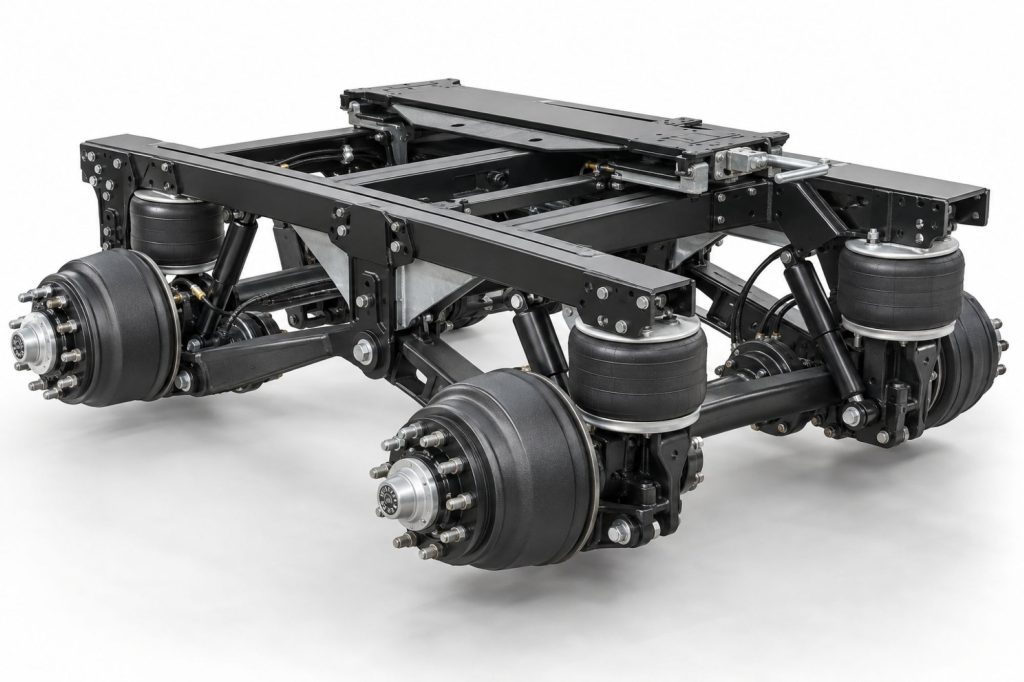
The Hendrickson ULTRAA-K is an integrated air-ride slider system developed for dry-van and refrigerated-trailer applications. It combines the sliding subframe, air suspension, trailer axles, wheel ends, and brake equipment into a coordinated assembly designed to reduce weight while maintaining structural strength and dependable service life.
ULTRAA-K represents the next generation of Hendrickson’s VANTRAAX slider technology. The system uses an optimized structural design, advanced air springs, and Hendrickson trailer components to deliver controlled ride characteristics and efficient load distribution.
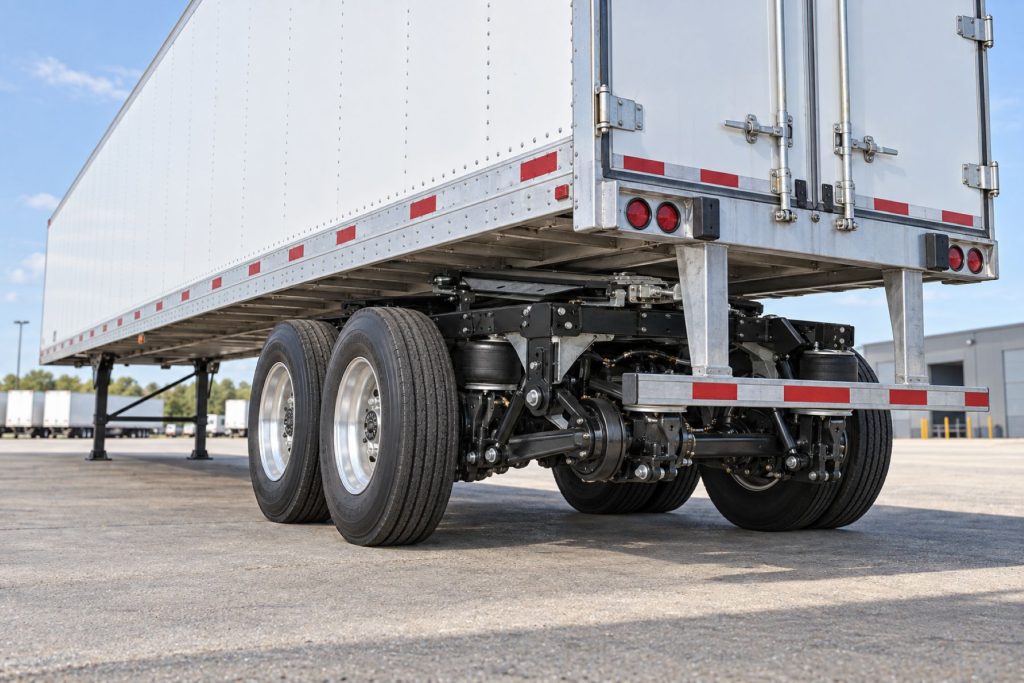
Because it is a movable tandem assembly, ULTRAA-K allows operators to reposition the trailer axles beneath the trailer. This helps fleets manage bridge-law requirements, distribute cargo weight between tractor and trailer axles, and adjust trailer handling characteristics.
Key Characteristics
- Integrated sliding tandem-axle suspension system
- Designed primarily for dry vans and refrigerated trailers
- Air-ride suspension for cargo protection and smoother trailer operation
- Weight-optimized structural design
- Movable tandem for axle-weight adjustment
- Integrated Hendrickson axles and wheel-end options
- Compatible with drum- and disc-brake configurations, depending on specification
- Designed to simplify trailer assembly and component integration
- Developed as the next generation of the VANTRAAX slider platform
Major Components
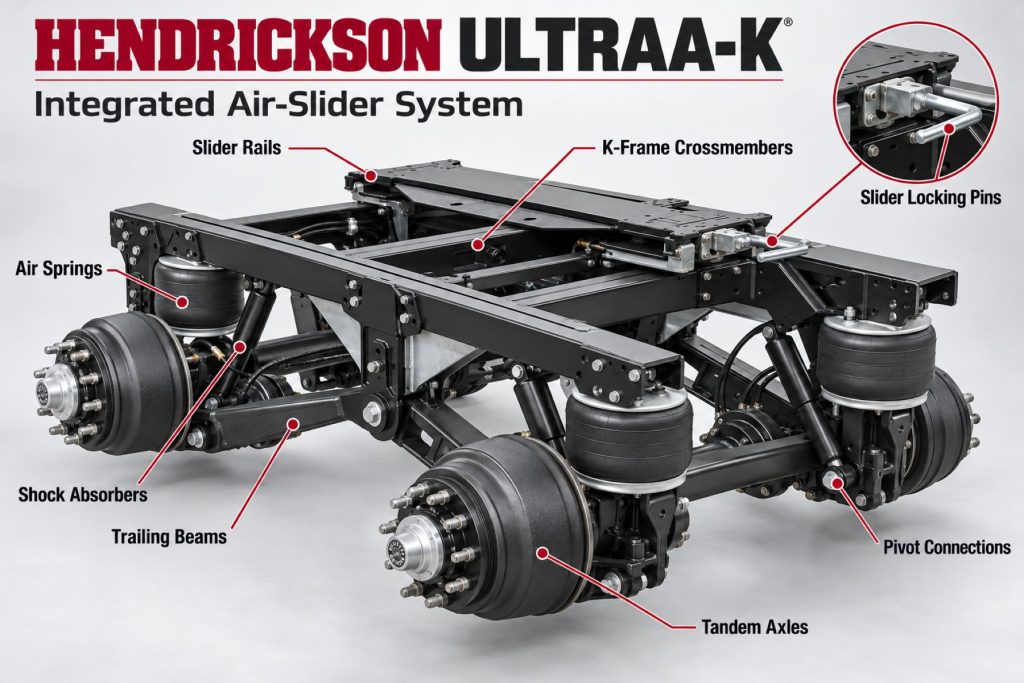
The ULTRAA-K system combines several major trailer components into one integrated assembly:
- Sliding subframe or slider box
- Tandem suspension beams
- Air springs
- Shock absorbers
- Height-control valve and air lines
- Trailer axles
- Axle seats and suspension connections
- Slider locking pins and release mechanism
- Crossmembers and structural supports
- Brake chambers, slack adjusters, and foundation brakes
- Wheel ends, hubs, bearings, and seals
- Optional tire-inflation and monitoring equipment
How the Suspension System Works
The ULTRAA-K uses compressed air inside flexible air springs to support the trailer and its cargo. As road inputs move the axles vertically, the air springs compress and expand to isolate the trailer body from much of the shock and vibration generated at the tires.
Shock absorbers control suspension movement and prevent excessive bouncing. A height-control valve adds or removes air from the air springs to maintain the specified trailer ride height as the load changes.
The entire suspension and axle assembly is mounted within a sliding subframe. When its locking pins are released, the tandem can move forward or rearward along rails beneath the trailer. Once positioned correctly, the locking pins engage the trailer rails and secure the assembly for operation.
Moving the tandem forward generally transfers more cargo weight to the trailer axles and reduces weight carried by the tractor drive axles. Moving it rearward generally transfers weight toward the tractor while increasing the distance between axle groups.
Suspension Position and Function
ULTRAA-K is installed beneath the rear portion of a semi-trailer. It supports the trailer’s tandem axle group while providing suspension movement, load distribution, braking support, and an adjustable wheelbase.
The slider function allows fleets and drivers to change tandem position without relocating the cargo. This is particularly important when balancing axle weights, meeting bridge-formula requirements, adjusting trailer swing clearance, and managing different loading patterns.
Common Specifications
- Configuration: Tandem-axle sliding trailer suspension
- Suspension Type: Air ride
- Trailer Applications: Dry van and refrigerated trailer
- Axle Arrangement: Two non-driven trailer axles
- Nominal Tandem Capacity: Commonly configured around standard North American tandem-axle limits; exact ratings depend on model and application
- Brake Options: Drum brakes or air disc brakes, depending on configuration
- Wheel-End Options: Various Hendrickson hub, bearing, seal, and lubrication packages
- Slider Operation: Manual or assisted pin-release configurations may be available
- Ride Height: Application-specific and determined by trailer design
- Axle Spacing: Selected according to trailer design, legal requirements, and operating needs
Specifications vary by trailer manufacturer, model year, axle package, brake selection, and fleet requirements. The trailer identification records and Hendrickson specification documents should be used to confirm an individual assembly.
Capacity, Ride Height, and Axle Travel
ULTRAA-K systems are configured for common North American van and refrigerated-trailer tandem requirements. Actual suspension and axle ratings depend on the selected model, axle spacing, wheel-end equipment, brakes, tires, and trailer structure.
Ride height must match the trailer manufacturer’s design. Installing incorrect air springs, height-control components, or suspension parts can alter ride height and affect axle alignment, suspension travel, tire clearance, and trailer handling.
Available jounce and rebound travel allow the wheels to follow uneven road surfaces while limiting shock transfer into the trailer body. Correct ride height is essential for preserving the intended suspension travel.
Ride Quality and Load Distribution
Air springs help isolate the trailer and cargo from pavement impacts more effectively than conventional mechanical suspensions. This can reduce vibration transmitted into the trailer floor and improve protection for packaged, temperature-controlled, or damage-sensitive freight.
The sliding tandem provides a second form of load management. Repositioning the tandem changes how cargo weight is divided among the steer axle, tractor drive axles, and trailer axles.
Proper tandem placement can help:
- Keep individual axle groups within legal limits
- Improve tractor and trailer stability
- Maintain adequate tractor drive-axle traction
- Provide sufficient tractor-to-trailer clearance
- Reduce unnecessary tire and suspension loading
Suspension Controls and Adjustment Options
Normal suspension control is handled by a height-control valve that maintains the designed ride height. Depending on trailer equipment, additional controls may include a dump valve, automatic suspension dump function, dock-height control, or tire-inflation system.
The tandem position is adjusted through the slider locking mechanism. The driver releases the locking pins, uses the trailer brakes to hold the tandem, and moves the tractor and trailer body until the selected rail holes align with the pins.
All locking pins must be completely engaged before the trailer returns to service. A partially engaged pin can allow the tandem to move unexpectedly and may damage the trailer or create a serious safety hazard.
Alignment and Suspension Geometry
Correct axle alignment is necessary to control tire wear, rolling resistance, and trailer tracking. Both axles must be properly aligned with the trailer centerline and with each other.
Potential causes of alignment problems include worn pivot components, loose fasteners, damaged suspension members, incorrect ride height, bent axles, improper installation, or collision damage.
Alignment should be checked after suspension repairs, axle replacement, abnormal tire wear, curb strikes, or structural damage. Ride height should be verified before final axle-alignment measurements are performed.
Axle, Brake, and Wheel-End Options
ULTRAA-K is designed as an integrated suspension-and-axle package. Available equipment depends on the trailer manufacturer and fleet specification.
Common options may include:
- Standard-duty trailer axles
- Drum-brake packages
- Air disc brakes
- Conventional wheel ends
- Low-maintenance wheel-end packages
- Preset or unitized bearing systems
- Automatic tire-inflation systems
- Tire-pressure monitoring equipment
- Wheel-end temperature or condition-monitoring technology
The exact axle, brake, and wheel-end components should be identified before ordering replacement parts.
Common Applications
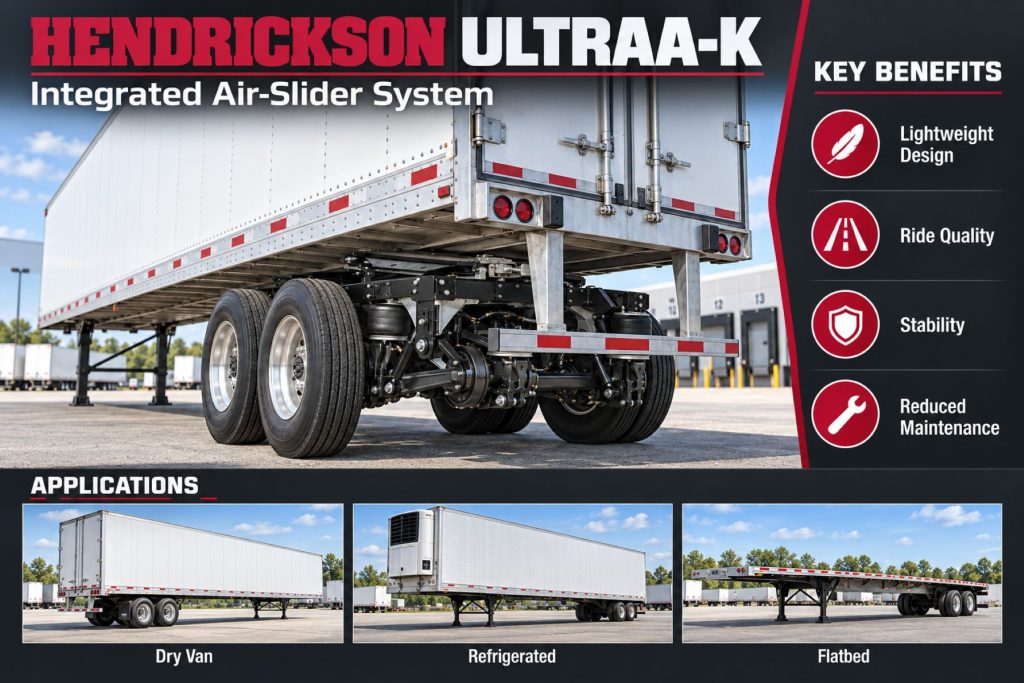
- Dry-van trailers
- Refrigerated trailers
- Truckload freight operations
- Less-than-truckload trailer fleets
- Regional distribution
- Long-haul freight transportation
- Drop-and-hook operations
- High-mileage fleet service
- Cargo-sensitive hauling
Vehicle, Axle, and Frame Compatibility
ULTRAA-K is intended for compatible van and refrigerated-trailer structures equipped with the correct slider rails, mounting dimensions, air system, axle spacing, tire clearance, and brake controls.
Compatibility depends on more than nominal capacity. Trailer manufacturers must account for frame strength, rail design, kingpin location, suspension travel, axle-to-body clearance, landing-gear clearance, and rear-impact-guard placement.
Replacement systems and major components should match the trailer manufacturer’s specifications. A suspension with a similar appearance may use different ride heights, beam geometry, axle connections, or slider dimensions.
Advantages
- Reduced system weight can increase available payload
- Air-ride design helps protect cargo from road shock and vibration
- Sliding tandem permits axle-weight adjustment
- Integrated system coordinates suspension, axle, brake, and wheel-end components
- Optimized structure provides a strong strength-to-weight relationship
- Improved ride control can reduce stress on the trailer body and cargo
- Multiple brake and wheel-end configurations support different fleet requirements
- Hendrickson parts and service support are widely available in the commercial-trailer market
Limitations or Considerations
- Air suspension requires a dependable compressed-air supply
- Air leaks can cause improper ride height or a lowered trailer
- Slider rails and locking pins require regular inspection and lubrication
- Incorrect ride height can affect alignment and component life
- Weight savings vary according to the complete axle, brake, and wheel-end specification
- Corrosion and debris can interfere with slider movement
- Drivers must confirm that all locking pins are fully engaged after adjustment
Driver and Operator Experience
Drivers should experience smoother trailer movement than with many mechanical spring suspensions, especially when the trailer is loaded. The controlled air-ride response can reduce harsh impacts and cargo movement over rough pavement.
The slider allows the driver to correct axle-weight distribution after loading. However, seized rails, damaged locking pins, poor lubrication, uneven parking surfaces, or excessive pressure against the pins can make adjustment difficult.
Drivers should visually check all locking pins after every tandem adjustment rather than relying only on the release handle’s position.
Maintenance and Ownership Notes
- Inspect the suspension during scheduled trailer preventive maintenance.
- Check air springs for cuts, abrasion, cracking, or leaks.
- Inspect air lines, fittings, valves, and reservoirs for leakage or damage.
- Verify ride height according to the trailer and suspension specifications.
- Check shock absorbers for leakage, loose mounts, or damaged bushings.
- Inspect slider rails, stops, crossmembers, and locking pins for damage.
- Keep slider rails and pin mechanisms properly lubricated.
- Inspect pivot connections and structural fasteners at required intervals.
- Monitor tires for feathering, diagonal wear, or other alignment-related patterns.
- Service brakes and wheel ends according to their specific manufacturer procedures.
- Confirm axle alignment after structural or suspension repairs.
Common Suspension Problems
- Air leaks: Damaged air springs, fittings, hoses, or valves may cause the trailer to settle or operate below its specified ride height.
- Incorrect ride height: A misadjusted or damaged height-control system can reduce suspension travel and contribute to poor handling or tire wear.
- Slider pins that will not release: Pin loading, corrosion, contamination, damaged linkage, or inadequate lubrication can prevent normal release.
- Pins that do not fully engage: Misaligned rail holes, bent components, debris, or linkage problems can prevent secure locking.
- Uneven tire wear: Incorrect axle alignment, worn components, improper ride height, tire-pressure differences, or bent axles may be responsible.
- Excessive bouncing: Worn shock absorbers, incorrect air pressure, damaged air springs, or height-control problems can reduce damping.
- Trailer leaning: Uneven loading, an air-system restriction, structural damage, or suspension problems can cause side-to-side height differences.
- Cracks or structural damage: Overloading, impacts, loose fasteners, corrosion, or severe service can damage the slider frame or suspension members.
Identification Information
Identification information is normally found on suspension, slider, or axle tags attached to the assembly. The trailer’s vehicle identification number and manufacturer build records may also be required.
Record the following information before ordering parts:
- Trailer manufacturer
- Trailer VIN
- Trailer model and production date
- Hendrickson suspension model
- Suspension assembly or serial number
- Axle model and identification number
- Ride height
- Axle spacing
- Brake type and size
- Wheel-end configuration
- Slider length or rail configuration
- Air-spring and shock-absorber part numbers
Visual appearance alone is not sufficient because similar ULTRAA-K configurations may contain different service components.
Buying Considerations
- Confirm compatibility with the trailer manufacturer’s frame and slider rails.
- Compare complete installed weight rather than the weight of only one component.
- Verify suspension and axle capacity for the intended operation.
- Choose the correct ride height and axle spacing.
- Determine whether drum brakes or air disc brakes are preferred.
- Review wheel-end maintenance requirements and warranty coverage.
- Consider tire-inflation or condition-monitoring options.
- Confirm replacement-parts availability within the fleet’s operating region.
- Evaluate corrosion protection for winter-road and coastal operation.
- Compare acquisition cost with expected payload, maintenance, tire-life, and fuel-saving benefits.
Variants and Configurations
ULTRAA-K can be configured differently according to trailer design and fleet specifications. Variations may involve:
- Ride height
- Axle spacing
- Slider length
- Axle-wall thickness and rating
- Track width
- Drum or air disc brakes
- Wheel-end package
- Tire-inflation equipment
- Suspension dump controls
- Pin-release mechanism
- Corrosion-protection package
- Trailer manufacturer integration
Available configurations can change by production year and trailer builder. Buyers should confirm current specifications directly through Hendrickson and the trailer manufacturer.
Comparison to Similar Equipment
Compared with the Hendrickson VANTRAAX, ULTRAA-K is the newer air-slider platform and emphasizes further structural and weight optimization while retaining the integrated slider concept.
Compared with the Hendrickson INTRAAX, ULTRAA-K includes a sliding subframe that allows tandem repositioning. INTRAAX is commonly used as a fixed-position integrated suspension and axle system.
Compared with a mechanical slider suspension, ULTRAA-K generally offers a smoother ride and better cargo isolation. Mechanical systems may be simpler in certain applications but do not provide the same air-ride characteristics.
Best Fit For
- Dry-van fleets requiring a movable tandem
- Refrigerated fleets transporting cargo sensitive to vibration
- Truckload carriers seeking lower trailer tare weight
- High-mileage highway operations
- Fleets that frequently adjust tandems to balance axle weights
- Trailer buyers seeking an integrated suspension, axle, and slider package
- Operations prioritizing ride quality, payload efficiency, and serviceability
Related Vehicle and Trailer Types
- Complete Guide to Trailer Types
- Dry Van vs Refrigerated Trailer
- Dry-van trailers
- Refrigerated trailers
- Pup trailers
- Truckload trailers
- Less-than-truckload trailers
Related Truck and Trailer Models
- Great Dane dry-van and refrigerated trailers
- Utility dry-van and refrigerated trailers
- Wabash dry-van and refrigerated trailers
- Hyundai Translead van trailers
- Stoughton dry-van trailers
- Vanguard van trailers
Related Suspension Types
- Air Suspension Systems
- Trailer Suspension Systems
- Hendrickson VANTRAAX
- Hendrickson INTRAAX
- Mechanical trailer suspensions
- Fixed-position trailer air suspensions
- Sliding tandem suspensions
- Integrated suspension and axle systems
Related Equipment Systems
- Suspension Systems
- Air Brake Systems Explained
- Axles & Differentials
- Brake systems
- Tires and wheels
- Trailer air systems
- Automatic tire-inflation systems
- Wheel-end systems
Related Guides
- Suspension System Guides
- Lift Axles Explained
- Choosing the Right Trailer for Your Freight
- Complete Guide to Freight Types
- Trailer Suspension Types Explained
- Air Suspension vs Leaf Spring Suspension
- How to Inspect a Commercial Truck or Trailer Suspension
- Common Commercial Suspension Problems
- How to Choose the Right Commercial Suspension System
Regulatory and Compliance Notes
The tandem position must allow the vehicle combination to comply with federal, state, provincial, and local axle-weight and bridge-formula requirements.
Suspension capacity does not override legal road-weight limits. Actual allowable weight depends on axle spacing, gross vehicle weight, jurisdiction, permits, tires, wheels, axles, brakes, and trailer ratings.
Drivers must ensure that the slider locking pins are fully engaged before operating the vehicle. Brakes, air lines, tires, wheel ends, and suspension components must also satisfy applicable inspection and out-of-service requirements.
Repairs or modifications should not change the approved ride height, axle spacing, structural integrity, or braking configuration without engineering authorization.
Real World Operating Notes
Slider problems often result from corrosion, packed debris, insufficient lubrication, damaged rails, or pressure against the locking pins. Releasing the tractor brakes while keeping the trailer brakes applied may help remove pin tension, but drivers should follow approved fleet procedures.
Tandem placement affects more than axle weights. Moving the tandem changes trailer wheelbase, low-speed turning behavior, rear swing, dock approach, and the clearance between the tractor and trailer.
Air-suspension problems should be corrected before alignment work begins. A trailer aligned at the wrong ride height may still track poorly once the suspension returns to its normal operating position.
Frequently Asked Questions
What is the Hendrickson ULTRAA-K?
The ULTRAA-K is an integrated tandem-axle air-ride slider system for commercial trailers. It combines the sliding subframe, suspension, axles, brakes, and wheel-end equipment into a coordinated package.
What trailers use the ULTRAA-K?
It is designed primarily for dry-van and refrigerated trailers operating in the North American commercial-freight market.
Is ULTRAA-K the same as VANTRAAX?
No. ULTRAA-K is the next-generation Hendrickson air-slider platform developed from the VANTRAAX concept. The systems are related, but their parts and complete assemblies should not be assumed interchangeable.
Can the trailer tandems be moved?
Yes. The suspension and axles are mounted in a sliding subframe that can be moved along the trailer rails after the locking pins are released.
Why would a driver move the tandems?
The tandems are moved to adjust axle-weight distribution, comply with bridge and axle-weight laws, improve clearance, or change trailer handling characteristics.
Does ULTRAA-K use air suspension?
Yes. Air springs support the trailer and help isolate the body and cargo from road shock.
Is ULTRAA-K available with air disc brakes?
Air disc brake and drum-brake configurations may be available depending on the trailer manufacturer, axle specification, and production offering.
How is the correct ride height determined?
The correct ride height is established by the suspension and trailer specifications. It should be verified using the approved Hendrickson service procedure for the exact configuration.
What causes an ULTRAA-K trailer to sit low?
Possible causes include an air leak, damaged air spring, blocked air line, faulty height-control valve, incorrect adjustment, insufficient tractor air pressure, or suspension damage.
How do I identify the correct replacement parts?
Use the suspension identification tag, axle tag, trailer VIN, ride height, brake configuration, and wheel-end information. Confirm the numbers through Hendrickson or the trailer manufacturer before ordering.
Availability and Where to Find
The Hendrickson ULTRAA-K is available as original equipment through participating commercial-trailer manufacturers. Replacement components are available through Hendrickson-authorized distributors, trailer dealers, fleet-parts suppliers, and commercial-vehicle service facilities.
New-system availability depends on the trailer builder, production year, suspension specification, axle spacing, brake package, and wheel-end selection. Used assemblies may be found through trailer dismantlers and heavy-equipment recyclers, but identification numbers and structural condition should be verified before purchase.
Current product information, service literature, parts assistance, and distributor resources are available through the Hendrickson ULTRAA-K product information page.
Support Trucking Families
Truck Equipment Atlas supports the mission of Grey Cross, a nonprofit dedicated to helping families of truck drivers who lose their lives while on the road. As the site grows, part of its mission is to bring awareness and support to these families.
Podcast or Video Section
Learn More Through Audio and Video
Truck Equipment Atlas will continue expanding with podcast episodes, interviews, and equipment breakdowns to help drivers and fleets better understand trucks and equipment.
Follow the Growth of Truck Equipment Atlas
Truck Equipment Atlas continues to expand with new truck profiles, trailer coverage, diesel engine pages, equipment system resources, manufacturer information, and educational guides.
Visit our Site Updates page to explore recent additions, project milestones, and upcoming resources as we continue building one of the industry’s growing commercial trucking equipment reference libraries.
View the Latest Site Updates: Truck Equipment Atlas Site Updates