
How Commercial Truck Transmissions Work
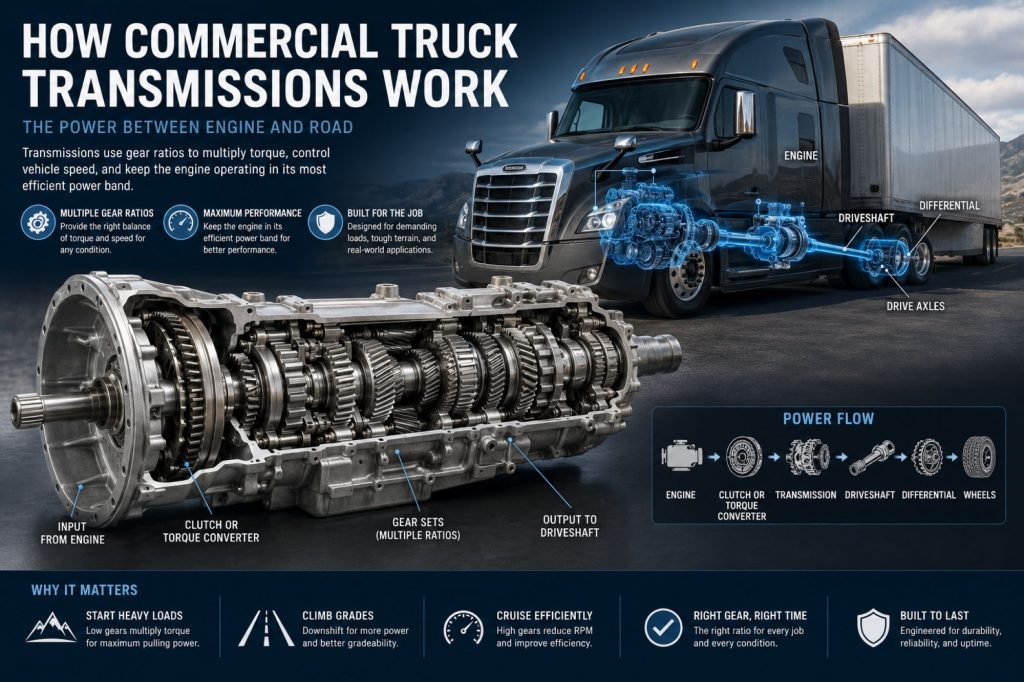
Commercial truck transmissions are a critical part of the powertrain, transferring engine power through the drivetrain while providing the gear ratios needed to start heavy loads, accelerate, climb grades, maneuver at low speeds, and operate efficiently at highway speeds.
A truck engine operates effectively within a limited range of engine speeds. The transmission allows that engine to move a vehicle weighing thousands of pounds across a much wider range of road speeds and operating conditions.
Commercial trucks use several transmission technologies, including traditional manuals, automated manual transmissions, and fully automatic transmissions. Although these systems operate differently, their fundamental purpose is the same: manage the relationship between engine speed, torque, and vehicle speed.
This guide explains how commercial truck transmissions work, how power moves through the drivetrain, why trucks need multiple gear ratios, and how different transmission technologies accomplish the same basic task.
The Commercial Truck Powertrain
The transmission is one component of a larger system responsible for moving the truck.
A typical commercial truck powertrain and drivetrain can be simplified into the following sequence:
Engine → Clutch or Torque Converter → Transmission → Driveshaft → Differential → Drive Axles → Wheels and Tires
Each component performs a different function.
Engine
The engine creates rotational power.
Diesel engines are particularly well suited to commercial trucking because they can produce substantial torque at relatively low engine speeds.
However, the engine cannot efficiently operate from zero road speed all the way to highway speed without some method of changing the mechanical relationship between the engine and drive wheels.
That is where the transmission becomes essential.
Clutch or Torque Converter
Power must move from the engine into the transmission.
Traditional manual transmissions and most automated manual transmissions use a clutch system.
Many fully automatic transmissions use a torque converter.
Both systems allow the engine and transmission to interact while accommodating the difference between engine operation and vehicle movement.
Transmission
The transmission provides multiple gear ratios.
These ratios allow the engine to operate within a useful RPM range while the truck travels at dramatically different vehicle speeds and loads.
Driveshaft
After power leaves the transmission, the driveshaft transfers rotational force toward the drive axles.
Heavy trucks may use multiple driveshaft sections depending on wheelbase and drivetrain configuration.
Differential
In a typical drive axle, the final-drive ring and pinion redirect power from the driveshaft and provide axle gear reduction. The differential distributes that torque to the axle shafts.
It also allows wheels on opposite sides of an axle to rotate at different speeds while turning.
Drive Axles
The drive axles transfer power from the differential to the wheels.
Tandem-drive Class 8 tractors typically use two powered rear axles, while other truck configurations may use a single drive axle or additional driven axles.
Wheels and Tires
The tires ultimately transfer the drivetrain’s rotational force to the road surface.
Without traction between the tires and road, the power produced by the engine cannot effectively move the vehicle.
Why Commercial Trucks Need Transmissions
An engine has a limited operating speed range.
A heavy-duty diesel engine may need to move a fully loaded combination from a complete stop and later maintain highway speed while operating efficiently.
Those two conditions require very different mechanical relationships between the engine and drive wheels.
The transmission solves this problem by providing multiple gear ratios.
Low gears provide greater mechanical advantage for starting and moving heavy loads.
Higher gears reduce the amount of engine speed required as vehicle speed increases.
Without multiple gear ratios, a commercial truck would either struggle to start heavy loads or operate inefficiently at highway speed.
Understanding Gear Ratios
A gear ratio describes the relationship between the rotational speed of the transmission input and output.
Consider a simplified example.
If a transmission gear has a 4:1 ratio, the transmission input rotates approximately four times for each rotation of the output.
This reduces output speed while increasing the mechanical advantage available to move the truck.
Ignoring losses, a 4:1 reduction produces about four times the input torque at one-quarter of the input speed. It does not create horsepower: extra torque is exchanged for lower rotational speed. See Understanding Horsepower vs Torque for the distinction between torque and power.
A lower numerical ratio provides less multiplication but allows greater output speed.
This is why trucks begin moving in lower gears and progressively shift into higher gears as road speed increases.
Torque Multiplication
Torque is rotational force.
Commercial trucks need substantial torque at the drive wheels when starting heavy loads, climbing grades, or operating at low speeds.
Lower transmission gears multiply the mechanical advantage provided by the engine.
This is particularly important when:
- Starting a heavily loaded truck
- Pulling a heavy trailer
- Climbing steep grades
- Operating on construction sites
- Moving oversized loads
- Maneuvering at low speeds
- Operating in soft terrain
- Performing severe-service work
As vehicle speed increases, less torque multiplication is required and the transmission can move into progressively higher gears.
Why Heavy Trucks Have So Many Gears
Gear count reflects the engine operating range, ratio spread, vehicle load, and duty cycle. Passenger vehicles can also use many ratios; a truck does not need more gears simply because it is larger.
Commercial trucks operate under much broader load conditions.
A tractor may operate empty, lightly loaded, at normal highway weight, or in specialized applications at extremely high gross combination weights.
Additional gears allow the driver or transmission control system to keep the engine operating within an appropriate RPM range as conditions change.
Commercial truck transmissions can include configurations such as:
More gears can provide smaller steps between ratios and a broader overall gearing range.
However, gear count alone does not determine whether a transmission is appropriate for an application.
First Gear and Startability
First gear is particularly important because it helps determine how effectively a truck can begin moving from a stop.
A numerically high first-gear ratio provides greater mechanical advantage.
This can be particularly valuable in:
- Heavy haul
- Construction
- Logging
- Dump operations
- Severe-service applications
- Steep terrain
- Off-highway operation
Transmission first gear works together with engine torque, axle gearing, tire size, and vehicle weight.
This relationship contributes to a truck’s startability, or its ability to begin moving under load.
Published startability values depend on the manufacturer’s assumptions, including launch torque or engine speed, weight, tire size, grade, and surface conditions. Compare values calculated on the same basis; traction, clutch heat, or torque-converter limits can constrain a launch even when the gearing appears adequate.
Gradeability
Gradeability describes a vehicle’s ability to climb a grade under specified conditions.
Transmission gearing plays an important role.
A truck climbing a steep grade may need to downshift so the engine can remain within an effective operating range.
If the selected gear is too high, engine speed may fall and the truck may lose momentum.
Selecting a lower gear increases mechanical advantage but reduces vehicle speed.
Modern automated transmissions can perform these downshifts electronically, while a manual transmission requires the driver to select the appropriate gear.
Direct Drive
A direct-drive gear generally provides a 1:1 relationship through the relevant transmission gearing.
This means the transmission input and output are rotating at approximately the same speed through that gear.
Direct-drive configurations can be combined with specific axle ratios to produce the desired overall drivetrain gearing.
Overdrive
An overdrive gear allows the transmission output to rotate faster relative to the input through the selected gear ratio.
Overdrive can reduce engine RPM during highway operation.
Potential benefits can include:
- Lower engine speed
- Reduced engine noise
- Improved highway efficiency
- Reduced engine wear under appropriate conditions
However, overdrive is not automatically better than direct drive.
Transmission gearing, axle ratio, engine characteristics, tire size, terrain, and vehicle application must be considered as a complete system.
Axle Ratios and Transmission Gearing
The transmission is only one part of the truck’s overall gearing.
After power passes through the transmission and driveshaft, the differential provides another gear reduction.
This is represented by the axle ratio.
For example, an axle ratio might be expressed as:
3.25:1
or
4.10:1
A numerically higher axle ratio generally provides greater mechanical advantage but causes the engine to operate at a higher RPM for a given road speed, assuming the other drivetrain variables remain the same.
A numerically lower axle ratio can reduce engine speed at highway speeds but provides less mechanical advantage.
Transmission ratios and axle ratios must therefore be considered together.
Example: A 4.00:1 transmission ratio and 3.25:1 axle ratio give 13.00:1 overall reduction before the tires. At steady speed with the clutch engaged or converter locked, engine RPM ≈ road speed in mph × tire revolutions per mile × transmission ratio × axle ratio ÷ 60. At 65 mph, 500 tire revolutions per mile, 0.80 top gear, and a 3.25 axle, the result is about 1,408 RPM. This is a gearing example, not an approved truck specification. Commercial Truck Axle Ratios Explained covers the final-drive relationship in more detail.
Manual Transmissions
Traditional Manual Transmissions require the driver to control gear selection and clutch operation.
The driver must coordinate:
- Engine speed
- Vehicle speed
- Clutch engagement
- Gear selection
- Load
- Terrain
Many heavy-duty manual transmissions use range and splitter systems to provide additional gear ratios.
Traditional manual transmissions can offer excellent driver control and remain important in vocational, heavy-haul, construction, logging, and specialized applications.
Automated Manual Transmissions
Automated Manual Transmissions, commonly called AMTs, use a mechanically geared transmission architecture while automating clutch operation and gear selection.
Electronic controls can monitor factors including:
- Engine speed
- Vehicle speed
- Engine load
- Throttle demand
- Road grade
- Current gear
- Vehicle operating mode
Actuators then operate the clutch and shift mechanism.
This allows an AMT to retain many characteristics of a geared mechanical transmission while reducing the amount of shifting required from the driver.
Two-pedal AMTs automate launch-clutch operation, but older automated products such as Eaton AutoShift retain a clutch pedal for starting and stopping. A purpose-designed AMT is not necessarily a manual gearbox with an actuator kit added. Check the exact model rather than judging its architecture by the selector or number of pedals.
Modern AMTs have become widely used throughout long-haul and regional Class 8 trucking and continue expanding into vocational and heavy-haul applications.
Automatic Transmissions
Automatic Transmissions operate differently from traditional manuals and most AMTs.
Many commercial automatics use a torque converter and automatic gear system.
The torque converter allows the engine to transfer power while providing smooth vehicle launches and low-speed operation without normal manual clutch control.
Automatic transmissions are particularly important in applications involving:
- Frequent stops
- Urban operation
- Low-speed maneuvering
- Multiple drivers
- Delivery routes
- Refuse collection
- Construction
- Utility operations
- Emergency vehicles
- Tow and recovery
- Municipal equipment
Heavy-duty automatic transmissions are also used in demanding vocational and severe-service applications.
How a Manual Transmission Shift Happens
During a traditional manual shift, the driver changes the mechanical gear relationship inside the transmission.
A simplified shift sequence involves:
- Reducing engine power
- Disengaging or unloading the drivetrain as required
- Moving the transmission out of the current gear
- Matching engine and transmission speeds
- Selecting the next gear
- Reapplying power
Heavy-truck shifting techniques vary depending on transmission design, vehicle, application, and driver technique.
Many heavy-duty manuals are non-synchronized and require the speed-matching and double-clutching procedures specified by their manufacturer. This sequence explains the mechanism; the driver instructions for the exact transmission govern operation.
Experienced drivers learn to coordinate engine RPM and road speed so the transmission can move smoothly between gears.
How an AMT Shift Happens
An AMT performs many of the same basic mechanical functions automatically.
During a shift, the electronic controls can:
- Determine that a gear change is required
- Coordinate with the engine control system
- Reduce engine torque
- Control clutch operation where required
- Move the transmission into the appropriate gear
- Re-engage the drivetrain
- Restore engine torque
This process can happen without the driver manually operating a clutch pedal or shift lever.
How an Automatic Transmission Shifts
A conventional commercial automatic uses hydraulic and electronic systems to control gear changes.
The transmission control system considers operating information such as vehicle speed, throttle demand, engine load, and current operating conditions.
Internal transmission components then change the gear relationship automatically.
In a typical planetary automatic, hydraulic pressure applies internal clutch packs or brakes to hold and connect different members of the gearsets. The torque converter can multiply torque during launch; multiplication decreases as its pump and turbine speeds converge. Lockup reduces converter slip, while controlled clutch-to-clutch shifts differ from the torque interruption typical of a single-clutch AMT.
Torque-converter lockup can also create a more direct mechanical connection under appropriate operating conditions to improve efficiency.
Range and Splitter Systems
Many traditional heavy-duty manual transmissions use range and splitter systems.
A range system allows one basic shift pattern to access multiple groups of gears.
A splitter allows certain gears to be divided into additional ratios.
This is how transmissions such as 13-speed and 18-speed heavy-duty manuals can provide numerous usable ratios without requiring an enormous shift pattern.
These additional ratios allow drivers to make smaller changes in gearing when moving heavy loads or operating across changing terrain.
Transmission Control Modules
Modern transmissions increasingly depend on electronic controls.
A transmission control module can receive information from multiple vehicle systems and determine how the transmission should respond.
Depending on the truck and transmission, the system may communicate with:
- Engine control module
- Vehicle speed sensors
- Throttle system
- Brake systems
- Cruise control
- Engine brake
- Grade sensors
- Stability systems
- Other vehicle electronics
This communication allows modern transmissions to operate as part of an integrated powertrain rather than as an isolated mechanical component.
Engine and Transmission Integration
Modern commercial truck manufacturers increasingly design engines and transmissions to operate together as integrated powertrains.
Electronic communication can allow the engine and transmission to coordinate:
- Engine torque
- Engine RPM
- Gear selection
- Shift timing
- Engine braking
- Cruise control
- Grade response
- Fuel-efficiency strategies
Examples of integrated heavy-duty powertrains include Detroit engines paired with the DT12, Volvo engines with I-Shift, Mack engines with mDRIVE, and PACCAR engines paired with PACCAR transmissions.
The goal is to optimize the complete powertrain rather than treating the engine and transmission as independent components.
Power Take-Off Operation
Many vocational trucks use a power take-off, commonly called a PTO.
A PTO allows engine power to operate auxiliary equipment.
Depending on the truck, PTO-driven equipment can include:
- Hydraulic pumps
- Dump bodies
- Refuse equipment
- Tow systems
- Cranes
- Aerial lifts
- Concrete equipment
- Vacuum systems
- Utility equipment
The PTO may interact directly with the transmission, making transmission and PTO compatibility an important consideration when specifying vocational equipment.
Learn more in the PTO System Explained guide.
Transmission Cooling and Lubrication
Commercial transmissions generate heat and friction during operation.
Lubricants help:
- Reduce friction
- Protect gears and bearings
- Control heat
- Reduce wear
- Protect internal components
Automatic transmissions also rely heavily on transmission fluid for hydraulic operation and heat management.
Severe-duty applications can place additional thermal stress on a transmission.
Proper fluid levels, correct lubricant specifications, cooling-system condition, and appropriate maintenance intervals are critical to transmission life.
Transmission Maintenance
Maintenance requirements vary considerably according to transmission type.
Common areas of attention include:
- Transmission fluid or lubricant
- Filters
- Clutch condition
- Clutch adjustment where applicable
- Shift actuators
- Clutch actuators
- Electronic controls
- Wiring
- Cooling systems
- Seals and gaskets
- Transmission mounts
- Driveshafts
- Universal joints
- Diagnostic fault codes
Drivers should also pay attention to changes in shift quality, unusual noises, vibration, fluid leaks, warning lights, delayed engagement, or unexpected transmission behavior.
Why Transmission Selection Matters
The transmission affects how effectively the engine’s power can be used.
A poorly matched transmission can affect:
- Startability
- Gradeability
- Highway efficiency
- Engine RPM
- Low-speed control
- Driver workload
- Heavy-haul capability
- PTO operation
- Maintenance
- Overall vehicle performance
This is why transmission selection should never be based solely on the number of gears or whether the transmission is manual or automatic.
The complete truck application must be considered.
Use How to Choose a Commercial Truck Transmission to turn these operating principles into an application and compatibility checklist.
Factors That Affect Transmission Selection
Important factors include:
- Engine
- Engine torque
- Vehicle class
- Gross vehicle weight
- Gross combination weight
- Trailer type
- Freight
- Terrain
- Highway versus vocational operation
- Axle ratio
- Tire size
- Gear ratios
- Startability
- Gradeability
- PTO requirements
- Heavy-haul requirements
- Driver experience
- Maintenance capabilities
- Service availability
A long-haul tractor, medium-duty delivery truck, dump truck, refuse vehicle, logging truck, and heavy-haul tractor can all require very different transmission characteristics.
Understanding the Three Major Transmission Types
The three primary transmission technologies used throughout commercial trucking are:
Manual Transmission
The driver controls the clutch and gear selection.
Automated Manual Transmission
A mechanically geared transmission uses electronic controls and actuators to automate clutch operation and shifting.
Automatic Transmission
The transmission automatically manages gear changes and commonly uses torque-converter technology in commercial applications.
Readers who want a detailed comparison can explore the Manual vs Automated Manual vs Automatic Transmissions guide.
Explore Transmissions by Application
Truck Equipment Atlas also organizes transmissions according to the types of trucks and operations they serve.
Heavy-Duty Transmissions
Explore transmissions used in Class 8 highway tractors, regional trucks, heavy-haul equipment, and demanding commercial applications.
Medium-Duty Transmissions
Explore transmissions used in delivery trucks, utility vehicles, towing equipment, service trucks, construction vehicles, and other medium-duty applications.
Vocational Transmissions
Explore transmissions used in construction, dump, refuse, logging, utility, heavy haul, municipal, and other demanding work-truck applications.
Explore Individual Commercial Truck Transmissions
Truck Equipment Atlas includes individual transmission profiles covering platforms from manufacturers and drivetrain suppliers including:
- Aisin
- Allison Transmission
- Detroit
- Eaton
- Eaton Cummins
- Ford
- General Motors
- International
- Mack
- PACCAR
- Volvo
Visit the Commercial Truck Transmission Library to explore individual transmission models, specifications, applications, operating characteristics, maintenance considerations, and related information.
Continue Learning About Commercial Truck Transmissions
This guide provides the foundation for understanding how commercial truck transmissions operate.
Continue with the other Truck Equipment Atlas Transmission Guides:
Visit Transmission Guides to explore the complete educational transmission guide library.
Manufacturer Technical References
Use current model-specific instructions and application approvals for operation, maintenance, and truck specification. These manufacturer resources provide supporting technical context.
- Eaton commercial vehicle transmission guide
- Eaton AutoShift driver instructions
- Cummins PowerSpec application and gearing manual
Final Thoughts
A commercial truck transmission does much more than simply change gears.
It manages the mechanical relationship between engine speed, torque, and vehicle speed while allowing the truck to operate across dramatically different loads, road speeds, terrain, and working conditions.
Low gears provide the mechanical advantage required to start and move heavy loads. Higher gears allow efficient operation as vehicle speed increases. Axle ratios, tire size, engine characteristics, vehicle weight, and transmission gearing all work together as part of the complete drivetrain.
Manual transmissions place much of this control in the driver’s hands. Automated manual transmissions use electronics and actuators to automate those mechanical processes. Fully automatic transmissions use a different approach to provide smooth, automatic power delivery.
Understanding how these systems work provides an important foundation for evaluating commercial trucks, comparing transmission technologies, and selecting equipment appropriate for a specific operation.
Truck Equipment Atlas will continue expanding its transmission profiles, educational guides, and drivetrain resources as the commercial transmission library grows.