
PACCAR TX-18 Transmission
Quick Facts
- Manufacturer: PACCAR
- Transmission Type: Heavy-Duty Automated Manual Transmission
- Transmission Family: PACCAR TX Series
- Primary Configuration: 18-Speed Overdrive
- Forward Speeds: 18
- Reverse Speeds: Three
- Maximum Engine Torque: 1,850 lb-ft
- Maximum Engine Horsepower: 510 horsepower
- Maximum Operating Weight: 140,000 pounds GCWR
- Overall Ratio: 20.46:1
- First-Gear Ratio: 14.32:1
- Top-Gear Ratio: 0.70:1 Overdrive
- Clutch Type: Maintenance-Free Self-Adjusting Diaphragm-Spring Clutch
- Clutch Control: Electronic Clutch Actuator
- Clutch Pedal: No
- PTO Openings: Standard 8-Bolt Bottom and 4-Bolt Rear
- Combined PTO Capacity: 160 horsepower and 610 lb-ft of torque
- PTO Speed: Approximately 111 percent of engine speed
- Compatible Engines: PACCAR MX-11 and PACCAR MX-13
- Approximate System Weight: 808 pounds including transmission, clutch, and oil
- Oil Capacity: Approximately 25.4 pints in a cooler-less, non-PTO configuration
- Recommended Lubricant: PACCAR-approved transmission lubricant meeting the applicable specification
- Maximum Oil-Change Interval: Up to 500,000 miles or five years in approved on-highway applications
- Primary Applications: Heavy On-Highway Hauling, Equipment Transport, Tankers, Construction, Regional Heavy Haul, and High-Performance Class 8 Trucks
- Production Status: Active Production
Overview
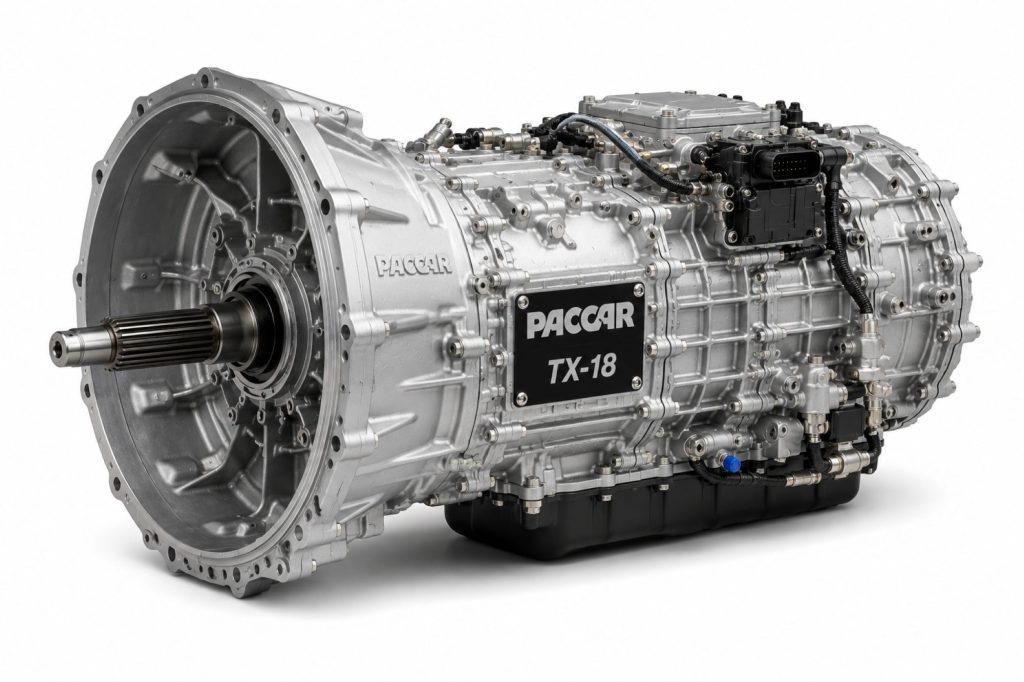
The PACCAR TX-18 is an 18-speed automated manual transmission designed for heavy-duty on-highway, vocational, and heavy-haul applications.
It is integrated with PACCAR MX-11 and MX-13 engines and offered in selected Kenworth and Peterbilt Class 8 trucks.
The TX-18 provides substantially greater ratio coverage than the 12-speed PACCAR TX-12. Its 18 closely spaced forward gears help keep the engine within an effective operating range while accelerating heavy combinations, climbing grades, and responding to changing road conditions.
The transmission supports engines producing up to 510 horsepower and 1,850 lb-ft of torque. Its maximum published operating weight is 140,000 pounds GCWR.
Three reverse gears provide additional control when backing equipment trailers, tankers, construction vehicles, and other heavy combinations.
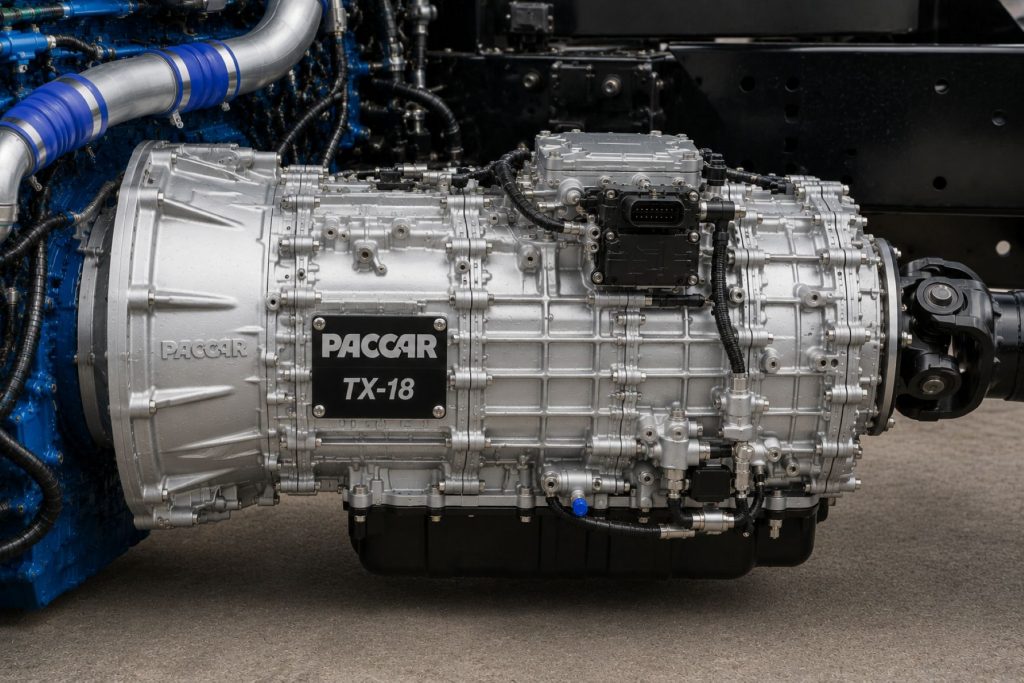
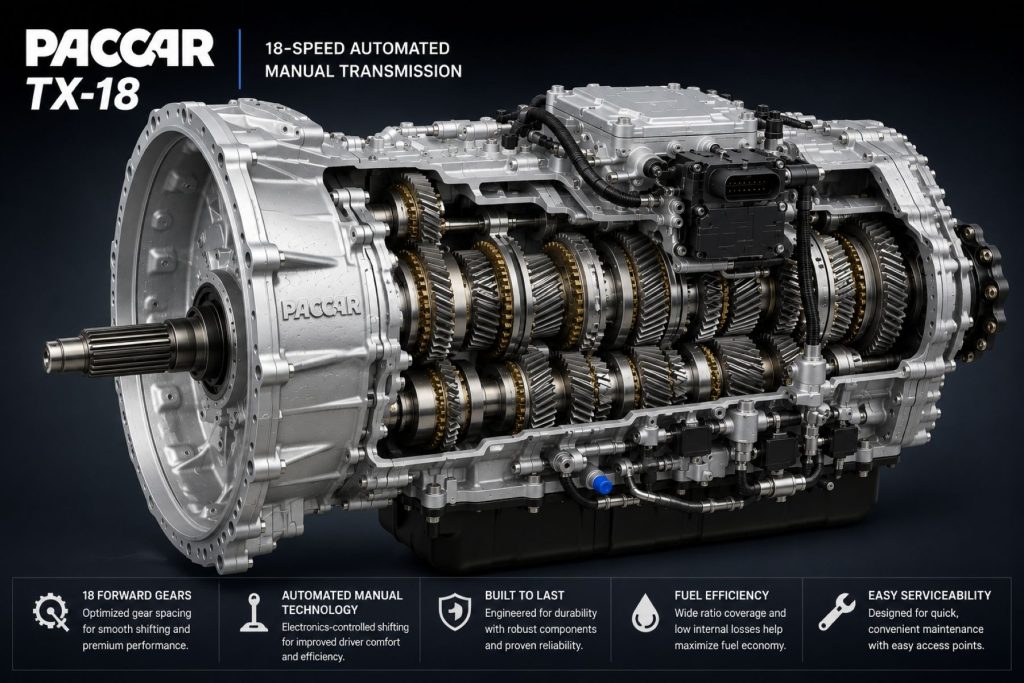
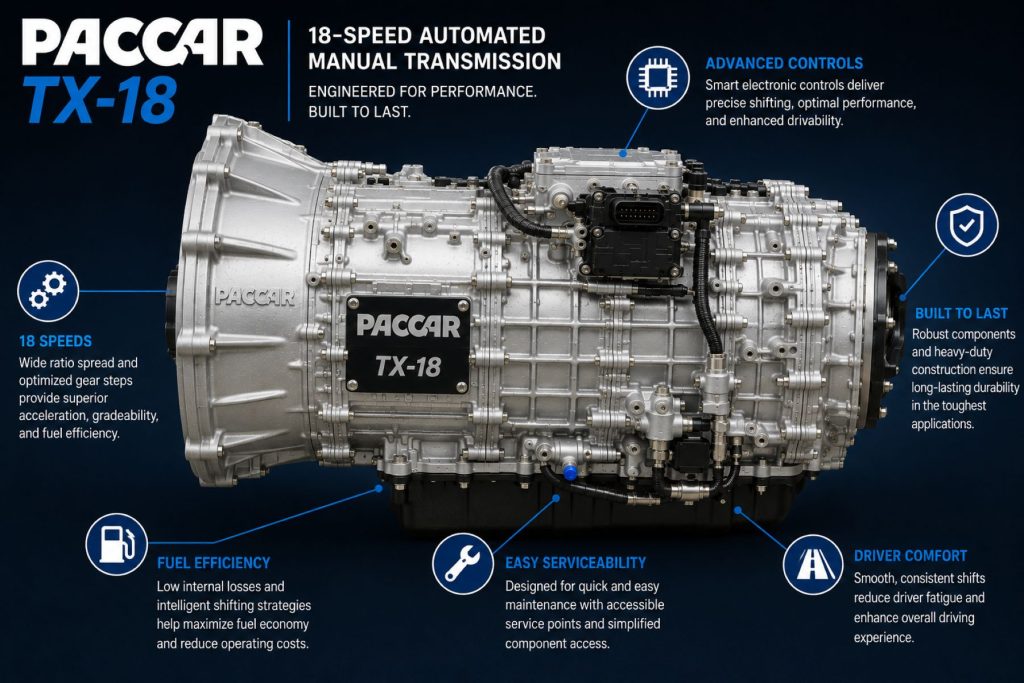
The TX-18 uses twin-countershaft construction, helical gears, large bearings, precision lubrication, an electronic clutch actuator, a self-adjusting clutch, dual PTO openings, and internal wiring and sensors.
The standard TX-18 is intended primarily for high-performance on-highway operation. The related TX-18 Pro adds an Extreme Duty clutch, additional reverse gears, Rock Free mode, and more specialized off-highway capabilities.
Key Characteristics
The TX-18 has a 20.46:1 overall ratio spread.
Its 14.32:1 first gear supports loaded starts, while the 0.70:1 eighteenth gear provides overdrive highway operation.
Most ratio changes are approximately 19 or 20 percent. These relatively small and consistent steps help maintain engine speed when the truck is heavily loaded.
The transmission uses twin-countershaft construction with helical gears and large bearings designed for higher torque and operating weights.
Internal wiring and sensors reduce exposure to road spray, corrosion, loose connections, and physical damage.
The transmission’s Precision Lubrication System directs lubricant to critical gears and bearings while reducing oil-churning losses.
Two standard PTO openings support hydraulic pumps, product-handling systems, blowers, cranes, winches, and other vocational equipment.
The TX-18 is approximately 225 pounds lighter than comparable older 18-speed UltraShift PLUS configurations, according to PACCAR’s related transmission design information.
How the Transmission Works
The PACCAR TX-18 uses a mechanical twin-countershaft geartrain combined with electronic controls, shift actuators, and an electronically operated dry clutch.
When the driver selects drive, the transmission controller evaluates vehicle weight, road grade, engine torque, throttle position, vehicle speed, and the selected operating mode.
The controller chooses an appropriate starting gear and commands the electronic clutch actuator to engage the clutch.
During acceleration, the transmission determines whether every gear is required. It can skip gears when the truck is lightly loaded or use smaller gear steps under heavier conditions.
Before shifting, the transmission requests a reduction in engine torque. This unloads the drivetrain and allows the current gear to disengage.
The shift actuator selects the next ratio while the engine and transmission controllers coordinate shaft speed and engine RPM.
When the next gear is engaged, engine torque is restored.
Hill Start Aid uses the truck’s foundation brakes to help prevent rollback when launching on a grade.
Urge to Move allows the truck to inch forward when the service brake is released.
Creep Mode provides controlled low-speed movement at engine idle with the clutch locked.
Enhanced Engine Braking commands downshifts when additional engine-brake performance is needed.
Predictive or terrain-aware shift strategies can prepare the transmission for upcoming road conditions when the truck is properly equipped.
Common Specifications
Transmission Type
The PACCAR TX-18 is a two-pedal automated manual transmission.
It uses a mechanical geartrain and dry clutch rather than the torque converter and planetary gearsets used in a conventional automatic transmission.
Forward Speeds
The transmission provides 18 forward gears.
These gears are separated by relatively small ratio steps to improve acceleration and grade performance under heavy loads.
Reverse Speeds
The standard TX-18 provides three reverse gears.
Published reverse ratios are:
- Reverse 1 — 15.25:1
- Reverse 2 — 12.73:1
- Reverse 3 — 10.67:1
The TX-18 Pro can provide as many as six reverse gears, but the additional high-speed reverse ratios are not part of the standard TX-18 configuration.
Forward Gear Ratios
- First Gear — 14.32:1
- Second Gear — 11.96:1
- Third Gear — 10.02:1
- Fourth Gear — 8.43:1
- Fifth Gear — 7.04:1
- Sixth Gear — 5.90:1
- Seventh Gear — 4.95:1
- Eighth Gear — 4.13:1
- Ninth Gear — 3.46:1
- Tenth Gear — 2.89:1
- Eleventh Gear — 2.41:1
- Twelfth Gear — 2.02:1
- Thirteenth Gear — 1.70:1
- Fourteenth Gear — 1.42:1
- Fifteenth Gear — 1.19:1
- Sixteenth Gear — 1.00:1 Direct Drive
- Seventeenth Gear — 0.83:1 Overdrive
- Eighteenth Gear — 0.70:1 Overdrive
Overall Ratio
The overall ratio spread is approximately 20.46:1.
This provides strong startability while retaining a tall overdrive ratio for highway operation.
Maximum Engine Torque
The maximum published engine-torque capacity is 1,850 lb-ft.
The PACCAR MX engine must be programmed within the approved transmission rating.
Maximum Engine Horsepower
The maximum published engine output is 510 horsepower.
Horsepower alone does not establish compatibility. Torque, governed speed, software, cooling, GCWR, and vehicle application must also be approved.
Maximum Operating Weight
The TX-18 has a maximum published operating weight of 140,000 pounds GCWR.
This transmission rating does not override the truck’s GVWR, axle ratings, tire ratings, fifth-wheel capacity, trailer ratings, or legal weight limits.
Clutch System
The standard TX-18 uses a maintenance-free, self-adjusting diaphragm-spring clutch.
An electronic clutch actuator controls engagement and disengagement.
The TX-18 Pro uses an Extreme Duty clutch for increased thermal capacity and off-highway maneuvering.
Transmission Controls
The transmission control system manages:
- Starting-gear selection
- Clutch engagement
- Upshifts and downshifts
- Skip shifting
- Engine-torque coordination
- Hill Start Aid
- Urge to Move
- Creep Mode
- Engine overspeed protection
- Enhanced engine braking
- Manual gear requests
Column-Mounted Selector
Kenworth and Peterbilt installations commonly use a right-hand column-mounted selector.
The selector can provide:
- Drive
- Neutral
- Reverse
- Manual Mode
- Low Mode
- Upshift and downshift requests
- Engine-brake controls depending on truck configuration
Twin-Countershaft Design
The TX-18 divides engine torque through two countershafts.
This construction helps distribute internal loads while supporting high engine torque and heavy vehicle weights.
Helical Gears
Helical gears help improve smoothness and reduce operating noise compared with many traditional straight-cut heavy-duty transmission gears.
Internal Wiring and Sensors
Internal wiring and sensor placement reduce exposure to corrosion, moisture, road debris, and physical damage.
The transmission includes fluid-pressure and oil-temperature monitoring to identify potentially damaging conditions.
PTO Openings
The TX-18 provides two standard PTO mounting locations:
- 8-bolt bottom opening
- 4-bolt rear opening
Both PTO drives operate at approximately 111 percent of engine speed.
PTO Capacity
Maximum combined PTO output is:
- 160 horsepower
- 610 lb-ft of torque
The total load of all simultaneously operating PTO equipment must remain within the combined limit.
Precision Lubrication
The Precision Lubrication System directs lubricant to gears and bearings.
This reduces unnecessary lubricant churning and can improve transmission efficiency.
Oil Capacity
A cooler-less, non-PTO configuration holds approximately 25.4 pints of lubricant.
Actual capacity can change with PTOs, cooling equipment, installation angle, and truck configuration.
Oil-Change Intervals
Published maximum service intervals include:
- On-Highway — 500,000 miles or five years
- Vocational — 250,000 miles or three years
Actual maintenance requirements depend on application and operating conditions.
Transmission Cooling
A transmission cooler may not be required in approved configurations operating below 110,000 pounds GCW.
Heavier, high-temperature, PTO-intensive, or severe applications may require additional cooling.
System Weight
The TX-18 system weighs approximately 808 pounds, including the transmission, clutch, and oil.
Additional PTOs, pumps, cooling equipment, mounts, and driveshaft components increase installed weight.
Common Applications
- Heavy on-highway hauling
- Regional heavy haul
- Equipment-hauling tractors
- Lowboy and RGN operations
- Tanker transportation
- Unbaffled milk tanker operations
- Grain hauling
- Livestock hauling
- Construction trucks
- Block trucks
- Refuse roll-off trucks
- Mobile-crane trucks
- Wrecker and recovery vehicles
- Double-trailer operations
- High-performance highway tractors
- Mixed highway and vocational service
Truck and Engine Compatibility
The PACCAR TX-18 is designed for integration with PACCAR MX engines and selected Kenworth and Peterbilt Class 8 trucks.
Confirmed Kenworth applications with live Truck Equipment Atlas pages include:
The TX-18 and TX-18 Pro were introduced as available options in the Kenworth T680, T880, and W990.
Confirmed Peterbilt applications with live pages include:
Transmission availability depends on model year, engine selection, torque rating, truck configuration, market, and vocation.
Compatible engine families include:
The engine and transmission communicate as an integrated PACCAR powertrain.
The TX-18 is not normally paired with Cummins, Detroit, Volvo, Mack, or International engines. Those engines use other automated manual transmission families.
Advantages
- 18 forward gears
- Three reverse gears
- Maximum torque capacity of 1,850 lb-ft
- Supports engines up to 510 horsepower
- Maximum GCWR of 140,000 pounds
- Closely spaced gear ratios
- Deep 14.32 first gear
- 0.70 overdrive top gear
- Strong heavy-load performance
- Automated clutch and gear selection
- No clutch pedal
- Self-adjusting clutch
- Hill Start Aid
- Urge to Move
- Creep Mode
- Smart starting-gear selection
- Skip-shift capability
- Enhanced engine braking
- Integrated PACCAR engine controls
- Dual PTO openings
- Maximum combined PTO output of 160 horsepower
- Precision Lubrication System
- Internal wiring and sensors
- Fluid-pressure and temperature monitoring
- Lower weight than comparable older 18-speed automated transmissions
Limitations or Considerations
- Primarily limited to Kenworth and Peterbilt trucks
- Designed specifically for PACCAR MX engines
- Maximum torque is limited to 1,850 lb-ft
- Maximum operating weight is 140,000 pounds
- Not intended for applications requiring unlimited GCW
- Only three reverse gears
- Does not include TX-18 Pro’s high-speed reverse capability
- Standard clutch is not the Extreme Duty Pro clutch
- Electronic controls require specialized diagnostics
- Clutch-actuator service requires calibration
- A transmission cooler may be required in heavier applications
- PTO equipment adds weight and maintenance
- Low-speed maneuvering can create clutch heat
- Truck and engine software must remain compatible
- Higher purchase cost than lighter highway transmissions
Driver and Operator Experience
The TX-18 provides two-pedal operation without a clutch pedal.
The driver selects drive, neutral, reverse, manual, or low mode using the column-mounted selector.
The transmission chooses an appropriate starting gear based on vehicle weight, grade, throttle demand, and engine torque.
Hill Start Aid helps prevent rollback during loaded launches on grades.
Urge to Move allows the truck to begin inching after the brake is released.
Creep Mode provides low-speed movement at engine idle with the clutch locked.
The 18 forward ratios allow the transmission to make smaller changes in engine speed than a 12-speed transmission.
The transmission can skip gears when lightly loaded rather than shifting through all 18 ratios.
Manual mode allows the driver to request or hold a gear when approaching a grade, descending with the engine brake, entering a construction area, or preparing for changing road conditions.
The controller may refuse a requested shift that could over-speed or lug the engine.
Maintenance and Ownership Notes
The TX-18 uses PACCAR-approved transmission lubricant.
A cooler-less, non-PTO configuration holds approximately 25.4 pints.
The maximum on-highway oil-change interval is up to 500,000 miles or five years.
Vocational applications use a shorter maximum interval of approximately 250,000 miles or three years.
Fluid-pressure and oil-temperature warnings should be investigated immediately.
The self-adjusting clutch does not require normal manual adjustment, but clutch wear, heat events, and actuator condition must still be monitored.
The transmission control module, electronic clutch actuator, speed sensors, internal wiring, external connectors, power supply, and vehicle data network require compatible diagnostic procedures.
PTO mounting, pumps, seals, hydraulic lines, controls, and driven equipment should be inspected regularly.
A transmission cooler, if installed, adds hoses, fittings, and heat-exchanger components to the maintenance program.
Common Transmission Problems
Transmission Will Not Engage a Gear
Possible causes include low battery voltage, an electronic clutch-actuator fault, speed-sensor failure, low air pressure, an active fault code, communication problems, or internal damage.
Electronic Clutch Actuator Faults
Actuator failure, wiring damage, incorrect calibration, clutch wear, or excessive heat can interfere with launches and shifting.
Clutch Overheating
Repeated creeping, prolonged backing, holding the truck on a grade with the accelerator, or operating above approved weight can overheat the clutch.
Harsh or Delayed Shifts
Shift-quality problems may result from software, sensor faults, engine communication, unsuitable calibration, clutch problems, or driveline issues.
Transmission Stuck in Neutral
The transmission may remain in neutral when it cannot verify gear position, complete a shift, match shaft speeds, or communicate with the engine controller.
Fluid-Pressure Warning
A pressure warning may indicate low lubricant, leakage, incorrect fluid, an internal lubrication problem, or sensor failure.
Transmission Overheating
High GCW, steep grades, heavy PTO use, low-speed operation, inadequate cooling, or low lubricant can increase temperature.
PTO Engagement Problems
PTO engagement may be prevented by incorrect conditions, failed interlocks, programming problems, hydraulic overload, or an active transmission fault.
Vehicle Data-Network Faults
Communication failures between the engine, transmission, brakes, and truck controllers can affect shifting and driver-assistance functions.
Oil Leaks
Leaks can occur at PTO openings, case joints, output seals, sensor locations, or cooler connections.
Buying Considerations
- Confirm that the transmission is the standard TX-18 rather than TX-18 Pro.
- Verify the truck is an approved Kenworth or Peterbilt model.
- Confirm PACCAR MX-11 or MX-13 compatibility.
- Verify the engine’s horsepower and torque.
- Confirm the maximum operating GCWR.
- Determine whether three reverse gears meet the application’s requirements.
- Compare rear-axle ratio and tire size with the transmission gearing.
- Calculate required PTO horsepower and torque.
- Determine whether one or both PTO openings are needed.
- Confirm whether a transmission cooler is required.
- Review clutch-life and heat-event information.
- Scan for active and inactive fault codes.
- Inspect the electronic clutch actuator.
- Verify software and calibration status.
- Test Hill Start Aid.
- Test Urge to Move and Creep Mode.
- Road-test automatic and manual operation.
- Test all reverse gears.
- Review lubricant-service records.
- Confirm PACCAR dealer and warranty support.
Variants and Configurations
- PACCAR MX-11 Configuration
- PACCAR MX-13 Configuration
- Three-Reverse-Gear Configuration
- 8-Bolt Bottom PTO Configuration
- Dual-PTO Configuration
- Cooler-Less Configuration
- Transmission-Cooler Configuration
- Heavy On-Highway Configuration
- Regional Heavy-Haul Configuration
- Equipment-Hauler Configuration
- Tanker Configuration
- Grain-Hauler Configuration
- Livestock-Hauler Configuration
- Construction Configuration
- Wrecker and Recovery Configuration
- Kenworth Configuration
- Peterbilt Configuration
Comparison to Similar Equipment
Compared with the PACCAR TX-12, the TX-18 provides six additional forward gears, three reverse gears, closer ratio spacing, greater heavy-load flexibility, and higher-capacity PTO equipment. The TX-12 is lighter and better suited to conventional highway service.
Compared with the PACCAR TX-12 Pro, the TX-18 supports higher GCW and provides 18 forward gears. The TX-12 Pro has an Extreme Duty clutch and vocational features for operations at or below 70,000 pounds.
Compared with the PACCAR TX-18 Pro, the standard TX-18 is more highway-oriented and uses three reverse gears. TX-18 Pro adds an Extreme Duty clutch, as many as six reverse gears, Rock Free mode, and off-highway programming.
Compared with Eaton Cummins Endurant XD, the TX-18 uses closely related transmission architecture but is integrated with PACCAR MX engines and PACCAR-branded trucks. Endurant XD is commonly paired with the Cummins X15 and other approved powertrains.
Compared with an Eaton Fuller 18-speed manual, the TX-18 automates clutch engagement and gear selection. The manual provides direct driver control, while the TX-18 reduces workload and standardizes shifting.
Compared with an Allison 4000 Series automatic, the TX-18 uses a dry clutch and mechanical geartrain rather than a torque converter. Allison offers smoother continuous low-speed power, while the TX-18 provides 18 ratios and strong mechanical efficiency.
Best Fit For
- Kenworth heavy-duty fleets
- Peterbilt heavy-duty fleets
- PACCAR MX-11-powered trucks
- PACCAR MX-13-powered trucks
- Regional heavy-haul carriers
- Equipment-hauling operations
- Lowboy and RGN carriers
- Tanker fleets
- Grain haulers
- Livestock carriers
- Construction operations
- Wrecker and recovery fleets
- Applications below 140,000 pounds GCWR
- Fleets wanting automated 18-speed operation
- Drivers needing closely spaced ratios without manual shifting
Related Truck Types
Related Truck Models
Related Engines
- PACCAR MX-11
- PACCAR MX-13
- Related Transmission Types
- Automated Manual Transmissions
- Heavy-Duty Transmissions
- Vocational Transmissions
- Manual Transmissions
- Automatic Transmissions
Related Transmission Types
- Automated Manual Transmissions
- Heavy-Duty Transmissions
- Vocational Transmissions
- Manual Transmissions
- Automatic Transmissions
Related Equipment Systems
- Electronic Clutch Actuators
- Self-Adjusting Clutches
- Transmission Electronic Controls
- Vehicle Data Networks
- Transmission Lubrication Systems
- Transmission Cooling Systems
- Transmission Diagnostic Systems
- Electrical Systems
- Driveshafts
- Axles and Differentials
- PTO Systems
- Brake Systems
Related Guides
Understand the operating principles in How Commercial Truck Transmissions Work, compare drivetrain designs in Manual vs Automated Manual vs Automatic Transmissions, and evaluate gearing, application, and compatibility in How to Choose a Commercial Truck Transmission.
Regulatory and Compliance Notes
The TX-18 must be installed in a PACCAR-approved Kenworth or Peterbilt powertrain configuration.
The engine’s programmed torque must not exceed the transmission’s 1,850-lb-ft rating.
The completed truck must remain within the TX-18’s 140,000-pound maximum operating-weight rating.
The truck must also remain within its GVWR, axle ratings, tire ratings, frame limits, suspension ratings, fifth-wheel capacity, and trailer ratings.
PTO equipment must remain within the combined 160-horsepower and 610-lb-ft limits.
Changes to the engine, axle ratio, tire size, transmission software, or electronic controls can affect shifting, speedometer accuracy, engine braking, and emissions-system communication.
Oversize and overweight movements remain subject to permits, route restrictions, bridge laws, axle-spacing requirements, signs, flags, and other regulations.
Real World Operating Notes
The TX-18’s closely spaced ratios are most useful when the truck operates at higher gross weights or encounters frequent changes in grade.
The transmission can skip gears when the vehicle is lightly loaded and use smaller steps when additional pulling power is needed.
Three reverse gears provide more backing control than many highway automated transmissions.
The 0.70 overdrive top gear must be matched carefully with rear-axle ratio, tire size, engine cruising speed, and expected operating weight.
Creep Mode improves low-speed control, but prolonged clutch slipping should still be avoided.
The standard TX-18 is intended primarily for on-highway heavy-duty operation. Fleets spending substantial time off highway should compare it with the TX-18 Pro.
Frequently Asked Questions
What is the PACCAR TX-18?
It is an 18-speed automated manual transmission designed for PACCAR MX-powered Kenworth and Peterbilt heavy-duty trucks.
How much torque can it handle?
The maximum published torque capacity is 1,850 lb-ft.
What is its maximum operating weight?
The maximum published operating weight is 140,000 pounds GCWR.
How many reverse gears does it have?
The standard TX-18 has three reverse gears.
Does it have a clutch pedal?
No. An electronic clutch actuator operates the self-adjusting dry clutch.
What engines work with the TX-18?
The transmission is designed for integration with PACCAR MX-11 and MX-13 engines.
Which trucks offer the TX-18?
Documented applications include the Kenworth T680, T880, and W990 and the Peterbilt 389, 567, and 579.
Can it operate two PTOs?
Yes. It has standard 8-bolt bottom and 4-bolt rear PTO openings with a combined maximum capacity of 160 horsepower.
What is the difference between TX-18 and TX-18 Pro?
TX-18 Pro adds an Extreme Duty clutch, up to six reverse gears, Rock Free mode, and off-highway programming.
How often is the transmission oil changed?
The maximum published interval is up to 500,000 miles or five years for approved on-highway applications and 250,000 miles or three years for vocational service.
Availability and Where to Find
The PACCAR TX-18 is available through participating Kenworth and Peterbilt commercial truck dealers.
It can be ordered in approved PACCAR MX-powered truck configurations, including selected Kenworth T680, T880, and W990 models and Peterbilt 389, 567, and 579 models.
Availability depends on model year, truck configuration, engine rating, vocation, GCWR, PTO requirements, and market.
Current specifications, resources, shift calibrations, warranty information, and dealer availability can be confirmed through the official PACCAR TX-18 page.
Support Trucking Families
Truck Equipment Atlas supports the mission of Grey Cross, a nonprofit dedicated to helping families of truck drivers who lose their lives while on the road. As the site grows, part of its mission is to bring awareness and support to these families.
Podcast or Video Section
Learn More Through Audio and Video
Truck Equipment Atlas will continue expanding with podcast episodes, interviews, and equipment breakdowns to help drivers and fleets better understand trucks and equipment.
Follow the Growth of Truck Equipment Atlas
Truck Equipment Atlas continues to expand with new truck profiles, trailer coverage, diesel engine pages, equipment system resources, manufacturer information, and educational guides.
Visit our Site Updates page to explore recent additions, project milestones, and upcoming resources as we continue building one of the industry’s growing commercial trucking equipment reference libraries.
View the Latest Site Updates: Truck Equipment Atlas Site Updates