
Mack mDRIVE HD Transmission
Quick Facts
- Manufacturer: Mack Trucks
- Transmission Type: Heavy-Duty Automated Manual Transmission
- Transmission Family: Mack mDRIVE HD
- Forward Speeds: 12, 13, or 14
- Reverse Speeds: 4, 5, or 6 depending on configuration
- Top-Gear Configurations: Direct Drive, Overdrive, or Dynamic Overdrive
- Maximum Input Torque: 1,950 lb-ft
- Clutch Type: Electronically Controlled Single-Disc Dry Clutch
- Driver Controls: Fleet or Premium Electronic Shifter
- Creeper Gears: Low and Ultra-Low Ratios on Applicable 13- and 14-Speed Versions
- PTO Compatibility: Single, Dual, or Triple PTO; DIN and SAE Provisions
- Common Engine Pairings: Mack MP7, Mack MP8, Mack MP8HE, Mack MP13, and Mack MP13HE
- Common Truck Applications: Mack Granite, Mack TerraPro, Mack LR, Mack Pinnacle, Mack Anthem, and Mack Pioneer
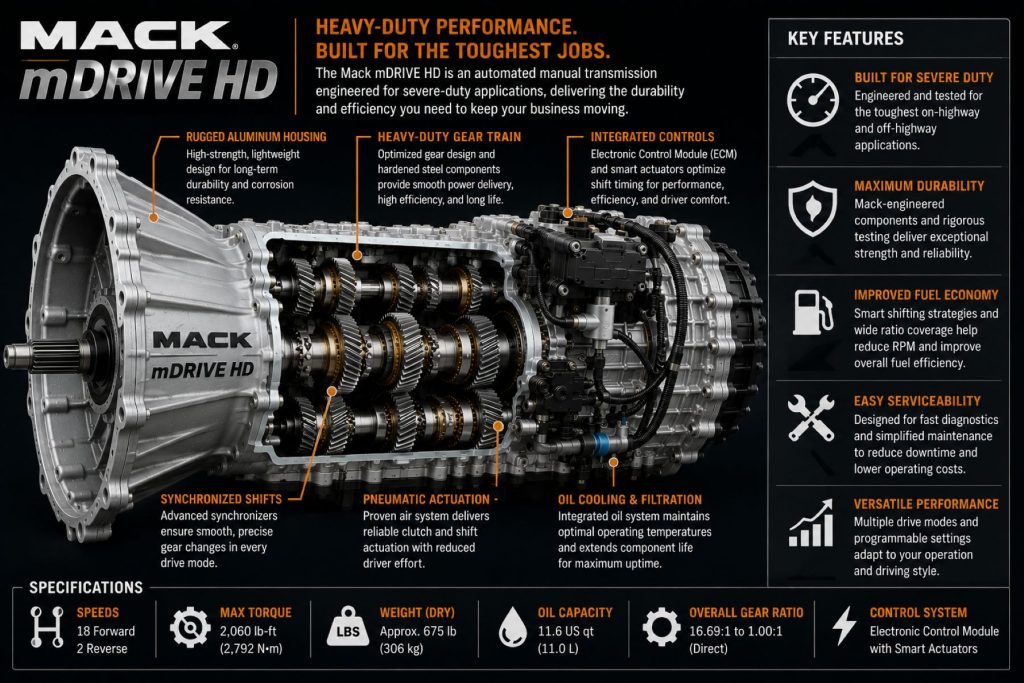
- Primary Applications: Construction, Dump, Refuse, Concrete, Heavy Haul, Mining, Off-Road Hauling, and Severe Vocational Work
Overview
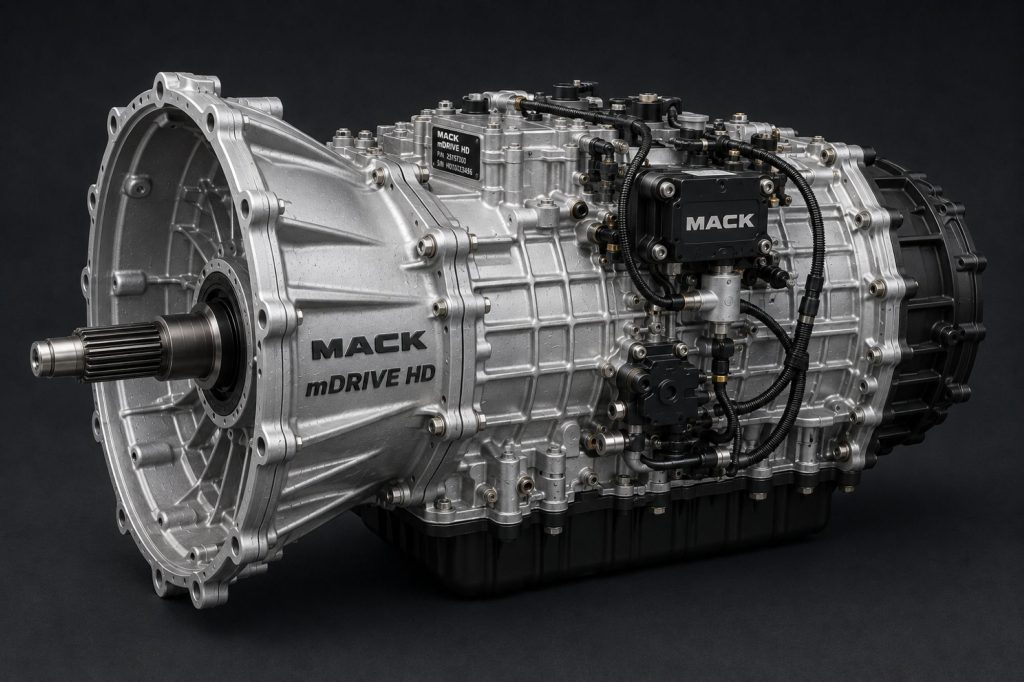
The Mack mDRIVE HD is a heavy-duty automated manual transmission developed for construction, refuse, concrete, heavy-haul, mining, off-road, and other demanding vocational applications.
It expands upon the standard Mack mDRIVE design with reinforced gears, hardened internal components, strengthened synchronizers, enhanced lubrication, vocational shift programming, optional deep creeper ratios, and multiple reverse speeds.
The transmission uses electronic controls and automated clutch actuation to provide two-pedal operation. Although it drives like an automatic from the operator’s perspective, it mechanically operates as a manual transmission with a computer-controlled dry clutch.
Mack offers 12-, 13-, and 14-speed mDRIVE HD configurations. The 13-speed adds a deep low-ratio creeper gear, while the 14-speed provides an additional ultra-low gear for applications requiring extremely slow movement and strong startability.
The mDRIVE HD is designed as part of an integrated Mack powertrain. It communicates with the engine, engine brake, vehicle controllers, driveline, PTO systems, and other truck components to coordinate power delivery and gear selection.
Key Characteristics
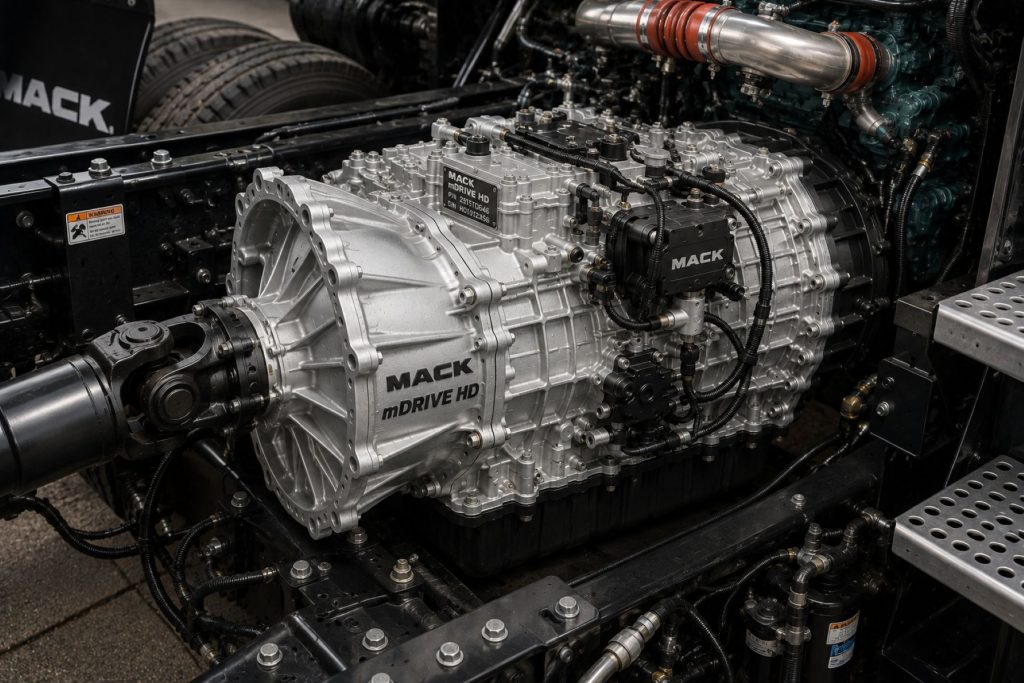
The mDRIVE HD uses reinforced internal components developed to withstand frequent shifting, high loads, rough terrain, and the repeated starts and stops common in vocational service.
Its gears and synchronizers receive additional surface hardening in applicable configurations. This construction helps the transmission tolerate operating conditions that may be too demanding for a highway-focused automated manual.
The transmission uses an advanced spring-loaded pneumatic countershaft brake. This system improves gear synchronization and helps the transmission complete shifts more quickly under demanding conditions.
An eccentric lubrication pump circulates lubricant through the transmission. Available cooling provisions help control temperature during heavy-duty, low-speed, and high-load operation.
Optional creeper gears provide increased overall reduction. These ratios help heavily loaded trucks start on grades and allow precise movement during paving, curb pouring, dumping, concrete placement, and off-road maneuvering.
Features such as Power Launch, Grade Gripper, Rock Free, MaxxBrake, Enhanced Construction Shift, and application-specific drive modes help adapt the transmission to vocational operating conditions.
How the Transmission Works
The mDRIVE HD uses a mechanically geared transmission controlled by electronic and pneumatic actuators. The system operates the clutch, selects the starting gear, changes ratios, and coordinates engine torque without requiring a clutch pedal.
When the driver selects Drive, the transmission evaluates vehicle weight, road grade, accelerator position, selected drive mode, and other operating data. It then chooses an appropriate starting gear.
During a shift, the transmission requests a temporary reduction in engine torque. It releases the current gear, uses its countershaft brake and synchronizers to match component speeds, engages the next ratio, and restores engine power.
The control system can skip unnecessary gears when the truck is lightly loaded. Under heavy loads or on rough terrain, it may use more ratios and hold gears longer.
The driver can allow the transmission to shift automatically or use manual mode to request a specific gear. Protective programming can reject a shift that would overspeed the engine, lug the powertrain, or exceed approved operating limits.
Creeper gears multiply torque and reduce vehicle speed without requiring continuous clutch slipping. This makes them useful for controlled vocational work and heavy starts.
The mDRIVE HD still uses a dry clutch. During very slow movement, the control system must partially engage that clutch. Excessive creeping, repeated backing, or holding the truck on a grade with throttle can generate damaging heat.
Common Specifications
Transmission Type
The Mack mDRIVE HD is an electronically controlled automated manual transmission with two-pedal operation.
It does not normally use the torque converter and planetary gear sets found in a conventional automatic transmission.
Forward Speeds
Available configurations include:
- 12-speed direct drive or overdrive
- 13-speed direct drive, overdrive, or Dynamic Overdrive
- 14-speed direct drive or overdrive
Reverse Speeds
Current Mack configurations include:
- 12-speed direct drive or overdrive: 4 reverse speeds
- 13-speed direct drive: 5 reverse speeds
- 13-speed overdrive or Dynamic Overdrive: 6 reverse speeds
- 14-speed direct drive: 5 reverse speeds
- 14-speed overdrive: 6 reverse speeds
Multiple reverse ratios improve backing control and maneuverability in confined work areas.
Maximum Input Torque
The current maximum published input-torque rating is 1,950 lb-ft.
The exact approved rating depends on the transmission model, clutch, engine calibration, truck specification, gross combination weight, and application.
Direct-Drive Configuration
A direct-drive configuration provides a 1:1 relationship through the main gearbox in its highest conventional operating gear.
When paired with an appropriate axle ratio, direct drive can reduce internal power losses while providing strong driveline efficiency.
Overdrive Configuration
An overdrive configuration reduces engine speed relative to vehicle speed in the highest gear. It provides additional flexibility when selecting axle ratios for highway speed, vocational operation, and startability.
Dynamic Overdrive
Dynamic Overdrive uses integrated engine, transmission, and axle controls to select an efficient power path based on load, terrain, speed, and torque demand.
Availability depends on the transmission, truck, axle, and powertrain specification.
Creeper Gears
The 13-speed mDRIVE HD can include a low-reduction creeper gear for improved startability on steep grades and under heavy loads.
The 14-speed version adds an ultra-low reduction gear for applications requiring extremely slow movement, such as curb pouring, paving, concrete placement, and operation in loose soil.
Clutch System
The transmission uses an electronically actuated single-disc dry clutch designed for precise engagement.
Clutch specifications and capacity must match the selected engine, transmission, vehicle weight, and vocation.
Countershaft Brake
A spring-loaded pneumatic countershaft brake helps synchronize component speeds during shifting. This system supports faster and more controlled shifts in demanding vocational conditions.
Internal Construction
Applicable mDRIVE HD models use reinforced gears and synchronizers with additional surface hardening.
The strengthened construction is designed to tolerate frequent shifting, high gross weights, rough surfaces, and repeated vocational loading cycles.
Lubrication System
The mDRIVE HD uses a robust lubrication system with an eccentric pump. Available cooling provisions help manage temperature and maintain lubricant coverage during demanding operation.
Lubricant type, capacity, filter requirements, and service intervals must be confirmed for the exact model.
Shifter Options
Available control packages include:
- Fleet Shifter
- Premium Shifter
Certain operating modes and shift programs require the Premium Shifter.
Drive Modes
Available modes can include:
- Economy+
- Economy
- Performance
- Heavy-Duty Mode
- Performance Plus
Mode availability depends on the truck, transmission, shifter, and software specification.
Shift Logic
Available shift strategies can include:
- EMAX
- ECON
- Dynamic Overdrive
- Comprehensive
- Heavy Haul
- Enhanced Construction
The transmission’s programming should be selected for the truck’s actual vocation rather than added only after the truck enters service.
Heavy-Haul Programming
Heavy-Duty Mode is intended for trucks operating at gross combination weights above approximately 125,000 pounds when the complete vehicle is properly configured and approved.
Performance Plus uses load-adaptive shifting to improve operation in difficult off-road and high-load environments.
Transmission programming does not independently establish the truck’s legal or structural weight rating.
PTO Compatibility
Mack lists single, dual, and triple PTO compatibility with DIN- or SAE-style provisions depending on the transmission and truck configuration.
Split-shaft PTO functionality is available on applicable 13- and 14-speed mDRIVE HD configurations.
Transmission-mounted PTOs are commonly intended for stationary operation. Applications requiring continuous mobile hydraulic power may need a rear-engine PTO, front-engine PTO, split-shaft system, or another approved arrangement.
Engine Compatibility
Current Mack compatibility information includes:
Installation Requirements
The mDRIVE HD requires compatible engine controls, vehicle controllers, wiring, air supply, clutch hardware, driveline components, axle gearing, transmission programming, and cooling provisions.
It is intended to be specified as part of an approved Mack powertrain rather than treated as a universal replacement transmission.
Common Applications
- Dump truck operations
- Refuse collection
- Concrete mixer trucks
- Concrete pump trucks
- Roll-off trucks
- Construction hauling
- Aggregate transportation
- Heavy-haul trucking
- Mining operations
- Off-road hauling
- Logging operations
- Oilfield transportation
- Municipal service
- Snow and ice control
- Utility construction
- Paving operations
- Curb-pouring applications
- Bulk hauling
- Vocational tractor operations
- Severe-duty job-site work
Truck and Engine Compatibility
The mDRIVE HD is designed primarily for vocational and heavy-duty Mack trucks equipped with compatible Mack engines and electronic controls.
Mack currently identifies the following truck families as compatible:
- Mack Anthem
- Mack Granite
- Mack LR
- Mack Pinnacle
- Mack Pioneer
- Mack TerraPro
The Granite and TerraPro are among the transmission’s most important vocational applications. The Pinnacle can use mDRIVE HD in bulk, construction-support, and heavy regional operations. Some Anthem and Pioneer configurations can use it where additional transmission durability or specialized gearing is required.
Common engine pairings include:
The MP7 and MP8 are the most established engine pairings in existing mDRIVE HD-equipped trucks. Newer Mack powertrains expand compatibility to the MP13 and MP13HE.
The exact transmission model must match the engine’s torque rating, truck model, axle ratio, tire size, gross weight, PTO equipment, and vocational duty cycle.
Advantages
- Two-pedal operation reduces driver workload
- Reinforced construction supports severe vocational service
- Available with 12, 13, or 14 forward speeds
- Low and ultra-low creeper ratios improve startability
- Multiple reverse speeds improve job-site maneuverability
- Handles up to 1,950 lb-ft of input torque
- Heavy-Haul and Enhanced Construction programming is available
- Power Launch supports difficult starts in loose terrain
- Grade Gripper reduces rollback on inclines
- Rock Free can help release a stuck vehicle
- MaxxBrake improves use of engine-braking power
- Auto Neutral can reduce accidental movement risk
- Advanced lubrication helps control heat
- Single, dual, and triple PTO configurations are available
- Split-shaft PTO functionality is available on applicable versions
- Integrated Mack powertrain controls improve coordination
- Automated shifts reduce dependence on manual-shifting ability
- Manual mode remains available when the operator needs more control
Limitations or Considerations
- The dry clutch remains a wear component
- Excessive creeping can overheat the clutch
- Repeated loaded backing can shorten clutch life
- Electronic diagnosis requires suitable software and training
- Repairs may be more specialized than conventional manual-transmission work
- Software selection strongly affects performance
- PTO installation requires correct programming and interlocks
- Not every feature is available with every configuration
- The Premium Shifter may be required for advanced modes
- Improper axle gearing can reduce performance and clutch life
- Low-speed behavior differs from a torque-converter automatic
- Severe-duty operation increases lubricant and cooling demands
- Used units may require vehicle-specific programming
- The transmission’s rating does not establish the truck’s legal payload
- A standard mDRIVE and mDRIVE HD should not be assumed interchangeable
Driver and Operator Experience
The mDRIVE HD eliminates the clutch pedal and conventional shift lever, reducing the effort required to operate a heavily loaded vocational truck.
Automatic mode selects gears according to vehicle weight, terrain, engine demand, accelerator position, and the selected drive program. Manual mode lets the operator request a gear when approaching grades, entering difficult terrain, or controlling vehicle speed.
Creeper ratios make it easier to move slowly without prolonged clutch slipping. They are especially helpful during paving, curb work, concrete placement, dumping, coupling, and maneuvering on uneven job sites.
Grade Gripper can hold the vehicle for up to approximately three seconds after the service brake is released. This gives the driver time to apply the accelerator without allowing the truck to roll backward.
Power Launch allows the engine to develop additional speed and torque before drive engagement when extra force is needed in sand or loose soil.
Rock Free alternates driveline direction to help free a truck stuck in difficult terrain. The feature should be used according to Mack’s instructions because aggressive rocking can damage tires, axles, driveline components, or the work surface.
Drivers should avoid using accelerator pressure to hold the truck stationary on a grade. The service brake, parking brake, or Grade Gripper system should support the vehicle instead.
Maintenance and Ownership Notes
Maintenance requirements depend on the transmission model, lubricant, gross weight, terrain, operating hours, PTO use, and vocational application.
The transmission case, seals, lubricant lines, cooler, pump, electrical connectors, air lines, mounts, and output components should be inspected regularly.
Only an approved transmission lubricant should be used. Incorrect fluid can affect internal protection, synchronizer performance, shift quality, and service life.
The clutch should be monitored for wear, overheating events, engagement quality, and calibration. A worn clutch can produce harsh starts, delayed engagement, excessive slipping, or fault messages.
The transmission’s air supply must remain clean and at the correct pressure. Air leaks or contamination can interfere with clutch actuation, countershaft-brake operation, and shifting.
Vocational trucks should receive additional inspection after severe off-road work, deep mud, flooding, impact events, or extended operation at high gross weights.
PTO systems require inspection of mounting hardware, seals, pumps, shafts, hydraulic lines, controls, and safety interlocks.
Software updates and calibration procedures should be completed by technicians familiar with Mack’s integrated powertrain controls.
Common Transmission Problems
Clutch Wear
Frequent starts, repeated loaded reversing, steep grades, excessive creeping, and improper driver technique can accelerate clutch wear.
Clutch Overheating
Holding the vehicle with throttle or maneuvering for extended periods at very low speed can produce excessive clutch temperature.
Harsh Engagement
Abrupt forward or reverse engagement can result from clutch wear, calibration problems, actuator faults, programming, engine-control problems, or driveline looseness.
Failure to Select a Gear
Low air pressure, electrical faults, sensor failures, clutch-actuator problems, selector faults, or active protection logic can prevent Drive or Reverse engagement.
Slow or Missed Shifts
Countershaft-brake problems, worn synchronizers, incorrect lubricant, air-system faults, speed-sensor problems, or damaged internal components can interfere with shifting.
Lubricant Overheating
High gross weight, low-speed operation, inadequate cooling, low lubricant level, or a lubrication-pump problem can increase transmission temperature.
Oil Leaks
Leaks can develop around input or output seals, PTO openings, cooler connections, gaskets, or damaged housings.
Electronic Faults
Damaged wiring, corroded connectors, poor grounds, controller problems, or failed sensors can cause intermittent or persistent transmission warnings.
PTO Problems
Incorrect PTO selection, improper programming, active interlocks, clutch behavior, insufficient air pressure, or incompatible operating conditions can prevent PTO operation.
Gear or Synchronizer Wear
Severe loading, improper lubricant, excessive shock loading, or unresolved shift problems can damage gears and synchronizers.
Driveline Shock or Vibration
Problems attributed to the transmission may come from universal joints, driveshaft angles, worn mounts, axle components, clutch engagement, or vocational body equipment.
Buying Considerations
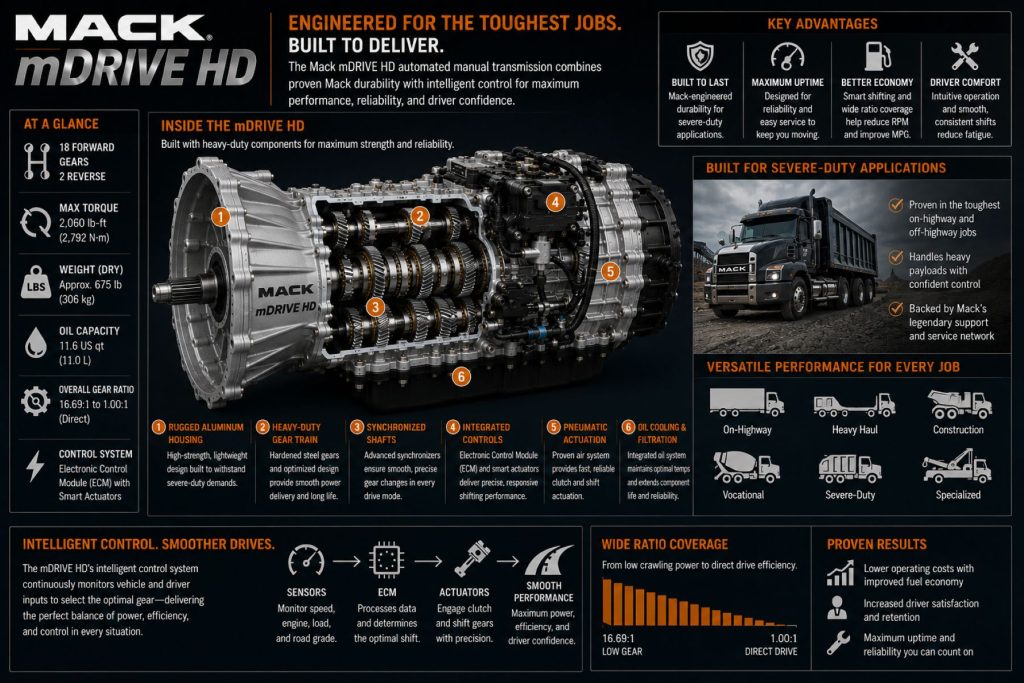
- Record the complete transmission model and serial number.
- Confirm whether it has 12, 13, or 14 forward speeds.
- Verify direct-drive, overdrive, or Dynamic Overdrive gearing.
- Confirm the number and ratios of reverse gears.
- Determine whether low or ultra-low creeper gears are installed.
- Verify the maximum approved input torque.
- Match the transmission to the engine model and rating.
- Review the truck’s axle ratio and tire size.
- Confirm the approved gross vehicle and combination ratings.
- Identify the installed shift logic and drive modes.
- Determine whether the Fleet or Premium Shifter is fitted.
- Confirm whether the required PTO openings are present.
- Verify PTO rotation, speed, torque capacity, and duty cycle.
- Check whether split-shaft PTO operation is required.
- Review clutch-wear and overtemperature history.
- Scan all vehicle controllers for active and stored faults.
- Inspect the lubricant for contamination or metal.
- Check the transmission cooler, lines, pump, and seals.
- Test Power Launch, Grade Gripper, manual mode, and reverse operation where equipped.
- Review maintenance and software-update records.
- Confirm parts and diagnostic support through a Mack dealer.
Variants and Configurations
- Mack mDRIVE HD 12-Speed Direct Drive
- Mack mDRIVE HD 12-Speed Overdrive
- Mack mDRIVE HD 13-Speed Direct Drive
- Mack mDRIVE HD 13-Speed Overdrive
- Mack mDRIVE HD 13-Speed Dynamic Overdrive
- Mack mDRIVE HD 14-Speed Direct Drive
- Mack mDRIVE HD 14-Speed Overdrive
- Low Creeper-Gear Configuration
- Ultra-Low Creeper-Gear Configuration
- Fleet Shifter Configuration
- Premium Shifter Configuration
- Heavy-Haul Shift Programming
- Enhanced Construction Shift Programming
- Economy-Oriented Programming
- Performance Plus Programming
- Single-PTO Configuration
- Dual-PTO Configuration
- Triple-PTO Configuration
- Split-Shaft PTO Configuration
Comparison to Similar Equipment
Compared with the standard Mack mDRIVE, the mDRIVE HD uses reinforced vocational components, additional shift strategies, enhanced lubrication, and available 14-speed gearing. The standard version is more focused on highway and regional efficiency.
Compared with the Volvo I-Shift, the mDRIVE HD shares related Volvo Group engineering but uses Mack-specific hardware, controls, programming, powertrain integration, and vocational packages.
Compared with the Volvo I-Shift with crawler gears, both transmissions provide deep low-speed ratios for heavy starts and precise movement. The correct choice depends on whether the transmission is being installed in a Mack or Volvo platform and the approved application specification.
Compared with the Eaton Cummins Endurant XD, both are automated manual transmissions intended for demanding vocational work. The mDRIVE HD is closely integrated with Mack engines and trucks, while Endurant XD is paired primarily with Cummins engines across compatible truck platforms.
Compared with the Eaton Cummins Endurant XD Pro, the mDRIVE HD offers related heavy vocational and low-speed capabilities. Exact gross combination ratings and extreme-duty suitability depend on the complete truck specification rather than only the transmission name.
Compared with an Allison 4000 Series, the mDRIVE HD uses a mechanical dry clutch instead of a torque converter. The Allison can provide smoother continuous torque multiplication at very low speed, while the mDRIVE HD can offer lower weight and a more direct mechanical power path.
Compared with an Eaton Fuller 18-Speed Manual, the mDRIVE HD reduces driver workload by automating the clutch and gear changes. The 18-speed manual provides greater direct driver control but requires more training and physical input.
Best Fit For
- Mack vocational fleets
- Dump truck operators
- Concrete and paving contractors
- Refuse fleets
- Roll-off operations
- Heavy-haul carriers
- Aggregate haulers
- Mining fleets
- Off-road construction operations
- Municipal public-works fleets
- Snow and ice control operations
- Bulk and vocational tractor fleets
- Applications requiring creeper gears
- Operations requiring multiple reverse speeds
- PTO-equipped vocational trucks
- Fleets seeking two-pedal operation without a torque-converter automatic
Related Truck Types
Related Truck Models
- Mack Granite
- Mack TerraPro
- Mack Pinnacle
- Mack Anthem
- Mack LR
- Mack Pioneer
Related Engines
Related Transmission Types
- Automated Manual Transmissions
- Heavy-Duty Transmissions
- Vocational Transmissions
- Heavy-Haul Transmissions
Related Equipment Systems
- Clutch Systems
- Driveshaft Systems
- Transmission Cooling Systems
- Transmission Control Systems
- Axles and Differentials
- Electrical Systems
- PTO Systems
- Brake Systems
Related Guides
Understand the operating principles in How Commercial Truck Transmissions Work, compare drivetrain designs in Manual vs Automated Manual vs Automatic Transmissions, and evaluate gearing, application, and compatibility in How to Choose a Commercial Truck Transmission.
Regulatory and Compliance Notes
The mDRIVE HD must be installed, programmed, and operated within Mack’s approved engine-torque, clutch, axle, driveline, vehicle-weight, and vocational ratings.
A transmission’s torque capacity does not determine the vehicle’s legal payload or gross combination weight. Operators must comply with the truck’s certification ratings, axle limits, tire ratings, bridge laws, and applicable permits.
Electronic transmission controls communicate with the engine, emissions system, brakes, instrument cluster, and vehicle controllers. Repairs or modifications must not disable required emissions, diagnostic, or safety functions.
PTO systems require properly rated components, guarding, controls, and safety interlocks. Body builders must program PTO parameters for the completed vehicle and intended equipment.
Oversized or overweight vocational loads may require permits, route approval, travel restrictions, signs, warning devices, or escort vehicles.
Real World Operating Notes
The mDRIVE HD can substantially reduce driver workload in stop-and-go vocational service. Operators can concentrate on positioning the truck, observing workers, and navigating the job site rather than manually operating a clutch and shift lever.
Creeper gears are especially valuable when precise movement is required. They allow slower vehicle speed with less clutch slipping than a standard starting ratio.
The system’s performance depends heavily on correct programming. A dump truck, concrete mixer, heavy-haul tractor, and refuse truck should not necessarily use the same starting-gear and shift strategy.
Drivers should expect a brief interruption in power during some shifts because the mDRIVE HD is an automated manual rather than a torque-converter automatic.
Rock Free and Power Launch can assist in difficult terrain, but they cannot overcome inadequate traction, excessive loading, unsuitable tires, or unsafe ground conditions.
Operators should watch clutch-temperature and transmission warnings closely. Continuing to maneuver after an overtemperature warning can cause expensive clutch damage.
Frequently Asked Questions
What is the Mack mDRIVE HD?
The mDRIVE HD is a reinforced automated manual transmission designed for Mack construction, refuse, concrete, heavy-haul, mining, and off-road trucks.
How many speeds does the mDRIVE HD have?
It is available with 12, 13, or 14 forward speeds.
How many reverse speeds are available?
Depending on the gearing, it has four, five, or six reverse speeds.
How much torque can it handle?
Current Mack specifications list a maximum input-torque capacity of 1,950 lb-ft.
Does the mDRIVE HD use a torque converter?
No. It normally uses an electronically controlled single-disc dry clutch.
What is the difference between the 13-speed and 14-speed versions?
The 13-speed adds a low creeper ratio. The 14-speed adds an additional ultra-low ratio for extremely slow and precise vocational operation.
Which engines can be paired with it?
Approved engine families include the Mack MP7, Mack MP8, MP8HE, MP13, and MP13HE.
Which trucks use the mDRIVE HD?
Common applications include the Mack Granite, Mack TerraPro, Mack LR, Mack Pinnacle, Mack Anthem, and Mack Pioneer.
What does Grade Gripper do?
Grade Gripper holds the truck briefly after the brake pedal is released, reducing rollback while the driver transitions to the accelerator.
What is Rock Free mode?
Rock Free alternates controlled forward and reverse movement to help release a truck stuck in mud, sand, or loose material.
Can it operate a PTO?
Yes. Single, dual, triple, and applicable split-shaft PTO arrangements are available depending on the transmission and truck specification.
Can the transmission shift while a transmission-mounted PTO is operating?
In many mDRIVE PTO configurations, the transmission cannot change gears while the PTO is active because the attached equipment adds torque and rotational inertia to the synchronization system. The correct procedure must be confirmed for the specific installation.
Is the mDRIVE HD suitable for highway use?
Yes, when correctly specified. However, its primary advantages are most valuable in vocational, heavy-haul, and off-road applications.
Availability and Where to Find
New Mack mDRIVE HD transmissions are available as part of compatible Mack truck specifications through authorized Mack dealers.
Replacement transmissions, clutches, actuators, controllers, coolers, PTO components, and service parts may be available through Mack dealers, authorized remanufacturers, commercial drivetrain suppliers, salvage operations, and used heavy-truck parts dealers.
A used transmission should be identified by its complete model and serial number. Buyers should not rely only on the mDRIVE HD name because the number of speeds, ratios, torque capacity, clutch, controls, PTO provisions, software, and application ratings can differ.
Before purchasing a used or remanufactured unit, verify compatibility with the truck’s VIN, engine model, engine rating, axle ratio, driveline, wiring, controllers, PTO equipment, and intended vocation.
Replacement transmissions and electronic controllers may require vehicle-specific programming, clutch calibration, and other setup procedures after installation.
Current configurations, specifications, support information, and dealer availability can be confirmed through Mack Trucks’ official mDRIVE HD page.
Support Trucking Families
Truck Equipment Atlas supports the mission of Grey Cross, a nonprofit dedicated to helping families of truck drivers who lose their lives while on the road. As the site grows, part of its mission is to bring awareness and support to these families.
Podcast or Video Section
Learn More Through Audio and Video
Truck Equipment Atlas will continue expanding with podcast episodes, interviews, and equipment breakdowns to help drivers and fleets better understand trucks and equipment.
Follow the Growth of Truck Equipment Atlas
Truck Equipment Atlas continues to expand with new truck profiles, trailer coverage, diesel engine pages, equipment system resources, manufacturer information, and educational guides.
Visit our Site Updates page to explore recent additions, project milestones, and upcoming resources as we continue building one of the industry’s growing commercial trucking equipment reference libraries.
View the Latest Site Updates: Truck Equipment Atlas Site Updates