
Stoughton Dry Van
Quick Facts
- Manufacturer: Stoughton Trailers
- Trailer Type: Dry Van Trailer
- Common Models: Z-Plate, Tough Plate, Aluminum Sheet-and-Post, Extra Wide
- Standard Trailer Length: 53 ft
- Exterior Width: Approximately 102 inches
- Interior Width: Up to approximately 101 inches depending on configuration
- Exterior Height: Approximately 13 ft 6 in
- Interior Height: Approximately 110 inches
- Rear Door Opening Height: Approximately 109⅞ inches
- Typical Payload Rating: Up to approximately 55,000 lbs depending on configuration
- Typical GVWR: Approximately 70,000 lbs depending on specifications
- Common Axle Configuration: Tandem Axle Sliding Suspension
- Typical Suspension: Air-Ride Suspension
- Common Door Configuration: Rear Swing Doors
- Floor Construction: Full-Width Laminated Oak Flooring
- Primary Applications: General Freight, Retail Distribution, Manufacturing Freight, Consumer Products, E-Commerce, Dedicated Freight, and Regional Distribution
- Production Status: Active Production
Overview
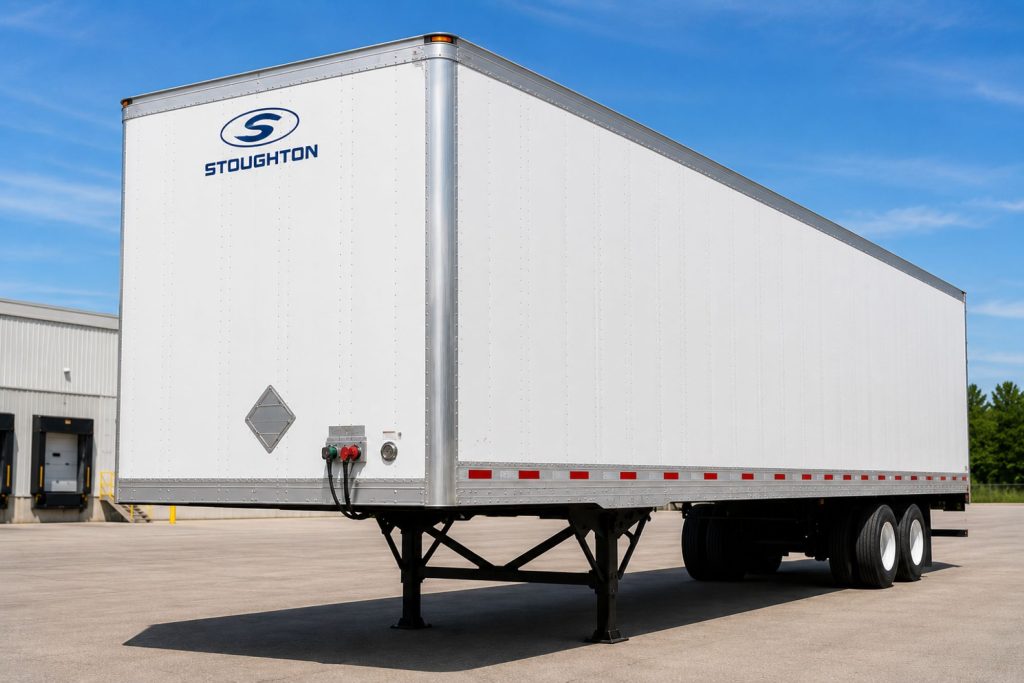
The Stoughton Dry Van is a commercial semi-trailer platform designed for dry van freight, retail distribution, manufacturing supply chains, e-commerce shipments, packaged goods, and regional or long-haul transportation.
Stoughton Trailers offers multiple dry van configurations, including Aluminum Sheet-and-Post, Extra Wide, Tough Plate, and Z-Plate models. These configurations allow fleets to select different combinations of sidewall construction, interior width, cargo capacity, damage resistance, and repairability.
The Stoughton Z-Plate uses patented composite laminate panels constructed with epoxy-coated galvanized steel skins. Its panel design allows damaged sections to be replaced without removing adjoining panels, helping reduce repair time and trailer downtime.
The Tough Plate configuration adds increased protection to the lower sidewall, an area frequently exposed to forklift impacts, pallet contact, and cargo-loading damage.
Most Stoughton dry vans are built as 53 ft dry van trailers with a tandem sliding suspension, air brakes, full-width oak flooring, and rear swing doors.
Key Characteristics
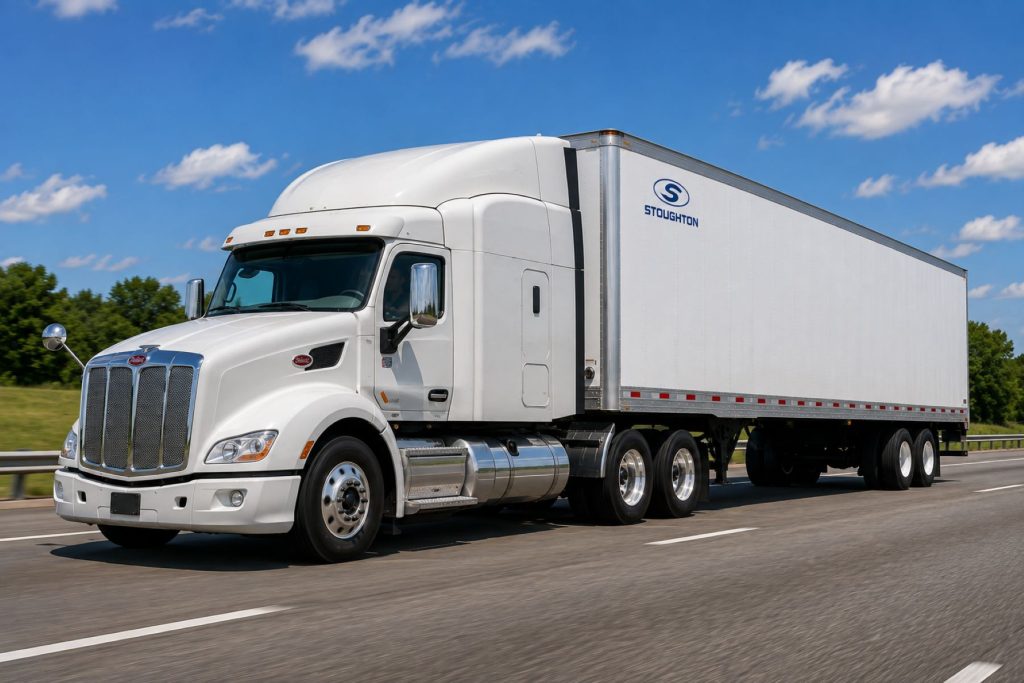
The Stoughton Dry Van is designed around structural durability, cargo protection, repairability, and long-term commercial service.
Its available configurations allow fleets to choose between traditional sheet-and-post construction and composite plate designs. The Z-Plate and Tough Plate models focus on reducing damage-related downtime while providing broad compatibility with standard palletized freight.
Key characteristics include:
- Standard 53-foot trailer length
- Approximately 102-inch exterior width
- Approximately 13-foot-6-inch exterior height
- Up to approximately 101 inches of interior width
- Approximately 110 inches of interior height
- Composite plate and sheet-and-post configurations
- Full-width laminated oak floor
- Tandem-axle sliding suspension
- Air-ride suspension
- Rear swing doors
- Hot-dipped galvanized components
- Cargo-control slots
- Wide aluminum scuff rails
- One-piece aluminum roof
- Galvanized steel roof bows
- Rear-impact guard
- ABS-equipped air brakes
- LED trailer lighting
- Standard loading-dock compatibility
Common Specifications
Trailer Length
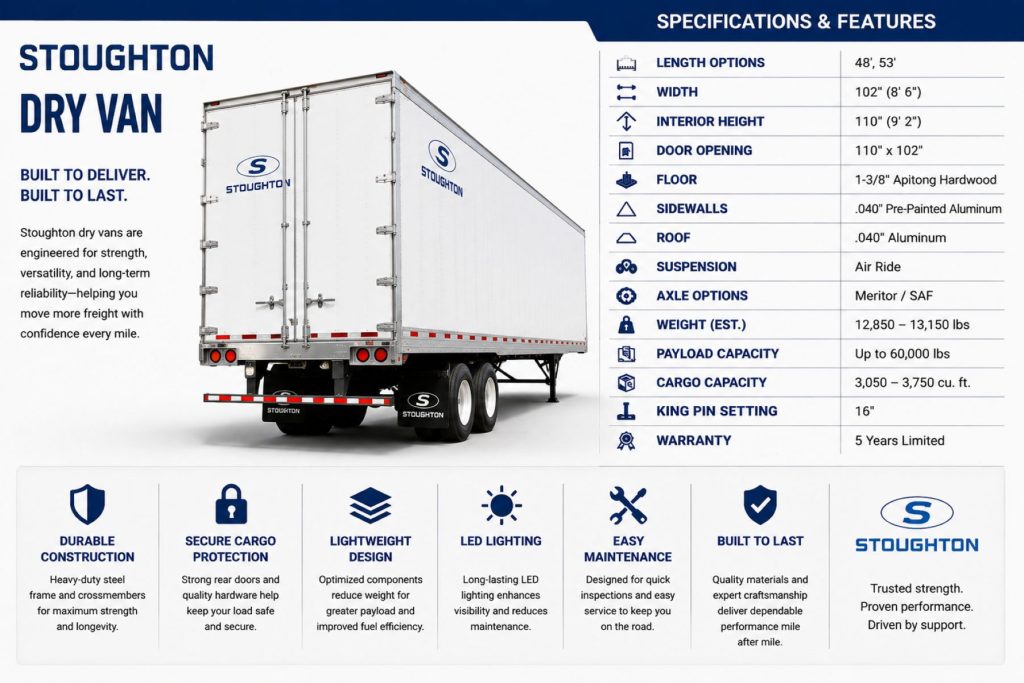
The standard Stoughton Dry Van is approximately 53 feet long.
The 53 ft dry van trailer is widely used in North American truckload, dedicated, retail, and distribution operations because it provides substantial cargo volume while remaining compatible with standard loading docks.
Other lengths may be available for fleet-specific applications, but specifications vary by model, production year, and customer requirements.
Width
The standard exterior width is approximately 102 inches.
The Z-Plate and Tough Plate configurations provide approximately 101 inches of interior width.
Interior width can affect pallet placement, cargo volume, wall clearance, and double-deck loading options.
Height
The standard exterior height is approximately 13 feet 6 inches when configured around a typical 47-inch fifth-wheel height.
Interior height is approximately 110 inches at the front and rear.
The rear-door opening is approximately 109⅞ inches high, although exact dimensions depend on rear-frame and door specifications.
Payload and GVWR
Applicable Stoughton dry van configurations may provide a rated payload of approximately 27.5 tons, or 55,000 pounds.
Typical GVWR can reach approximately 70,000 pounds depending on axles, tires, suspension, brakes, wheels, and other equipment.
The trailer’s legal cargo capacity is usually lower than its structural rating because the tractor, trailer, fuel, driver, accessories, and cargo must remain within federal and state gross and axle-weight limits.
Sidewall Construction
Stoughton offers multiple sidewall systems.
The Aluminum Sheet-and-Post configuration uses traditional exterior sheets supported by vertical posts.
The Extra Wide configuration provides additional interior width for greater cargo capacity.
The Z-Plate uses patented composite laminate panels manufactured with epoxy-coated inner and outer galvanized steel skins.
The Tough Plate uses composite construction with additional protection in the lower sidewall area to resist concentrated contact from forklifts, pallets, and loading equipment.
Floor Construction
Stoughton dry vans commonly use a full-width laminated oak floor extending forward from the rear sill.
Floorboards are supported by closely spaced crossmembers designed for commercial loading operations. Applicable configurations may offer higher floor ratings for repeated forklift loading.
The floor, crossmembers, and threshold plate should be matched to the weight and type of loading equipment entering the trailer.
Crossmembers
Stoughton dry vans commonly use high-strength steel I-beam crossmembers.
Crossmember spacing may be reduced in high-stress loading areas to provide additional floor support.
Damage to crossmembers can reduce floor strength and cause uneven flooring, water entry, or structural problems.
Roof Construction
The trailer commonly uses a one-piece aluminum roof sheet supported by galvanized steel roof bows.
The roof is designed to protect cargo from weather while contributing to trailer structural integrity.
Roof punctures, loose fasteners, damaged seams, and collision repairs should be inspected regularly for water intrusion.
Front Wall
The front wall commonly uses aluminum exterior panels supported by galvanized steel posts and reinforced lower-sill components.
The inside front wall can be protected with OSB, plywood, composite panels, or scuff material depending on fleet specifications.
Rear Frame
The rear frame uses reinforced steel corner posts, a shallow header, lower sill, protective light guards, dock bumpers, and a rear-impact guard.
Galvanized rear-frame components may be available to improve corrosion resistance.
The rear frame receives frequent contact from loading docks and should be checked regularly for twisting, cracked welds, damaged door alignment, and corrosion.
Rear Doors
Rear swing doors commonly use composite panels, weather-resistant gaskets, aluminum hinges, locking bars, and door holdbacks.
Door seals help protect cargo from water, dust, and road contamination.
Roll-up-door configurations may be available for specialized applications, depending on fleet requirements.
Suspension
A tandem-axle sliding air-ride suspension is common.
The sliding tandem allows drivers to adjust trailer axle position for weight distribution, bridge-law compliance, maneuverability, and loading-dock access.
The air-ride suspension can improve cargo protection and ride quality compared with many mechanical-spring configurations.
More information is available through Suspension Systems.
Axles
Tandem trailer axles are commonly rated at approximately 20,000 pounds each, depending on the selected configuration.
Axle ratings must be considered together with suspension, brake, tire, wheel, and legal road-weight limitations.
Additional information is available through Axles and Differentials.
Brakes and ABS
Stoughton dry vans commonly use commercial air brakes with automatic slack adjusters, spring-brake chambers, and trailer ABS.
The braking system is designed to comply with applicable Federal Motor Vehicle Safety Standards.
More information is available through Brake Systems and Air Brake Systems Explained.
Tires and Wheels
Common configurations use eight 295/75R22.5 tires mounted on hub-piloted steel wheels.
Aluminum wheels, wide-base tires, and automatic tire-inflation systems may be available, depending on fleet requirements.
More information is available through Tires and Wheels.
Landing Gear
Two-speed landing gear supports the trailer when disconnected from the tractor.
Landing-gear mounting areas are reinforced through the trailer crossmembers and subframe.
Landing gear should be inspected for proper operation, lubrication, damage, misalignment, and stable ground contact.
Electrical and Lighting System
Stoughton dry vans commonly use LED exterior lights connected through a commercial seven-way electrical system.
Lighting includes stop, tail, turn, marker, clearance, license-plate, and conspicuity equipment.
Additional information is available through Electrical Systems.
Common Applications
The Stoughton Dry Van is used across numerous freight and distribution sectors.
- Dry Van Freight
- General palletized freight
- Retail distribution
- Consumer products
- Manufacturing freight
- E-commerce shipments
- Warehouse distribution
- Dedicated transportation
- Regional distribution
- Long-haul freight
- Less-than-truckload operations
- Automotive parts
- Paper products
- Furniture and appliances
- Packaged food not requiring refrigeration
- Household goods
- Building products protected from weather
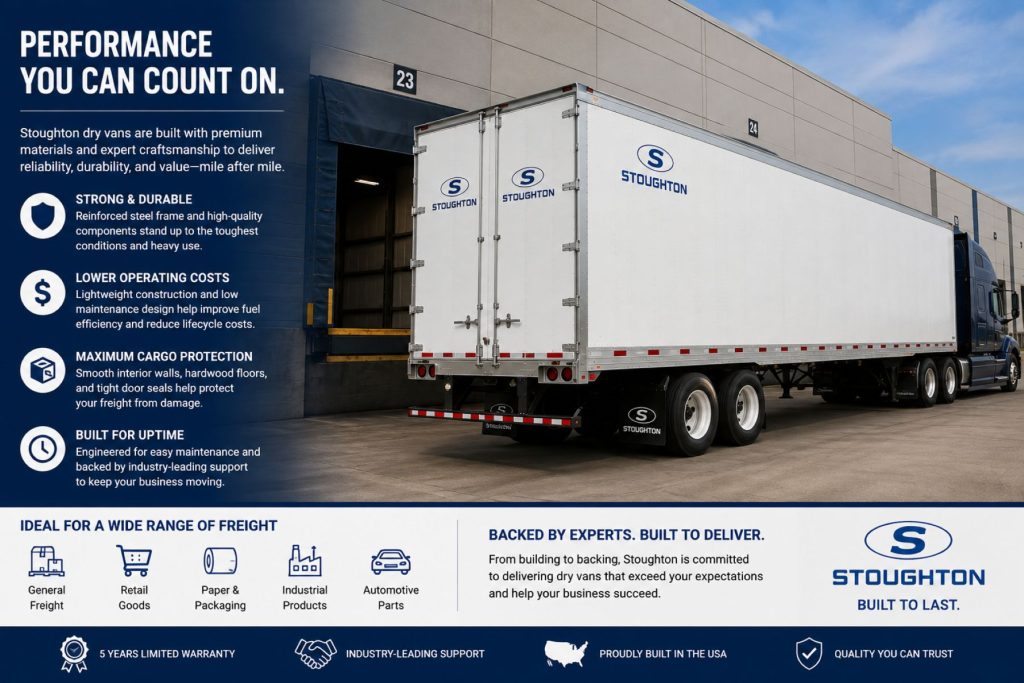
The enclosed trailer body protects freight from weather, road debris, and unauthorized access while supporting standard loading-dock operations.
Advantages
The Stoughton Dry Van provides several advantages for commercial carriers and private fleets.
- Multiple construction configurations
- Patented Z-Plate composite panels
- Replaceable individual sidewall panels
- Tough Plate lower-wall protection
- Strong resistance to loading damage
- Wide interior cargo space
- Full-width oak flooring
- Air-ride suspension availability
- Sliding tandem axle configuration
- Cargo-control compatibility
- Standard loading-dock compatibility
- Galvanized structural components
- One-piece aluminum roof
- LED lighting
- Rear-impact protection
- Good regional and long-haul capability
- Reduced downtime through repairable panels
- Broad compatibility with palletized freight
Limitations or Considerations
The Stoughton Dry Van also has limitations and ownership considerations.
- Not suitable for cargo requiring active refrigeration
- Enclosed body limits oversized freight
- Interior dimensions restrict unusually large cargo
- Composite panels require correct repair procedures
- Roof damage can cause water intrusion
- Liftgates and accessories reduce payload capacity
- Sliding tandems require regular inspection and lubrication
- Rear frames are vulnerable to loading-dock impacts
- Wood floors can be damaged by improper forklift operation
- Air-ride systems require air-line and suspension maintenance
- Aerodynamic equipment can be damaged by curbs and road debris
- Tire and wheel-end failures can create costly roadside downtime
- Actual payload depends on tractor and trailer empty weight
- Replacement components may require Stoughton-compatible parts
The trailer should be selected according to cargo, loading methods, route type, maintenance resources, dealer support, and expected ownership period.
Driver and Operator Considerations
Drivers operating a Stoughton Dry Van must monitor trailer height, length, tandem position, cargo weight, door clearance, and loading-dock conditions.
Before departure, the driver should inspect the kingpin, upper coupler, landing gear, air lines, electrical connection, brakes, tires, wheels, suspension, lights, doors, roof, sidewalls, floor, and rear frame.
The trailer’s sliding tandem should be positioned correctly to maintain legal axle weights and comply with applicable bridge laws.
Cargo should be distributed evenly and secured against forward, rearward, and lateral movement. Concentrated freight placed improperly can overload the tractor drive axles or trailer tandems.
Drivers must verify that both swing doors are closed, locked, and secured before moving. Door holdbacks should be used when backing into loading docks with the doors open.
The trailer’s approximately 13-foot-6-inch exterior height must be considered when approaching bridges, tunnels, parking structures, loading areas, trees, and overhead utility lines.
Maintenance and Ownership Notes
Consistent preventive maintenance is important for protecting trailer reliability, cargo, and resale value.
Routine maintenance should include:
- Brake inspection and adjustment
- ABS warning-system inspection
- Tire-pressure and tread inspection
- Wheel-end and bearing service
- Suspension inspection
- Axle-alignment checks
- Landing-gear lubrication
- Kingpin and upper-coupler inspection
- Rear-door hinge and seal inspection
- Roof inspection
- Sidewall and composite-panel inspection
- Floor and crossmember inspection
- Rear-frame inspection
- Rear-impact-guard inspection
- Lighting and electrical-system testing
- Air-line and hose inspection
- Slider-pin inspection
- Dock-lock inspection
- Aerodynamic-equipment inspection when equipped
- Tire-inflation-system inspection when equipped
- Liftgate maintenance when equipped
- Cargo-control-system inspection
Composite-panel damage should be repaired according to approved procedures. Improper repairs can affect appearance, structural strength, cargo protection, and long-term trailer value.
Roof seams, front corners, rear-door seals, and repaired sidewall sections should be checked regularly for water intrusion.
Buying Considerations
Before purchasing a Stoughton Dry Van, buyers should determine which configuration best fits their cargo and fleet-maintenance requirements.
Important considerations include:
- Z-Plate, Tough Plate, Extra Wide, or Sheet-and-Post construction
- Required interior width
- Required interior height
- Expected cargo weight
- Trailer empty weight
- Payload requirements
- Floor rating
- Forklift-loading requirements
- Swing-door or roll-up-door preference
- Suspension configuration
- Axle ratings
- Brake specifications
- Tire and wheel selection
- Automatic tire-inflation system
- Cargo-control equipment
- Liftgate requirements
- Aerodynamic equipment
- Corrosion-protection features
- Operating region
- Dealer and parts support
- Warranty coverage
- Expected ownership period
- Used-trailer condition
Buyers evaluating a used trailer should inspect the roof, sidewalls, composite panels, floor, crossmembers, rear frame, landing gear, kingpin area, suspension, axles, brakes, tires, wheel ends, doors, seals, and electrical system.
Poorly completed panel repairs, water intrusion, forklift damage, twisted rear frames, cracked crossmembers, or irregular tire wear can indicate significant future repair costs.
Common Brands or Manufacturers
Stoughton Trailers competes with several established North American trailer manufacturers.
- Utility Trailer Manufacturing Company
- Great Dane
- Wabash
- Hyundai Translead
- Vanguard National Trailer Corporation
- Manac
- Strick Trailers
Only manufacturers with confirmed individual Truck Equipment Atlas pages should be linked. These manufacturer names remain unlinked because their individual manufacturer pages have not been confirmed.
Variants and Related Configurations
Stoughton offers several dry van configurations.
Z-Plate
The Z-Plate uses patented composite laminate panels with epoxy-coated galvanized steel inner and outer skins.
Its design allows a damaged panel to be replaced without removing adjoining panels, reducing repair time and trailer downtime.
Tough Plate
The Tough Plate adds increased durability to the lower sidewall area.
This configuration is designed for operations involving frequent forklift loading, concentrated interior scuffing, pallet contact, and other demanding loading conditions.
Extra Wide
The Extra Wide configuration provides greater usable interior width for additional cargo capacity and improved pallet positioning.
Aluminum Sheet-and-Post
The Aluminum Sheet-and-Post configuration uses a traditional wall design that may appeal to fleets familiar with conventional dry van construction and repairs.
Tandem Sliding Suspension
A sliding tandem configuration allows axle placement to be adjusted according to cargo distribution and applicable weight regulations.
Liftgate Configuration
Liftgate-equipped trailers can serve locations without loading docks but have greater empty weight and additional maintenance requirements.
Roll-Up-Door Configuration
Roll-up doors improve access in confined delivery environments but may reduce usable rear-opening height.
Fleet-Specific Configuration
Stoughton can configure trailers with different flooring, cargo-control systems, tires, wheels, brakes, lighting, aerodynamic equipment, and corrosion-protection packages.
Comparison to Similar Trailers
The Stoughton Dry Van is commonly compared with the Utility 3000D Dry Van, Great Dane Champion Dry Van, Wabash DuraPlate Dry Van, and Hyundai Translead Dry Van.
Compared with conventional sheet-and-post trailers, the Stoughton Z-Plate provides composite-panel construction and individual panel replacement.
Compared with the Utility 3000D, Stoughton emphasizes its Z-Plate composite design, repairability, full-width oak floor, and multiple wall configurations.
Compared with the Great Dane Champion, Stoughton competes through composite-panel durability, lower-sidewall protection, cargo-control compatibility, and repair simplicity.
Compared with the Wabash DuraPlate, the Stoughton Z-Plate provides its own patented composite laminate construction and panel-replacement method.
Compared with the Hyundai Translead Dry Van, Stoughton offers its Z-Plate and Tough Plate configurations along with traditional sheet-and-post and extra-wide designs.
The best trailer depends on purchase price, wall construction, empty weight, floor rating, repair network, warranty, dealer support, and expected lifecycle costs.
Best Fit For
- Truckload carriers
- Regional freight fleets
- Dedicated contract carriers
- Private fleets
- Retail distributors
- Manufacturing companies
- E-commerce operations
- Warehouse distribution
- Consumer-goods transportation
- Automotive-parts distribution
- Furniture and appliance transportation
- Carriers seeking composite-wall construction
- Fleets prioritizing repairability
- Operations involving frequent forklift loading
- Fleets needing lower-sidewall protection
- Businesses requiring standard loading-dock compatibility
Related Equipment
- Brake Systems
- Suspension Systems
- Axles and Differentials
- Tires and Wheels
- Electrical Systems
- Aerodynamics and Fairings
- Telematics and ELD Systems
- Safety Systems
Related Freight Types
- Dry Van Freight
- Dedicated Dry Van Freight
- Regional Dry Van Freight
- Long-Haul Dry Van Freight
- Specialty and Niche Freight
Related Trailer Types
- Dry Van Trailers
- 53 ft Dry Van Trailer
- 48 ft Dry Van Trailer
- Refrigerated Trailers
- Conestoga Trailers
Related Trailer Models
Related Guides
- Complete Guide to Trailer Types
- Dry Van vs Refrigerated Trailer
- Choosing the Right Trailer for Your Freight
Regulatory and Compliance Notes
The Stoughton Dry Van must comply with federal, state, provincial, and local regulations governing commercial trailers, dimensions, axle weights, braking systems, lighting, tires, cargo securement, and overall vehicle condition.
Operators should monitor:
- Maximum trailer width
- Maximum vehicle height
- Trailer GVWR
- Actual loaded trailer weight
- Gross combination weight
- Individual axle weights
- Sliding-tandem position
- Bridge-formula requirements
- Brake and ABS requirements
- Lighting and conspicuity requirements
- Tire and wheel ratings
- Cargo-securement requirements
- Annual inspection requirements
- Rear-impact-guard condition
A trailer with an approximately 70,000-pound GVWR cannot necessarily carry 70,000 pounds of cargo. Legal payload is limited by the combined weight of the tractor, trailer, fuel, driver, equipment, and freight, along with federal and state axle-weight regulations.
Real World Operating Notes
In real-world operations, the Stoughton Dry Van is valued for its composite-panel options, cargo capacity, repairability, and suitability for standard freight networks.
The Z-Plate can be useful for fleets seeking composite construction and replaceable individual wall panels.
The Tough Plate can benefit operations involving frequent forklift loading and repeated contact with the lower sidewall area.
Loading practices strongly affect trailer life. Forklift impacts, improperly secured cargo, overloaded floors, loading-dock collisions, and repeated rear-frame contact can cause expensive structural damage.
Drivers should inspect the trailer’s doors, roof, sidewalls, floor, tires, lights, suspension, brakes, and aerodynamic equipment during every pre-trip inspection.
Fleet operators should also monitor empty weight. Liftgates, additional batteries, cargo-control systems, heavy-duty floors, tire-inflation systems, and specialized rear equipment reduce available payload.
Frequently Asked Questions
What type of trailer is the Stoughton Dry Van?
It is an enclosed dry van trailer designed to transport general freight that does not require active temperature control.
How long is a Stoughton Dry Van?
The most common Stoughton Dry Van is approximately 53 feet long.
How wide is a Stoughton Dry Van?
The exterior width is approximately 102 inches. Applicable configurations provide up to approximately 101 inches of interior width.
What is a Stoughton Z-Plate trailer?
The Z-Plate uses patented composite laminate panels with epoxy-coated galvanized steel inner and outer skins. Damaged panels can be replaced without removing adjoining panels.
What is a Stoughton Tough Plate trailer?
The Tough Plate adds increased protection to the lower sidewall area to resist forklift, pallet, and loading-equipment damage.
What is the payload rating of a Stoughton Dry Van?
Applicable configurations may provide a rated payload of approximately 27.5 tons, or 55,000 pounds. Legal payload depends on tractor weight, trailer weight, cargo distribution, and applicable road regulations.
Does the Stoughton Dry Van use air-ride suspension?
Air-ride tandem sliding suspensions are common, although exact suspension specifications depend on the trailer configuration.
Can a Stoughton Dry Van have a roll-up door?
Roll-up-door options may be available for applicable fleet configurations. Rear swing doors remain common on standard highway trailers.
Can the Stoughton Dry Van carry refrigerated freight?
No. A standard dry van does not include the insulation and refrigeration equipment required for temperature-controlled cargo. A refrigerated trailer is required for that application.
What freight is commonly carried in a Stoughton Dry Van?
Common freight includes packaged goods, retail products, manufacturing freight, consumer products, furniture, appliances, automotive parts, e-commerce shipments, and palletized cargo.
Availability and Where to Find
New Stoughton dry van trailers are available through Stoughton Trailers, authorized dealers, commercial-trailer distributors, leasing companies, and fleet-purchasing programs.
Availability depends on production schedules, wall construction, suspension, axles, brakes, tires, wheels, rear doors, flooring, cargo-control equipment, and fleet-specific options.
Used Stoughton trailers are available through trailer dealerships, fleet-retirement sales, leasing companies, equipment auctions, and online commercial-trailer marketplaces.
When evaluating a used Stoughton Dry Van, buyers should inspect the roof, sidewalls, composite panels, floor, crossmembers, rear frame, landing gear, kingpin, upper coupler, suspension, axles, brakes, tires, wheel ends, doors, seals, lighting, and rear-impact guard.
Maintenance records, previous cargo, repair history, water intrusion, corrosion, and evidence of forklift or loading-dock damage should also be reviewed before purchase.
Support Trucking Families
Truck Equipment Atlas supports the mission of Grey Cross, a nonprofit dedicated to helping families of truck drivers who lose their lives while on the road. As the site grows, part of its mission is to bring awareness and support to these families.
Podcast or Video Section
Learn More Through Audio and Video
Truck Equipment Atlas will continue expanding with podcast episodes, interviews, and equipment breakdowns to help drivers and fleets better understand trucks and equipment.
Follow the Growth of Truck Equipment Atlas
Truck Equipment Atlas continues to expand with new truck profiles, trailer coverage, diesel engine pages, equipment system resources, manufacturer information, and educational guides.
Visit our Site Updates page to explore recent additions, project milestones, and upcoming resources as we continue building one of the industry’s growing commercial trucking equipment reference libraries.
View the Latest Site Updates: Truck Equipment Atlas Site Updates