
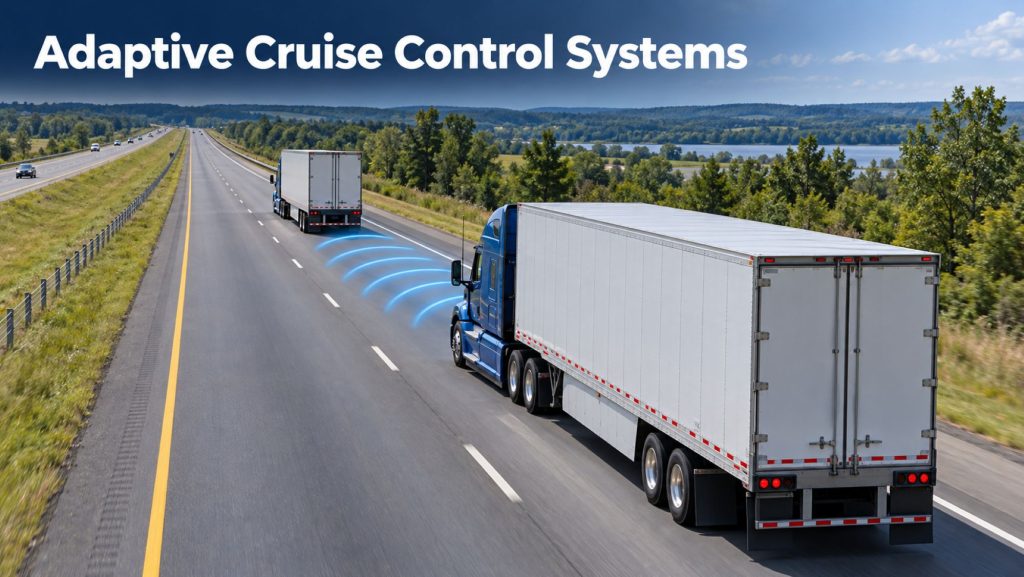
Adaptive cruise control systems help commercial truck drivers manage cruising speed and following distance. When a supported vehicle ahead travels more slowly than the selected cruising speed, the system can adjust the truck’s speed within its operating capabilities.
Depending on the installation, speed adjustment may involve engine power reduction, engine retarding, and supported service-brake application. Minimum operating speeds, stopping capability, restart procedures, and available following-distance settings differ between products and vehicle configurations.
Truck Equipment Atlas covers adaptive cruise operation, forward sensing, driver controls, vehicle integration, maintenance, operating limitations, and the individual safety-system platforms that provide these functions.
Adaptive Cruise Control Systems on Truck Equipment Atlas
Explore the product families being added to this category. Adaptive cruise control may be one function within a larger collision mitigation or driver-assistance package.
Bendix
- Bendix Wingman Fusion Collision Mitigation System
- Bendix Wingman Advanced Collision Mitigation System
ZF WABCO
Detroit
Additional platforms and system generations will be added as the library expands. Check each profile for the functions documented for its specific configuration.
How Adaptive Cruise Control Works
The driver selects a cruising speed using the vehicle’s controls. When the system detects a supported vehicle ahead, it evaluates the following relationship and adjusts speed according to its programmed behavior and available vehicle controls.
If traffic ahead slows, the installation may reduce propulsion or request supported retarding and braking. When the monitored path clears, the system may increase speed toward the selected setting within its operating limits.
Drivers must continue monitoring traffic and controlling the vehicle. The selected cruise speed is not an instruction to maintain that speed regardless of weather, road conditions, visibility, or traffic.
Conventional Cruise Control vs Adaptive Cruise Control
Conventional Cruise Control
Conventional cruise control primarily manages a selected speed. Its operation does not by itself establish traffic detection or automatic following-distance adjustment.
Adaptive Cruise Control
Adaptive cruise control adds a following function based on detected forward traffic. The system’s sensing coverage, available speed adjustment, and operating conditions depend on the installation.
Predictive Cruise Control
Predictive cruise functions may use route or terrain information to plan speed and powertrain behavior. Predictive operation and forward-traffic adaptation are separate capabilities, even when offered together.
Major Adaptive Cruise Control Components
Depending on the platform, the complete installation may include:
- Forward-facing radar equipment.
- A forward-facing camera where required.
- Processing electronics and control software.
- Cruise-control switches and driver settings.
- Driver display, status indicators, and alerts.
- Engine and powertrain interfaces.
- Supported retarder and brake-system interfaces.
- Vehicle-network connections.
- Electrical wiring and approved mounting hardware.
A standalone hazard-warning camera does not become an adaptive cruise system simply because it detects a forward vehicle. Supported speed-control integration is also required.
Following Distance and Time-Gap Settings
Where adjustable following settings are provided, learn what each setting represents in the vehicle’s manual. Do not assume that a display bar corresponds to a fixed number of feet or that identical symbols mean the same thing across manufacturers.
A time-based following interval corresponds to a greater physical distance as speed increases. Drivers still need to allow room appropriate to the load, traction, visibility, road grade, and surrounding traffic.
Engine Power, Retarding, and Service Braking
Adaptive cruise systems can use different methods to reduce speed. Power reduction, engine retarding, and service-brake application have different roles, and the available combination depends on vehicle integration.
For example, Bendix describes Wingman Fusion adaptive cruise operation as using throttle reduction, engine retarding, and foundation braking to help maintain the selected following relationship. That description should not be applied automatically to every adaptive cruise product.
Drivers should understand the vehicle’s brake and retarder instructions and remain prepared to manage speed directly when conditions require it.
Highway Adaptive Cruise Applications
Highway evaluation should consider sustained cruising, changing traffic speeds, grades, curves, and vehicles entering or leaving the lane. Driver training should address how the installed system responds when its forward target changes.
- Selected cruising speed.
- Following settings and detected-vehicle indicators.
- Supported speed reduction and braking.
- Driver cancellation and override procedures.
- System availability and fault messages.
Regional and Urban Operation
Regional routes can include intersections, frequent merging, sharp turns, and repeated traffic stops. Confirm whether cruise use is appropriate for those conditions under the vehicle manufacturer’s instructions.
Low-speed capability varies. A system described as adaptive cruise should not automatically be treated as suitable for every urban maneuver or stop-and-go situation.
Low-Speed, Stop, and Resume Functions
Some installations support following operation down to a stop; others have higher minimum operating speeds. Stopping capability, holding behavior, and restart requirements must be checked separately.
- Minimum activation and operating speeds.
- Whether following control can bring the truck to a stop.
- How control behaves after stopping.
- Whether driver input is required to resume.
- Powertrain and vehicle configuration requirements.
Do not infer automatic restart from a claim that a system can operate down to zero speed.
Common Specifications and Compatibility
Before comparing installations, obtain the following information for the exact truck:
- System name, generation, and software configuration.
- Supported vehicle model and model year.
- Engine and transmission compatibility.
- Brake and retarder integration.
- Available following settings.
- Activation and operating speed ranges.
- Low-speed, stop, and resume behavior.
- Driver controls and alerts.
- Calibration and diagnostic requirements.
Adaptive Cruise and Collision Mitigation
Adaptive cruise manages normal following behavior during supported cruise operation. Collision warning and emergency braking address specified risk conditions and may have different activation rules.
Shared sensors do not make these functions interchangeable. Learn which warnings or interventions remain available when cruise control is canceled, using the documentation for the installed system.
Sensor Mounting and Calibration
Forward sensing requires the approved mounting arrangement and alignment. Inspect for damage, movement, obstruction, or changes caused by accessories and repair work.
Check calibration requirements after work affecting the radar, camera, brackets, windshield, or related vehicle geometry. Follow the exact manufacturer procedure before returning affected functions to service.
Operating Limitations and Driver Responsibilities
Use adaptive cruise only under the conditions permitted by the vehicle and system instructions. Drivers must judge whether the selected speed and following interval suit the road, weather, visibility, load, and traffic.
- Review limitations involving curves, merging traffic, and target changes.
- Understand the documented response to stationary objects.
- Recognize sensor obstruction and unavailable-system messages.
- Learn when direct driver braking or speed control is required.
- Follow the vehicle’s cruise-use restrictions.
Common Adaptive Cruise Control Problems
- Cruise activation conditions not being met.
- Blocked or damaged forward sensors.
- Sensor alignment or calibration issues.
- Electrical supply, wiring, or connector faults.
- Vehicle-network or related control-system faults.
- Incorrect expectations about low-speed or resume functions.
- Unexpected behavior following repairs or configuration changes.
Record the displayed message and operating conditions before diagnosis. Use supported service tools to distinguish a fault from normal operating restrictions.
Inspection and Maintenance
- Check status indicators and reported faults.
- Inspect accessible sensor surfaces and mounting hardware.
- Use approved cleaning procedures.
- Inspect accessible wiring and connectors.
- Maintain the vehicle’s brakes, tires, and related controls.
- Complete required calibration after relevant repairs.
- Record updates, replacement parts, and service work.
Driver Controls and Training
Training should use the controls and manual for the actual truck. Drivers need to understand setting speed, selecting any available following interval, canceling cruise, resuming operation, and identifying unavailable functions.
When changing trucks, review differences in controls and behavior before using the system. Similar dashboard symbols do not establish identical operation.
Common Applications
- Long-haul highway tractors.
- Regional and day-cab tractors.
- Distribution trucks with supported factory equipment.
- Vocational vehicles with approved configurations.
- Commercial fleets comparing integrated driver-assistance packages.
Selecting an Adaptive Cruise Control System
Evaluate adaptive cruise as part of the complete vehicle specification. For an existing truck, obtain written confirmation of any approved upgrade or retrofit rather than assuming a sensor can be added independently.
- Verify the truck and powertrain configuration.
- Compare documented following and braking functions.
- Review operating speeds and restart requirements.
- Assess driver controls and training needs.
- Check installation, calibration, and diagnostic support.
- Confirm upgrade eligibility and replacement availability.
- Compare the installed cost and ownership requirements.
Related Safety System Categories
- Collision Warning and Automatic Emergency Braking Systems
- Lane Departure Warning and Lane Keeping Systems
- Blind-Spot and Vulnerable Road User Detection Systems
- Reversing Safety and Audible Warning Systems
- Camera Monitor and Surround-View Systems
Related Safety System Guides
- Safety System Guides
- How Commercial Truck Safety Systems Work
- Adaptive Cruise Control for Commercial Trucks Explained
- Collision Warning and Automatic Emergency Braking Explained
- Lane Departure Warning and Lane Keeping Assistance Explained
- How to Choose a Commercial Truck Safety System
Related Truck and Equipment Resources
- Safety Systems
- Commercial Trucks
- Commercial Trailers
- Brake Systems
- ABS and Electronic Braking Systems
- Tires & Wheels
- Electrical Systems
- Telematics & ELD Systems
- Equipment Systems
Adaptive Cruise Control Library Expansion
Truck Equipment Atlas will expand this category with additional system generations, vehicle-specific packages, driver-interface information, and comparisons of documented operating capabilities.
- Additional manufacturer platforms.
- Low-speed and stop-and-go configurations.
- Powertrain integration and cruise-control comparisons.
- Supported retrofit and upgrade information.
- Sensor, calibration, and service resources.
Explore the Complete Safety Systems Library
Visit the Safety Systems hub to explore collision mitigation, adaptive cruise control, lane assistance, blind-spot detection, reversing equipment, camera monitor systems, product profiles, and educational guides.
Follow the Growth of Truck Equipment Atlas
Truck Equipment Atlas continues to expand with new truck profiles, trailer coverage, diesel engine pages, equipment-system resources, manufacturer information, and educational guides.
Visit the Truck Equipment Atlas Site Updates page to explore recent additions, project milestones, and upcoming resources.