
Quick Facts
- Manufacturer: NorthStar Battery Company
- Model: NSB-AGM31
- Product Type: Commercial AGM battery
- Battery Technology: Thin-plate pure-lead absorbed glass mat
- BCI Group Size: Group 31
- Nominal Voltage: 12 volts
- Cold-Cranking Rating: 1,150 CCA
- Pulse-Cranking Rating: 2,150 amps for five seconds
- Cranking Rating: 1,370 CA or MCA
- 20-Hour Capacity: 103 amp-hours
- Reserve Capacity: 220 minutes
- Terminal Configuration: Threaded stud terminals
- Primary Applications: Commercial trucks, vocational vehicles, buses, recreational vehicles, emergency equipment, and auxiliary-power systems
- Production Status: Legacy NorthStar-branded product; current availability and replacement options should be confirmed
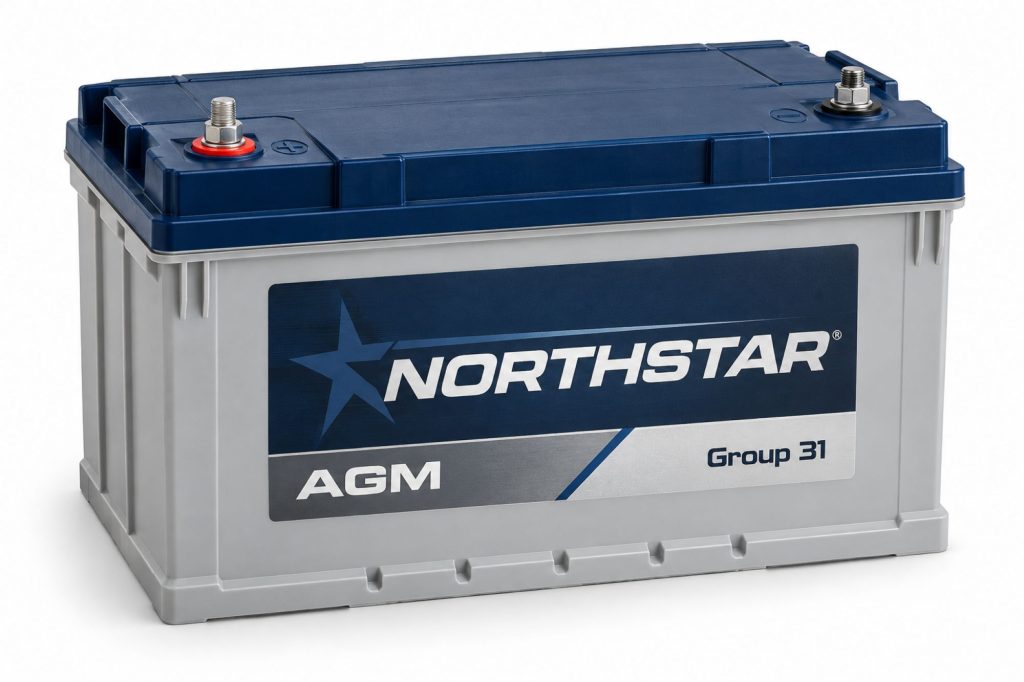
Overview
The NorthStar Group 31 Commercial AGM Battery, commonly identified by the NSB-AGM31 model number, is a 12-volt thin-plate pure-lead battery developed for demanding commercial starting and reserve-power applications.
Its absorbed glass mat construction holds the electrolyte within fiberglass separators instead of using freely flowing liquid electrolyte. This produces a sealed, maintenance-free battery that does not require routine water additions.
The battery combines a high cranking rating with useful reserve and cycling capacity. That combination allows it to support engine starting as well as electrical loads from sleeper equipment, emergency systems, communication devices, liftgates, auxiliary lighting, and other vehicle accessories.
The NorthStar-branded NSB-AGM31 is now generally considered a legacy product. Batteries sold as replacements should be checked carefully for terminal design, dimensions, polarity, electrical ratings, charging compatibility, and current manufacturer support.
Key Characteristics
- BCI Group 31 commercial-battery configuration
- Thin-plate pure-lead AGM construction
- Sealed and maintenance-free design
- High cold-cranking output
- Strong five-second pulse-cranking capability
- 103-amp-hour published capacity
- 220-minute reserve-capacity rating
- Threaded terminals for commercial cable connections
- Low internal resistance
- Designed for starting and cycling service
- Improved vibration resistance compared with many conventional flooded batteries
- No routine electrolyte watering
- Suitable for multi-battery commercial installations when properly matched
Major Components
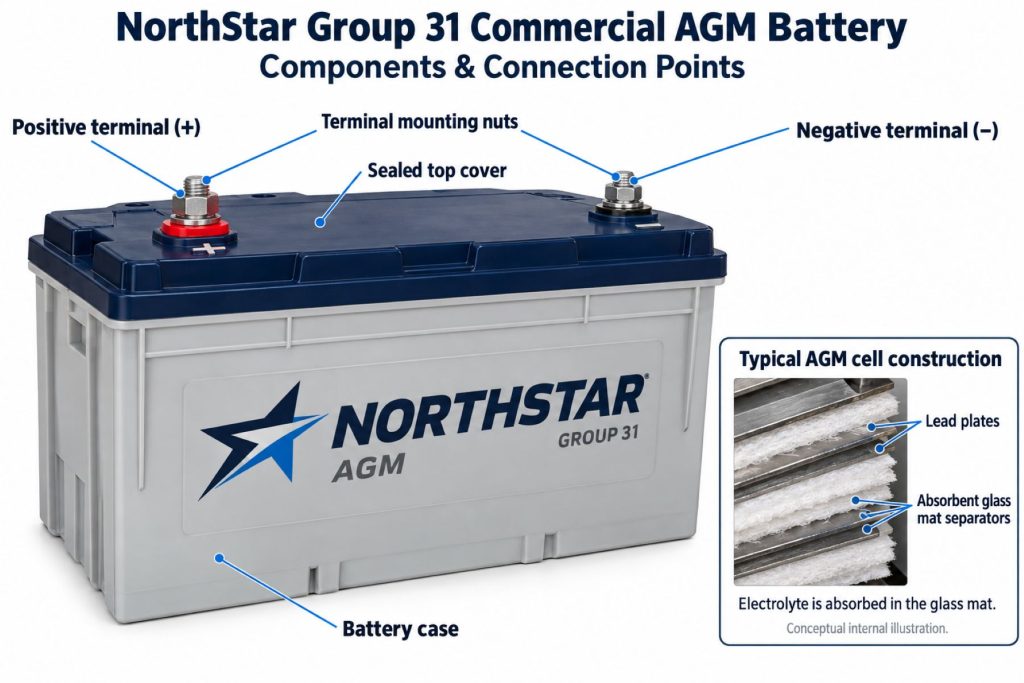
- Pure-lead positive and negative plates
- Absorbed glass mat separators
- Electrolyte absorbed within the separator material
- Internal plate straps and connectors
- Threaded positive terminal
- Threaded negative terminal
- Pressure-regulating safety valves
- Flame-resistant battery case and cover
- Internal cell partitions
- Terminal seals
- Identification and warning labels
- Vehicle hold-down and mounting interfaces
Product Type and Construction
The NSB-AGM31 is a valve-regulated lead-acid battery using absorbed glass mat and thin-plate pure-lead construction. Its closely packed plates provide a large active surface area, supporting high current delivery and relatively low internal resistance.
The electrolyte is retained in compressed glass mat separators. This eliminates routine watering and reduces the possibility of acid leakage under normal operating conditions, although the battery still contains lead and sulfuric acid and must be handled accordingly.
How the Electrical Component or System Works
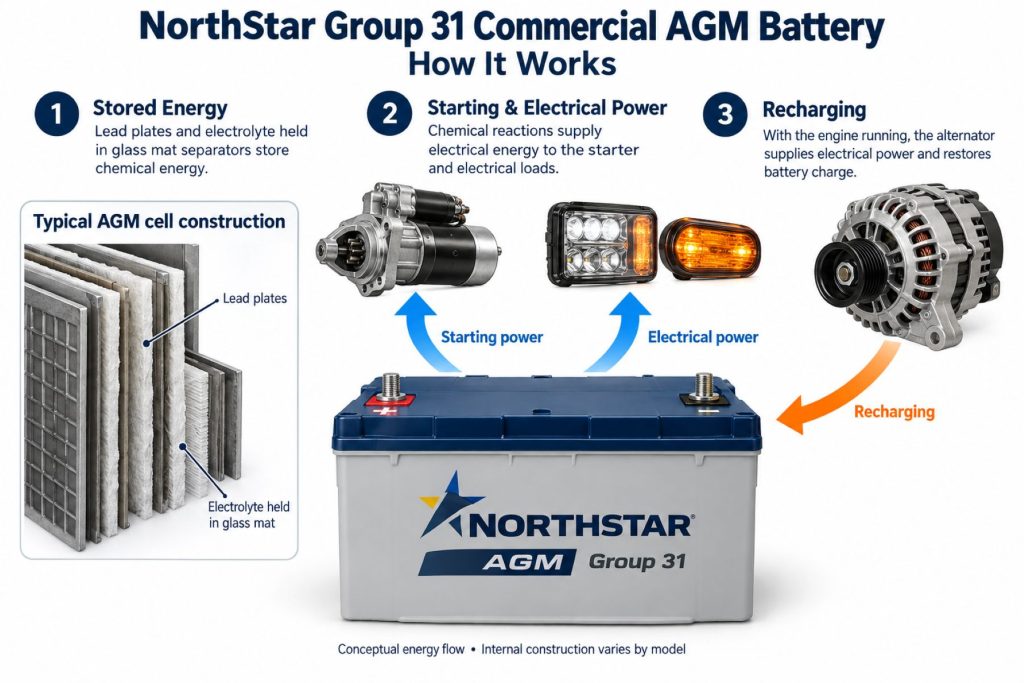
The battery converts stored chemical energy into electrical energy. During engine cranking, current flows from the battery through the starting cables and starter solenoid to the starter motor.
Once the engine is operating, the alternator supplies vehicle loads and restores energy removed from the battery. The AGM separators keep the electrolyte in close contact with the plates and support internal gas recombination during normal charging.
Position and Function Within the Vehicle
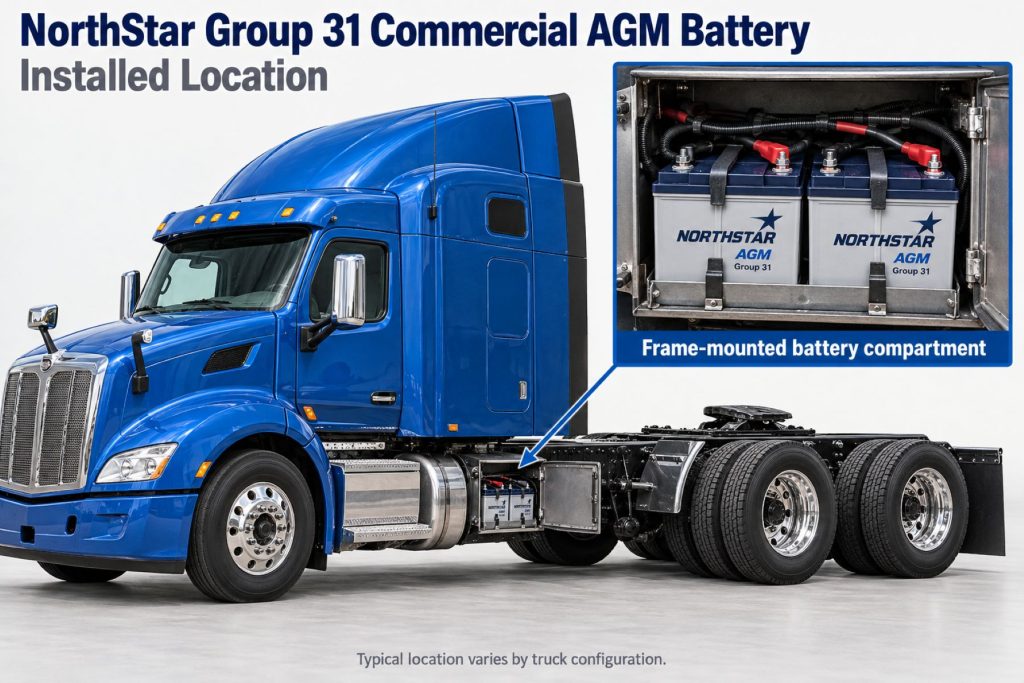
The battery is normally installed in a frame-mounted battery box, under-cab compartment, engine compartment, step box, or protected equipment enclosure. Depending on the vehicle’s electrical architecture, one battery may be used alone or multiple batteries may be connected in parallel or series-parallel arrangements.
Its primary functions can include engine starting, voltage stabilization, reserve power, accessory operation, and support for safety-critical electrical equipment when alternator output is unavailable.
Common Specifications
- Battery Model: NSB-AGM31
- Battery Classification: BCI Group 31
- Nominal Voltage: 12 volts
- Battery Chemistry: Valve-regulated lead acid
- Internal Design: Thin-plate pure-lead AGM
- Cold-Cranking Amps: 1,150 amps
- Five-Second Pulse-Cranking Amps: 2,150 amps
- Cranking Amps: 1,370 amps
- 20-Hour Capacity: 103 amp-hours
- Reserve Capacity: 220 minutes
- Internal Resistance: Approximately 2.2 milliohms at 77 degrees Fahrenheit
- Published Short-Circuit Current: Approximately 5,000 amps
- Terminal Type: Threaded commercial stud
Case Size: Standard Group 31 footprint; exact dimensions should be confirmed before installation
Operating Capacity and Performance
The battery’s 1,150-CCA rating supports high-current engine starting in cold conditions, while its 220-minute reserve capacity provides extended electrical support when charging-system output is unavailable.
Actual performance depends on battery temperature, state of charge, age, cable resistance, starter condition, engine displacement, oil viscosity, charging voltage, parasitic loads, and the number of batteries installed.
Installation Position and System Function
The battery should be installed in a properly sized and secured Group 31 tray or battery box. Its terminals must match the vehicle’s cable arrangement without requiring stretched, crossed, or sharply bent cables.
AGM batteries should be protected from excessive heat, direct impact, conductive debris, loose tools, and damaged hold-down hardware.
System Voltage and Electrical Architecture
The NSB-AGM31 is a 12-volt battery. Commercial vehicles may use one battery, several batteries connected in parallel for additional 12-volt capacity, or series-parallel arrangements supporting other system architectures.
Every battery within a connected bank should have compatible voltage, chemistry, capacity, age, condition, and state of charge. Mixing mismatched batteries can reduce performance and shorten service life.
Electrical Input, Output, and Power Function
The battery accepts charging current from the alternator or an approved external charger and supplies direct current to the vehicle’s starter, control modules, lighting, accessories, and emergency circuits.
Available output decreases as the battery becomes discharged or cold. Excessive discharge can leave insufficient power for engine starting even when some accessories continue to operate.
Voltage, Current, and Electrical Load Management
Battery-bank capacity should be matched to the truck’s starting requirements and key-off electrical loads. High-resistance cables, loose connections, corrosion, and poor grounds can prevent available battery current from reaching the starter.
Low-voltage disconnects, idle-management systems, auxiliary power units, and battery-monitoring equipment can help prevent excessive discharge.
Starting, Cycling, and Reserve-Power Function
The NSB-AGM31 combines high starting output with greater cycling capability than many conventional starting batteries. It can support vehicles that experience repeated starts or operate electrical accessories with the engine off.
It should not be treated as an unlimited energy source. Repeated deep discharge, chronic undercharging, or long periods in a discharged condition can still damage the battery.
Cold-Cranking and Reserve Capacity
Cold-cranking amps indicate the battery’s ability to deliver current during a standardized cold-temperature test. Reserve capacity estimates how long a fully charged battery can sustain a specified electrical load before reaching the test cutoff voltage.
Neither rating guarantees performance in a specific truck. Cable condition, battery-bank configuration, starter demand, temperature, and actual accessory loads must also be considered.
Thin-Plate Pure-Lead Design
Thin-plate pure-lead construction uses numerous closely spaced plates to increase active surface area. This design supports rapid current delivery and low internal resistance while maintaining useful cycling performance.
Proper charging remains essential. A high-performance AGM battery cannot compensate for an alternator, regulator, wiring system, or external charger that operates outside the battery manufacturer’s requirements.
Internal Components and Electrical Design
Each internal cell contains positive and negative lead plates separated by absorbed glass mat material. Internal straps connect the plates, while intercell connectors combine the cells into the battery’s nominal 12-volt output.
Pressure-regulating valves allow controlled venting if internal pressure exceeds the intended range. These valves must never be blocked or modified.
Materials and Component Construction
- High-purity lead plates
- Absorbed glass mat separators
- Sulfuric-acid electrolyte
- Heavy internal plate straps
- Commercial threaded terminals
- Reinforced polymer case and cover
- Pressure-regulating vent valves
- Sealed terminal and cover joints
Wiring, Terminals, Connectors, and Grounding
Battery cables must have sufficient conductor size for starter current and cable length. Terminal lugs should sit flat against clean contact surfaces and be secured to the specified torque without overtightening the terminal studs.
Positive cables, negative cables, frame grounds, engine grounds, and body grounds should be inspected together. A poor ground can produce the same symptoms as a weak battery.
Circuit Protection and Electrical Safety
Vehicle circuits connected to the battery should use properly rated fuses, fusible links, or circuit breakers. Battery cables must be routed away from exhaust components, sharp edges, steering parts, and moving suspension components.
Because a commercial battery can deliver extremely high fault current, an unprotected short circuit can cause fire, cable damage, molten metal, battery rupture, or serious injury.
Controls, Monitoring, and Diagnostics
The battery has no internal driver-operated controls. Its condition may be monitored through vehicle voltage displays, battery-management devices, telematics systems, low-voltage alarms, or shop diagnostic equipment.
Useful tests include open-circuit voltage, conductance, approved load testing, charging-voltage measurement, parasitic-draw testing, cable voltage-drop testing, and inspection of every battery in the bank.
Electronic Controls and Driver-Assistance Integration
The battery can supply power to engine controllers, transmission controls, antilock brakes, stability systems, collision-mitigation equipment, telematics, lighting controllers, and other electronic systems.
Low system voltage can create multiple warning messages or communication faults. Battery condition and electrical connections should therefore be checked before individual electronic modules are condemned.
Power Demand, Capacity, and Energy Management
Commercial electrical loads may include starting, cab climate equipment, refrigerators, lighting, communication devices, liftgates, pumps, inverters, powered accessories, and emergency equipment.
The battery bank and charging system should be sized from measured or calculated demand rather than battery group size alone.
Charging Efficiency and Energy Recovery
AGM batteries can accept charging current efficiently, but charge time still depends on alternator capacity, regulator strategy, battery temperature, depth of discharge, wiring resistance, and competing vehicle loads.
A short engine run may not restore the energy consumed during extended key-off operation. Periodic external charging may be required in vehicles with high accessory demand or limited operating time.
Heat, Efficiency, and Electrical Loss Management
Heat accelerates battery aging, while extreme cold reduces available cranking output. Loose or corroded connections create resistance, voltage loss, and localized heating.
The battery should be protected from exhaust heat and installed where normal ventilation is available. Charging-system faults that create excessive voltage must be corrected promptly.
Environmental Sealing and Contamination Protection
The sealed AGM construction reduces routine electrolyte exposure, but the terminals and external connections remain vulnerable to moisture, conductive dirt, road salt, and corrosion.
Battery boxes should drain properly, remain securely covered, and prevent tools or cargo from contacting the terminals.
Duty Cycle and Operating Conditions
The NSB-AGM31 can support highway, regional, vocational, emergency, bus, recreational, and auxiliary-power duty cycles. Service life varies substantially with temperature, vibration, discharge depth, time spent partially charged, charging quality, and vehicle maintenance.
Mounting and Installation
The battery must fit the tray, enclosure, hold-down system, cable layout, and terminal-clearance requirements of the vehicle. It should be secured against movement without deforming or damaging the case.
Terminal polarity should be confirmed before any connection is made. Reversed polarity can immediately damage vehicle electronics and charging components.
Wiring, Grounding, and Installation Requirements
- Confirm battery polarity before installation
- Use correctly sized battery cables
- Clean all cable and ground contact surfaces
- Replace damaged or overheated terminal lugs
- Route cables away from heat and moving parts
- Install terminal protection where specified
- Secure the battery with the approved hold-down
- Follow the specified terminal-fastener torque
- Verify charging voltage after installation
- Test voltage drop during engine cranking
Vehicle and Electrical-System Compatibility
Compatibility depends on battery-box dimensions, terminal location, polarity, cable reach, hold-down design, starting demand, charging voltage, battery-bank arrangement, and electrical-load requirements.
A Group 31 designation alone does not confirm that every Group 31 battery is interchangeable. Terminal types, terminal orientation, height, case details, capacity, and chemistry can differ.
Battery and Charging-System Compatibility
The alternator, voltage regulator, external charger, battery isolator, low-voltage disconnect, and auxiliary-power equipment must be suitable for AGM batteries.
When multiple batteries are connected, the batteries should be closely matched. Replacing only one severely aged battery in a bank can produce uneven charging and discharging.
Related Component and System Compatibility
- Heavy-duty starters
- High-output alternators
- Battery cables and ground straps
- Battery isolators and disconnect switches
- Low-voltage disconnect systems
- Inverters and converters
- Auxiliary power units
- Liftgate electrical systems
- Emergency and warning equipment
- Vehicle telematics and monitoring systems
Common Applications
- Highway tractors
- Regional-haul tractors
- Vocational trucks
- Dump trucks
- Refuse vehicles
- Emergency vehicles
- Commercial buses
- Recreational vehicles
- Service trucks
- Utility vehicles
- Construction equipment
- Auxiliary-power installations
Advantages
- High cold-cranking output
- Strong pulse-current capability
- Useful reserve capacity
- Supports starting and cycling service
- Sealed AGM construction
- No routine water additions
- Low internal resistance
- Good vibration resistance
- Reduced risk of free-electrolyte leakage
- Compatible with many commercial Group 31 installations
Limitations or Considerations
- NorthStar-branded availability may be limited
- Usually costs more than a conventional flooded battery
- Requires an AGM-compatible charging profile
- Can be damaged by chronic undercharging
- Excessive charging voltage can shorten service life
- Heavy battery weight requires careful handling
- Threaded terminals must match the vehicle cables
- Deep discharge can still cause permanent damage
- All batteries in a connected bank should be properly matched
- Legacy warranty information may not apply to remaining inventory
Driver and Operator Experience
A healthy battery bank should provide consistent cranking speed and stable voltage during starting. Its reserve capacity can help support key-off accessories, but operators should still monitor extended electrical use.
Slow cranking, dim lighting, repeated low-voltage warnings, electronic resets, or difficulty restarting after a rest period may indicate a discharged battery, deteriorated battery, charging problem, excessive parasitic load, or high-resistance connection.
Controls, Indicators, and Driver Feedback
Driver feedback normally comes through the vehicle voltmeter, battery warning indicator, low-voltage alarms, diagnostic messages, or aftermarket battery-monitoring equipment.
A normal dashboard voltage reading does not prove that every battery in a multi-battery bank is healthy. Individual testing may reveal a weak battery hidden by the remaining batteries.
Common Electrical Tests and Diagnostic Information
- Visual case and terminal inspection
- Open-circuit voltage measurement
- Individual-battery conductance testing
- Approved battery load testing
- Charging-voltage testing
- Starter-current testing
- Positive-cable voltage-drop testing
- Ground-circuit voltage-drop testing
- Key-off parasitic-draw testing
- Battery-bank balance testing
- Comparison of battery temperature and state of charge
Inspection and Wear Points
- Battery case and cover
- Positive and negative terminals
- Terminal seals
- Cable lugs and fasteners
- Ground straps
- Battery hold-down
- Battery tray and enclosure
- Cable insulation
- Interbattery cables
- Fuse and disconnect connections
- Signs of heat, swelling, leakage, or corrosion
Cooling, Ventilation, and Environmental Requirements
The battery compartment should provide the ventilation required by the vehicle and battery manufacturers. AGM batteries can vent gas during abnormal charging or internal failure and must not be installed in an improperly sealed occupied compartment.
The battery should also be protected from standing water, excessive exhaust heat, direct road impact, and conductive contamination.
Component Service Life and Replacement
Battery service life depends more on operating conditions than calendar age alone. High temperatures, vibration, repeated deep discharge, prolonged partial charge, parasitic drain, and incorrect charging voltage can shorten useful life.
Before replacement, the entire battery bank, starter circuit, charging system, and key-off electrical demand should be tested. Otherwise, the condition that damaged the original battery may damage the replacement.
Maintenance and Ownership Notes
The sealed AGM design does not require electrolyte-level checks or water additions. It still requires regular inspection, cleaning, testing, and charging-system maintenance.
- Keep the battery fully charged during storage
- Inspect terminals and cables regularly
- Keep the case clean and dry
- Maintain the battery hold-down
- Test the complete battery bank
- Correct parasitic draws
- Verify alternator and regulator operation
- Use an AGM-compatible external charger
- Replace damaged terminal hardware
- Recycle retired batteries through an approved facility
Common Electrical-System Problems
- Slow engine cranking: Low state of charge, battery deterioration, cold temperature, high-resistance cables, poor grounds, or starter problems may reduce cranking speed.
- Repeated battery discharge: Parasitic loads, extended key-off operation, insufficient alternator output, short duty cycles, or defective charging equipment may be responsible.
- Uneven battery-bank performance: Mismatched batteries, unequal cable resistance, loose interbattery connections, or one failed battery can unbalance the bank.
- Low charging voltage: Alternator problems, regulator faults, belt issues, poor connections, or excessive electrical demand can prevent full charging.
- Excessive charging voltage: Regulator failure, incorrect charger settings, wiring faults, or incompatible charging equipment may overheat and damage the battery.
- Terminal heating: Loose fasteners, corrosion, damaged lugs, undersized cables, or excessive current can create heat at the connection.
- Swollen battery case: Overcharging, excessive heat, internal failure, or freezing while discharged may deform the case.
- Electronic warning messages: Low battery voltage or unstable power can create controller resets, communication faults, and multiple warning indicators.
Safety and Service Precautions
Commercial batteries can deliver enough current to cause severe burns, fire, molten metal, or battery rupture. Eye protection, appropriate gloves, insulated tools, and approved service procedures should be used.
- Remove jewelry before battery service
- Prevent tools from bridging the terminals
- Follow the correct disconnection and reconnection sequence
- Keep sparks, flames, and smoking materials away
- Do not open or modify the battery case
- Do not block pressure-relief valves
- Use proper lifting methods
- Neutralize and clean electrolyte exposure according to approved procedures
- Confirm polarity before connecting cables
- Recycle the battery through an authorized facility
Identification Information
Identification information should be taken from the battery label and vehicle records. Record the complete model number, voltage, Group 31 designation, terminal arrangement, manufacturing or date code, electrical ratings, and installed battery-bank configuration.
A battery should not be identified solely by case dimensions. Similar-looking Group 31 batteries may use different terminals, polarity arrangements, internal construction, capacities, and charging requirements.
Buying Considerations
- Confirm the complete NSB-AGM31 model designation
- Verify whether the battery is new production or older inventory
- Check manufacturing and storage dates
- Confirm Group 31 dimensions
- Match the terminal type and orientation
- Verify cold-cranking requirements
- Compare reserve capacity and amp-hour capacity
- Confirm AGM charging compatibility
- Check battery-box and hold-down fit
- Review current warranty coverage
- Confirm whether all batteries in the bank should be replaced
- Compare current EnerSys or Odyssey replacement options
Variants and Configurations
NorthStar offered Group 31 AGM batteries for commercial, transportation, marine, and specialty applications. Variants could differ in terminal configuration, labeling, distribution channel, warranty, and intended market.
- Commercial threaded-stud configurations
- Transportation-oriented Group 31 batteries
- Marine-labeled Group 31 variants
- Starting and dual-purpose applications
- Single-battery installations
- Parallel multi-battery banks
- Series-parallel electrical arrangements
Comparison to Similar Equipment
Compared with the Odyssey Extreme Series Group 31 Battery, the NorthStar NSB-AGM31 has closely aligned thin-plate pure-lead construction and published electrical ratings. Current replacement status should be verified through the manufacturer or an authorized distributor.
Compared with the Deka Intimidator AGM Group 31 Battery, both use sealed AGM construction, but their plate designs, exact ratings, charging characteristics, warranties, and terminal options may differ.
Compared with the Deka Flooded Group 31 Commercial Battery, the NorthStar uses sealed AGM construction and requires no routine watering. A flooded battery may cost less but can have different vibration, cycling, maintenance, and charging characteristics.
Best Fit For
- Vehicles originally equipped with an NSB-AGM31 battery
- Commercial trucks requiring high cranking output
- Vehicles with significant key-off electrical loads
- Emergency and service vehicles
- Vocational equipment exposed to vibration
- Applications needing starting and cycling performance
- Fleets preferring maintenance-free AGM batteries
- Battery boxes designed for threaded-terminal Group 31 batteries
Related Vehicle and Trailer Types
- Highway tractors
- Medium- and heavy-duty trucks
- Regional-haul trucks
- Vocational trucks
- Dump trucks
- Refuse trucks
- Emergency vehicles
- Commercial buses
- Recreational vehicles
- Utility and service trucks
Related Truck and Trailer Models
- Freightliner Cascadia
- Kenworth T680
- Peterbilt 579
- Volvo VNL
- International LT Series
- Mack Anthem
- Western Star 57X
Related Electrical System Types
- Commercial Truck Batteries & Energy Storage
- Alternators & Charging Systems
- Starters & Starting Systems
- Wiring, Connectors & Power Distribution
- Inverters, Converters & Auxiliary Electrical Power
- AGM commercial batteries
- Flooded commercial batteries
- Dual-purpose starting and cycling batteries
- Multi-battery starting banks
Related Electrical Products
- Odyssey Extreme Series Group 31 Battery
- Deka Intimidator AGM Group 31 Battery
- Deka Flooded Group 31 Commercial Battery
- Delco Remy 40SI Heavy-Duty Brushless Alternator
- Leece-Neville IdlePro Extreme Alternator
- Delco Remy 39MT Heavy-Duty Gear-Reduction Starter
- Prestolite PowerPro Extreme Starter
Related Equipment Systems
- Electrical Systems
- Engines
- Transmissions
- Telematics & ELD Systems
- Safety Systems
- Starting systems
- Charging systems
- Auxiliary power systems
- Battery monitoring systems
Related Guides
- Electrical System Guides
- How Commercial Truck Electrical Systems Work
- Commercial Truck Batteries Explained
- Commercial Truck Alternators and Charging Systems Explained
- Commercial Truck Starters and Starting Systems Explained
- How to Inspect and Maintain Truck Wiring and Electrical Connections
Regulatory and Compliance Notes
Lead-acid batteries are subject to transportation, workplace-safety, recycling, and environmental requirements. Handling and disposal procedures should follow applicable federal, state, provincial, local, and facility rules.
Replacement batteries must preserve the vehicle’s required starting capability and must not interfere with safety systems, battery-box retention, circuit protection, or electrical-system certification.
Real World Operating Notes
A battery showing acceptable open-circuit voltage may still fail under starter load. Proper diagnosis should include a load or conductance test and voltage-drop measurements across the starting circuit.
In a multi-battery bank, one weak battery can reduce the performance of the entire system. Batteries should be charged and tested individually before replacement decisions are made.
Older NorthStar inventory should be checked for manufacturing date, storage history, state of charge, warranty eligibility, and current manufacturer support before purchase.
Frequently Asked Questions
What is the NorthStar NSB-AGM31?
It is a 12-volt Group 31 thin-plate pure-lead AGM battery designed for commercial starting, reserve-power, and cycling applications.
How many cold-cranking amps does it provide?
The published cold-cranking rating is 1,150 CCA.
What is its reserve capacity?
The published reserve-capacity rating is 220 minutes under the applicable standardized test conditions.
Does this battery require water?
No. Its sealed AGM construction does not require routine electrolyte watering.
Can it support sleeper-cab accessories?
It can support key-off accessories when the complete battery bank is properly sized. Runtime depends on accessory demand, battery condition, battery quantity, temperature, and depth-of-discharge limits.
Can it replace any Group 31 battery?
No. Terminal configuration, polarity, dimensions, charging requirements, electrical ratings, hold-down design, and vehicle specifications must all be verified.
Can it be mixed with flooded batteries?
Mixing battery technologies within one connected bank is generally undesirable because charging characteristics and operating behavior may differ. Follow the vehicle and battery manufacturers’ requirements.
Why does a truck still crank slowly with charged batteries?
High-resistance cables, poor grounds, loose connections, cold temperatures, starter wear, incorrect engine oil, or mechanical engine problems may restrict cranking performance.
Is the NorthStar NSB-AGM31 still available?
NorthStar-branded availability may be limited to remaining inventory or specialty distributors. Buyers should verify current EnerSys or Odyssey replacement options using the complete part number and required specifications.
How should the correct replacement be identified?
Use the complete battery number, Group 31 size, terminal arrangement, polarity, dimensions, cold-cranking rating, reserve capacity, amp-hour rating, battery-bank configuration, and charging-system requirements.
Availability and Where to Find
The NorthStar NSB-AGM31 may be available through remaining distributor inventory, commercial battery suppliers, heavy-duty parts dealers, fleet-service providers, and specialty battery retailers.
Because the NorthStar-branded product is a legacy model, buyers should confirm manufacturing date, storage condition, warranty coverage, terminal configuration, and whether a current EnerSys or Odyssey battery is the recommended replacement.
Support Trucking Families
Truck Equipment Atlas supports the mission of Grey Cross, a nonprofit dedicated to helping families of truck drivers who lose their lives while on the road. As the site grows, part of its mission is to bring awareness and support to these families.
Podcast or Video Section
Learn More Through Audio and Video
Truck Equipment Atlas will continue expanding with podcast episodes, interviews, and equipment breakdowns to help drivers and fleets better understand trucks and equipment.
Follow the Growth of Truck Equipment Atlas
Truck Equipment Atlas continues to expand with new truck profiles, trailer coverage, diesel engine pages, equipment system resources, manufacturer information, and educational guides.
Visit our Site Updates page to explore recent additions, project milestones, and upcoming resources as we continue building one of the industry’s growing commercial trucking equipment reference libraries.
View the Latest Site Updates: Truck Equipment Atlas Site Updates