
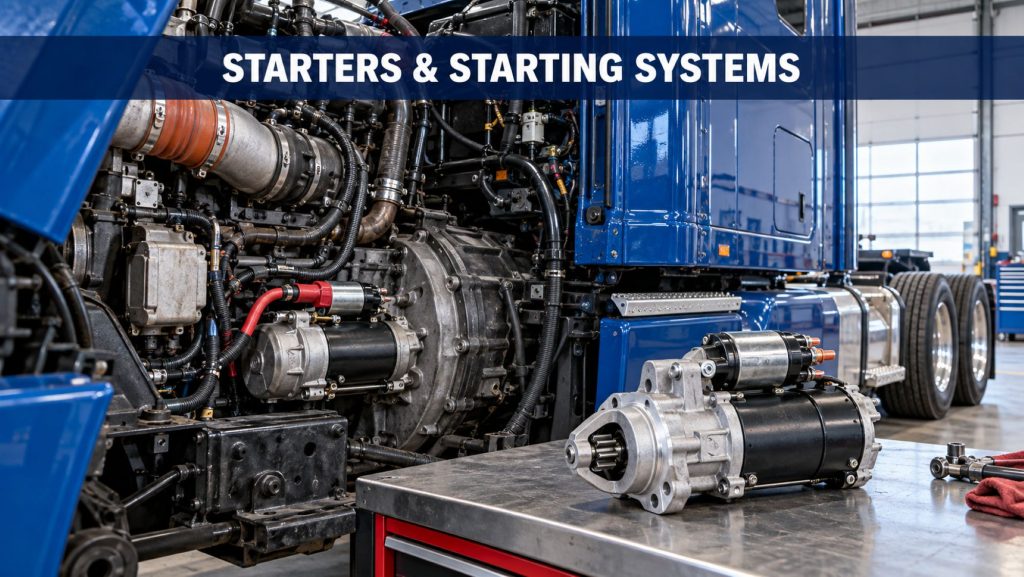
Commercial truck starters and starting systems convert electrical energy stored in the battery bank into the mechanical rotation needed to crank and start the engine.
Heavy-duty starting systems must produce sufficient cranking torque under changing temperatures, battery conditions, engine loads, oil viscosities, and operating environments. Their performance depends on the starter, batteries, cables, grounds, switches, relays, solenoids, engine controls, and mechanical connections working together correctly.
Truck Equipment Atlas covers heavy-duty starter motors, gear-reduction starters, starter solenoids, magnetic switches, starting cables, control circuits, over-crank protection, electrical soft-start technology, maintenance, troubleshooting, and individual starter models from major manufacturers.
Commercial Truck Starters on Truck Equipment Atlas
Explore the commercial-truck starter and starting-system products being added to Truck Equipment Atlas:
Delco Remy
Prestolite
Additional direct-drive, gear-reduction, high-torque, severe-service, vocational, transit, and specialty commercial starter products will be added as the Truck Equipment Atlas Electrical Systems Library continues to expand.
How Commercial Truck Starting Systems Work
When the driver activates the starting circuit, a control signal is sent through the ignition switch, starter relay, electronic controls, or another application-specific control path.
The starter solenoid or magnetic switch closes the high-current electrical circuit between the battery bank and starter motor. At the same time, the starter drive moves the pinion gear into engagement with the engine flywheel or flexplate ring gear.
The starter motor turns the pinion gear, which rotates the engine crankshaft. Once combustion begins and the engine starts, the starting control is released and the pinion disengages from the ring gear.
Major Starting-System Components
A commercial-truck starting system can include:
- Starting battery bank
- Positive battery cables
- Negative cables and ground straps
- Battery disconnect switch
- Ignition or start switch
- Starter relay
- Magnetic switch
- Starter solenoid
- Starter motor
- Starter-drive pinion
- Flywheel or flexplate ring gear
- Neutral-start or clutch-interlock circuit
- Engine electronic controls
- Over-crank protection
A problem in any of these components can prevent normal cranking even when the starter motor itself remains serviceable.
Direct-Drive and Gear-Reduction Starters
Direct-drive starters connect the electric motor to the starter drive without an internal reduction-gear set. These starters have an established service history and remain in use on certain commercial engines and equipment.
Gear-reduction starters use internal gears between the electric motor and starter pinion. This arrangement allows the motor to operate at a higher speed while the reduction gears increase torque at the pinion.
Gear-reduction designs can provide high cranking torque from a smaller and lighter starter assembly. The correct design depends on the engine, mounting arrangement, electrical system, flywheel housing, pinion specifications, duty cycle, and manufacturer requirements.
Starter Voltage and Cranking Capacity
Commercial starter motors must match the vehicle’s electrical-system voltage. North American highway trucks commonly use 12-volt starting systems, while certain buses, military vehicles, heavy equipment, specialty trucks, and imported vehicles may use 24-volt systems.
Cranking performance depends on:
- Starter design and rated capacity
- Battery voltage and state of charge
- Battery cold-cranking capacity
- Battery-bank configuration
- Cable size and circuit length
- Terminal and ground resistance
- Engine displacement and compression
- Engine temperature
- Engine-oil viscosity
- Accessory-drive resistance
A starter with the correct voltage but the wrong mounting, pinion, rotation, torque capacity, or control configuration should not be installed.
Starter Solenoids and Magnetic Switches
The starter solenoid performs two important functions. It moves the starter pinion into engagement with the engine ring gear and closes the high-current contacts that supply battery power to the starter motor.
Some heavy-duty starting systems use a separate magnetic switch to control solenoid current. This can reduce the electrical load carried by the ignition switch and improve voltage delivery to the starter solenoid.
Worn contacts, damaged coils, low control voltage, loose wiring, corrosion, heat, or mechanical binding can prevent the solenoid or magnetic switch from operating correctly.
Electrical Soft Start and Pinion Engagement
Some modern heavy-duty starters use electrical soft-start technology to improve pinion engagement before full cranking torque is applied.
Controlled engagement can help reduce tooth impact between the starter pinion and engine ring gear. This may improve engagement consistency and reduce damage associated with harsh or incomplete meshing.
Starter engagement still depends on correct mounting, pinion dimensions, ring-gear condition, control voltage, battery condition, and engine position.
Over-Crank Protection
Starter motors are designed for short operating periods. Extended cranking can create excessive heat and damage the motor, solenoid, wiring, batteries, or related components.
Over-crank protection can interrupt starter operation when cranking exceeds a defined time or temperature limit. The exact protection method depends on the starter and vehicle control system.
Over-crank protection should not be treated as permission to continue repeated starting attempts. A hard-starting or no-start engine requires diagnosis of the batteries, starting circuit, fuel system, engine controls, mechanical condition, and environmental factors.
Starting Cables, Grounds, and Voltage Drop
Heavy starter current must travel from the batteries to the starter and return through the ground circuit. Resistance anywhere in this path can reduce cranking voltage and create excessive heat.
Important starting-circuit connections include:
- Battery-to-battery interconnects
- Positive battery cable
- Starter-terminal connection
- Battery negative connections
- Engine ground connections
- Frame ground straps
- Starter control wiring
- Relay and magnetic-switch connections
Voltage-drop testing performed while the starter is operating can identify resistance that may not appear during a visual inspection or unloaded continuity test.
Starter Mounting and Ring-Gear Compatibility
The starter must match the engine flywheel housing, mounting opening, flange design, bolt pattern, pinion position, tooth count, tooth pitch, rotation, and ring-gear configuration.
Mounting considerations can include:
- Mounting-flange type
- Mounting-hole arrangement
- Starter nose and pinion reach
- Pinion tooth count
- Pinion pitch
- Motor rotation
- Solenoid position
- Engine and frame clearance
- Exhaust-system clearance
- Electrical-terminal access
A rotatable mounting flange or adjustable solenoid position may support multiple applications, but the complete starter specification must still be confirmed before installation.
Cold-Weather Starting
Cold weather increases the demand placed on a commercial starting system. Battery output decreases as temperature falls, while cold engine oil and internal friction increase the torque required to crank the engine.
Cold-weather starting performance can be affected by:
- Battery state of charge
- Battery cold-cranking capacity
- Battery and cable condition
- Engine-oil viscosity
- Starter-motor condition
- Fuel-system condition
- Intake-air heater operation
- Engine-block or coolant heaters
- Electronic engine controls
Repeated extended cranking can overheat the starter and discharge the batteries. Starting procedures should follow the engine and vehicle manufacturers’ instructions.
Common Starter and Starting-System Problems
Starting-system problems can result from the starter motor or another electrical, control, battery, grounding, or engine component.
Common problems include:
- Starter does not operate
- Starter clicks but does not crank
- Slow engine cranking
- Intermittent starter operation
- Starter pinion fails to engage
- Starter remains engaged after startup
- Grinding during engagement
- Damaged pinion or ring-gear teeth
- Overheated starter motor
- Worn solenoid contacts
- Loose or corroded cable connections
- Poor engine or frame grounds
- Weak or discharged batteries
- Starter relay or control-circuit failure
- Neutral-start or clutch-interlock fault
Replacing the starter without testing the batteries, cables, grounds, control circuit, mounting, and engine condition can leave the original starting problem unresolved.
Starter and Starting-System Inspection
Commercial starting systems should be inspected and tested according to vehicle-manufacturer instructions, starter-manufacturer guidance, fleet procedures, and operating conditions.
Important inspection areas include:
- Battery condition and state of charge
- Battery-bank configuration
- Battery cable and terminal condition
- Engine and frame grounds
- Starter mounting security
- Starter housing condition
- Solenoid and terminal condition
- Control-circuit voltage
- Starter current draw
- Cranking voltage
- Positive-circuit voltage drop
- Ground-circuit voltage drop
- Cranking speed
- Pinion and ring-gear condition
- Unusual noise, heat, or odor
Testing should account for battery temperature, engine temperature, oil viscosity, engine condition, and the procedures specified for the exact starter and vehicle.
Common Applications
- Long-haul highway tractors
- Regional and day-cab tractors
- Pickup-and-delivery trucks
- Box trucks
- Dump trucks
- Concrete mixers
- Refuse trucks
- Utility and service trucks
- Tow and recovery vehicles
- Transit and school buses
- Construction and off-highway equipment
- Emergency vehicles
- Specialized commercial vehicles
Selecting a Commercial Truck Starter
Starter selection should be based on verified vehicle, engine, electrical-system, mounting, pinion, control, and operating requirements.
Important selection factors include:
- Vehicle system voltage
- Engine manufacturer and model
- Required cranking torque
- Direct-drive or gear-reduction design
- Mounting-flange configuration
- Pinion tooth count and pitch
- Pinion reach and engagement position
- Motor rotation
- Solenoid position
- Electrical-terminal locations
- Over-crank protection
- Electrical soft-start capability
- Engine and frame clearance
- Operating temperature and duty cycle
- Warranty and replacement availability
Purchase price should not be evaluated separately from starting performance, weight, durability, electrical efficiency, serviceability, installation requirements, downtime, warranty support, and expected operating life.
Related Electrical System Categories
- Commercial Truck Batteries & Energy Storage
- Alternators & Charging Systems
- Wiring, Connectors & Power Distribution
- Truck & Trailer Lighting Systems
- Inverters, Converters & Auxiliary Electrical Power
Related Electrical System Guides
- Electrical System Guides
- How Commercial Truck Electrical Systems Work
- Commercial Truck Batteries Explained
- Commercial Truck Alternators and Charging Systems Explained
- Commercial Truck Starters and Starting Systems Explained
- How to Inspect and Maintain Truck Wiring and Electrical Connections
- Commercial Truck and Trailer Lighting Systems Explained
Related Truck and Equipment Resources
- Electrical Systems
- Commercial Trucks
- Diesel Engines
- Transmissions
- Telematics & ELD Systems
- Safety Systems
- Equipment Systems
Starter and Starting-System Library Expansion
Truck Equipment Atlas will continue expanding its commercial starter and starting-system coverage as additional manufacturers, starter designs, engine applications, voltages, and control technologies are added.
Future coverage may include:
- Additional heavy-duty gear-reduction starters
- Direct-drive commercial starters
- Medium-duty truck starters
- Twenty-four-volt starter motors
- Severe-service and off-highway starters
- Transit and school-bus starters
- Starter solenoids and magnetic switches
- Over-crank protection systems
- Electrical soft-start technology
- Starting cables and ground systems
- Starter-control relays and interlocks
- Commercial starting-system comparisons
The goal is to build an organized commercial starting-system reference that helps drivers, owner-operators, fleets, technicians, students, and equipment buyers understand how heavy-duty starters operate and where individual products fit within the trucking industry.
Explore the Complete Electrical Systems Library
Visit the Electrical Systems hub to explore batteries, alternators, starters, wiring, electrical connectors, power-distribution equipment, truck and trailer lighting, inverters, converters, auxiliary electrical-power systems, product profiles, and educational guides.
Follow the Growth of Truck Equipment Atlas
Truck Equipment Atlas continues to expand with new truck profiles, trailer coverage, diesel engine pages, equipment-system resources, manufacturer information, and educational guides.
Visit our Truck Equipment Atlas Site Updates page to explore recent additions, project milestones, and upcoming resources.