
Quick Facts
- Manufacturer: TRW
- Current Brand Support: ZF Aftermarket
- Product Series: EV Series
- Product Type: Engine-driven hydraulic power-steering pump
- Pump Design: Positive-displacement hydraulic pump with application-specific flow and pressure controls
- Primary Function: Supplies hydraulic pressure and flow to a commercial-vehicle steering gear
- Drive Method: Engine accessory drive, gear drive, or application-specific mechanical drive
- Primary Applications: Medium- and heavy-duty trucks, buses, motorhomes, emergency vehicles, and specialty commercial chassis
- Hydraulic Output: Determined by the complete pump model and vehicle steering requirements
- Replacement Identification: Complete pump number, rotation, shaft, mounting, port, flow, and pressure specifications required
Overview
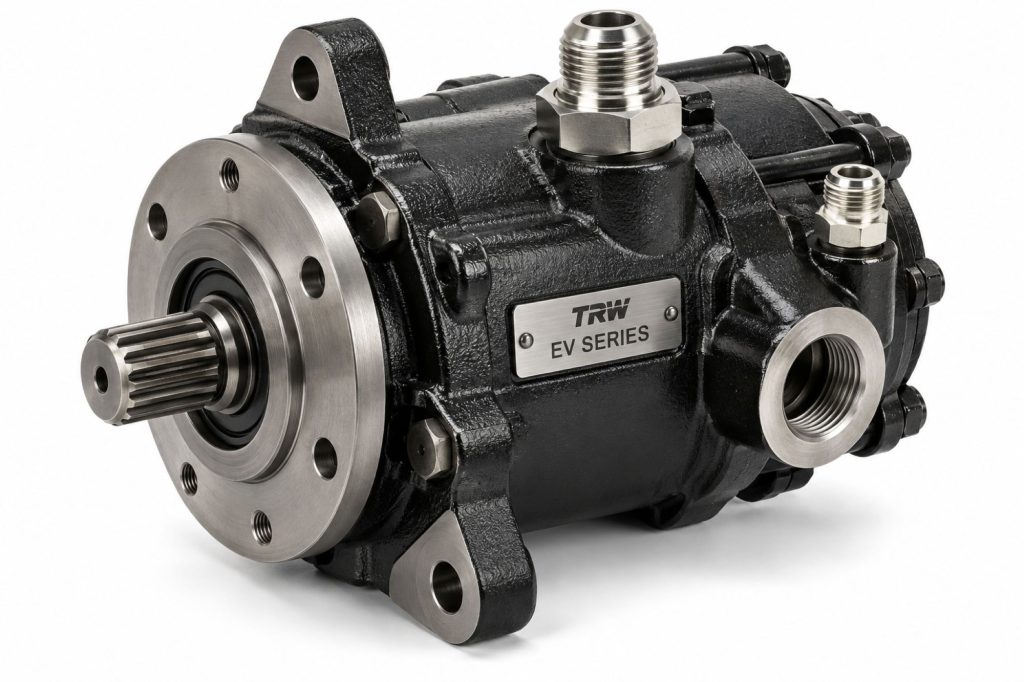
The TRW EV Series is a mechanically driven hydraulic power-steering pump family used in commercial trucks, buses, motorhomes, and specialty vehicles. It supplies pressurized hydraulic fluid to an integral power-steering gear, reducing the effort required to steer heavily loaded front axles.
The pump is driven by the vehicle’s engine through an application-specific gear, shaft, coupling, or accessory-drive arrangement. As the pump rotates, it draws fluid from the steering reservoir and delivers controlled flow to the steering gear.
EV Series pumps were produced in multiple configurations with different shafts, rotations, mounting flanges, port arrangements, pressure settings, flow ratings, and reservoir connections. Replacement pumps must be matched by their complete identification information rather than appearance alone.
The EV Series differs from the ZF Electrically Powered Hydraulic Steering Pump. The EV Series depends on a mechanical engine drive, while the electric pump operates independently of engine speed through an electric motor.
Key Characteristics
- Mechanically driven hydraulic steering pump
- Designed for commercial-vehicle steering systems
- Supplies pressure and flow to an integral hydraulic steering gear
- Positive-displacement pump operation
- Application-specific pressure and flow control
- Multiple shaft, rotation, mounting, and port configurations
- Output varies with pump speed and system demand
- Compatible with approved TRW and other hydraulic steering gears
- Used across highway, vocational, bus, and specialty applications
- New, remanufactured, and service-replacement availability depends on configuration
Major Components
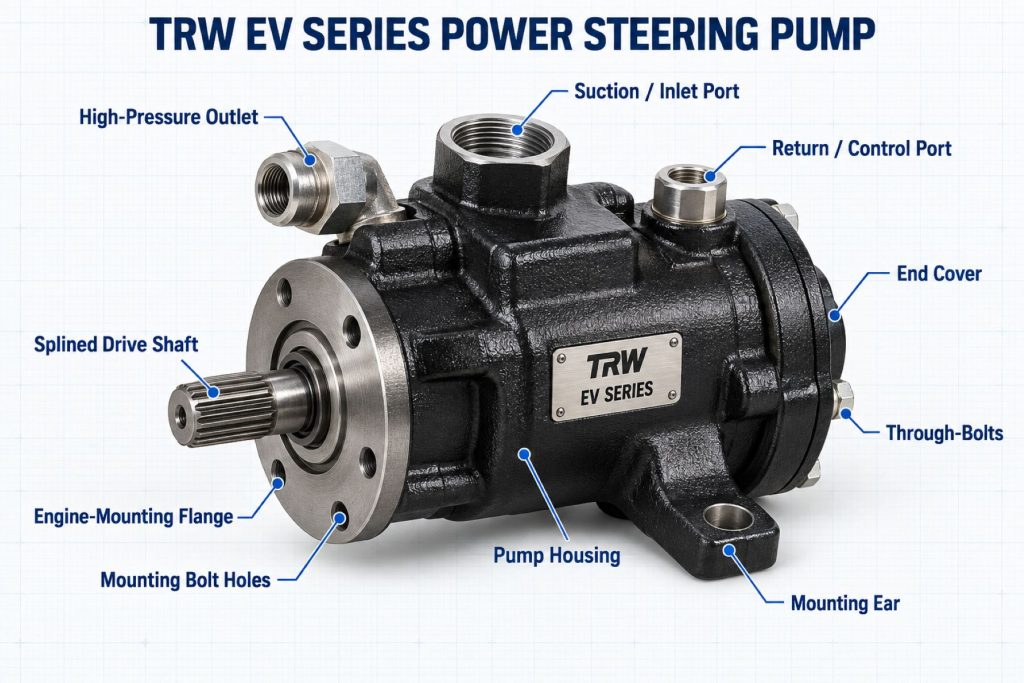
- Pump housing
- Drive shaft
- Drive gear, coupling, or splined connection
- Pumping elements
- Rotor and internal pumping chamber
- Flow-control valve
- Pressure-relief components
- Shaft bearings or bushings
- Shaft seal
- Housing seals and O-rings
- Hydraulic inlet port
- Hydraulic pressure outlet
- Mounting flange
- Reservoir, hoses, fittings, and filter used by the complete system
Product Type and Construction
The EV Series is a positive-displacement hydraulic pump designed to operate from a mechanical drive. Its housing contains the rotating pumping assembly, bearings or bushings, seals, and pressure-and-flow-management components.
The pump’s shaft, mounting flange, port orientation, rotation, and internal calibration are selected for the original vehicle application. Similar-looking pumps may produce different output or rotate in opposite directions.
How the Driveline or Steering Component Works
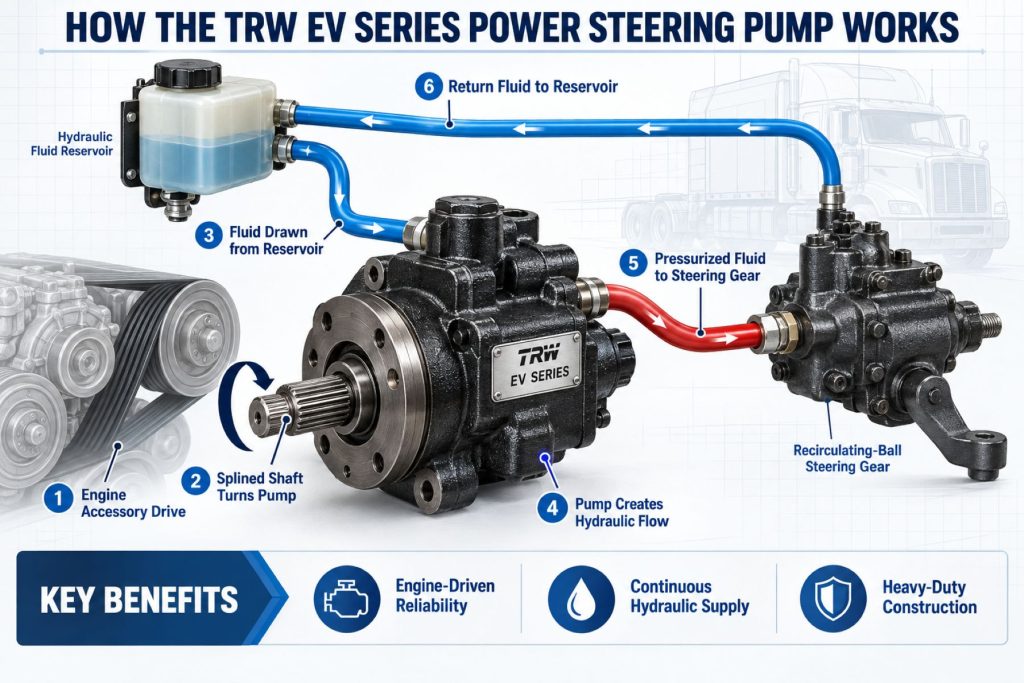
The engine rotates the EV Series pump through its accessory or gear drive. The pump draws hydraulic fluid from the reservoir through the inlet hose and moves it into the pressure circuit.
Pressurized fluid travels to the steering gear. When the driver turns the steering wheel, the steering gear directs pressure to assist movement of its internal piston, sector shaft, pitman arm, drag link, and steer wheels.
A flow-control system regulates the amount of fluid delivered as pump speed changes. Pressure-relief components limit maximum pressure when steering resistance becomes high or the system reaches its travel limit.
Position and Function Within the Vehicle
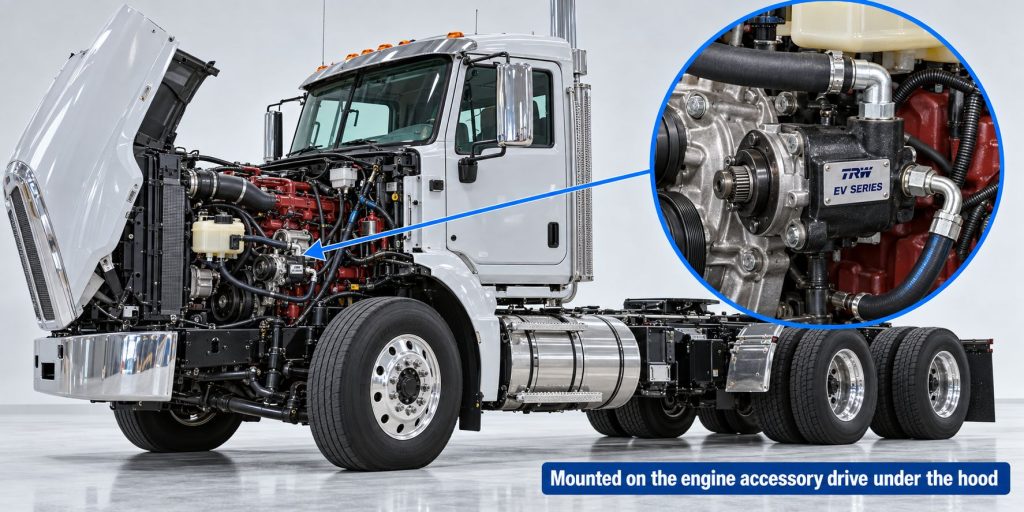
The pump is normally mounted to the engine or an application-specific accessory-drive location. Its drive shaft connects mechanically to the engine, while hydraulic hoses connect it to the reservoir and steering gear.
Its function is to convert mechanical engine power into the hydraulic pressure and flow required for power-steering assistance.
Common Specifications
- Pump Type: Mechanically driven hydraulic power-steering pump
- Product Family: TRW EV Series
- Drive Source: Engine accessory drive or application-specific mechanical drive
- Rotation: Application-specific
- Drive Shaft: Application-specific splined, keyed, geared, or coupling arrangement
- Mounting Flange: Application-specific
- Hydraulic Inlet: Reservoir supply connection
- Hydraulic Outlet: High-pressure steering-gear connection
- Pressure Rating: Determined by the complete pump specification
- Flow Rating: Determined by pump speed and application-specific control components
- Hydraulic Fluid: Vehicle-manufacturer-approved power-steering fluid
Operating Capacity and Performance
Operating capacity depends on pump displacement, drive speed, pressure setting, flow control, steering-gear requirements, front-axle loading, tire equipment, hydraulic temperature, and system condition.
The pump must provide adequate assistance at low engine speed without producing excessive flow at higher engine speed. The correct application-specific flow-control components are therefore essential.
Installation Position and System Function
The pump’s mounting position is determined by the engine and chassis application. The housing, drive shaft, gear or coupling, rotation, and hydraulic ports must match the original installation.
The pump should receive an unrestricted fluid supply from the reservoir and maintain secure pressure and return connections throughout engine and chassis movement.
Torque Transfer or Steering-Assist Function
Engine torque rotates the pump’s drive shaft. The pump converts that mechanical input into hydraulic flow and pressure rather than transmitting torque directly to the steering linkage.
The hydraulic steering gear combines the resulting pressure with the driver’s mechanical steering input to move the steer wheels.
Driveline Geometry and Operating Angles
The pump drive must remain correctly aligned with the engine accessory or gear-drive system. Incorrect gear engagement, shaft alignment, coupling fit, or mounting depth can cause noise, rapid wear, or pump failure.
The steering-column and linkage geometry remain separate but important. A correctly operating pump cannot compensate for binding shafts or incorrect steering geometry.
Steering Geometry and Movement
Caster, camber, toe, ride height, axle position, steering stops, linkage angles, kingpin condition, wheel offset, and tire size affect the hydraulic effort required from the pump.
Incorrect steering geometry may cause high pressure, excessive heat, poor return-to-center behavior, tire wear, or complaints of heavy steering.
Slip, Articulation, and Operating Travel
Hydraulic hoses must accommodate engine movement, chassis flex, vibration, and steering-system service without rubbing, kinking, stretching, or contacting hot components.
Axle stops should limit steering travel correctly. The steering system should not be held against hydraulic relief pressure longer than necessary.
Bearings, Joints, Shafts, Gears, and Structural Design
The pump contains a drive shaft, bearings or bushings, pumping elements, control-valve components, and a structural housing. These parts experience continuous rotational, hydraulic, and thermal loading while the engine operates.
Drive gears, couplings, splines, and mounting surfaces must be inspected whenever the pump is replaced. Damage outside the pump can cause a replacement unit to fail prematurely.
Materials and Component Construction
The EV Series uses a heavy-duty housing with precision-machined hydraulic surfaces, hardened drive components, bearings or bushings, pressure-control parts, and fluid-compatible seals.
Hoses, fittings, reservoir components, and mounting hardware must be rated for the pressure, temperature, vibration, and fluid used by the complete steering system.
Hydraulic and Electric Steering Assistance
The EV Series is a conventional hydraulic pump driven mechanically by the engine. It does not use an integrated electric motor to produce hydraulic flow.
Vehicles requiring hydraulic pressure independently of engine operation may use an electric hydraulic pump such as the ZF Electrically Powered Hydraulic Steering Pump when approved for the application.
Electronic Controls and Driver-Assistance Integration
A conventional EV Series pump is primarily mechanical and hydraulic. The pump does not normally provide electronic steering control by itself.
The vehicle may still use electronic stability control, steering-angle sensors, lane-support systems, or the ZF ReAX Adaptive Steering System. Those systems operate through separate controllers, sensors, and steering components.
Speed, Torque, and Load Management
Pump speed generally follows engine speed. Internal flow-control components manage output so that the steering system receives appropriate flow across the engine’s operating range.
High steering loads increase hydraulic pressure and engine torque demand. Overloaded steer axles, underinflated tires, stationary steering, soft ground, binding linkage, or full-lock operation can increase pump loading.
Vibration, Balance, and Noise Control
The pump should operate without excessive whining, knocking, or vibration. Normal hydraulic sound may change with engine speed and steering demand.
Excessive noise may result from low fluid, trapped air, cavitation, inlet restrictions, worn bearings, damaged drive components, incorrect fluid, loose mounting, or steering-system restrictions.
Lubrication, Sealing, and Contamination Protection
Approved hydraulic fluid lubricates the pump’s internal components while transmitting force and carrying heat. Shaft seals, housing seals, fittings, hoses, and reservoir components retain fluid and limit contamination.
Dirt, water, metal particles, degraded hose material, or incompatible fluid can damage the pump, control valve, seals, and steering gear. Open lines and ports should be capped during service.
Duty Cycle and Operating Conditions
EV Series pumps may operate in highway, regional, urban, construction, refuse, transit, emergency, recreational, and severe vocational service.
Frequent low-speed maneuvering, high axle loads, rough terrain, extreme temperatures, contamination, and extended full-lock operation can increase wear and fluid temperature.
Mounting and Installation
Installation requires the correct pump model, rotation, shaft, drive gear or coupling, mounting flange, port arrangement, seals, fittings, and fasteners.
The drive components should be lubricated and installed according to the engine and pump service procedures. Hydraulic hoses must be routed away from heat, abrasion, sharp bends, and moving components.
After installation, the reservoir should be filled with approved fluid and the system bled completely. Operating the pump without adequate fluid can damage it quickly.
Alignment, Driveline, and Mounting Geometry
The pump must sit squarely against its mounting surface with the correct drive engagement and shaft position. Incorrect mounting depth or gear engagement can place damaging loads on the pump and engine drive.
The reservoir and inlet hose should be positioned to provide a consistent, unrestricted fluid supply without drawing air into the pump.
Vehicle, Transmission, Axle, and Steering Compatibility
Compatibility depends on the engine, accessory drive, vehicle manufacturer, chassis, steer-axle rating, hydraulic steering gear, pump rotation, pressure, flow, shaft, mounting flange, ports, reservoir, and fluid specification.
The transmission normally does not drive the pump directly, but powertrain packaging and auxiliary equipment can affect mounting and hose routing.
Related Component and System Compatibility
The EV Series must match the steering gear, reservoir, hydraulic fluid, filter, cooler, inlet hose, pressure hose, fittings, drive components, engine accessory system, and front-axle steering requirements.
Installing a pump with incorrect flow or relief pressure can cause heavy steering, overheating, leakage, steering sensitivity, pump noise, or steering-gear damage.
Common Applications
- Heavy-duty highway tractors
- Regional-haul trucks
- Medium-duty commercial trucks
- Dump trucks
- Concrete mixers
- Refuse trucks
- Fire and emergency vehicles
- Transit and commercial buses
- Motorhomes
- Municipal and utility vehicles
- Specialty commercial chassis
Advantages
- Provides hydraulic assistance for heavy steer axles
- Established commercial-vehicle steering technology
- Uses a direct and dependable mechanical drive
- Application-specific pressure and flow control
- Compatible with multiple hydraulic steering gears
- Available in numerous mounting and port configurations
- Suitable for highway and vocational service
- Replacement and remanufactured options may be available
- Does not require a separate high-current electric motor or controller
Limitations or Considerations
- Pump operation depends on engine operation
- Output changes with pump and engine speed
- Continuously consumes some engine power while operating
- Incorrect rotation can damage the pump or prevent operation
- Hydraulic leaks and contamination can reduce assistance
- Drive gears, couplings, and seals are wear points
- Incorrect pressure or flow can damage the steering system
- Replacement must match the complete specification
- Does not normally provide engine-off steering assistance
- Older configurations may require careful parts identification
Driver and Operator Experience
A correctly operating EV Series pump should provide consistent steering assistance across the engine’s normal operating range. Steering may require more effort at very low engine speed if the pump, hydraulic system, or steering load is outside normal condition.
Drivers should report heavy steering, intermittent assistance, pump noise, steering pulsation, visible leakage, fluid odor, excessive heat, or changes associated with engine speed.
Steering Feel and Driver Feedback
Steering feel depends on pump output, hydraulic pressure, steering-gear calibration, engine speed, axle loading, tire pressure, alignment, and linkage condition.
Excessively light, heavy, noisy, or inconsistent steering may indicate incorrect pump specifications or a problem elsewhere in the hydraulic or mechanical steering system.
Operating Speed, Angle, and Load Management
The internal flow-control system manages pump output as engine speed changes. Steering demand increases during low-speed maneuvering, stationary steering, heavy axle loading, and operation on soft or uneven ground.
Operators should not hold the steering wheel against full lock. Continuous relief operation creates excessive pressure, heat, pump loading, and fluid stress.
Control Setup and System Calibration
A conventional EV Series pump normally uses mechanical and hydraulic flow-and-pressure controls rather than programmable electronic control.
Correct setup requires the specified control valve, relief setting, drive ratio, steering gear, fluid, reservoir, and hose arrangement. Adjustable components should not be altered without approved service information.
Inspection and Wear Points
- Pump housing
- Mounting flange and fasteners
- Drive shaft and splines
- Drive gear or coupling
- Shaft seal
- Hydraulic inlet and outlet ports
- Inlet and pressure hoses
- Reservoir, cap, filter, and fluid
- Fittings, clamps, and O-rings
- Cooler and cooling lines where equipped
- Evidence of leakage, cavitation, overheating, or contamination
- Hydraulic steering gear and steering linkage
- Engine accessory-drive mounting and condition
Lubrication Requirements
Use only the hydraulic fluid approved by the vehicle manufacturer. Fluid provides lubrication, pressure transfer, cooling, and sealing support throughout the pump and steering gear.
The pump must not be operated dry. Drive splines, gears, or couplings should be lubricated according to the applicable engine and pump installation instructions.
Component Service Life and Rebuildability
Service life depends on fluid cleanliness, operating temperature, drive alignment, engine speed, steering demand, filtration, hose condition, installation, and duty cycle.
Some EV Series pumps may be professionally remanufactured. Rebuilding requires approved internal components, precision measurements, seal installation, control-valve setup, and hydraulic testing.
Shaft, Joint, Bearing, Gear, and Linkage Service Life
The pump shaft, bearings, bushings, drive gear, coupling, and internal pumping surfaces wear through repeated rotation and hydraulic loading.
External steering-linkage wear can increase steering effort and hydraulic demand. The pitman arm, drag link, tie rod, kingpins, wheel bearings, and steering column should be inspected during diagnosis.
Seal, Hose, Sensor, and Electronic Service Life
Shaft seals, housing seals, hoses, and fittings deteriorate through age, heat, pressure cycling, vibration, abrasion, and incompatible fluid.
The conventional EV Series pump normally has limited electronic content. Sensors and electronic steering components elsewhere on the vehicle should be diagnosed separately from the mechanical pump.
Maintenance and Ownership Notes
Maintenance should include checking fluid level and condition, inspecting hoses and fittings, servicing filters where equipped, checking the cooler, monitoring leakage, and inspecting the pump’s drive and mounting.
Repeated pump failure often indicates an unresolved cause such as contaminated fluid, damaged steering gear, restricted hoses, incorrect pressure, improper drive installation, or failure to flush the system.
Common Driveline and Steering Problems
- Heavy steering: Low fluid, trapped air, worn pumping elements, low engine speed, an inlet restriction, incorrect flow control, steering-gear problems, or excessive steering load may be responsible.
- Pump noise: Cavitation, low fluid, aeration, contaminated fluid, restricted inlet flow, worn bearings, incorrect rotation, or damaged drive components may create noise.
- Hydraulic leakage: Worn shaft seals, housing seals, hoses, fittings, reservoirs, or steering-gear seals may cause fluid loss.
- Low-pressure output: Pump wear, incorrect relief settings, internal leakage, restricted supply, damaged control components, or incorrect drive speed may reduce output.
- Excessive pressure: A stuck control valve, incorrect pump specification, blocked hose, or incorrect relief components may overload the steering system.
- Overheating: Continuous full-lock operation, excessive flow, restrictions, low fluid, poor cooling, severe duty, or internal leakage may raise temperature.
- Steering pulsation: Trapped air, pump wear, drive problems, damaged hoses, or irregular hydraulic flow may create pulsation.
- Drive failure: Incorrect gear engagement, worn splines, improper mounting, seizure, or contaminated fluid may damage the pump drive.
Safety and Service Precautions
The EV Series pump is part of a safety-critical steering system. Service should follow current TRW, ZF, engine-manufacturer, vehicle-manufacturer, and fleet procedures.
- Secure the vehicle before steering-system service.
- Allow hot hydraulic components to cool.
- Relieve hydraulic pressure before opening the system.
- Keep open hoses and ports protected from contamination.
- Verify pump rotation before installation.
- Use the correct drive gear, coupling, and mounting hardware.
- Do not operate the pump without fluid.
- Do not exceed approved pressure or flow settings.
- Flush contaminated systems using the approved procedure.
- Bleed the hydraulic system completely after service.
- Verify steering assistance and complete a controlled road test.
Identification Information
Identification information may be stamped into the housing or shown on an attached tag. Record all numbers before ordering a replacement or remanufactured pump.
- Vehicle manufacturer
- Vehicle identification number
- Vehicle model and model year
- Engine manufacturer and model
- Complete TRW pump number
- Serial or date information
- Pump rotation
- Drive-shaft type and dimensions
- Drive gear or coupling information
- Mounting-flange configuration
- Hydraulic-port sizes and locations
- Pressure and flow specifications
- Steering-gear model and specification
Buying Considerations
- Confirm the complete TRW pump number.
- Use the vehicle identification number and original build information.
- Verify clockwise or counterclockwise rotation.
- Match the drive shaft, gear, or coupling.
- Confirm the mounting flange and installation depth.
- Match hydraulic-port sizes and locations.
- Verify pressure and flow ratings.
- Confirm steering-gear compatibility.
- Use the approved hydraulic fluid.
- Inspect the reservoir, hoses, filter, and cooler.
- Flush contamination before installing the replacement pump.
- Review warranty and core-return requirements.
Variants and Configurations
- Different pump displacements
- Different pressure settings
- Different flow-control specifications
- Clockwise and counterclockwise rotation
- Different drive-shaft configurations
- Different drive gears and couplings
- Different mounting flanges
- Different inlet and outlet-port arrangements
- Highway and vocational calibrations
- New, service-replacement, and remanufactured assemblies
Comparison to Similar Equipment
Compared with the ZF Electrically Powered Hydraulic Steering Pump, the EV Series uses a mechanical engine drive and normally requires the engine to operate before it can produce steering pressure.
Compared with the planned Eaton Commercial-Vehicle Power Steering Pump, the EV Series uses TRW-specific housing, drive, control, mounting, and application specifications.
Compared with the ZF ReAX Adaptive Steering System, the EV Series only supplies hydraulic pressure. ReAX adds electronically controlled steering torque and adaptive steering behavior.
Compared with full electric power steering, the EV Series retains hydraulic fluid, hoses, a reservoir, pressure controls, and a conventional hydraulic steering gear.
Best Fit For
- Vehicles originally equipped with a matching TRW EV Series pump
- Medium- and heavy-duty trucks
- Highway tractors
- Vocational vehicles
- Commercial buses
- Motorhomes and specialty chassis
- Vehicles using integral hydraulic steering gears
- Applications with a compatible mechanical pump drive
- Fleets maintaining conventional hydraulic steering systems
Related Vehicle and Trailer Types
- Highway Tractors
- Class 6, Class 7, and Class 8 Trucks
- Vocational Trucks
- Dump Trucks
- Concrete Mixer Trucks
- Refuse Trucks
- Fire and Emergency Vehicles
- Commercial Buses
Related Truck and Trailer Models
- Freightliner Cascadia
- Freightliner M2 106
- Kenworth T680
- Kenworth T880
- Peterbilt 579
- Peterbilt 567
- International LT Series
- International HX Series
- Mack Anthem
- Mack Granite
- Volvo VNL
- Western Star 49X
Related Driveline and Steering System Types
- Power Steering Pumps & Hydraulic Assist
- Steering Gears & Steering Linkage
- Steering Columns & Driver Controls
- Advanced Steering & Lane-Keeping Systems
- Commercial Truck Driveshafts
- Universal Joints, Slip Yokes & Center Bearings
Related Driveline and Steering Products
- ZF Electrically Powered Hydraulic Steering Pump
- ZF ReAX Adaptive Steering System
- ZF TRW THP Series Steering Gear
- ZF TRW TAS Series Steering Gear
- R.H. Sheppard M-Series Steering Gear
- Eaton Commercial-Vehicle Power Steering Pump
- LuK Commercial-Vehicle Power Steering Pump
Related Equipment Systems
- Drivelines & Steering Systems
- Engines
- Suspension Systems
- Axles & Differentials
- Tires & Wheels
- Brake Systems
- Electrical Systems
- Equipment Systems
Related Guides
- Driveline & Steering System Guides
- How Commercial Truck Steering Systems Work
- Hydraulic vs Electric-Assisted Commercial Truck Steering
- Common Commercial Truck Driveline Vibrations and Steering Problems
- Commercial Truck Steering Components Explained
- How to Inspect Commercial Truck Steering Systems
- Common Commercial Truck Power-Steering Problems
Regulatory and Compliance Notes
The pump is part of a safety-critical commercial-vehicle steering system. Leakage, insecure mounting, damaged hoses, excessive free play, inadequate assistance, or contaminated fluid may make the vehicle unsafe to operate.
Replacement must preserve the approved pressure, flow, steering response, hydraulic connections, drive configuration, axle ratings, and completed-vehicle certification.
Commercial-vehicle inspection and out-of-service requirements may apply to steering-system defects. Local regulations and fleet standards may impose additional requirements.
Real World Operating Notes
A noisy pump is not always internally damaged. Low fluid, aeration, restricted inlet hoses, contaminated filters, incorrect fluid, or loose mounting can create similar symptoms.
When replacing a failed pump, the steering system should be inspected for contamination. Installing a clean pump into a contaminated circuit can cause rapid failure of the replacement unit.
Heavy steering may be caused by the steering gear, linkage, kingpins, tires, alignment, or front-axle loading rather than inadequate pump output.
Because pump output is tied to engine speed, complaints that occur mainly at idle should be compared with operation at approved higher engine speed while following safe diagnostic procedures.
Frequently Asked Questions
What is the TRW EV Series Power Steering Pump?
It is a mechanically driven hydraulic pump that supplies power-steering pressure and flow for commercial-vehicle steering systems.
Is the EV Series an electric steering pump?
No. Despite the EV Series name, it is a conventional mechanically driven hydraulic power-steering pump rather than an electrically powered pump.
Does pump rotation matter?
Yes. The replacement must match the required rotation. An incorrect-rotation pump may not produce pressure and can be damaged.
What causes an EV Series pump to whine?
Possible causes include low fluid, trapped air, cavitation, a restricted inlet, incorrect fluid, worn bearings, contaminated fluid, or damaged drive components.
What causes heavy steering at idle?
Possible causes include pump wear, incorrect flow control, low fluid, trapped air, a restricted inlet, low idle speed, hydraulic leakage, steering-gear problems, or excessive front-axle loading.
Can an EV Series pump be rebuilt?
Some configurations can be professionally remanufactured using approved parts, precision measurements, correct control components, and hydraulic testing.
Should the steering system be flushed after pump failure?
Yes, when contamination is present or the applicable service procedure requires it. Contaminated fluid can quickly damage a replacement pump and steering gear.
Can an EV Series pump replace another TRW pump?
Only when the complete application, rotation, drive, mounting, ports, pressure, flow, fluid, and steering-gear requirements match an approved replacement specification.
Does the pump provide steering assistance with the engine off?
Normally no. Because the pump is mechanically driven by the engine, it generally stops producing hydraulic flow when the engine stops.
How is the correct replacement pump identified?
Use the complete TRW pump number, vehicle identification number, engine model, rotation, drive shaft, gear or coupling, mounting flange, ports, pressure, and flow specifications.
Availability and Where to Find
TRW EV Series pumps, remanufactured assemblies, seal kits, drive components, fittings, hoses, and related steering parts may be available through commercial-truck dealers, ZF and TRW distributors, heavy-duty parts suppliers, steering specialists, and professional remanufacturers.
Availability depends on the exact pump number, rotation, shaft, mounting flange, ports, pressure, flow, engine, vehicle application, and production status.
Current parts and service information is available through the ZF Aftermarket website.
Support Trucking Families
Truck Equipment Atlas supports the mission of Grey Cross, a nonprofit dedicated to helping families of truck drivers who lose their lives while on the road. As the site grows, part of its mission is to bring awareness and support to these families.
Podcast or Video Section
Learn More Through Audio and Video
Truck Equipment Atlas will continue expanding with podcast episodes, interviews, and equipment breakdowns to help drivers and fleets better understand trucks and equipment.
Follow the Growth of Truck Equipment Atlas
Truck Equipment Atlas continues to expand with new truck profiles, trailer coverage, diesel engine pages, equipment system resources, manufacturer information, and educational guides.
Visit our Site Updates page to explore recent additions, project milestones, and upcoming resources as we continue building one of the industry’s growing commercial trucking equipment reference libraries.
View the Latest Site Updates: Truck Equipment Atlas Site Updates