
Alcoa LvL ONE Aluminum Wheel
Quick Facts
- Manufacturer: Alcoa Wheels, a Howmet Aerospace brand
- Product Family: LvL ONE
- Product Type: Forged-aluminum commercial wheel with a bright finish
- Wheel Category: Commercial truck, trailer, bus, and severe-service aluminum wheel
- Construction: One-piece forged aluminum
- Finish: LvL ONE bright finish
- Common Diameters: Application-specific, including 19.5-, 22.5-, and 24.5-inch configurations
- Common Widths: Application-specific, including standard and wide-base configurations
- Mounting System: Hub-piloted or application-specific mounting
- Primary Applications: Highway tractors, vocational trucks, buses, trailers, and severe-service vehicles
- Production Status: Current finish technology with availability depending on wheel model and market
- Primary Benefit: Combines forged-aluminum weight savings with a finish brighter than a conventional machine-finished wheel
Overview
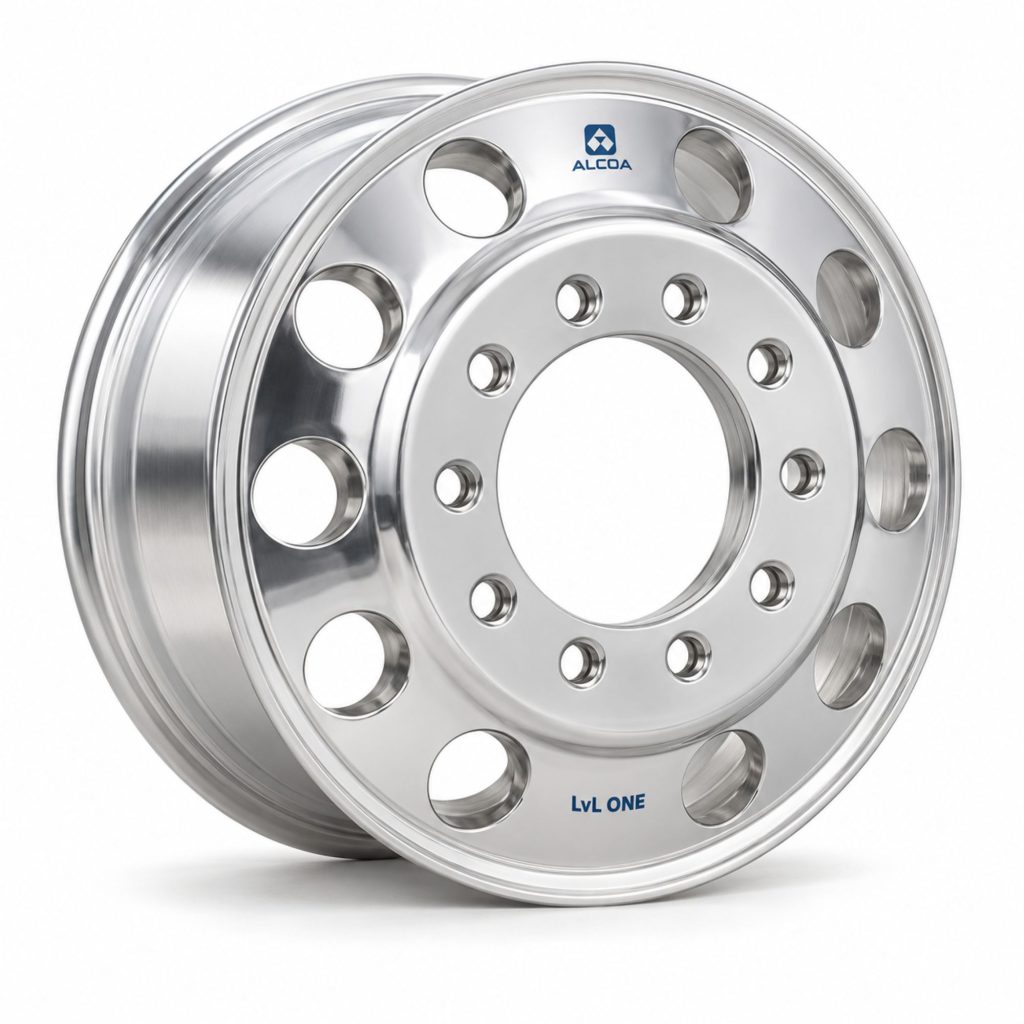
The Alcoa LvL ONE Aluminum Wheel is part of Alcoa’s forged-aluminum commercial-wheel range. LvL ONE describes the wheel’s bright appearance and finishing process rather than one universal wheel size or part number. The finish is offered on multiple wheel configurations intended for commercial trucks, trailers, buses, and vocational equipment.
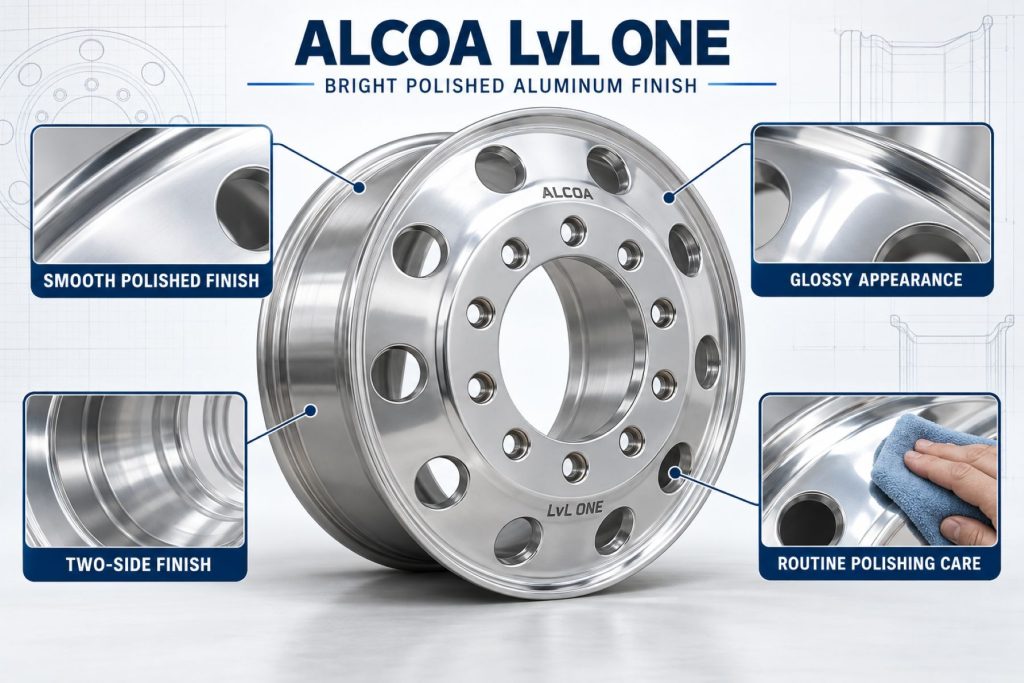
Alcoa describes LvL ONE wheels as substantially brighter than conventional machine-finished wheels. They provide fleets with an appearance upgrade while retaining the basic advantages associated with forged-aluminum construction, including reduced wheel weight, corrosion resistance, heat dissipation, and the potential to increase usable payload compared with heavier steel wheels.
Wheel diameter, width, offset, inset or outset, bolt pattern, hand-hole design, maximum load, inflation rating, and recommended tire size vary by individual part number. Buyers must identify the exact wheel rather than treating LvL ONE as a single interchangeable model.
Key Characteristics
- One-piece forged-aluminum construction
- Bright LvL ONE finish
- Brighter appearance than a conventional machine-finished wheel
- Multiple diameters, widths, offsets, and load ratings
- Standard-width and wide-base applications
- Truck, tractor, trailer, bus, and vocational configurations
- Lower weight than many comparable steel wheels
- Natural aluminum corrosion resistance
- Efficient transfer of brake and wheel-end heat
- Serviceable using established commercial-wheel procedures
- Polishable when restoration of appearance is desired
- Part-number-specific vehicle and tire compatibility
Major Components
- Forged-aluminum wheel disc
- Rim base
- Inboard and outboard rim flanges
- Bead seats
- Drop center
- Center bore
- Bolt holes
- Hand holes or ventilation openings
- Valve-stem opening
- Valve stem and sealing components
- Hub-contact surface
- Wheel-nut contact surfaces
- Identification markings and part number
- LvL ONE finished surfaces
Wheel Type and Design
Alcoa manufactures these wheels from forged aluminum. Forging shapes the material under controlled pressure and produces a grain structure that follows the wheel’s form. The resulting one-piece wheel can provide the strength required for commercial operation with less material and weight than many comparable steel designs.
LvL ONE is a finish option applied to eligible Alcoa wheel configurations. It produces a bright appearance but should not be confused with Alcoa Dura-Bright EVO, which is a surface treatment designed around reduced polishing requirements. LvL ONE wheels can be cleaned and polished as appropriate under Alcoa’s published procedures.
How the Wheel Supports the Vehicle
The wheel connects the tire to the vehicle’s hub. Vertical vehicle and cargo loads pass through the axle and hub into the wheel disc, rim, and inflated tire. Acceleration and braking torque also pass through the wheel-to-hub joint.
Proper clamping force from the wheel nuts holds the wheel against the hub. The center bore, bolt-hole pattern, disc contour, offset, and mounting-face geometry must match the vehicle’s hub and mounting system. The rim profile must also match the tire size and bead design.
An aluminum wheel also helps move heat away from the brake and hub area. Actual wheel-end temperature depends on braking demand, bearing condition, tire pressure, vehicle loading, airflow, and the complete wheel-end design.
Position and Function Within the Vehicle
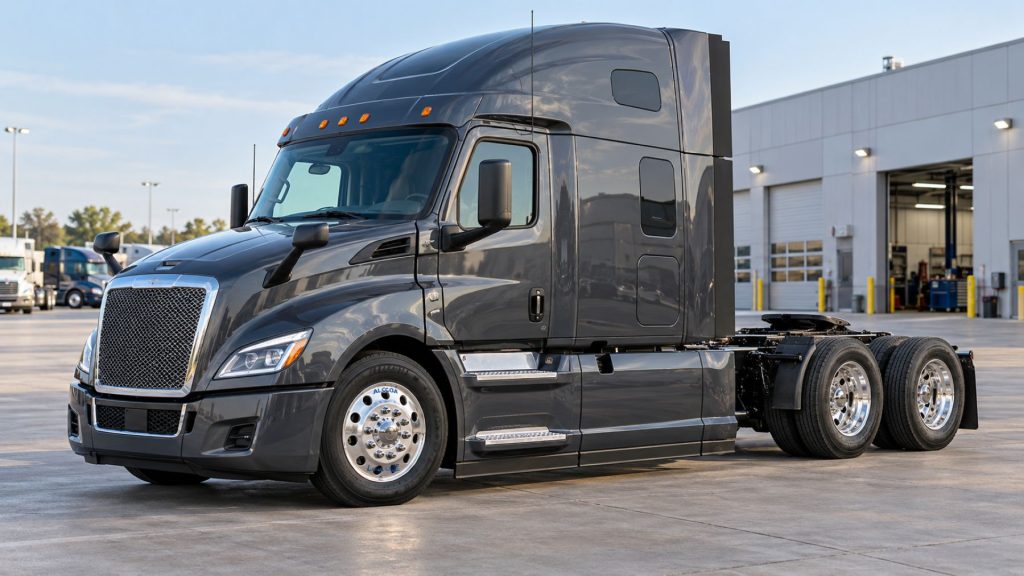
Depending on its part number, an Alcoa LvL ONE wheel may be used at a steer, drive, trailer, tag, pusher, or bus axle position. Some versions are intended for dual assemblies, while others support single or wide-base tire arrangements.
The wheel performs several important functions:
- Supports the tire and its inflation pressure
- Transfers vehicle weight to the tire contact patch
- Transfers acceleration and braking forces
- Maintains the tire bead in the correct operating position
- Provides clearance for hubs, brake drums, rotors, and calipers
- Helps dissipate wheel-end heat
- Maintains the specified track width and dual spacing
- Provides access for wheel-end inspection and service
Common Specifications
- Material: Forged aluminum
- Construction: One-piece commercial wheel
- Finish: LvL ONE bright finish
- Wheel Diameter: Varies by part number; applications may include 19.5-, 22.5-, and 24.5-inch wheels
- Wheel Width: Varies by standard-width or wide-base application
- Bolt Pattern: Application-specific
- Center Bore: Application-specific
- Offset and Disc Position: Application-specific
- Mounting: Primarily hub-piloted or otherwise specified for the selected wheel
- Load Rating: Part-number-specific
- Inflation Rating: Part-number-specific
- Tire Compatibility: Determined by rim size, approved tire dimensions, load, and inflation requirements
- Valve Equipment: Application-specific valve stem and sealing hardware
- Finish Maintenance: Routine cleaning with polishing when needed or desired
Load Ratings and Operating Capacity
Load capacity depends on the exact LvL ONE wheel part number. Alcoa’s currently featured North American LvL ONE Severe Service examples include a 22.5 × 8.25-inch configuration weighing approximately 50 pounds with an 8,050-pound wheel rating and a 24.5 × 8.25-inch configuration weighing approximately 62 pounds with an 8,300-pound wheel rating.
These examples do not establish the specifications of every LvL ONE wheel. The installed wheel must be rated for the vehicle’s axle load, tire capacity, inflation pressure, duty cycle, and mounting position. The wheel rating does not increase the vehicle’s gross axle weight rating or gross vehicle weight rating.
The safe operating capacity of the assembly is controlled by its lowest-rated component, which may be the wheel, tire, valve, hub, axle, suspension, brake system, or vehicle certification.
Wheel Size, Offset, and Dual Spacing
Wheel diameter and rim width must match an approved tire size. Offset determines the relationship between the rim centerline and mounting face and affects track width, bearing loads, suspension clearance, steering geometry, and brake clearance.
In a dual-wheel installation, the selected wheel offset must provide sufficient spacing between the inflated and loaded tires. Inadequate dual spacing can cause the sidewalls to contact each other, trap heat, damage the casings, and lead to tire failure.
Changing from steel to aluminum wheels may require different wheel studs, nuts, valve equipment, or mounting procedures because disc thickness and hardware requirements can differ. Offset should never be selected solely by visual appearance.
Hub, Fastener, and Mounting System
Most modern North American commercial vehicles use hub-piloted wheels. The hub pilots center the wheel, while two-piece flange nuts provide the clamping force that secures the assembly. Older or specialized vehicles may use different mounting systems that require different wheels and fasteners.
Mounting surfaces must be clean, flat, and free of loose corrosion, dirt, paint buildup, damaged material, and foreign objects. Wheel nuts must be tightened in the specified sequence and to the vehicle or wheel manufacturer’s required torque using calibrated equipment.
Fasteners must match the hub, wheel-disc thickness, thread size, seating design, and single- or dual-wheel arrangement. Incorrect nuts or inadequate thread engagement can cause clamp-load loss and wheel separation.
Tire and Valve Compatibility
The tire must be approved for the wheel’s diameter and width. Its load and inflation requirements must remain within the ratings of the wheel, valve, and associated components.
Valve-stem style and orientation depend on the wheel position, tire-pressure system, and service-access requirements. Dual assemblies require valve placement that permits inflation and pressure checks without damaging the stems or extensions.
Wide-base wheels require tires, hubs, offsets, and axle clearances specifically approved for wide-single operation. A standard dual wheel should not be substituted for a wide-base wheel merely because the nominal diameter matches.
Brake and Wheel-End Compatibility
The wheel must provide the correct clearance for the installed brake drum or air-disc-brake rotor and caliper. Hand-hole shape, disc contour, offset, and mounting-face position can affect this clearance.
The complete installation must also match the hub, wheel studs, wheel nuts, bearing system, axle rating, and tire-pressure equipment. Brake components should never contact the wheel during steering, suspension travel, thermal expansion, or normal wheel-end movement.
Aluminum’s thermal conductivity can help transfer heat away from the wheel end, but it does not compensate for dragging brakes, overloaded axles, underinflated tires, incorrect bearing adjustment, or improper driving technique.
Installation and Mounting
Installation should be completed by trained personnel using commercial tire and wheel service procedures. Before mounting, technicians should confirm the wheel part number, size, load rating, mounting system, offset, tire compatibility, valve equipment, and brake clearance.
Important installation practices include:
- Inspecting the wheel for cracks, distortion, corrosion, gouges, and damaged mounting surfaces
- Confirming that the tire and wheel sizes match
- Using an approved tire lubricant during mounting
- Keeping the mounting faces clean and flat
- Using the correct wheel nuts and related hardware
- Tightening fasteners in the specified sequence
- Applying the required torque with calibrated equipment
- Checking valve-stem clearance and accessibility
- Confirming dual-tire spacing when applicable
- Checking brake, hub, suspension, and body clearance
- Following fleet procedures for post-installation torque verification
Vehicle, Axle, and Wheel-End Compatibility
Compatibility depends on the complete wheel part number and the vehicle’s original equipment specifications. A correct installation must account for:
- Vehicle manufacturer, model, and model year
- Axle position and gross axle weight rating
- Hub-piloted or other mounting design
- Bolt pattern and center-bore diameter
- Wheel-stud length and thread specification
- Wheel-nut design
- Brake-drum or air-disc-brake clearance
- Wheel diameter and rim width
- Offset, inset, or outset
- Single, dual, or wide-base arrangement
- Tire size, load range, and inflation pressure
- Valve and tire-pressure system
- Suspension, steering, body, and chassis clearance
Common Applications
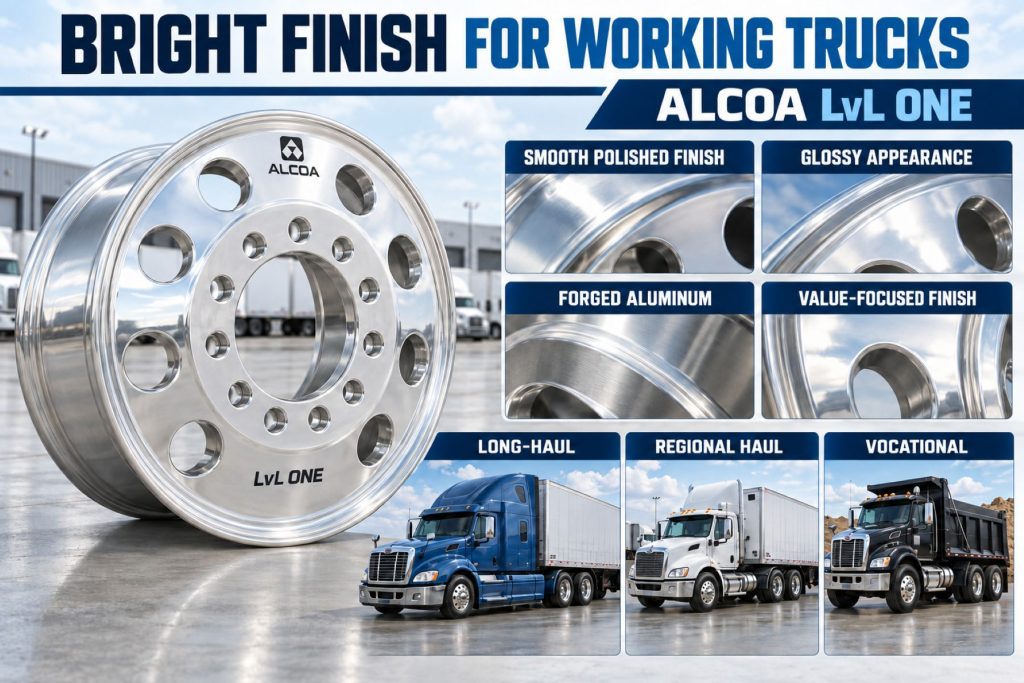
- Long-haul highway tractors
- Regional-haul tractors
- Commercial straight trucks
- Dry van trailers
- Refrigerated trailers
- Tank trailers
- Flatbed trailers
- Vocational trucks
- Dump trucks
- Refuse vehicles
- Concrete mixers
- Heavy-haul equipment
- Transit and motor coaches
- Emergency and specialty vehicles
Advantages
- Brighter appearance than a conventional machine-finished wheel
- Forged-aluminum strength with relatively low weight
- Potential payload improvement compared with heavier steel wheels
- Reduced unsprung and rotating mass
- Natural resistance to rust
- Effective heat transfer from the wheel end
- Available across multiple commercial-vehicle applications
- Can be cleaned and polished to maintain its appearance
- May simplify wheel inspection because the aluminum surface is visible
- Supports fleet appearance and vehicle presentation goals
- Multiple sizes and load ratings available
- Suitable for highway and selected severe-service applications when correctly specified
Limitations or Considerations
- LvL ONE identifies a finish family rather than one universal wheel specification
- Exact capacity and dimensions vary by part number
- The finish requires cleaning and may require polishing to retain maximum brightness
- It does not provide the same low-maintenance surface behavior as Dura-Bright EVO
- Initial cost may be higher than that of a comparable steel wheel
- Incorrect service tools can scratch or gouge the aluminum
- Harsh or incompatible chemicals may damage the appearance
- Wheel hardware may differ from steel-wheel hardware
- Improper torque can damage components or allow clamp-load loss
- Severe rim-flange wear requires measurement and evaluation
- Cracked, distorted, or improperly repaired wheels must be removed from service
- The wheel does not increase the vehicle’s certified axle or gross weight ratings
Driver and Operator Experience
Drivers may notice the LvL ONE wheel primarily through its bright appearance. Replacing heavier steel wheels with correctly specified forged-aluminum wheels can also reduce vehicle weight, although the effect on ride and fuel consumption depends on the number of wheels replaced, vehicle configuration, route, loading, and driving conditions.
Operators should watch for changes that may indicate tire or wheel-end problems, including vibration, steering shake, air-pressure loss, loose-wheel symptoms, unusual heat, damaged valve stems, visible wheel movement, or abnormal tire wear. Any suspected looseness, cracking, impact damage, or air leakage requires prompt inspection.
Inspection and Wear Points
Routine wheel inspections should cover:
- Inboard and outboard rim flanges
- Bead-seat areas
- Bolt holes
- Center bore and hub pilots
- Mounting-face surfaces
- Hand holes and ventilation openings
- Valve-stem hole and valve hardware
- Disc-to-rim transition areas
- Visible cracks, gouges, distortion, or impact marks
- Corrosion or contamination at mating surfaces
- Wheel-nut condition and signs of movement
- Rim-flange wear from tire movement
- Air leakage around the bead or valve
- Evidence of excessive wheel-end heat
Any wheel that has experienced a collision, curb strike, severe pothole impact, tire failure, loose-wheel event, or wheel-end overheating should receive a detailed inspection before returning to service.
Cleaning and Finish Care
LvL ONE wheels should be cleaned regularly to remove road film, brake dust, deicing chemicals, oil, and other contamination. Use cleaning materials and procedures approved for uncoated or polishable aluminum wheels.
Allow hot wheels to cool before washing. Rinse away loose debris, use a suitable cleaner with a soft cloth, sponge, or brush, and rinse thoroughly. Avoid aggressive abrasives, incompatible acids, and tools that can scratch, gouge, or remove wheel material.
Polishing may restore brightness when normal oxidation or staining dulls the surface. Polishing must not remove enough aluminum to alter critical dimensions or conceal cracks, rim-flange wear, impact damage, or other unsafe conditions.
Balancing, Alignment, and Runout
Correct balance helps reduce vibration, tire wear, and driver fatigue. Before adding balance weight, technicians should verify that the tire is correctly seated, the wheel and hub mounting faces are clean, the wheel is centered properly, and the tire does not have excessive radial or lateral runout.
Persistent vibration may result from tire uniformity, improper mounting, wheel damage, hub runout, brake-drum or rotor imbalance, worn bearings, suspension wear, steering problems, or driveline issues. Repeatedly adding balance weight may hide rather than correct the underlying condition.
Axle alignment and steering geometry strongly affect tire wear but do not normally originate in the wheel itself. Irregular wear should prompt inspection of tire pressure, alignment, suspension condition, bearing adjustment, and wheel runout.
Wheel Service Life and Refinishing
Wheel service life depends on load, inflation pressure, operating environment, impact exposure, tire maintenance, mounting practices, cleaning methods, and wheel-end temperature. There is no single service-life figure that applies to every LvL ONE wheel.
Routine cosmetic polishing may be appropriate for the LvL ONE finish, but structural repair or reshaping should never be improvised. Welding, heating, bending, machining, drilling, or filling damaged areas can alter the wheel’s strength and make defects more difficult to detect.
A wheel that exceeds allowable wear limits or shows cracks, distortion, severe corrosion, elongated bolt holes, damaged mounting surfaces, or other structural concerns should be removed from service and evaluated under the manufacturer’s instructions.
Maintenance and Ownership Notes
- Check tire inflation pressure on the fleet’s established schedule
- Inspect the wheel during every tire removal
- Keep the hub and wheel mounting faces clean
- Use correct wheel nuts and service tools
- Follow the specified tightening sequence and torque
- Inspect bolt holes for movement or elongation
- Monitor rim flanges for wear
- Check valves, extensions, and pressure-system hardware for leaks
- Remove road salt and corrosive contamination regularly
- Use aluminum-compatible cleaning and polishing products
- Investigate vibration and repeated pressure loss promptly
- Record wheel part numbers when managing mixed fleet inventories
- Replace damaged or unapproved hardware
- Follow Alcoa service information when evaluating wheel condition
Common Wheel Problems
- Loss of brightness: Road film, oxidation, brake dust, deicing chemicals, and neglected cleaning can dull the LvL ONE finish.
- Air leakage: A damaged valve, contaminated bead seat, tire-bead problem, cracked wheel, or improper tire installation may cause pressure loss.
- Loose fasteners: Incorrect torque, dirty mounting faces, wrong hardware, inadequate stud engagement, or damaged components can reduce clamp load.
- Elongated bolt holes: Wheel movement caused by insufficient clamping force can damage the bolt holes and mounting surfaces.
- Rim-flange wear: Tire movement against the flange can gradually remove material, particularly in demanding applications.
- Cracks or impact damage: Overloading, severe impacts, loose-wheel operation, incorrect tire service, or excessive wheel-end heat can damage the wheel.
- Vibration: Tire imbalance, runout, improper centering, hub problems, wheel damage, alignment issues, or suspension wear may be responsible.
- Dual-tire contact: Incorrect offset, tire size, inflation pressure, or loading can reduce the spacing between dual tires.
- Valve damage: Incorrect valve orientation, poor extension support, road debris, or contact with adjacent components can cause leaks.
Safety and Service Precautions
- Deflate the tire completely before disassembling a tire-and-wheel assembly
- Use trained personnel and approved commercial tire-service equipment
- Never exceed the wheel’s load or inflation rating
- Never use heat to loosen a wheel, straighten damage, or assist tire removal
- Do not weld, bend, drill, machine, or otherwise alter the wheel
- Use the correct mounting hardware for aluminum wheels
- Keep wheel and hub mating surfaces clean
- Follow the specified fastener sequence and torque
- Use an inflation restraint and remote inflation equipment when required
- Remove cracked, distorted, severely worn, or fire-damaged wheels from service
- Investigate signs of loose-wheel operation immediately
- Follow Alcoa, tire-manufacturer, vehicle-manufacturer, and applicable industry procedures
Identification Information
Identification markings are typically stamped or roll-stamped into the wheel. Record the complete markings before ordering a replacement.
- Alcoa manufacturer identification
- Complete wheel part number
- Wheel diameter and rim width
- Maximum load rating
- Maximum inflation rating
- Offset or mounting-position information
- Bolt pattern and center-bore dimensions
- Manufacturing date or production code
- Finish designation
- Applicable certification markings
- Valve-stem specification
Characters within an Alcoa part number may identify the base wheel design and finish. Because similar-looking wheels can have different capacities, offsets, or mounting dimensions, appearance alone is not a reliable identification method.
Buying Considerations
- Confirm the exact Alcoa wheel part number
- Verify diameter and rim width
- Match the bolt pattern and center bore
- Confirm hub-piloted or other mounting requirements
- Verify offset and mounting-face position
- Check wheel load and inflation ratings
- Confirm tire-size compatibility
- Verify single, dual, or wide-base use
- Check brake and wheel-end clearance
- Confirm valve-stem and pressure-system compatibility
- Determine whether LvL ONE provides the desired maintenance level
- Compare LvL ONE with polished, Dura-Bright EVO, and Dura-Black finishes
- Verify wheel-stud length and fastener requirements
- Inspect used wheels for alterations, wear, cracks, and impact damage
- Purchase through an authorized or knowledgeable commercial-wheel supplier
Variants and Configurations
- 19.5-inch commercial-wheel configurations
- 22.5-inch commercial-wheel configurations
- 24.5-inch commercial-wheel configurations
- Standard-width wheels
- Wide-base wheels
- Steer-axle applications
- Drive-axle applications
- Trailer-axle applications
- Bus and motor-coach applications
- Severe Service configurations
- Different load ratings
- Different offsets and disc positions
- Different hand-hole designs
- Different valve-stem arrangements
Availability varies by region and production schedule. The current Alcoa product guide and exact wheel data sheet should be used to confirm dimensions, weight, load rating, finish code, and intended application.
Comparison to Similar Equipment
Compared with the Alcoa Dura-Bright EVO Aluminum Wheel, the LvL ONE wheel provides a bright, polishable finish but generally requires more appearance maintenance. Dura-Bright EVO uses a proprietary surface treatment intended to simplify cleaning without routine polishing.
Compared with the Alcoa Ultra ONE Aluminum Wheel, LvL ONE identifies a finish rather than Alcoa’s proprietary MagnaForce-alloy lightweight wheel technology. A wheel may need to be identified by both its structural product technology and its finish.
Compared with the Alcoa Dura-Black Aluminum Wheel, LvL ONE has a bright aluminum appearance instead of a dark decorative finish.
Compared with an Accuride Aluminum Commercial Wheel, the LvL ONE wheel represents Alcoa’s forged-wheel and finish offering. Final selection depends on size, weight, capacity, offset, finish, warranty, service support, and fleet preference.
Compared with a Maxion Steel Commercial Truck Wheel, the Alcoa aluminum wheel is generally lighter and does not develop red rust. A steel wheel may offer a lower initial purchase price and different repair or fleet-standardization considerations.
Best Fit For
- Fleets wanting a brighter wheel than a conventional machine finish
- Operators willing to clean and polish aluminum wheels when needed
- Highway tractors seeking wheel-weight reduction
- Trailers where lower tare weight can improve payload efficiency
- Vocational vehicles requiring properly rated forged-aluminum wheels
- Buses and coaches where appearance is important
- Owner-operators who prefer a bright aluminum finish
- Fleets replacing an existing LvL ONE wheel by exact part number
- Applications requiring available Severe Service configurations
- Vehicles using standard or wide-base commercial tires
Related Vehicle and Trailer Types
- Complete Guide to Semi Truck Types
- Day Cab Semi Trucks
- Sleeper Cab Semi Trucks
- Dry Van Trailers
- Refrigerated Trailers
- Flatbed Trailers
- Tank Trailers
- Dump Trucks
- Heavy Haul Freight Guide
Related Truck and Trailer Models
- Freightliner Cascadia
- Kenworth T680
- Peterbilt 579
- Volvo VNL
- International LT Series
- Mack Anthem
- Western Star 57X
Related Tire and Wheel Types
- Commercial Truck Wheels
- Aluminum Commercial Truck Wheels
- Steel Commercial Truck Wheels
- Wide-Base Commercial Wheels
- Steer & All-Position Truck Tires
- Drive Tires
- Trailer Tires
- Vocational & Severe-Service Tires
Related Tire and Wheel Products
- Alcoa Ultra ONE Aluminum Wheel
- Alcoa Dura-Bright EVO Aluminum Wheel
- Alcoa Dura-Black Aluminum Wheel
- Alcoa Polished Aluminum Wheel
- Alcoa Dura-Flange Aluminum Wheel
- Alcoa ULT36x Ultra ONE Wheel
- Alcoa 84U64x Ultra ONE Wide-Base Wheel
- Accuride Aluminum Commercial Wheel
- Maxion Steel Commercial Truck Wheel
Related Equipment Systems
- Tires & Wheels
- Axles & Differentials
- Brake Systems
- Suspension Systems
- Tire Pressure Monitoring & Inflation Systems
- Safety Systems
- Equipment Systems
Related Guides
- Tire & Wheel Guides
- Aluminum vs Steel Commercial Truck Wheels
- How to Read Commercial Truck Tire Sizes and Ratings
- How to Inspect and Maintain Commercial Truck Tires
- Commercial Truck Tire Types Explained
- Steer vs Drive vs Trailer Tires
- How to Inspect Commercial Truck Wheels
- Commercial Truck Wheel Sizes, Offset, and Mounting Explained
Regulatory and Compliance Notes
The wheel, tire, valve, axle, hub, and fasteners must meet the load and inflation requirements of the completed vehicle. Installing a higher-rated wheel does not increase the vehicle’s certified gross axle weight rating, gross vehicle weight rating, tire capacity, or legal road-weight allowance.
Commercial tire and wheel service must follow applicable workplace-safety requirements, manufacturer instructions, fleet procedures, and industry standards. Tire inflation, wheel inspection, fastener condition, and mounting practices may also be reviewed during roadside and preventive-maintenance inspections.
Altered, improperly repaired, or incorrectly matched wheels can create serious safety risks. Replacement wheels should meet the vehicle manufacturer’s dimensional, load, inflation, clearance, and mounting requirements.
Real World Operating Notes
LvL ONE should be treated as the finish designation, not the complete replacement-wheel specification. Two LvL ONE wheels can look similar while having different widths, offsets, bolt patterns, load ratings, or brake clearances.
For appearance-focused fleets, consistent washing is more effective than allowing brake dust and road chemicals to accumulate and then relying on aggressive polishing. Cleaning products and tools should be suitable for polishable aluminum.
When converting a vehicle from steel to aluminum wheels, verify stud length, nut design, dual spacing, valve access, axle track, and brake clearance. The weight reduction should be documented using the actual old and new wheel weights rather than a general estimate.
Replacement decisions should be based on the stamped part number and current technical data. Photographs and nominal tire size alone are not enough to confirm wheel compatibility.
Frequently Asked Questions
What is an Alcoa LvL ONE Aluminum Wheel?
It is an Alcoa forged-aluminum commercial wheel produced with the company’s bright LvL ONE finish. LvL ONE is available on multiple wheel models rather than being one universal wheel specification.
Is LvL ONE a wheel model or a finish?
LvL ONE is primarily a finish technology. Diameter, width, offset, weight, load rating, and application depend on the underlying Alcoa wheel part number.
How is LvL ONE different from Dura-Bright EVO?
LvL ONE is a bright, polishable finish. Dura-Bright EVO is a proprietary surface treatment designed to retain its appearance through cleaning without routine polishing.
Are LvL ONE wheels lighter than steel wheels?
Forged-aluminum commercial wheels are generally lighter than comparable steel wheels. The precise weight savings must be calculated using the exact aluminum and steel wheel part numbers being compared.
Can an LvL ONE wheel be used on any axle?
No. Use at a steer, drive, trailer, tag, or auxiliary axle depends on the wheel’s size, load rating, offset, mounting geometry, tire compatibility, and vehicle approval.
Can LvL ONE wheels be polished?
Yes. Appropriate cleaning and polishing can restore the brightness of the LvL ONE finish. Only aluminum-compatible products and approved procedures should be used.
Does an aluminum wheel increase vehicle capacity?
No. A lighter wheel may reduce empty vehicle weight, but it does not increase the certified ratings of the axle, suspension, tires, brakes, frame, or completed vehicle.
Can steel-wheel hardware be reused?
Not automatically. Stud length, nut style, thread engagement, wheel-disc thickness, and mounting configuration must be checked before any hardware is reused.
What causes an aluminum wheel to lose air?
Possible causes include valve leakage, tire-bead damage, bead-seat contamination, tire puncture, improper mounting, corrosion, impact damage, or a cracked wheel.
How is the correct replacement wheel identified?
Use the complete stamped wheel part number together with the diameter, width, offset, bolt pattern, center bore, load rating, inflation rating, mounting position, and finish designation.
Availability and Where to Find
Alcoa LvL ONE wheels may be available through authorized Alcoa wheel distributors, commercial-truck dealers, trailer dealers, tire dealers, wheel specialists, fleet-service facilities, and heavy-duty parts suppliers.
Availability depends on wheel diameter, width, offset, load rating, mounting system, finish code, market, and production schedule. Buyers should confirm the complete part number and obtain the current data sheet before ordering.
Current product information, wheel data, care instructions, technical literature, and distributor resources are available through the Alcoa Wheels LvL ONE website.
Support Trucking Families
Truck Equipment Atlas supports the mission of Grey Cross, a nonprofit dedicated to helping families of truck drivers who lose their lives while on the road. As the site grows, part of its mission is to bring awareness and support to these families.
Podcast or Video Section
Learn More Through Audio and Video
Truck Equipment Atlas will continue expanding with podcast episodes, interviews, and equipment breakdowns to help drivers and fleets better understand trucks and equipment.
Follow the Growth of Truck Equipment Atlas
Truck Equipment Atlas continues to expand with new truck profiles, trailer coverage, diesel engine pages, equipment system resources, manufacturer information, and educational guides.
Visit our Site Updates page to explore recent additions, project milestones, and upcoming resources as we continue building one of the industry’s growing commercial trucking equipment reference libraries.
View the Latest Site Updates: Truck Equipment Atlas Site Updates