
Quick Facts
- Manufacturer: Premier Manufacturing Company
- Product Model: Premier 270
- Product Type: Air-operated slack-reducing coupling
- Coupling Type: Drawbar-eye and pintle-style coupling
- Mounting Type: Four-bolt vehicle crossmember mounting
- Maximum Gross Trailer Weight: 90,000 pounds
- Maximum Tongue Weight: 18,000 pounds
- Ultimate Latch Capacity: 12,000 pounds
- Maximum Drawbar-Eye Cross-Section: 1-13/16 inches
- Minimum Drawbar-Eye Opening: 2-3/8 inches
- Air-Service Chamber: Required
- Published Unit Weight: Approximately 26.3 pounds
- Primary Applications: Converter dollies, full trailers, vocational trucks, and commercial drawbar towing
- Production Status: Current product; specifications and configurations should be confirmed with Premier Manufacturing
Overview
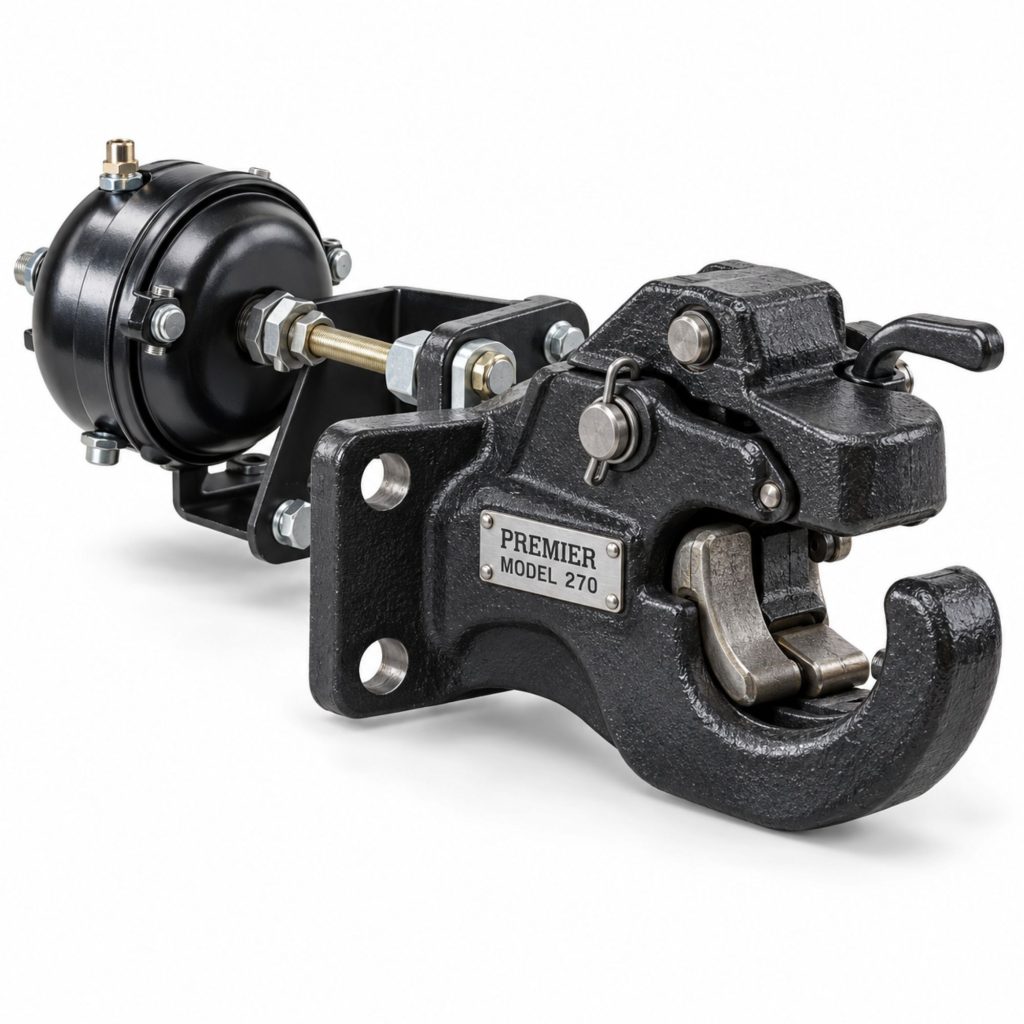
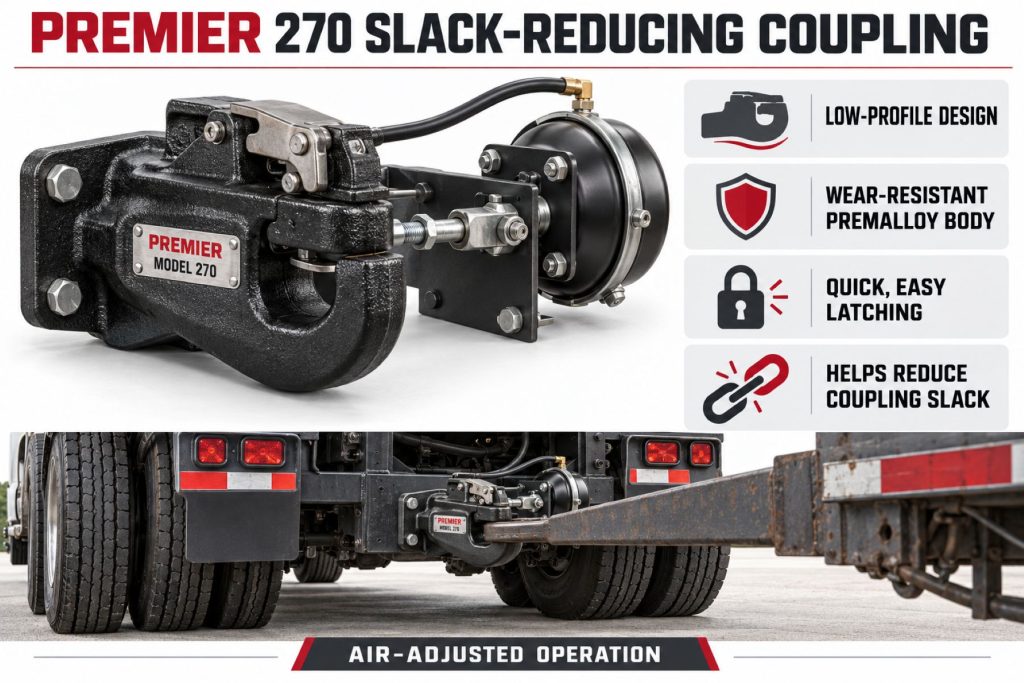
The Premier 270 is a low-profile slack-reducing coupling designed to connect a towing vehicle with a trailer or converter dolly equipped with a compatible drawbar eye. It combines a wear-resistant Premalloy body, quick-operating latch, internal slack-reducing shoe, and required pneumatic actuation.
Compressed air applied through the service chamber rotates the shoe toward the drawbar eye. The shoe reduces free movement between the coupling and eye, helping smooth acceleration and braking while reducing impact between the mating components.
The 270 uses the same popular four-bolt mounting pattern associated with the Premier 2200. Its low-profile body makes it useful where mounting space or coupling height is limited.
Key Characteristics
- Air-operated slack-reducing coupling
- Low-profile Premalloy body
- Popular four-bolt mounting pattern
- Maximum gross trailer weight rating of 90,000 pounds
- Maximum tongue weight rating of 18,000 pounds
- Ultimate latch capacity of 12,000 pounds
- Quick-operating upper latch
- Internal shock-absorbing shoe
- Required Type-24 or Type-30 air-service chamber
- Designed for a 90–120 PSI air supply
- Replaceable latch and shoe components
- Optional drawbar guides
- Wear and latch gauges available
Major Components
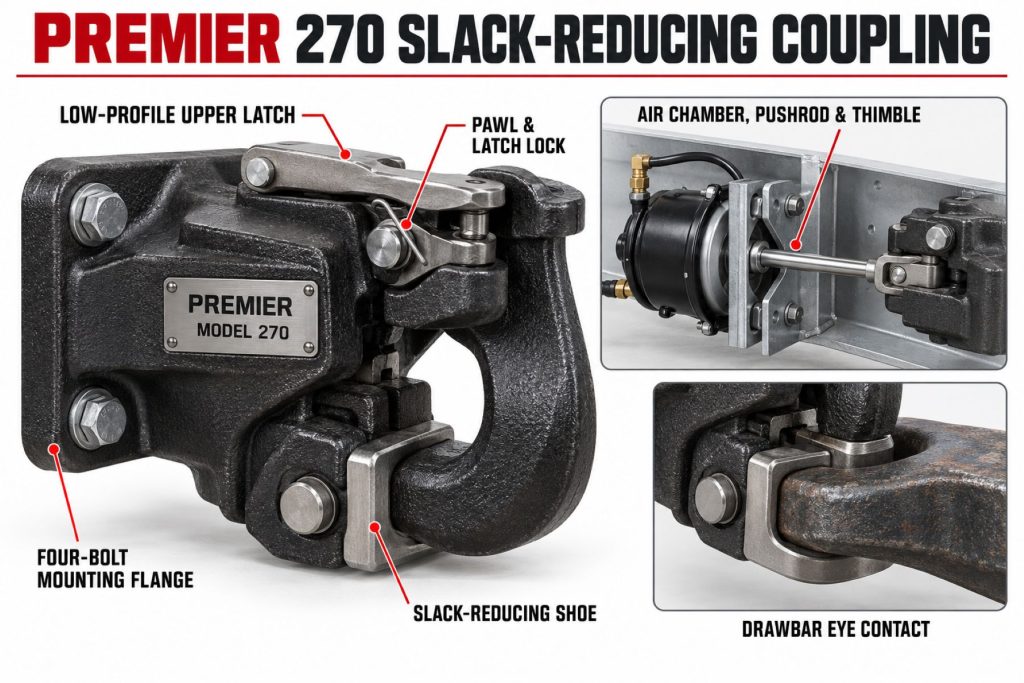
- Premalloy coupling body and hook
- Upper latch
- Latch pawl
- Pawl spring
- Slack-reducing shoe
- Shoe spring
- Latch bolt and locknut
- Pins and retaining rings
- Set screw
- Premier 271 thimble
- Premier 281 Type-24 air chamber
- Premier 267 air-chamber adapter bracket
- Premier 501 mounting-bolt kit
- Optional Premier 282 Type-30 air chamber
- Optional alternate-height chamber brackets
- Optional 378M drawbar guides
Coupling Type and Design
The Premier 270 uses an open-hook coupling body with a movable upper latch. A compatible drawbar eye enters from the front and rests around the coupling hook.
The low-profile casting reduces the vertical space required by the coupling. Its pneumatic shoe applies pressure against the drawbar eye while allowing the articulation needed for normal towing.
How the Coupling System Works
During coupling, the towing vehicle is aligned with the trailer drawbar. The latch is opened, and the drawbar eye is guided into the coupling until it rests fully around the hook.
The upper latch closes over the seated drawbar eye, and the pawl holds the latch in its secured position. When the vehicle’s emergency-side air supply is pressurized, the air chamber moves the slack-reducing shoe toward the drawbar eye.
The shoe acts as a shock-absorbing device that helps smooth movement between the vehicles. Premier specifies that the shoe is not part of the primary latching mechanism.
Position and Function Within the Vehicle
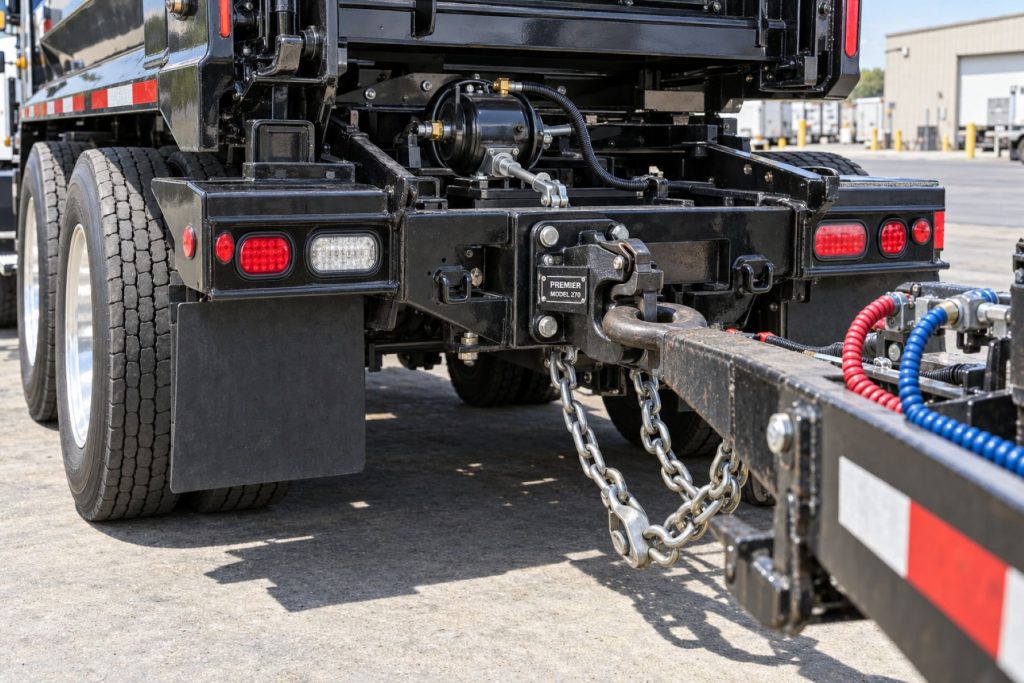
The Premier 270 is mounted to a reinforced crossmember at the rear of a truck, tractor, converter dolly, or other approved towing vehicle. The mating drawbar eye is installed on the trailer or towed equipment.
The coupling transfers pulling, braking, tongue-load, and turning forces while allowing the trailer drawbar to move through its required articulation range.
Common Specifications
- Coupling Type: Air-operated slack-reducing coupling
- Maximum Gross Trailer Weight: 90,000 pounds
- Maximum Tongue Weight: 18,000 pounds
- Ultimate Latch Capacity: 12,000 pounds
- Maximum Drawbar-Eye Cross-Section: 1-13/16 inches
- Minimum Drawbar-Eye Opening: 2-3/8 inches
- Published Unit Weight: Approximately 26.3 pounds
- Mounting Pattern: Four-bolt commercial coupling pattern
- Required Air Chamber: Approved Type-24 or Type-30 chamber
- Standard Air Chamber: Premier 281 Type-24
- Optional Air Chamber: Premier 282 Type-30
- Required Air Pressure: 90–120 PSI
- Standard Thimble: Premier 271
- Standard Installation Kit: Premier 270A
Load Ratings and Operating Capacity
Premier publishes a maximum gross trailer weight of 90,000 pounds and maximum tongue weight of 18,000 pounds for the 270. Its ultimate latch capacity is listed at 12,000 pounds.
These ratings apply only when the coupling is correctly installed, maintained, and matched with compatible equipment. The towing combination remains limited by the lowest-rated component, including the drawbar eye, mounting structure, frame, brakes, axles, suspension, tires, and wheels.
Articulation and Oscillation
The drawbar eye rotates and articulates inside the coupling as the towing vehicle and trailer turn or travel over uneven surfaces. The coupling must provide sufficient clearance for required movement while the shoe reduces unnecessary slack.
The vehicle combination must not be forced into a binding or jackknifed position. Extreme articulation can overload the coupling, drawbar eye, mounting structure, and trailer drawbar.
Sliding and Adjustment System
The Premier 270 is mounted in a fixed position and does not use a sliding adjustment system. The air-operated shoe automatically reduces movement around the drawbar eye.
Air-chamber pushrod length must be adjusted during installation according to the mounting-structure thickness. Premier specifies a standard pushrod length of 3-5/8 inches plus the thickness of the mounting structure.
Release and Locking Mechanism
The upper latch closes over the seated drawbar eye. A pawl rotates into position to hold the latch closed and prevent unintended opening during towing.
The latch, pawl, pins, springs, and retaining components must move freely and remain within Premier’s wear limits. Pneumatic shoe operation does not replace or supplement an improperly closed latch.
Air and Electronic Controls
The Premier 270 must be used with an approved air-service chamber. Premier specifies a Type-24 or Type-30 chamber supplied with 90–120 PSI.
Premier instructs installers to connect the air chamber to the vehicle’s emergency-side air supply rather than the service-side brake supply. When the emergency-side air supply is pressurized, the shoe should rotate toward the coupling hook. When pressure is removed, the shoe should retract completely.
The coupling does not require electronic controls. Vehicle installations may use protected pneumatic valves, warning labels, or equipment interlocks.
Mounting and Installation
The 270 must be mounted to a reinforced crossmember capable of supporting the published coupling loads. The standard 270A kit includes the coupling, 501 bolt kit, 281 Type-24 air chamber, 267 adapter bracket, and 271 thimble.
Premier requires new 0.75-inch Grade 8 mounting bolts and Grade C locknuts or the approved 501 bolt kit. The air-chamber pushrod must be cut to the correct length for the mounting structure.
An air chamber must never be used on a Premier coupling without the appropriate 271 Series thimble. The coupling assembly must not be welded.
Vehicle Frame and Mounting Compatibility
Compatibility depends on the vehicle crossmember, frame strength, mounting pattern, structure thickness, coupling height, air-system layout, and required trailer clearance.
The crossmember must be engineered to carry the trailer’s gross weight, tongue load, and dynamic forces. Matching the bolt pattern does not by itself confirm adequate structural capacity.
Mating Component and Trailer Compatibility
The drawbar eye must have a cross-section no greater than 1-13/16 inches and an opening no smaller than 2-3/8 inches. It must also have a rating equal to or greater than the intended towing load.
Drawbar geometry, tongue load, articulation requirements, trailer brakes, safety chains, electrical connections, and vehicle clearances must be evaluated as part of the complete coupling system.
Common Applications
- Converter dollies
- Full trailers
- Truck-and-trailer combinations
- Dump trucks and pup trailers
- Vocational trucks
- Municipal vehicles
- Utility trucks
- Construction equipment
- Aggregate-hauling combinations
- Industrial towing equipment
- Commercial drawbar trailers
- Applications requiring a low-profile coupling
Advantages
- Low-profile coupling design
- Reduces movement between the hook and drawbar eye
- Can reduce impact loading and coupling noise
- Wear-resistant Premalloy construction
- Quick-operating latch design
- Popular four-bolt mounting pattern
- Type-24 and Type-30 chamber options
- Optional brackets for different mounting structures
- Optional drawbar guides improve alignment
- Replaceable latch and shoe components
- Wear and latch gauges support measurable inspections
- Established use in commercial fleets
Limitations or Considerations
- Cannot be operated without an approved air chamber
- Requires a dependable 90–120 PSI air supply
- Must be connected to the correct emergency-side air circuit
- Pushrod length must match mounting-structure thickness
- Requires a compatible 271 Series thimble
- Coupling assembly must not be welded
- Hook surface must not be lubricated
- Internal operating components still require lubrication
- Binding or jackknifing can damage the coupling
- Mounting fasteners require regular inspection
- Maximum ratings do not increase vehicle-certified ratings
- An incompatible drawbar eye can prevent safe operation
Driver and Operator Experience
A properly maintained Premier 270 can provide a tighter, smoother connection than a conventional coupling with excessive clearance. Drivers may notice less clunking and abrupt movement during acceleration, braking, and gear changes.
The operator must verify that the drawbar eye is fully seated, the latch and pawl are correctly engaged, the air chamber moves the shoe properly, and all required safety connections are attached.
Coupling and Uncoupling Procedure
Before coupling, inspect the hook, latch, pawl, shoe, air chamber, mounting fasteners, drawbar eye, and surrounding structures. Open the coupling and align the vehicle squarely with the trailer drawbar.
Seat the drawbar eye fully around the hook, close and verify the latch, confirm pawl engagement, and pressurize the emergency-side air supply. Visually confirm that the shoe rotates toward the hook.
Before uncoupling, secure the trailer, relieve tension, remove air pressure so the shoe retracts, disconnect the appropriate lines and safety chains, and open the latch according to Premier procedures.
Inspection and Wear Points
- Premalloy hook
- Hook cross-section
- Upper latch
- Latch gap
- Latch pawl
- Pawl spring and set screw
- Slack-reducing shoe
- Shoe spring
- Pins, bolts, locknuts, and retaining rings
- Mounting bolts and locknuts
- Premier 271 thimble
- Air-service chamber and diaphragm
- Pushrod and alignment
- Air lines and fittings
- Drawbar eye
- Vehicle crossmember and reinforcement
Lubrication Requirements
Premier specifies that the coupling’s moving components be lubricated at intervals no longer than 90 days. Severe duty, frequent trailer changes, contamination, or pressure washing may require shorter intervals.
The coupling hook and saddle area must not be lubricated. Latch rotation points, pins, bushings, pawl components, and the shoe mechanism should be serviced according to Premier’s current instructions.
Maintenance and Ownership Notes
The coupling and drawbar eye should be cleaned and inspected before every use. Hook wear, latch gap, shoe movement, air-chamber operation, and mounting integrity require particular attention.
Premier offers wear gauge 14011 for checking the 270 hook and latch gauge 14026 for measuring the allowable latch gap. The coupling body must be replaced if hook wear reaches or exceeds 20 percent of its original cross-section.
Premier’s 270PK kit provides approved replacement latch components. The 279PK kit supports service of the shoe-related components.
Common Coupling Problems
- Excessive coupling slack: A worn hook, drawbar eye, shoe, spring, or latch component may allow excessive movement.
- Shoe does not apply: Insufficient air pressure, incorrect plumbing, a damaged chamber, incorrect pushrod length, or binding components may prevent movement.
- Shoe does not retract: Air remaining in the chamber, a damaged return spring, corrosion, or mechanical binding can hold the shoe forward.
- Latch will not close: An incorrectly positioned or incompatible drawbar eye, contamination, damage, or worn latch components may prevent closure.
- Latch will not release: Vehicle tension, corrosion, inadequate lubrication, a damaged pawl, or worn pins can bind the mechanism.
- Air leakage: Damaged hoses, fittings, chamber diaphragms, or control valves can reduce shoe force.
- Rapid hook wear: Misalignment, an incompatible drawbar eye, contamination, overloading, or extreme articulation can accelerate wear.
- Loose mounting hardware: Incorrect torque, reused fasteners, damaged crossmember material, or repeated impact loading may loosen the installation.
Safety and Service Precautions
Inspect the coupling and drawbar eye before every use. Do not tow with a cracked, excessively worn, improperly latched, loosely mounted, or pneumatically inoperative coupling.
Do not weld on the coupling, lubricate the hook, substitute non-Premier internal parts, or operate the 270 without an approved air chamber and 271 Series thimble.
Keep hands away from the coupling during pneumatic testing. The shoe can move forcefully when the emergency-side air supply is activated.
Identification Information
Record the following information before ordering a coupling, installation kit, accessory, or replacement component:
- Premier coupling model
- Premier eight-digit part number
- Coupling-body configuration
- Gross trailer weight requirement
- Tongue weight requirement
- Drawbar-eye dimensions
- Mounting-bolt pattern
- Crossmember thickness
- Air-chamber model
- Air-chamber bracket model
- Pushrod length
- Thimble model and length
- Mounting-kit number
- Replacement-parts kit number
- Towing vehicle information
Buying Considerations
- Confirm gross trailer and tongue weight requirements
- Measure the drawbar-eye opening and cross-section
- Verify the four-bolt mounting pattern
- Inspect the towing vehicle’s crossmember
- Confirm availability of a 90–120 PSI emergency-side air supply
- Select a Type-24 or Type-30 air chamber
- Choose the correct air-chamber bracket
- Confirm mounting-structure thickness and pushrod length
- Select the correct 271 Series thimble
- Determine whether drawbar guides are required
- Order new Grade 8 mounting hardware
- Review service-kit and gauge availability
- Use a qualified commercial coupling installer
Variants and Configurations
- Premier 270 coupling with 271 thimble
- Premier 270A complete installation kit
- Premier 281 Type-24 air chamber
- Premier 282 Type-30 air chamber
- Premier 267 standard adapter bracket
- Premier 267H alternate-height bracket
- Premier 267F extended bracket
- Premier 271 standard thimble
- Premier 271B extended thimble
- Premier 271C extended thimble
- Premier 378M drawbar guides
- Premier 270PK replacement-parts kit
- Premier 279PK shoe-component kit
Comparison to Similar Equipment
Compared with the Premier 2200 Slack-Reducing Coupling, the 270 has lower published gross trailer, tongue weight, and latch ratings. The 270 requires an air-service chamber, while the 2200 can operate with or without one.
Compared with the Premier 370 Slack-Reducing Coupling, the 270 uses the mounting pattern shared with the Premier 2200 and has a different body and latch arrangement.
Compared with the Premier 2300 Slack-Reducing Coupling, the 270 has a lower-profile body and different mounting, latch, and service components.
Compared with a conventional pintle hook, the 270’s pneumatic shoe reduces free movement around the drawbar eye but adds air-system and shoe-maintenance requirements.
Best Fit For
- Commercial drawbar trailers
- Converter dollies
- Truck-and-pup-trailer combinations
- Vocational trucks
- Municipal and utility fleets
- Construction and aggregate operations
- Applications requiring reduced coupling slack
- Installations requiring a low-profile coupling
- Vehicles with an approved emergency-side air supply
- Fleets familiar with Premier coupling maintenance
Related Vehicle and Trailer Types
- Converter Dollies
- Full Trailers
- Dump Trailers
- Equipment Trailers
- Utility Trucks
- Municipal Trucks
- Vocational Trucks
- Complete Guide to Semi-Trailer Types
Related Truck and Trailer Models
- Mack Granite
- Kenworth T880
- Peterbilt 567
- Freightliner 114SD
- International HX Series
- Western Star 47X
- Volvo VHD
- Trail King TK Series Lowboy Trailer
Related Coupling Types
- Pintle Hooks & Drawbar Couplings
- Commercial Truck Fifth Wheels
- Fifth Wheel Sliders & Mounting Systems
- Heavy-Haul & Severe-Duty Fifth Wheels
- Terminal Tractor & Yard Coupling Systems
- Trailer Kingpins & Upper Couplers
Related Coupling Products
Related Equipment Systems
- Fifth Wheels & Coupling Equipment
- Brake Systems
- Suspension Systems
- Axles & Differentials
- Tires & Wheels
- Electrical Systems
Related Guides
- Fifth Wheel System Explained
- Fixed vs Sliding Fifth Wheels
- How to Couple and Uncouple a Semi-Trailer Safely
- How to Inspect and Maintain a Fifth Wheel and Kingpin
- How to Choose a Commercial Truck Fifth Wheel
- Pintle Hooks & Drawbar Couplings
Regulatory and Compliance Notes
Premier instructs that the 270 be installed in compliance with applicable commercial-vehicle regulations, including requirements governing the towing of full trailers. State, provincial, local, and workplace rules may add further requirements.
The coupling, drawbar eye, mounting structure, safety chains, brakes, lighting, and connected components must comply with applicable requirements. The coupling rating does not override the towing vehicle’s certified ratings or legal weight limits.
Real World Operating Notes
The 270 depends on correct air pressure and pushrod geometry for effective slack reduction. A coupling can latch mechanically while its shoe remains ineffective because of an air-system or installation problem.
The shoe should move toward the hook when the emergency-side air supply is pressurized and retract fully when pressure is removed. This movement should be verified during inspections and after air-system service.
A new shoe or stronger air chamber cannot compensate for a hook or drawbar eye that has exceeded its wear limits. Both mating components must be measured when excessive movement is found.
Frequently Asked Questions
What is the Premier 270?
It is a low-profile, air-operated slack-reducing coupling for commercial drawbar trailers and converter dollies.
What is its maximum gross trailer weight?
Premier lists a maximum gross trailer weight of 90,000 pounds.
What is its maximum tongue weight?
The published maximum tongue weight is 18,000 pounds.
Does the Premier 270 require an air chamber?
Yes. The 270 must be operated with an approved Type-24 or Type-30 air-service chamber.
Which air circuit should supply the chamber?
Premier directs installers to use the vehicle’s emergency-side air supply rather than the service-side brake supply.
What air pressure is required?
Premier specifies an air supply between 90 and 120 PSI.
Does the slack-reducing shoe lock the trailer?
No. Premier identifies the shoe as a shock-absorbing device rather than part of the primary latching mechanism.
Can the hook be greased?
No. Premier instructs users not to apply lubricant to the hook or saddle area.
How is hook wear checked?
Premier offers wear gauge 14011 for evaluating the 270 hook against its service limit.
How can the correct replacement parts be identified?
Use the Premier model and part number, air-chamber model, bracket, thimble, mounting kit, and replacement-parts kit information.
Availability and Where to Find
The Premier 270, 270A installation kit, replacement parts, air chambers, brackets, thimbles, gauges, and mounting hardware may be available through Premier distributors, truck dealerships, heavy-duty parts suppliers, trailer-equipment specialists, and vocational-truck upfitters.
Availability depends on the air chamber, adapter bracket, thimble length, mounting kit, and vehicle application. Buyers should confirm the complete Premier model and eight-digit part numbers before ordering.
Current catalogs, installation instructions, service procedures, parts information, and support resources are available through the Premier Manufacturing website.
Support Trucking Families
Truck Equipment Atlas supports the mission of Grey Cross, a nonprofit dedicated to helping families of truck drivers who lose their lives while on the road. As the site grows, part of its mission is to bring awareness and support to these families.
Podcast or Video Section
Learn More Through Audio and Video
Truck Equipment Atlas will continue expanding with podcast episodes, interviews, and equipment breakdowns to help drivers and fleets better understand trucks and equipment.
Follow the Growth of Truck Equipment Atlas
Truck Equipment Atlas continues to expand with new truck profiles, trailer coverage, diesel engine pages, equipment system resources, manufacturer information, and educational guides.
Visit our Site Updates page to explore recent additions, project milestones, and upcoming resources as we continue building one of the industry’s growing commercial trucking equipment reference libraries.
View the Latest Site Updates: Truck Equipment Atlas Site Updates