
Bendix ESP Full-Stability System
Quick Facts
- Manufacturer: Bendix Commercial Vehicle Systems
- Product Name: Bendix ESP Full-Stability System
- ESP Meaning: Electronic Stability Program
- Product Type: ABS-based electronic stability-control system
- Brake-System Category: ABS and electronic braking system
- Primary Functions: Rollover mitigation, directional-stability assistance, antilock braking, and traction control
- Stability Coverage: Roll and yaw stability
- Recognized Events: Potential rollover, understeer, oversteer, wheel slip, and loss-of-control situations
- Primary Intervention Methods: Selective wheel braking, tractor service-brake application, trailer-brake application, and engine-torque reduction
- Core Controller: Bendix ESP-compatible electronic control unit, including EC-80 system configurations
- Primary Applications: Heavy-duty tractors, straight trucks, buses, motor coaches, and vocational vehicles
- Installation Type: Original-equipment, vehicle-specific integrated system
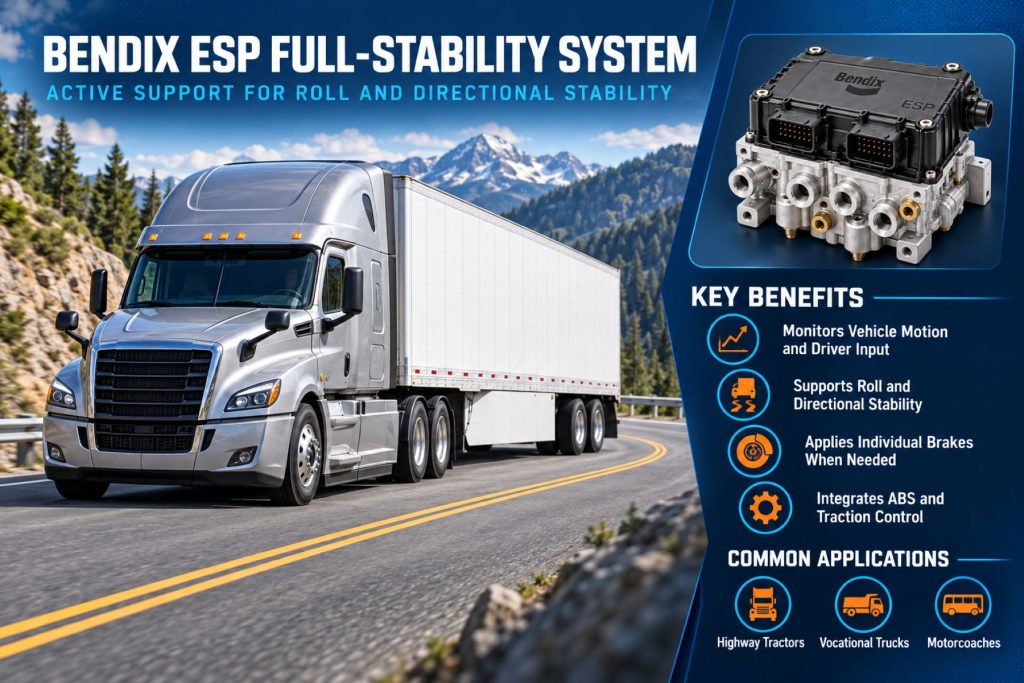
- Primary Benefit: Helps the driver maintain vehicle stability during certain rollover and loss-of-control situations
Overview
The Bendix ESP Full-Stability System is an electronic braking and vehicle-dynamics system designed to help mitigate certain rollovers and loss-of-control events involving commercial vehicles.
Unlike a roll-only stability system, Bendix ESP monitors both roll stability and directional stability. It can recognize conditions associated with excessive lateral acceleration, understeer, oversteer, wheel slip, and rapidly developing rollover risk.
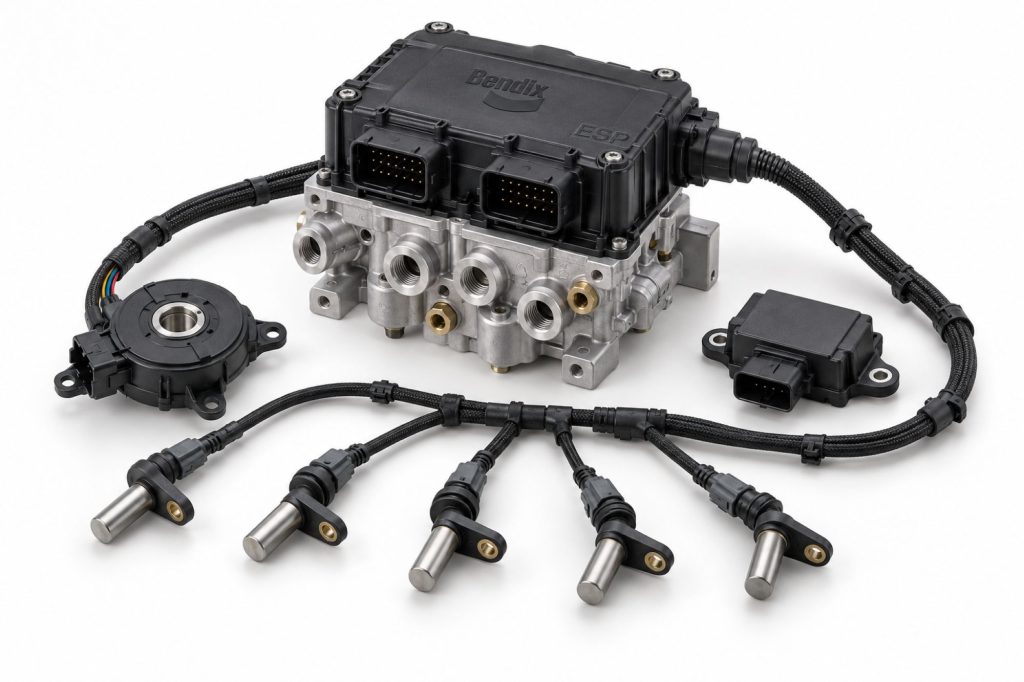
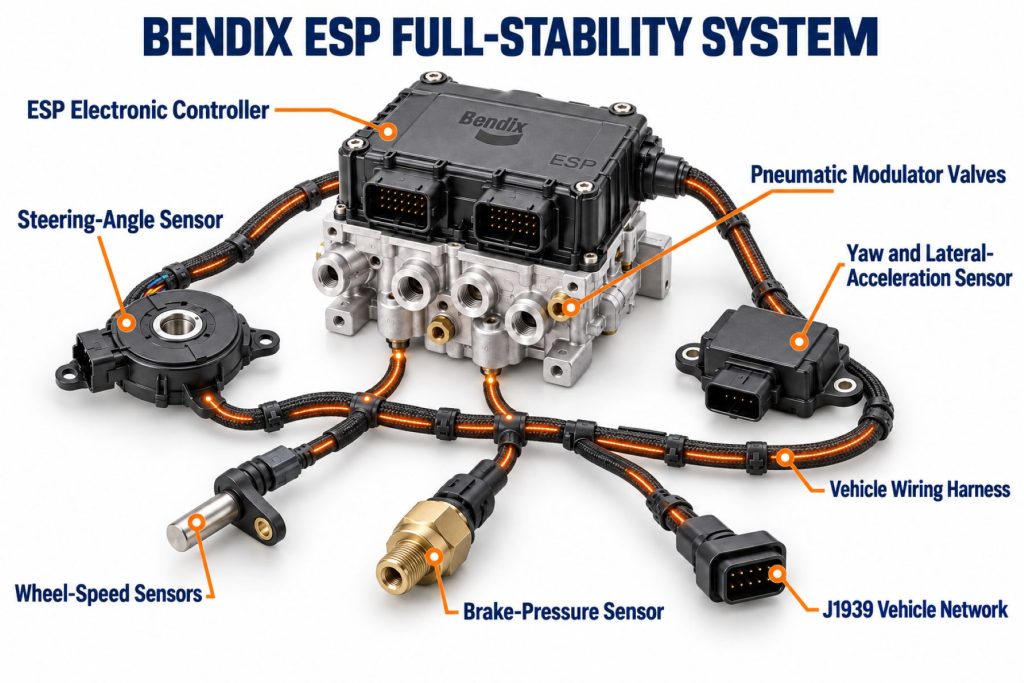
The system uses information from wheel-speed sensors, a steering-angle sensor, a yaw-rate and lateral-acceleration sensor, brake-pressure information, and other vehicle data. Its electronic controller continually compares the driver’s intended direction with the vehicle’s actual movement.
When the system identifies an unstable condition, it can reduce engine torque and apply selected foundation brakes. Depending on the event and vehicle configuration, it may apply individual wheel brakes, multiple tractor brakes, and trailer brakes to help slow the vehicle and restore stability.
Bendix describes ESP as an ABS-based full-stability system that provides both roll and yaw stability and may assist during understeer, oversteer, and low-traction events. Bendix ABS and ESP product information
Key Characteristics
- ABS-based full-stability technology
- Provides roll and yaw stability functions
- Monitors driver steering input
- Monitors the vehicle’s actual direction of travel
- Recognizes certain understeer conditions
- Recognizes certain oversteer conditions
- Identifies developing rollover risk
- Can selectively apply individual wheel brakes
- Can apply broader tractor braking when required
- Can command trailer-brake application
- Can request engine-torque reduction
- Includes antilock braking functionality
- Includes automatic traction control functionality
- Supports diagnostic trouble codes and warning indicators
- Records application-specific diagnostic and event information
- Integrates with compatible advanced driver-assistance systems
- Designed as driver assistance rather than autonomous vehicle control
Major Components
- ESP electronic control unit
- Antilock braking controller
- Wheel-speed sensors
- Wheel-speed sensor tone rings
- Steering-angle sensor
- Yaw-rate sensor
- Lateral-acceleration sensor
- Brake-pressure sensor
- Brake pedal or stop-lamp input
- ABS modulator valves
- Automatic traction-control valve
- Compatible relay valves
- Tractor service-brake chambers
- Trailer-brake control circuit
- J1939 vehicle data-network connection
- Engine electronic control module interface
- Transmission communication interface where applicable
- ABS warning lamp
- Automatic traction-control or stability indicator
- Diagnostic connector
- Electrical wiring harnesses
- Air lines and fittings
- Compatible foundation brakes
How the Brake Component or System Works
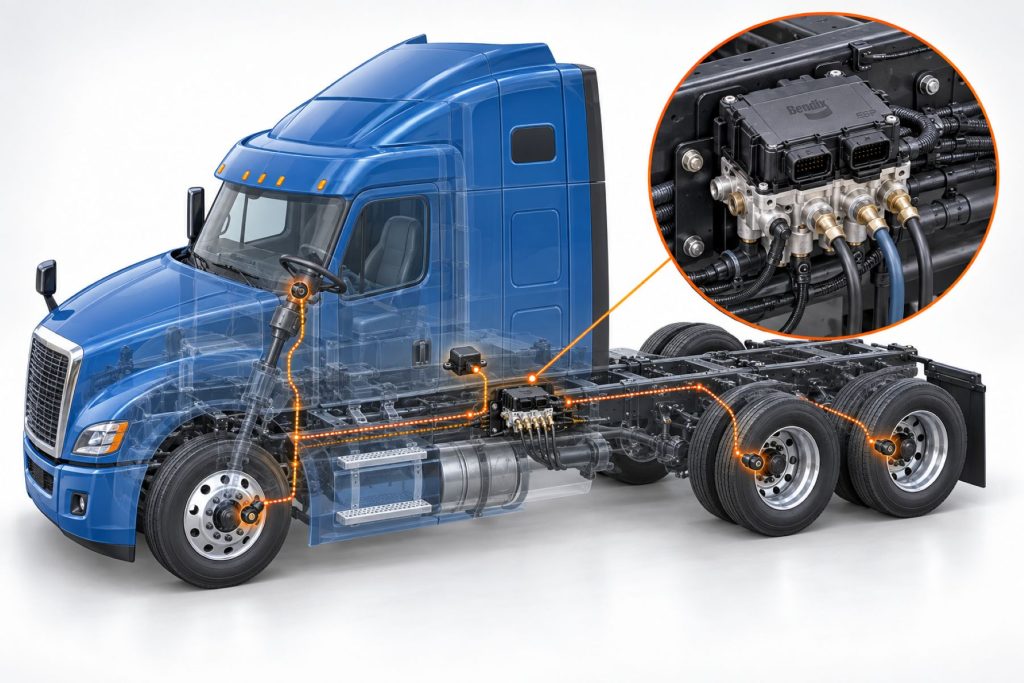
The Bendix ESP controller continuously evaluates data from several vehicle systems. Wheel-speed sensors report how quickly each monitored wheel is rotating. The steering-angle sensor reports where the driver intends to direct the vehicle. The yaw-rate sensor measures how quickly the vehicle is rotating around its vertical axis, while the lateral-acceleration sensor measures side force.
The controller uses this information to compare the vehicle’s intended path with its actual movement.
During a potential rollover event, the system may determine that the vehicle is entering a curve too quickly or generating excessive lateral acceleration. It can reduce engine torque and automatically apply the vehicle’s brakes to lower speed and reduce rollover risk.
During an understeer event, the truck turns less than the steering input indicates. The system may selectively apply brakes to help reduce speed and assist the vehicle in following the intended path.
During an oversteer event, the rear of the vehicle begins rotating farther than intended. The system may apply selected wheel brakes to create a stabilizing force and help reduce excessive yaw movement.
These interventions can occur before the driver fully recognizes how quickly the unstable condition is developing.
Position and Function Within the Brake System
Bendix ESP operates as an advanced control layer within the vehicle’s air-brake and ABS architecture. It does not replace the service brakes, parking brakes, foundation brakes, or the driver’s normal brake controls.
The system coordinates information and commands among:
- The ABS electronic controller
- Vehicle-dynamics sensors
- Engine-management system
- Pneumatic brake-control components
- Tractor foundation brakes
- Trailer service-brake circuit
- Vehicle communication network
During ordinary braking, the driver controls brake application through the foot valve. ABS intervenes if monitored wheels approach lockup.
When ESP identifies a stability event, the controller can command braking independently of direct brake-pedal pressure. It may apply only selected wheel brakes or use a broader braking response, depending on the instability it detects.
Common Specifications
- System Type: Electronic full-stability control
- Base Technology: Commercial-vehicle antilock braking system
- Stability Functions: Roll and yaw stability
- Traction Function: Automatic traction control
- Primary Sensor Inputs: Wheel speed, steering angle, yaw rate, lateral acceleration, and brake pressure
- Primary Brake Outputs: Individual and multiple-wheel brake applications
- Engine Integration: Electronic torque-reduction request
- Trailer Integration: Trailer service-brake application on compatible tractor-trailer systems
- Vehicle-Network Integration: Application-specific SAE J1939 communication
- Controller Family: Bendix ESP-compatible ECU, including EC-80 configurations
- Foundation-Brake Compatibility: Vehicle-specific air-disc or drum-brake systems
- Warning Indicators: ABS and stability or traction-control lamps, depending on vehicle design
- Diagnostics: Bendix-compatible diagnostic software and vehicle diagnostic interface
- Installation: Original-equipment and vehicle-specific
Exact controller, valve, sensor, wiring, software, and calibration specifications depend on the vehicle manufacturer and chassis configuration.
Operating Specifications and Performance
Bendix ESP operates automatically whenever the vehicle is running, the system is functioning normally, and the required operating conditions are present. It continuously monitors sensor and vehicle-network information without requiring the driver to activate the stability function.
The system’s ability to intervene depends on:
- Vehicle speed
- Steering input
- Wheel-speed information
- Measured yaw rate
- Lateral acceleration
- Brake-system condition
- Tire traction
- Vehicle loading
- Road surface
- Trailer behavior
- Sensor accuracy
- Available air pressure
- Foundation-brake performance
The controller uses vehicle-specific programming developed for the chassis. Wheelbase, axle arrangement, steering characteristics, brake configuration, center-of-gravity assumptions, and other vehicle parameters may be included in the calibration.
The system cannot overcome the physical limits of tire traction or vehicle stability. Excessive speed, abrupt steering, high center of gravity, improperly secured cargo, severe road conditions, and mechanical failures may still result in a collision or rollover.
Braking Performance and System Integration
Full-stability intervention requires coordinated electronic and pneumatic operation. The controller must receive accurate sensor information, communicate with the engine controller, and operate compatible ABS modulator valves and brake-control components.
During a stability intervention, the system may:
- Reduce engine torque
- Apply a brake at one wheel position
- Apply brakes at multiple wheel positions
- Apply tractor service brakes
- Apply trailer service brakes
- Combine torque reduction with automatic braking
Selective braking can create a corrective yaw moment. Broader braking can reduce vehicle speed and lateral force during a potential rollover event.
Foundation-brake condition directly affects the system’s performance. Worn linings, damaged rotors or drums, incorrect adjustment, air leaks, contaminated friction material, and mismatched brake components can reduce the available braking force.
Air Supply, Controls, and Electronic Integration
The ESP system depends on both the vehicle’s compressed-air system and its electronic network. The electronic controller determines when intervention is appropriate, while pneumatic valves deliver pressure to the selected brake chambers.
Integrated systems may include:
- Bendix air compressor and air-treatment equipment
- Brake reservoirs
- Foot brake valve
- Relay valves
- ABS modulator valves
- Automatic traction-control valve
- Brake-pressure sensor
- Tractor-protection system
- Trailer service-control circuit
- Electronic engine controller
- Electronic transmission controller
- SAE J1939 data network
- Instrument-panel warning lamps
- Diagnostic connector
Certain advanced driver-assistance systems use Bendix ESP as their braking and vehicle-dynamics foundation. Bendix Wingman Fusion, for example, integrates radar, camera information, and ESP capabilities for application-specific driver-assistance functions.
ESP remains a separate stability function. It should not be confused with forward-collision warning, lane-departure warning, or autonomous emergency braking, even when those technologies share vehicle sensors and braking components.
Installation, Adjustment, and Brake Balance
Bendix ESP is a vehicle-integrated system that must be correctly configured for the chassis. It is not a universal add-on that can be installed safely by adding a controller and several sensors.
Correct operation depends on:
- Approved controller calibration
- Correct wheel-speed sensor installation
- Accurate steering-angle information
- Proper yaw and lateral-acceleration sensor mounting
- Correct axle and wheelbase data
- Proper modulator-valve plumbing
- Compatible foundation brakes
- Balanced brake output
- Correct tire sizes
- Reliable vehicle-network communication
- Required sensor-calibration procedures
Steering-angle sensor calibration may be necessary following steering repairs, alignments, sensor replacement, or other work specified by the vehicle manufacturer.
Yaw-rate and lateral-acceleration sensors must be mounted in the approved position and orientation. Moving a sensor, installing it backward, or mounting it on an unstable surface can provide inaccurate information.
Brake balance must be maintained across the vehicle. Mismatched chambers, slack adjusters, brake linings, calipers, drums, or rotors can change how the vehicle responds during an automatic intervention.
Foundation Brake, Axle, and Wheel-End Compatibility
Bendix ESP can be integrated with approved air-disc or S-cam drum-brake systems. The exact combination is determined by the vehicle manufacturer and Bendix calibration.
Compatibility depends on:
- Vehicle manufacturer and model
- Chassis configuration
- Wheelbase
- Number of axles
- Drive configuration
- Steering system
- ABS configuration
- Foundation-brake type
- Brake chamber size
- Drum or rotor dimensions
- Tire size
- Rear-axle ratio
- Suspension configuration
- Trailer-control system
- Electronic engine interface
Changes to tire diameter, axle configuration, steering geometry, suspension height, or foundation brakes may affect system operation. Vehicle modifications should be evaluated using manufacturer-approved procedures.
Common Applications
- Class 7 and Class 8 highway tractors
- Day cab tractors
- Sleeper tractors
- Straight trucks
- Tank trucks
- Concrete mixers
- Refuse trucks
- Dump trucks
- Heavy-haul vehicles
- Fire apparatus
- Transit buses
- Motor coaches
- School buses
- Specialty commercial vehicles
- Vehicles equipped with compatible Bendix advanced driver-assistance systems
Vehicle and Brake-System Compatibility
Bendix ESP is commonly installed as original equipment on supported commercial-vehicle platforms. Availability depends on the vehicle manufacturer, model year, chassis, brake system, electronic architecture, and selected safety package.
A vehicle should not be assumed to have ESP merely because it has Bendix ABS. Possible Bendix configurations include:
- Basic ABS
- ABS with automatic traction control
- Roll-stability control
- ESP full stability
- ESP integrated with advanced driver-assistance technology
The controller label, vehicle build sheet, diagnostic information, and Bendix service documentation should be used to identify the installed system.
Replacement controllers and sensors must match the vehicle application. Installing a physically similar ECU with incorrect programming can disable functions or create improper system behavior.
Advantages
- Provides both roll and yaw stability assistance
- Can recognize certain potential rollover events
- Can assist during understeer and oversteer
- Uses selective wheel braking
- Can apply tractor and trailer brakes
- Can request engine-torque reduction
- Builds on established ABS technology
- Includes traction-control functionality
- Operates automatically
- Responds faster than many drivers can during rapidly developing events
- Supports diagnostic trouble codes
- May provide event information for maintenance and driver training
- Can serve as a foundation for advanced driver-assistance systems
- Supports many highway and vocational vehicle applications
Limitations or Considerations
- Cannot prevent every rollover or collision
- Cannot overcome the physical limits of tire traction
- Does not replace attentive driving
- Vehicle-specific calibration is required
- Not designed as a universal aftermarket add-on
- Sensor faults can disable stability functions
- Low air pressure can reduce available intervention
- Worn foundation brakes can reduce system performance
- Improper tire sizes can affect wheel-speed calculations
- Steering and alignment changes may require calibration
- Electrical and data-network faults can trigger warning lamps
- System behavior varies with road and loading conditions
- Improperly secured cargo can still destabilize the vehicle
- Trailer condition affects combination-vehicle stability
- Drivers may feel automatic braking or engine-power reduction during intervention
Driver and Operator Experience
Most of the time, Bendix ESP operates in the background without being noticed. During a stability event, the driver may feel the engine reduce power or experience automatic braking at one or more wheel positions.
A stability or traction-control indicator may flash during an intervention. The exact lamp behavior depends on the vehicle.
Drivers should understand that an intervention indicates the vehicle may be approaching an unstable condition. The correct response is generally to maintain controlled steering, reduce speed safely, and avoid abrupt control inputs.
Drivers should report:
- ABS warning lamps that remain illuminated
- Stability-control warning lamps
- Traction-control lamps that remain on
- Unexpected brake applications
- Unexplained engine derating
- Fault messages
- Intermittent speedometer or wheel-speed behavior
- Vehicle pulling during braking
- Recent steering, suspension, or tire changes
- Damaged sensor wiring
The system is designed to assist the driver, not to encourage faster cornering or operation beyond normal safety margins.
Maintenance and Ownership Notes
- Inspect ABS wheel-speed sensor wiring.
- Check sensor connectors for corrosion and damage.
- Inspect tone rings for cracks, contamination, and missing teeth.
- Verify correct wheel-speed sensor clearance.
- Inspect steering-angle sensor wiring and mounting.
- Check yaw and lateral-acceleration sensor mounting.
- Inspect brake-pressure sensor connections.
- Check ABS modulator valves and pneumatic lines.
- Test the air system for leakage.
- Maintain correct tire sizes and inflation pressures.
- Inspect foundation brakes at scheduled intervals.
- Check brake chamber stroke and brake adjustment.
- Inspect drums, rotors, linings, pads, and calipers.
- Monitor ABS and stability warning lamps.
- Retrieve and document diagnostic trouble codes.
- Follow Bendix procedures for sensor calibration.
- Verify repairs with an approved diagnostic road test when required.
- Do not replace components solely because a fault code is present.
- Use Bendix-compatible diagnostic software and service information.
Common Brake-System Problems
- ABS warning lamp remains illuminated: A wheel-speed sensor, tone ring, wiring circuit, modulator valve, controller, power supply, or communication fault may be present.
- Stability function becomes unavailable: Sensor faults, low voltage, network problems, ABS faults, incorrect calibration, or controller problems can disable ESP intervention.
- Steering-angle fault: A damaged sensor, misalignment, incorrect calibration, wiring issue, or steering-system repair may cause implausible steering information.
- Yaw-sensor fault: Loose mounting, incorrect orientation, electrical failure, water intrusion, or sensor damage can affect measured vehicle movement.
- Intermittent wheel-speed signal: Excessive sensor gap, wheel-bearing movement, a damaged tone ring, corrosion, debris, or damaged wiring may interrupt the signal.
- Unexpected traction-control intervention: Different tire sizes, wheel slip, sensor errors, driveline problems, or low-traction surfaces may trigger torque reduction or braking.
- Uneven brake response: Foundation-brake wear, air-delivery problems, mismatched components, incorrect adjustment, or contaminated friction material may create imbalance.
- Communication fault: Damaged J1939 wiring, poor terminal connections, electrical interference, controller faults, or lost engine communication can affect integrated functions.
- Low-voltage fault: Weak batteries, charging-system problems, loose grounds, damaged wiring, or corroded connections can interrupt controller operation.
- Fault returns after component replacement: The original diagnosis may have missed wiring, connector, calibration, mounting, or foundation-brake problems.
Safety and Service Precautions
Bendix ESP is a safety-critical system. Diagnostic and repair work should be performed by technicians trained in commercial ABS, air brakes, electrical systems, and vehicle communications.
Before service:
- Park the vehicle on a level surface.
- Apply the parking brakes.
- Block the wheels.
- Follow approved lockout procedures.
- Drain or isolate air pressure when opening pneumatic circuits.
- Disconnect electrical power when required by the service procedure.
- Record active and stored diagnostic trouble codes.
- Identify the exact controller and system configuration.
- Use the correct Bendix and vehicle-manufacturer documentation.
Do not probe sealed connectors with tools that spread or damage terminals. Do not apply external voltage to sensor or controller circuits unless instructed by an approved diagnostic procedure.
Automatic brake applications may occur during diagnostic tests. Personnel must remain clear of wheel ends, pushrods, brake linkage, driveshafts, and moving vehicle components.
A warning lamp should not be cleared without correcting the underlying fault. Erasing a diagnostic code does not repair the system.
Identification Information
Identification information may be found on the electronic controller, vehicle build sheet, component labels, diagnostic report, or manufacturer service records.
Record the following information:
- Vehicle manufacturer
- Vehicle identification number
- Model and model year
- Chassis configuration
- Bendix controller model
- Controller part number
- Controller serial number
- Software or calibration information
- ABS configuration
- ESP system designation
- Wheelbase
- Axle configuration
- Steering-angle sensor part number
- Yaw-rate sensor part number
- Brake-pressure sensor information
- ABS modulator-valve numbers
- Foundation-brake type
- Tire size
- Active diagnostic trouble codes
- Stored diagnostic trouble codes
Do not identify the system only by the ABS lamp or Bendix name on one component. A vehicle with Bendix ABS may not have full-stability functionality.
Buying Considerations
- Confirm that the vehicle is equipped with Bendix ESP.
- Record the complete controller part number.
- Retrieve the vehicle’s build information.
- Verify the chassis and wheelbase.
- Confirm the axle configuration.
- Identify all active diagnostic trouble codes.
- Determine whether the problem involves a component, wiring, calibration, or programming.
- Match replacement sensors by exact part number.
- Confirm controller software compatibility.
- Use approved ABS modulator valves.
- Check connector and harness condition before replacing electronics.
- Determine whether calibration is required after installation.
- Verify access to Bendix-compatible diagnostic software.
- Use a repair facility experienced with commercial stability systems.
- Avoid used controllers with unknown programming or vehicle history.
- Confirm that replacement work will preserve all original safety functions.
Variants and Configurations
- Bendix ABS with automatic traction control
- Bendix roll-stability configurations
- Bendix ESP full-stability configurations
- EC-80 ESP controller applications
- ABS-6 ESP system applications
- Four-channel ABS configurations
- Six-channel ABS configurations
- Tractor applications
- Straight-truck applications
- Bus and motor-coach applications
- Highway vehicle calibration
- Vocational vehicle calibration
- Air-disc brake integration
- S-cam drum-brake integration
- Mixed foundation-brake applications
- ESP integrated with Bendix Wingman systems
- ESP integrated with Bendix Wingman Fusion
- Vehicle-manufacturer-specific software and calibrations
- Configuration names, controller generations, sensors, and available functions depend on the vehicle model and production year.
Comparison to Similar Equipment
Compared with a basic Antilock Braking System, Bendix ESP monitors overall vehicle dynamics in addition to wheel lockup. ABS primarily manages wheel slip during braking, while ESP can automatically intervene during certain rollover, understeer, and oversteer events.
Compared with a roll-only stability system, ESP evaluates both roll risk and directional stability. A roll-only system generally focuses on excessive lateral acceleration and rollover potential without providing the same yaw-control capabilities.
Compared with automatic traction control, ESP addresses a broader range of vehicle behavior. Traction control primarily limits drive-wheel spin during acceleration, while full stability can selectively brake wheels and reduce engine torque during certain loss-of-control situations.
Compared with Bendix Wingman Fusion, ESP is the underlying vehicle-stability and braking foundation. Wingman Fusion adds camera, radar, collision-mitigation, and other driver-assistance functions.
Best Fit For
- Heavy trucks requiring full-stability technology
- Highway tractors
- Tank and liquid-hauling vehicles
- Vehicles with high centers of gravity
- Vocational trucks
- Concrete mixers
- Refuse vehicles
- Fire apparatus
- Buses and motor coaches
- Fleets prioritizing rollover mitigation
- Fleets seeking yaw-stability assistance
- Vehicles using compatible Bendix advanced driver-assistance systems
- Applications originally engineered for Bendix ESP
- Operators with access to qualified electronic brake-system service
Related Vehicle and Trailer Types
- Complete Guide to Semi Truck Types
- Class 6 vs Class 7 vs Class 8 Trucks
- Highway tractors
- Day cab tractors
- Sleeper tractors
- Tank trucks
- Concrete mixers
- Refuse trucks
- Dump trucks
- Fire apparatus
- Transit buses
- Motor coaches
- Tractor-trailer combinations
Related Truck and Trailer Models
- Freightliner Cascadia
- Kenworth T680
- Peterbilt 579
- Volvo VNL
- International LT Series
- Mack Anthem
- Freightliner M2 106
- Mack Granite
- Kenworth T880
- Peterbilt 567
Related Brake System Types
- Brake Systems
- Air Brake Systems
- ABS & Electronic Braking Systems
- Air Disc Brake Systems
- Drum Brake Systems
- Trailer Brake Systems
- Antilock braking systems
- Automatic traction-control systems
- Electronic stability-control systems
- Roll-stability systems
- Yaw-stability systems
- Collision-mitigation braking systems
Related Brake Products
- Bendix ADB22X Air Disc Brake
- Bendix ADB22X-LT Air Disc Brake
- Bendix EverSure Spring Brake
- Bendix EnduraSure Pro Spring Brake
- Bendix SR-7 Spring Brake Modulating Valve
- ABS electronic controllers
- Wheel-speed sensors
- ABS modulator valves
- Automatic traction-control valves
- Steering-angle sensors
- Yaw-rate sensors
- Brake-pressure sensors
Related Equipment Systems
- Equipment Systems
- Axles & Differentials
- Suspension Systems
- Tires & Wheels
- Steering systems
- Vehicle electrical systems
- Compressed-air systems
- Engine-management systems
- Transmission controls
- Advanced driver-assistance systems
- Vehicle telematics systems
Related Guides
- Brake System Guides
- Air Brake Systems Explained
- How Truck ABS and Electronic Stability Control Work
- How to Inspect and Maintain Commercial Truck Brakes
- Tractor vs Trailer Brake Systems
- Air Disc Brakes vs Drum Brakes
- Commercial Truck Brake Components Explained
Regulatory and Compliance Notes
Electronic stability control is required on many new heavy truck tractors and certain large buses sold in the United States under applicable federal vehicle-safety standards. Requirements depend on vehicle type, production date, and regulatory classification.
The presence of Bendix ESP does not change the driver’s responsibility to operate at a safe speed, secure cargo properly, maintain adequate following distance, and adjust for road, weather, traffic, and loading conditions.
The system’s ABS, stability-control, brake, and warning functions must remain operational according to applicable regulations and manufacturer requirements. A malfunctioning warning lamp or disabled system may place the vehicle out of compliance.
Modifications involving wheelbase, axles, steering, suspension, brakes, tires, or electronic controllers can affect stability-system certification and performance. Significant modifications should receive engineering review and any required recalibration or recertification.
Diagnostic records should be retained according to fleet policy and applicable maintenance requirements.
Real World Operating Notes
Full-stability systems are especially valuable on vehicles with high centers of gravity, shifting loads, or demanding operating environments. Tankers, concrete mixers, refuse trucks, buses, and loaded tractor-trailers can experience rapid changes in stability during curves or emergency maneuvers.
A stability intervention should be treated as meaningful driver feedback. Repeated interventions at the same location, with the same driver, or under similar loading conditions may indicate excessive approach speed, aggressive control inputs, load-distribution problems, or route-specific risks.
Tire condition remains critical. ESP can only create corrective forces through available tire-to-road traction. Worn tires, incorrect inflation, mixed tire sizes, ice, standing water, gravel, and contaminated road surfaces reduce the amount of corrective force available.
Repairs should begin with diagnostic testing rather than automatic component replacement. Wiring faults, connector corrosion, incorrect sensor gaps, calibration errors, low system voltage, and vehicle-network problems can create similar warning symptoms.
Frequently Asked Questions
What is the Bendix ESP Full-Stability System?
It is an ABS-based electronic stability-control system that provides roll and yaw stability assistance for compatible commercial vehicles.
What is the difference between full stability and roll-only stability?
Roll-only systems focus primarily on rollover risk. A full-stability system also monitors directional control and may assist during understeer and oversteer events.
Can Bendix ESP apply the brakes automatically?
Yes. When the system identifies certain unstable conditions, it can automatically apply selected foundation brakes and may apply broader tractor and trailer braking.
Can the system reduce engine power?
Yes. ESP can request engine-torque reduction through the vehicle’s electronic communication network.
Does ESP replace ABS?
No. ESP builds on ABS technology. Antilock braking remains one of the system’s core functions.
Does ESP work with a trailer?
On compatible tractor-trailer applications, the system can command trailer service-brake application as part of a stability intervention.
Can ESP prevent every rollover?
No. It may help mitigate certain events, but it cannot overcome excessive speed, insufficient traction, improper loading, abrupt steering, mechanical failures, or the physical limits of the vehicle.
Is Bendix ESP the same as Bendix Wingman Fusion?
No. ESP provides vehicle-stability control. Wingman Fusion combines camera, radar, ESP, and other technologies to provide additional driver-assistance and collision-mitigation functions.
Can ESP be retrofitted to any truck?
Generally, no. It requires vehicle-specific sensors, valves, wiring, controller programming, calibration, and engineering integration.
Why is the ABS or stability warning lamp illuminated?
Possible causes include wheel-speed sensor faults, damaged wiring, controller problems, sensor-calibration issues, low voltage, communication faults, or defective pneumatic components.
Does the system require special diagnostic equipment?
Proper diagnosis commonly requires Bendix-compatible diagnostic software, a vehicle communication adapter, electrical test equipment, and the correct service documentation.
How can I confirm whether a truck has full ESP?
Check the vehicle build information, controller identification, diagnostic configuration, warning-lamp system, and Bendix service documentation. The presence of Bendix ABS alone does not confirm ESP.
Availability and Where to Find
Bendix ESP is primarily installed as original equipment on supported commercial-vehicle platforms. Complete systems are engineered and calibrated with the vehicle manufacturer rather than sold as universal aftermarket kits.
Replacement controllers, wheel-speed sensors, steering-angle sensors, yaw sensors, pressure sensors, modulator valves, harnesses, and related components may be available through commercial-truck dealers, Bendix distributors, fleet-parts suppliers, and authorized brake-system service facilities.
Before ordering a replacement component, buyers should confirm the vehicle identification number, Bendix controller number, chassis configuration, software calibration, sensor type, connector arrangement, and diagnostic trouble codes.
Current product information, technical documentation, diagnostic resources, and support are available through the Bendix ABS and ESP product page and B2Bendix.
Support Trucking Families
Truck Equipment Atlas supports the mission of Grey Cross, a nonprofit dedicated to helping families of truck drivers who lose their lives while on the road. As the site grows, part of its mission is to bring awareness and support to these families.
Podcast or Video Section
Learn More Through Audio and Video
Truck Equipment Atlas will continue expanding with podcast episodes, interviews, and equipment breakdowns to help drivers and fleets better understand trucks and equipment.
Follow the Growth of Truck Equipment Atlas
Truck Equipment Atlas continues to expand with new truck profiles, trailer coverage, diesel engine pages, equipment system resources, manufacturer information, and educational guides.
Visit our Site Updates page to explore recent additions, project milestones, and upcoming resources as we continue building one of the industry’s growing commercial trucking equipment reference libraries.
View the Latest Site Updates: Truck Equipment Atlas Site Updates