
Brake System Guides
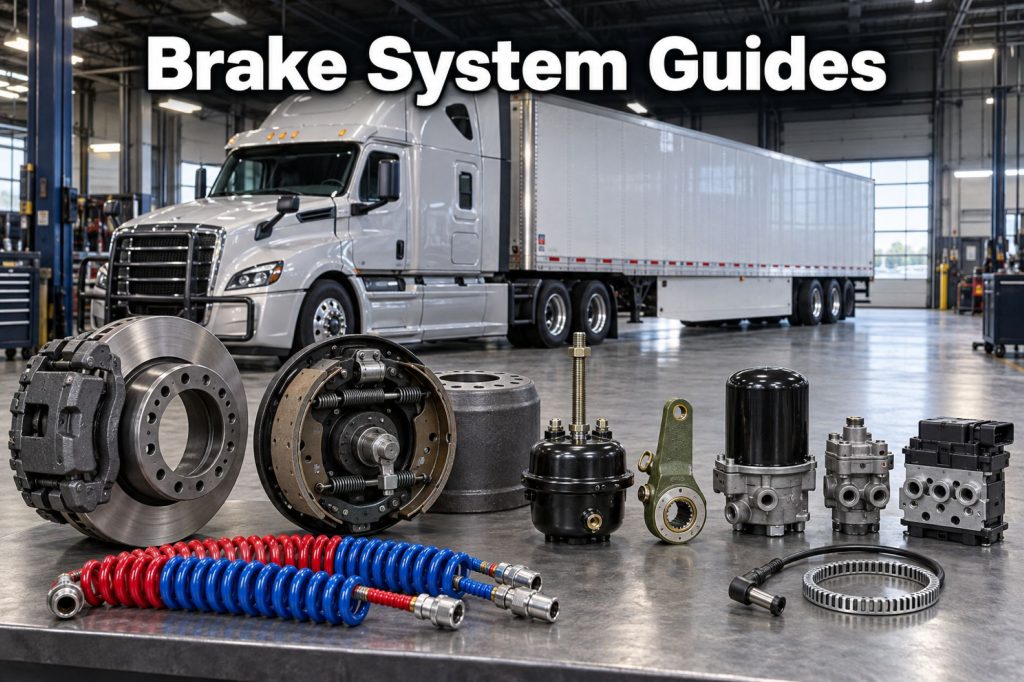
Commercial truck and trailer brake systems control vehicle speed, stop loaded equipment, hold parked vehicles, and help maintain stability during normal, emergency, and low-traction braking conditions.
The Truck Equipment Atlas Brake System Guides explain how air brakes operate, identify the components used throughout the system, compare air disc and drum brakes, examine the differences between tractor and trailer braking, cover ABS and electronic stability control, and provide general inspection and maintenance information.
These guides are designed to help drivers, owner-operators, fleet managers, technicians, equipment buyers, CDL students, and other readers understand the braking systems used throughout the commercial trucking industry.
Explore Brake System Guides
Air Brake Systems Explained
Learn how commercial truck and trailer air-brake systems produce, store, control, and distribute compressed air.
This guide explains air compressors, governors, air dryers, reservoirs, brake valves, relay valves, air lines, brake chambers, service brakes, parking brakes, emergency brakes, and the connections between tractors and trailers.
Commercial Truck Brake Components Explained
Explore the pneumatic, mechanical, and electronic components used throughout commercial truck and trailer brake systems.
This guide covers air compressors, dryers, reservoirs, valves, hoses, brake chambers, slack adjusters, S-cam drum-brake components, air disc brake components, ABS sensors, modulator valves, warning devices, and tractor-trailer connections.
Air Disc Brakes vs Drum Brakes
Compare the two primary foundation-brake designs used on air-braked commercial vehicles.
This guide explains differences in operation, braking response, heat management, brake fade, inspection, adjustment, maintenance, initial cost, parts availability, and suitability for highway, vocational, and trailer applications.
Tractor vs Trailer Brake Systems
Learn how tractor and trailer brake systems operate independently while functioning together as one combination-vehicle braking system.
This guide explains the supply and service air lines, gladhands, tractor-protection valve, trailer relay emergency valve, reservoirs, spring brakes, foundation brakes, ABS systems, brake balance, and emergency response during trailer separation or supply-pressure loss.
How Truck ABS and Electronic Stability Control Work
Learn how antilock braking systems, automatic traction control, electronic stability control, and rollover-control technologies monitor commercial-vehicle movement.
This guide explains wheel-speed sensors, tone rings, modulator valves, electronic controllers, steering-angle sensors, yaw-rate sensors, lateral-acceleration sensors, selective braking, engine-torque reduction, and tractor and trailer stability systems.
How to Inspect and Maintain Commercial Truck Brakes
Learn how drivers and qualified brake inspectors evaluate commercial truck and trailer brake systems.
This guide covers air-pressure checks, warning devices, air leaks, chambers, pushrod stroke, slack adjusters, air disc brakes, drum brakes, friction materials, rotors, drums, ABS components, tractor-trailer connections, preventive maintenance, and common warning signs.
What These Guides Cover
The Brake System Guides provide educational information across the major braking technologies used on commercial trucks, tractors, trailers, buses, and vocational vehicles.
Topics include:
- Air-brake system operation
- Air production and storage
- Air compressors and governors
- Air dryers and reservoir systems
- Brake-control and relay valves
- Air hoses, tubing, and fittings
- Brake chambers and actuators
- Service brakes
- Parking brakes
- Emergency brakes
- Spring-brake systems
- Air disc brakes
- S-cam drum brakes
- Foundation-brake components
- Tractor and trailer brake interaction
- Antilock braking systems
- Automatic traction control
- Electronic stability control
- Roll-stability systems
- Brake inspection
- Preventive maintenance
- Common brake problems
- Brake-system warning signs
Air Brake System Information
Commercial Air Brake Systems use compressed air to operate service, parking, and emergency brakes.
The brake guides explain:
- How the compressor produces air
- How the governor controls compressor operation
- How the air dryer removes moisture and contamination
- How reservoirs store compressed air
- How primary and secondary circuits provide redundancy
- How the brake pedal controls service-brake pressure
- How relay valves reduce application delay
- How spring brakes provide parking and emergency braking
- How low-air warning systems alert the driver
- How tractor and trailer air systems connect
Begin with Air Brake Systems Explained for a complete overview of air-brake operation.
Air Disc Brake Information
Air Disc Brake Systems use brake chambers and calipers to clamp friction pads against rotating rotors.
The brake guides explain:
- How calipers apply the brake pads
- How pads create friction against the rotor
- How internal adjusters maintain running clearance
- How guide mechanisms allow caliper movement
- How disc brakes manage heat
- How pad and rotor wear are inspected
- What causes uneven pad wear
- What can cause an air disc brake to drag
- How disc brakes compare with drum brakes
- Where air disc brakes are commonly used
Readers comparing foundation-brake designs should use Air Disc Brakes vs Drum Brakes.
Drum Brake Information
Drum Brake Systems commonly use S-cam mechanisms to push brake shoes against the inside of rotating brake drums.
The brake guides explain:
- How brake chambers move pushrods
- How automatic slack adjusters rotate camshafts
- How S-cams push brake shoes outward
- How friction linings contact the drum
- How return springs release the shoes
- Why pushrod stroke is important
- How drums and linings wear
- How heat can affect drum-brake performance
- What causes brake drag or uneven wear
- How drum brakes compare with air disc brakes
Drum brakes remain widely used across highway, vocational, severe-duty, and trailer applications.
Brake Chamber and Actuator Information
Brake Chambers and Actuators convert compressed-air pressure into the mechanical force needed to apply the foundation brakes.
The guides cover:
- Service chambers
- Spring-brake chambers
- Combination chambers
- Diaphragms
- Pushrods
- Clevises
- Power springs
- Chamber mounting
- Chamber sizing
- Pushrod alignment
- Brake stroke
- Parking-brake actuation
- Emergency-brake operation
Brake chambers are critical to both air disc and drum brake systems.
ABS and Electronic Braking Information
ABS and Electronic Braking Systems monitor wheel movement, driver input, and vehicle behavior.
The brake guides explain:
- How ABS helps reduce wheel lock
- How wheel-speed sensors monitor rotation
- How tone rings create wheel-speed signals
- How modulator valves control brake pressure
- How tractor and trailer ABS differ
- How automatic traction control manages wheel spin
- How electronic stability control detects instability
- How rollover-control systems reduce vehicle speed
- How selective brake applications help stabilize a truck
- How engine-torque reduction supports stability control
- What ABS and ESC warning lamps mean
- Why electronic controls cannot replace mechanical brake maintenance
For a detailed overview, visit How Truck ABS and Electronic Stability Control Work.
Tractor and Trailer Brake Information
A tractor and semitrailer have separate brake systems connected through pneumatic and electrical lines.
The brake guides explain:
- How the tractor produces compressed air
- How the trailer reservoirs receive and store air
- How the service line carries the brake-control signal
- How the supply line charges the trailer and releases its spring brakes
- How gladhands connect the two air systems
- How the trailer relay valve applies the trailer brakes
- How the tractor-protection valve preserves tractor air
- How trailer brakes respond to supply-pressure loss
- How tractor and trailer ABS systems remain separate
- Why brake balance matters throughout the combination
Visit Tractor vs Trailer Brake Systems for the complete comparison.
Brake Inspection and Maintenance Information
Commercial brake systems require regular inspection and preventive maintenance.
The guides cover:
- Air-pressure build-up
- Low-air warning systems
- Air-loss testing
- Compressor and governor operation
- Air-dryer condition
- Reservoir contamination
- Air hoses and fittings
- Gladhand connections
- Brake chambers
- Pushrod stroke
- Automatic slack adjusters
- Brake pads and linings
- Brake drums and rotors
- Air disc brake calipers
- S-cam components
- ABS sensors and wiring
- Modulator valves
- Warning lamps
- Brake balance
- Brake drag
- Overheated wheel ends
- Maintenance documentation
Inspection and repair procedures must follow applicable requirements and the instructions published by the vehicle and component manufacturers.
Visit How to Inspect and Maintain Commercial Truck Brakes for the complete inspection and maintenance guide.
Foundation Brake Comparison
The foundation brake is the wheel-end equipment that creates friction and slows the vehicle.
The two primary commercial air-brake designs are:
Air Disc Brakes
Air disc brakes use a caliper to press brake pads against both sides of a rotor.
Potential characteristics include:
- Consistent braking response
- Strong resistance to heat-related fade
- Easier friction-material inspection
- Fewer traditional moving foundation-brake components
- Higher initial cost in many applications
Drum Brakes
Drum brakes use brake shoes and linings that expand against the inside of a rotating drum.
Potential characteristics include:
- Lower initial cost
- Broad parts availability
- Familiar maintenance procedures
- Extensive application coverage
- More mechanical wear points
- Greater sensitivity to adjustment and heat
Neither design is automatically correct for every commercial vehicle. Brake selection should consider the vehicle, duty cycle, axle ratings, operating environment, maintenance capabilities, and total ownership requirements.
Who These Guides Are For
The Brake System Guides are designed for:
- Commercial truck drivers
- Owner-operators
- Fleet managers
- Maintenance technicians
- Brake inspectors
- Trailer technicians
- Equipment buyers
- Truck and trailer dealers
- Vocational fleet operators
- CDL students
- Heavy-haul operators
- Safety managers
- Anyone learning about commercial-vehicle brake systems
How to Use the Brake System Guides
- Begin with Air Brake Systems Explained to understand how compressed air moves through the system.
- Use Commercial Truck Brake Components Explained to identify individual pneumatic, mechanical, and electronic components.
- Review Air Disc Brakes vs Drum Brakes when comparing foundation-brake designs.
- Use Tractor vs Trailer Brake Systems to understand how the two vehicles communicate and brake together.
- Read How Truck ABS and Electronic Stability Control Work for electronic braking and stability-control information.
- Consult How to Inspect and Maintain Commercial Truck Brakes for inspection areas, maintenance considerations, and warning signs.
Brake Systems Library
The Brake Systems hub provides access to commercial truck and trailer brake categories, component information, individual equipment profiles, and educational resources.
Explore the brake library by category:
- Air Brake Systems
- Air Disc Brake Systems
- Drum Brake Systems
- Brake Chambers and Actuators
- ABS and Electronic Braking Systems
- Trailer Brake Systems
Related Guide Libraries
- Truck Guides
- Trailer Guides
- Axle and Differential Guides
- Suspension System Guides
- Transmission Guides
- Equipment System Guides
Related Equipment Systems
Brake Guide Library Expansion
Truck Equipment Atlas will continue expanding its brake-system educational library as additional technologies, manufacturers, maintenance topics, and vehicle applications are added.
Future brake guides may cover:
- Commercial truck brake adjustment
- Understanding brake-chamber sizes
- Commercial truck air leaks
- Brake fade and overheating
- Spring-brake systems explained
- Commercial truck brake warning lights
- Trailer ABS troubleshooting
- Brake considerations for vocational trucks
- Brake considerations for heavy-haul equipment
- Commercial truck downhill braking
- Engine brakes and retarders
- Common causes of uneven brake wear
Follow the Growth of Truck Equipment Atlas
Truck Equipment Atlas continues to expand with new truck profiles, trailer coverage, diesel engine pages, equipment-system resources, manufacturer information, and educational guides.
Visit the Truck Equipment Atlas Site Updates page to explore recent additions, project milestones, and upcoming resources.