
Hendrickson INTRAAX
Quick Facts
- Manufacturer: Hendrickson
- Product Type: Integrated trailer air suspension, axle, and brake system
- Primary Configurations: Fixed, low-ride, liftable, extreme-duty, and compact trailer suspensions
- Common Product Families: AAT, AANT, AAL, AANL, AANLS, and AAED
- Common Capacities: 20,000, 23,000, 25,000, and 30,000 pounds per axle
- Available Ride Heights: Approximately 6.25 to 21 inches across different models
- Primary Applications: Dry vans, refrigerated trailers, flatbeds, tankers, dumps, grain hoppers, lowboys, auto haulers, livestock trailers, and specialty trailers
- Alignment System: Hendrickson QUIK-ALIGN
- Brake Options: Drum brakes and air disc brakes in compatible configurations
- Optional Ride Technology: Hendrickson ZMD zero-maintenance damping on selected models
- Operating Environment: On-highway, limited off-highway, and extreme-duty service depending on model
- Page Slug: hendrickson-intraax
Overview
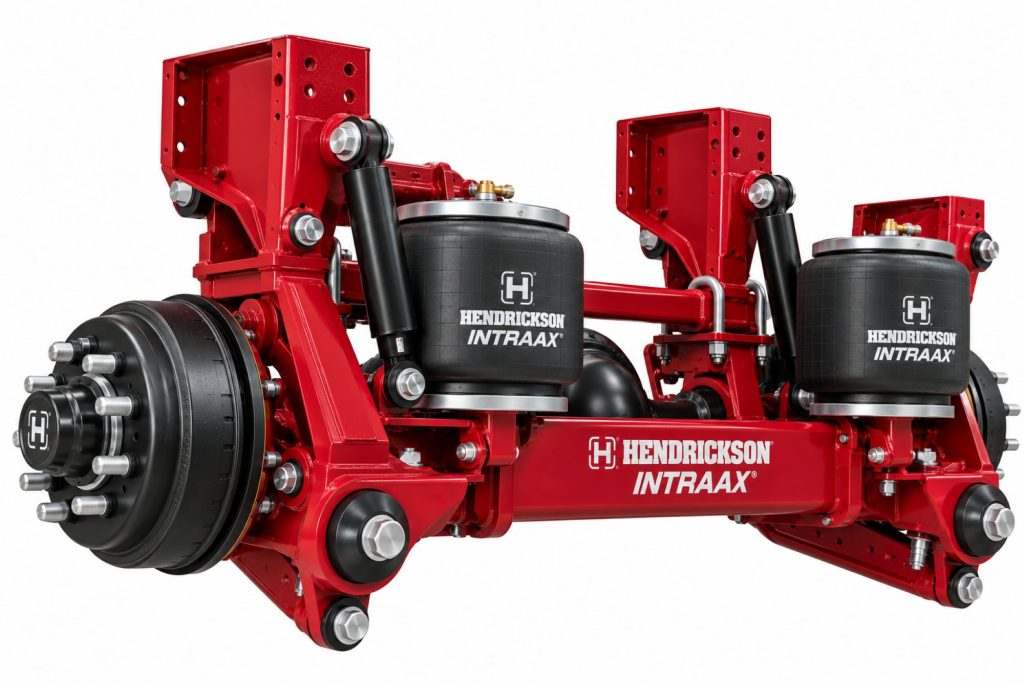
Hendrickson INTRAAX is an integrated trailer suspension system combining the air suspension, axle, trailing beams, brakes, and related components into a coordinated assembly. This integration reduces component count and allows Hendrickson to control the suspension geometry, axle connection, braking setup, and ride characteristics as one system.
INTRAAX is available in multiple configurations for different trailer designs. Top-mount models serve conventional vans, tankers, platforms, dumps, and grain trailers. Low-ride and liftable versions support lowboys, drop decks, auto haulers, and other trailers with limited frame clearance. Extreme-duty systems are available for demanding on/off-highway applications.
Capacities generally range from 20,000 to 30,000 pounds per axle, depending on the model. Available ride heights extend from approximately 6.25 to 21 inches across the broader product family.
Key Characteristics
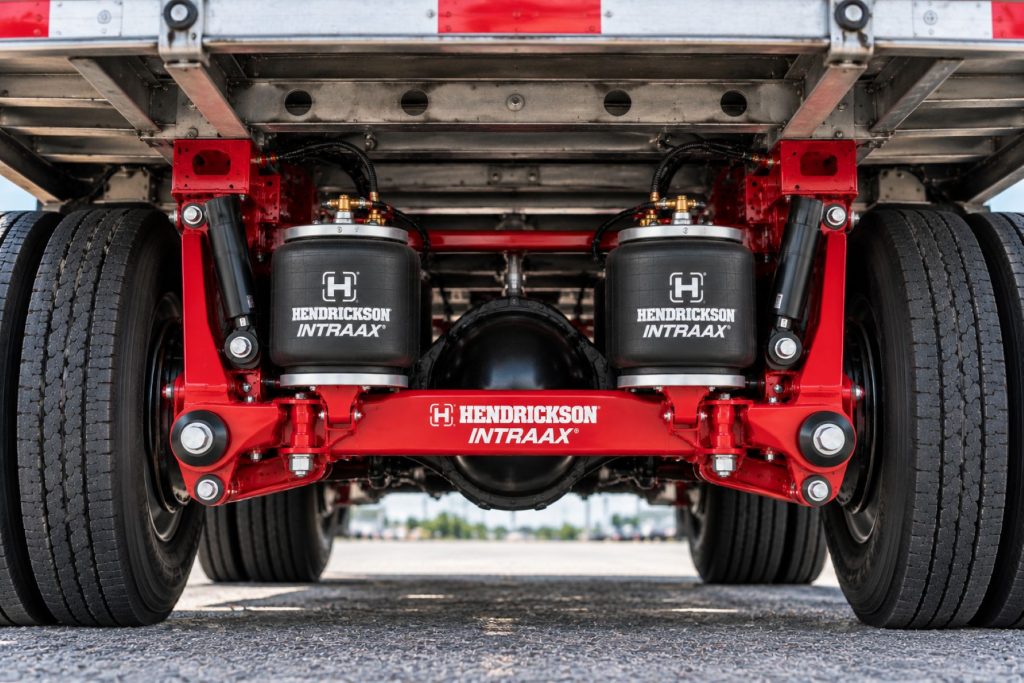
- Integrated trailer suspension, axle, and brake system
- Air-ride design for improved cargo protection
- Fixed and liftable configurations
- Top-mount and low-ride-height models
- Capacity ratings from 20,000 to 30,000 pounds per axle
- Wide range of available ride heights
- Rigid trailing-arm and axle connection
- QUIK-ALIGN axle-alignment system
- High-capacity air springs with relatively low operating pressure
- Large-bore shock absorbers on standard damped configurations
- Optional ZMD damping technology on selected models
- Drum- and air-disc-brake options
- Standard, specialty, and extreme-duty configurations
- Single-source parts, service, training, and warranty support
Major Components
- Air springs
- Integrated trailer axle
- Rigid trailing beams
- Axle-to-beam connections
- Frame hangers
- Pivot bushings
- QUIK-ALIGN eccentric and concentric collars
- Pivot bolts and related fasteners
- Shock absorbers or ZMD down stops
- Brake spiders or air-disc-brake mounting components
- S-camshafts and cam tubes on drum-brake configurations
- Brake chambers and slack adjusters
- ABS sensors and tone rings
- Wheel hubs, bearings, and seals
- Height-control valve and linkage
- Air lines, fittings, and pressure-protection components
- Lift bags and lift hardware on liftable models
- Chain down stops on certain extreme-duty configurations
How the Suspension System Works
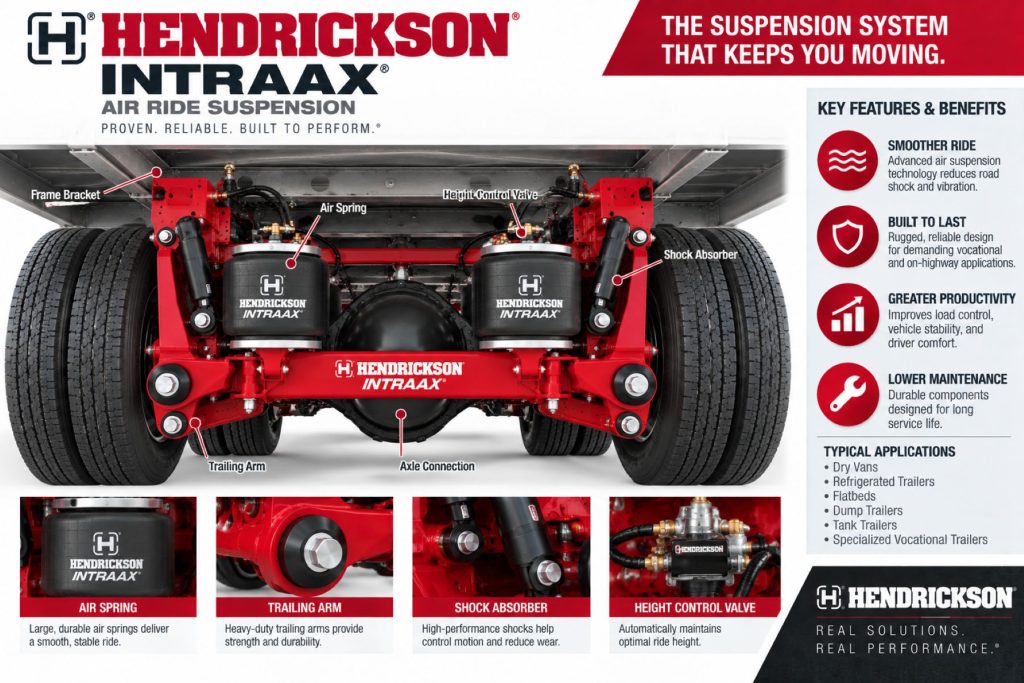
INTRAAX uses air springs positioned between the trailing beams and trailer frame to support the trailer’s weight. As the trailer passes over bumps, potholes, or uneven surfaces, the air springs compress and expand to reduce shock transferred into the frame and cargo.
A height-control valve regulates air pressure and returns the suspension to its specified ride height as loading changes.
The rigid trailing beams connect the axle to pivot bushings mounted in the frame hangers. These beams control longitudinal axle movement and transfer braking forces into the trailer structure.
Shock absorbers control repeated suspension movement on conventional configurations. Selected models can use ZMD technology, which provides damping within specially designed air springs and uses down stops instead of conventional shock absorbers.
Suspension Position and Function
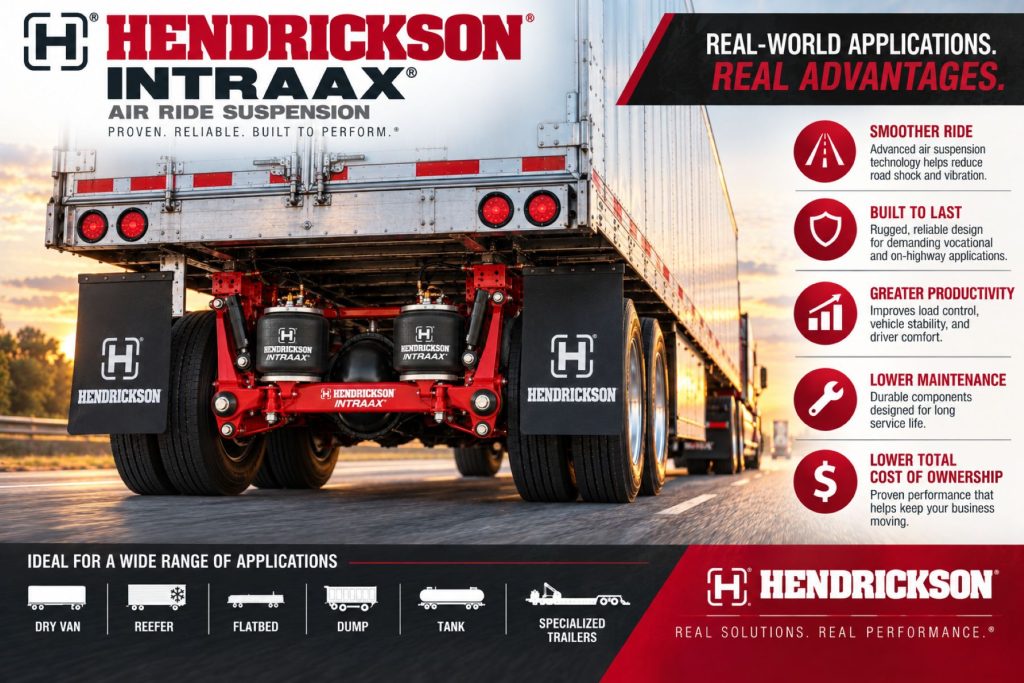
INTRAAX is installed beneath a commercial trailer. A trailer may use one, two, three, or more INTRAAX assemblies depending on its axle configuration and application.
The system performs several functions:
- Supports the trailer and cargo
- Connects the axles to the trailer frame
- Maintains the specified ride height
- Absorbs bumps and road irregularities
- Controls longitudinal and vertical axle movement
- Provides mounting for the trailer brakes and wheel ends
- Maintains axle alignment
- Distributes weight across a multi-axle group
- Protects cargo and trailer structure from road shock
- Raises an axle in compatible liftable configurations
Common Specifications
- AANLS Capacity: 20,000 pounds per axle
- AANLS Ride Heights: Approximately 6.25, 7, 9, and 12 inches
- AANL Capacity: 23,000 pounds per axle
- AANL Ride Heights: Approximately 6.5 to 17 inches
- AAT Capacities: 23,000, 25,000, and 30,000 pounds per axle
- AAT Ride Heights: Approximately 13.5 to 19 inches in listed North American configurations
- AAL Capacities: 23,000, 25,000, and 30,000 pounds per axle
- AAL Ride Heights: Approximately 6.5 to 21 inches across listed configurations
- AAED Capacity: 30,000 pounds per axle
- AAED Top-Mount Ride Heights: Approximately 14 to 19 inches
- AAED Low-Ride Ride Heights: Approximately 9 to 17 inches
- Common Drum Brake Sizes: 15-inch or 16.5-inch brake packages, depending on the model
- Common Air Disc Brake Rotors: Application-specific packages including approximately 377-, 415-, and 430-millimeter rotors in listed configurations
- Common Spindle Types: Hendrickson HN and HP configurations, depending on model
These values describe the broader INTRAAX family. The exact capacity, ride height, brakes, wheel ends, and duty-cycle approval must be confirmed for the individual suspension model.
Capacity, Ride Height, and Axle Travel
INTRAAX capacity is rated per axle. Common models are rated at 20,000, 23,000, 25,000, or 30,000 pounds. A tandem trailer may therefore have two suspension assemblies, but the usable trailer rating remains limited by the frame, brakes, tires, wheels, kingpin, coupler, and applicable regulations.
Ride height is measured between the axle centerline and the underside of the trailer structure at the specified reference location. Correct ride height is essential for load equalization, air-spring geometry, axle travel, tire clearance, and suspension durability.
Available axle travel varies by suspension model, ride height, shock or ZMD configuration, and trailer structure. Tire and air-spring clearance must be maintained through full jounce, rebound, and lateral movement.
Liftable models require sufficient clearance to raise the axle and tires without contacting the trailer frame, body, plumbing, landing gear, or other equipment.
Ride Quality and Load Distribution
INTRAAX uses low spring rates and high-capacity air springs to reduce road shock and vibration. This helps protect cargo, trailer bodies, tanks, structural components, and wheel-end equipment.
Pivot bushings influence both ride softness and axle control. The rigid trailing beams maintain a stable connection between the axle and suspension while the bushings allow controlled movement at the pivots.
Correct ride height helps equalize loads among axles on tandem, tridem, and multi-axle trailers. Incorrect height, mismatched air springs, blocked air lines, or improperly adjusted controls can overload one axle while leaving another underloaded.
Air suspension does not correct poor cargo placement. Freight distribution, trailer geometry, axle spacing, and tractor fifth-wheel position continue to determine actual axle loading.
Suspension Controls and Adjustment Options
- Standard INTRAAX controls can include:
- Height-control valve
- Height-control linkage
- Pressure-protection valve
- Air reservoir connections
- Suspension dump valve
- Lift-axle control valve
- Automatic lift-axle controls
- Manual lift controls where permitted
- Air-pressure gauge
- ABS and brake-system controls
Liftable configurations may use air pressure to raise the axle when reduced axle capacity is acceptable. The axle must be lowered whenever required to carry the trailer’s weight or comply with applicable regulations.
Suspension dump controls can exhaust air when loading, unloading, coupling, or operating specialized equipment. Their use depends on the trailer manufacturer’s instructions.
Alignment and Suspension Geometry
INTRAAX commonly uses Hendrickson’s QUIK-ALIGN system. Eccentric and concentric collars at the pivot connection allow the technician to move the axle and correct alignment without cutting, welding, or installing traditional alignment shims.
Correct alignment reduces tire scrub, rolling resistance, and uneven tread wear. All axles must be aligned relative to the trailer kingpin and to each other.
Important checks include:
- Axle thrust angle
- Axle spacing
- Pivot-bushing condition
- QUIK-ALIGN collar position
- Pivot-bolt clamping force
- Ride height
- Trailing-beam condition
- Frame-hanger alignment
- Tire and wheel condition
- Lift-axle position
- Trailer frame condition
The trailer should be supported, loaded, and measured according to the applicable alignment procedure.
Axle, Brake, and Wheel-End Options
INTRAAX integrates the axle and suspension, allowing Hendrickson to coordinate the axle beam, spindle, trailing arms, brakes, and wheel ends.
Brake options can include:
- 15-inch drum brakes for certain 19.5-inch wheel applications
- 16.5-inch drum brakes for common 22.5- and 24.5-inch wheel applications
- Air disc brakes in approved configurations
- Hendrickson Cam Tube System on applicable drum-brake models
- Standard or long-stroke brake chambers, depending on specification
- ABS sensor provisions
Common wheel-end options include conventional-service hubs, extended-service packages, different spindle designs, and tire-inflation-system compatibility.
The axle structure rating may differ from the ratings of the brakes, hubs, bearings, tires, and wheels. The lowest-rated component determines usable capacity.
Common Applications
- Dry van trailers
- Refrigerated trailers
- Flatbed trailers
- Step-deck trailers
- Lowboy trailers
- Dump trailers
- Tank trailers
- Grain hopper trailers
- Livestock trailers
- Auto haulers
- Moving vans
- Pup trailers
- B-trains
- Logging trailers
- Chip vans
- Specialty trailers
Vehicle, Axle, and Frame Compatibility
INTRAAX is designed for commercial trailers rather than truck or tractor chassis. Compatibility depends on the trailer structure, frame width, axle spacing, ride height, capacity, suspension orientation, tire size, brake system, and intended duty cycle.
Top-mount AAT configurations suit conventional trailer frames requiring standard ride heights. AAL and AANL models support low-ride and liftable applications. AANLS is intended for compact installations where available mounting space is limited. AAED serves more demanding on/off-highway operation.
Trailer manufacturers must provide adequate structural reinforcement around the hangers and air-spring mounting points. Frame width and hanger spacing must remain within Hendrickson tolerances to prevent premature pivot-bushing wear.
Advantages
- Integrated suspension, axle, and brake package
- Broad selection of capacities and ride heights
- Improved cargo and trailer protection
- Low spring rates provide good ride quality
- Rigid trailing-arm design provides axle control
- QUIK-ALIGN simplifies axle alignment
- Alignment requires no welding or special alignment shims
- Fewer separate components than many non-integrated systems
- Fixed and liftable configurations
- Low-ride and compact options
- Standard and extreme-duty versions
- Drum- and air-disc-brake compatibility
- Optional ZMD damping technology
- Single-source product and technical support
Limitations or Considerations
- Each model has a specific approved application range
- Not every INTRAAX suspension is approved for extensive off-highway operation
- Incorrect ride height can overload axles and damage the suspension or trailer
- Air leaks can lower the trailer or cause unequal axle loading
- Pivot bushings and QUIK-ALIGN connections require inspection
- Liftable systems add controls, plumbing, and operating requirements
- Brake and wheel-end ratings may be lower than the axle structure rating
- Low-ride models require careful tire and air-spring clearance checks
- ZMD and conventional air springs must not be mixed on the same suspension
- Extreme-duty trailers require the correct AAED or other approved configuration
- The integrated axle should not be welded or repaired without an approved procedure
- Trailer and suspension capacity do not override legal axle-weight limits
Driver and Operator Experience
Drivers generally experience less trailer bounce and cargo movement than with a mechanical spring suspension. The trailer may also track more smoothly over pavement joints and rough road surfaces.
A correctly aligned INTRAAX system can reduce tire scrub and help the trailer follow the tractor without persistent pull or dog tracking.
Drivers should inspect the trailer for leaning, low ride height, air leaks, damaged air springs, loose components, or tires contacting the trailer structure. Liftable axles should be confirmed in the proper position before entering public roads or loading the trailer.
Maintenance and Ownership Notes
- Inspect air springs for cracks, abrasion, contamination, and incorrect positioning.
- Check air lines, fittings, reservoirs, and valves for leakage.
- Verify ride height at recommended maintenance intervals.
- Inspect height-control valves and linkages.
- Check shock absorbers for leakage, damaged mounts, or worn bushings.
- Inspect ZMD air springs and down stops where installed.
- Do not mix standard and ZMD air springs on the same suspension.
- Inspect pivot bushings for wear or movement.
- Check QUIK-ALIGN collars and pivot fasteners.
- Inspect trailing beams, hangers, and axle connections for cracks or damage.
- Check brake stroke, friction material, chambers, slack adjusters, and cam components.
- Inspect ABS sensors and wiring.
- Check hubs, bearings, seals, tires, and wheels.
- Inspect lift bags and controls on liftable configurations.
- Use Hendrickson procedures when servicing or aligning the integrated axle.
Common Suspension Problems
- Air leaking from springs, lines, fittings, or valves
- Trailer sitting below its specified ride height
- Uneven ride height across the axle group
- Incorrect height-control linkage adjustment
- Damaged or abraded air springs
- Leaking or worn shock absorbers
- Damaged ZMD down stops
- Standard and ZMD air springs incorrectly mixed
- Worn pivot bushings
- Loose pivot bolts
- QUIK-ALIGN collars moving after alignment
- Axle misalignment
- Rapid or irregular tire wear
- Trailer dog tracking
- Brake camshaft or bushing wear
- Excessive brake stroke
- ABS sensor or wiring faults
- Wheel-bearing or hub-seal problems
- Liftable axle failing to raise or lower
- Tire, frame, or air-spring interference
- Cracked hangers or damaged trailing beams
Identification Information
Begin identification with the trailer vehicle identification number, manufacturer build sheet, suspension identification tag, axle identification, and brake specifications.
Important identification information includes:
- Trailer identification number
- Trailer manufacturer and model
- Model year
- INTRAAX model designation
- Suspension capacity
- Ride height
- Top-mount or low-ride configuration
- Fixed or liftable arrangement
- Axle spacing
- Axle serial number
- Spindle type
- Brake size and type
- ABS configuration
- Wheel-end package
- Air-spring part number
- Shock or ZMD configuration
- Pivot-bushing and hanger configuration
Model designations such as AAT, AANT, AAL, AANL, AANLS, and AAED identify different architectures. The complete model number is required because capacity and ride height can vary within each family.
Buying Considerations
- Identify the complete INTRAAX model.
- Confirm the rated capacity per axle.
- Verify the required ride height.
- Determine whether the suspension is fixed or liftable.
- Check whether the trailer operates on-highway, off-highway, or in extreme-duty service.
- Confirm compatibility with the trailer frame and axle spacing.
- Identify the brake type and size.
- Verify wheel, tire, hub, bearing, and spindle ratings.
- Determine whether the suspension uses shocks or ZMD technology.
- Inspect all air springs for damage or leakage.
- Check pivot bushings and QUIK-ALIGN connections.
- Inspect trailing beams, hangers, and axle structures.
- Examine tires for alignment-related wear.
- Check brakes, ABS components, hubs, bearings, and seals.
- Road-test the trailer for pulling, bouncing, leaning, or braking problems.
- Confirm replacement-part availability using the complete model and serial information.
Variants and Configurations
- INTRAAX AAT: Top-mount system available in 23,000-, 25,000-, and 30,000-pound capacities for conventional trailer applications.
- INTRAAX AANT: Narrow-bushing, tapered-beam top-mount suspension designed to reduce weight in approved applications.
- INTRAAX AAL: Low-ride-height and liftable system available in 23,000-, 25,000-, and 30,000-pound capacities.
- INTRAAX AANL: Lightweight low-ride and liftable system with a 23,000-pound capacity.
- INTRAAX AANLS: Compact short-beam suspension with a 20,000-pound capacity for trailers with restricted mounting space.
- INTRAAX AAEDT: Extreme-duty top-mount system rated at 30,000 pounds per axle.
- INTRAAX AAEDL: Extreme-duty low-ride or liftable system rated at 30,000 pounds per axle.
- ZMD-Equipped INTRAAX: Selected models using air springs with integrated damping and separate down stops instead of conventional shocks.
- Drum-Brake Configuration: Integrated system using S-cam drum brakes and compatible wheel ends.
- Air-Disc-Brake Configuration: Integrated system using approved air disc brakes.
Comparison to Similar Equipment
Compared with Hendrickson VANTRAAX, INTRAAX is generally a fixed or individually mounted suspension system. VANTRAAX combines multiple integrated suspension assemblies with a sliding subframe for dry van and refrigerated trailer applications.
The Hendrickson ULTRAA-K is a newer lightweight integrated trailer suspension designed around additional weight savings and updated axle-beam technology.
The Hendrickson ULTRAA-K Slider System combines lightweight suspension technology with a movable trailer slider assembly.
Compared with SAF-Holland CBX trailer suspensions, INTRAAX offers Hendrickson’s integrated axle, QUIK-ALIGN, brake, wheel-end, and optional ZMD technologies within a broad product family.
Best Fit For
- Trailer manufacturers needing an integrated suspension and axle package
- Dry van and refrigerated trailer fleets
- Flatbed, tanker, dump, and grain-hauling operations
- Lowboy and drop-deck trailers requiring low ride heights
- Applications requiring a liftable trailer axle
- Weight-conscious auto-hauler and moving-van fleets
- Trailers requiring 20,000- to 30,000-pound per-axle capacity
- Severe-service trailers using an approved extreme-duty model
- Fleets wanting QUIK-ALIGN axle adjustment
- Operators prioritizing cargo protection and reduced maintenance
Related Vehicle and Trailer Types
- Complete Guide to Trailer Types
- Dry Van vs Refrigerated Trailer
- Flatbed vs Step Deck vs Double Drop
- Dry van trailers
- Refrigerated trailers
- Flatbed trailers
- Step-deck trailers
- Lowboy trailers
- Dump trailers
- Tank trailers
- Grain hopper trailers
- Livestock trailers
- Auto-hauler trailers
- Logging trailers
- Specialty trailers
Related Truck and Trailer Models
- Great Dane Champion Dry Van
- Wabash DuraPlate Dry Van Trailer
- Utility 3000R Reefer Trailer
- Fontaine Revolution Flatbed Trailer
- Timpte Super Hopper
- Polar Tank Trailer
- East Dump Trailer
Related Suspension Types
- Trailer Suspension Systems
- Air Suspension Systems
- Auxiliary & Lift Axle Suspensions
- Hendrickson VANTRAAX
- Hendrickson ULTRAA-K
- Hendrickson ULTRAA-K Slider System
- Integrated trailer suspensions
- Top-mount trailer air suspensions
- Low-ride trailer suspensions
- Liftable trailer suspensions
- Extreme-duty trailer suspensions
Related Equipment Systems
Related Guides
- Suspension System Guides
- How Commercial Truck Suspension Systems Work
- Air Suspension vs Leaf Spring Suspension
- How to Choose a Commercial Truck Suspension
- Truck Suspension Components Explained
- Truck vs Trailer Suspension Systems
- Choosing the Right Trailer for Your Freight
- Lift Axles Explained
Regulatory and Compliance Notes
An INTRAAX-equipped trailer must remain within federal, state, provincial, axle-group, bridge-formula, tire, wheel, brake, frame, and gross vehicle weight limits. Suspension capacity does not determine the trailer’s legal payload by itself.
Trailer ABS and brake systems must comply with applicable commercial-vehicle braking requirements. Correct sensor installation, brake adjustment, air-system operation, and warning-lamp function are required.
Liftable axle operation must comply with applicable axle-weight and control requirements. The axle must be lowered whenever needed to carry the load or meet roadway regulations.
Off-highway use must remain within the approval for the exact INTRAAX model. Applications exceeding the normal duty cycle may require Hendrickson approval.
Real World Operating Notes
Correct ride height is one of the most important factors in INTRAAX performance. An improperly adjusted suspension can produce unequal axle loading, tire interference, poor ride, damaged air springs, and accelerated pivot-bushing wear.
Alignment should be checked whenever abnormal tire wear appears. Replacing tires without correcting a loose pivot connection or incorrect axle thrust angle will not solve the problem.
ZMD-equipped suspensions must use the correct matched air springs. Standard and ZMD air springs provide different damping characteristics and should not be mixed on the same suspension.
Frequently Asked Questions
Is Hendrickson INTRAAX a complete axle?
INTRAAX is an integrated trailer suspension, axle, and brake system rather than only a standalone suspension.
Is INTRAAX used on trucks or trailers?
It is designed for commercial trailers.
What capacities are available?
Common models are rated at 20,000, 23,000, 25,000, or 30,000 pounds per axle.
What ride heights are available?
The broader INTRAAX family covers ride heights from approximately 6.25 to 21 inches, depending on the model.
What is the difference between AAT and AAL?
AAT is generally a conventional top-mount suspension. AAL is designed for low-ride-height and liftable applications.
What is INTRAAX AANLS?
AANLS is a compact short-beam suspension designed for trailers such as auto haulers, moving vans, drop frames, high-cube vans, and pup trailers.
What is INTRAAX AAED?
AAED is the extreme-duty 30,000-pound version intended for demanding on/off-highway trailer applications.
What is QUIK-ALIGN?
QUIK-ALIGN uses eccentric and concentric collars at the pivot connection to adjust axle alignment without welding or traditional shims.
Can INTRAAX use air disc brakes?
Yes. Air-disc-brake packages are available on compatible models. Drum-brake configurations are also widely available.
What is ZMD technology?
ZMD uses specially designed air springs to provide suspension damping without conventional shock absorbers. Down stops control rebound travel.
Can standard and ZMD air springs be mixed?
No. Hendrickson advises against mixing standard and ZMD air springs on the same suspension.
What commonly causes uneven tire wear on INTRAAX?
Possible causes include axle misalignment, loose pivot fasteners, worn pivot bushings, incorrect ride height, wheel-bearing problems, brake drag, tire-pressure differences, or damaged trailer structure.
Can an INTRAAX axle be welded or straightened?
Axle repairs must follow Hendrickson’s approved procedures. Unauthorized welding, heating, bending, or straightening can weaken the axle and make the trailer unsafe.
Availability and Where to Find
Hendrickson INTRAAX is available through numerous commercial trailer manufacturers and can be found on new and used dry vans, refrigerated trailers, platforms, tankers, dumps, lowboys, grain hoppers, auto haulers, and specialty trailers.
Replacement air springs, shocks, ZMD components, pivot bushings, QUIK-ALIGN hardware, brake components, hubs, bearings, seals, and axle assemblies are available through Hendrickson distributors, trailer dealers, repair facilities, and heavy-duty parts suppliers.
Current product and selection information can be checked through Hendrickson’s official INTRAAX AAT product page, INTRAAX AAL product page, INTRAAX AANL product page, INTRAAX AANLS product page, INTRAAX Extreme Duty page, and L707 trailer suspension application guide.
Support Trucking Families
Truck Equipment Atlas supports the mission of Grey Cross, a nonprofit dedicated to helping families of truck drivers who lose their lives while on the road. As the site grows, part of its mission is to bring awareness and support to these families.
Podcast or Video Section
Learn More Through Audio and Video
Truck Equipment Atlas will continue expanding with podcast episodes, interviews, and equipment breakdowns to help drivers and fleets better understand trucks and equipment.
Follow the Growth of Truck Equipment Atlas
Truck Equipment Atlas continues to expand with new truck profiles, trailer coverage, diesel engine pages, equipment system resources, manufacturer information, and educational guides.
Visit our Site Updates page to explore recent additions, project milestones, and upcoming resources as we continue building one of the industry’s growing commercial trucking equipment reference libraries.
View the Latest Site Updates: Truck Equipment Atlas Site Updates