
Transmission Guides
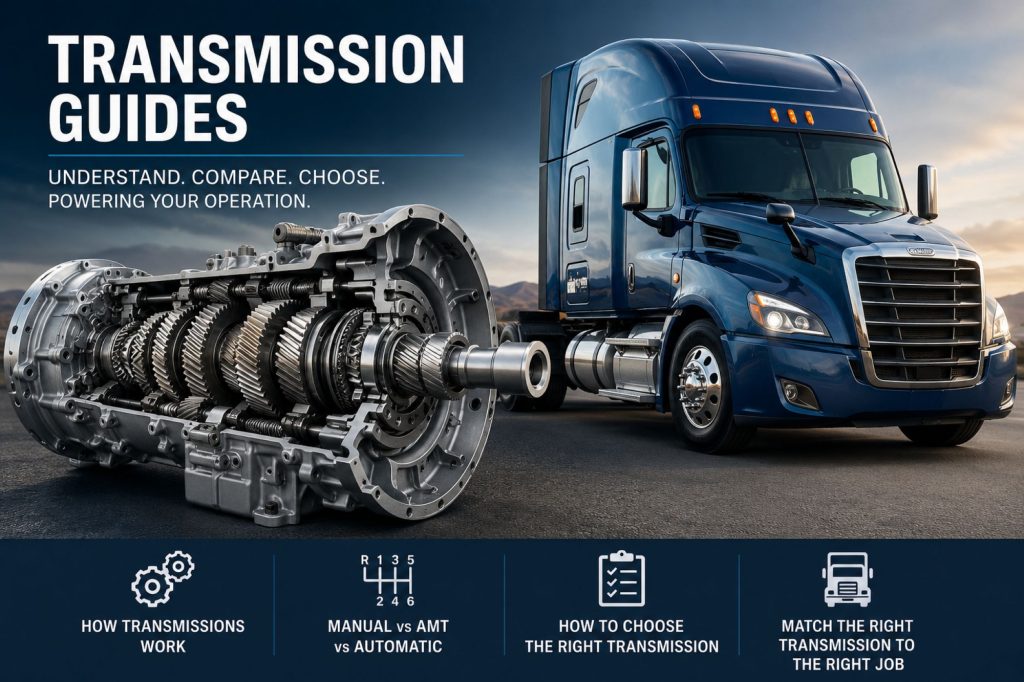
Commercial truck transmissions play a critical role in how power moves from the engine through the drivetrain and ultimately to the drive wheels.
The Truck Equipment Atlas Transmission Guides section provides educational resources designed to help drivers, owner-operators, fleet managers, technicians, students, equipment buyers, and trucking enthusiasts better understand commercial truck transmissions, how different transmission technologies work, and how transmission selection affects vehicle performance and operation.
These guides complement the individual transmission profiles available throughout the Truck Equipment Atlas Transmission Library by focusing on broader educational topics, comparisons, and equipment selection.
Explore Transmission Guides
How Commercial Truck Transmissions Work
Learn how a commercial truck transmission transfers engine power through the drivetrain, why multiple gear ratios are necessary, and how transmission gearing affects vehicle speed, torque, acceleration, gradeability, and overall truck performance.
This guide explains important transmission concepts including:
- Transmission input and output
- Gear ratios
- Torque multiplication
- Clutch operation
- Torque converters
- Transmission gearing
- Direct drive and overdrive
- Engine and transmission interaction
- Driveshaft and axle connections
- Electronic transmission controls
This is the best starting point for readers who want to understand the basic operation of commercial truck transmissions.
Manual vs Automated Manual vs Automatic Transmissions
Commercial trucks use three major transmission technologies, and each provides a different combination of driver control, automation, operating characteristics, maintenance requirements, and application suitability.
This guide compares:
- Manual transmissions
- Automated manual transmissions
- Fully automatic transmissions
- Driver involvement
- Clutch operation
- Torque converter operation
- Gear selection
- Highway applications
- Vocational applications
- Heavy-haul applications
- Maintenance considerations
- Advantages and limitations
The guide is designed to help readers understand the fundamental differences between the transmission types found throughout modern commercial trucking.
How to Choose a Commercial Truck Transmission
Selecting the right transmission requires more than simply choosing between a manual, AMT, or automatic.
The complete truck specification and intended application must be considered.
This guide explores factors including:
- Engine torque
- Vehicle class
- Gross vehicle weight
- Gross combination weight
- Trailer and freight requirements
- Highway versus vocational operation
- Terrain
- Axle ratios
- Gear ratios
- Startability
- Gradeability
- Heavy-haul requirements
- PTO requirements
- Driver experience
- Maintenance
- Service availability
- Operating costs
The goal is to help readers understand how transmissions should be matched to the truck and the work it is expected to perform.
Explore the Commercial Truck Transmission Library
Readers looking for information about specific transmission models and families can explore the Truck Equipment Atlas Transmission Library.
The Transmission Library includes individual profiles covering commercial transmissions from manufacturers and drivetrain suppliers including:
- Aisin
- Allison Transmission
- Detroit
- Eaton
- Eaton Cummins
- Ford
- General Motors
- International
- Mack
- PACCAR
- Volvo
Individual transmission profiles provide deeper information about specifications, applications, operating characteristics, maintenance considerations, compatibility, and the types of trucks in which different transmission platforms are used.
Explore Transmissions by Type
Truck Equipment Atlas also organizes commercial transmissions according to transmission technology and application.
Manual Transmissions
Explore traditional commercial truck transmissions that give the driver direct control over clutch operation and gear selection.
Automated Manual Transmissions
Explore AMTs that combine mechanically geared transmission designs with automated clutch operation and electronically controlled shifting.
Automatic Transmissions
Explore fully automatic commercial transmissions commonly used throughout medium-duty, vocational, severe-service, and specialized commercial applications.
Explore Transmissions by Application
Transmission requirements vary considerably according to vehicle class, weight, operating environment, and the work a truck performs.
Heavy-Duty Transmissions
Explore transmissions used throughout Class 8 highway, regional, heavy-haul, vocational, and severe-service trucking.
Medium-Duty Transmissions
Explore transmissions used in delivery trucks, utility vehicles, tow trucks, construction equipment, municipal trucks, service vehicles, and other medium-duty applications.
Vocational Transmissions
Explore transmissions designed for demanding work applications including construction, dump, refuse, logging, utility, heavy haul, municipal service, towing, and other vocational operations.
Why Transmission Type Matters
The transmission affects much more than how a driver changes gears.
Transmission design and gearing can influence:
- Vehicle startability
- Gradeability
- Highway engine speed
- Low-speed control
- Fuel consumption
- Driver workload
- Towing capability
- Heavy-haul performance
- PTO operation
- Maintenance requirements
- Powertrain integration
- Overall vehicle performance
A transmission that works well in a long-haul tractor may not be the best choice for a dump truck, refuse vehicle, utility truck, heavy-haul tractor, or local delivery vehicle.
Understanding these differences is an important part of properly evaluating commercial truck equipment.
Understanding the Complete Powertrain
A commercial truck transmission does not operate independently.
It works as part of a complete powertrain and drivetrain that can include:
- Engine
- Clutch or torque converter
- Transmission
- Driveshaft
- Differentials
- Drive axles
- Final drive gearing
- Wheels and tires
The way these components are matched can significantly affect how a truck performs.
Engine torque, transmission ratios, axle ratios, tire size, vehicle weight, and operating environment must all be considered when evaluating a commercial truck powertrain.
Readers can also explore the Truck Equipment Atlas Engine Library for information about the engines that power commercial trucks.
Connect transmission behavior to engine horsepower and torque, axle ratios and cruise RPM, and PTO operation and compatibility. These systems must work together in an approved vehicle specification.
Transmission Technology Continues to Evolve
Commercial truck transmission technology has changed significantly over time.
Traditional manual transmissions dominated heavy-duty trucking for decades and remain important in specialized applications.
Automated manual transmissions have become increasingly common in modern highway tractors and are expanding further into vocational and heavy-haul operations.
Fully automatic transmissions remain particularly important throughout medium-duty, vocational, severe-service, municipal, refuse, emergency, and other applications where smooth low-speed operation and reduced driver workload can be valuable.
Electronic controls and increased powertrain integration are also allowing modern transmissions to communicate more closely with engines, braking systems, cruise control, vehicle sensors, and other truck systems.
Truck Equipment Atlas will continue documenting these technologies as the Transmission Library expands.
Additional Transmission Guides Coming
The Transmission Guides library will continue growing beyond the initial three guides.
Future topics may include:
- Commercial Truck Gear Ratios Explained
- Direct Drive vs Overdrive Transmissions
- Truck Transmission Maintenance Guide
- How Axle Ratios Affect Transmission Performance
- Understanding Transmission Torque Ratings
- PTO and Transmission Compatibility
- Heavy-Haul Transmission Selection
- Transmission Warning Signs and Common Problems
These future resources will provide deeper coverage of commercial truck drivetrain technology while supporting the growing collection of individual transmission profiles throughout Truck Equipment Atlas.
Explore More Truck Equipment Guides
Transmission Guides are part of the larger Truck Equipment Atlas Guides Library.
Readers can also explore educational resources covering:
- Trucks
- Trailers
- Engines
- Equipment systems
- Freight and transportation
- Equipment buying and selection
Truck Equipment Atlas will continue expanding these resources as new equipment categories, individual equipment profiles, and educational content are added to the site.
About Truck Equipment Atlas
Truck Equipment Atlas is an educational reference dedicated to commercial trucking equipment and the systems that keep freight moving throughout North America.
Our goal is to build an organized resource where readers can explore commercial trucks, trailers, engines, transmissions, equipment systems, manufacturers, freight sectors, and educational guides from one interconnected platform.
New transmission profiles, transmission guides, equipment pages, and educational resources will continue to be added as Truck Equipment Atlas grows.